




Abstract
Proactive coping styles may help students deal with their study workload and stress in healthier ways. In this explanatory mixed methods study, data were gathered among professional students in higher music education in Finland and the United Kingdom about their experiences of workload, stress, and proactive coping. Bivariate analyses were used to explore prevalence of study workload, stress, and seven proactive coping styles among genders, levels of degree, genre groups, and study programs, and investigate whether stress is predicted by study workload and proactive coping styles. Music students’ lived experiences were analyzed to find the determinants of their workload, stress, and coping. Results indicate significant differences between genders and study programs and specific concerns for music students, such as working alongside studying and physical and psychological problems. Higher music education institutions can utilize this evidence to better support music students in their studies and professional careers.
Keywords
There is a growing need for research and interventions concerning professional students’ workload experiences in higher music education. 1 For example, previous research in higher education indicates that workload is interrelated with approaches to learning (Kember, 2004) and predicts perceived stress overload (Kausar, 2010), which can lead to failure and attrition (Amirkhan & Kofman, 2018). According to Deasy et al. (2014), “significant levels of psychological distress have been reported in higher education students globally, who experience greater psychological distress than the general population” (p. 2). In higher music education, students may face discipline-specific workloads. Bernhard (2007a, 2007b, 2010) shows that music majors likely experience higher levels of psychological problems than nonmusic majors. These include performance anxiety, perfectionism, and career concerns because of music studies’ potentially increased academic and performance requirements. There can also be differences in experienced stress, particularly between genders, and in mood, bodily tensions, and somatic symptoms between music students studying in different programs (Zetterberg et al., 1998).
Therefore, more research is needed to understand how daily activities and skills for managing time and stress may be related to a student’s workload, learning, distress, and burnout in higher education (Amirkhan & Kofman, 2018; Jacobs & Dodd, 2003; Kember, 2004). Research-based evidence on music students’ learning experiences, when connected to the development of teaching and learning environments, may support the music students’ higher education studying. For example, developing ways to support music students’ positive experiences connected to their workload may help students concentrate on more meaningful aspects of music with more sophisticated and high-quality learning (Reid, 2001). Indeed, research on flow 2 among music students shows that autonomous motivation and perceived competence affect flow variations (Valenzuela et al., 2018).
In our earlier research (Jääskeläinen et al., forthcoming), we conducted a systematic review to map previous research on music students’ experiences of workload in higher education and recommendations for interventions. As a result, a framework of music students’ experienced workload was constructed based on three contexts where developmental actions could be recommended in higher music education: (1) music students’ studying and coping strategies, (2) teachers’ interaction with music students, and (3) aspects in teaching and learning environments, such as university institution and livelihoods. This study focuses on the first developmental action by investigating music students’ experiences of coping with workload and stress. 3
Supporting music students to cope with workload and stress
Folkman and Lazarus (1980) define coping as “the cognitive and behavioral efforts made to master, tolerate, or reduce external and internal demands and conflicts among them” (p. 223). According to American Psychological Association (2020), coping strategies refer to actions, sets of actions, or thought processes utilized in unpleasant or stressful situations or relating to such situations. Usually, they entail conscious choices to deal with challenges in concrete ways. Previously, coping strategies in higher arts education have been studied, for example, in dance education concerning male dance students’ anxieties that they may experience with theatrical dance, often taken as a feminine realm, and the stereotype of effeminate male dancers (Lehikoinen, 2006). Lehikoinen and Turpeinen (2022) note that such strategies can help students maintain their self-worth and pride and provide self-protection. In higher music education, many students try to find the optimal balance between paid and unpaid work and studying to succeed academically and financially (Jääskeläinen et al., 2020). Particularly neoliberal education policies view “students’ life as human capital, economic investment for the labour market and consumer power” (Jääskeläinen et al., 2020, p. 505) as required by global markets (López-Íñiguez & Bennett, 2021). Such balancing between working and studying can lead to negative coping strategies that intensify the stress, such as drinking, missing sleep, skipping exercise, and less time with friends and family (Beban & Trueman, 2018). It can also increase the nonmedical use of prescription drugs (Betancourt et al., 2013).
Previous research indicates several effective research-based ways to support students with their higher education workload. It is vital to provide an induction session (1) at the beginning of the academic year to familiarize students with learning, evaluation, and grading processes (Kausar, 2010). Orientation (2) is also essential to offer students transparent and clear information about the study program’s expectations and requirements (Kyndt et al., 2014). Counseling (3) should be readily available for students to help them to cope more effectively with everyday challenges in their studies (Kausar, 2010) and to adopt a developmental approach to improving generic skills (i.e., those context- and subject-specific study skills that are necessary for students to be able to succeed in their studies, such as writing skills for assignments and reading skills in preparation for exams; Giles, 2009). In addition to stress management skills (4) (Betancourt et al., 2013), encouraging a good peer relationship (5) seems to help students to cope with stress, and leisure activities (6) can support students to reduce stress in studying (Kyndt et al., 2014). Time management skills (7) are crucial for students to set priorities and plan efficient schedules by understanding that their quantitative perceived workload differs from objective workload (Kyndt et al., 2014). For example, the research findings of Wennström (2006) show that only half of the allocated time in the curriculum was used for studying by students who felt that they had a heavy workload.
It is crucial to offer encouraging feedback to music students—especially at the beginning of their higher education studies—on their first music performance (8) (Burt & Mills, 2006). In addition to formal assessment, teachers’ and peer students’ informal comments should be given in safe learning spaces, such as small groups (Burt & Mills, 2006). Constructive feedback, both negative and positive, can help students to progress and cope with the possible feelings of inadequacy typically identified among many outstanding musicians (Burt & Mills, 2006). It can also create a supportive community of learning which may increase students’ confidence and enjoyment in performing (Perkins et al., 2017). Student burnout affects students during studies and after graduation (Hamann & Daugherty, 1985). Therefore, music students may need support from specialized counselors (9) familiar with the music profession’s demands and the unique challenges in studying music (Dews & Williams, 1989). In addition to cognitive and psychological issues such as performance anxiety (10) (e.g., Kenny, 2011), music students need support with physical issues (11). They have a high incidence of musculoskeletal problems, especially with the shoulders, neck, wrists/hands, and thoracic spine (Baadjou et al., 2016; Williamon & Thompson, 2006; Zetterberg et al., 1998).
Proactive coping styles
Our previous research indicates that music students’ experienced workload, especially overload, is often connected to stress (Jääskeläinen et al., 2020). According to Nogaj (2017), “coping with stress, including stage fright, is one of the fundamental competences indispensable for a young musician” (p. 280). However, students cope differently with varying levels of success (Deasy et al., 2014). Therefore, research-based evidence of music students’ experiences of workload, stress, and coping is crucial for institutions to support these students in the best possible ways.
Greenglass and Fiksenbaum (2009) argue that because the focus in traditional psychological research has been on “negative states, their determinants, and consequences” (p. 29), most of the stress-related research provides results of reactive strategies to use after getting stressed (e.g., Deasy et al., 2014; Nogaj, 2017). This study focuses on preventive strategies that can be proactively utilized before facing stressful situations. Proactive coping strategies “generate positive affect” (Folkman & Moskowitz, 2000, p. 652), which is directed to increase “general resources that facilitate promotion toward challenging goals and personal growth” (Schwarzer & Taubert, 2002, p. 9). Greenglass (2002) defines proactive coping as a complex construct with seven dimensions: proactive coping, reflective coping, strategic planning, preventive coping, instrumental support seeking, emotional support seeking, and avoidance coping. According to Greenglass (2002), proactive coping styles benefit individuals in supporting health and managing life quality, particularly by utilizing social resources to achieve goals, meet challenges, support personal growth, and increase the feeling of being in control. Proactive coping may also play an essential role in reducing burnout symptoms (e.g., Greenglass, 2005).
Aim of the study and research questions
Our aim in this mixed methods study was to explore workload experiences, experiences of stress, and proactive coping styles used by music students. The sample consisted of students in randomly selected higher music education institutions in Finland and the United Kingdom as a combined group. 4 Specifically, we addressed the following research question and subquestions:
How do professional students in higher music education in Finland and the United Kingdom experience workload and stress and use proactive coping styles?
• Subquestion 1: What are the prevalences of music students’ experienced study workload, experienced stress, and proactive coping styles among genders, levels of degree, genre groups, 5 and study programs?
• Subquestion 2: Can music students’ experienced stress be predicted by their experienced study workload and proactive coping styles?
• Subquestion 3: What are the determinants of experienced workload, experienced stress, and proactive coping styles for music students?
Method
Study design
In this mixed methods research study, we used a sequential explanatory design consisting of two distinct data collection phases for subsequent combination for analysis purposes: quantitative followed by qualitative (Ivankova et al., 2006). Combining quantitative and qualitative data helped us provide a more holistic picture of music students’ workload, stress, and coping experiences than using a single method (Creswell & Plano Clark, 2007). Indeed, we considered the qualitative data crucial for this sensitive topic, which caused the need to connect emotionally with the students and hear their stories to understand the quantitative results on a deeper level.
Questionnaire
The assessment instrument Workload, Stress, and Coping (WSC) questionnaire was created by combining and adapting sections from two renowned, validated questionnaires from the learning sciences. The first instrument was the standardized study workload and stress section of the Learn questionnaire used in the Finnish higher education context (i.e., Parpala & Lindblom-Ylänne, 2012). The second instrument was the Proactive Coping Inventory for Adolescents (PCI-A) developed in Canadian higher education (i.e., Greenglass et al., 2008). The WSC questionnaire also included demographic items and open-ended questions about workload, stress, coping, and the students’ interaction experiences with teachers.
The experienced study workload scale (see Supplementary Materials 1 online) included two positively and three negatively worded items. The scale assessed students’ workload experiences when considering studies as a whole in their main subject (e.g., “I must work very hard with my main subject studies”). For the analysis, positively worded items were recoded and reworded so that higher scores indicated greater experienced workload. Responses to items were scaled from 1 = Not at all true through 4 = Complete true. A single item assessed students’ current feelings of experienced stress. Although single-item measures for psychological phenomena have been argued to raise issues in terms of reliability and validity, a single-item measure can be sufficient in cases where the measured construct is narrow (Freed, 2013). Therefore, we considered a single item as sufficient with the concept of feeling stress because in the questionnaire it was described clearly as the situations in which students had felt anxious, restless, nervous, or distressed or when they have had difficulties sleeping because their problems were continuously playing on their mind. Item responses ranged from 1 = Not at all through 4 = All the time. The study workload and stress items were pilot-tested among students in higher music education, and Cronbach’s alpha coefficient measuring the reliability of the study workload scale was .75 in the pilot study (Jääskeläinen, 2016). In the current study, Cronbach’s alpha coefficient was .63 on the study workload scale.
The proactive coping section (see Supplementary Materials 1 online) included seven different scales assessing proactive coping styles (e.g., “I plan my strategies to change the situation before I act”): proactive coping with 14 items, reflective coping with 11 items, strategic planning with 4 items, preventive coping with 10 items, instrumental support seeking with 8 items, emotional support seeking with 5 items, and avoidance coping with 3 items (PCI-A; see Greenglass et al., 2008). Responses to items were scaled from 1 = Not at all true through 4 = Complete true. The Proactive Coping Inventory’s subscales have high internal consistency—Cronbach’s alpha coefficient reported for the Canadian Student sample ranged from .71 to .85 for all seven scales—and good item-total correlations and acceptable skewness as an indicator of symmetry around the mean (Greenglass et al., 1999). Cronbach’s alpha coefficient in the current study ranged from .63 to .83 for all seven scales.
All instructions and items in the questionnaires were available in English. They were translated into Finnish for the data collection in Finland by following guidelines recommended by van Widenfelt et al. (2005). Thus, two independent English–Finnish translations were produced by the first author and an official academic translator. After agreement on the final Finnish translation was reached, documents were translated back into English, and the Finnish documents were revised when inconsistencies were found. We pilot-tested the translated documents with Finnish- and English-speaking music students and higher music education teachers to validate the items. The final documents were refined by their feedback—for example, we reformulated the wording with three items in PCI-A after obtaining permission from Professor Greenglass (see Items 38, 39, and 43 in Supplementary Materials 1 online and the original wordings in Greenglass et al., 2008).
Interviews
The first author conducted the semistructured in-depth interviews either in contact meetings or remotely and used time varied from 30 to 90 min. The interviews aimed to obtain deeper understandings concerning the participants’ open-ended answers in the questionnaire. The interview questions were informed by previous research (e.g., Deasy et al., 2014). The topics consisted of questions that encouraged students to reflect on their workload, stress, and coping as professional students in higher music education (see Supplementary Materials 1 online).
Sample
The data were gathered online through an institutional Surveypal questionnaire (see Supplementary Materials 1 online for data collection instrument). We randomly selected seven university-level music institutions in Finland and the United Kingdom (to protect participants’ anonymity, the details of institutions and how they were divided by countries are not available). We sent the invitation to participate in the research via student email lists, thus potentially reaching over 7,000 music students. The invitation email included a brief outline of the study and the questionnaire. Also, an information sheet was provided, which included the nature and purpose of the study. Participation was voluntary, and confidentiality of information was assured. We sent reminder invitations via email to encourage students to participate. A total of 155 music students (108 in Finland and 47 in the United Kingdom) completed the questionnaire in five different institutions (including total of 5,900 music students). Students could express their willingness to be contacted for further research in the questionnaire, and 29 music students volunteered to participate in the interviews. The total response rate was relatively low (9% in Finland and 1% in the United Kingdom), which is quite common in online surveys among students because of the survey fatigue they are typically exposed to (Porter et al., 2004).
It is a common assumption that survey nonresponse bias may lead to inaccurate population estimates. However, according to Fosnacht et al. (2017), low response counts—such as 50 respondents—can provide reliable estimates, and a response rate of 5% can be considered reliable when at least 1,000 students have been contacted to ask them to participate. Furthermore, “it is not representativeness of the study subjects that enhances the generalization, it is knowledge of specific conditions and an understanding of mechanism for a proper generalization” (Rothman et al., 2013, p. 1013). While increasing sample size can reduce sampling error, it will not necessarily increase representativeness or reduce systematic error called bias. In that line, an ideal sample is representative when it is similar to the target population in every conceivable way. Demographic characteristics of the participants given in Table 1 include a variety of genders, levels of degree, genre groups, and study programs typically found in higher music education institutions.
Demographic Characteristics of All Participants in the Sample (N = 155).
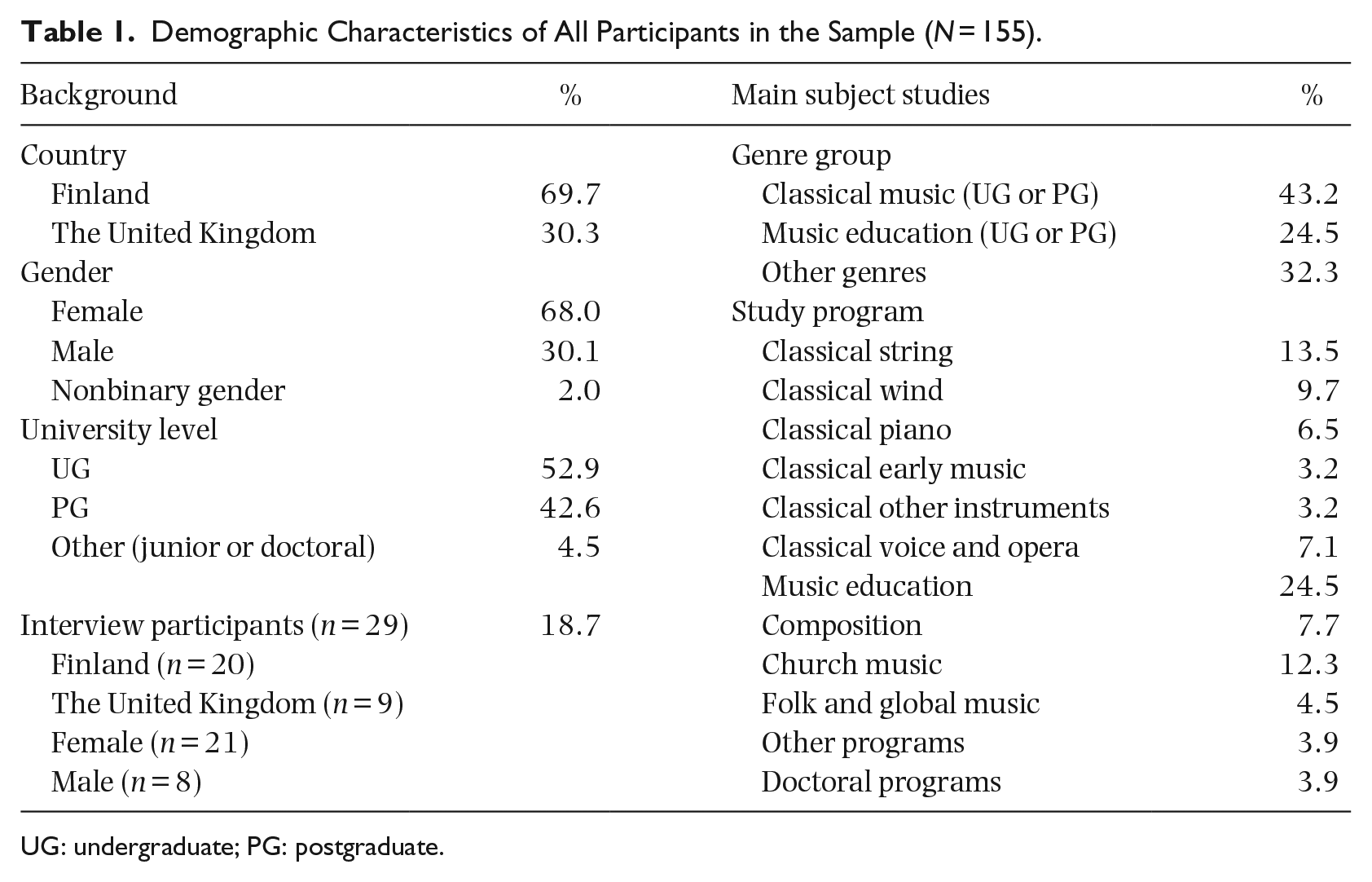
UG: undergraduate; PG: postgraduate.
Ethical statement
The University of the Arts Helsinki’s Research Ethics Committee, in Finland, and Conservatoires United Kingdom Research Ethics Committee granted the approval after reviewing the methods, the research tools, and the participant informed consent and information sheets that clarified the voluntary nature of participation and the protection of anonymity. We obtained research permissions from participating institutions in Finland and the United Kingdom. We informed study participants that they provided their consent by submitting the questionnaire. Interview participants provided written consent. The participants were not compensated for their time.
Data analysis
We analyzed the questionnaire data with the SPSS (Version 23). Three respondents of 155 participants in the WSC questionnaire had missing values in most proactive coping styles subscales, and their responses were removed from the statistical analyses. The remaining 152 respondents had only a few missing values, which were replaced with the concerned scale’s mean value. After descriptive analysis with demographic characteristics (frequencies, means, and standard deviations), we computed inferential analyses. Study workload scale, stress scale, and seven proactive coping styles subscales were tested for parametric statistics assumptions using the Kolmogorov–Smirnov and the Shapiro–Wilk tests. Scores were calculated to summarize the extent to which study workload, stress, and each type of coping style were used by genders, levels of degree, genre groups, and study programs. The parametric test (one-way analysis of variance [ANOVA]) was used with the normally distributed scales. With the scales which were not normally distributed, both the aforementioned parametric test and nonparametric test (Kruskal–Wallis test) were used. Because there were no differences between the results, we will report the results of the parametric tests. In addition, the Bonferroni correction for multiple comparisons was used. With the stress scale, study workload scale, and seven proactive coping styles subscales, bivariate analyses with scatterplots, Pearson’s correlation, and multiple linear regression were used. We used a significance level of α = .05, which corresponds to a 95% confidence interval.
We used the ATLAS.ti (Version 9.0.7) to code and analyze the qualitative data concerning the answers to open-ended questions in the WSC questionnaire and transcribed interviews. The first author performed the analysis in collaboration with the second author, who ensured the validity and reliability of the process by coding 5% of the data. The interrater agreement of the two independent coding choices was calculated by using Holsti’s method and Krippendorff’s Alpha, and were favourably calculated as 0.924 and 0.918 respectively, with both values indicating very high levels of reliability. A thematic coding framework was built on 13 codes, 4 categories, and 3 overarching themes derived from the systematic review mentioned above (deductive analysis). Following the analytical process of transcendental phenomenology (see full procedure presented in Jääskeläinen, 2022b), we added further depth into the framework by including the 14 codes extracted from the interview data (inductive analysis) to clarify and incorporate students’ lived experiences concerning workload while studying in higher music education. The analysis continued through the process of horizonalization (i.e., Moustakas, 1994). All the interview transcripts and open-ended answers in the questionnaire were read and relevant expressions concerning workload were listed, grouped, and coded. Coded expressions were grouped according to three overarching themes based on the context of the student’s experienced workload: student, teacher, and environment. The thematic coding framework is presented in Table 2.
Thematic Coding Framework.
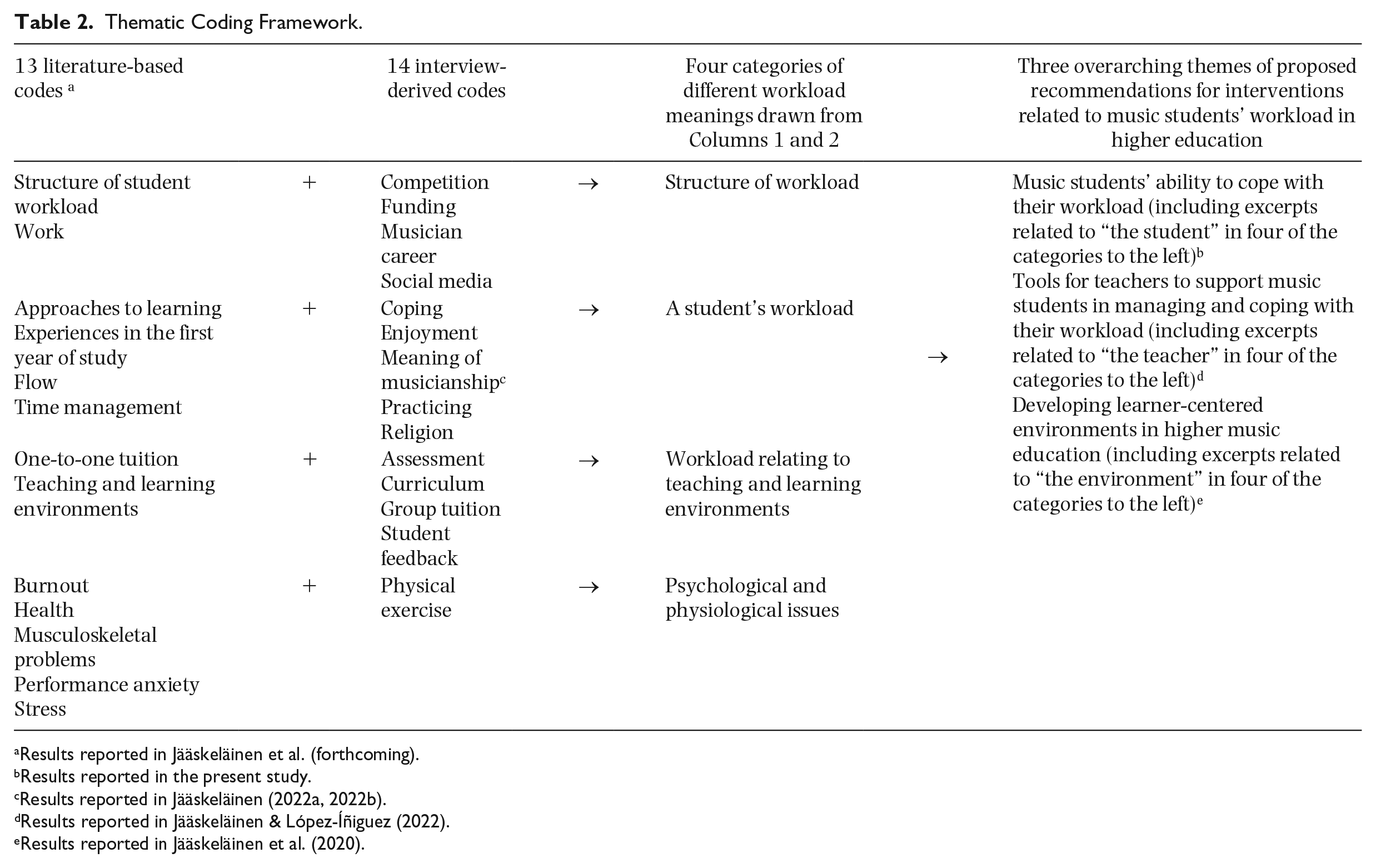
Results reported in Jääskeläinen et al. (forthcoming).
Results reported in the present study.
Results reported in Jääskeläinen (2022a, 2022b).
Results reported in Jääskeläinen & López-Íñiguez (2022).
Results reported in Jääskeläinen et al. (2020).
For this study, we continued the analysis with the extracts linked to the overarching theme of student. The Finnish participants’ quotes were translated from Finnish into English by the first and third authors who speak both languages fluently.
Results
Quantitative results
Table 3, which shows the results of the descriptive analysis, answers to the first subquestion about the prevalence of music students’ experienced study workload, experienced stress, and seven proactive coping styles among genders, levels of degree, genre groups, and study programs. High scores indicate that the student often experienced study workload or stress or used the proactive coping style described by that scale. This table also presents the bivariate analysis’ (one-way ANOVA for genders, levels of degree, genre groups, and study programs) key findings and statistically significant differences in subscales concerning demographic variables.
Differences in Professional Music Students’ Experiences of Study Workload, Stress, and Proactive Coping Styles in Relation to Demographic Variables.
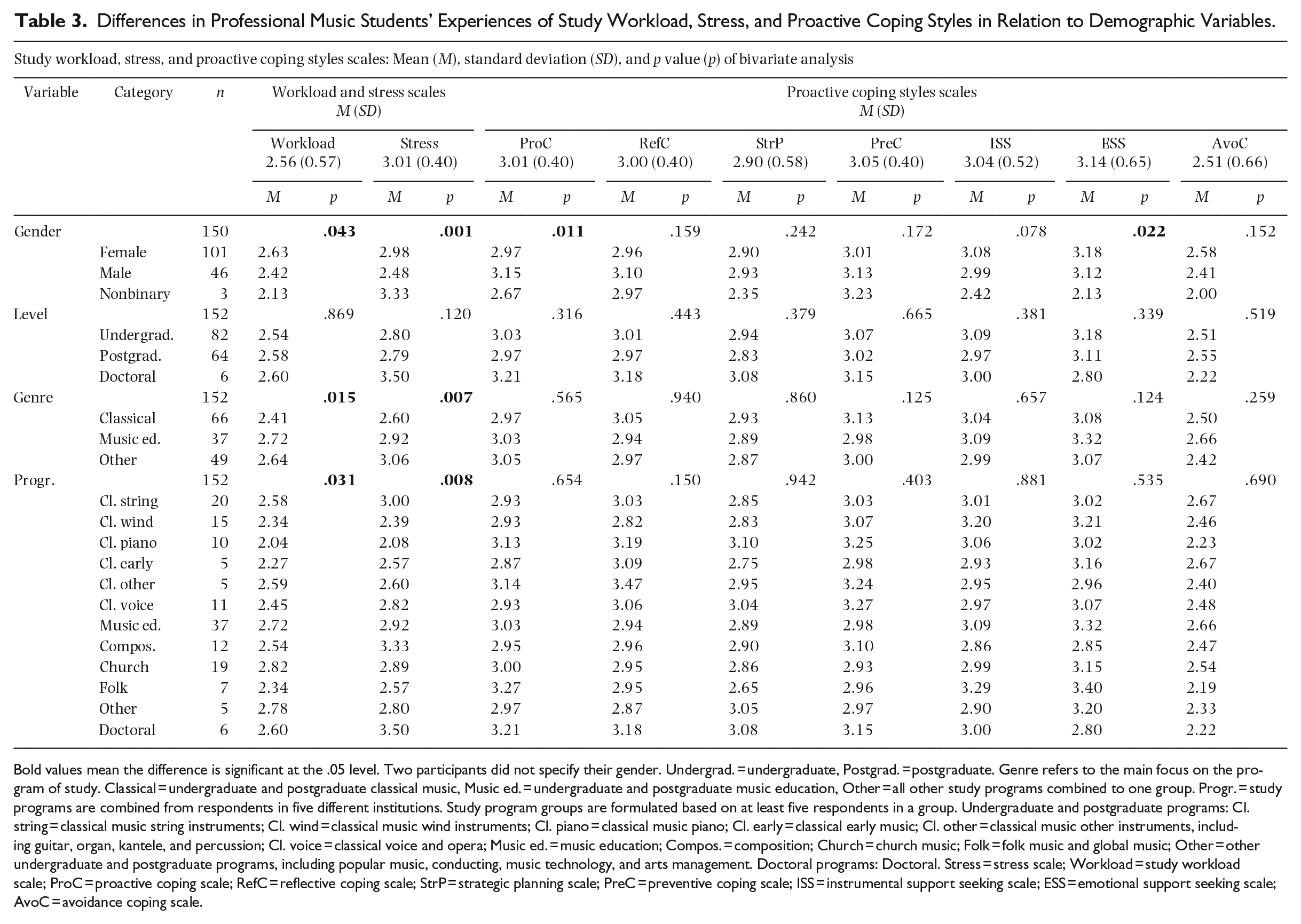
Bold values mean the difference is significant at the .05 level. Two participants did not specify their gender. Undergrad. = undergraduate, Postgrad. = postgraduate. Genre refers to the main focus on the program of study. Classical = undergraduate and postgraduate classical music, Music ed. = undergraduate and postgraduate music education, Other = all other study programs combined to one group. Progr. = study programs are combined from respondents in five different institutions. Study program groups are formulated based on at least five respondents in a group. Undergraduate and postgraduate programs: Cl. string = classical music string instruments; Cl. wind = classical music wind instruments; Cl. piano = classical music piano; Cl. early = classical early music; Cl. other = classical music other instruments, including guitar, organ, kantele, and percussion; Cl. voice = classical voice and opera; Music ed. = music education; Compos. = composition; Church = church music; Folk = folk music and global music; Other = other undergraduate and postgraduate programs, including popular music, conducting, music technology, and arts management. Doctoral programs: Doctoral. Stress = stress scale; Workload = study workload scale; ProC = proactive coping scale; RefC = reflective coping scale; StrP = strategic planning scale; PreC = preventive coping scale; ISS = instrumental support seeking scale; ESS = emotional support seeking scale; AvoC = avoidance coping scale.
With females, males, and nonbinary gender, the ANOVA results indicated statistically significant differences between groups in study workload, F(2, 147) = 3.214, p = .043, η2 = .042. However, the Bonferroni correction for multiple comparisons did not show any significant pairwise contrasts. There was a statistically significant difference among females, males, and nonbinary gender in stress, F(2, 147) = 4.288, p = .001, η2 = .085. The Bonferroni correction for multiple comparisons indicated statistically significant differences so that females (p = .002) experienced more stress than males.
There were no statistically significant differences between groups in study workload and in stress with undergraduate, postgraduate, and doctoral levels.
With genre groups, there were statistically significant differences in study workload, F(2, 149) = 4.354, p = .015, η2 = .055, and stress, F(2, 149) = 5.064, p = .007, η2 = .064. The Bonferroni correction for multiple comparisons indicated statistically significant differences so that students in the music education genre group (p = .024) experienced more study workload than students in the classical music genre group. Students in the other genres group (p = .008) experienced more stress than students in the classical music genre group.
With study programs, there were statistically significant differences in study workload, F(11, 140) = 2.020, p = .031, η2 = .137, and stress, F(11, 140) = 2.433, p = .008, η2 = .160. The Bonferroni correction for multiple comparisons indicated statistically significant differences so that students in church music (p = .028) experienced more study workload than students in classical piano. Both students in composition (p = .017) and students in doctoral programs (p = .039) experienced more stress than students in classical piano.
Figure 1 shows the statistically significant results of the professional music students’ experienced study workload and experienced stress.
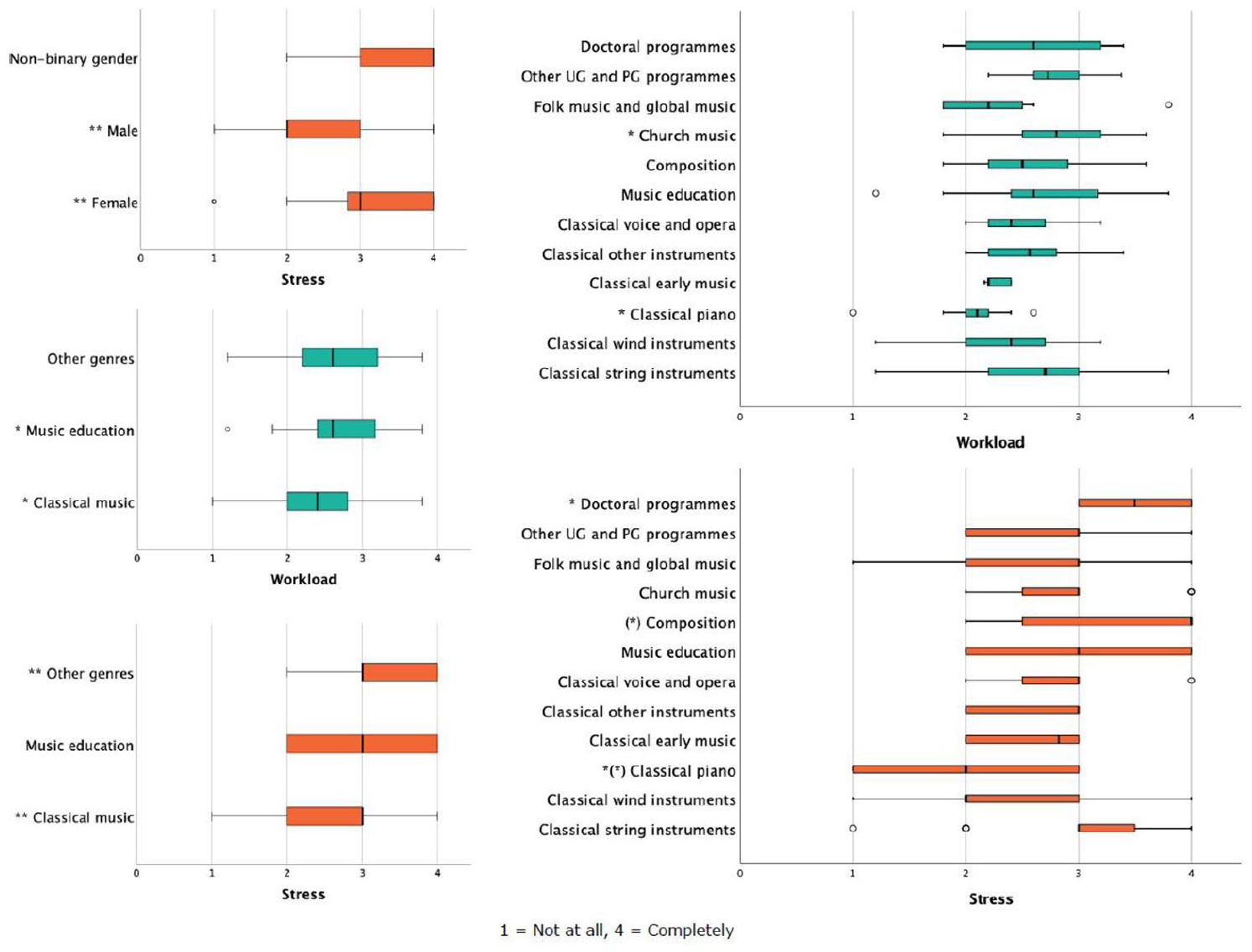
Statistically Significant Results of the Professional Music Students’ Experienced Study Workload and Experienced Stress.
With seven proactive coping styles, emotional support seeking was used the most, followed by preventive coping, instrumental support seeking, proactive coping, reflective coping, strategic coping, and avoidance coping. There were statistically significant differences among genders in using proactive coping, F(2, 147) = 4.697, p = .011, η2 = .060, and emotional support seeking, F(2, 147) = 3.940, p = .022, η2 = .051. The Bonferroni correction for multiple comparisons indicated statistically significant differences so that males (p = .031) used proactive coping more than females. Both females (p = .017) and males (p = .030) used emotional support seeking more than nonbinary gender. With reflective coping, strategic coping, preventive coping, instrumental support seeking, and avoidance coping, there were no statistically significant differences between genders. With the level of degree, genre group, and study program, there were no statistically significant differences between groups in using seven proactive coping styles. Figure 2 shows the statistically significant results of the used proactive coping styles by the professional music students.
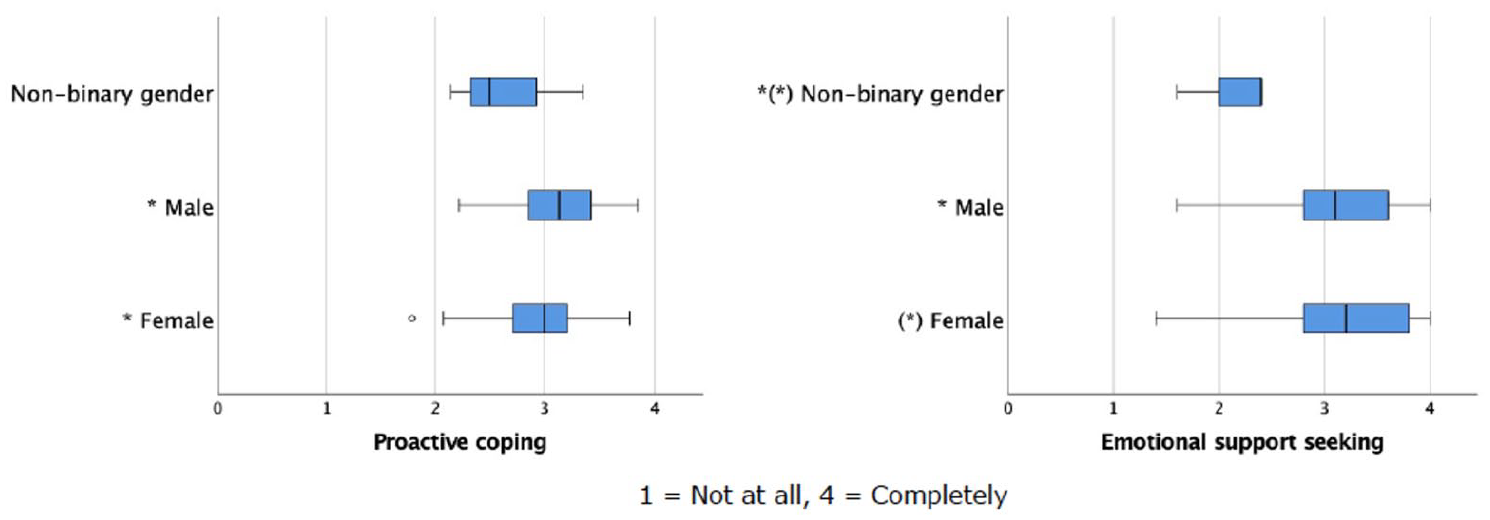
Statistically Significant Results of the Used Proactive Coping Styles by the Professional Music Students.
To answer the second subquestion about the potential prediction of music students’ experienced stress by their experienced study workload and each of the seven proactive coping styles, we performed Pearson’s correlation analysis (see results in Figure 3).
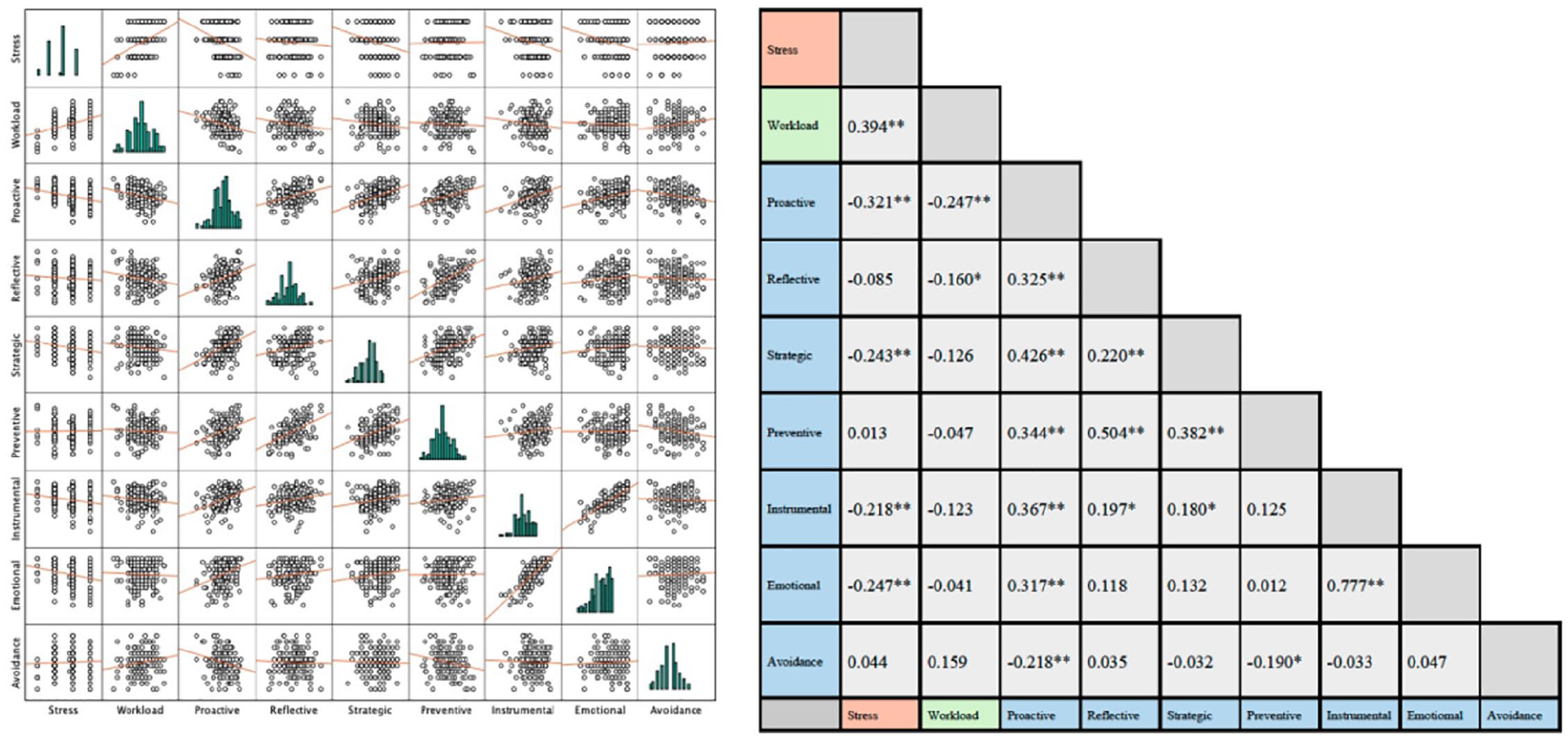
Distributions, Interconnections, and Bivariate Relationships of the Scales for Experienced Stress, Experienced Study Workload, and Seven Proactive Coping Styles (N = 152).
We also performed a multiple linear regression analysis to predict music students’ experienced stress based on their experienced study workload and seven proactive coping styles (see results in Table 4).
Multiple Linear Regression of Professional Music Students’ Experienced Study Workload and Seven Proactive Coping Styles as Predictors of Students’ Experienced Stress.
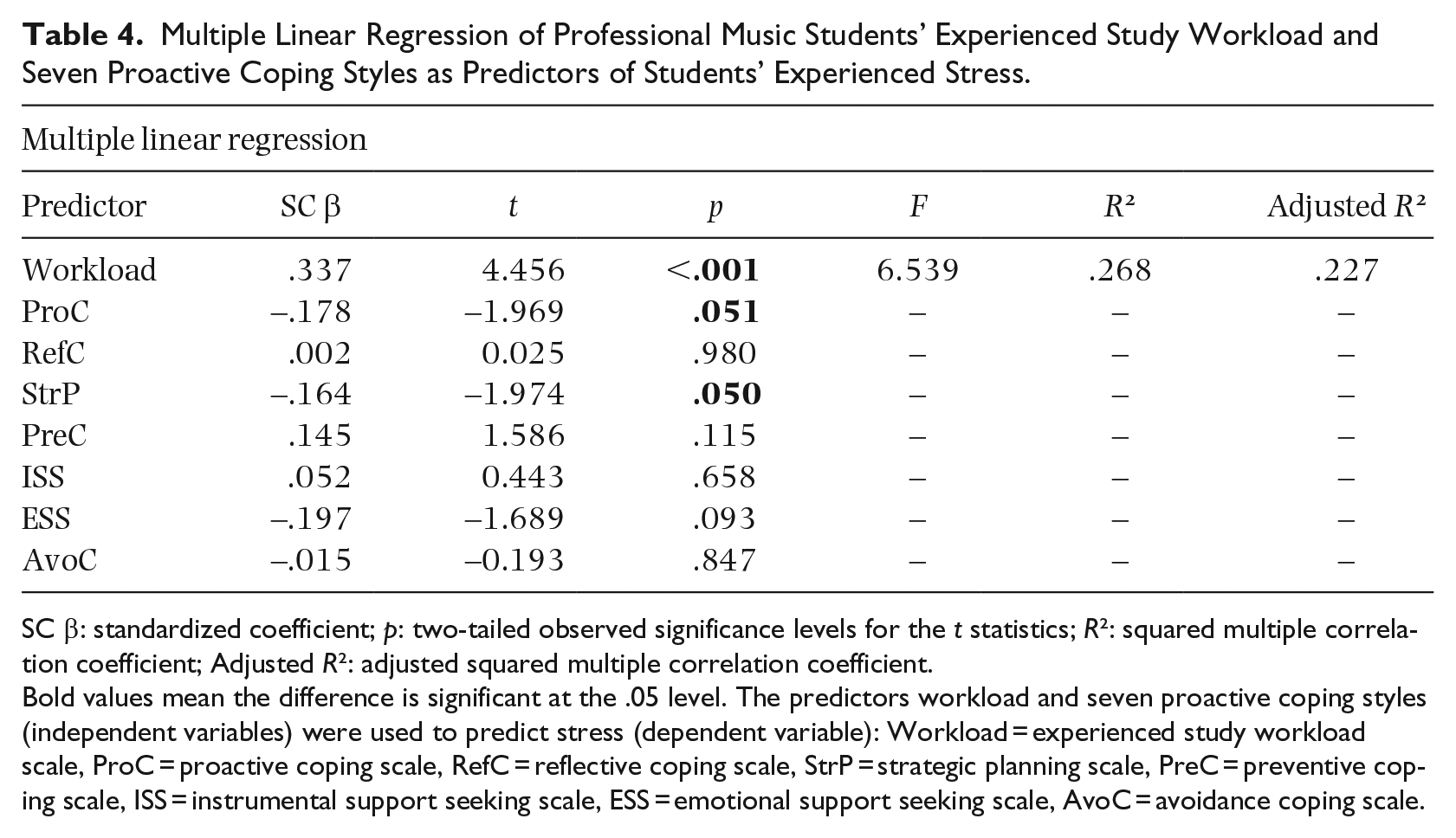
SC β: standardized coefficient; p: two-tailed observed significance levels for the t statistics; R²: squared multiple correlation coefficient; Adjusted R²: adjusted squared multiple correlation coefficient.
Bold values mean the difference is significant at the .05 level. The predictors workload and seven proactive coping styles (independent variables) were used to predict stress (dependent variable): Workload = experienced study workload scale, ProC = proactive coping scale, RefC = reflective coping scale, StrP = strategic planning scale, PreC = preventive coping scale, ISS = instrumental support seeking scale, ESS = emotional support seeking scale, AvoC = avoidance coping scale.
It was revealed in the multiple linear regression that music students’ study workload and seven proactive coping styles accounted for 27% of the variance. Music students’ study workload was a significant predictor of stress. Within seven proactive coping styles, proactive coping and strategic planning emerged as significant predictors, and they predicted stress negatively.
Qualitative findings
To answer the third subquestion concerning the determinants of experienced workload, experienced stress, and proactive coping styles for music students, we analyzed qualitative findings by looking at the excerpts consisting of the answers to open-ended questions in the WSC questionnaire from 155 participants and transcribed interviews from 29 participants. Qualitative findings resulted in recurrent ideas, which were categorized to themes according to 13 codes from deductive analysis and 14 codes from inductive analysis (see Table 2). These 27 themes were separated into four thematic groups: (1) structure of workload in studying music (see six themes in Figure 4), (2) a music student’s workload (see nine themes in Figure 5), (3) music students’ workload relating to teaching and learning environments (see six themes in Figure 6), and (4) psychological and physiological issues in studying music (see six themes in Figure 7).
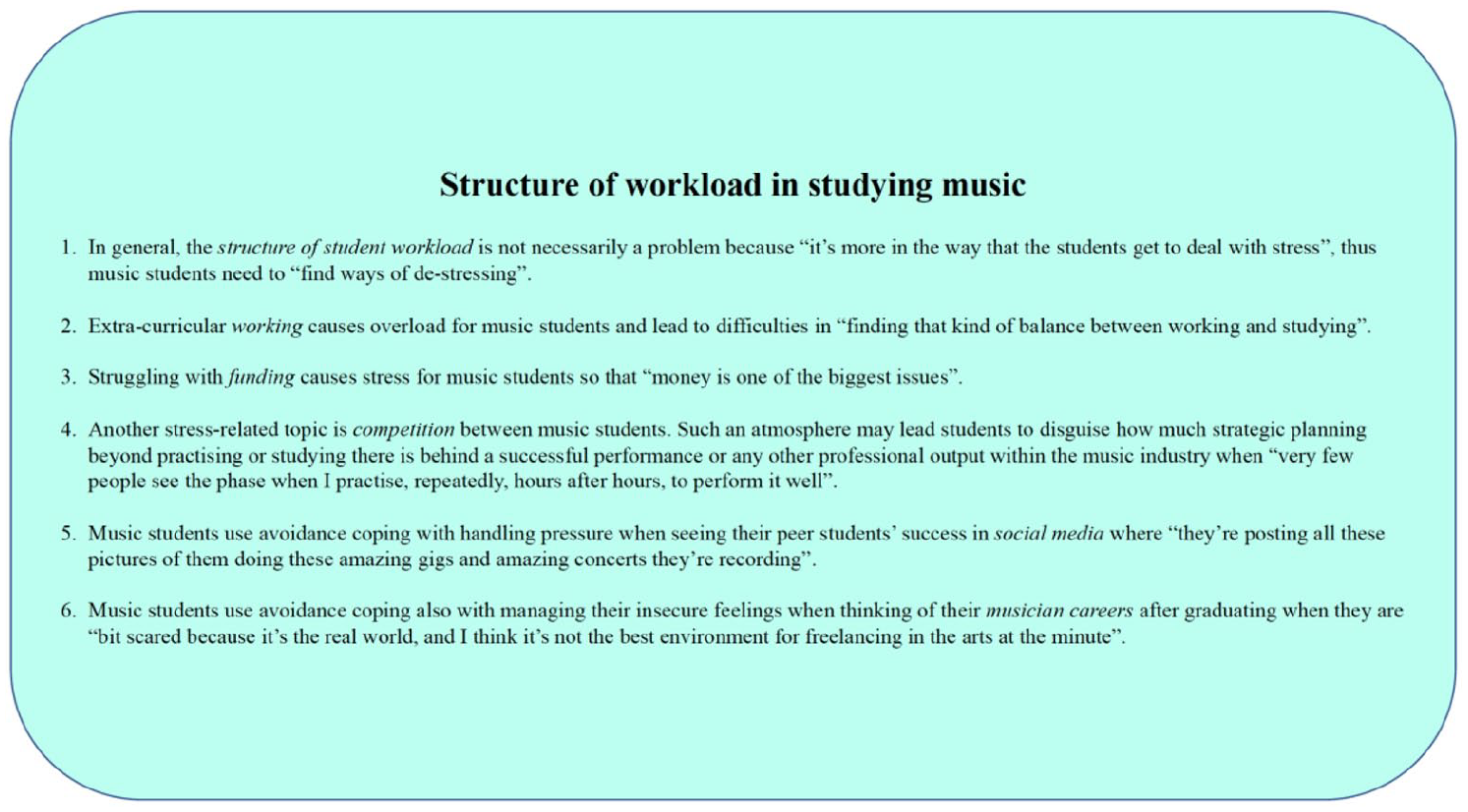
The Findings of Qualitative Analysis in the Thematic Group “Structure of Workload in Studying Music” Concerning Professional Music Students’ Experiences of Workload, Stress, and Proactive Coping Styles According to Six Themes (in Italics) Which Are Illustrated With Participants’ Words Verbatim.
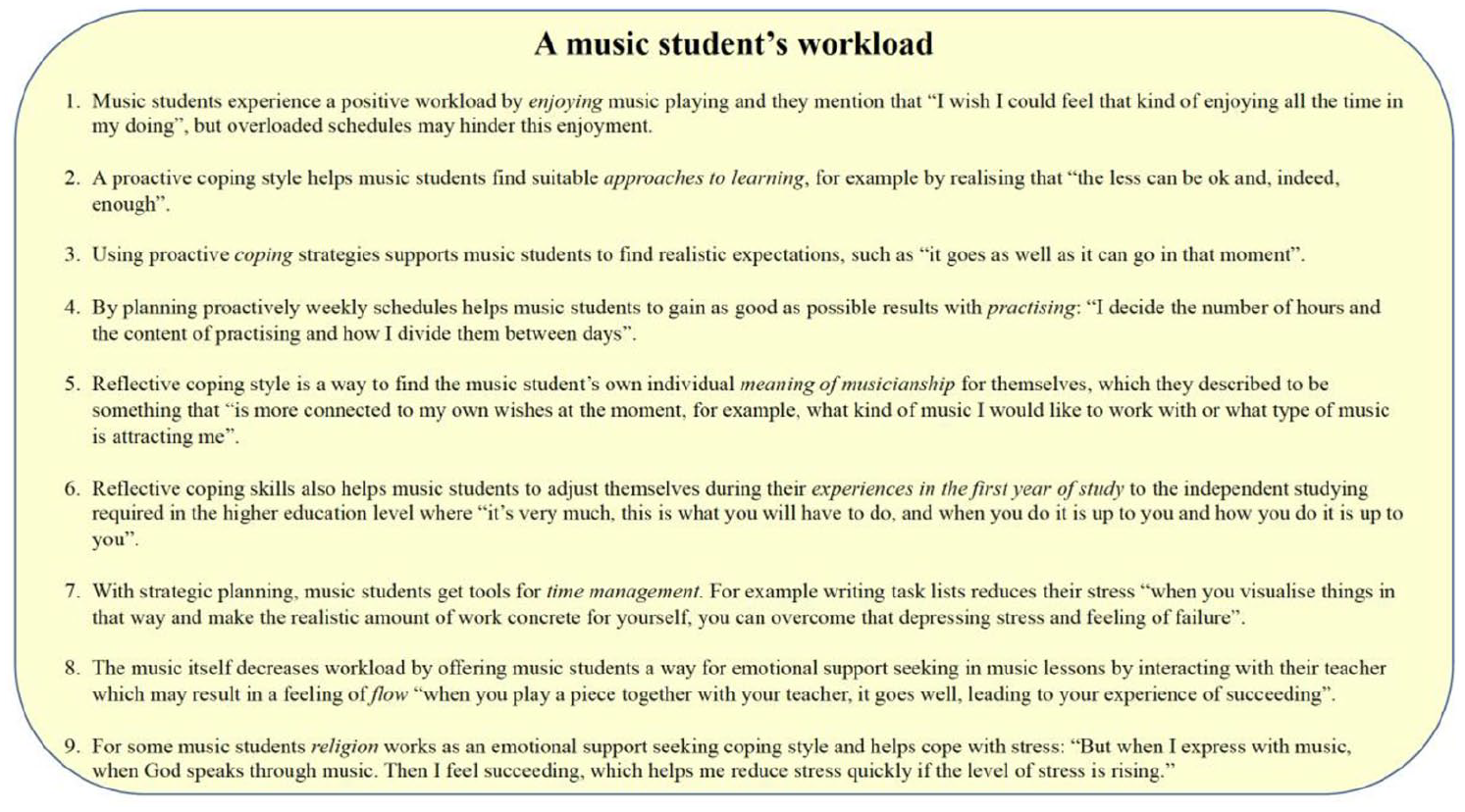
The Findings of Qualitative Analysis in the Thematic Group “A Music Student’s Workload” Concerning Professional Music Students’ Experiences of Workload, Stress, and Proactive Coping Styles According to Nine Themes (in Italics) Which Are Illustrated With Participants’ Words Verbatim.
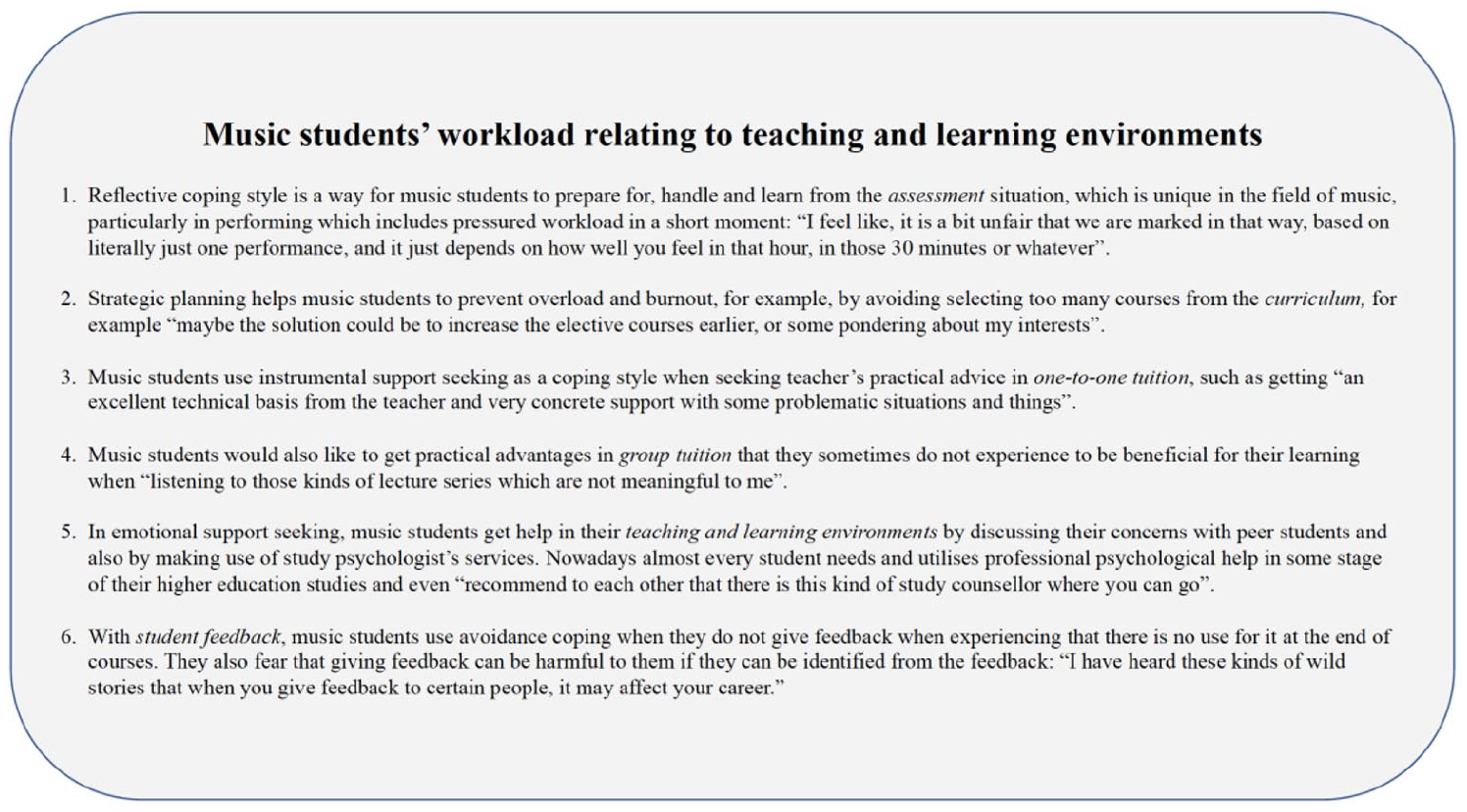
The Findings of Qualitative Analysis in the Thematic Group “Music Students’ Workload Relating to Teaching and Learning Environments” Concerning Professional Music Students’ Experiences of Workload, Stress, and Proactive Coping Styles According to Six Themes (in Italics) Which Are Illustrated With Participants’ Words Verbatim.
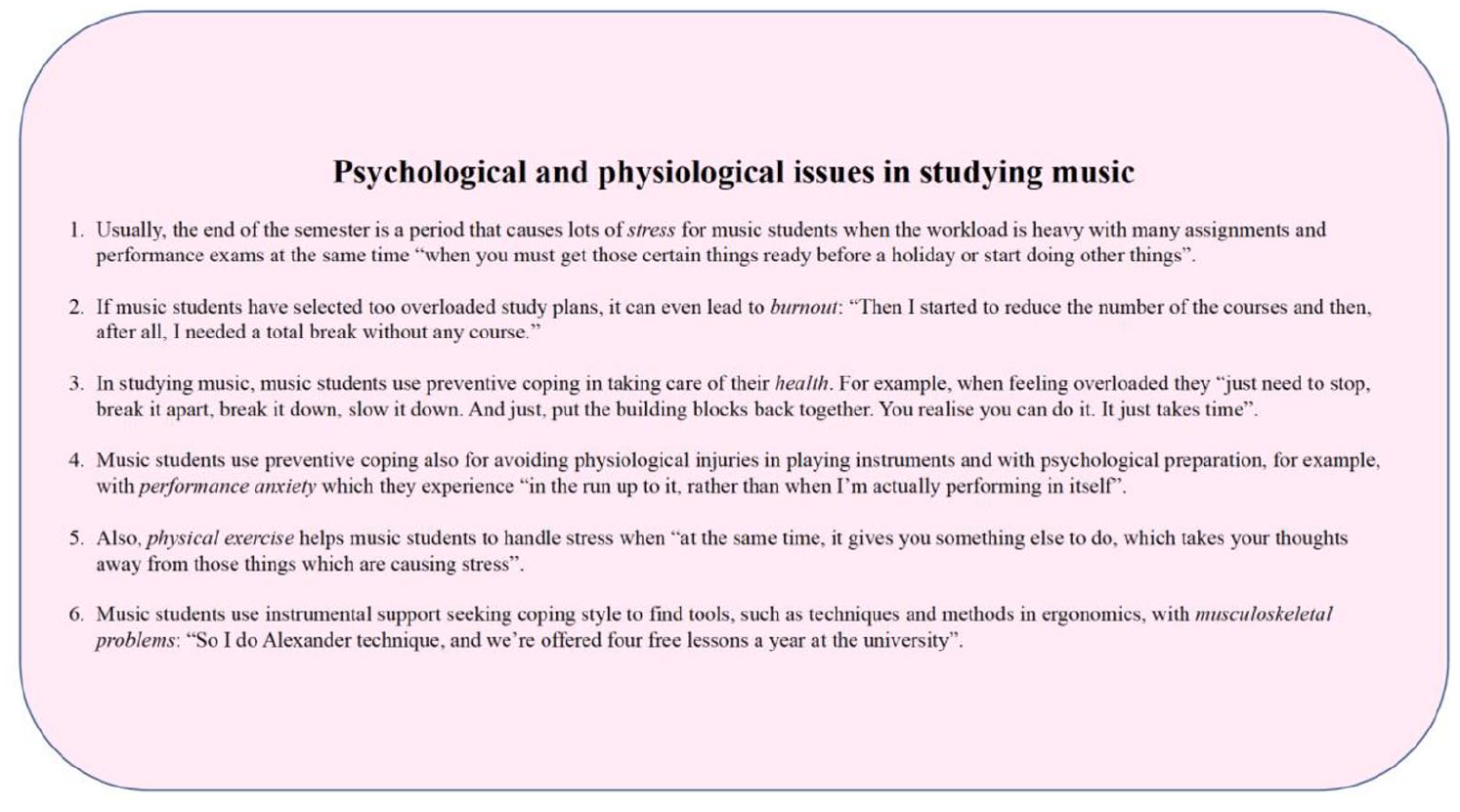
The Findings of Qualitative Analysis in the Thematic Group “Psychological and Physiological Issues in Studying Music” Concerning Professional Music Students’ Experiences of Workload, Stress, and Proactive Coping Styles According to Six Themes (in Italics) Which Are Illustrated With Participants’ Words Verbatim.
More extensive examples of excerpts from participants reflecting the determinants of experienced workload, experienced stress, and proactive coping styles for the professional students in higher music education are arranged by themes and thematic groups in Supplementary Materials 2 online. In the “Discussion” section, we integrate these qualitative findings with the quantitative results.
Discussion
Our primary research question was as follows: How do professional students in higher music education in Finland and the United Kingdom experience workload and stress and use proactive coping styles? To answer this question, we will next integrate the statistically significant quantitative results and qualitative findings through previously formulated recurrent themes and four thematic groups (see Figure 8).
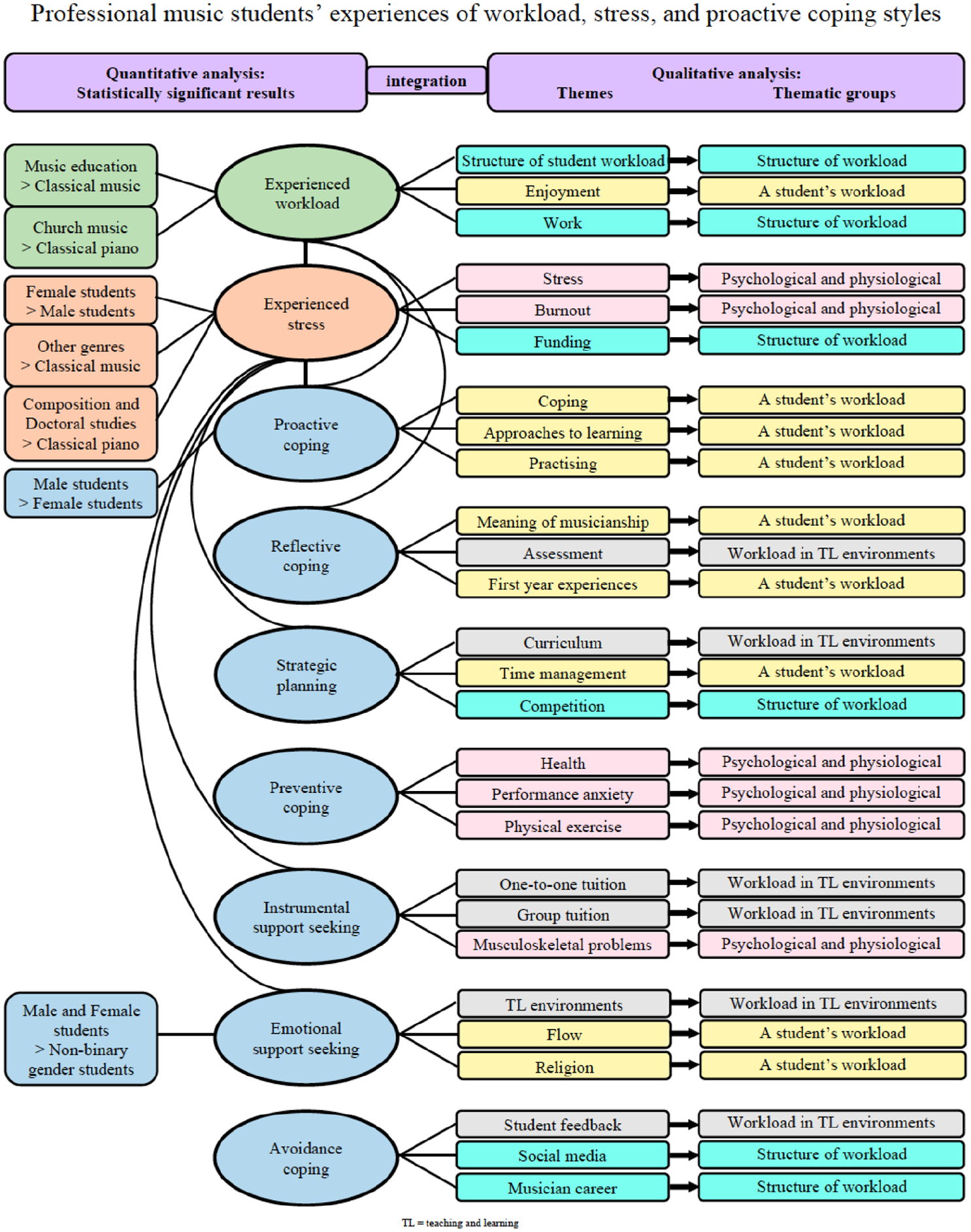
Integration of the Results of Quantitative Analysis and the Findings of Qualitative Analysis Concerning Professional Music Students’ Experiences of Workload, Stress, and Proactive Coping Styles.
Structure of workload in studying music
Linear regression shows that music students’ experienced study workload is a statistically significant predictor of experienced stress. Proactive coping and strategic planning negatively predict music students’ stress, which means that the more students use these coping styles, the less they experience stress. Also, there is a statistically significant negative correlation between stress and instrumental support seeking coping style and between stress and emotional support seeking coping style. Thus, using these coping styles may also help reduce stress. Excerpts from the participants reveal that the structure of student workload, in general, is not necessarily a problem, but music students need to “find ways of de-stressing.” Working besides studying causes overload, and struggling with funding causes stress for music students. Another stress-related topic was the competition between music students. Such an atmosphere based on global market demands may lead students to disguise how much strategic planning beyond practicing or studying there is behind a successful performance or any other professional output within the music industry. In this regard, Burt and Mills (2006) found in their research that music students in higher education have specific experiences concerning competition with their peer students. Indeed, music students in our study mentioned that they need support to cope with their potential feelings of inadequacy when “studying in the field of music includes much more workload because it is connected to your personal life and personality too.” Music students used avoidance coping with handling pressure when seeing their peer students’ success in social media and managing their insecure feelings when thinking of their musician careers after graduating. The study therefore confirms that it is vital for higher education institutions to promote “a culture of well-being” through institutional practices that support students in using positive coping strategies which minimize their distress and maladaptive coping during their studies, thus affecting their future careers (Deasy et al., 2014, p. 16).
A music student’s workload
There is a statistically significant negative correlation between music students’ study workload and proactive coping style and between study workload and reflective coping style. Such a correlation suggests that the more students use these coping styles, the less they experience a study workload. Music students experience a positive workload by enjoying music playing, but overloaded schedules with courses may hinder this enjoyment. A proactive coping style can help music students find suitable approaches to learning, for example, by realizing that “the less can be ok and, indeed, enough,” and coping strategies for practicing to gain as good as possible results in their studies. Reflective coping style is a way to find the student’s meaning of musicianship for themselves, such as “what kind of music I would like to work with or what type of music is attracting me.” Moreover, this kind of meaningful engagement in music can help students manage their workload in studying music (Jääskeläinen, 2022a). Reflective coping skills can also help music students to adjust themselves during their experiences in the first year of study to the independent studying required in the higher education level. With strategic planning, students get tools for time management which can reduce their stress. Indeed, more research is needed to understand the connection between students’ daily coping, time management, and burnout during their university studies (Jacobs & Dodd, 2003). The music itself can decrease workload by offering a way for emotional support seeking in music lessons when students interact through music with the teacher. A student mentioned this kind of interaction “leading to your experience of succeeding” which results in a feeling of flow. According to the findings by Valenzuela et al. (2018), music students’ perceived competence was the strongest predictor of flow variations. The researchers suggest teachers acknowledge this to motivate their students. In our study, religion also worked as an emotional support seeking coping style and helped some students cope with stress.
Music students’ workload relating to teaching and learning environments
When comparing genre groups, students in the music education study program group experience statistically significantly more study workload than students in the classical music study program group. Students in other genres group, which included all other study programs, experience statistically significantly more stress than students in the classical music study program group. When comparing study programs, students in church music experience statistically significantly more study workload than students in classical piano. Students in doctoral programs and composition experience statistically significantly more stress than students in classical piano. Particularly in music education and church music, students have multiple study- and instrument-specific demands—which may cause challenges to concentrate properly on learning—compared to classical music study programs. Also, Zetterberg et al. (1998) found in their research that students in church music experience more psychosocial demands and distress—also causing musculoskeletal problems—than students in other study programs. Reflective coping style is a way for a student to prepare for, handle, and learn from the assessment situation that is unique in music, particularly in performing, which includes pressured workload in a short moment. Also, previous research indicates that coping strategy to handle stress connected to performing is an inevitable skill for music students (Nogaj, 2017). Strategic planning can help students prevent overload and burnout, for example, by avoiding selecting too many courses from the curriculum when “pondering about my interests.” Music students use instrumental support seeking as a coping style when seeking a “technical basis from the teacher and very concrete support with some problematic situations and things” in one-to-one tuition. They would also like to get practical advantages in group tuition that they sometimes do not experience to benefit their learning. In emotional support seeking, music students get help in their teaching and learning environments by discussing their concerns with peer students and using study psychologist’s services. Research conducted over 30 years ago by Dews and Williams (1989) indicated that friends were the most critical source of support for music students, and professional support was considered the last option. Participants in our study pointed out that nowadays, almost every student needs and utilizes professional psychological help in some stage of their higher education studies. With student feedback, music students use avoidance coping when they do not give feedback when experiencing that there is no use for it at the end of courses or when fearing that giving feedback can be harmful to them and their future careers if they can be identified from the feedback.
Psychological and physiological issues in studying music
In this study, female music students experience statistically significantly more stress than male music students. Such an alarming finding is in line with similar results found by Zetterberg et al. (1998). Using a proactive coping style can decrease stress; for instance, in our study, male students used a proactive coping style statistically significantly more than female students did. The differences between genders may be explained in line with research by Bull (2019), who found that the traditions in practices and aesthetics of classical music reproduce hierarchical gender roles in a way that there are different gendered pathways for men and women. The normative, unequal gender positions in music, which are built on “a raced, classed, and gendered hierarchy of value in which women and non-white others are associated with the bodily and white men with the cognitive, and the latter is valued over the former” (Bull, 2019, p. 23), may also connect with our result: nonbinary gender music students use emotional support seeking coping style statistically significantly less than female and male music students. Perhaps nonbinary gender music students cannot find suitable support for themselves in the current normative educational structures? Our results align with the growing need to conduct more research on students’ emotional well-being in higher music education (Araújo et al., 2017; Ginsborg et al., 2009), particularly attending to minority and marginal groups (Beban & Trueman, 2018). Usually, the end of the semester is a period that causes lots of stress for music students when the workload is heavy with many assignments and performance exams at the same time. If students have selected too overloaded study plans, it can even lead to burnout. Similarly, Bernhard (2007a, 2007b, 2010) highlights this in the burnout study among music students. In studying music, students use preventive coping in taking care of their health. They use preventive coping also for avoiding physiological injuries in playing instruments and in singing and with psychological preparation, for example, with performance anxiety which students described as having “in the run up to it, rather than when I’m actually performing in itself.” Also, physical exercise helps students prevent and handle stress. Music students use instrumental support seeking coping style to find tools, such as techniques and methods in ergonomics, with musculoskeletal problems: “So I do Alexander technique, and we’re offered four free lessons a year at the university.”
Limitations
We address certain limitations in our study. The first notion concerns the generalization of the results and findings. Because our empirical data were gathered in two countries, results and findings cannot be generalized outside those countries. The second limitation includes the use of a single-item measure of feeling stress. Although we carefully defined the stress in the questionnaire, multiple items may better measure particularly the experiences of stress in future research. The third limitation concerns the use of self-reported experiences by music students. This limitation could be overcome when combining self-reported and biophysical data, following the example with stress levels in the interventional and longitudinal research design by Asikainen and Katajavuori (2021). The fourth limitation is the small sample size: extending the statistical representativeness of sample sizes would increase the results’ generalizability. On the contrary, results by Fosnacht et al. (2017) challenge the assumption that low response rates among higher education students lead to biased results. Indeed, they encourage researchers to “spend less time worrying about achieving a high response rate and more time evaluating and using the data they collect” (p. 262).
Implications
Our study has several developmental implications. The emphasis on music students’ experiences offers a way to strengthen students’ voices to be integrated into developmental work in teaching and higher education administration. The research-based knowledge of music students’ workload and stress provides significant aspects, such as differences between genders and study programs. These differences should be discussed in connection with the curriculum and higher music education systems to investigate more thoroughly why these unequal differences exist (Jääskeläinen, 2021) and how these issues can be overcome so that all study programs have the appropriate workload for students. Our study’s main implication is to present how music students use proactive coping styles: proactive coping, reflective coping, strategic planning, preventive coping, instrumental support seeking, emotional support seeking, and avoidance coping (Greenglass, 2002). Indeed, studying music has its unique characteristics compared to other fields in higher education, and showing professional music students’ particular ways to cope with their studies may serve as valuable models for students in higher music education. This is even more crucial when sudden, unexpected changes in learning circumstances such as those caused by the COVID-19 pandemic also affect music students’ well-being (Rosset et al., 2021). More research is needed, mainly longitudinal study design, to examine how different proactive coping styles affect music students’ learning and well-being, for example, in different learning cultures (Casas-Mas et al., 2015).
Conclusion
This study provides both quantitative and qualitative research-based evidence on professional students’ experiences of workload, stress, and proactive coping in higher music education in Finland and the United Kingdom. The results indicate that there are statistically significant differences among music students in genre groups and study programs in relation to experienced study workload, and also in genders, genre groups, and study programs in relation to experienced stress, In addition, there are statistically significant differences in genders in relation to use of coping styles. Music students’ study workload is a significant predictor of stress. However, proactive coping and strategic planning can be used to reduce stress because they predict stress negatively. The professional music students have their issues and ways to cope with workload and stress concerning, for example, working alongside studying, competing with peer students, handling information on social media, and finding support for music-specific physical and psychological problems. Integration of results and findings shows the areas where it is important to continue research on workload, stress, and coping to better support music students to have successful, healthy, and enjoyable study experiences in higher education which prepare them for their professional careers.
Supplemental Material
sj-pdf-1-pom-10.1177_03057356211070325 – Supplemental material for Experienced workload, stress, and coping among professional students in higher music education: An explanatory mixed methods study in Finland and the United Kingdom
Supplemental material, sj-pdf-1-pom-10.1177_03057356211070325 for Experienced workload, stress, and coping among professional students in higher music education: An explanatory mixed methods study in Finland and the United Kingdom by Tuula Jääskeläinen, Guadalupe López-Íñiguez and Kai Lehikoinen in Psychology of Music
Supplemental Material
sj-pdf-2-pom-10.1177_03057356211070325 – Supplemental material for Experienced workload, stress, and coping among professional students in higher music education: An explanatory mixed methods study in Finland and the United Kingdom
Supplemental material, sj-pdf-2-pom-10.1177_03057356211070325 for Experienced workload, stress, and coping among professional students in higher music education: An explanatory mixed methods study in Finland and the United Kingdom by Tuula Jääskeläinen, Guadalupe López-Íñiguez and Kai Lehikoinen in Psychology of Music
Footnotes
Acknowledgements
We wish to thank all the university music students who participated in this study by generously sharing their experiences and time. We like to thank Michelle Phillips for her contribution to ethical approval and data collection procedures in the United Kingdom, and Matti Vuorre for his feedback on statistical methods. We would also like to thank Heidi Westerlund for her additional expertise as the first author’s co-supervisor.
Declaration of conflicting interests
The author(s) declared no potential conflicts of interest with respect to the research, authorship, and/or publication of this article.
Funding
The author(s) disclosed receipt of the following financial support for the research, authorship, and/or publication of this article: This work was undertaken at the Center for Educational Research and Academic Development in the Arts (CERADA), University of the Arts Helsinki, Finland, and funded by the Sibelius Academy Music Education Doctoral Programme and ArtsEqual Research Initiative, supported by the Academy of Finland’s Strategic Research Council under Grant 314223/2017. The data collection in the United Kingdom was funded by the Sibelius Academy Foundation travel grant.
Ethical statement
The studies involving human participants were reviewed and approved by the University of the Arts Helsinki Research Ethics Committee in Finland and Conservatoires United Kingdom Research Ethics Committee. All participants provided their written informed consent to participate in this study.
Availability of data and material
The anonymized datasets generated for this study are available on request to the corresponding author.

Supplemental material
Supplemental material for this article is available online.
Notes
References
Supplementary Material
Please find the following supplemental material available below.
For Open Access articles published under a Creative Commons License, all supplemental material carries the same license as the article it is associated with.
For non-Open Access articles published, all supplemental material carries a non-exclusive license, and permission requests for re-use of supplemental material or any part of supplemental material shall be sent directly to the copyright owner as specified in the copyright notice associated with the article.
