




Abstract
This article examines children’s playgrounds as technological, spatial, and historical phenomena, juxtaposing their origins in the industrial era of the late 19th to early 20th centuries with Lightbug, a recent project to develop digitally augmented playground equipment. Questions of space, movement, mechanics, imagination, play, and technical and historical specificity will be explored and it will be suggested that attention to the industrial and machinic character of playground technology can highlight contemporary attitudes to, and possibilities for, children’s outdoor play in the postdigital era. It asks questions about the introduction of digital technology and media forms into long-established physical play, about the physicality and technical nature of embodied play, and about the relationships between play, play environments, and imagination highlighted in times of technological change.
Keywords
Children’s playgrounds are spatial, historical, and technological phenomena. The industrial cities of the mid- to late 19th century were marked by new temporal and spatial divisions between work and leisure, and were made concrete in the conversion of common and waste ground into parks for the rapidly growing urban population. A key impetus to the construction of parks—and subsequently to the playgrounds established within parks—was a desire to tame and localize children’s outdoor play. As technical and disciplinary structures, playgrounds enclosed play, but also shaped it. The infrastructure of children’s playgrounds mechanized earlier environments of play; the playful capacities of trees, slopes and banks, undergrowth, and bodies of water were simulated by climbing frames, slides, sand pits, paddling pools, and swings, in a new scaffolding of the bodily techniques and vertiginous pleasures of physical play. This ludic infrastructure was industrial in form and material as well as function: cast iron, sheet steel, bolts, rivets, axles, bearings, and chains. It persists today, often little changed from Edwardian times. What place does or should it have in a postindustrial period of rapid technological change, not least in a children’s play culture characterized by the intangible technics of streamed digital media, networked communication, and videogame worlds? Through the juxtaposition of an Edwardian park playground in inner city Bristol, South West England, with a research project imagining a postdigital future playground, I will explore issues of movement, imagination, play, and technical and historical specificity. I will suggest that attention to the industrial and machinic character of playground technology can highlight contemporary attitudes to, and possibilities for, playgrounds in the postdigital era. To this end, I will take as a case study the design and testing of an experimental digitally augmented playground swing. The Lightbug project integrated interactive lights, movement-sensing, and programmable game mechanics into the industrial era swing. It asked questions about the introduction of digital technology and media forms into long-established physical play, about the physicality and technical nature of embodied play—the bodily techniques required by or instantiated by particular mechanical apparatus, and about the relationships between play, play environments, and imagination highlighted in times of technological change.
There are five playgrounds in my local park. They include a metal-framed and fenced basketball court close to one of the bordering roads, during the day mainly populated by groups of young men shooting hoops or playing five-a-side football, in the evening by clusters of younger kids and teenage boys and girls, often with phones and Bluetooth speakers adding to the aural ambience. Nearby is a “half-court,” a small square of tarmac with a metal grille wall that supports a basketball hoop, attended by a steel booth-like structure designed to attract older children and teenagers, at dusk as the younger children and their parents depart. It provides a little shelter for social interaction but without allowing too much privacy. At the top of the hill a small fenced play area for infants and toddlers, funded in part by the middle-class parents that now populate the nearby streets and patronize the adjacent café, set in a hip classic Citroën van. A short metal slide runs safely down the side of a low mound covered in artificial grass, a low extended structure of metal and plastic rails and tubes, and a large heavy swing with a netted hoop seat. Carry on over the top of the hill and nestled between a steep slope and the railway line that marks the northern edge of the park is a long narrow play area, the oldest serving play area in the park: a timeworn collection of a small steel slide about 1.5 m tall, a set of swings for babies and toddlers with rubber cage seats, and a taller frame supporting three swings for older and larger bodies. They are set in an expanse of crumbling tarmac with patches of the now ubiquitous minced rubber-tire surface to mitigate trips and falls.
Fragments of the longer material and cultural history of the park can still be glimpsed in the original Victorian iron railings—removed to supply arms production in World War I and now just rough metal stubs set into the low surrounding walls, and in the name itself—Victoria Park—one of many such in the United Kingdom. Evidence of the park’s earlier structures of play and leisure can only be found now in photographs and accounts published by local historians—an Edwardian lido, a bandstand. The park itself was established as the result of rate-paying industrial workers of south Bristol petitioning the council for a green space for leisure, a place to meet away from their tightly packed terraced houses and cramped backyards. They petitioned the city council in 1871 with a “Cry of the Poor” for a “People’s Park,” a “breathing place” amid the cramped housing and dirty workshops of Bedminster. The park was eventually opened in 1891 (Drummond, n.d.). As across the United Kingdom at the time, waste ground and common land were territorialized by stone walls and iron railings, tamed and landscaped, lawns and flower beds laid down, and rules and bye-laws imposed (Figure 1).
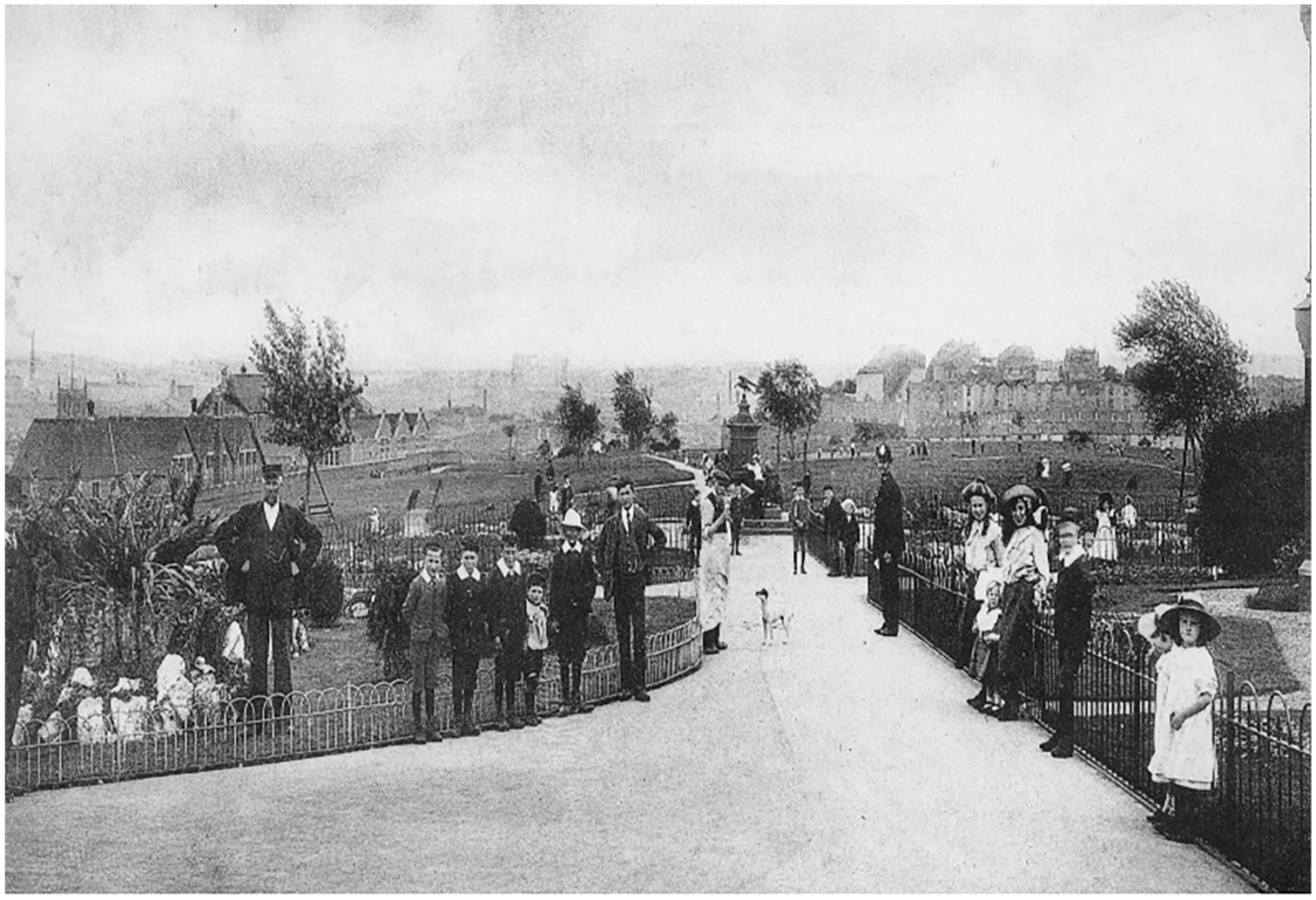
Victoria Park, Bedminster, Bristol, c.1905 (out of ©).
I have been unable to find any record or photograph of specialized playgrounds or apparatus in Victoria Park itself, though at least one other park in the southwest of England had recognizable swings and seesaws by 1905 (Figure 2). Swings began to appear in school playgrounds in the United States by the late 1840s (Brett et al., 1993, p. 17), and New York passed legislation to establish small parks with playground equipment in the 1880s (Brett et al., 1993, p. 20), though these were often very simple, with just sets of swings and sandpits. Sutton-Smith (2016) notes that playground equipment at this time was often sport-oriented, “gym” structures including ladders and parallel bars, intended to responding to perceived demands of the emerging cultures of organized sport along with the military anxieties of new or newly competitive nation-states (pp. 177–178). New social forces of privatization and domestication resonated with these health and military concerns, Victorian morality and fascination with childhood, and the influence of idealist educationalists such as Rousseau and Froebel (Sutton-Smith, 2016, pp. 151–152).
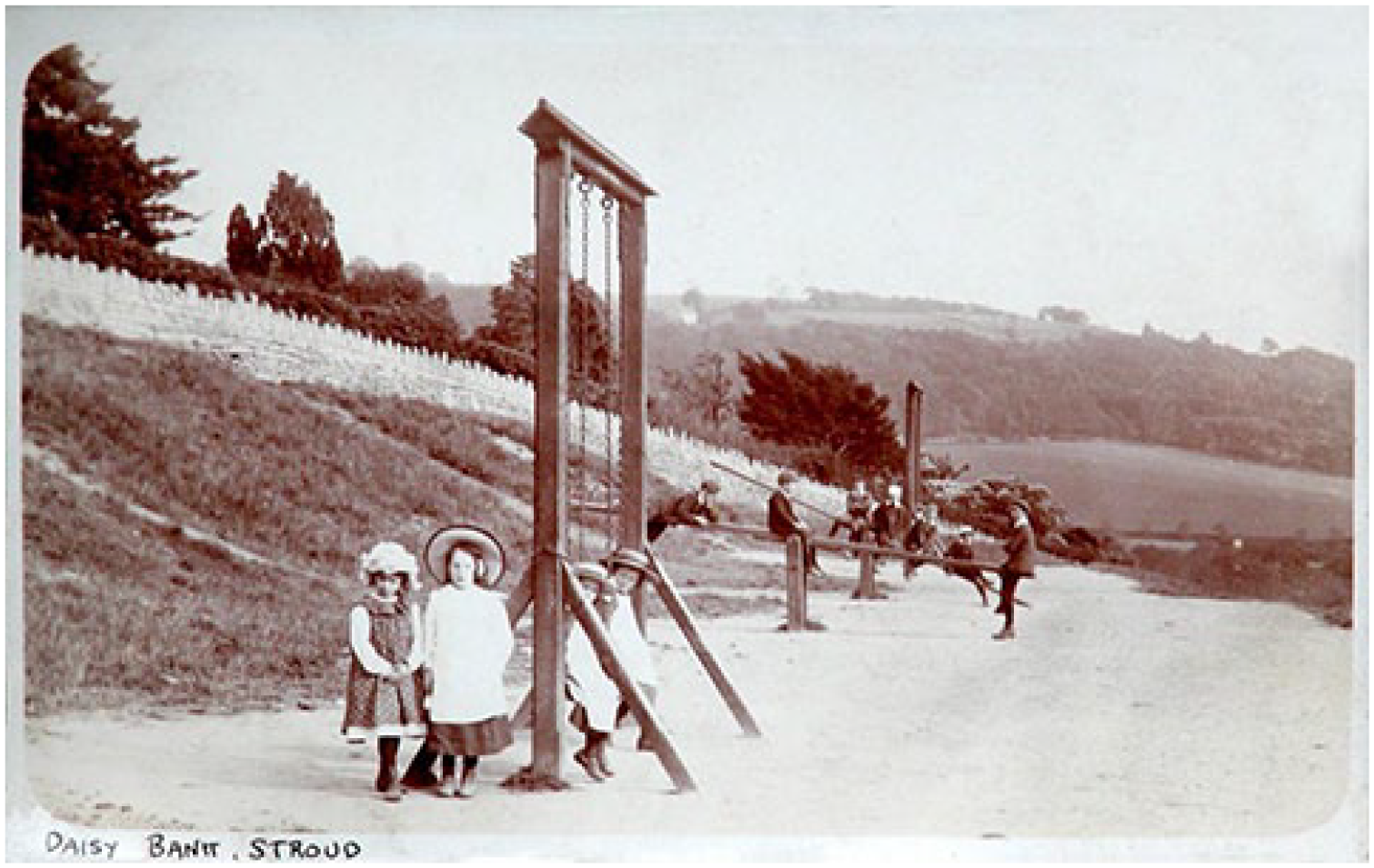
Daisy Bank Park, Stroud, South West England, Postcard Franked 1905 (out of ©).
One approach to theorizing the playground as a historical and cultural space amid current urban, media, and social transformation would be to address this process in particular: the demarcation of a space of regulated leisure as separate from working and domestic urban space by walls and railings, and the formal, aesthetic, and ergonomic territorialization of the newly enclosed space. From this perspective, the park’s external and internal boundaries are key—materially and politically in terms of its establishment as a park, and socially as a space with distinct rules and specialized roles (gardeners, wardens, park-keepers, etc.). The Victorian park was one instance of the broader forces of urban development and discipline that Michel Foucault describes in Discipline and Punish: the subjugation of liminal and common space, with all the opportunities it offers for unregulated meeting and exchange (Foucault, 1979). As with all the inter-linked phenomena Foucault discusses (hospitals, prisons, schools, boulevards) these newly disciplined spaces were in many ways productive—here of healthy leisure in the industrial city, of new forms of sociality, and of play. For working class children though it appears that the park radically changed and constrained their lives, at least in the brief moments of play available to them outside work and education. As cities expanded rapidly in the late 19th century, surrounding fields, woods, and rivers were swallowed up and only streets and urban waste grounds were available. Children’s outdoor play at this time is largely undocumented and we can only guess at its specificities and extent from hints in contemporaneous literature or extrapolate from more recent documents such as the work on play in post-war bombsites (Highmore, 2013) or the descriptions of street and playground play in the work of Iona Opie and Peter Opie (2013; Opie 1993). One of the main impetuses for the establishment of Victoria Park was to address contemporaneous concerns about children’s uncontrolled occupation of the waste ground and common spaces from which it would be shaped. In particular, the “ratepayers” wanted park wardens to police the children’s behavior (Drummond, n.d.). In the 1840s, the newspaper editor Joseph Leach described the children of Bedminster in near Biblical terms: I never saw such living swarms before in my life. They buzzed about like flies, alighted on every projection, crept up every eminence, filled the air with their voices and the face of nature with their forms and seemed in numerical extent and facility of annoyance to be only surpassed by the Egyptian locusts. (Drummond, n.d.)
Here then is a microcosmic echo of Foucault’s analysis of Haussman’s Paris: at once productive of formal aesthetics of space and lines of sight and genteel pleasures of bourgeois and respectable working class people (Figure 1); and disciplinary in its organization of space for surveillance and the formal and informal policing of disruptive behavior. It chimes with contemporaneous playground construction initiatives across the United Kingdom, the United States, Europe, and New Zealand (Brett et al., 1993; Frost, 2012; Lauwaert, 2009; Nansen, 2020; Sutton-Smith, 2016) and their common goals to channel children’s movement into physically and morally healthy play. Against Leach’s pestilential vision, we can place the Bedminster ratepayers’ original appeal for a place where family men could “feel the grass under our feet, or sit with our wives on a summer’s eve and watch our children play” (Drummond, n.d.).
The trade-off between the safety and proximity of the formal park and the openness and adventure of play in woods and waste ground seems today to be a poor deal for generations of children. Before dedicated areas for children’s play were established in the early parks, children were presumably expected to accompany their parents on sedate walks between the flower beds, obeying the signs to keep off the grass—or transgress and face the warden or park-keeper. This disciplinary figure entered children’s media culture in the United Kingdom in comics such as The Beano as a mythic antagonist always appearing to police ball games, tree climbing, and swimming.
1
Children did not necessarily accept these new restrictions and surveillance, and resisted spatial boundaries and adult supervision: Although playgrounds increased, children did not wholeheartedly embrace this socialization of play [. . .] Children struggled to hold on to their former freedom to play where they pleased. (Lauwaert, 2009, p. 38)
Gutman and de Coninck-Smith (2008) note that such resistance to the new disciplinary regimes of education and spatial play was evident throughout the late 19th century and beyond, as “boys and girls wrestled with each other, their parents, and civic authorities as they laid claim to streets as their public territory well into the 20th century” (p. 4). 2
My concern in this article is with playground equipment in particular—as technology and its part in these shifting spatiotemporal dynamics of children’s play. I argue that architecture, landscaping, urban zoning, and the machinery of playground apparatus are all technical in the same sense that digital media and online playspaces are understood as technical. All are designed to facilitate, shape, or channel the possibilities for play and often to close off or deny particular parameters of time and space in play. That is to say that while the spaces of children’s play have changed significantly over the past few centuries—and those changes can be explained in broad terms in relation to historical and economic periodization (industrialization and urbanization, mobile privatization (Williams, 1974), the rise of the middle class and consumer culture—including for children (Bak, 2020), and the informational and virtualized era of postindustrial capitalism)—they are in no way a shift from a pre-technological to a technological environment and culture in children’s play. Climbing a tree has its distinct technics and bodily techniques and a rope swing is nothing if not a ludic machine.
So, for the purposes of this article, two main spatial and machinic dynamics are pertinent. First, the historical and cultural dynamics of playground establishment and construction itself in the late Victorian and Edwardian era (in the United Kingdom at least): the conversion of waste ground and common land into formal parks with severe limitations on children’s freedom of movement and play. This can be symbolized by boundaries: the new iron railing-topped stone walls around the new park and the low wire tracery around rose beds and lawns, box and privet hedges, and tended grass that demarcated activity within it. Second, the dynamic of children’s play equipment within their newly designated zones of play. When the playgrounds did appear in the United Kingdom, generally in the early years of the 20th century, they offered a mechanized analogue of the play environments and behaviors the parks had replaced. Slides, swings, climbing frames, and roundabouts offered a regulated and intensified simulation of the vertiginous pleasures of rope swings, tree climbing, mud slides, and so on. An extensive space of play that was effectively borderless with natural features and zones that might afford manifold play potential (a tree can be climbed, inhabited, imagined as a pirate ship, etc.) rendered intensive, localized in space, play itself focused, and scaffolded in cast iron, bearings, rivets, and chains. This raises a question for the study and design of playspaces today: If the industrial technologies of cast iron and steel and the Victorian engineering of urban space have profoundly shaped outdoor play throughout the 20th century, to what extent—or could—digital technologies effect an analogous shaping of postindustrial play?
To approach a critical study of the historical periodization of children’s physical play culture, one needs to look more to the study of technology, architecture, and ergonomic design than the more familiar attention to media culture (Cross, 1997; Kline, 1993). Children’s material culture is under-researched and underplayed in the formation of modernity and modern subjectivity (Gutman & de Coninck-Smith, 2008 and Brandow-Faller, 2018 are notable exceptions) yet design, technologies, and progressive ideas about play and education have both shaped and been shaped by modern design (Giddings, 2020). We can track cultural shifts and preoccupations in the shapes and colors of play equipment—colorful plastic, painted wood, and decorative elements transform the iron frames of climbing frames at the end of the 20th century. The anticipation and configuration of playful behaviors of this architectonic design have changed more slowly and less significantly, however. The engineering of swings has been tweaked to facilitate slightly different kinesthetic experiences; for instance, roundabouts have either been modified to address concerns about safety and maintenance or simply been removed, and contemporary slides tend to of a modest height or are constructed down steep slopes to remove the dangers of children falling from their steps and sides. Climbing frames have changed the most in appearance, again partly to reduce the risks of falling and partly because their form and function suggest more sculptural latitude.
These changes aside; however, the proprioceptic and vertiginous pleasures of swinging and sliding persist, and children in playgrounds today are still largely climbing on, swinging through, and sliding down industrial forms and engineering. This kinesthetic activity is not an eloquent or easily translatable language, but it does speak of a lived relationship with the mechanics of modernity that is at once absolutely tightly riveted to industrial forms in material terms, but free-floating in the imaginary. The stories, characters, and scenarios—or just free-floating chat, songs, and jokes—may not appear to relate at all to the mining, smelting, forging, and manufacturing of the steel infrastructure, but they are not arbitrary, no mere dreams. Rather they are generative of a diffuse and dispersed imaginary: embodied movement, scale, latitude in relation to the equipment itself, temporalities, repetitions (and rebellions) set to the rhythms of school life, meal-times, and bedtimes that regulate children’s lives in the late modern era. How then might playground equipment be rethought and redesigned, adjusted, or augmented for a postdigital era? Is its mechanical simplicity and ergonomic scaffolding of proprioceptive play essentially perfected now, separate from the industrial age in which it was forged and the mediated and virtualized play of the 21st century?
It was getting dark and the damp air was now a steady drizzle as the chill of a December evening intensified. None of this was noticed by the children in our playtest however as they swung to and fro, excitedly calling out to each other and to the adults in attendance. The darkness only added to their excitement as the strips of light-emitting diode (LED) lights we had cable-tied to the park swings apparatus glowed brightly, lines of vivid color, alternating green, blue, purple, and red as we pressed buttons on the remote control in response to the flying children’s instructions. The cast iron frame and steel chains were almost invisible now, all that could be seen were the strips of floating light catching flailing feet and excited faces in lurid split-second images (Figures 3 and 4). The children’s excited shouts tangled up imaginative play, competitive boasts, and design ideas:
The ultimate level should be where it changes colors!
(Adult: If anyone’s feeling cold and wet, we could head back.)
I like cold and wet, cold and wet is good.
Oh yes, I leveled up! I’m on the highest level!
I’m higher than you!
Oh white . . . maybe white should be the lowest level. Because the other colors are more exciting . . .
Rainbow should be the highest . . . the flashing one should be the highest.
(Lots of overlapping statements and suggestions about colors)
And multi-colored should be higher than Alfie’s head!
The London-based Danish artist Tine Bech was conducting an early test in a project to explore the possibilities of pervasive media for “traditional” playground equipment, and specifically to bring the mechanical technology of outdoor play into the digital age, not through touch screens and game controllers, but through interactivity, game mechanics, and light. The aim was to test whether these forms and activities, familiar to children today through digital game play, can enhance and extend imaginative and physical engagement with play on and around playground equipment. Tine’s art and research explore the playful possibilities of interactive art, using light and sensors rather than screens and buttons (Bech, 2014). The children were our “young coaches,” 3 a team of 7 to 12 years olds who had been partners in the design process from the start, contributing to the selection and commissioning process, then consulting on and testing the resulting projects. Our group encouraged and shaped the playground idea into a focus on swings, and they tested and fed back on the swing’s iterations on its journey from drawings to full prototype.
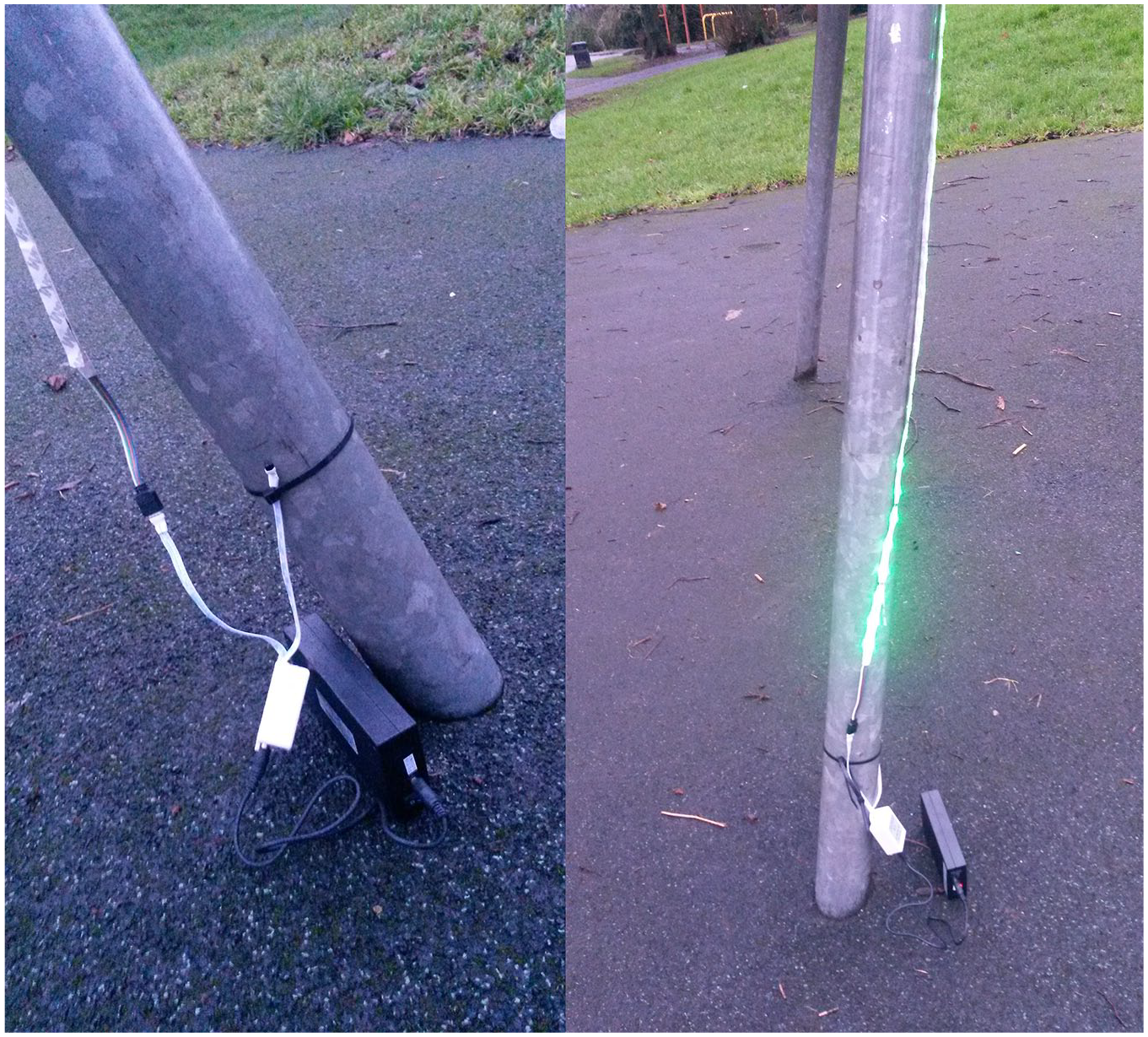
Interactive LED Strips, Brandon Hill Park, Bristol (© the Author December 2014).
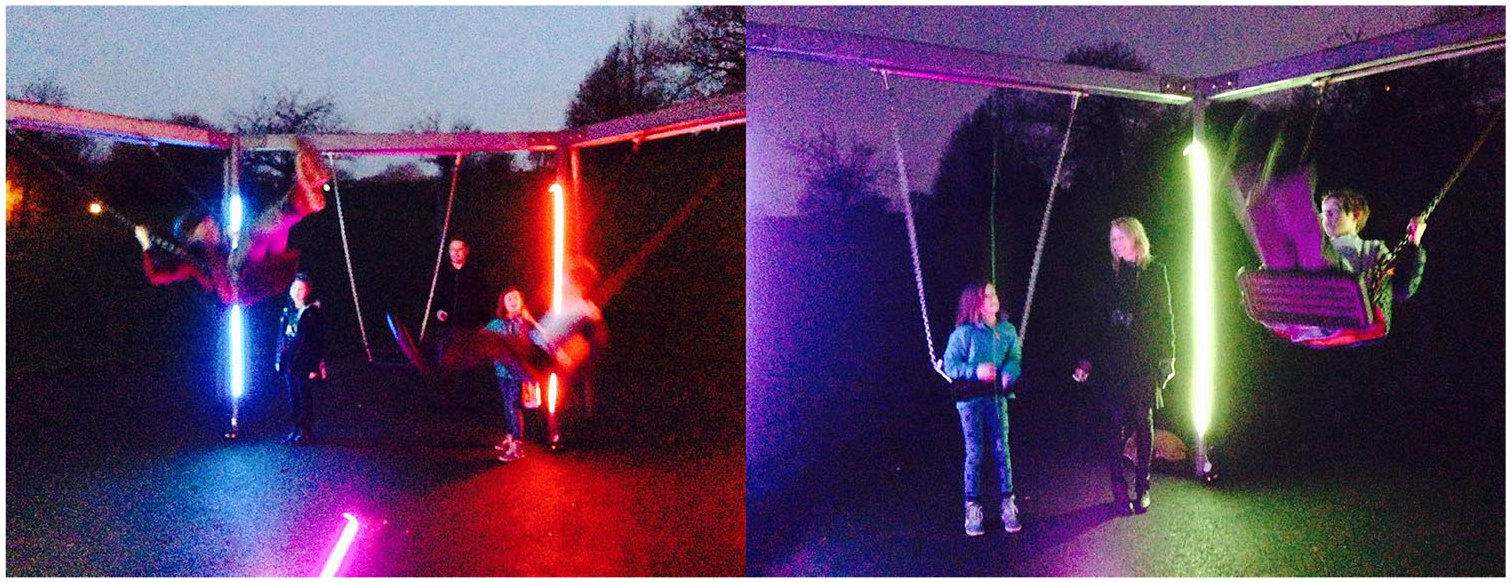
Playtesting Light/Swing Play, Brandon Hill Park, Bristol (© the Author December 2014).
My initial interest in this project was theoretical, almost skeptical. In my research on play and technology, and videogame and toy cultures in particular, I have been suspicious of, on the one hand, attempts to repurpose videogame modes and pleasures to other more “meaningful” or educational activities, and on the other, widespread assumptions that attaching screens, buttons, and “interactivity” to existing practices and environments inevitably improves children’s engagement and captures their interest. So, my initial, friendly, and genuinely open question on joining the project as an academic researcher was “why does playground equipment need augmenting with digital technology?”
I am using the word technology in the broadest terms here. It includes the code and LEDs of an experimental interactive swing, the mechanics of “traditional” swings, and the architecture and zoning of the playground itself− a “machine for playing” (to misquote Le Corbusier). The disciplining of children’s lives, movement, and games by broader trends of urban planning, education, and media, to the moving human body itself are also technical processes (Mauss, 1960). This article’s title is a nod to Heidegger’s equipment as technology in this broadest sense of an instrumentalized environment: tools, machines, and systems “to-hand.” Heidegger illustrates this concept with an image of a skilled craftsman in his workshop, a space and set of tools so familiar it can be navigated and used without the need for conscious thought (Heidegger, 1953/2010). This blurring of mind and body, technologies and expertise, suggests a rich comparison with the child’s “work” of play and the phenomenology of play with apparatus from toys to balls, slides to climbing frames, and videogames to smart phones. However, whereas Heidegger’s paradigmatic example of the craftsman/hammer emphasizes the dextrous and expert hand, playground equipment demands the movement of the whole body. Hands grasp the swing chains, but the initiation and maintenance of the swinging action are both a whole-body, coordinated and rhythmic, working with gravity and momentum: a corporeal and sensorimotor achievement. Heidegger’s “equipment” also brings a critical attention not limited to any particular localized tool use, but rather to tools, technicities, and systems that are always part of larger networks and systems: from the child on the swing to foundries and factories of steel-framed apparatus, contractors and maintenance teams, out to more diverse and historical technics of council planning departments, and the zoning and circumscribing of parks themselves. Our experimental swing project itself was equipped from a tangle of technics, systems, and contingencies; from Danish-distributed computing systems to public research funding; and from ad hoc assemblages of climbing ropes and carabinas to children’s media-fuelled imaginations and bodily rhythms and pleasures.
The children’s enthusiastic and sustained engagement with the test in the park offered early encouragement: that making colorful and responsive innovations to the swing might actually make a qualitative change in children’s imaginative and physical play with this Victorian apparatus. The modes of play that manifested during the test spun off from the familiar swinging activity, as the added spectacle and atmosphere provided by the light strips stimulated social play and collective suggestions from and between the swinging children as they shouted out what color they wanted their strips to change to, and spontaneously generated game mechanic ideas—demanding a particular color when the swing reached a particular height, for example. It demonstrated that an interactive, illuminated play structure could be an exciting augmentation, prompting new and sustained modes of play, both imaginative and kinesthetic.
The test raised a number of issues that stayed with us throughout the project. First, the visual spectacle of lines and light and the more complicated shapes and movement of playing bodies through them gave this test and subsequent tests a distinct visual and environmental character—both for the swinger moving through the light frame and for spectators and their cameras. The combination of industrial and preindustrial play and electronic lines of light gave the project a science fiction (SF) edge, in action reminiscent of Tron or other SF visions of light and speed (Figure 5). As Tine constructed actual prototypes, the apparatus often took on a steampunk or cyberpunk feel, with LEDs lashed to chains and digital components wired to the steel frame (Figure 4). Second, and more problematically, the test demonstrated clearly the limitations of LED light in daylight. After dark the lights were thrilling, during the dim late afternoon less so, and in full sunlight they were barely noticeable.
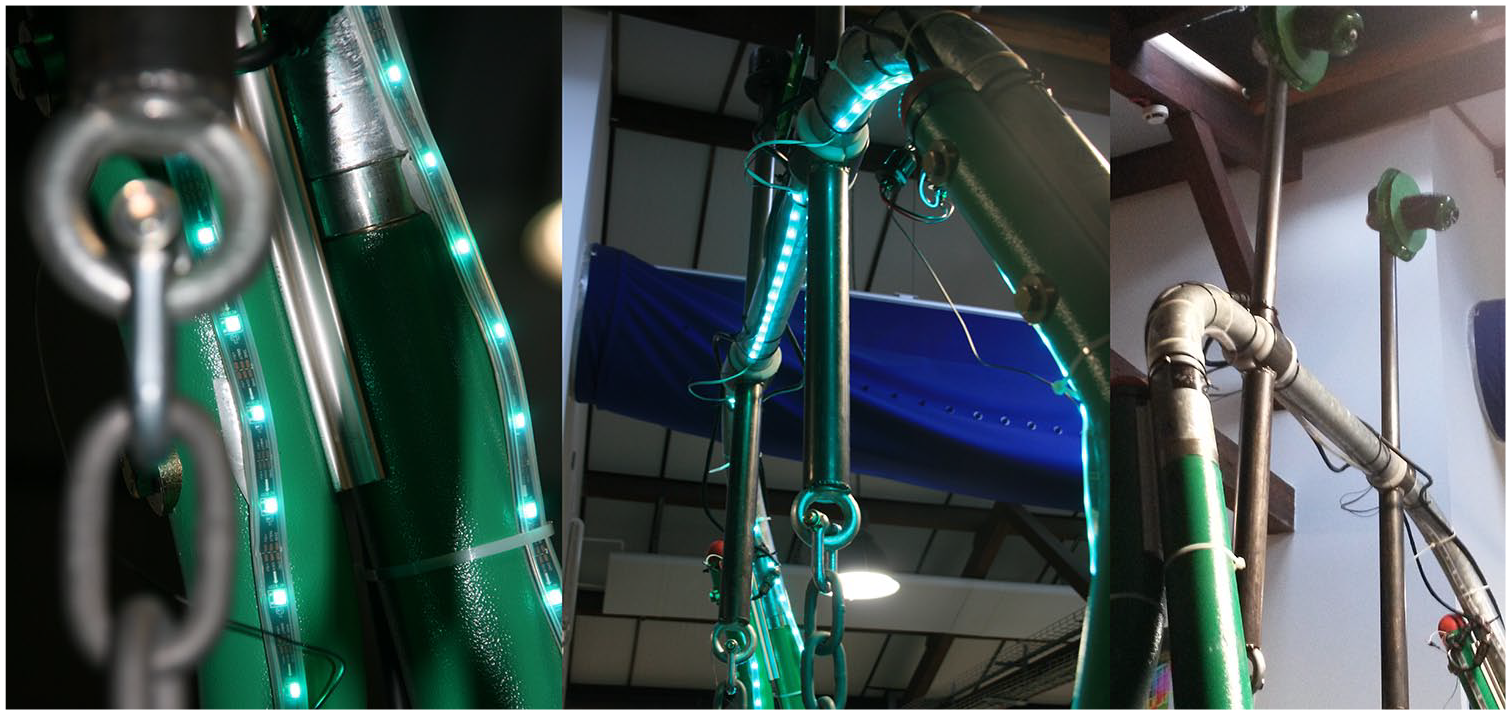
First Prototype of Lightbug, Installed at the Pervasive Media Studio, Watershed, Bristol (© the Author February 2015).
Third, and most promisingly, the test demonstrated emphatically that interaction in the form of responsive light was appealing to children, that it might keep them playing on the play equipment for longer, and that older children, children who saw themselves as perhaps a little too old now for swings, were more than happy to play, enthusiastically and imaginatively.
Along with considerations of light levels, a number of other material and environmental questions were raised. What infrastructural investment would be needed—power supply, maintenance, health and safety, and vandal-proofing—if this were installed in a public park? What kinds of play might manifest if augmented swings were to become familiar and unexceptional? What game mechanics might be coded in? And what new games might develop spontaneously? If this early test hinted at some answers to these questions, it strongly suggested the methodological and conceptual trajectory of the research. The contrast between the play on the swings and the initial stages of work with the young coaches was marked, and telling. We had worked with the children at the Pervasive Media Studio some weeks earlier. With no actual apparatus to play on, we discussed the project with them, and asked them about their attitudes to and play in park playgrounds. They “always” go on the swings when they go to the park, they reported, and they use the play equipment, but “not how it’s supposed to be used” as Addy put it, “it’s been around for such a long time that you want to make it do something different.” Caitlin recounted her favorite game with and around a slide, the details of which were lost in the enthusiasm of the telling, but involved “everyone running around, up the ladder and down the slide.” We asked them to imagine a new technologically augmented swing. What, we asked them to speculate on and draw, might it look like and be able to do? Their talk and drawings demonstrated a very particular imaginative mode: They conjured up a swing frame encrusted with digital media functionality and leisure-oriented accessories: lights and audio speakers, drinks holders, and sockets to plug in iPods and phones, something like an outdoor analogue of an ideally equipped bedroom. 4 Swinging itself was barely mentioned.
For the project itself as a play or game design process, the difference between this drawn imaginary of children’s media lives and the emergent action and interaction of the park playtest demonstrated the value of early testing with moving bodies as well as imagining minds. This has philosophical as well as methodological ramifications. As Harker notes, in his theorization of the spatial and temporal dimensions of children’s play, different modes of play, or “playing performances,” demand varying relationships of the affective and the cognitive. In kinesthetic play such as that evident in the winter swing test, “it is the affective register that becomes heightened. Playing is not thoughtless as such, but rather in many instances prioritizes non-cognitive (physical and emotional) processes” (Harker, 2005, p. 56). The salience of his assertion that “the materiality of bodies in mobile play exceeds representation” was evident in the different responses of these playful bodies when asked to sedately (and cognitively) imagine an advanced interactive swing as against the sensual corporeality—proprioceptive, visual, social—of actual swinging in the LED apparatus. Ferrer et al. make a similar argument as they reflect on the relationship between imagining and embodied action in their design and testing of a digitally interactive slide structure. They note that “imagining combines an awareness of relationships between bodies with a certain inadequacy or incompleteness in knowledge.” A discussion of ideas between two designers during the production and testing of their slide illustrates this: they were . . . imagining user bodily actions through their own body actions and based on other interaction experiences [through gestural movements they were] imagining the user’s engagement at the same time as their body actions and transitions were put in relation to code, machines, software tools, and other devices. (Ferrer et al., 2016, p. 124)
The value of embodied and technical play in itself as a research method and imaginative resource became clear. With only pens, paper, talk, and more or less sedentary bodies, the children’s speculative designs for the future play equipment could only anticipate technological accretion. Whereas once swinging, their imaginations were distributed through their bodies and the physics of the equipment itself. 5 Conversely, the madness of the swing test had its own cognitive method: Amid the flailing and shouting, ideas for game mechanics were ejected: systems of quantification and reward and computer game conventions of levels and bosses—all tied to the concrete technical features of LEDs and sensors that were being tested, and lived, in real time.
For the conceptualization of play with mechanical equipment, the design and testing process opened up new insights into the character of, and possibilities for, kinesthetic games. In mechanical terms, what kinds of movement do swings facilitate, and how can these dimensions and dynamics of movement be sensed or captured and fed back in a game mechanic? Tine and I spent some time remembering our own childhood swing play and testing different types of contemporary swing (Figure 6). More conceptually, I wondered, what kinds of space were the children, swings, and lights operating in? Or, more accurately, what kinds of space and spatial dynamics were they bringing into being? 6 Tine’s early ideas for connected playground equipment aimed to open up these possible dynamics (Figure 7).
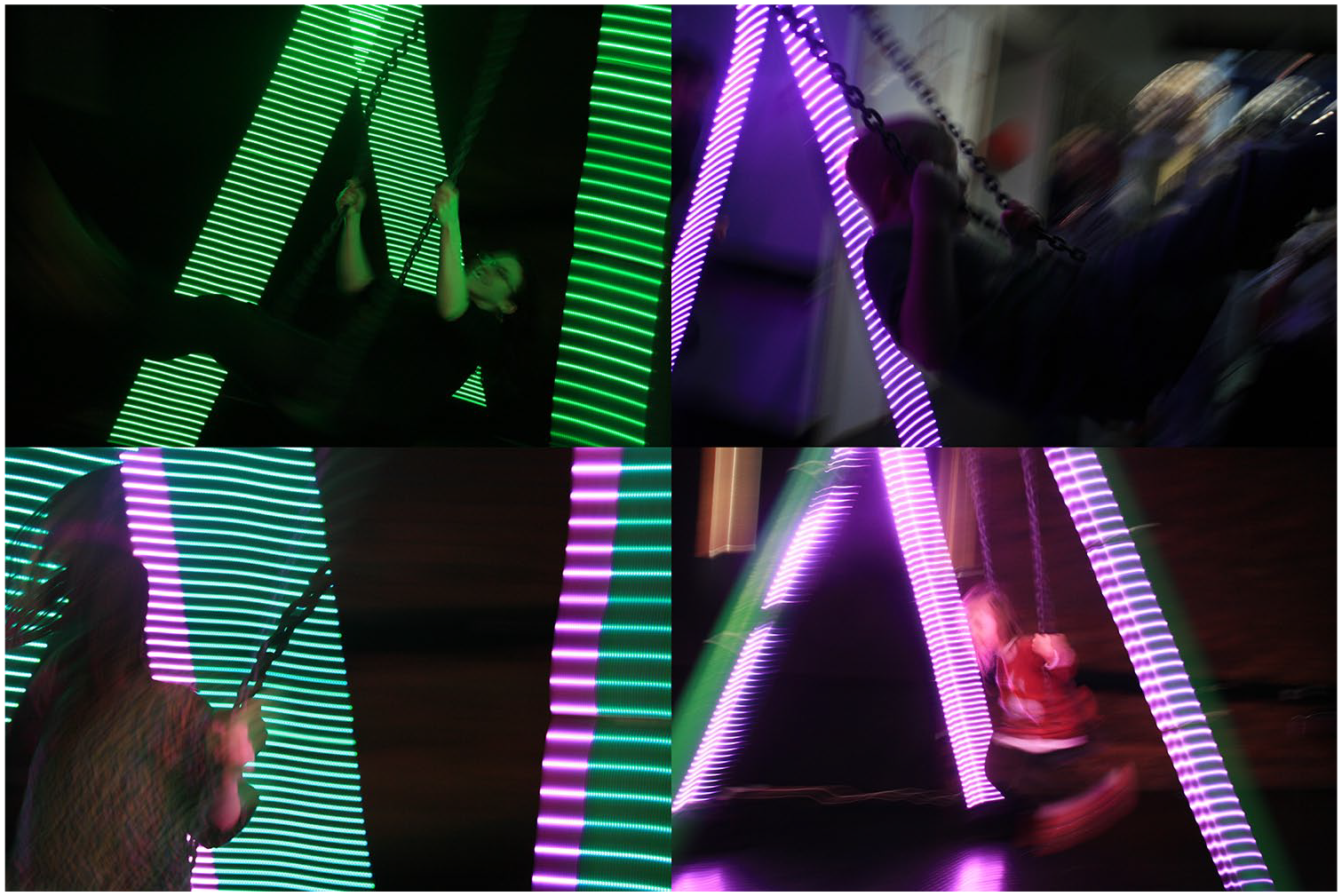
Lightbug in Motion at the Pervasive Media Studio, Watershed, Bristol (© the Author February 2015).
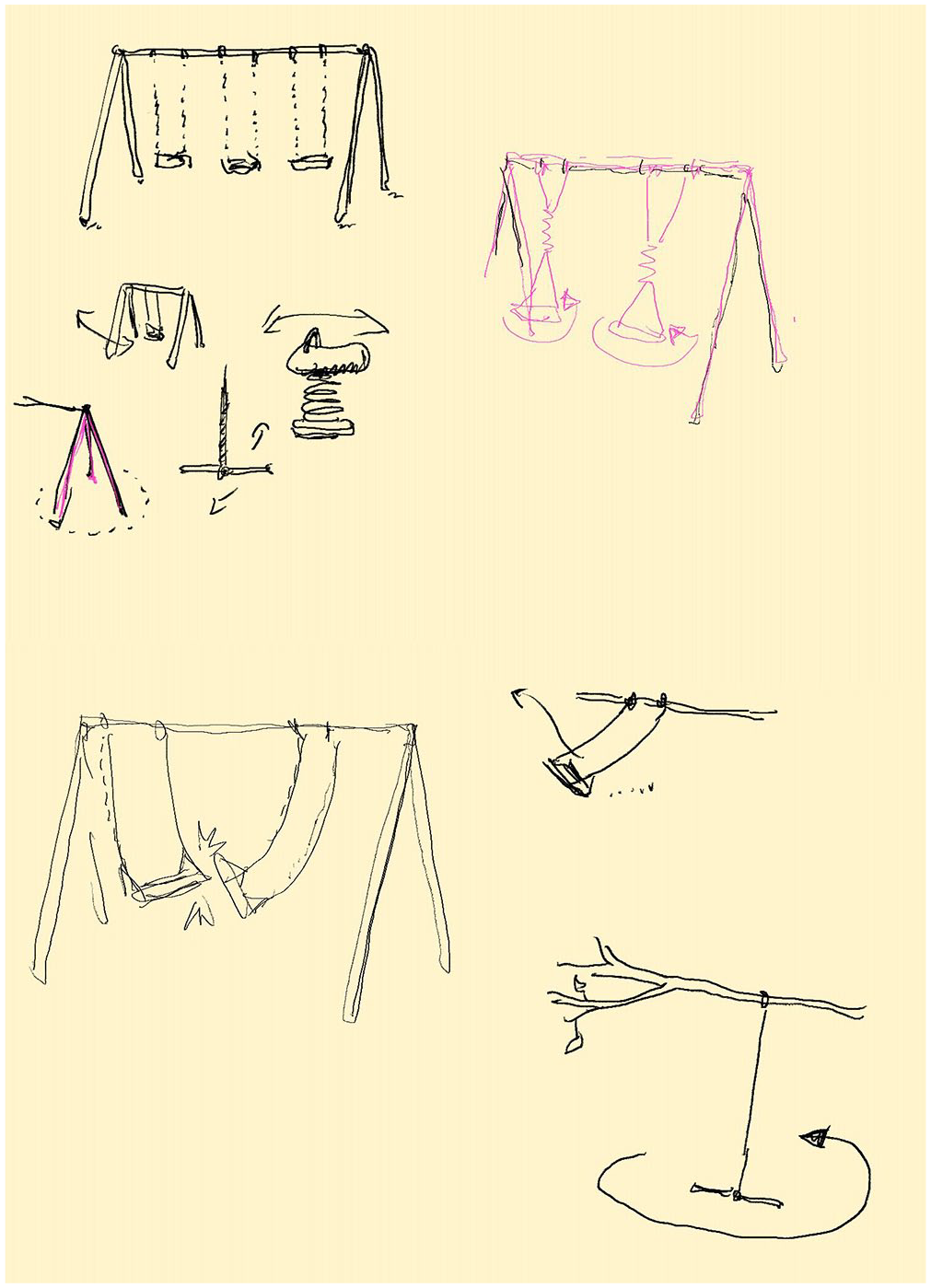
The Ludomechanics of Swings (© the Author November 2014).
At first glance swing play would seem to be of a different order of kinesthesia and space: The rigid apparatus is set in concrete, and the swing’s movement through it constrained to a one-dimensional arc, to and fro. Leaving aside for now the wider loops of play around and through swings (the role of pusher as well as swinger, lying or standing on the swing, jumping off, dodging the swing, climbing the frame, etc.), swing play is an intriguing challenge for the description and conceptualization of space and movement, and the relationships between technologies, bodies, and imagination. A swing is a simple machine: an extended line or set of lines, usually but not always flexible (rope, chains), usually with some kind of attachment at the bottom end of the line to facilitate the support of the body or grip of the hands (a seat, a strong stick, even just a knot in the rope), and at the other end attached to a support from which the line or lines can pivot, a tree branch or manufactured frame (Figure 8).
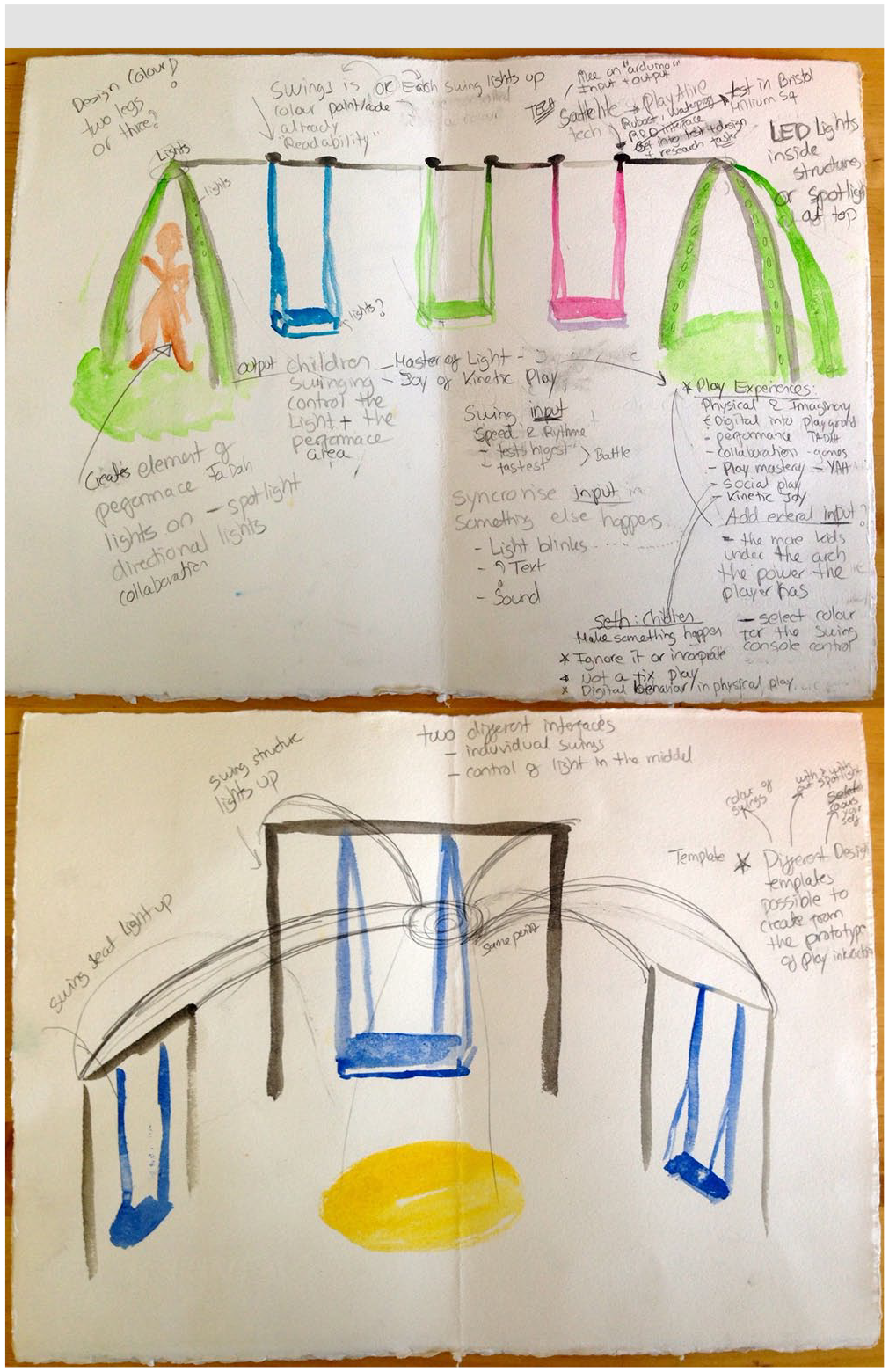
Early Sketch Ideas for Interactive Playground Equipment (© Tine Bech, 2014).
So, a single swing offers very little in the way of varied input: pendular motion with no opportunity for punctual input other than the moments of starting and stopping—and even these are imprecise zones of phase change not the responsive immediacy of the button presses that drive most computer game play. Two or more chains or ropes more or less constrain the swinging movement to one dimension, whereas a single line opens up a two-dimensional space of movement (Figure 6). The degree of flexibility in the lines determines any latitude for departure from the mechanical metastability of the one-dimensional arc. Large fairground swings with rigid metal lines offer no flexibility or latitude; common park swings on chains allow a number of other dimensions of movement (and hence possibilities for play): rotating the swing on the horizontal plane so that the chains twist around one another, building up kinetic energy to be released in a vertiginous spin, side-to-side movement—often in combat with a neighboring swing (Figure 6). But even “normal” swinging requires the learning of a complex bodily and mechanical technique: a coordinated and rhythmic set of movements, swinging the legs forward while leaning back and sometimes using the hands to bend the line of the supporting chains to add impetus. Once the to-and-fro momentum has been established it can be sustained or added impetus. Standing on the swing facilitates a greater acceleration of motion as the legs can be bent and straightened to thrust the seat forward and the whole weight of the body thrown back and forward through the chains. The relatively recent wide hoop swings, now found in parks and public spaces, are engineered to minimize the range and speed of swinging to a relatively short and slow arc. They impel a more sedate movement and hence a more contemplative attitude to play, or perhaps the very edges of play: a gentle distracted rhythm, suggesting gentle conversation and a relaxed gaze up into the trees and sky.
Each of these modes of movement-space no doubt suggests or seeds their own broad channels of imaginative play. Some, closely bound to the movement itself—high swinging suggesting flight for instance—with others the gentle pendulum motion generating lines of thought not connected to the apparatus itself . . . daydreams, idle conversation. For the research project we were less immediately concerned with play in general and more with games as a distinct, structured mode of play. This was in the first instance as much a question about the engineering of movement as it was about game design: In what ways could the simple engagement with a swing be registered as an input to be processed and responded to by an augmented swing apparatus? And what kinds of output, initiatory or responsive, could a swing generate that could be recognized and in turn responded to in a sensitive enough way to satisfy the player and with enough variety or latitude for the construction of a satisfactory game mechanic? 7
As the core interactive system for the swing, Tine chose the Danish company PlayAlive’s “satellite” system. Designed to be embedded in outdoor play equipment, it is robust, vandal-proof, and versatile, and it offers a button press (or kick) mode of interaction. It does not have a screen as such, but has a petal-like arrangement of colored LEDs under its thick, translucent, and convex surface which support a simple form of animation and visual feedback. Once embedded in play equipment, it appears as a circular and convex plastic disk. We had visited an installation of the system in a Copenhagen public park: the circular surfaces animated to suggest birds’ wings flapping in flight across the famous Copenhagen rooftops, here abstracted and miniaturized as low structures to climb over and through (Figure 9). The satellites drew potential players into their orbit through synthetic birdsong as well as the blue or red animated wings. This facility immediately opened up the possibility of enriching the speculative system’s feedback to players through sound as well as light.
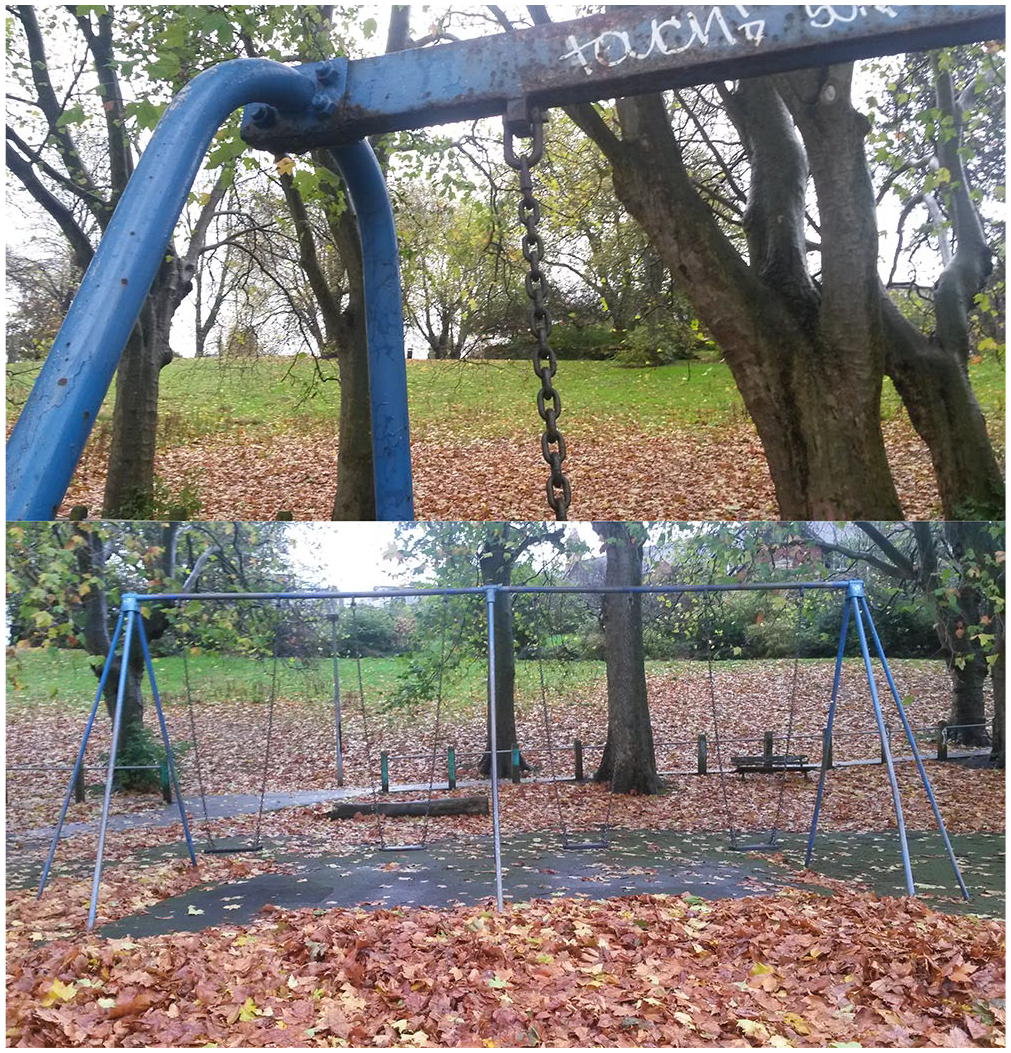
Swing Apparatus, Victoria Park, Bristol (© the Author November 2014).
Two other features of the satellite device subsequently shaped the project direction most significantly, however. First, its ability to be linked in a series or network with other satellites and programmed as a distributed mesh of responsive elements, a spatialized system. Second, each contains an accelerometer so that attached to moving equipment they can measure the extent and speed of motion, supporting games and play requiring the sensing and processing of mechanical movement. After some discussion and testing with PlayAlive, Tine settled on an arrangement of the satellites as mounted above the swing frame, on rigid extensions of the chains (Figure 10). As the seat and chains traced their arc under and through the frame, the buttons above rocked back and forth, their motion digitized, and processed as input to a laptop running PlayAlive’s software.
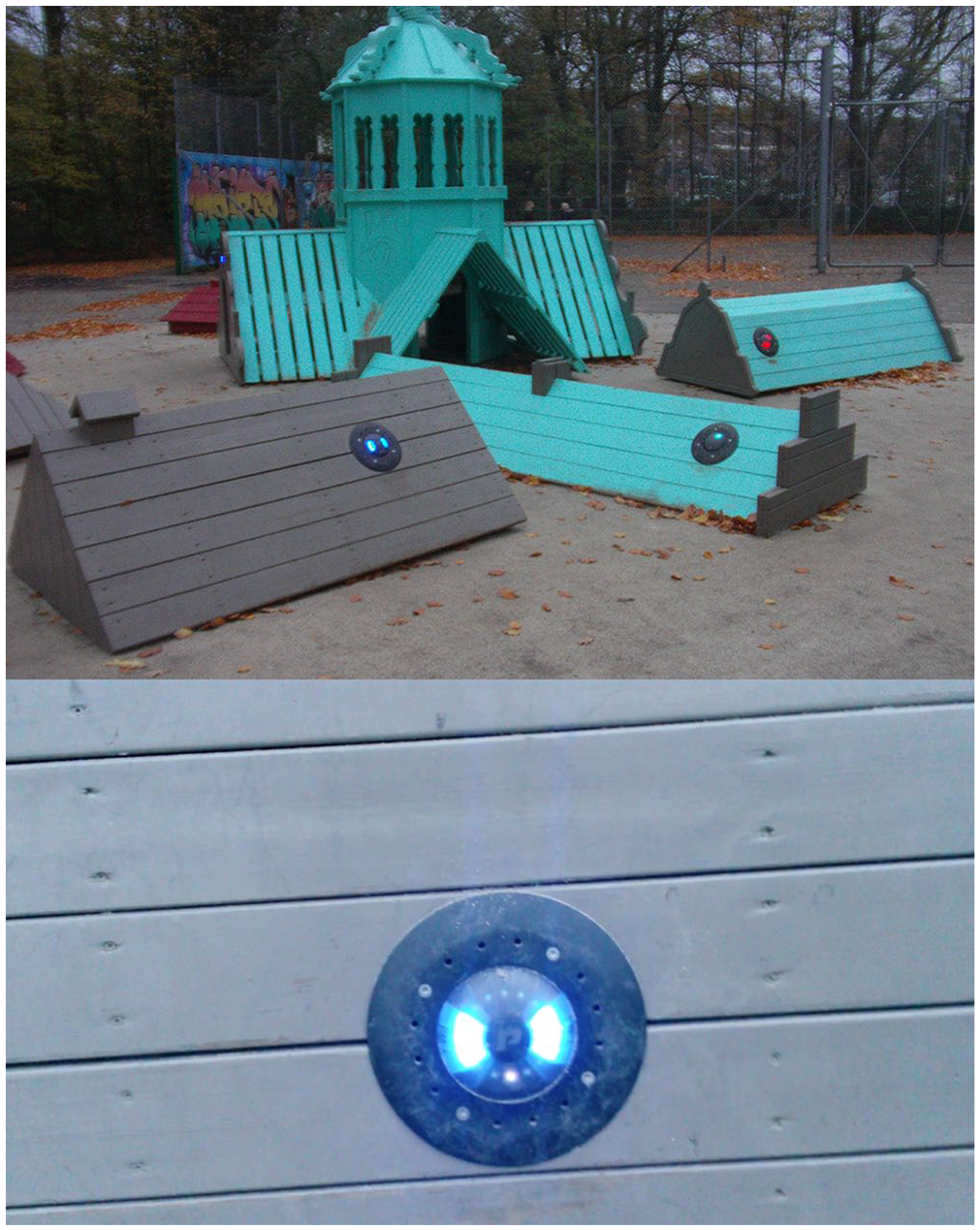
PlayAlive’s Satellites Installed in “Rooftops” Apparatus in Copenhagen (© the Author November 2014).
Playtesting and public presentations of the first iteration of Lightbug—as the swing was now called, its satellites on stalks reminiscent of insect’s compound eyes and antennae—demonstrated a definite appeal (Figure 10).
The prototype featured a simple challenge/reward game: The child (or their “assistant”) would choose a color by hitting a satellite at the foot of the swing (Figure 11.). This satellite was programmed to cycle through its colors: white, purple, blue, orange, and so on. Thumping the satellite when a particular color was displayed would select that color for the game. The accelerometers mounted on the top of the swing apparatus, connected to the moving chains supporting the swing seat, converted the swinging motion into responsive light. The light crept up each leg of the swing’s frame, dropping back a little if the swinging slowed, but with a regular enough motion the LED strips would light up the legs of the swing, meeting at the top, and rewarding this achievement with a fanfare of fun sounds and the flashing color of the whole apparatus. This simple game proved very popular, with a queue of children and adults waiting to try or retry it all day. Some people immediately picked up on the game mechanic and played with concentration, and were quickly rewarded with the flashing lights and sounds. Others, smaller children and adults of a more contemplative bent, were happy to toy with the apparatus’s response in a more exploratory way: starting, stopping, swinging slowly to see the lights rise and fall, and setting pulsing rhythms rather than linear progression to the climactic win-state. 8
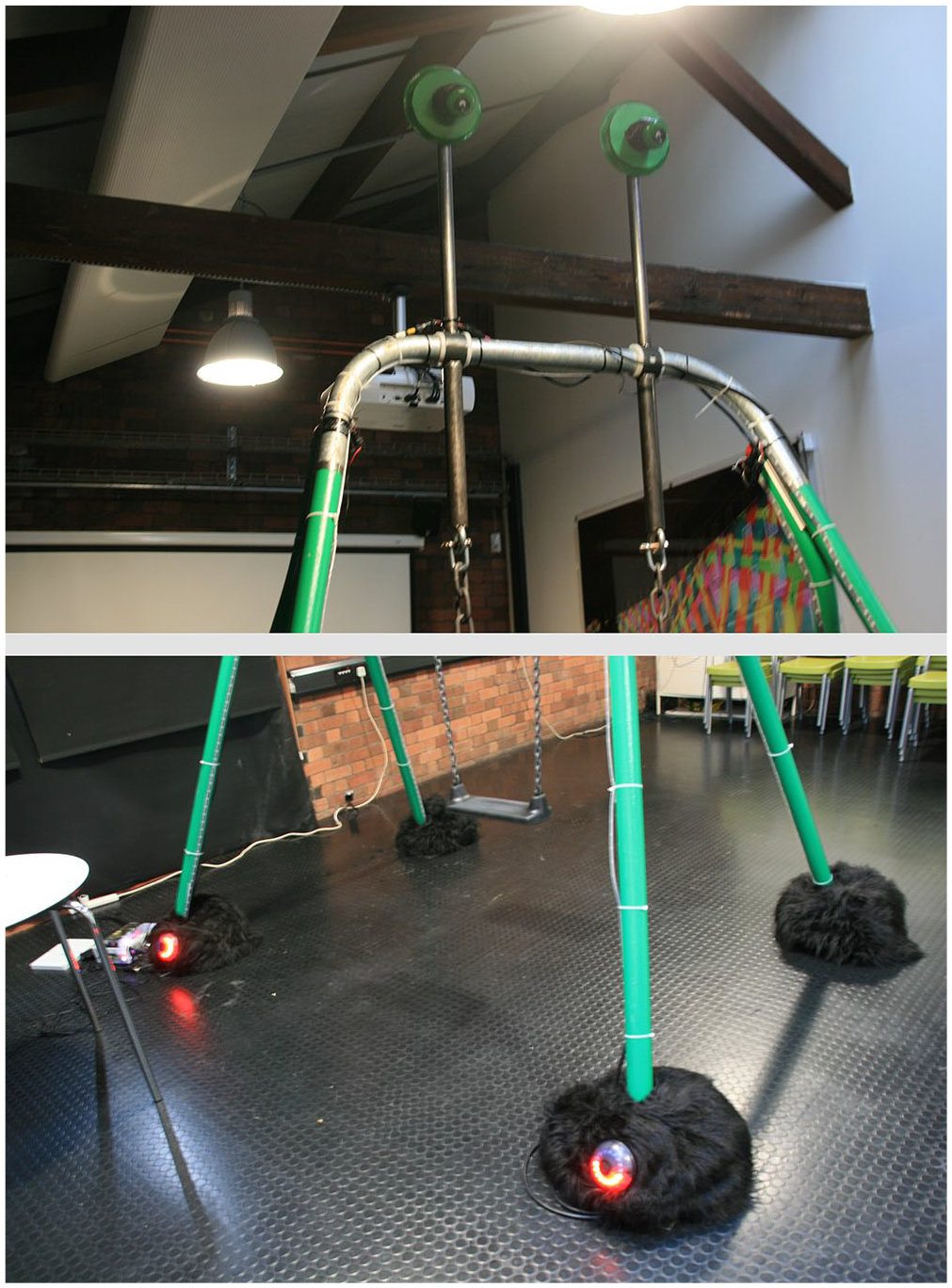
Testing the Prototype Lightbug (© the Author February 2015).
The choice of satellites and the mechanical design their accelerometers necessitated meant a rigid enforcement of the swing’s dimensions of movement. The pivots on the crossbar and the steel tubes were needed to remove any flexibility or latitude in the chains’ movement to control and maximize the transmission of the swing’s motion to the satellites’ accelerometers. Thus, side-to-side movement was removed, as was play by twisting the seat and chains. Any possible interactive response or game mechanic then could only work with this single dimension of space, leading necessarily to the only other variable available to us: time. Speed, rhythm, and the punctuality of starting and stopping were the only factors that the accelerometers could register as player-generated input. As noted above, we always anticipated that any future development of the project could include networked input across the playground: a distributed interface with input from satellites as accelerometers (on a roundabout, for instance) and as buttons (at the top of a climbing frame perhaps). We imagined this as an installation in a public park playground, gently glowing or flashing structures luring would-be players into intense, programmed games or more contemplative or distracted play, less rule-driven, more a relaxed and exploratory testing of the equipment’s responsive range and parameters in sound and light. 9 However, it should be noted that experimental projects such as Lightbug struggle against this longer history of play technology. Environmental, economic, and infrastructural challenges to novel and technologically complex apparatus led discussions of Lightbug’s possible futures toward visitor attractions, fairgrounds and shopping centers, and specific installations for festivals. For now at least, the mechanics and economics of the interactive playground tend toward a more privatized form of playspace.
Conclusion: Playground Equipment From the Victorian to the Postdigital
The structures and spaces of playground equipment are at once documents of the shifting historical attitudes to and investment in children and outdoor play, and the actual machinery of these attitudes and investment. A public park today is a palimpsest of 150 years of municipal, philanthropic, and community investment (and neglect), and of engineering of distraction, exercise, imagination, sociality, and pleasure from the height of the Industrial Revolution to the postindustrial and postdigital era. The apparatus available to children in park playgrounds has, in general, changed very little. Swings and slides persist, roundabouts and seesaws have dwindled. Late 20th and early 21st century additions (e.g., half-courts, skate parks) are built very much on the same schema: specialized space, discipline and safety, steel and concrete to resist the elements and vandalism, and to optimize the economics of maintenance. Play apparatus is still nearly always equipped and powered only by the playing bodies themselves, gravity, centrifugal forces, and individual or intersubjective imaginative impetus.
That the numbers of unattended children now playing on this equipment are modest is similarly significant. The lack of technical innovation and the relatively lower use of the playground speak of a lack of public investment in children’s outdoor play and the continuation of the broad processes of mobile privatization. If the postdigital playground is developing anywhere, it is in the home, in and around videogames, and in social media. 10 Like nearly all other public and school playgrounds, Victoria Park is postdigital only at the level of imaginative dynamics brought to bear by the children from their popular digital and networked cultures at home (Burn, 2013), or—now—with the ubiquitous presence of mobile phones (Nansen, 2020).
In acknowledging the trends toward domestication and virtualization of spatial play, I do not want to either overstate this shift (plenty of children still play in parks) or reinforce prevalent notions of a rigid distinction between play with digital media and outdoor active and imaginative play. As Nansen (2020) argues, the latter is contrasted with digital devices, “[h]ere, outdoor play often enters public discourse as a way of getting children away from the screen” (p. 61). 11 Moreover I would note that the contemporary valorisation of outdoor play often echoes the “improving” motivations and ideologies of the first playgrounds, but now updated with new concerns about solitariness, obesity, inappropriate media, online risks, and so on. Unlike other experiments and research into interactive playgrounds (e.g., Poppe et al., 2014), the Lightbug project was interested in play for its own sake, as an end in itself, not in regulating and surveilling children’s behavior or promoting health, child cognitive or motor development, or social activity for their own sake. We were keen to resist that opposition, to see the flow of embodied and imaginative play across the virtual and actual, while keen to experiment with alternatives to screens, keyboards, and controllers (Bech, 2014), and to facilitate different kinds of cognitive and sensorimotor engagement and response. We were interested from the start by what the children might bring to the equipment, and what emergent physical or imaginative games and modes of play they might build around the structure, the interaction, and the simple game mechanics. On the one hand then, we were not interested in disciplining or shaping play any more than necessary, while on the other attempting to imagine postdigital play as building on and working with well-established, natural even, mechanics of space, infrastructure, and bodies and the new possibilities of augmented proprioception, sensing, computer feedback, and game mechanics.
Footnotes
Declaration of Conflicting Interests
The author(s) declared no potential conflicts of interest with respect to the research, authorship, and/or publication of this article.
Funding
The author(s) disclosed receipt of the following financial support for the research, authorship, and/or publication of this article: The Lightbug project was funded by the UK Arts and Humanities Research Council through REACT (Research and Enterprise in Arts and Creative Technology), 2012−16.
