




Abstract
Cities are complex spaces of contesting infrastructures, media, humans and more-than-human interactions. They are places that house multiple visible and invisible cartographies that draw on multisensorial ways of being in the world. In the city, our senses are amplified and intensified in ways that reorient our processes of worlding. Cities have, more recently, been defined and approached as spaces for play. In this article, we explore how understanding the city as a playground—or through the activity of playgrounding—can invite new ways of designing urban games and playful interventions that acknowledge the uneven and multisensorial ways we inhabit the world. We reflect upon dominant, innovative, and interventionist ideas of playgrounds and notions such as the playful or playable city. We then reflect on findings from a placemaking game workshop designed around the Spanish Superillas (superblocks) in Barcelona. Superillas are playgrounds designed into street intersections that have transformed specific sections of the city in a playground. What does it mean to think about the city as a playground? Can this speculation/ provocation help us rethink the city in more inclusive and sensorial ways?
Introduction
Cities are complex spaces of contesting infrastructures, media, humans, and more-than-human interactions—assemblages of corporate and public interests (Clark & Wu, 2021). They are also places that house multiple visible and invisible cartographies that draw on multisensorial ways of being in the world. Through our senses—such as sight, touch, hearing, and proprioception (knowing through movement)—we experience the city in diverse and uneven ways. Sensory studies explore how we can understand places in different ways (Bull et al., 2006; Pink, 2015). As Pink notes, exploring places through sensory ethnography can undercover new (often tacit) ways of understanding our world (Pink, 2015). In the city, our senses are amplified and intensified in ways that reorient our processes of being in the world.
In urban studies, cities have been conceptualized in different ways over the last few decades. The rise of digital networked media and commodification of public spaces has led to much contestation (Clark & Wu, 2021). But they can also be sites for citizen placemaking and grassroot reimagination, in keeping with the important work by Jane Jacobs (1961). In the 1960s, Jacobs organized grassroot activism to challenge the then male-dominated area of urban planning and renewal especially around New York City. Placemaking was about understanding the city in terms of quotidian citizens.
More recently, placemaking has been discussed in terms of the digital—especially as the digital is now embedded across spaces, places, and practices (Foth et al., 2015). Digital placemaking nods to the activist work of Jacobs while also acknowledging the complex entanglements, power inequalities and assemblages of the digital that are particular for cities today. For example, Halegoua and Polson (2021) argue that digital placemaking has emerged from the ways in which digital citizenship contests traditional notions of place. They note that the digital can amplify the inequalities of spaces and places just as they provide vehicles for creative placemaking. Human geography researchers have also explored some of the challenges and opportunities posed by the digital overlay within cities—especially in terms of smart cities (Kitchin & Dodge, 2011; Kitchin et al., 2015; Leszczynski, 2015).
We are particularly interested in the ways in which play, digital media, and placemaking can provide ways for reimagining cities for its citizens. Specifically, we are interested in how play as a method, mode of critical inquiry and space for speculation and creativity (Sicart, 2014) can be deployed to reimagine a city as a space for multisensorial engagements and encounters that invite types of activism and speculation. Or what curator and design historian Domitilla Dardi would call “playgrounding” (Dardi, 2022). For Dardi, playgrounds reflect our definitions of urban space, creativity, contestation, and childhood. It is the “anthropological heart of our social relations.” Playgrounding focuses on the process of social relations and how play, place, and space can create new ways of being in the world.
In this article, we examine the role of playgrounds—and the process of playgrounding—as an alternative way to activate and feel the city. We consider how to understanding the city as a playground can invite new ways of designing playful interventions that acknowledge the multisensorial ways we inhabit and move in the world. We first explore some of the ways in which play and the city have been discussed and envisaged. We reflect upon dominant, innovative, and interventionist ideas of playgrounds and notions such as the playful or playable city. We then outline why multisensorial approaches to the city provide new insights and understandings—exploring some key examples of multisensorial projects such as Kate McLean’s sensory maps which mapped the city in terms of smell and Jason Sweeney’s project that crowd-sourced quiet areas of the city. We consider how these projects reshape definitions of urban play and how they allow us to think differently about urban playgrounds and their potential.
We then reflect on a speculative workshop we held around the Superillas (superblocks) in Barcelona as part of Design Week 2017. Superillas are a prompt for redesigning the city for intergenerational play. As playgrounds placed in the middle of street intersections, they turn streets into spaces for pedestrian sociality rather than just for cars. designing games that are attuned to nonnormalized ways of moving through the city and encountering. They are also invitation for intergenerational play—reconfiguring the city for playgrounding.
The Playground: A Reflection for Our Cultural and Social Mores
From the late 19th century, cities in industrialized countries increasingly became spatial (infra)structures with designated spaces for certain activities, including playgrounds. An attempt was made to structure and control urban environments, allowing certain paths of movements and allocating spaces for designated activities. Yet despite these efforts of structuring and delineating the city through urban planning, the experience of moving through such environments still remained tricky, less structured and more fluid (Certeau, 1984), thus still retaining possibilities of other multisensorial engagements than prescribed. Nevertheless, with the regulations of urban environments, the decline of outdoor spaces, and the increase of leisure time, playgrounds emerged as designated and separate areas for leisure activities. As images of this time and age show (Figure 1), some of these playgrounds were still rather “open,” yet playgrounds in cities increasingly took the form of spaces with robust boundaries.
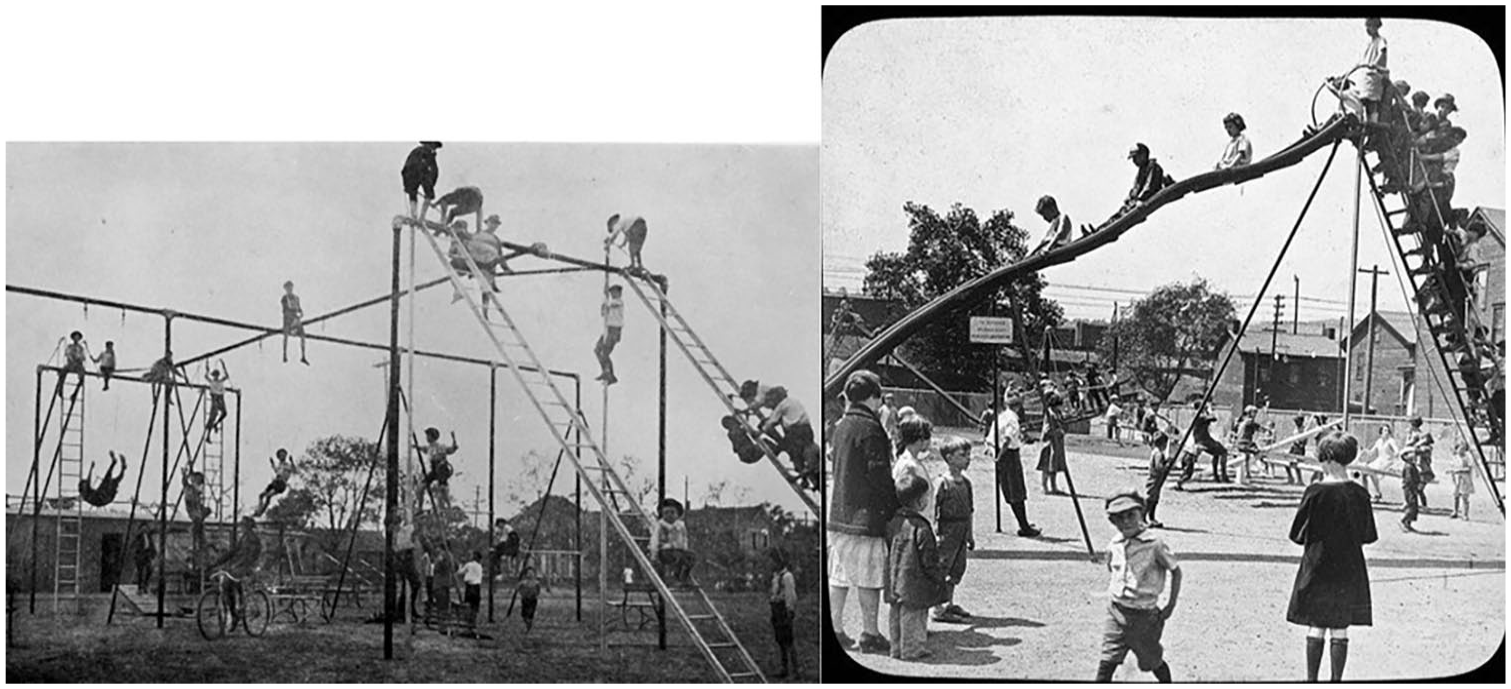
Playgrounds, ca. 1912.
As such this ideal of the late 19th playground fits seamlessly into the notion of the magic circle as discussed by cultural historian and play scholar Huizinga. In Homo Ludens (Huizinga, 1971 [1938]). Huizinga introduced this concept to define how play worked. According to Huizinga play always takes place in a ritualistic space with rules that are different from “outside” quotidian life. With clear entrance points (gates), boundaries, playgrounds are a perfect example of what Huizinga had in mind. But at the same time, this new effort to create separate playgrounds for children, shows how the notion of the magic circle is not universal, but the outcome of a particular ideological setting. Play doesn’t have a-priori boundaries—instead they are created as a result of social networks of actors (Lammes, 2008; Latour, 2005) with certain shared beliefs. This article is about how such boundaries can be produced, but also about how urban environments have the potential to hybridize and make such boundaries less frozen and more fluid and thus the playgrounds more open and uneven.
The development of urban playgrounds from the late 19th century onwards was mainly about setting such boundaries—simultaneously spatially demarcating and infantilizing the playground, as well as bringing in dimensions of class, ethnicity and gender. Playgrounds reflected societal norms about public space, children and families. From the late 19th century onwards, a concerted effort was made—by educators, philanthropist, social reformers, urban planners—to control and delineate play, either in terms of age, gender, class, or space. Control of how children played and who played was pivotal to this modernist ideal of the playground, whether through supervision, enclosure, or rules on use of play equipment. As such these playgrounds were the outcomes of processes informed by particular ideologies resonating with the ideal of modern disciplinary societies (Foucault, 2012) in which control was pivotal. In addition, these playgrounds also subscribe to prevalent ideas of childhood as a separate stage of life, educational ideologies and leisure as part of “mechanised” industrialized societies (Adorno & Horkheimer, 1979, p. 137).
When we however look in retrospect at images of urban prewar playgrounds—often typified by the swing, seesaw, slide, and sandbox—it is striking how dangerous and risky they look from our contemporary perspective. As Figure 1 for example shows, construction could be exceptionally high, the ground on which children could fall or slip could be hard, and safety measures don’t seem to be in place. These material aspects and affordances of such playground allowed for more risk and a greater spectrum of multisensorial experiences, such as pain, tension, and vertigo (cf. Caillois, 1991 [1958]).
In that sense, such playgrounds still had a certain openness to them, allowing children to experience playful encounters that are more uneven, intuitive, and dangerous. Risk assessment and protocols have become more far-reaching and stringent in urban spaces nowadays which, at least to a certain extent, has evened out and limited the possibilities of play. With the increase of risk assessment and protocol, one could argue, the possibilities of multisensorial experiences of play diminished as well.
Postwar playgrounds often propagated the idea of control further, bringing (landscape) architecture and urban planning into the equation and tightening protocols regarding safety and risk. How this materialized was again dependent on local culture and policy. In some countries or cities, playgrounds were designed that were more in tune with specific local textures and needs.
This was, for example, the case in Amsterdam where the Dutch thinker and architect—Aldo van Eyck—was prolific in designing more than 100 playgrounds (Withagen & Caljouw, 2017) (see Figure 2). Van Eyck’s playgrounds were minimalist looking sculptural areas that were specifically designed for the local spaces in which they were built. Almost like an ethnographer, van Eyck observed the local activities, architecture, social texture, and the materials of the neighborhood as part of his design process that was based on the principle of dialogue. He saw it as his task to design not so much magic circles (his playgrounds were never fenced off), but liminal spaces: “Its job is to provide this in-between realm by means of construction, i.e., to provide, from house to city scale, a bunch of real places for real people and real things” (Withagen & Caljouw, 2017, p. 55). Other beautiful and imaginative examples of postwar playgrounds are those conceived by brutalist architects in the United Kingdom (Figure 3), also seeking abstraction in their design. If we compare such playgrounds with how we know playgrounds today, they seem to be less concerned with “the representational” as play equipment in the shape of ships, animals, or castles are largely absent.
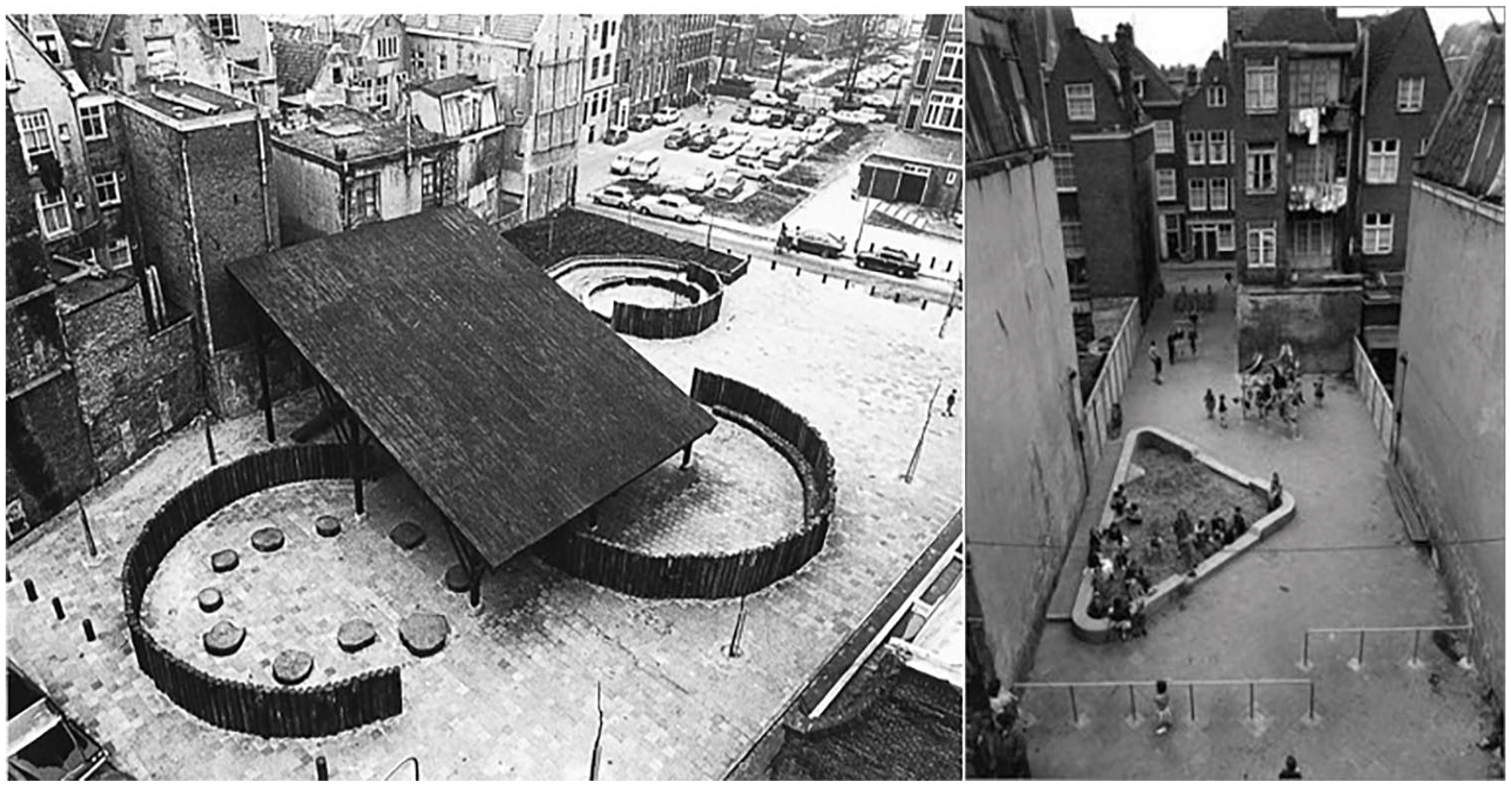
Playgrounds Designed by Aldo van Eyck in Amsterdam.
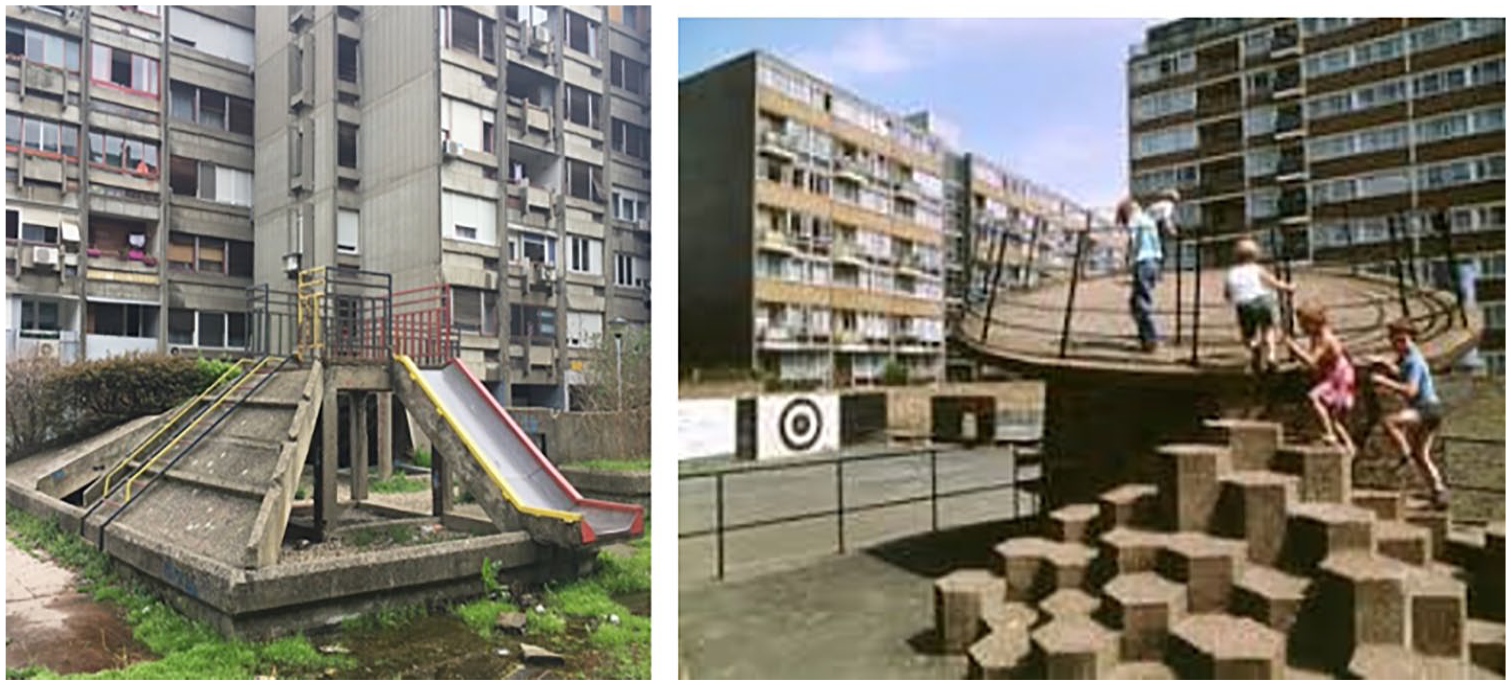
Brutalist Playgrounds in the United Kingdom.
The Brutalist playgrounds and those of van Eyck are fine examples of the aestheticization of the playground through the postwar involvement of (landscape) architects and urban planners in their design and development. Yet, probably because of this, such playgrounds also seem to want to minimize risk and danger and intrinsic to this, they have a rigid structure. The more playgrounds become controlled, one could state, the less they are open for noncurated playful practices and uneven experiences.
Indeed, as Kozlovsky (2008) notes in Adventure Playgrounds and Postwar Reconstruction, designing and curating playgrounds point to an inherent contradiction. After all play should be a practice that we experience as free, open and pleasurable and thus to a certain extent embraces danger, but by creating rules and demarcations these qualities can diminish. We probably all remember the best playtimes of our childhood as taking place outside the strict parameters of the playground, bordering on the illicit or dangerous. Outside the playground play can unfold that is more uneven, messy and tricky and appeals to our senses in more imaginative and visceral ways.
Yet a counter-postwar movement pushed against the idea of the safe and curated playground, particularly in postwar Britain (Read, 2006). As Britain was heavily hit by bombardments in the second world, lots of empty ruined spaces emerged in cities, that began to be used for playful activities by children. Inspired by this, landscape architect Lady Allen of Hurtwood (Allen, 1968) started a movement for adventure playgrounds that left more room for risk, unevenness, and multisensorial experiences. Similar movement emerged in other cultures, also inspired by Ledermann and Trachsel’s (1968) book on creative playgrounds. Although adventure playgrounds mostly still materialized in designated “empty” spaces and were primarily aimed at youth and children, they did not adhere to the idea that playgrounds are about safety and rigid structures. Instead, fluidity, changeability, messiness, and danger became core to their design.
Although playful mobile explorations have always been part of quotidian life, the possibilities of the city as a playground or gigantic game board (cf. Lammes & Wilmott, 2016) for different age groups became more explicitly addressed and celebrated after the 50s (see Figure 4). In tandem with what some have called a “ludification of culture” (Raessens, 2006)—a process in which play gradually became more dispersed and less cordoned—groups and movement like the Situationists International (SI)—started to agitate against the order in cities that did not seem to allow for much playful movement outside designated areas, also separating children from other age groups.
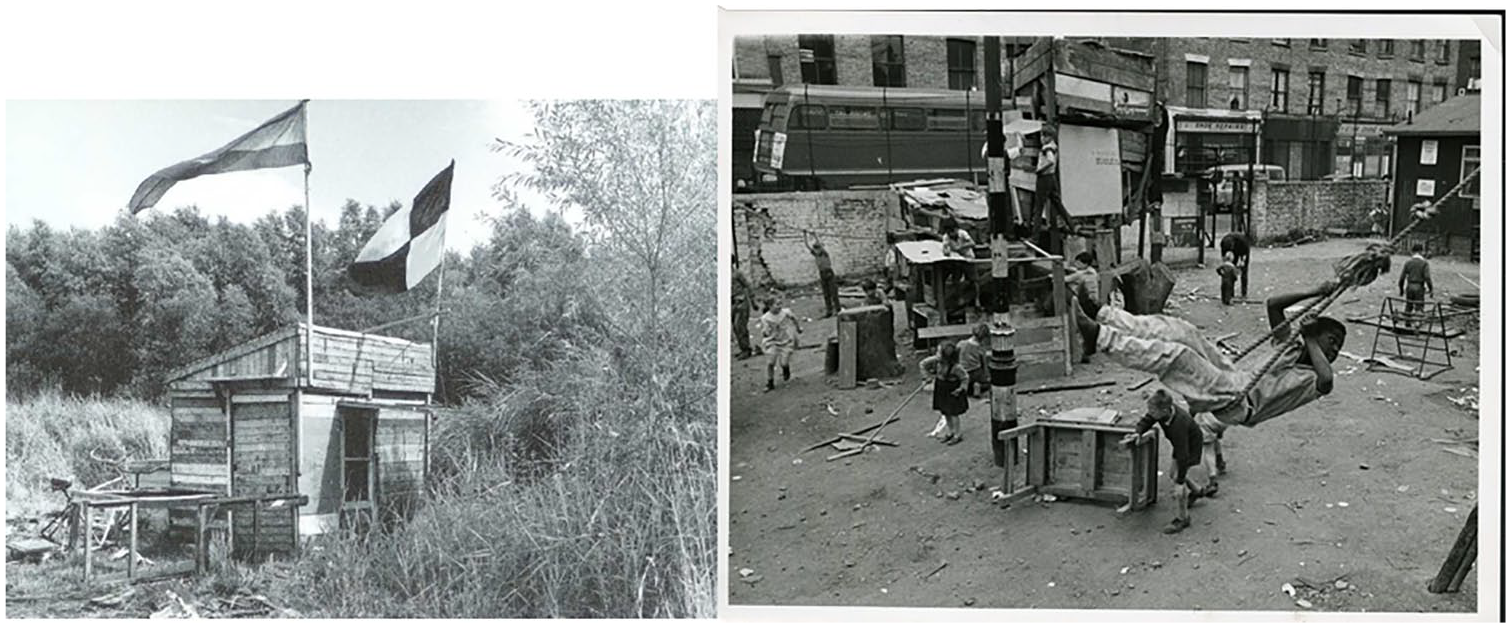
Nottinghill Adventure Playground 1959, Jeugdland Amsterdam 1959.
In the early 60s, SI made wandering through cities without a direct goal a more political and interventionist act. Especially the Dérive (Debord, 1958) was meant as a wandering practice against capitalism and institutions and the urban spaces that they produced (Lefebvre, 1991 [1974]), transforming the affordances of urban interfaces—such as pavements or walls—and introducing the possibility that they could be broken, overturned, augmented (e.g., painted) or repurposed. As a radical creative movement of playgrounding, SI’s practices included hands-on interventions and transformed cities like Amsterdam and Paris into multisensory playgrounds. Their interventionist ways of producing urban playgrounds resonate with current urban practices, such as parkours (de Souza e Silva & Hjorth, 2009) or graffiti, that may be sometimes less directly politically motivated, but also attempt to overturn consolidate meanings of cities through playful interventions. A wall becomes an interface for jumping or exhibiting.
Hence, although urban environments always invited play outside of demarcations, decreasing its circularity and age-specificity and escaping surveillance and control, but such possibilities became more celebrated after the 60s. From murals to graffiti, parkours, yoga, and political demonstrations, play can’t be held in one place and be limited to one age group—and this became increasingly palpable and recognized in outdoor play cultures. The risk they involve goes together with a heightening of the multisensorial, such as listening, looking, moving, smell, and hands-on and fear.
An important shift in this came with the introduction of GPS devices, first as stand-alone devices and later as a feature on smartphones. Locative art projects such as Blast Theory (Adams, 2006; Wilken, 2013) emerged that integrated location tracking and mapping and transformed the urban landscape into a playground (de Souza e Silva & Hjorth, 2009; Lammes & Wilmott, 2016; Tuters, 2012; Tuters & Varnelis, 2006). In tandem, more popular mobile games emerged as forms of digital placemaking (cf. Pang et al., 2020). Pokémon Go as a Location-based games is a fine and much-discussed example of how mobile media transformed urban spaces into playgrounds, engaging with an augmented reality in which a square could for example become a gym (Hjorth & Richardson, 2017a,b).
Such games also show that urban play can potentially be intergenerational, inviting people from different backgrounds to play together instead of producing separated spaces for play. What they also bring to the fore is that the whole city has the potential to be playgrounded as we explore in the next section.
Playgrounding the City: Workshop Explorations and Speculations
Playgrounds, like cities, reflect cultural and social mores. Bringing play to the city can invite innovation, creativity and curiosity. In the exhibition, Playgrounds: Reinventing the square (Reina Sofía, Madrid in 2014) curators Manuel Borja-Villel, Teresa Velázquez and Tamara Díaz explored “historical and artistic approach to the space reserved for play and its socializing, transgressive and political potential from the dawn of modernity to the present day” (Borja-Villel et al., 2014, n.p). As the curators note, “the model of the modern playground” is full of contradictions—from “the urban revolution of the 1960s, the consideration of the city as a relational and psychological construction and works that parallel aesthetic and political transformations” (Borja-Villel et al., 2014, n.p).
We were inspired by the Spanish urban playful intervention of the Superilla (superblock, see Figure 5) as a space or living lab for playgrounding the city. Superillas are playgrounds that were designed into road intersections in the area of El Poblenou in 2017—completely transforming how the city was navigated. Suddenly cars were disadvantaged in favor for pedestrian and cyclists’ ways of moving through the city. Play became an invitation for social encounters. Superillas are also invitation for intergenerational play—reconfiguring the city as a playground for intergenerational sociality. The Superilla provided a great context to explore and rethink the intersections between formal and informal play modes and space in the city.
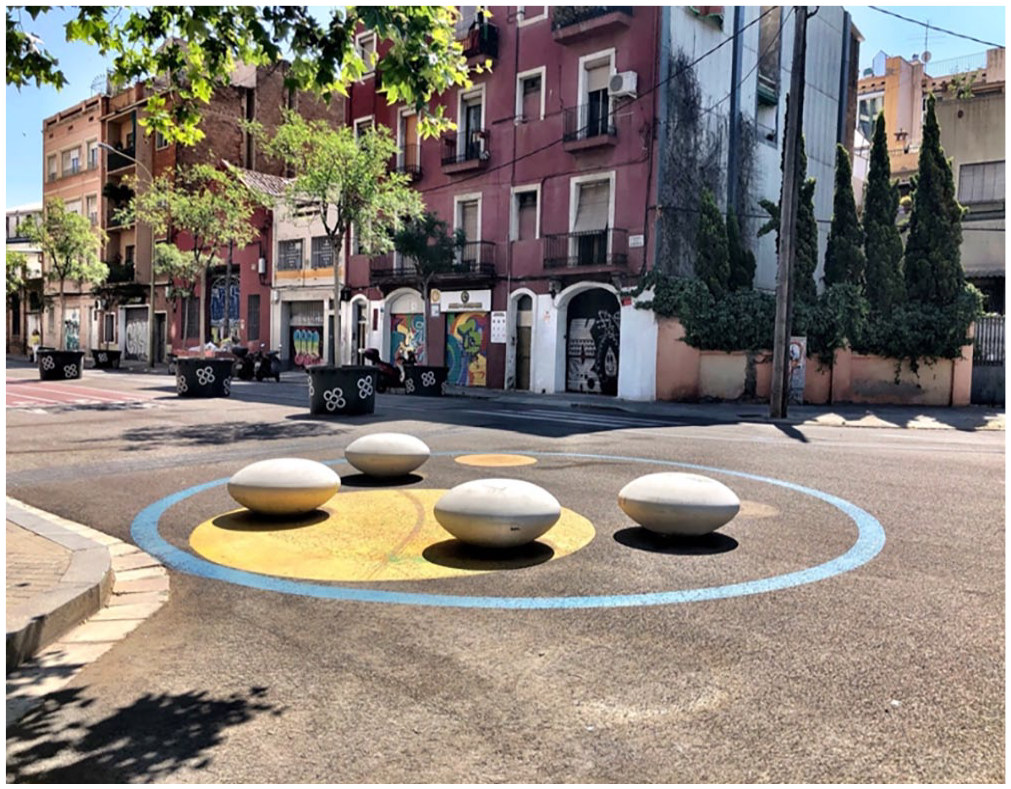
Superilla. Photo: Hjorth.
The Superillas divided the city of Barcelona. Families and pedestrians loved them—they made more moments for playful social encounters. For taxi and car drivers, the Superillas meant that the city became harder to navigate. Designing playful interventions into a city can transform how it sees itself and “feels” about a city. For example, Danish conceptual art group Superflex did such a thing in their Superkilen park in which an area of Copenhagen was transformed into a play space that reflected the multicultural fabric of that part of the city (Figure 6).
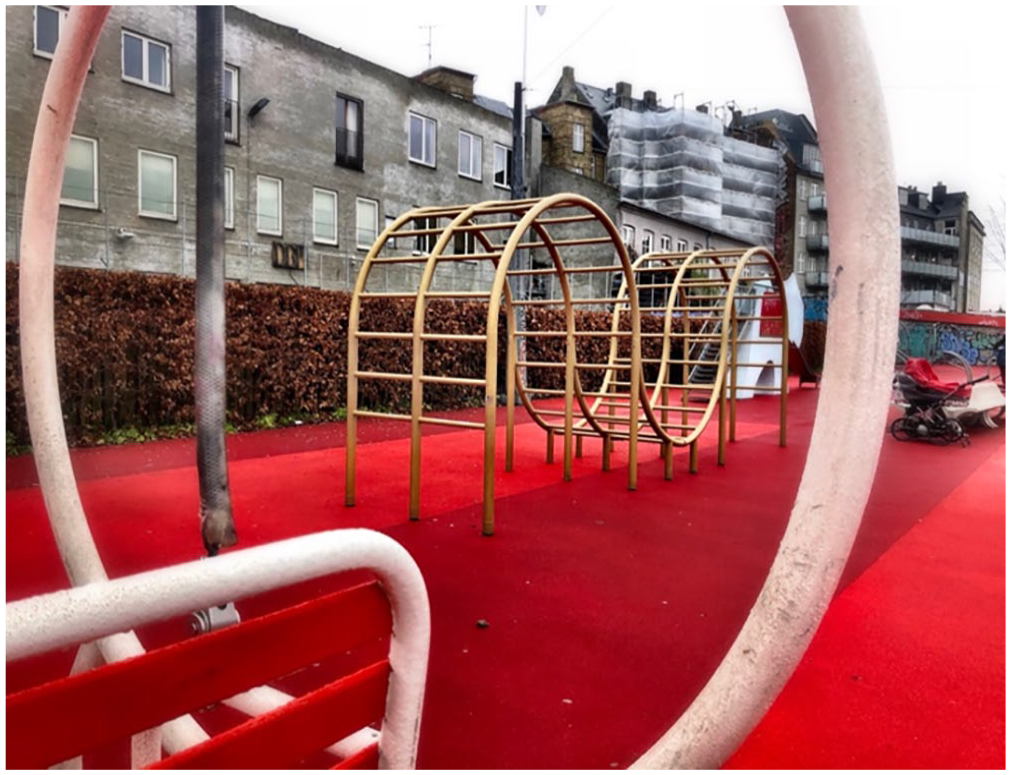
Superflex’s Superkilen Park in Copenhagen. Photo: Hjorth.
Organized at RMIT Europe (El Poblenou, Barcelona) as part of Design Week, the workshop activities sought to activate the streets—playgrounding—through the Superillas, The Superillas provided perfect living labs in which we could test ideas out in the messiness of the real world. Living labs are a design research methodology that involves co-creating innovation with participants. Invented at MIT, living labs are about real-life research that is experimental in nature. As Dell’Era and Landoni (2014) note, living labs operate as a space between user-centered and participatory design.
As playful interventions, the Superillas became a living lab for games for change, wayfinding and architectural speculative futures. In our workshop, participants were asked to take on the roles of game designers in the living lab of the Superillas. The workshop also deployed the design mechanism of speculation (Figure 7). Speculative design can play a powerful role in addressing some of the ways in which we imagine a future through a shaping of present perceptions. By proposing potential challenges or possibilities, speculative thinking introduces imaginary end-users and theoretical technical constraints which departs significantly from a typical design cycle; while speculative thinking’s absence of “real” audiences or limits encourages highly creative and disruptive thought, it also challenges the need for traditional, tangible design output (Dunne & Raby, 2013, 160; von Mengersen, 2018, 203).
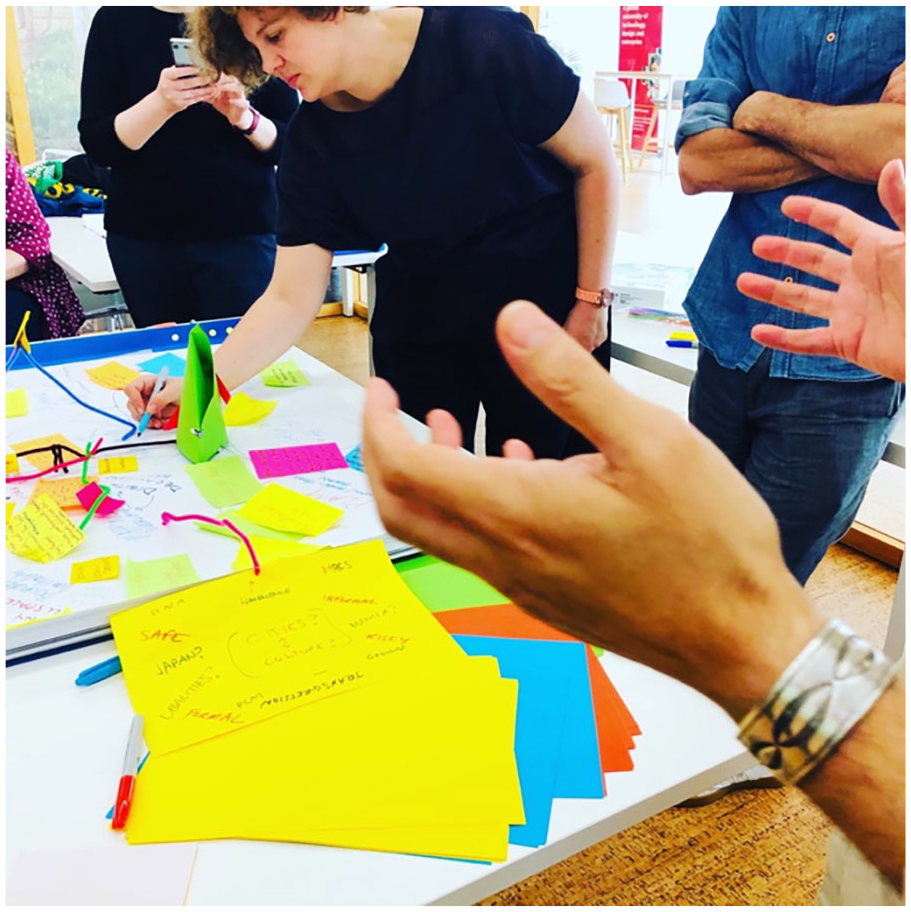
Workshop Codesign. Photo: Hjorth (2018).
The workshop consisted of a variety of exercises and activities that sought to activate participants to think differently about playgrounds in the city. Games for change expert game designer Colleen Macklin provided us with the principles of game design in physical spaces, wayfinding explorations of the Superilla location by Game artist Troy Innocent and Humanities scholar Jill Didur conducted wayfinding exercises in and around the Superillas. We also had a 2040 speculative futures exercise by architect Roger Paez Blanch. Playgrounding and play were initialized in a variety of ways from a critical methodology, a mode of inquiry, a lens for seeing the world. Play scholars such as Sicart have highlighted the power of play as a methodology, epistemology, and ontology (Sicart, 2014). Many of the activities deployed what Gaver et al. (1999) call cultural probes. That is, materials that prompt participants to reflect upon their activities in different ways. Probes can include photos, cards, provocations to name a few. Cultural probes is a technique used to inspire ideas and gather data from people’s lives. For Loi (2009), cultural probes can take various directions—from reflective and primitive to playful triggers.
In the workshop, we were interested in how the invitation of the “city as playground” might address the unevenness and inequalities of moving through the city (Dovey & Wood, 2015; Hjorth & Richardson, 2017c). Pushing against the dominant focus of games and play on younger bodies, we sought to get workshop participants to explore how we might design a game around non-normalized, and especially aging, bodies (Figure 8). We asked a series of questions: How would we design a game in which players are visually or mobility impaired? What would the game look and feel like? How does framing the city as “playful” allow innovative and multisensorial ways to navigate and experience the city? And how does the digital wayfaring of playful cities afford new intergenerational literacies, encounters and ways to codesign urban cartographies? In the workshop, participants designed games that focused on one sense—for example, hearing impairment, visual impairment, mobility restricted.
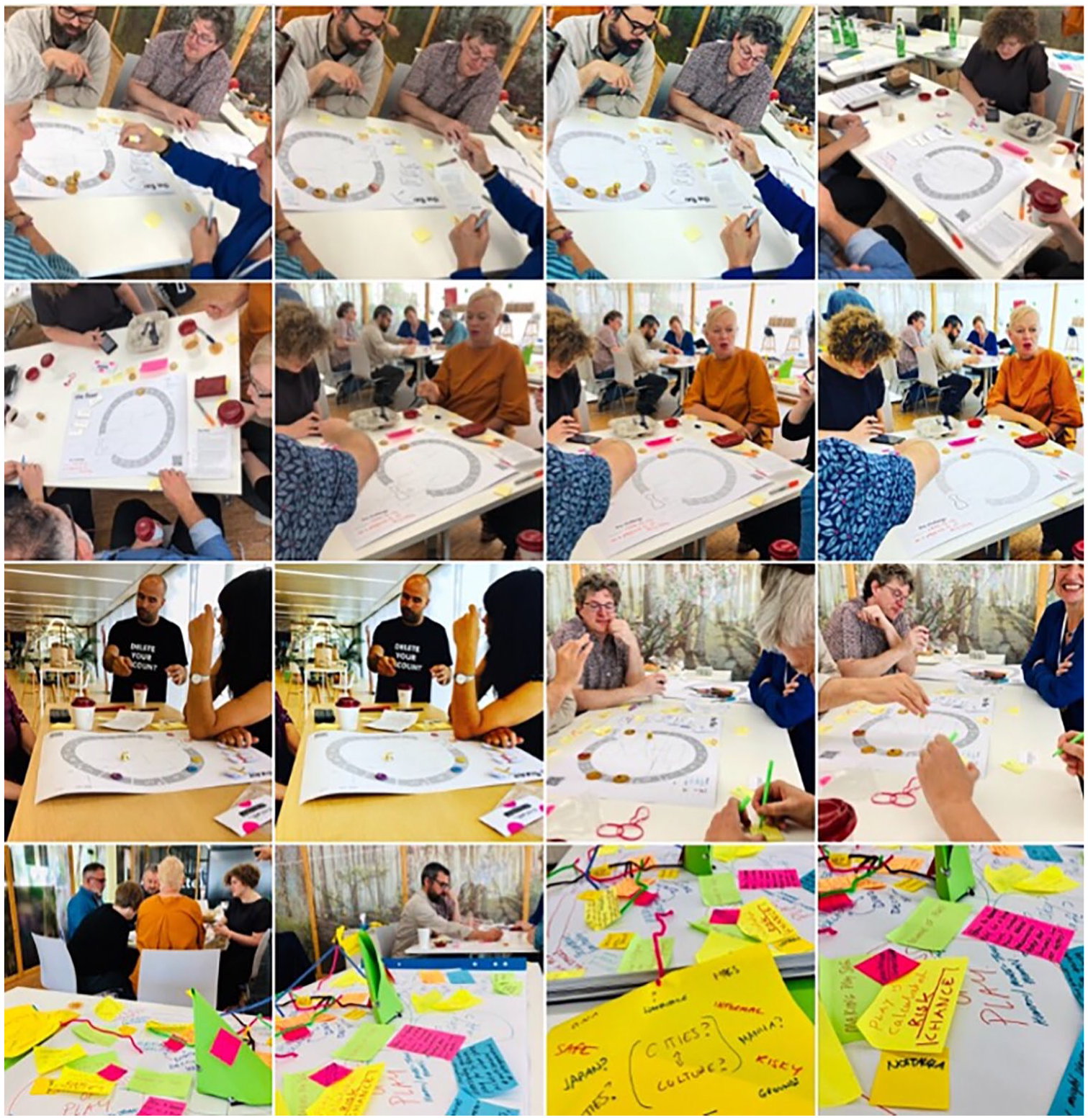
Codesign Games for the Senses. Photo: Hjorth.
Having explored the local area in El Poblenou and how the Superillas had intervened in the local urban environment, we asked workshop participants—all bringing an interdisciplinary expertise to the topic—to think about how the local context would be experienced and moved through by non-normalized bodies—such as the disabled body, the hearing, or visually impaired, the frail body. We asked them to reflect upon one dimension—looking, feeling, hearing and touching for example. We then asked them to design a game that focused on one sense and to design a site-specific game that explored the Superilla sites. The workshop ran for 2 hours. We first outlined ways in which the senses could be reconfigured in the city (McLean, 2017).
Participants made groups of two to five people. They then walked around the Superillas to reflect upon the ways in was currently being used in terms of intergenerational play (Figure 9). One group designed a game around feel. They took paper around and rubbed crayon to make textures. These texture maps were then given as instructions. Players used the texture maps to search the site—looking for objects and surfaces that would feel like the rubs. Winners were the players that identified the rubbings with the current textures.
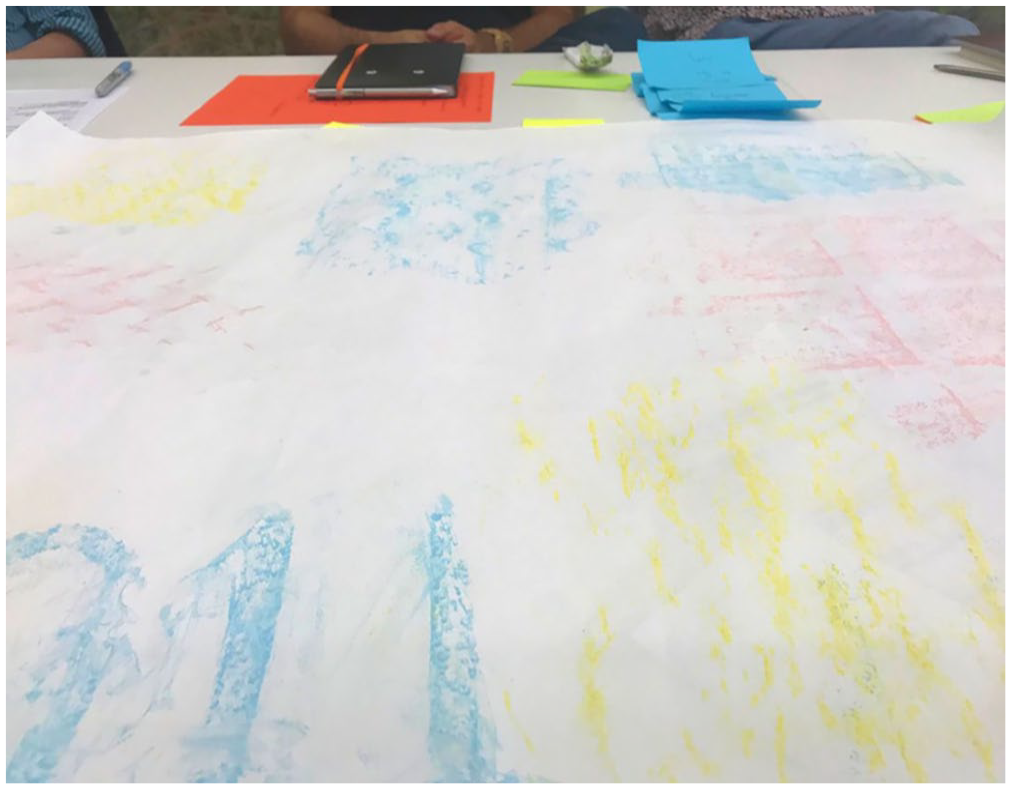
Textures of the Playground as City. Photo: Hjorth (2018).
Another game, entitled “feeling inanimate” (Figure 10) consisted of a series of cards options. One set of cards consisted of gestures such as hugging, kissing and stoking. The other set of cards consisted of inanimate objects. Each player takes a card from each of the sets. For example, “hugging” and “signpost.” The player then has to hug the signpost for one minute. Another example is “kissing” and “rock.” This player has to kiss the rock for one minute. Each player takes it in turn until they can’t do the combination (i.e., like a dare).
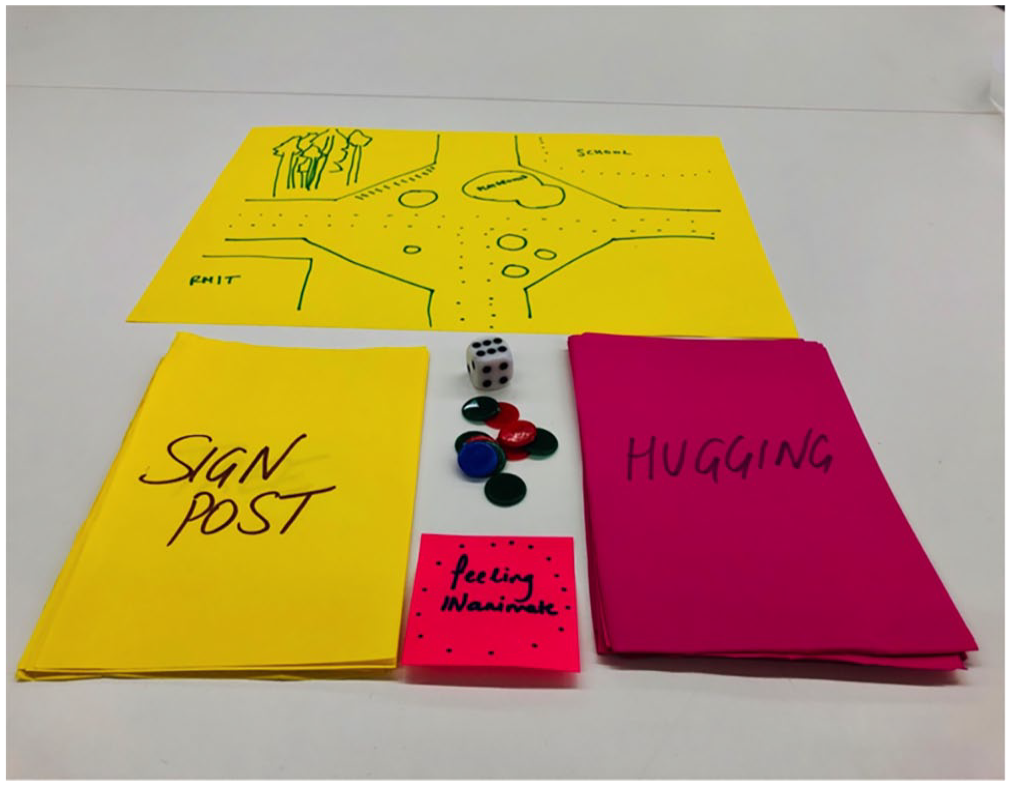
“Feeling Inanimate”. Photo: Hjorth.
Another group blindfolded the players and they had to feel their way from one Superilla to another. Through the various site-specific games, players reflected upon the difficulties and differences in navigating spaces. They considered how designing for non-normalized bodies might allow for new ways of moving and imagining the city (Torrington et al., 2004). The various games demonstrated the ability for sensory games to uncover new possibilities and understandings in the city as playground. What became apparent was the uneven ways in which the local area had been designed in light of non-normalized bodies. More work into the ways in which games can expose the inequalities of bodies through city spaces is needed (Salen Tekinbaş, 2017). Through the games, we can take risks and develop empathy for the complex, multifaceted and multisensorial ways of navigating the city.
In these workshops, we developed playful methods across a variety of registers—as a series of cultural probes, a series of provocations/ invitations and encounters, a critical way of seeing the world (Powell, 2010). Through the process of playgrounding, the groups examined different ways of placemaking in and around the Superillas. The workshops highlighted how play and playgrounding can create a space for us to critically reflect on cities from various perspectives—material, social, and digital.
As we have outlined in this article, using creative techniques like speculative design or living labs can allow for us to reimagine the city in powerful ways. Through focusing on the senses, this workshop sought to invite participants to think about how cities are designed, like playgrounds, around particular types of subjects that reflect particular cultural and social norms. Taking the prompt of the Superilla to rethink the city as a playground could provide us with innovative ways to reimagine the city, especially as populations age (Hjorth & Piera Jimenez, 2019) and the city needs to engage differently with diverse bodies and sensory experiences (McLean, 2017; Parisi, 2009).
Conclusion: Playground as a Method for Reimagining the City
In this article, we have explored the notion of playgrounding as a prompt to rethink how sensory and sensing games can allow for new ways of being in the city. We have provided a history for understanding the playground as a physical expression of societal norms. We then explored how the idea of playgrounding as a process might help us examine multisensorial ways of being in the world, especially for non-normalized bodies. We then turned to workshop conducted around Barcelona’s Superillas which sought to further prompt invitations, encounters and reimagination.
Most playgrounds in cities still adhere to the idea that play is differentiated in time and space from other areas of life (the playground, or playtime), and that it is confined to a limited life-stage (childhood). The traditional urban playground is mostly a curated “surface” on which children navigate and which consists of paths, things, and other actors that are regulated. How this regulation manifests itself varies greatly: In certain cultures, domestic animals such as dogs are not allowed, others only allow children when they are supervised by adults, while, in other instances, such areas are forbidden for grown-ups.
Formed by postwar civic re-invention of the city, current playgrounds are barometers for how play, urban spatiality, and sociality are understood culturally and offer the potential to be platforms to develop creative and alternative scenarios for urban environments. In each different culture, in each different epoch, playgrounds take on diverse ideologies, possibilities and potentialities. Their design speaks of cultural and historical milieu.
Playgrounds are physical manifestations of how we do urban play and civic engagement and are as such in situ places to play with present and future scenarios. The metaphor of the playground or the practice of playgrounding (Dardi, 2022) is fertile ground for talking about, and playing with, intergenerational connection in public space. It can be a way of rethinking urban design which puts people and play at the center (Silver & Clark, 2016). Urban environments form dynamic assemblages of buildings, people and technologies, and as such function as hubs for cultural transformation and experimentation and placemaking.
In this article, we have sought to recalibrate the urban playground as something more fluid, open, and uneven, thus allowing multisensorial experiences that go beyond certain age groups. Play “is brought by people to the complex interrelations (. . .) between things that form daily life” (Sicart, 2014, p. 2) and as such also has the potential to change how such interrelations are produced, translated and traversed. This process can open up new ways to engage with our senses. Engaging with the senses (McLean, 2017) is especially pertinent in urban environments which form complex and dense networks with an overload of sensorial stimuli and experiences (smells, noise, temperature etc.)—prompting us to question about how we can approach urban environments as playgrounds through which we navigate through multisensorial encounters, exchanges, and experiences, creating less normative ways of navigating instead producing the urban as a playful multisensorial assemblage.
As we showed by discussing a series of case studies, through alternative ludic and multisensorial encounters and experimentations we can produce urban playgrounds that are non-normative and that are also inclusive for experiences that may otherwise have less agency, such as using other senses that transform and augment the city for less mobile or visually impaired citizens. Such different ways of engaging with the urban, also through digital placemaking, will both heighten the awareness of how cities have multisensorial affordances, as well as making us more critical and creative in how we can produce urban assemblages. Through navigating such networks in creative and playful ways we can change our engagement with urban spaces and through placemaking produce different sensorial environments that can inscribe themselves in urban cartographies as more than ephemeral moments and create a deeper sense of empathy.
Footnotes
Acknowledgements

Declaration of Conflicting Interests
The author(s) declared no potential conflicts of interest with respect to the research, authorship, and/or publication of this article.
Funding
The author(s) received no financial support for the research, authorship, and/or publication of this article.