



Abstract
The article contributes to understanding of how collective life in post-socialist mass housing is ordered by discussing the ambiguous relations that exist between sound, privacy, and home. It demonstrates how residents of Severnaya Dolina, a large housing estate in St. Petersburg, Russia, experience certain neighborly sounds as nuisances and calls to action to react to and prevent sonic intrusions. Privacy at home is a collective achievement: Residents assemble complex combinations of materials, regulations, relationships, and practices to achieve privacy in their apartments. Analyses of sources, circulation, articulations, evaluations, and contestations of sound in Severnaya Dolina demonstrate how residents, who can hardly rely on the local authorities to create and regulate privacy, employ various sound politics. They define who and what is accountable for sound circulations and evoke various means to create privacy.
Introduction: Sound, Home, and Privacy
Home is critical to discussions of privacy. This concerns definitions of privacy as liberty, “sovereignty within one’s own home” and as dignity (Whitman, 2003, p. 1162), that is, protecting one’s personality, individuality, and intimate acts (Solove, 2002). Homes provide control over space removed from the public realm (Madanipour, 2003) and are often regarded as “crucial and empowering in the construction of individual privacy” (Över, 2013, p. 232; see also Mallett, 2004; Munro & Madigan, 1993). As a “protected sphere of action and responsibility” (Rossler, 2018, p. 6), home constitutes a space of independence from neighbors and state intrusions and provides freedom of action (Després, 1991).
Neighborly life in large housing estates challenges such an understanding of home and privacy. Co-residing strangers living in the estate’s apartments enjoy, contest, hate, or simply disregard their neighbors’ everyday activities: despite renovating apartments, moving furniture, turning on household appliances, walking, or even talking happen in private homes, these activities become “unwelcome presence or interference” (Kasper, 2005, p. 76), that is, sonic intrusions upon the privacy of the others. Sounds circulate and actualize co-presence in a material environment where walls and floors simultaneously separate and unite residents, reinforcing a sense of community or, contrarily, producing social isolation and fragmentation (LaBelle, 2010; Lewis, 2020).
Studying aural dimensions provides a novel entry point into relations between privacy and home. Sounds do not fill space like a container but shape and reconfigure it (Atkinson, 2007; Gallagher, 2011; LaBelle, 2010). While some sounds create feelings of being “at home” and a sense of belonging (Duffy & Waitt, 2013), others (e.g., abject noises) contribute to the instability of home’s boundaries and problematize the privacy of home space (Beere, 2014). Sound circulation makes clear the extent to which home can both keep private what occurs inside and protect from outside intrusions (Beere, 2014). Thus, the privacy of home is an achievement rather than a matter of fact. With this being the case, how do residents manage neighborly sounds so as to make their home spaces private?
Empirically, I turn to how the residents of Severnaya Dolina, a large housing estate in St. Petersburg, Russia, nominate, evaluate, and treat the neighborly sounds. Severnaya Dolina is a typical post-socialist housing estate in Russia with its gigantic size, location on the city’s outskirts, complex property regime, and restricted state control over the territory. This case brings an extra context to the discussion of home, privacy and collectivity, that is, contemporary conceptions of “private” and “the commons” in Russia that emerge from the organization of everyday life in socialist times (Chernysheva & Sezneva, 2020; Kasatkina, 2011) when the state owned, allocated, and controlled housing (including control with neighborly surveillance), challenging the status of home as a space for autonomy (Boym, 1994; Gerasimova, 2002; Harris, 2006; Klepikova, 2015; Reid, 2006).
To approach the sonic life of Severnaya Dolina, I employ the concept of sound politics (Cardoso et al., 2018), closely related to other concepts that depict the intertwining of power and sound: the politics of sound, the politics of noise, and acoustic politics (Attali, 1985; Beere, 2014; Chandola, 2012; LaBelle, 2010; Revill, 2000). These all disclose how sound mediates relations between individuals and the “larger social fabric” (LaBelle, 2010, p. xxi) and suggest various ways to approach sound in pursuing aims or producing social effects. Spatializing auditory experience, the politics of sound, the politics of noise, and acoustic politics frame power relations of sound production, naming, mediation, interpretation, and evaluation.
While these concepts elaborate upon the “cultural life of the senses” (Chandola, 2012), sound politics are methodologically rooted in assemblage thinking. Accordingly, both sound and politics reveal their instabilities and the instability of a shared sonic life: “As a marker of co-presence to the hearing body, sound opens up the politics of shared existence. As a matter of defining and performing the collective, politics opens up the acoustics of human and nonhuman associations” (Cardoso et al., 2018, p. 206). In his study of community noise in São Paulo, Cardoso et al. (2018) analyze controversy around sounds (see also Martín Sainz de los Terreros, 2018). Tracing how “sounds enter (and leave) the sphere of state control” (Cardoso et al., 2018, p. 194), he suggests that the concept of sound politics grasps various regulatory and disciplining mechanisms, practices, devices, and documents that turn sound into multiple versions of noise.
Sound politics contains sensitivity to the ways sound is produced, distributed, and measured, and thus has potential for studying housing estates, where the material environment plays a significant role (Power, 2015). However, while Cardoso et al. (2018) focus on the stabilization of sound as “objective” decibels that quantify sound pressure, I am interested in sound as subjective “nuisance.” Contrary to Cardoso’s locals in São Paulo, Severnaya Dolina residents do not merely complain and mobilize for state intervention, since law enforcement is often strained, they also actively evaluate and regulate sound. In this article, I trace not how the state but neighbors “mediate the conversion of sound into sound politics through a different set of mechanisms” (Cardoso et al., 2018, p. 206) to achieve privacy in their homes.
I followed the sources, circulations, evaluations, and contestations of sound in Severnaya Dolina articulated in 21 interviews with residents 1 and 25 threads concerning neighborly noise posted in an online Severnaya Dolina social media group on https://VK.com (the number of comments in each thread reached 300). Locals administered the online group from which I extracted threads, which is followed by about 40,000 users. The group provides infrastructure to connect, share information, and discuss a wide spectrum of neighborly concerns (Chernysheva & Gizatullina, 2021). Since it is public, that is, open access, I documented noise-relevant discussions as a follower.
In this article, inspired by the scholars who demonstrate that various historical, cultural, and political experiences of home do not fit Western conceptions of privacy (Hareven, 1991; Mahajan, 2009), I elaborate upon socialist and post-socialist conceptions of privacy in relation to home and argue that privacy is a collective effort. I focus upon the ways in which the residents of a large housing estate with poor sound insulation react to and prevent sonic intrusions in the conditions of regulatory vacuum, and how they control what happens inside and outside their homes. I trace how and what neighborly sounds residents experience as nuisances and which call for discussions and action. In this way, I aim to oppose the idea of a united “acoustic community” (Truax, 1984) that shares the interpretation of “noise” and how it should be treated. Based on empirical materials, I elaborate upon the four sound politics of home that emerge in the residents’ efforts to achieve privacy in a place they call “home.” In studying ambiguous relations between sound, privacy, and home in a post-socialist mass housing, I contribute to understanding how collective life in mass housing is ordered and how residents attempt to find ways to deal with the vagaries of neighborly life.
Privacy and Home Under (Post) Socialism
In approaching post-socialist configurations of privacy, I start by creating a backdrop that renders today’s mass housing experience brighter. The precise time to examine is 65 years ago, the beginning of the massive housing campaign, when millions of Soviet citizens who had endured serious housing crises were relocated from dilapidated houses, barracks, overcrowded dormitories, and communal apartments into newly built mass hosing. There was no need to share communal spaces (kitchen, bathroom, and corridor) with several families of non-relatives anymore (see Attwood, 2004; Reid, 2005, 2006). This was the time when the Soviet state and citizens rearranged the privacy of home.
Instead of “public privacy” in communal apartments characterized by “openness of personal life to public scrutiny and location of everyday domestic activities in collectively controlled territory” (Gerasimova, 2002, p. 224; see also Klepikova, 2015), the residents of Khrushchev’s buildings have got privacy as possibility to conceal at home some aspects of life. However, if to define privacy in terms of autonomy from the state, there are diverse understandings of how relations between the state and citizens have changed. While some argue that separate apartments provided greater autonomy for residents (Shlapentokh, 1989), others point that they became a new means of state control (Buchli, 1997; Reid, 2005) or even introduced a state-citizen dialog (Harris, 2006). Looking through the lens of such a dialog, Harris (2006) indicated a new way of articulating privacy in mass housing of 1950s—the one that was closely connected to neighborly sounds. After devaluing of privacy in the 1920s to 1930s for its connection to “bourgeois” individualism (Klepikova, 2015), the socialist state of the 1950s reformulated privacy hygienically, linking it to public health and the collective good. The sound politics the socialist state imposed upon mass housing established specific parameters of privacy in terms of peace and tranquility, and primary conditions for the effective reproduction of labor. The citizens must contribute to collective good by “embrac[ing] a regime of tranquility” (Harris, 2006, p. 182) and caring about their neighbors, reducing mundane sound production.
Despite prominent differences, both versions of socialist privacies (relevant for communal and separated apartments) had a common basis: a collective underpinning. The one was practiced within collective control that was not just neighborly curiosity but policing with political components: communal housing was mobilized by the government to control citizens (Gerasimova, 2002; Reid, 2006). The other was reformulated in terms of collective good and assured by collective efforts for caring of tranquility at home that would provide the neighbors with the conditions conducive to the reproduction of labor. Socialist privacy at home was rather collective enterprise than individualistic, while both contained autonomy as a core element.
After the post-socialist transformation, the officially formulated parameters of privacy as peace and tranquility are still reproduced in official documents. The federal law, on the sanitary-epidemiological well-being of the population, defines what sound (in terms of decibel level) is appropriate for homes. 2 Local legislation in St. Petersburg 3 —referred to subsequently as the Noise Regulations—clarifies what “noise” is in terms of the activities causing it and when it occurs. Noise is determined by the actions that lead to violation of the “peace and quiet of citizens” between 10 p.m. and 8 a.m. on weekdays, and 10 p.m. and 12 p.m. on weekends and holidays. These include “construction works that entailed a violation of the peace and quiet of citizens at night” as well as “screaming, whistling, knocking, moving furniture, singing, playing musical instruments, and other actions.” Noise violations engender a warning to the violator or an administrative fine. 4
While post-socialist regulations in Russia inherited socialist standards and approaches to sound, the conception of privacy at home has changed since the institutional environment that defines relations between the state and citizens has been transformed dramatically. The following sections explore sound politics in Severnaya Dolina, a housing estate in St. Petersburg, Russia, that reveals the character of post-socialist relations between privacy and home.
Severnaya Dolina: A Large Housing Estate Behind the State Control
In the 2010s, post-socialist Russia underwent a new wave of relocation to mass housing. This was once again related to the state’s political agenda, albeit driven by market logic. After the collapse of the Union of Soviet Socialist Republics, post-socialist economic development introduced a real estate market (Golubchikov, 2004; Golubchikov et al., 2014; Makarova, 2010). Supported by the introduction of mortgages for vast numbers of people in early 2000, this market provided residents of Russian cities with the option to move (Zavisca, 2012). State and local governments still allocated social housing but primarily performed controlling functions. At the same time, since the mid-2000s, regional governments have had to follow Federal Performance Indicators and demonstrate a year-by-year increase in housing construction. That is, St. Petersburg’s government encouraged the construction of large housing estates on the city’s periphery (Pachenkov et al., 2020).
Severnaya Dolina is a typical case illustrating this. In 2006, the local government leased a vast parcel of land to Glavstroy-SPb development company for long-term rental (around 50 years). Thus, 670 acres of greenfield became a housing estate inhabited by 80,000 residents. Started in 2009, Severnaya Dolina is still under construction, so those residing there live on territory Glavstroy-SPb still controls. According to the contract signed by Glavstroy-SPb and the city government, the developer is obliged to provide the residents with a well-designed urban environment, including green spots, playgrounds, transportation, and social infrastructure (schools, kindergartens, and hospitals). However, far from all these amenities are available to residents (Pachenkov et al., 2020). While the façade of state policy manifests caring for citizens by raising living standards, the local government minimized its role in regulating construction, allocation, and housing maintenance, providing social benefits, and controlling urban land (Pachenkov et al., 2020).
Consequently, a police station opened only 6 years after the first residents moved into Severnaya Dolina. Thus, until 2016, some 40,000 people had limited access to law enforcement (“Uchastkovyy punkt politsii otkrylsya v Vyborgskom rayone,” 2016). Still, it works only several days a week. This is why the Noise Regulations do not preserve the peace and tranquility of residents of Severnaya Dolina: they often complain about the challenges they face attempting to implement the Noise Regulations.
Mobilizing the Noise Regulations when neighborly sounds exceed established decibel levels at night was challenging in St. Petersburg. Until 2020, the various branches of St. Petersburg’s executive authority could not effectively share responsibility for managing noise regulation issues. Police called by residents to fine neighbors noisy at night did not have the right to issue an offense report, while the institution that did, the City Government’s Committee on the Rule of Law, Order, and Security (CGCRLOS) only responded to calls from 9 a.m. to 6 p.m., Monday to Friday. CGCRLOS employees could come to measure noise levels during their working hours, but this hardly helped protect nighttime peace and tranquility. Consequently, activating the right to quiet, relying only upon the police’s ability to transmit their reports to the CGCRLOS before the statute of limitations expired, was complicated. According to messages in Severnaya Dolina online groups, the police officers, if they came at all, often limited their intervention to asking the noisemakers to stop making noise.
Moreover, similar to why nuisance sounds appeared in socialist housing (Harris, 2006), the demand for noise regulation is high and rooted in the materiality of Severnaya Dolina. The enormous size of the estate’s buildings results from the market logic of profitmaking essential to private development companies: towers reach 29 floors and comprise up to 1,500 apartments. Every apartment is surrounded by 5 to 19 other apartments connected horizontally by a common corridor, with the same number above and below. The development company “Glavstroy-SPb” constructed Severnaya Dolina as affordable housing and tried to make the apartments relatively cheap. The residents therefore believe sound protection was not a concern and low-quality materials were used: “The walls in the building are such that you can only install your own sound insulation or move out” (Elena). As a result, private practices inside apartments travel outside the physical boundaries of walls, ceilings, and floors and invade surrounding private spaces as sounds. Though they are exhausting, these sounds of everyday life evade regulation.
In terms of autonomy from the state, Severnaya Dolina is a perfect domain of privacy, since neither the federal nor the local government has the means to regulate life there or the political will to develop the means to do so. St. Petersburg’s government still formulates privacy in terms of quantifiable peace and tranquility. However, if under Khrushchev’s mass housing campaign in the 1950s, privacy even “reached beyond the home,” extending to rest in city parks and other locations that provide quiet (Harris, 2006, p. 184), nowadays in Severnaya Dolina privacy is related to property rights. Severnaya Dolina’s land, buildings, and apartments are domains of privacy—spaces of neoliberal deregulation. Sounds, the materiality of buildings, and privacy are the concerns of market relations between residents and “Glavstroy-SPb” development company, creating a regulatory vacuum that makes it near-impossible for police, executive staff, and residents to mobilize the Noise Regulations. The problems with regulating neighborly sounds stem from the materiality of buildings and their governance, and how the responsibility for protecting privacy is distributed among authorities. Nuisance sounds circulate all day long and often slip away from regulations—this situation requires the residents themselves to play a central role in rendering their homes “private.”
Disciplining Sounds in the Neighborhood
The lack of regulation calls for the residents of Severnaya Dolina to develop their local sound politics. Various regulatory and disciplining mechanisms and practices that the residents employ define how and in what cases sound can be nominated as “noise” and, correspondingly, consider how sound is produced and distributed. This chapter will demonstrate what the “noise” derives from, how the residents react to it, and how they prevent sounds from becoming “noise,” disciplining it with various practices and materials.
On Severnaya Dolina’s online public page, Maria complains that her neighbors disturb her everyday well-being: “A family living above us turns on a drill almost every day between 12pm and 3pm, when my baby goes to bed. It is impossible to negotiate with them. The lady is abnormal. What should I do? How to write a complaint?.”
5
Unfortunately for Maria, no institution can help her address the problem. However, the act of posting online is not just aimed at obtaining advice, but also at (re)producing the rules and demonstrating that making certain sounds is unacceptable since they disturb one’s neighbors. Ekaterina believes that public discussion contributes to the development of empathy: “I hope at least someone will be thoughtful regarding their neighbors after such posts are published.”
Maria mentions that she began by talking to the troublesome neighbors, to no effect. Her failure does not mean all Severnaya Dolina residents are uncompromising: a friendly conversation is still an effective way to act “po-chelovecheski,” or “in a civilized manner,” to oppose the legal strategies for dealing with conflicts that can destroy neighborly relations (Hendley, 2017). Often, to remain anonymous and preserve neutral relationships, residents stick notes on the doors of those producing annoying sounds. However, these tactics are often challenged. The buildings’ construction makes it difficult to ascertain the source of annoying sounds. Residents seeking quiet cannot locate the disturber. Alisa reports that her neighbor suddenly showed up at her door: “He complained that I move chairs loudly early in the morning. I showed him that I’ve just moved into this apartment, and I have no chairs yet.” The house redistributes sounds and sends them in unexpected directions, making it “come from nowhere.” Privacy entails negotiating not only with neighbors from the apartments a floor above and below oneself but also with the larger collective.
Maria, who wants to protect her baby’s nap, has other options. Her neighbors might suggest reorganizing the materiality of her apartment, through soundproofing. Some people protect their apartments from invasion materially, while others protect their neighbors’ apartments. They consider how their activities at home affect their neighbors and thus reduce the spread of annoying sounds. Interior decorations are evaluated by potential noise impact on neighbors. Being asked about the best flooring, Alexander argues that the material affects the lives of the downstairs neighbors. “Tarkett linoleum is good, I think. You can wash it easily, and you won’t irritate your neighbors with your ‘clattering.’” Linoleum is a neighborly material. Daria adds, “laminate is to [hit] the neighbors’ brains, especially if something falls on it.”
Other neighbors could suggest that Maria use shared building infrastructures to protect her privacy. That is what the neighbors of Vanya, my informant, did. Sitting in Vanya’s apartment, I heard a loud, sharp, prolonged drilling sound that almost drowned out our conversation. Then there was a loud ringing noise from the heating system. Vanya commented: “Yes, this often happens. Someone bangs on the pipes to stop someone else from drilling.” Neighbors use the heating system to respond to noise challenges since it passes through all the floors from bottom to top, creating sound distribution channels. Because of this, the heating system is probably one of the most popular channels for neighborly communications regarding disturbing noises in high-rise residential buildings. Banging on a radiator delivers a loud ringing sound to all one’s neighbors above and below. If someone disturbs them with music or a crying baby, neighbors clarify this by producing another disturbing sound. However, this signal of dissatisfaction is noisy and disturbing. Moreover, it increases the number of residents who are disturbed. Peter implores his neighbors to break the vicious cycle: “It’s time to find this scamp that hits the radiator and our nerves! . . . but DO NOT RESPOND THE PERSON IN THE SAME WAY!.”
Although police, local officials, and legislation are hard to engage in regulating sonic life, they still possess authority. This means residents can use the Noise Regulations as a generalized authority, even mimicking their language. Let us look at Maria’s post again. She believes her baby’s daytime nap must be protected in the same manner nighttime sleep is. Several years ago, a previous version of the Noise Regulations defined “daytime quiet hours.” Although this version is no longer valid and daytime quiet hours are no longer legally valid, residents discuss them, referring to the missing regulation. Children nap in the afternoon and go to bed before the legally defined quiet time so their parents articulate the need to modify the Noise Regulations and to follow alternative rules that exceed the current legal regime.
Some people employ camouflage strategies to legitimate the rules they need. The following announcement was once posted on a building bulletin board: Attention! It is forbidden to do construction from 22:00 to 10:00 and from 14:00 to 17:00. The PENALTY is a fine up to 50,000 rubles!—The Administration
Space turned the document into an agent ordering neighborly life: the housing maintenance company uses the board to provide information. The document pretended to be the conveyor of a regulation, written in the style the authorities use, hiding behind the signature, “The Administration.” It probably worked for some time; however, online forum commentators uncovered the forgery. Denis writes: “Seems a crazy mommy invented a new rule and signed herself as the administration,” receiving 87 likes from his neighbors. Notably, the fake notice does not refer to a particular regulation or authority but relies upon a general notion that there are rules and sanctions.
The above tactics disclose how the absence of an authority to regulate and provide law enforcement to the inhabitants of Severnaya Dolina’s poorly sound-protected apartments engenders various means for organizing sonic life. These include disciplining bodies and household appliances, improving apartments’ material conditions, negotiating, sending signals—personal or anonymous, addressed to individuals or the collective—and attempts to impose general rules. Residents employ different strategies depending on whether a regulation is universal or contextual and who or what is accountable for transforming sounds into “noise.” In the next section, I will demonstrate how these differences shape the sound politics of Severnaya Dolina.
The Right to Quiet or the Right to Sound: Privacy and Sound Politics in Severnaya Dolina
Complaints about violations of order or “bad” behavior (re)produce a specific moral order (Stokoe and Wallwork, 2003). However, in Severnaya Dolina, many sound violation complaints do not generate a shared moral framework or unambiguous opinions of “bad” and “good” neighbors. Instead, they disclose multiple conflicting frameworks creating a politics of sound and efforts to protect privacy.
Following sound in Severnaya Dolina reveals that the neighborhood’s moral framework is not centered only upon people and their actions. The residents also apply their frameworks to (non)human elements. Olga’s story exemplifies this. She once received an anonymous note from her neighbors demanding she calm down her screaming pet bird. Answering them in an online post, Olga emphasizes that she considers the people around her and protects their peace when she is at home. However, while she is outside, this is out of her control: It is not clear how the bird can violate, since after 11 p.m. it and I are asleep. In the afternoon, it is sometimes alone, and it can chirp, I’m sorry. But I don’t know how to ask it not to chirp while I am not at home!!! . . . I do everything possible for my neighbors, but it’s not in my power to keep this bird silent!!!.
Although Olga is not acquainted with her neighbors, she intimates she knows what protects their privacy. In the following discussion, Olga cited that people in her apartment “don’t play music loudly even during the day, don’t do laundry after 9pm, don’t turn on the dishwasher after 9pm, we even pick up the chairs when moving them.” When another neighbor, Alexander, reproaches her for being both an irresponsible pet owner and a bad neighbor, Olga writes: “There is much noise in the apartment building. Should we then keep children asleep all day long, never do any repairs, and move in socks over the laminate? Daytime is for living life!!!.” Alexander replies: “Once again, you keep whatever pet you want, just consider where you live.”
This episode illustrates how accountability for maintaining or violating privacy is distributed. These include the person (the bird’s owner) and their empathy, the bird itself (with the feature of unpredictable chirping), furnishings and flooring materials (which emit sound when people engage with them), household appliances (which probably vibrate while operating), neighbors (those who probably do not want to endure evening-time vibrations), external circumstances (necessity to go for work and leave the bird alone), and the materiality of building (“just consider where you live”). Connecting some elements and ignoring others, Olga and Alexander perform moral assessments that become the basis for conflicting sound politics.
Two general parameters frame sound politics in Severnaya Dolina. The first is a distinction between universal and situational regulation. For those who follow the situational approach, a “good” neighbor is one who focuses on co-presence, sacrifices anonymity, reduces distance between neighbors through face-to-face contacts, and considers their interests and life circumstances. A “bad” neighbor is the one who—mistakenly—assumes that the Noise Regulations accomplish all this work. Irina’s comment illustrates this: “I have neighbors with children. I perfectly understand that there are certain circumstances [in everyday life], and I try to adapt myself [to their children’s sounds].” For those who rely upon the Noise Regulations, there are no other external elements that protect privacy: “This is a huge housing building. You bother someone all day. If you try too hard to accommodate all your neighbors’ interests, your life will become unbearable” (Viktoria). Residents who post fake official notices also seek a universalist approach, albeit to impose an alternate idea of quiet hours.
Sound politics’ second general parameter concerns whether residents should adapt to sound or adapt to quiet. Andrey (A) and Grigory (G) debate this question:
Grigory, the one who produces noise must install soundproofing, isn’t it clear? Or otherwise [they] should not produce noise. And it doesn’t matter whether these are the sounds of laughter or of flushing the toilet.
Andrey, no, it’s not clear. Soundproofing is necessary for those who need quiet. If we are talking about “illegal” noise, that can result in a fine.
Quiet is the only acceptable soundscape for many residents. Alien sounds are deviations that require fixing by apology, adjustment, attention, or even moving out—in other words, extra “neighborly work,” or extra care. Alexander, who criticized the chirping bird, thus transferred responsibility for protecting privacy onto Olga, the bird owner. His privacy depends upon the practices and circumstances associated with his neighbors’ private spaces. If the sounds cannot be disciplined inside the apartment, one should ask the neighbors to allow a violation, as in Julia’s case: The other day, I was surprised by an encounter with the man working in our neighbors’ place. He caught me in the elevator and immediately wondered when it was okay to make noise, and what time my baby sleeps during the day. He is working all day long but does not bother us. It’s great when people respect each other.
However, along with the right to quiet, there is an articulation of the right to produce sound, or the right to act in a private space without consideration for how audible those actions are in other private spaces. “Soon, we will be obliged to go to the surrounding apartments and ask people what time our sex will not bother them,” Julia jokes. The art of neighboring for her is to adapt to the sounds of someone else’s private life rather than try to influence them. Another resident advises: “Teach your child to sleep with noise.” The sounds occurring in an apartment—whatever they are—are an issue for those who consider them noise to manage, not for those who produce the sounds during everyday activities. If people desire quiet, as Angelica did, they should explain this to their neighbors, who take that into consideration while performing everyday activities: “At 7pm I went and asked [my neighbors to be quiet] because my child had fallen ill and was asleep. They didn’t refuse.”
The two intersecting parameters analytically distinguish four sound politics with corresponding means of rendering homes private (see Table 1): Universal VS Situational Regulation and the Right to Sound VS Quiet. Those who believe in universal rules and want to sound refer to the Noise Regulations as the only necessary and sufficient framework that could restrict everyday sonic life. “Noise” in this sense is a sound that goes beyond what Noise Regulations allow. What violates privacy are personal circumstances that become visible through notes with claims, angry online posts, and individual requests to quiet the private life. Others share the idea of universal rules but consider any neighborly sound as violation if only it comes through the walls. They believe, the specifics of large housing estates (demographic and material) call for articulation of local (still universal) rules. What violates these vague rules is “noise,” not just “sound.” The residents who pretended to be an “administration” and posted fake official advertisements seek to speak the language of “universalism” to impose an altering idea of quiet hours. The third sound politics follow the same attitude toward quiet while considering personal circumstances to be unique and significant. Those who impose this sound politics treat carefully household equipment and chairs in their apartments not to disturb neighbors accidentally. If the sounds cannot be disciplined inside the apartment, the person should asks the neighbors to permit violation—for example, to drill from 3 to 4 p.m. on Sunday. “Sound” turns into “noise” if it unexpectedly and unreasonably (for the neighbors) comes out of the apartment’s walls. Finally, the fourth sound politics states that the right to sound is essential in a large housing estate with poor sound insulation; however, circumstances of the residents are unique and may require some quiet. If someone desires quiet, s/he should report this to others who take it into account doing everyday activities. Invasion of sound that goes against a reasonable request for temporal tranquility is a “noise.”
Four Sound Politics in Severnaya Dolina
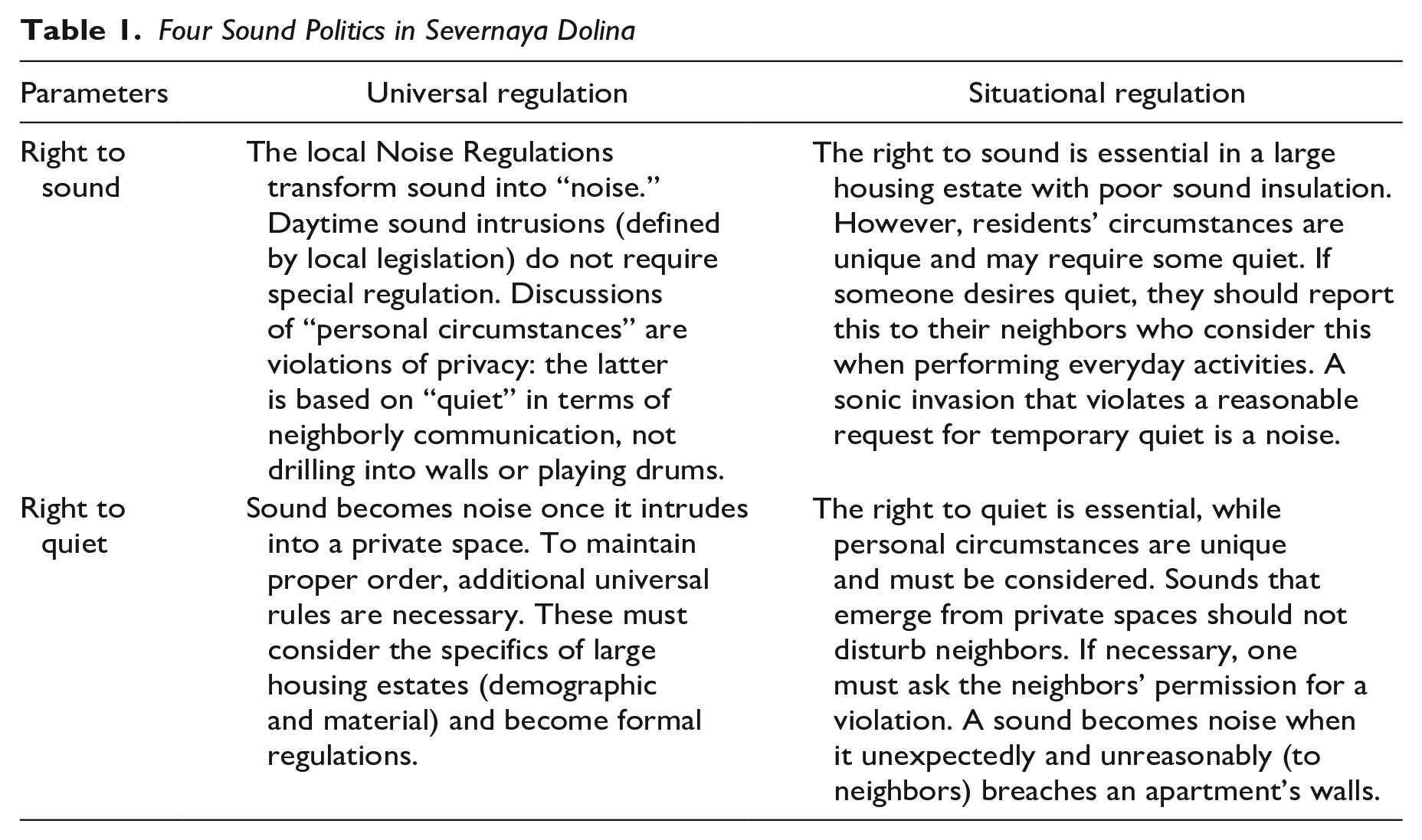
Notably, “good” and “bad” neighbors are not “human” in the full sense of the word: these are not just residents who “keep quiet” or “make noise” but complicated configurations of circumstances, time regimes, objects, materials, and infrastructures in which sound violates boundaries of apartments and causes annoyance. Different sound politics imply different configurations: some bestow greater accountability for privacy violations upon material objects and others, by contrast, upon people and their practices. Accordingly, the means of protecting privacy are not centered upon the person and go beyond the private space of individual apartments.
Conclusion
The case of Severnaya Dolina’s sonic life contributes to the body of knowledge on how collective life in mass housing is ordered and how residents deal with the vagaries of neighborly life. It could become a contribution to a number of important issues such as how cultural traits, social norms, and formal institutions interact with each other in an urban community or how grassroots initiatives substitute dysfunctional regulation, to name a few. However, this paper does not follow these directions and focuses on the elementary level of what could be interpreted as grassroots initiatives, cultural traits, social norms, institutions, or communities. These are nominations and evaluations of mundane affairs and corresponding practices of ordering collective life. Unable to address all the relevant issues, I focused on sound circulations and politics, which reveal the relations between post-socialist privacy and home, both individual and collective affairs.
Privacy is not a word translatable into Russian, but it nonetheless finds expression in practices. Its meanings differ over time and cultures and likewise depend upon various situational configurations. The meaning formulated in the Soviet 1950s is, to some extent, still relevant to residents in Russian post-socialist mass housing. Apart from the plurality of western conceptions that define privacy (while still mentioning its vagueness), Severnaya Dolina’s everyday life articulates privacy as feeling comfortable living in peace and tranquility with no uncontrolled neighborly sound intrusions. In this article, I have traced how privacy at home is achieved in the everyday practices of ordering a neighborhood’s life. I have examined how residents deal with sounds inside and outside their homes—sounds that intrude upon their private space and remind them of the co-presence of other residents.
The problem of neighborly sound invasions into private space that proved so annoying to Leningraders in the 1950s remains relevant to residents of the newly constructed Severnaya Doling housing estate. People move there, leaving student dormitories, overcrowded communal apartments in the city center, and small socialist apartments occupied by their extended families. They seek separation and “housing autonomy” (Zavisca, 2012)—a crucial feature of decent housing in Russia. They create little private worlds within the context of a plurality of other private worlds: in some buildings, there can be up to 1,500 apartments that share the same infrastructure. Seeking weekend rest or decorating personal space, wishing to be left alone or inviting friends for a party, putting children to sleep, turning on household appliances, walking inside their private apartments, cooking, and even leaving their homes for work, residents feel the proximity of neighbors. They often suffer from sounds that are inevitable, considering the co-presence of such large numbers of people.
Residents barely rely upon local government authorities to create and regulate privacy. Housing is no longer a social good; it is commodified and consumed, framed by relations between apartment owners and development companies. Mobilizing the Noise Regulations to protect privacy constitutes a challenge due to the specificity of Severnaya Dolina’s materiality, the local governance regime, and institutional relations within executive power structures. Individual apartment owners suffer from neighbors’ noise, blame the development company for constructing huge apartment buildings using poor sound insulation, and cannot rely upon the law. They fill the regulatory gap by debating who is accountable for the sounds that flow from one apartment to another, how, and when; and who must deal with them, in what ways, and under what circumstances.
Sounds produced by people, animals, household appliances, and repair tools, mediated by materials stuck to walls and floors bind private spaces together, making privacy a matter of collective concern. It is not sufficient to move into a separate apartment and close the door to achieve privacy. Residents must assemble complex combinations of decoration materials, Noise Regulations, acquaintances, relationships, time regimes, and body-disciplining practices. These combinations are situational and unstable.
In Severnaya Dolina, there is no “acoustic community” (Truax, 1984), whose members interpret sonic phenomena equally and share a conception of what constitutes “a violating sound.” Arguments about neighborly noise disclose conflicting ways of evaluating the morality of neighborly sound circulation. Thus, what is the only necessary to know about a neighbor is what moral frameworks s/he relies upon, and what kind of sound politics s/he imposes. These are organized around two crossed parameters (universalism vs. situationism and the rights to quiet vs. sound). They order perceptions and emotions related to sounds and sound production, hearing, and regulating practices.
Sound politics define who and what are accountable for sound circulation. Severnaya Dolina’s material environment and crowded life make accountability complicated. Walls and ceilings, heating infrastructure, exhaust ventilation, and floor coverings contribute to sound circulation along with residents’ everyday practices, operation of household appliances, and the qualities of furniture and other items they use. Different sound politics relate to different configurations of accountability: some people assume that “knowing the secrets of one’s neighbors” (Harris, 2006) is unavoidable in certain material environments. Others believe that residents have to discipline this environment. That is, people and their practices are to be blamed.
Sound politics evoke different ways of creating privacy, which sometimes clash. Following sounds in Severnaya Dolina reveals that, while residents share the same general abstract conception of privacy as outlined above, they create multiple versions of it in practice. These differ according to three parameters: (1) whether a person cares about their own privacy or the privacy of others; (2) whether a neighbor’s personal circumstances should be allowed to limit others’ privacy; and (3) whether formal regulations, local collectively shared rules, or situational empathy earns pride of place in the regulation of privacy.
People create privacies on their own and require their neighbors to contribute. However, few attempts to create rules regarding sound succeed. This is not just because the configurations and circumstances of the production, distribution, and perception of sound are unique in each case. It is not only because the buildings’ designs, floor arrangements, people’s needs, and forms of sound perception vary. However, it is also because setting rules means reducing conceptions of privacy to a single one that must be common and general. This is hardly possible. Post-socialist housing is no longer a Soviet modernist project with universal and stable rhythms of life and forms of consumption and housekeeping. Instead, it includes various lifestyles, inconstancy in daily life, the complexities of negotiations, anonymity, mobility, and a power institution vacuum when it comes to organizing and managing privacy. Current sound politics in Russian mass housing share some of the features of Soviet sound politics, but no one is in charge anymore to ensure people can enjoy a sense of privacy.
Footnotes
Declaration of Conflicting Interests
The author(s) declared no potential conflicts of interest with respect to the research, authorship, and/or publication of this article.
Funding
The author(s) received no financial support for the research, authorship, and/or publication of this article.
