




Abstract
Drawing on ethnographic fieldwork from a public housing area in Copenhagen, this article explores how dwelling, spatiality, materiality, sociality, and the senses interplay and inform different qualities of neighbor relations. Starting from the individual home space and moving to the space of the stair-case shared with other residents who live next door, below, or above, the article argues that neighbor relations constitute a practical embodied experience of the neighborhood. The article describes the condition of dwelling related to home as bestowing a certain embodied dimension to neighborhood relations. Furthermore, the article illustrates near-dwelling, or living near, as one distinctive context for neighbor relations, which involve material and sensorial aspects of neighboring. The article concludes that spatiality and materiality may condition yet not determine the nature of social relations among neighbors.
Introduction
Disparate disciplines have explored relations among neighbors in different ways, emphasizing different intensities of relations between them. Quantitative studies of neighbor relations often presume that trust and strong ties are essential to good neighborhood relations (Hooghe et al., 2009; Lancee & Dronkers, 2011). These studies of neighborhood relations have contributed to an understanding of the complex nature of neighbor relations by illustrating the limitation of such relations as partial, temporary, and externally conditioned and characterized by distanciation and avoidance of conflicts (Birenbaum-Carmeli, 1999; Gullestad, 1992). Furthermore, studies assign neighboring the perspective of being a social practice constituted in a production of space (Shove et al., 2012), primarily consisting of sharing space as neighbors (Amin, 2012). Neighbor relations comprise “neighbouring” as a form of practice constituted in occasional activities, such as a coming together between residents conditioned by chance activities in the neighborhood (Laurie et al., 2002; Noble, 2013). The purpose of this article is to contribute to qualitative research through a perspective on how physical structures and sociality are co-constitutive phenomena in neighboring by exploring the embodied, spatial and material nature of neighbor relations.
Writing about the figure of the neighbor, Painter (2012) defines neighbor relations as basically constituting a co-presence in space rather than a community of interest, thereby stating a significance of space over sociality. He emphasizes that whereas political attention has been on the neighborhood, for example, as a determent for defining its residents, the figure of the neighbor is either under-theorized or framed as a source of trouble. Painter suggests going beyond such moral overtones that surround notions of the neighbor by pointing to research observations that indicate being neighbors is a matter of location and living near as a distinctive context for this relationship (Abrams in Painter, 2012, p. 523). To illustrate this, he emphasizes the etymology of the concept neahgebur, meaning nigh-dweller, and implies notions of dwelling and building/cultivating nearby (Painter, 2012, p. 522), with the bour in neighbor deriving from cultivation and building, thus suggesting both the materiality and spatiality of neighboring.
Dwelling involves embodiment and the body as constituting an integral part of spatiality, embodied space being a physical and biological entity, lived experience, and center for agency (Low, 2003). The body, by making space habitable, is spatial (Simonsen, 2007). Embodied space constitutes different spatial realities depending on the particular place-taking (Richardson, 1982). Moreover, it involves dwelling as a way of being-in-the-world in contexts of homing and housing, and thus the inseparability of home/housing and dwelling/housing (Handel, 2019; McFarlane, 2011). From the perspective of Heidegger, dasein, or being-in-the-world, is an everyday skilful engagement with an environment, including things and human beings, a situation and contingent process of engagement with the environment (Obrador-Pons, 2007). Heidegger’s concept of dwelling is described as a state of being and remaining at peace that exceeds the subject–object dichotomy and is the basic character of human beings. In Ingold’s (1995) interpretation, consciousness is not preceding but emerging from the act of dwelling, embodied coping or engagement with the environment, and human experience is ongoing and happens along our making of environments.
The transgression of subject–object and material–human dimensions is found in notions of dwelling as spatially situated and in a constant and reciprocal relationship with human and nonhuman networks (McFarlane, 2011). Dwelling is an embodied immersion in an environment where all aspects—such as objects, materials, nature, and people—continuously inform the life pattern of one another in a relational process (Biehl, 2020). Being neighbors, that is, near-dwelling, indicates a certain formation in space: a “materiality of neighbouring” (Painter, 2012, p. 530). Material objects may thus actively participate in the making of social relations (Pels, Hethering & Vandenberghe, 2002). Materiality is integral to relations between neighbors, for example, in the ways that the materiality—such as the entrance to the building, hall, stairwell, or other forms of materiality—is the setting of encounters among neighbors. For instance, neighbor relations may occur as nested zones that subdivide the environment around one’s home into sections of distinct spatial, social, and emotional nearness. Micro settings, street blocks, and other zones thus entail different practical uses, sentiments, neighborly interactions and collective representations (Kusenbach, 2008).
These different theoretical and analytical perspectives on neighbor relations deal with the relationship between spatiality and sociality, often with a focus on space as prior to sociality and somehow defining the quality of the emotional nearness or distance among neighbors. However, sociality may not be merely a function of space. The article explores how dwelling, spatiality, materiality, sociality, and the senses interplay and inform different qualities of neighbor relations as they unfold in different zones, such as the home, the staircase, balconies, and between floors. The article thus contributes with a perspective on how spatiality, materiality, and sociality are co-constitutive in neighbor relations. It focuses on how different practices of neighboring relate to different productions of spaces and express different interactions, sentiments, and experiences of neighbor relations.
The article is based on fieldwork conducted in a public housing project called Green Park in Copenhagen. The first section of the article analyses different spatial formations and experiences, conceptions, and spatial practices of neighborhood relations, starting from the individual home space and moving to the staircase and other spaces shared among residents who live next door, below or above. The last section describes material and sensorial aspects of neighboring, such as sounds, smells, and moving objects that transgress physical boundaries.
Researching Neighbor Relationships in Green Park
Green Park is a public housing project constructed in 1966 as a new modern residential area situated in a neighborhood on the southern outskirts of Copenhagen. It has become known and stigmatized for being a vulnerable social housing area at risk of developing into a ghetto. The housing project is situated in a neighborhood with mixed housing, consisting of villas, row houses and low-story buildings and is within reach of shops, collective transportation, wide green areas, and a long beach.
Green Park is arranged in 13 blocks of four stories each (from ground floor to third floor) and is comprised of 470 apartments with balconies facing big open green areas. The apartments vary in size and comprise both large families with children living in three-room or four-room apartments and single people, for example, seniors, who live in one-room or two-room apartments. Green Park has a main path running from the entrance at the main road next to a supermarket and a couple of small shops up to the last block. Residents called this path the “greeting path” (hilse stien), as they often met neighbors on their way in or out of the area. And depending on the character of their relationships, they greet each other with a nod, smile or a “hello,” or stop for a small chat. About a thousand people reside in Green Park, with more than 40% being of migrant descent, mainly from countries such as Turkey, Lebanon, Iraq, Morocco, Pakistan, India, and Somalia. About 50% of the residents have low incomes, and many receive some kind of social benefit. Many residents have lived in Green Park for decades and are quite familiar with their neighbors, including those living in more distant blocks. Green Park is described as a vibrant residential area due to the visibility of residents in the many green common spaces or crossing the area through the criss-crossing paths.
I carried out fieldwork in Green Park in 2010 and 2011 as part of a research project on neighbor relations in multiethnic public housing. 1 The fieldwork involved participant observation, qualitative individual interviews with 34 residents, four focus group interviews, and numerous conversations with different categories of residents aged from 21 to 77. At the beginning of my fieldwork, Green Park was undergoing major reconstruction as part of the urban regeneration plans of the municipality of Copenhagen to change its generally worn appearance and make it attractive to middle-class residents with a higher socio-economic status. The dull white-gray and black house façades were replaced with sparkling white façades with elements of wood and glass, new and larger windows and other fixtures. In this process, the residential area seemed to be torn up at its roots as new fixtures and fittings replaced the old. The residents expressed that they lived under conditions that were very different and even chaotic from their everyday lives. Unfortunately, the renovation meant that Green Park appeared very vacant as it was more or less devoid of any traces of the residents. But, because of the renovation, the residents were used to opening their doors to strangers, such as the local renovation inspector, engineers, building constructors, and architects, thus quickly allowing the researcher into their homes.
At the start of the fieldwork, I was given a workstation in the project office, along with the project leader, urban planners and social workers. In addition, I followed the local renovation inspector, Per, also a resident in Green Park. Per was overseeing the general renovation process and coordinating contact between the residents and the external team of workers carrying out the renovation. His work duties as local renovation inspector involved informing residents about the plans for the rebuilding of their individual homes. He also inspected whether they had made arrangements for the rebuilding, such as giving access to the construction workers by removing furniture from the window spaces. I often joined him on these unplanned home visits, which provided an opportunity to be introduced to the residents of Green Park. Although the researcher was formally introduced as such at an important meeting for the residents, my co-appearance with the inspector and my workstation in the project office often resulted in misunderstandings about my role in Green Park. Many residents primarily saw me as one of the “project people” and would stop me in the neighborhood to ask for information and help, or to complain about the renovation process.
All names of places and people in this article are anonymised. The interviews were recorded and transcribed as part of the organization of the empirical material, which was carefully read and listened to, and analytical themes were created within the premises on the ethnographic fieldwork. The material was later organized and processed in Nvivo.
Home as Dwelling
At the onset of my fieldwork, I accompanied Per on his daily work routines to get acquainted with Green Park and its residents. During my first visits to residents’ homes, I was shocked by the intimacy people displayed. For example, I encountered intimate situations with residents such as a middle-aged woman confiding that she was removing hair from her armpits with a hair removal cream, an elderly couple welcoming us inside their home while the wife was zipping and buttoning her pants having come from the bathroom, and a middle-aged man inviting us inside while only dressed in black underwear. Residents willingly opening their front doors and exposing their nakedness may reveal cultural forms of Danishness, such as exhibiting nudity as something natural and unrestrained. Furthermore, the home visits illustrate the informed complicity and taken-for-grandness that permeate “being at home,” where space and subject blur, and where the home is the place where one is oneself (Bruun & Vacher, 2009). Home is a form of being, a relation, a continuation of the body (Vacher, 2010), and it is as much inside of us as we are inside it (Bachelard, 1958 in Wenzel, 2006, p. 152), thus representing embodied space (Low, 2003). As such, home is a space of intimacy, which implies a certain behavior, such as walking around naked and not caring who might knock on one’s door and enter the home. The empirical examples illustrate the home as a condition and a relation, an extension of the body. Being at home is a fundamental existential relationship to the world (Vacher, 2010). The particular kind of homey behavior illuminates dwelling as a basic character of human beings, a mode of making oneself at-home-in-the world, an embodied engagement in making one’s environment. As the next section describes, the dwelling of home also affects the perception of neighbors.
The Embodiment of Neighbor Relations
As part of my fieldwork, I had prepared a small interview guide to ask the residents open questions about the nature of neighbor relations. Interviews generally took place in residents’ living rooms, often consisting of sofa arrangements facing bookshelves and family pictures, or at the kitchen table overlooking Green Park. When interviewing residents about their neighborhood relationships, I started out with quite general and abstract questions like “How are neighbour relations here in Green Park?” and “How much contact do you have with your neighbors?” However, residents rarely answered such questions, even when I repeatedly tried to make them reflect on them. Instead, they tended to either remain silent or say they did not really have any relationships with their neighbours. Rather than contemplating on the nature of neighbor relations, the residents often accounted for everyday activities that included their neighbors, and thus illustrated neighborhood relations as an outcome of everyday practices. During conversations, residents used nonverbal communication, such as pointing with their fingers, waving with hands and nodding their heads in their neighbors’ directions, indicating their homes or places in Green Park where they meet them.
By using their bodies as indexical markers for social encounters, they illustrated how meanings are created in the practically oriented and relational body (Bille & Simonsen, 2021, p. 6). They thus revealed neighborhood relations as being primarily practical, as an embodied experience of the neighborhood and the neighbors as being extensions of their bodies. When I asked Karen, a 67-year-old woman who had lived in Green Park since its construction in 1966, whether she had any contact with her migrant neighbors, she answered: No. I talk with only a few. There is Siddharta [looks up to her neighbour living in the apartment above]. And then there’s the one I take dance lessons with, Rashmi, who’s living over there [points in the direction of the block in front of hers]. And then there’s one [woman] from Morocco, who is also living over there [points in the direction of the block in front of hers]. I also talk with her. . . about different things when we meet.
Through such references to neighbors, Karen and others illustrated the use of the body as a means of communication and location for speaking and acting in the world (Low & Lawrence-Zúñiga, 2003). This reflects the human being as a body that directs its attention toward things and human beings in the world through sight and movement, and how this bodily relationship contributes to their experiences (Merleau-Ponty, 1962). Karen’s mode of expressing her relationship to her neighbors reveals ways of spatializing relationships through the body, as an extension of the body. In this case, the body is the locus for spatial orientation and perception, creating a mobile spatial and social field. As the body moves around the neighborhood, it meets other bodies of neighbors, constituting mobile spatial fields and creating space as a potentiality for social relations. This example illustrates human beings as spatial beings who are taking place (Low, 2014, p. 35).
I used methods such as qualitative interviews and participant observation for researching neighbor relations. However, these two methods produced very different and almost contrasting results. Residents often reported having no relations with their neighbors when speaking about neighborhood relations and described experiences of differentness, distanciation, and separation. However, my observation of their practices of neighbor relations tended to contradict such statements (Jensen, 2016). In line with other studies on neighbor relations in different settings (Gullestad, 1992; Henning & Lieberg, 1996; Laurie et al., 2002; van Eijk, 2012), I found that residents generally gave little importance to contact with neighbors. However, when asking questions about or observing everyday situations of contact with their neighbors, they revealed multifarious relationships based on routine and unreflected encounters, such as meeting neighbors when out and about in the neighborhood. Neighboring was thus constituted in occasional activities conditioned by chance (see Laurie et al., 2002). The most fundamental forms of interaction were based on contact situations such as acknowledgment, greetings and helping others. People would meet each other when out and about in the neighborhood, that is, on the staircases, on the footpaths, at the laundry rooms, and so on. Forms of neighborhood contact were characterized by the flow of everyday life constituted in practices and places (Pink, 2012). However, when interviewing residents inside their individual homes about neighbor relations, they showed a certain blindness toward such relations because of the practical and embodied qualities of these relations. The absence of the interviewed residents’ reflections on neighborhood relations can be explained by the fact that such relations are constituted in practice and may be more a matter of co-presence in space than a matter of community feeling (Painter, 2012).
The dwelling of home conditions the experiences and ways of talking about neighbor relations. As the next section illustrates, this condition of home as dwelling gives a certain understanding to neighbor relations, recalling the etymology of the neighbor as a nigh-dweller and implying notions of dwelling nearby (Painter, 2012, p. 522).
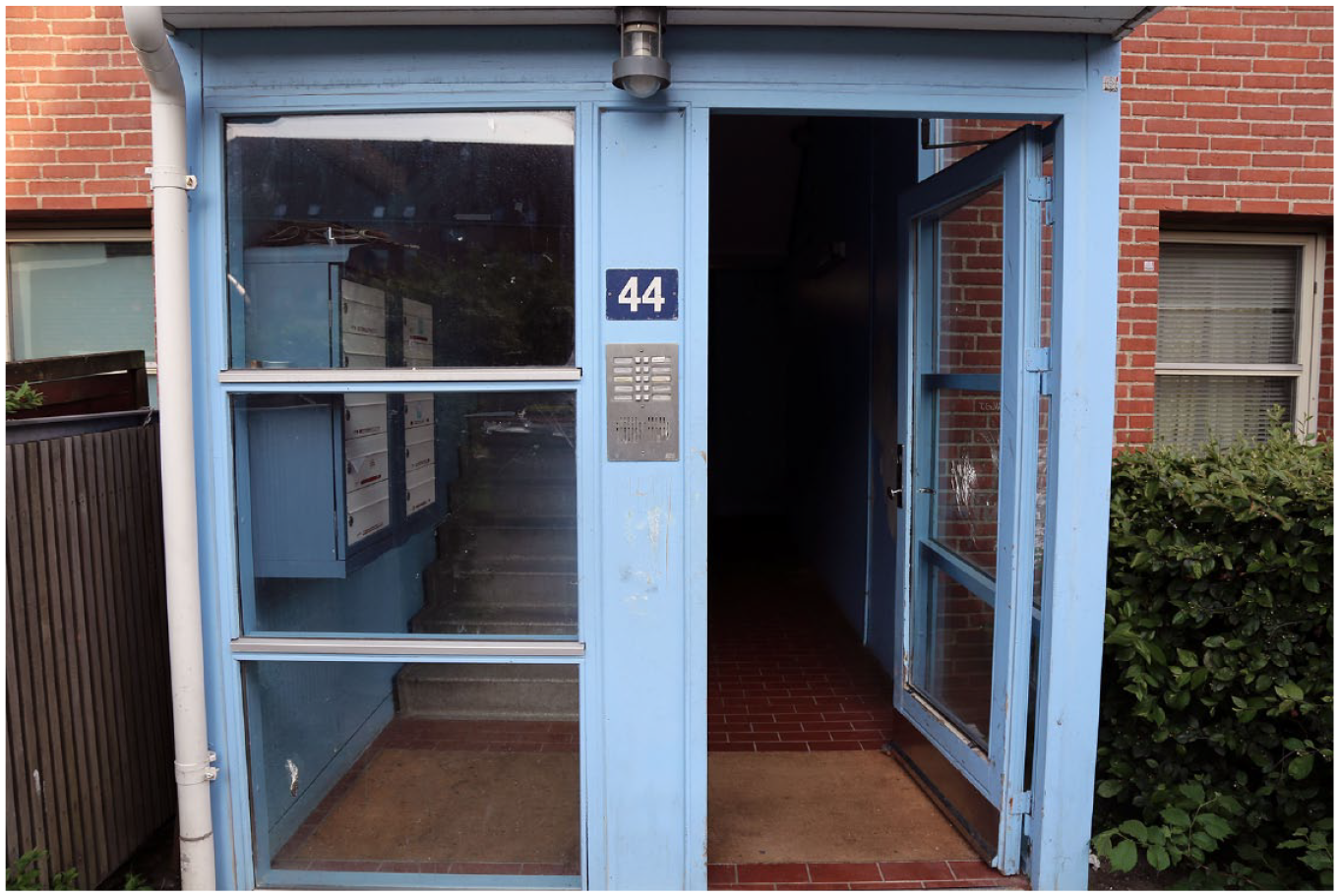
Entrance to a stair-case in Green Park. Photo by Tina Gudrun Jensen
Near-Dwelling: Living Door by Door
Selma is a 50-year-old woman from North African living with her youngest son, who is 15 years old, on the third floor of one of the blocks in Green Park. The block has a yellowish staircase with two red door apartment entrances facing each other on each floor. I had passed by Selma a few times on the main “greeting path” (hilse stien) before spontaneously ringing her doorbell. Selma opened the door dressed in a housecoat and with damp hair. She recognized me but did not know from where and did not ask. However, she invited me inside and sat down in one of her big leather sofas. Then, Selma started talking to me in a very informed and confidential way about the current state of her health, her hair, and the hair treatment that she had just rubbed into her hair a few minutes before. After only about 5 minutes, Selma suddenly inquired, “Who are you by the way?” and then asked where I lived in Green Park, misidentifying me as a neighbor. Selma’s informed behavior characterized the domain of home and illustrated the intersection of home and dwelling as a fundamental existential relationship (Vacher, 2010). This behavior also permeated her first moments of relating to me as a visitor.
Over time, I came to know Selma quite well as she occasionally invited me to visit her home. During these visits, Selma often talked about her next-door neighbor, Kirsten, a woman who, like Selma, was in her early fifties. Selma and Kirsten often visited each other wearing their nightgowns, crossing the three meters of hallway between them on their top floor, where their doors were facing one another. This behavior is similar to other cases of door-to-door behavior described in this volume (Tkach, 2023). They crossed the hallway sometimes several times during the day, for example, to borrow a cup of sugar or other stuff for cooking, to ask for practical help, to chit-chat, to drink coffee together, or to eat together. Their interaction consisted greatly of talking, albeit on visits or meeting on the staircase. Selma and Kirsten had different socio-economic statuses, yet they shared something that resembled a friendship based on reciprocity, trust, loyalty, and feelings of togetherness (Beer, 2001). Selma was an unemployed single mom, while Kirsten worked as a secretary, was married to Niels and had no children. Despite their differences, they shared a bond that went beyond their age and sex. They helped and supported each other in everyday activities and events. Selma and Kirsten had a relationship that was characterized by small and major exchanges. For instance, Selma had confided in Kirsten about a female neighbor who had offended her because of her North African background and about being afraid of a former neighbor, a young drug-user. Moreover, Niels helped Selma with different kinds of paperwork, such as correspondences with the housing association and local authorities. The women had exchanged keys to their respective homes, with Selma looking after Kirsten’s place when away for weekends and holidays in her countryside cottage and Kirsten letting Selma’s son in when he had forgotten his keys. Moreover, both Selma and Kirsten took care of their neighbor, Mrs. Hansen, who was ill for a long time, until she passed away at the age of 89.
Selma’s and Kirsten’s practices of walking to and from each other’s homes in their nightgowns if they needed something, help, company, or just to chat created an extended private sphere between their homes. This extension of the private sphere accommodated both of them and reflected the embodiment of being “at home.” The relation between Selma and Kirsten thus revealed how neighbor relations are expressed as a continuation of the body, as a bodily experience and embeddedness in the home as a place where one is oneself. In that way, the private sphere and the home was extended to include neighbors. Their relations can be seen as an extension of their individual body’s spatial orientations. The proximity of Selma’s and Kirsten’s apartments allowed for a certain privacy in the public space of the stairway. They lived facing each other on the top floor, undisturbed by other neighbors, which allowed for an extension of their respective homes and dwelling. Their nightgown behavior spilled from their private homes over the staircases, thus creating an extended private sphere that connected the two apartments.
As this example illustrates, neighboring is a social practice constituted in a production of space (Shove et al., 2012), which indicates a certain formation in space, or spacing (McFarlane, 2012, p. 651) where private and public, subject and object dissolve into a blur of bodies, staircases and relationships, thereby illustrating a simultaneous materiality and sociality of neighboring. In this particular embodied space, sociality, and spatiality merge, with the top-floor staircase representing a nested zone, a micro setting of mutual visibility of private and semiprivate routines that may induce sentiments of trust and dependency (Kusenbach, 2008, p. 232).
Near-Dwelling: Across Balconies
The case of Selma and Kirsten illustrates how neighbor relations constitute an undivided spacing of physical objects and materials, subjects, and relations. Thus neighbor relations are both spatial, physical, material, and social. During the fieldwork, the social life of balconies also caught my attention. Sharing a row of balconies led to some interaction across the balconies. When interviewing Gustav, a 67-year-old retired electrician, and Cenk, a 38-year-old IT specialist, who both lived on the top floor in separate but adjacent staircases, they both referred to their respective balconies. Gustav was married and had an adult daughter living in the neighborhood with her husband and their small son, who often stayed over with Gustav and his wife. Cenk was married with three young children. Gustav and Cenk’s contact began as a co-presence on their respective balconies. The balconies had a semipublic character due to their placement along the façade of the building and openness to the big green yard. The balconies were connected yet divided by a wall partially constituting a glass façade between the apartments, which facilitated the sight and sound of activities on adjacent balconies. Many residents covered the glass façades by gluing or hanging paper, posters, and other items to cover the sight and sound of adjacent balconies, thus creating physical and symbolic fences that illustrated inaccessibility (Gullestad, 1986) and distanciation to neighbors. However, this was not the case of Gustav and Cenk, who had developed a kind of relationship across their balconies. Gustav often played board games with his grandson on his balcony, which Cenk witnessed one summer evening. This joyful pastime led Cenk to initiate contact with them, and he offered and served them some of his homemade pizza across the balconies. This was the beginning of their many conversations on their balconies.
However, Gustav and Genk’s relationship went beyond the balconies. They would climb the stairs and knock on each other’s doors when in need of help with practical stuff, such as scraping snow of their cars, and they often stopped for a chat when meeting each other in front of their respective hallways. The case of Gustav and Cenk illustrates both visual and aural contact emerging from the physical conditions forming certain spatial arrangements that place neighbors in situations of contact (Laurier et al., 2002). In this case, two connected balconies imply that individuals see, hear, and, thereby, get to know one another.
The contact between Gustav and Cenk started as a co-presence on their respective balconies, which constituted smooth transitions between private and public spaces. Their balconies had glass facades that allowed them to see into each other’s private homes. Despite the option to seal off contact between their balconies or to ignore each other, the physical reality of the balcony vertically connecting their homes led to their engagement. However, their relationship cannot be seen as merely a function of space. Despite their age differences, Gustav and Cenk shared certain similarities. They both appeared to be quiet guys dedicated to their families and homes. During my fieldwork, I repeatedly observed other similar relationships among residents that somehow grew out of their immersion in the physical and material environment. Neighbor relations were often rooted in ways that the physical environment conditioned neighbors to relate to one another. Outdoor places, common rooms, windows, balconies, and living next-door constituted informal contact situations where residents bumped into each other. Residents’ practices of dwelling were not restricted to their homes but extended to the entire residential area and often involved the co-presence of neighbors. The outdoor areas entailed several sitting and standing opportunities, with residents leaning against the block walls, sitting on benches and hanging around on other physical objects such as playground equipment and decorative monuments. As described by Tuominen (2024) in this volume, Green Park also entailed various forms of transitions between private and public spaces such as borders between private apartments and common areas, which cause the boundaries between private homes and the residential area to blur. Meetings in the residential area, the laundry, shared staircases, or balconies constituted “buffer zones” between private and public spaces, where the private spilled into the public and vice versa.
The different examples illustrate the interaction between physical and material environment and social relationships. Neighbor relations illustrate the simultaneity of space and social relations. The following section explores the interaction between material and human entities in sensorial experiences of neighbor relations.
Atmospheric Disturbances
Activities in Green Park were usually manifested through sounds, smells, and moving substances. These manifestations appeared to transgress their own physical boundaries and enter certain places in private homes, where the residents sensed these manifestations as having a life of their own. Such conditions of emotional spatiality constitute an affective space, where people are emotionally in touch through their openness to the world and its capacity to affect them, thus illustrating how expressive and affective spaces involve practices of active, living bodies intertwining with their social and material environment (Bille & Simonsen, 2021, p. 7). Daily sensorial phenomena of objects radiating into the environment thus constitutes atmosphere, a co-presence of subject and object constituted by a reality of the perceived as a sphere of its presence and the reality of a perceiver who is bodily present in a certain way (Böhme, 1993, p. 122).
Emanations such as sounds and smells affected the relationship between neighbors in different ways. Specifically, the residents talked about smells from their neighbors’ cooking. Some liked the smells, others did not. Those who did not like the smells would complain that their neighbors did not close their windows while cooking. They would then demonstratively close their own windows as a statement of intolerance toward their neighbors’ cooking. The disagreement about smells from their neighbors’ cooking thus revolved around their own opportunities to act on these external smells by either closing or opening windows to let smells in or out.
As also described in the contributions by Chernysheva (2023) and Tkach (2023) in this volume, emanations such as sounds were also important issues among the residents of Green Park. The residents particularly referred to sounds of other neighbors and their ways of living, which they experienced as noise. These sounds communicated the residents’ lives and behaviors in adjacent apartments, on the staircase and outside the blocks. The noises involved people who talked or yelled at one another, played loud music, had loud sex, and children who shouted out loud and jumped on the floor. Most of the noises alluded to by the residents came from other neighbors who talked loudly or yelled.
Selma disclosed she often heard the rows of her Iraqi neighbors living on her top floor level at the adjacent staircase. Because Arabic is also Selma’s native tongue, she could understand not only what they were saying but also what they quarreling about. Being involuntarily involved in their problems was not something she was comfortable with, and a consequence was that they were unfriendly to her upon meeting in the complex. This situation seemed to cause a sensation of reciprocal invasion among the neighbors.
Other emanations of sounds affected neighbor relations in more subtle ways. Riya, a 50-year-old woman who had lived in Green Park since leaving India at the age of 21, was now living alone in her apartment after her husband’s death and her children moving out. During an interview, she related that her apartment was very “noisy” (lydt). She could hear her upstairs neighbor urinating in the toilet while sitting on her sofa in the living room. Such sounds, among others, can affect neighbor relations in more subtle ways. “It’s like I’m being peed on my head,” she exclaimed, thus indicating how the experience induced feelings of humiliation. For many years, she had had a tense relationship with her neighbors, a married couple from Pakistan, who were around her age. Their conflict was intertwined with the conflict between their respective countries. Moreover, she revealed that her neighbors had a habit of throwing out garbage in the garbage shaft of the staircase late at night when she had already gone to bed. One wall of her bedroom was adjacent to the staircase space and the garbage shaft. Thus the sound of garbage being thrown by her upstairs neighbors would wake her up. During our conversations, she wondered whether her neighbors did this on purpose or simply did not consider that throwing out garbage late at night would disturb others. The experience of noise and nuisance from neighbors is often linked to morality because it can create a feeling of a lack of consideration and respect from neighbors. Noise is thus a relational phenomenon depending on one’s relationship to the person who produces the sound: if one knows or identifies oneself with one’s neighbors, one is less likely to experience their sounds as nuisance (Petersen, 2020, p. 15).
More serious events in the history of Green Park were, for example, water leaks that caused damage in neighboring apartments. Riya had a bad relationship with her neighbors living in the apartment above her after they detected water damage in their bathroom some years ago. She believed that her complaint to the housing administration about the damage had initiated a conflict and that her neighbors might have felt insulted by her complaint, as they had not visited her since. Riya’s experience shows how relations to her upstairs neighbors materialized as an assemblage of material and human networks (McFarlane, 2011, p. 651). In addition, Riya complained to me about her upstairs neighbors throwing tufts of hair and cigarette butts out of their window, which would fly down and land on her floor or bed through the open window of her bedroom. She felt insulted and humiliated by this act, which she saw as another example of their lack of consideration and respect for her. In a similar manner, Selma complained about her neighbors, the married couple from Iraq, who had placed a fruit bowl on their kitchen table beside the window, which she thought would attract flies and infest her apartment as well. Her annoyance and accusation were reinforced by the tense relationship she already had with them. Similarly, Riya’s experience of flies, cigarette butts, and tufts of hair from her neighbors aroused feelings of hostility, invasion, and attacks, which were interpreted as motivators of harm. In both cases, material objects were experienced as the main driver in shaping animosity in the social relation between the neighbors.
Living close together in a block entails small everyday events that illustrate the porous and pervasive boundaries in the form of doors, windows, walls, ceilings, and floors. These boundaries can arouse sensations of humiliation, invasion, and hostility, as they are constantly being crossed by neighbors. Atmospheric phenomena such as sounds, smells, fluids, and moving substances between neighboring apartments unfold as the relation between neighbors in “atmospheric practices” (Bille & Simonsen, 2021, p. 2). Neighbors experience substances such as urine, hair, and cigarette butts as having an agency of their own, thus illustrating the ways in which material objects, effects, the senses, and social relations are interrelated.
Conclusion: Different Typologies of Spatial Realities Related to Neighboring
This article aims to contribute to the research field of neighboring by exploring neighbor relations as a matter of spacing that exceeds the subject-object and material-human divides. It highlights the co-constitutive phenomena of physical structures, materiality, the senses, and sociality in neighboring. Embodiment and dwelling, as everyday skilful engagements with the environment, including human beings and things, are essential conditions for neighbor relations. The article describes near-dwelling and notions of dwelling related to home as a way of being, a relation, a bodily relationship, a continuation of the body. It argues that these notions condition the ways that residents express their relationships to their neighbors, revealing such relations as a practical embodied experience of the neighborhood and the neighbor as an extension of their bodies.
The different examples of home and dwelling, dwelling near and senses at stake in neighbor relations reflect different dimensions and intensities of neighboring that constitute different bodily representations and spatial realities. At the outset, the home constitutes a personal space of dwelling, where home and person merge, which is a condition for perceiving and expressing neighbor relations. Residents use their bodies as a means of communication and location for speaking and acting when talking about their neighbors, thereby revealing neighbor relations as a practical embodied experience of the neighborhood and their neighbors as being extensions of their bodies. Such embodied extensions also characterize the relationship to next-door neighbors, comprising vertical spacings across or between staircases. This illustrates neighbor relations as spatial, physical, and social, thus highlighting the importance of physical proximity in neighboring. The cases of staircases and balconies reflect another mode of neighboring, where embodied immersions spill from private homes over semipublic spaces to constitute particular formations in space. This hybridity of people, physical structures and material objects constitutes social relations between neighbors, thus highlighting the importance of semi-public spaces in neighboring. Other material and sensorial aspects—such as sounds, smells and moving objects—that transgress physical boundaries and are experienced as having a life on their own illustrate the way that materiality and social relationships influence one another. The different examples of sensorial aspects of neighboring highlight how homes are penetrated from outside and arouse negative sensations of involuntary awareness of others’ private lives, of mutual invasion and of personal attacks in a neighbor war.
These examples show that neighbor relations are not merely an effect of but interplay with spatiality and materiality and sociality in various ways. In Green Park, the spatiality of neighbor relations of the top floor and adjacent balconies may occur as particularly nested zones that subdivide the environment around one’s home into sections of distinct spatial, social, and emotional nearness and entail different practical uses, sentiments and neighborly interactions (Kusenbach, 2008). However, similar zones or spatialities may result in various forms of sociality, and neighbors may choose to avoid contact by covering glass façades between apartments, while others initiate contact. This suggests that relationships may not be reduced to a function of space but are also a function of personality. The examples of Gustav and Cenk, and of Selma and Kirsten, showed that despite their differences, they shared important similarities, such as gender, family life, work life, age, and personality. Such similarities often produce sentiments of identification, which are a foundation of friendships (Bell & Coleman, 2020). In addition, friendly relations among neighbors may exist in very different spaces, while tensions between neighbors produced by atmospheric disturbances between apartments may thrive well without any physical contact. However, the experience of atmospheric manifestations are relational phenomena that depend on one’s relationship to the person who produces them (Petersen, 2020).
Consequently, spatiality and materiality may condition but not determine the nature of social relations. Whereas material and spatial conditions alone may produce negative sentiments among neighbors, positive sentiments, and relationships among neighbors are very likely conditioned by the stuff that makes friendships, such as sentiments of identifications. Everyday civil relations among neighbors, such as holding doors and other informal forms of contact, are often neutral and consist of sharing space. Living together as neighbors, first, and foremost, constitutes a form of co-presence without strong expectations of mutual empathy (Amin, 2012, p. 75).
Finally, Green Park constitutes a type of housing with a certain spatiality of residents living near each other, illustrating the etymology of the neighbor as living near (Abrams in Painter, 2012, p. 523). Such spatial relations may be very different in other types of housing, such as privately owned detached homes.
Footnotes
Declaration of Conflicting Interests
The author(s) declared no potential conflicts of interest with respect to the research, authorship, and/or publication of this article.
Funding
The author(s) received no financial support for the research, authorship, and/or publication of this article.
