




Abstract
With the rise of pervasive games in the last two decades, peaking with Pokémon GO, questions surrounding the perceptions, use, and ownership of public space have rapidly emerged. Beyond commercial and public uses of city spaces, how are such experiences attentive to local, regional, cross-cultural, ancient, and persistent notions of place? How can locative and pervasive experiences respond to local and Indigenous understandings of place? Perhaps most decisively, what is the compatibility of ancient and Indigenous stories of sustainability set within rapidly obsolete frameworks of the latest mobile devices? In considering these questions, this article reviews the current literature on Indigenous pervasive games and discusses an augmented reality audio-game that features Australian First Nations’ stories of land, river, and sky. Players of the game are transformed into wayfarers as they move across the landscape to uncover alternate and pre-settlement cartographies bringing new insights to familiar territory.
Keywords
Introduction
Pervasive games are digitally enabled experiences embedded in physical locations. Well-known pervasive games include Ingress and Pokémon GO. Through the act of play, these experiences can shape impressions of place and offer players opportunities to reflect on the often-contested spaces they traverse. This article reflects on the development and delivery of the TIMeR project in Melbourne, Australia, a pervasive game audio tour that invites cross-cultural attention to Boon Wurrung history, present and future (Briggs et al., 2019). Boon Wurrung are one of the five First Nations groups that constitute the Kulin Nations of Victoria. The other groups are the Woiwurrung, Dja Dja Wurrung, Taungurung, and Wathaurung. For thousands of years, Boon Wurrung people have walked land that is now the greater city of Melbourne (including the wider double bay and peninsula) or Naarm.
Prior to colonization, there were approximately 39 language groups in Victoria, and the language boundaries between groups were indistinct. Through mutually recognizable markers in the landscape, groups retained defined and shared understandings of space and place. Since invasion and colonial settlement, the vestiges of these complex systems have been mostly overrun by buildings and roads. 1 Key waterways and river systems have been diverted to shape the contemporary city of Melbourne that overlays Naarm (Clark & Heydon, 2004). These forces of colonial dispossession have deeply affected First Nations notions not only of place but also of knowledge. Indigenous knowledge encompasses theoretical frameworks, ontologies, and cultural expressions or—ways of knowing, being and doing that continue to be intrinsic to Aboriginal and Torres Strait Islander lifeways and historical transformations over millennia (K. Martin & Mirraboopa, 2003; Russell, 2005).
Of the numerous pervasive, locative, and hybrid reality games that have occurred in Australia, only a small handful have drawn attention to traditional or Indigenous knowledge and notions of place. This reflects a broader tendency in digital games culture that has favored Western narratives, experiences, understandings, and representations of space. Previous scholarship has explored the disappearance of non-White bodies, stories, and histories in digital games (Disalvo et al., 2008; Kafai et al., 2010) while Mukherjee (2016) and P. Martin (2018), respectively, have considered the ways in which games construct notions of spatiality, political systems, ethics, and society that are often deeply imbued with colonial leanings.
RMIT University acknowledges the people of the Woi wurrung and Boon Wurrung language groups of the eastern Kulin Nation on whose unceded lands the business of the university is conducted. As residents on unceded territory, our collaboration aimed to provoke dialogue on place-relations and cross-cultural connections across differences from students to educators, from academia to industry, from migrants to settlers. TIMeR is the first in a series of playful projects developed by a team of researchers at RMIT, that seeks to explore stories of place from multiple positions grounded in Indigenous knowledge. TIMeR approaches these concerns through the medium of pervasive games. Scholarly investigations into Hybrid Reality Games by de Souza e Silva and Delacruz (2006) have observed how mobility, location awareness, collaboration, and sociability in games can contribute to discovery and learning while Wood (2012) has shown how play can create and transform a player’s understanding of space. Pervasive games that are attentive to existing and under-represented notions of place, we argue, provide the opportunity to reimagine familiar spaces with awareness of Indigenous understandings of place.
TIMeR Pervasive Game
Presented at RMIT in 2019, the augmented reality (AR) audio-game TIMeR (2019) explores the multiple, multisensorial and contested modes of making place. Featuring stories of land, river, and sky with Boon Wurrung Elder N’Arweet Carolyn Briggs, players of TIMeR are transformed into wayfarers as they move across the university campus to uncover alternate cartographies bringing new insights to familiar routes. TIMeR was created to invite cross-cultural awareness of First Nations place and knowledge systems both for its players and for the development team behind its creation. Hugh Davies is an Australian-born game maker and researcher of British ancestry living on Dja Dja Wurrung Country. Olivia Guntarik is a non-Indigenous Australian migrant and First Nations woman from Borneo in southeast Asia living on Boon Wurrung Country. Troy Innocent is an Australian-born urban play scholar and artist gamemaker of British ancestry living on Boon Wurrung Country. Developed with collaboration from Elders in Residence at RMIT’s Ngarara Willim Centre, the TIMeR project considers how traditional and alternate knowledges of space can be communicated through pervasive games, and how space itself can be understood as a platform carrying media.
As creators of the TIMeR app, we bring experience in pervasive and locative design with attention to understandings of place. Olivia Guntarik has co-designed and curated place-based cultural walking trails with Traditional Custodians, using mobile apps as self-guided digital tour guides, and as a way to commemorate sites of historical significance. Guntarik’s cultural apps draw on developments in games technology, as well as augmented and virtual reality applications and digital storytelling (Guntarik, 2018; Ridgeway & Guntarik, 2017). Hugh Davies has designed, developed, and delivered pervasive and locative games globally, while as a researcher, he has traced deep histories of Pokémon GO in Japanese Shinto religion and traditions of seasonal play (Davies, 2021). Troy Innocent has developed a number of mixed reality projects that combine digital design, art practice, and location-based gaming to create digital layers over physical city space and has previously engaged in Indigenous-informed game design (Conway et al., 2020). Wayfinder Live is a series of geometric abstractions found across the city, featuring scannable digital codes that become activated or recoded when viewed through a smartphone (Leorke, 2019). Through the digital interface, players are drawn into a digital layer where Innocent’s sculptures extend and transform reality itself (Davies & Innocent, 2017). Through our combined experience in pervasive games, we argue that these experiences hold the potential to fundamentally alter understandings of place.
By situating games within the phenomenological, material experience of place, urban play (Innocent, 2020) creates situations and encounters with a broader range of understandings of spatiality. Mobile play is speculative and imaginative, ambiguous and open-ended—creating a space of possible experiences and understandings for the player rather than facilitating a particular transaction or function, such as a digital mapping service delivering a person to a specific location with little attention paid to the journey, for example. TIMeR situates knowledge and stories in relation to walking, sitting, exploring, looking, and other modes of spatial engagement with the urban environment of the RMIT city campus. In doing so, the game also asks players to reflect upon their own relationship to place, inviting participants to “walk with purpose” rather than simply to reach a destination or endpoint.
The app is experienced on a smartphone and headphones—important for immersion in deep listening—that are provided by the player, often in a self-guided mode of engagement (Figure 1). It was developed using Unity 3D, a freely accessible and commonly used game development tool that operates equally in the languages of app design and digital games. As a prototype, the design is experimental and brings together audiowalks, AR, and a “choose-your-own-adventure” approach to branching spatial narratives (Figure 2). The approach to development was iterative; this tool allowed for new content to be included and experienced by the collaborators through rapid prototyping, inviting feedback and reflection. Our goal was to create an experience that placed players in a mode of imaginative, open-minded reflection on space and place through play (Figure 3).
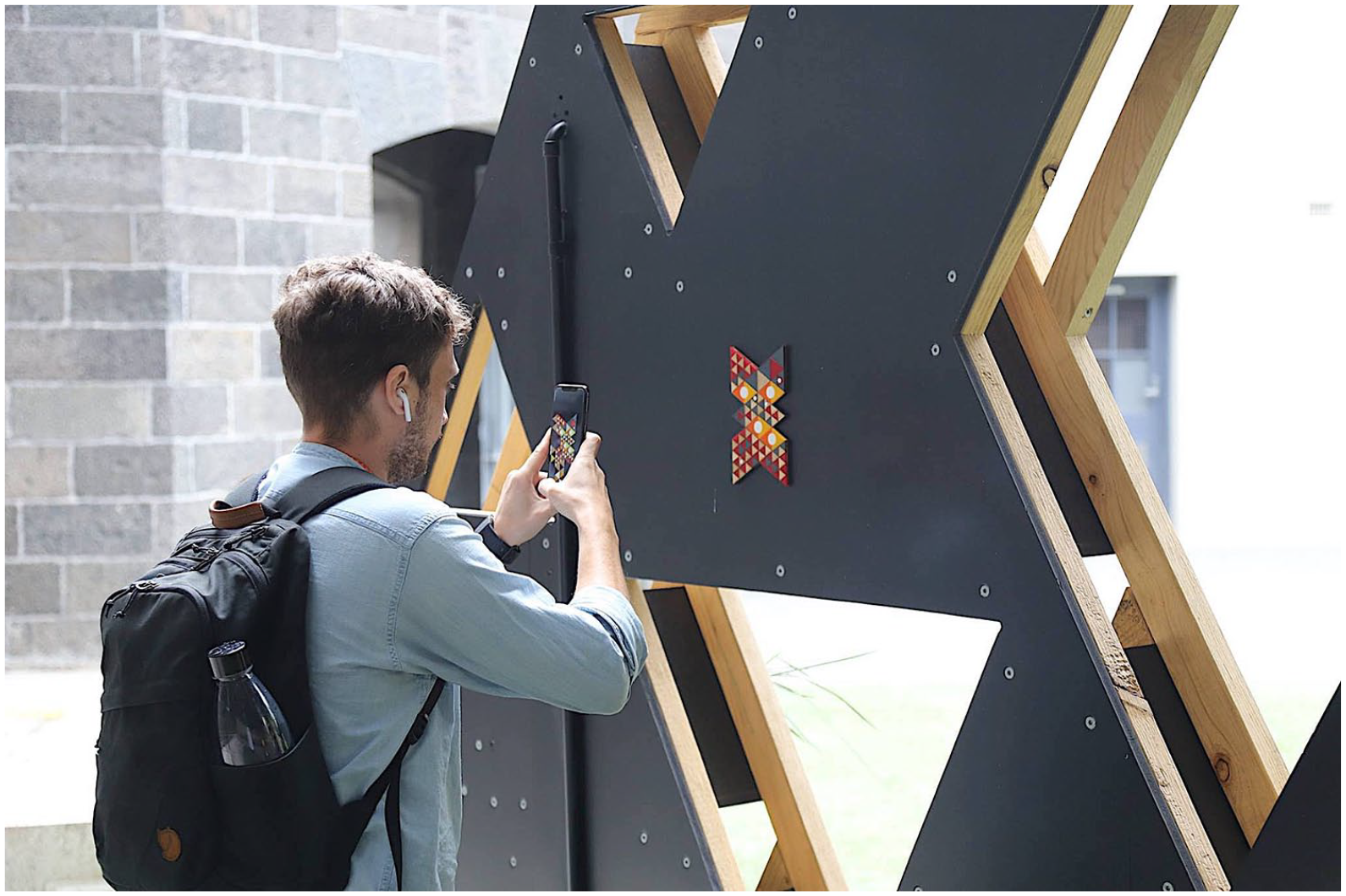
TIMeR Participant Scanning Code and Listening Through Earphones.
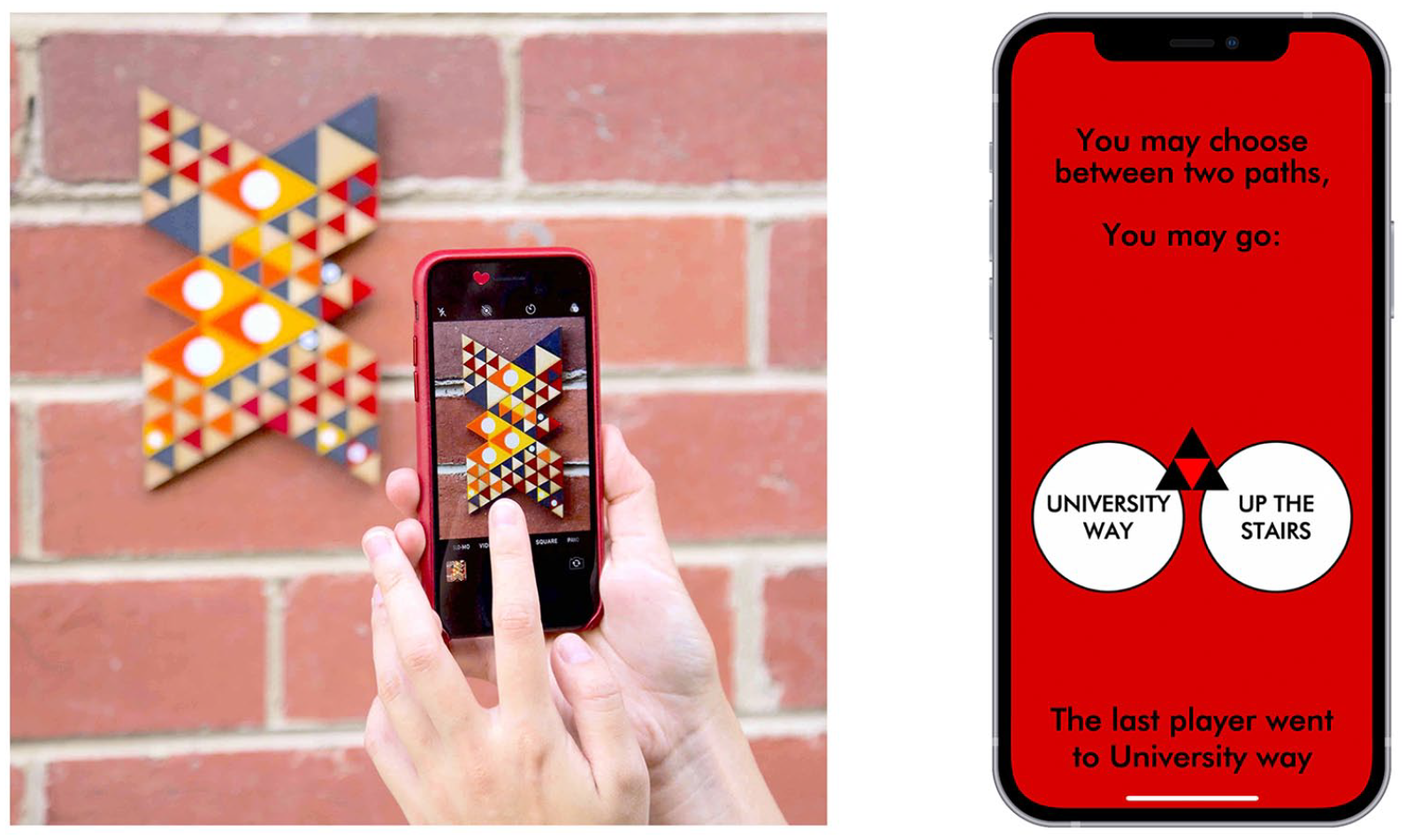
TIMeR Participant Reaching a Point in the Branching Journey.
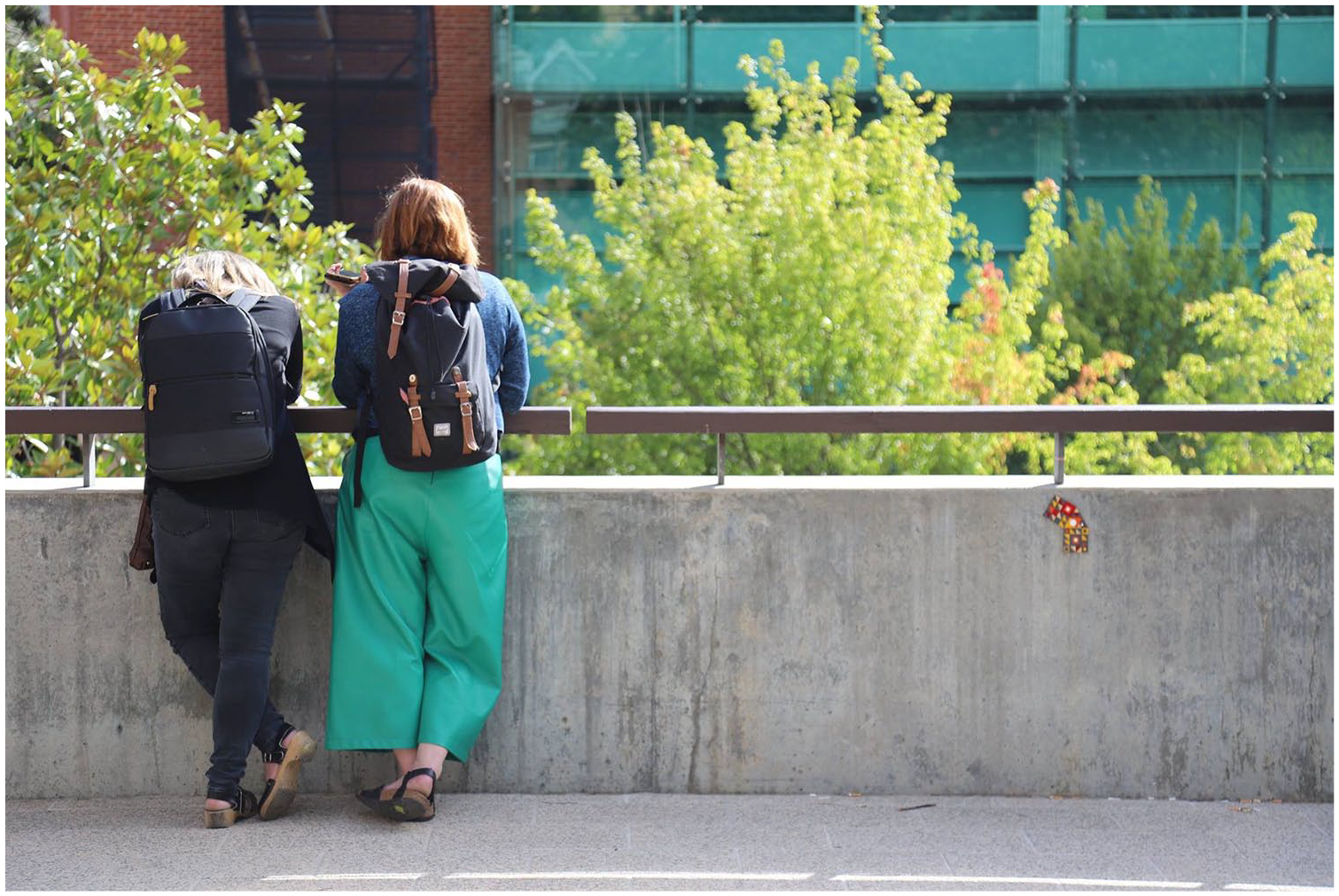
TIMeR Participants Listening to Stories of Place on the RMIT Campus.
Notions of space and place are invariably entangled with questions of belonging and exclusion, as well as how everyday mobile technologies are used to create interactive experiences. In the development and delivery of the TIMeR project, the following questions arose. What fractures emerge between current and historical notions of place, its care, and its occupation? How do enduring and expansive understandings of place within Indigenous culture find compatibility in the virtual projections of space delivered on mobile interfaces in pervasive games? Can space and place itself be understood as media and as a means for recording and replaying experiences and knowledge? To what extent are these knowledges complementary and compatible—or is the gap between them their poetic poignancy? Surveying the recent rise of AR applications and games that address notions of place from Australian First Nations’ perspectives, this article considers the opportunities and tensions arising at this juncture.
Indigenous Place and Pervasive Play
An emerging and growing practice of games-based projects engages with Indigenous knowledges of place. While many of these initiatives have centered on First Nations communities in Canada (Lameman & Lewis, 2011; Lewis, 2014), notable projects in Australia include Virtual Songlines (Levy et al., 2019), Digital Songlines (Wyeld et al., 2007), Nyungar Place Stories (Irving & Hoffman, 2014), and an increasing number of Welcome to Country mobile apps (Bessant, 2014). Bidwell et al. (2007) have developed methodologies for Indigenous users of mobile phones to connect media to place. These initiatives build on themes concerned at a broad level with the relationship between the “spatial”—relating to space—and “platial”—the notion of place-based studies. Echoing understandings from previous studies, much of this work centers on the meaning and value of Indigenous cultural heritage and digital archives (Fforde et al., 2013), and the role of new media in immersive storytelling for cultural heritage (Cameron & Kenderdine, 2016). Research questions are organized around how to digitally “map” places of historical significance and sensitivities, such as contested spaces of frontier genocides, massacre and sacred sites, and truth-telling (Dwyer & Ryan, 2016).
The emergence and popularity of pervasive games means that issues of Indigenous place can be positioned as significant and urgent. These issues are invariably entangled with questions of belonging, exclusion, and ontology, as well as how everyday mobile technologies are used to create and politicize interactive experiences. Such studies alert us to questions of historical scale, including how we remember stories of the past and bring them into the present in ways meaningful for current generations. Complex questions then arise about who owns this knowledge and how this knowledge is shared, sustainably archived, and expressed through how we act toward the other. At the heart of the matter is the very real and continuing threat of ongoing forms of colonial violence; how not to re-colonize digital spaces pertaining to Indigenous ontology and in forms that do not reinscribe previous histories of encounter (Latour, 1993; Todd, 2016).
What emerges from our practice is a pressing and persistent question that we envision will be increasingly significant for non-Indigenous designers, artists, writers, and other creative practitioners working with Indigenous content or newly engaging with Indigenous knowledges and place-based considerations. How to treat sacred and secret Indigenous sites where sensitive or prohibited material and cultural laws and ontologies are under threat of being breached, overlooked, or misappropriated? Christen (2012) discusses how cultural protocols can easily get violated because protocols “are not rigid; they assume change, they accept negotiation, and they are inherently social—not given, neutral, or natural” (p. 2885).
. . . images of people who were deceased were catalogued with no warnings; pictures of sacred sites were divulged with no connection to the ancestors who cared for those places; and ritual objects were disconnected from the practices, people, and places that they need to be efficacious. (Christen, 2012, p. 2885)
The danger of committing such violations immediately takes us to the center of what is at stake in cross-cultural encounters and that is how to make culturally aware decisions about one’s “practice,” position, or own way of being in the world (ontologies of self). If we understand ontology in relation to different levels of engagement, what is also at stake here is how to engage purposefully and deeply as we solve problems with intention-based designs and techniques driven by ethical principles of cultural engagement. Following principles in relational ontology (Deleuze, 1994; de Spinoza, 1994), we suggest that to understand another culture experientially is to engage across two inseparable dialectics: caring for one another and self (ethics of practice) and caring for Country and the world (ethics of place) (Guntarik, 2020). 2
This ethics of engagement ties in with ongoing discussions about the value of Indigenous peoples and places in future decision-making processes, as well as understanding the usefulness of technological applications in digital and design developments. This includes, for instance, how Indigenous ways of knowing can offer ways for us to act in times of crisis whether environmental, political, cultural, or social (Raheja, 2017), and in terms of technology, how digital tools and systems can be applied to restrict, manage, or alter human behavior in place-based and controlled environments (Wyeld et al., 2008). Resonating with Pavlovian contingencies of conditioned responses, this highlights the ways that humans can learn complex paradigms through digital scaffolds, to be critically present, to see things in given ways, to be guided deeply and conscientiously to ethical and culturally mindful ways to engage with the world.
Pervasive games afford new modes to redraw and redistribute power relations through the strategic repositioning of storylines. By this, we mean that mobile and AR applications can be applied to place-based games development as a tool of contextualisation, cultural awareness building, co-creation, and knowledge sharing between Indigenous and non-Indigenous people. In this instance, the TIMeR app provided ways for players to call attention to their own relationships to place. This made the app a two-way interactive tool rather than simply a unidirectional and one-dimensional recording of Indigenous audio stories. In other words, the political agency lay with the listener. This encouraged players to be responsive to Indigenous place knowledges and aspirations. Players could leave suggestions on how to improve the game, they could plant a virtual tree, they could bring something to eat, they could leave the place untouched. Symbolic gestures can be interpreted in myriad ways, thus marking time and place in a larger poetic cartography, and one that is based on principles of reciprocity and deep listening (Atkinson, 2017).
Our intention, in prompting players’ place-relations consciousness, shifts the emphasis from seeing Indigenous place as purely representational rather than simultaneously relational. While we were interested in the stories and knowledges connected to specific places in the city of Melbourne, we also sought to motivate people’s own stories of place (no matter where they came from) and how they related (or not) to local Indigenous stories specifically. This focus on the relational features of place required us to encourage non-Indigenous participants to listen to Boon Wurrung stories featured on the app as they considered their own relationships to Melbourne and Indigenous Australia. The features of place included the city, sea, and sky, and the learnings each of these themes contained, as well as the listeners’ own history and engagements with Indigenous places. Participants subsequently recorded their individual story in response to a Boon Wurrung story. This intention allowed us to be attentive to practices of reconciliation and the politics of social relations between Indigenous and non-Indigenous participants.
In this way, the TIMeR project was able to build upon and complement studies in mobile media place-making, where humans transform physical spaces into socially relevant and meaningful sites (Ingold, 2013; Massey, 2010; Paulsen, 2009). Place-making research has been shown to support reconciliation processes, offering ways to address social justice issues concerning Indigenous people and place (McGaw et al., 2011; Porter, 2018). Pervasive games offer the potential of using mobile and locative technologies to enhance knowledge sharing practices through an appreciation of Indigenous cartographies. To this extent, we see our work as both place-based and practice-led, inviting an attentiveness to place as well as to the practical and political dimensions of place. This included the practice of traversing through, behaving mindfully and with regard to the long history of colonial and neo-colonial encounter, and connecting with the land and its original people (see Justice, 2010; Land, 2015). Indigenous scholars have long recognized the significance of the interconnections between land, kin, culture, language, law, and identity (Chrulew et al., 2012; Grieves, 2009; Moreton-Robinson, 2015; Rose, 2011). Perkins (2009) and Kitchin et al.’s (2009) ideas have similarities to how digital maps have been viewed not as “objects” but rather as “practices” where sharing, social, and task-oriented activities dominate.
This approach to engaging with social relations issues reveals the importance of pervasive games and mobile media as a practical technology for creative and cultural application (Hjorth & Richardson, 2017). Mobile media place-making is intrinsic to “self-determined storytelling,” accentuating the political capacity for digital technologies to support Aboriginal self-representation (Edmonds et al., 2014). Rather than viewed as simply a record of the past, the digital technologies applied in place-making practices can be used to strengthen creative-based community collaborations (Deger, 2017). Such technologies generate important political content or forms of “vernacular creativity,” which hold significant implications for democratic participation (Burgess, 2006). TIMeR offered ways to unlock underdeveloped potentials of digital technologies to promote wider engagements with Indigenous places, support Indigenous cultural reclamation practices, and explore opportunities for “interactive and performative interventions” (Russell, 2005).
Reframing Pervasive Games Theory and Design
Pervasive games emerged largely as a response to opportunities afforded by the availability of ubiquitous computing to artists and designers interested in exploring urban environments and the potential to make these playable (Montola et al., 2009). The original vision of ubiquitous computing (Weiser, 1991) has been expanded to include the role of culture in shaping place and how this may also in turn influence the design of technologies (Bell & Dourish, 2011). Pervasive games hold the potential to radically alter understandings of place, leading to questions about what we might learn from Indigenous ways of knowing, being, and connecting to place that can inform pervasive game design. By deploying creative practice in this way, we are not only representing Indigenous stories of place but also reframing them in a contemporary context—a platform that has the potential to situate players in new relationships to place leading them into embodied experiences of Indigenous ways of being and knowing.
There is significant risk here in recolonising this knowledge, using it to make games without considering the complex relationships that it has to the deep history of the land, and to more recent post-European histories. When Europeans first settled in Australia, the advanced position of Aboriginal society and economy was quickly erased and forgotten under the colonial doctrine of terra nullius (Gammage, 2012; Noonuccal, 1970) so that when others arrived later, it appeared not to have existed at all. Agricultural practices were destroyed by introduced species of livestock, and populations were decimated by disease (Fels, 2011). In translating knowledge, we as non-Indigenous Australian designers need to ensure that the original voice is not lost, exploited, or undermined. Translating Indigenous knowledge into pervasive game design is an ambitious goal, and we do not claim that our current design for TIMeR has achieved this goal. However, by starting with this goal in mind, we were able to address challenges in cultural translation by focusing on two key design elements. First, we sought to situate Indigenous stories of place within a context that acknowledges local First Peoples’ history in oral histories and performative storytelling by working closely with Elders to ensure the inclusion of First Nations voices, histories, and perspectives. Second, we sought to reframe the theory and design of pervasive games by challenging existing preconceptions and approaches to their design as also originating in another, quite different, cultural context. This allowed us—with care, respect, and time—to ensure original voices were not lost in the process, and facilitated safe cultural spaces whereby we could pay attention to the historical context and cross-cultural aspects of those playing our game who may be new to these ideas or to exploring answers about their own relationship to place.
This goal for pervasive games—to radically alter our understandings of place—is equally ambitious. In relation to a diverse range of urban play activities that emerged in the first decade of this century, Montola et al. (2009) expanded Huizinga’s “magic circle” in three directions: spatially, temporally, and socially. Informed by the relational aesthetics of locative media and the design opportunities of ubiquitous computing, games that expressed “experiences on the boundary of life and play” shifted and transcended the ways in which play could be situated—particularly in the public spaces of cities. Subsequently, play scholars such as Sicart (2014) further defined the role of play as “a form of understanding what surrounds us and who we are, and a way of engaging with others” (p. 1). Play is defined as a social activity, a way of being in the world. Pervasive games situate this play and create ways into these other ways of being through the ludification of culture—making the world playable. With this framework in mind, how then can we revisit the three expansions of the magic circle informed by Indigenous ways of knowing and being? Situating this knowledge and experience in playable urban and bushland environments (Riley & Innocent, 2014) may also allow for Indigenous ways of knowing and connecting to place, to be understood and appreciated at a deeper level via their expression as a play experience, making them accessible to new audiences.
In their book, Divining a Digital Future (Dourish & Bell, 2011), Scottish computer scientist Paul Dourish and Australian cultural anthropologist Genevieve Bell set the scene for this discussion by reframing ubiquitous computing as a cultural, contextual, situated activity articulated via ethnographic accounts of communities adapting these technologies to their own purposes and specific cultural contexts. Throughout their discussion, the relationships of Indigenous Australians to their ancestral and traditional places are evoked as being emblematic of this new approach. In doing so, Dourish and Bell draw on the work of Nancy Munn (1996), an American anthropologist who identifies the connection between people and the world and the ways in which this “is reinforced by the land also being seen to carry the resonances of human activities and events there as well as mythical events” (Dourish & Bell, 2011, p. 81). They note, “the spatial model here is one of centers of ritual potency that resonate out of the environment.” In this approach, “space is organized not just physically but also culturally; cultural understandings provide a frame for encountering space as meaningful and coherent” (Dourish & Bell, 2011, p. 115) and this results in both a different map and mode of navigation for traversing space. Such connections and relationships between land and First Nations people are clearly articulated by Noonuccal researcher Karen Martin-Booran Mirraboopa of North Stradbroke Island (K. Martin & Mirraboopa, 2003).
We believe that country is not only the Land and People, but is also the Entities of Waterways, Animals, Plants, Climate, Skies and Spirits. Within this, one Entity should not be raised above another, as these live in close relationship with one another. (p. 207)
Indigenous knowledge, culture, and place are intimately connected. In stark contrast, most location-based games use street map data as the starting point for their design, reskinning them to match the theme but maintaining the established spatial logic of street names, buildings, landmarks, and so on. However, our lived environment has many more layers that can be made readable and tangible via experiences that are “designed particularly to allow people to navigate a space defined not according to Cartesian measures but instead relationally and historically—one in which people, along with relationships and movements, determine the parameters of spatial experience” (Dourish & Bell, 2011, p. 135). In the context of ubiquitous computing design practice, Dourish and Bell (2011) articulate its potential impact as “a generative notion of culture, a processual account of everyday phenomena, and an examination of information technology as a site of cultural production” (p. 189). Bidwell et al. (2007) put this thesis into practice through their work with the Gungarri people of southern Queensland by activating “socio-cultural and ecological memory that is embedded in the natural terrain” via experimental interface design. In acknowledging this understanding, we can thus extend these ideas to pervasive game design and reconsider them both within the context of a design process situated in a cultural framework and that also considers the potential of play as a mode of being for a heightened connection with place.
Circles of Play and Space as Media
Returning to the role of play, this approach can inform the three expansions of the magic circle in pervasive game design as a strategy for decoding the urban environment (Innocent, 2015). First and foremost, it is important to highlight the motivation for this “breaking” of Huizinga’s magic circle in that it recognizes that pervasive games are messy, situated, and embedded in lived experience in a multitude of different ways. Play is not separate from everyday life but embedded within it, situated in relation to space and place, connected to multiple layers—and to others who may move between different ways of being in play. Spatially, Indigenous pervasive games may draw upon a rich pre-digital culture connecting story and place, including design solutions that use music, voice, and visual language in sophisticated mappings of space that are at once performed through individual experiences of place and the environment in which they are situated through the activation of meaning embedded in the landscape itself. In an urban environment, this landscape is multi-layered consisting of the built environment, semi-permanent landmarks, transient traces, past evocations of place, and situated storytelling. In the design of TIMeR, stories of land, river, and sky relate both to the immediate environment of the player—the RMIT city campus includes both planned and unplanned traces of Indigenous presence—and through the situated storytelling that speaks more broadly to ways of understanding the world and how it came to be. So, the cultural approach to pervasive game design shifts the ways that the game is mapped spatially away from a set of discrete GPS coordinates on a Cartesian grid to a map that shifts in scale and intensity of experience and as a result the logic of the game map is configured in a more organic, non-linear way.
Shifts also occur temporally, first as the stories of land, river, and sky are situated in a tradition of oral storytelling that is often circular shifting between past, present, and future as the narrative context changes. The experience of the game is not only what is happening now as the player listens to a story, moves from one place to the next, or scans a sculpture that extends and transforms reality itself but also the ways in which it resonates across different timeframes. This includes not only these moments but also the ways in which Indigenous ways of connecting people and place create resonant layers of meaning that form a temporal landscape on which more transient moments of interaction may be situated.
The stories performed in TIMeR refer to different timeframes—events that happened on a geological timescale, for example, whose impact is still being felt now and continues to do so into the future. Play is designed to be open-ended; there is no time limit or pressure—as players wander about the spaces described in the experience, they are encouraged to give themselves the time to slow down and be aware of how their mind is also wandering in its own way. This different pace that results in a slow intensity is characteristic of Indigenous ways of being in the world originating in a recognition that everything is alive, moving, and being at its own pace. In relation to pervasive game design, these temporal shifts express a new logic—being simultaneously in a single moment of interaction and within the collective strata of multiple timelines happening in the world in which the game is being played.
Socially, a different set of relations are also in play. As the predominant logic of the design is cultural, the player is situated in relation to place, community, story—and other players. This connects to the potential of pervasive games to engage and situate people in new ways, and to express social frameworks of people and place. We have argued for the cultural significance of Indigenous knowledges of place and the importance of exploring these knowledges in processes of reconciliation and relational attentiveness. However, Indigenous knowledges of place are not only culturally significant but rich in opportunities for pervasive game design expressive of the cultural and social value of play.
Often the goal of pervasive game design is creating meaningful connection of people with place—fostering social networks that are embedded in space and time is an effective way to achieve this goal. In TIMeR, for example, the design situates players physically in relation to one another by leading them through shared spaces and virtually through the collective gestures remembered in the game world—planting a virtual tree, bringing something to eat, or leaving the place untouched. So, while listening to stories of land, river, and sky that articulate sets of social relations connected to place that may be unfamiliar or new to the player, the game also asks of them to participate through small gestures in the collective formation of a shared gameworld also shaped through social relationships.
With TIMeR, we propose bringing this model of pervasive game design into conversation with Indigenous ways of connecting knowledge to place. The stories that N’Arweet shares in the experience are embedded in place; they are effectively pervasive media delivered through oral histories. Further temporalities and spatialities are brought into play by situating these stories within a contemporary context, in that they are not relegated to history, and within an urban environment, in that they are not experienced as outside everyday experience but within the center of a city. Furthermore, this city is two worlds at once—the unceded lands of the Eastern Kulin nation and a major city of Australia, both of which co-exist in the same space and time. We hope that players will come to this knowledge through their experience of TIMeR and lead them to reflect on their own relationship to place.
Our goal is to develop an approach to pervasive game design that situates play experiences in relation to Indigenous ways of knowing and connecting to place. Establishing a productive relationship between these two practices is mutually beneficial. Not only are these knowledge practices characterized by rich experiences and stories worth telling but they may also present novel solutions to many of the challenges of pervasive game design—presenting alternate cartographies, ways of being, and situating storytelling in a broader historical and intercultural context. In contrast to typical approaches or pervasive game design, this approach explores environmental knowing, in which “information or knowledge incorporated in traditional technologies and technological representations is only one among many ways of understanding the relationship between people, space, and action” (Dourish & Bell, 2011, p. 198). Key to this productive fusion is the consideration of habitation of place through media that “do not contain information in the manner we might normally propose but rather are inhabited in ways that render them informative.” The heightened sense of connection to place is generated through play design principles (Innocent & Leorke, 2019) that contextualize pervasive game design to create new ways of being (Conway & Innocent, 2017) and connecting with the world.
It can prove useful in approaching this mind-set to think of space as media—or at least as a media format as able to store and communicate information (Davies, 2007). This notion of space as media in pervasive games, also understood as “environmental storytelling” or “environmental knowing” within digital games, recalls the study of the psychological impressions and effects of a geographical environment also known as psychogeography (Lynch, 1960). Such impressions or subjective recordings of place might include the effects of its formal features such as size and scale as well as the resonance of its history and memories. While space refers to the structural and geometrical qualities of a physical location, the notion of psychogeographic place includes the scope of experience, interaction, and the use of space by its inhabitants. Psychogeographies or “recordings” of place, in imposing new narratives or ignoring existing histories that are not attentive to existing notions of place, risk becoming colonial exercises.
Conversely, by adding additional layers of information that offer a response to and is complementary to and compatible with what exists in those locations, pervasive games hold the potential to radically alter and re-evoke understandings of place. Rather than providing answers to questions in relation to conceptions of space, TIMeR seeks to provoke subjective and personal reflections on what the space of Naarm means to each individual player. Framing creative practice in this way provides opportunities to explore our connections to Indigenous stories of place and contextualize them through cross-cultural experiences. As a platform, this also has the potential to situate players in new relationships to place, thus equitably inviting participants into reciprocal relations by valuing and acknowledging diversity in Indigenous ways of knowing and being. The focus on behavioral change and reflective action in turn enacts ethical decisions in the cultural logic of the design.
Conclusion
To know place, and to situate the self in place, is to engage with the familiar and with the local. But “knowing” place also invites a perspective, a way of knowing and being, as well as a response and an engagement with the histories of place and their cultural context. As traditional owner N’Arweet Carolyn (Briggs,2019, n.p.) states, these histories are complex and deserve greater attention than to be consumed in the generalist approach that always portrays us as innocent victims who had no control over our destiny . . . I caution you to take care and responsibility in engaging in representing our culture and history.
For engaging responsibly is not simply about representing place but bringing the past in dialogue with the present in ways that invite us to act on that history symbolically, politically, and relationally. Such a framework encourages altruism, a goodwill gesture, an expression of one’s value system in response to another’s. We are asked to ponder: Where are you from? What is your purpose for coming here? We are reminded of our own connections and disconnections to the land and our environment. These are crucial provocations in a world of increasing social and political instability and flux, and as the environment faces growing threats on a global scale. The stories of Indigenous place remind us not only that everything changes, but that we each play a role in mobilizing change. Having the stories contextualized over local landscapes invites us to stop long enough to listen to the morals in stories and to ponder where we are in our own experiences of exploration, discovery and participation.
Footnotes
Acknowledgements
We acknowledge Boon Wurrung Elder Dr. N’Arweet Carolyn Briggs AM in writing this paper and her ongoing support during the development of the TIMeR app. N’Arweet generously shared her family stories for inclusion on the app and led numerous discussions with us at key conferences and public events to support our thinking as the project evolved. We also thank our RMIT colleague social anthropologist Associate Professor Suzi Hutchings (Central Arrernte) for assistance in constructing this paper’s statement on Native Title determinations and issues of contestation around Traditional Ownership. We thank the anonymous reviewers for their thoughtful and constructive feedback, which greatly helped to refine this paper and our reflections on cross-cultural engagement.
Declaration of Conflicting Interests
The author(s) declared no potential conflicts of interest with respect to the research, authorship, and/or publication of this article.
Funding
The author(s) disclosed receipt of the following financial support for the research, authorship, and/or publication of this article: RMIT’s Enabling Capability Platform Design and Creative Practice funded the development of TIMeR while the broader approach was supported through an Australian Research Council project (LP180100397).
