




Abstract
Sensing and knowing Country in deeply colonised southeastern Australia is affected by persistent undermining, in both physical and metaphorical forms, by individuals, organisations and structures. Physical undermining occurs when extractive regimes, such as mining, damage Country while metaphorical undermining can play out when Indigenous knowledges are not centred when engaging with Country. Ngayirr Ngurambang: Sacred Country near Mudgee, Wiradjuri Country, an art exhibition led by Wiradjuri curator Aleshia Lonsdale, aimed to invite people to experience, engage with and awaken to these challenges. The exhibition brought together Indigenous and non-Indigenous artists from regional places, to reflect on, and build, sensibilities and knowledges of one part of this Country: The Drip, Goulburn River National Park. The physical undermining of this treasured women's water place comes from encroaching coal mines in the region while a form of metaphorical undermining arises in persistent settler colonial structures and processes. By drawing together insights from the curator, artists and participants of the exhibition, through interviews and qualitative surveys, this paper argues that artmaking and receiving can push against colonial hegemonic structures and enable different sensing and relational onto-epistemologies that are based in respect.
Introduction
Sensing and knowing Country, and learning from and with it in deeply colonised waterscapes, can be fraught with challenges when Country is persistently undermined, both metaphorically and physically. In this paper, we consider undermining as a literal reality and metaphorical concept due to ongoing settler colonial practices that damage Country and minimise its importance, despite ongoing strong and specific Indigenous connections with Country and especially waterscapes (Leonard et al., 2023). Here, we focus on efforts to extend understandings of Country in the Ngayirr Ngurambang: Sacred Country exhibition, an event inspired by a water place known as The Drip, Wiradjuri Country. The Drip is close to Mudgee and has been differently valued by generations of custodians, visitors and local residents. It is a sandstone escarpment that overhangs the Goulburn River that percolates water from the fern and moss-covered towering rock, into the river below, hence ‘The Drip’. It is a sacred women's site for local Wiradjuri people and is collaboratively managed by the Mudgee Local Aboriginal Land Council and the National Parks and Wildlife Service (NPWS). Coal mines surround The Drip and current expansions are under evaluation by relevant government authorities. The Drip has and continues to weather many imposed settler colonial changes. This paper uses the concept of undermining as a framing device to draw together purposeful efforts to undermine settler colonial hegemony but also as a physical activity that can threaten the integrity of Country.
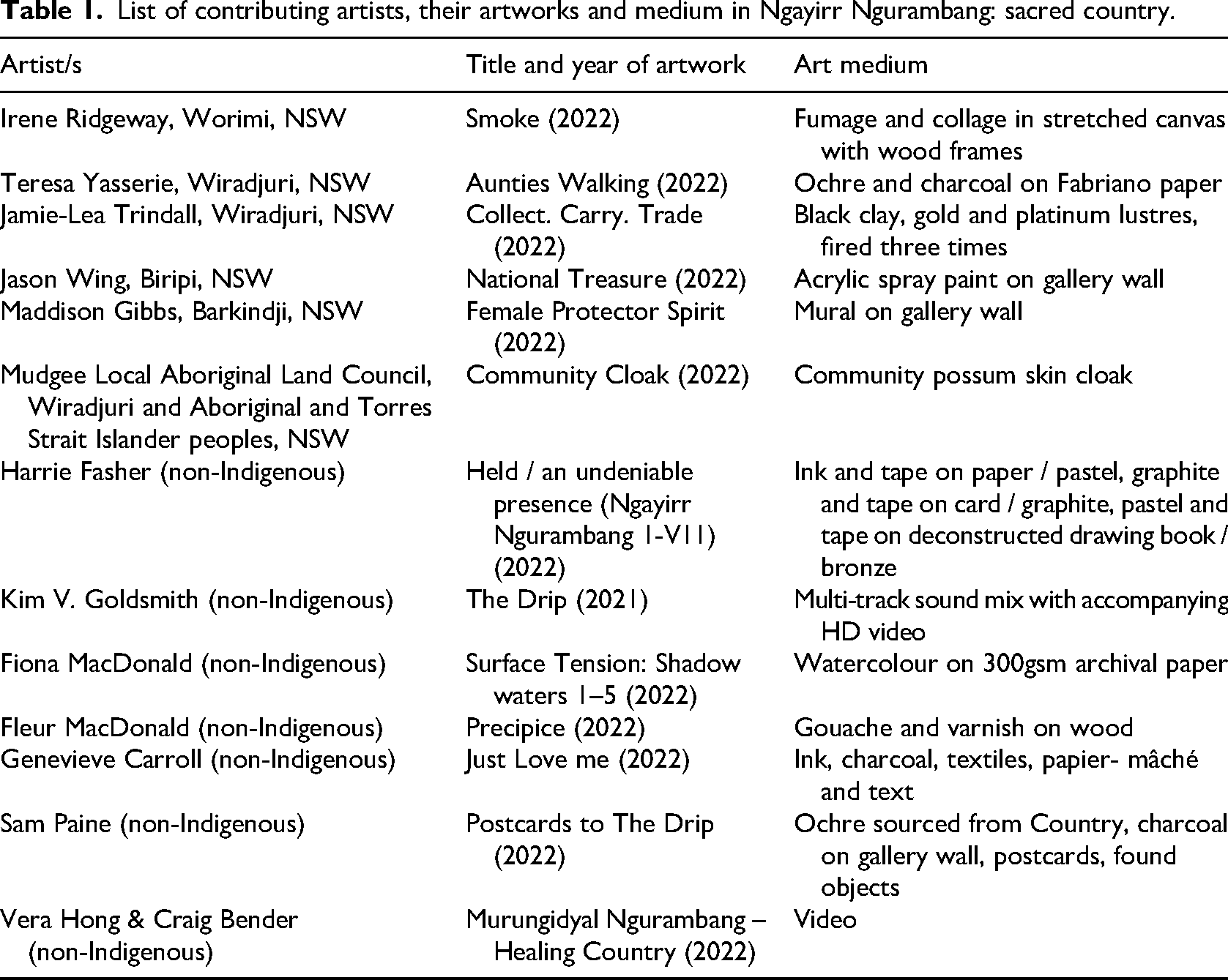
The Ngayirr Ngurambang: Sacred Country exhibition was curated by Aleshia Lonsdale, a local Wiradjuri artist, and was the first time that Mudgee, located in the central-west region, New South Wales (NSW), held an Indigenous-led art exhibition. Over 8000 members of the public experienced the exhibition from September to December 2022. The exhibition, hosted by the Mudgee Arts Precinct, celebrated ‘the importance of place, Country and story through creative artworks, addressing cultural, environmental, historical and social values that make up the water cultures of the Goulburn River and The Drip Gorge (Mudgee Arts Precinct, 2022a). The exhibition featured 13 artworks, including six by Indigenous artists and seven by non-Indigenous artists (see Table 1). The works spanned a diverse range of mediums and approaches, including paintings made with ink, pastel, ochre and charcoal; gallery wall-based murals using ochre and acrylic spray paint; mixed-media works incorporating textile and papier-mâché, fumage and collage; as well as video and sound compositions. Sculptural pieces were also included, using materials such as clay, wood, bronze and found objects. All artists were directly invited to participate by curator Aleshia Lonsdale, whose aim was to showcase the diversity of regional artists and the varied ways they might express the significance of this water place through their own lens, materials and methods.
List of contributing artists, their artworks and medium in Ngayirr Ngurambang: sacred country.
The Community Cloak, made by the Mudgee Local Aboriginal Land Council and led by curator Aleshia Lonsdale (see Figure 1), was a pivotal part of the exhibition and is a living artwork that portrays how The Drip is, was and always will be Aboriginal land and waterscape.
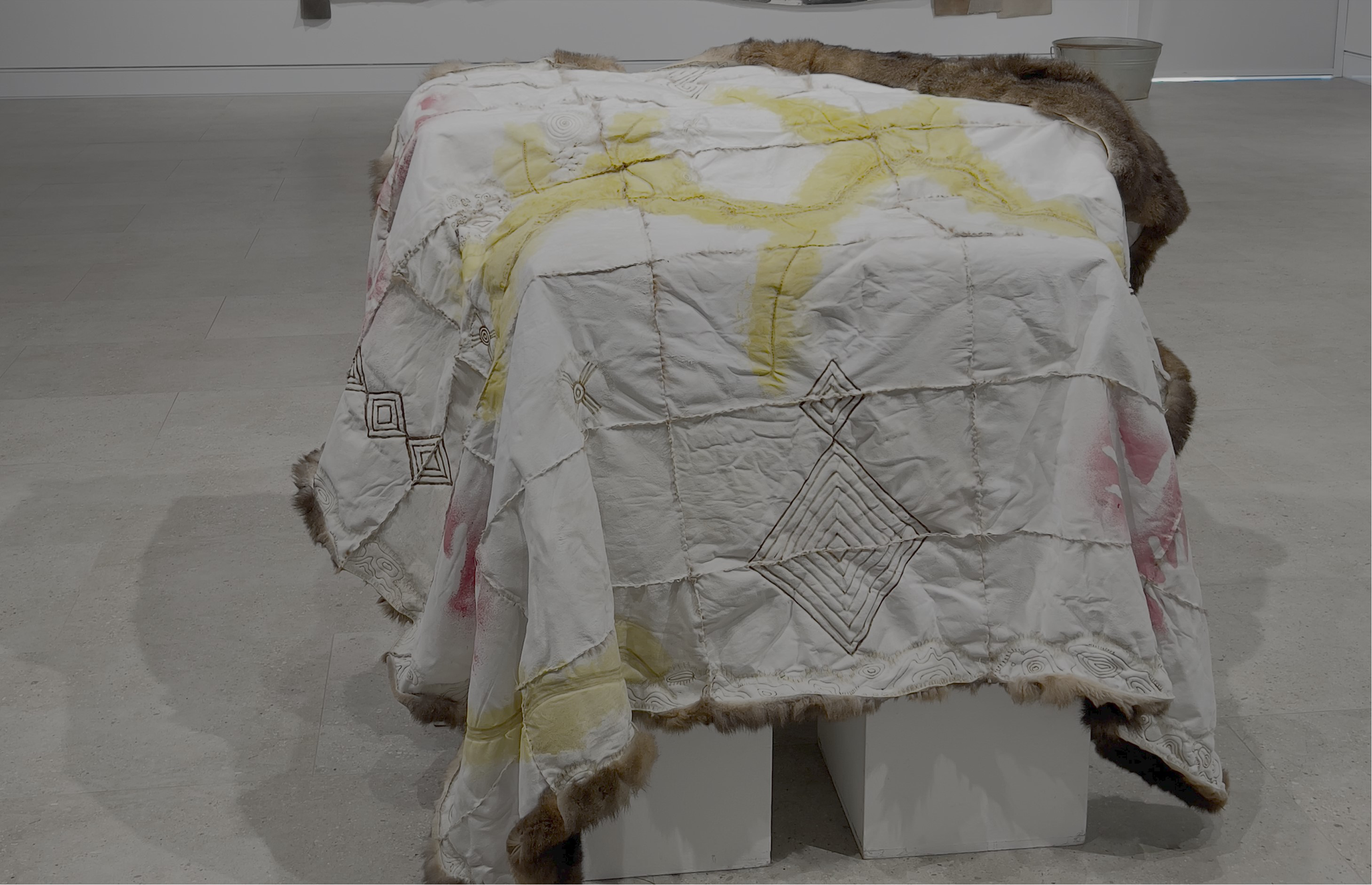
Possum skin cloak by Mudgee local Aboriginal land council.
The possum skin cloak traces the pathway of the Goulburn River and its tributaries, mapping a woman's songline and marking significant places such as The Drip, meeting grounds and important water places for local Aboriginal people. The practice of making and wearing possum skin cloaks represents generational continuity and ‘mirrors the ongoing work of community to maintain, share and revitalise cultural knowledge around caring for Country’ (Possum Skin Cloak, 2022). Possum skin cloaks grow with their owners throughout their lives, and this cloak will similarly grow with the community. The cloak carries stories and knowledge of place that will be added to over time. In this way, it invites ongoing engagement, interpretation and education. As the local Aboriginal community changes, these will be reflected in the stitching on the smooth side of the possum skin. The possum skin could be read as a way to envisage different futures that enable decolonisation of nature and centring Indigenous knowledges (Demos, 2016a).
By gathering information about what inspired the artists when making their works and what exhibition participants thought and felt about the artworks, this paper documents this Country-centring event and shares some of its impact. Furthermore, we extend understanding of the ways that Country can become known in heavily settled, contested and reconfigured land and waters, asking for geographers and others to foreground the political realities and responsibilities of caring for/as Country (Bawaka Country et al., 2013; Yandaarra with Gumbaynggirr Country et al., 2022). Geographic research has consistently shown that mismanagement and over-extraction persist in Australian rivers, and at the same time Indigenous water values and rights are under-acknowledged (Hartwig et al., 2018; Moggridge, 2021). Therefore, much needs to be done to change these social, cultural, political and environmental practices and to re-orient them towards care and repair. The Ngayirr Ngurambang: Sacred Country exhibition has, in a small way, contributed to that work by providing opportunities for sharing local Indigenous and non-Indigenous water knowledges from The Drip with the wider community. In doing so, we respond to Indigenous scholar Marcia Langton's (1993: 8) question and response ‘Can we ever decolonise Australian institutions? Can we decolonise our minds? Probably not. But we can try to find ways to undermine the colonial hegemony’ (Figure 2).
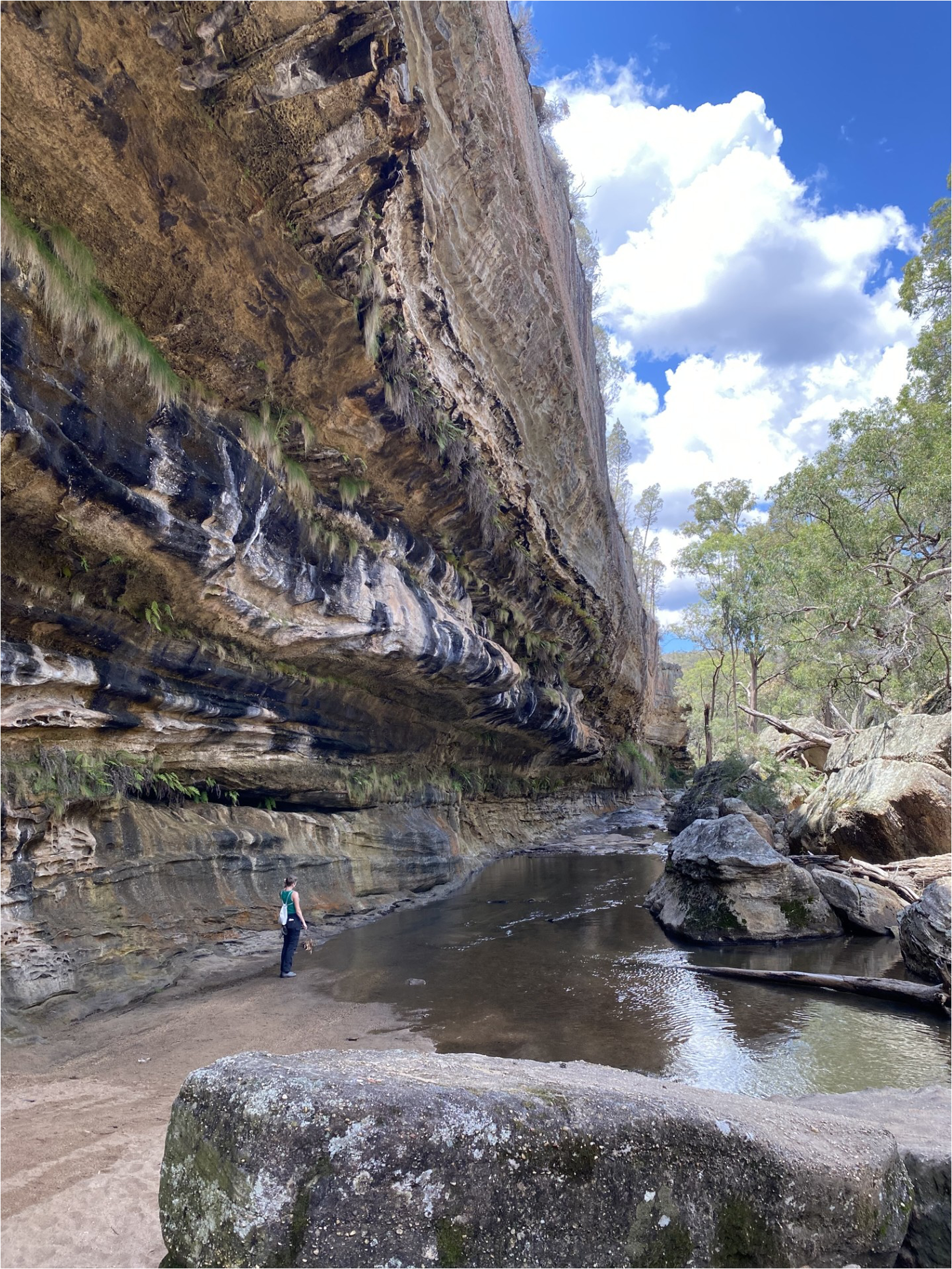
The drip, Goulburn River National Park (source: authors).
This research arises from ongoing and new relationships between geographers, curators, artists and gallery staff, formally beginning in 2021 with conversations about the exhibition. The author team includes Jessica McLean, a White settler woman who has long-standing connections to the area; Corrinne Sullivan, a Wiradjuri woman who lives and works on Dharug Country; and Laura Hammersley, a non-Indigenous woman who lives and works on Yuin, Dharawal and Wadi Wadi Country. Research ethics was approved by Macquarie University and built upon pre-existing research relationships in the area as captured in earlier research (McLean et al., 2018) and currently developing a new project with local people. We attended the exhibition's opening night, conducted follow-up interviews with artists interested in discussing their work and creative process, distributed a qualitative survey to attendees and interviewed members of the public who participated in the exhibition. We use the term Indigenous in this paper to refer to Aboriginal and/or Torres Strait Islander peoples, and where possible, we will use the Nation or Nations to refer to specific geographic areas or to attribute correct nationhood to individuals. If the Nation of an individual is not known, we will use either the term Indigenous or Aboriginal, depending on which term has been used publicly.
Background to the Ngayirr Ngurambang: Sacred Country exhibition
The Drip is a water place that forms part of the border Country belonging to Wiradjuri, Kamilaroi/Gamileroi and Wonnarua Nations. It is a beautiful sandstone cliff that overhangs the Goulburn River and is a sacred women's site that forms part of a songline including Hands on Rock, a Wiradjuri place containing stencils of hands placed on sandstone rock faces across the highway from The Drip. The Goulburn flows into the Hunter River, Awabakal Country, and the water that percolates from the sandstone escarpment into the Goulburn is the source of The Drip's widely accepted name.
For millennia, it has been cared for by Aboriginal people and has cared for custodians, too. It is a vital water place that shelters and nourishes humans and more-than-humans in multiple ways, offering fresh water, cooler temperatures and protection on high-heat days. But it has always been more than a place of physical care, support and nourishment, similar to other important water places for Indigenous peoples. As Leonard et al. (2023: 376) noted in their paper on Indigenous Water Sovereignty, ‘Water and Waterscapes are crucial to Indigenous Peoples’ spirituality, well-being, livelihoods, and identities’. Despite settler colonial presences, The Drip has been and always will be a source of well-being, livelihoods, spirituality and identities for local Aboriginal peoples (McLean et al., 2018).
Settler colonial people have spent leisure time at The Drip for over 100 years, a place that has been subject to Aqua Nullius thinking (Marshall, 2016): water belonging to no one. It was a regular site of picnics, and a walking track from the main road to The Drip has been informally managed prior to gazetting as a park. In 1970, Brett Whiteley, a renowned Australian artist, went on a camping trip to the area and vandalised the rock by painting human figures and animals on a cave upstream from The Drip. White paint was used to create outlines of figures that Whiteley described as reminiscent of Aboriginal art works. This ‘artwork’ has been leveraged as another reason to conserve the area (Hannam, 2015).
Undermining Country has co-existed with efforts to protect and care for this water place. For example, the land surrounding and including The Drip was sold by the NSW Government to Yancoal (a mining company) as a freehold title for only $2084 in 2010 (Hannam, 2015) although this was disputed by the mine owners. Andrew Gee, member for the Calare NSW Government, made a statement in 2012 in the NSW Legislative Assembly that the Moolarben coal mine (95% owned by Yancoal) owned The Drip and that the previous Labor Government had sold it to them without informing the community (NSW Parliament Legislative Assembly, 2012).
Subsequently, The Drip was gazetted as a National Park before the 2015 NSW state government election (Hannam, 2015), extending the adjacent Goulburn River National Park. The Drip's inclusion in the Park was also made possible thanks to the donation of land from private landholders Julia and Colin Imrie (McCarthy, 2020). After its redesignation, a formal co-management agreement was formed between the Mudgee Local Aboriginal Land Council and the NPWS (McLean et al., 2018).
Coal mining around The Drip has expanded over time and space since inception. There are now three proposed coal mine expansions under consideration in close proximity to The Drip. The Environmental Impact Statement produced to gain approval for one of these, the Moolarben coal mine, outlines how they will ‘develop four new open cut pits … within existing mining tenements’ (Yancoal Moolarben Coal, 2022: 1-1). The new mines would extend coal mining and intensify water extraction from the Goulburn River and affect groundwater sustainability (Imrie, 2019). The proposed expansion is a controlled action under the federal Environment Protection and Biodiversity Conservation Act 1999 but is being managed as a NSW State Significant Development. That decision-making process is still underway (at the time of writing) after a public consultation process: Moolarben Coal Operations (MCO) is now required to respond to all submissions before a determination is made. If it does get approved, expanding coal mining will result in the clearing of 470 ha of critically endangered box gum woodland (Gorman, 2023) and koala habitat.
Methodology
We consulted with Aleshia Lonsdale, the exhibition curator, about what research would work in relation to her goals before developing an approach and methodology for this paper. We then liaised with the head curator of the Mudgee Arts Precinct and responded to their suggestions for the survey of exhibition attendees. Following those discussions, we planned the following data-gathering activities: participation in the opening night of the exhibition; follow-up interviews with artists who were keen to talk thereafter; a qualitative survey of exhibition attendees; and interviews with exhibition-participating members of the public.
We interviewed seven participating artists over the months following the exhibition, and the survey was administered through the Mudgee Arts Precinct and online through their social media accounts. There were 11 survey responses and three short interviews with exhibition attendees. The survey included basic demographic questions and the following open-ended questions:
How long did you spend in the Ngayirr Ngurambang exhibition? What was your favourite artwork in the exhibition? Why? Have you been to The Drip in Goulburn River National Park before? If so, how many times? If you haven’t been to The Drip, do you plan on going to visit it now? Why/why not? What does Ngayirr Ngurambang: Sacred Country mean to you?
The interviews with exhibition participants included questions about what they thought of the exhibition, whether they had visited The Drip and what they thought about this water place. Interviews with artists aimed to find out what motivated their contribution and what they thought about the whole exhibition. An open conversation started with these questions: ‘You had an artwork called xxx in the exhibition – could you please tell us about it? What inspired you to make it?’
Thematic analysis was used to identify patterns and relationships in the interview data; each interview transcript was read and re-read by the research team to glean insights. This approach to the interview data drew on ‘an iterative and reflective process that develops over time and involves a constant moving back and forward between phases’ (Nowell et al., 2017: 4). Qualitative data from these sources were analysed for major themes to outline what motivated artists and the exhibition curator, as well as to understand perspectives about reception of the exhibition. The different sources of data offered insights into people's understandings of the social, cultural and political structures (Crang, 2005) affecting this part of Country. Our research approach centres relationality, following Tynan and Bishop (2023), at each stage of the project, including when canvassing the literature, developing a methodology and analysing our data, respectfully engaging with non-academic people involved in the research context in Mudgee, as well as the academic literature that this work talks with and to. While we have only a small amount of research participants relative to the approximately 8000 people who engaged with the exhibition, this paper shares interesting perspectives on this landmark event.2
Positioning our research
Public art by Indigenous peoples: Sharing geographies of Country
Art is a form of social action for many Indigenous people, according to research led by Indigenous scholar Professor Bronwyn Fredericks, providing opportunities to intervene in settler colonial processes and practices. Fredericks and Bradfield (2021) argued that it offers ‘a way for Indigenous peoples to engage, collaborate, negotiate, express and share identities with each other and with non-Indigenous people’ (p. 32). For example, Indigenous arts collective Capricornia Arts Mob (CAM) created a public artwork Honouring Land Connections, which sits alongside the river in Rockhampton and marks previous floods, while also carrying Indigenous knowledges in the form of carvings. The public art provides a way to capture learning on Country and communicate this learning to a broader audience (Fredericks and Bradfield, 2021).
The process of creating artworks for an exhibition that aims to share Indigenous knowledges has helped to ask deep questions and develop a collective story for those involved (Fredericks et al., 2014). In the lead up to an exhibition by the CAM, collaborators created an artmaking space and process that centred cultural safety and followed practices such as yarning and mentoring young people. Fredericks et al. (2014: 30) explored the impacts of this as an instance of embodying solidarity, building relationality and changed ‘lives in ripples of consciousness about Indigenous peoples, cultures, histories and Countries’. Both the process of making art and then sharing it in the exhibition space contributed to this transformation.
For the Ngayirr Ngurambang: Sacred Country exhibition, Aleshia Lonsdale had intended to bring together invited artists for workshops on Country, but COVID-19 restrictions prohibited this. The Drip, as a water place that is Country, was central for contributing artists. This contrasts with Kwon's (2002) insights that as artists seek out methods of making art that does not focus on the object, but rather the process, many artists who work on site-specific projects are engaging with social and political issues, rather than a physical place. Thinking about Indigenous connections to Country, a physical place is part and parcel of the social and political issues of making art. Drawing on Kester's (2013) concept of dialogic aesthetics, art can be understood not as a fixed or final object, but as a process in which meaning is co-produced through relational encounters between the artist and audience, communities and epistemologies. This framework is useful to understand Indigenous public art where the process of making art is deeply situated and not only shaped by Country, kinship and cultural protocols, but oriented towards sovereignty and care for Country. The exhibition demonstrates this dialogic approach by creating a space where artworks sit in conversation with each other and invites the audience to participate as listeners and learners in a shared conversation, not just about place, but in dialogue with place. For this research project, we can see evidence of a particular physical place, process, object, social and political issues as all intertwined. Art, as collaborative, place-based and process driven, then becomes a means of social transformation by activating a sense of responsibility, understanding and care in those who engage with it (Beuys, 2004).
In other settler colonial contexts, Indigenous and non-Indigenous people have collaborated to create and then share artmaking with transformative goals. White woman settler Heather McLean (2022) offered an example of this form of cross-cultural exchange in creative arts-based geographies. Indigenous curator Elwood Jimmy and Indigenous scholar Vanessa Andreotti and White settler scholar Sharon Stein produced a booklet reflecting on their collaborative and relational arts practices involving Indigenous and non-Indigenous artists and scholars. McLean described how their art practice required ‘generosity, humour, (self) compassion, depth, and rigour without turning away from contradictions, paradoxes, difficulties, and discomfort’ (Jimmy, Machado de Oliveira and Stein, 2018 in McLean, 2022: 315). The mixed emotions and strategies for working with confronting material and across difference are important to note here as there is no benefit to romanticising what might be, in certain spacetimes, difficult forms of relationality, and connection and disconnection.
Indigenous and non-Indigenous people's engagement with Country through art
Providing opportunities to learn about Country through creating art, despite intense settler colonial structures and extractive processes, has enabled greater knowledge about Indigenous people's ontologies. For instance, Harrison et al. (2016) explained how a Sydney-based project involving Dharug artist Leanne Tobin helped school children learn about Country – that urban places are Country – by co-generating a mural. The collaboration pointed to the importance of ‘learning to be affected by the differences and multiplicities of the country around us’ (Harrison et al., 2016: 1329). In that paper, Leanne Tobin said that life-long learning as an artist involves being open: ‘You’ve never ever got it all and that way it's kept me open to learning from lots of different people and a lot of the time from being in country, near country, walking around with your feet on the ground with your eyes looking everywhere observing different things and changes’ (Harrison et al., 2016: 1329). For Leanne, openness involves sensing things differently, using all available embodied ways of knowing to receive information and form attachments.
In collaborative research with high school children in Ntaria in the Northern Territory and Warmun in Western Australia, St John and Edwards-Vandenhoek (2022) described drawing on Yunkaporta's 8 Ways approach to facilitate a multidisciplinary strategy for learning together on Country. Artmaking and Indigenous Elder-led instruction were part of that strategy. The project found that the 8 Ways approach in these contexts led to ‘revealing connections between learning, Country, community, creativity, family, and identity’ (St John and Edwards-Vandenhoek, 2022: 98). Our research project builds on these earlier efforts and aims to foreground the politics of centring Country in art. We emphasise the multi-vocality of perspectives in this piece, joining curator, artists and exhibition participants to interpret Ngayirr Ngurambang.
Sensing/sensibility and relationality in and with art
The research and practice-based worlds of geography and art are now frequently connected, in productive collaborations, studies and projects. Harriet Hawkins (2011) has reflected on this shift, arguing that ‘geographies of art take seriously art as constitutive rather than reflective of meaning and experience, productive rather than representative of culture’ (p. 473). She outlined how art enables seeing the world more relationally, breaking down dualities and binaries and thinking and feeling with and through difference. Similarly, the work of Gómez-Barris in South America (2017) illustrated how creative and relational practices, traditions and knowledge systems enable Indigenous artists, activists and communities to enact forms of resistance that counter the colonial extractive view and challenge the erasure of Indigenous ways of knowing, being and relating. In this context, water is a site of both extraction and connection – a living entity that carries stories, trauma, memory and resistance. For the purposes of this paper, we are asking how Wiradjuri Country becomes known despite persistent undermining and what making sense of the world occurs when an art exhibition about one water place is led by an Indigenous curator and diverse artists. Furthermore, the contestation of water places is important here, and we aim to draw out the political concerns raised in this exhibition as they are central to how Country is known, sustained or silenced.
The way art and geographic scholarship is foregrounding relationality aligns with similar efforts in Indigenous geography and anthropology scholarship. For instance, Metis scholar Zoe Todd (2015) proposed that we Indigenise the Anthropocene and drew on Indigenous epistemologies in art to do so. Todd (2015, 252) wrote that ‘Art, as one mode of thought and praxis, can play a role in dismantling the condos of the art and academic world and help us build something different in their stead’. Similarly, Tynan (2021) argued that a relational approach that centres Country can counter extractive research practices and ground human and more-than-human in ethical connection.
Introducing a special issue on art, geography and collective memories, Castro et al. (2023) outlined how geographers are engaging with creative approaches and collaborations in and of artmaking. A standout contribution to that special issue is by Libby Harward (2023), a Ngugi woman of Mulgumpin island (Quandamooka Country), who creates art to reconnect with Country and disrupt settler colonial presences. Harward (2023: 34) followed Ganngulanji, walking Country with Elders and ‘calling out, listening, thinking and understanding as one single process’. The making of art comes from this calling out, listening, thinking and understanding for Harward (2023) who stated that ‘Through Ganngulanji, I am enacting a process of re-remembering with my Country and with my kin’ (p. 43). In dialogue with Harward's thoughts, a key aim of this research is to examine whether an art exhibition, including Indigenous and non-Indigenous artists, can facilitate a greater awareness of Country that is seriously threatened by extractive regimes.
Discussion
Bringing together reflections from the curator, artists and exhibition attendees/participants, this discussion intertwines voices, perspectives and materiality, to illuminate connections and insights between participants with respect to Country in this art space and engage with themes raised in the literatures pertinent to this research. We see this project as offering an example of how an exhibition about a water place in Ngayirr Ngurambang facilitates sensing Country in new ways, opening up pathways for protection and meeting across difference and reimagining geographies of Indigenous and settler colonial onto-epistemologies. The discussion is organised into four thematic sections: (1) we start by discussing The Drip as a water place that inspires artwork for Indigenous and non-Indigenous people; (2) we consider how creating a dialogue through Country offers reflections on spacetime contingencies and liminality; (3) we analyse multiple values and scope underlying the framing of this water place; and (4) we conclude with analysis of how Country invites us to think, to visit, to feel, to hear, to connect, to learn.
The Drip: A water place inspiring artwork for Indigenous and non-Indigenous artists
‘Exhibitions tend to be about the artworks on display’ (Fredericks et al., 2014: 16); however, the processes, practices and learning leading up to an exhibition and the eventual creation of the artwork can also be quite illuminating. Therefore, ‘art can be both a process of creation and understanding, and an artefact that exists through time’ (Fredericks and Bradfield, 2021: 32). For the Ngayirr Ngurambang: Sacred Country exhibition, Aleshia Lonsdale offers the following context: I have chosen artists who [pause] I guess I like the way they think, and the way they look at the world and the way that they respond to it. I have also chosen artists who work across lots of different mediums. So, I just didn’t want an exhibition that was all canvases on the wall … we have ceramicists, installation, sculpture, sound, film, we have a really diverse mix. (Mudgee Arts Precinct, Aleshia Lonsdale3 2022b)
Aleshia values both Indigenous and non-Indigenous artists using myriad mediums of artistic expression as it enables drawing out, and stretching, different imaginings and experiences of Country. One of the Indigenous artists, Jason Wing, reflected on connections to Country: I think it's good to be inclusive of all people … I think, that you know public lands, public land, and people have their own personal relationships with Aboriginal land, you know, different to Aboriginal people, but still their own relationship.
While Jason was supportive of the inclusion of Indigenous and non-Indigenous artists to contribute to the exhibition, he did feel that there were differences in the perspectives of The Drip: I kind of felt like a lot of the Aboriginal art is kind of sort of more like went into the landscape, and I know if the non-Aboriginal artist is sort of like depictions of … I mean that that was just like my sort of noticeable thing … I guess I just saw like a lot more layers, more layers to the Aboriginal people's interpretations of the landscape, even they are super diverse. But really talking about the same thing…
Prior knowledge and understanding of The Drip and Indigenous ways of knowing Country among the artists ranged from emergent appreciation to deeper and more nuanced insights. Therefore, the artworks are a manifestation of each artist's own perceptions and contemplations of The Drip.
Artists drew on local knowledges (where possible), the landscapes and waterscapes and understandings of Country to develop their artworks ‘focusing on The Drip and all the different histories and cultures of that place’ (Mudgee Arts Precinct, 2022b). Aleshia's intention was to encourage greater awareness of place and the meaning of Country and landscapes – because Country authors much of the ballast of knowledge, of life, for Indigenous people in Australia. The relationship between Country, identity, knowledge and responsibility is central to Indigenous ways of being and caring for Country (Harrison et al., 2016; Tynan, 2021). Aleshia (Mudgee Arts Precinct, 2022b) said that she wants all visitors to sense The Drip viscerally, that they will be ‘going there respectfully … and just being there and being in the moment and just experiencing it … hopefully the artworks that we have in the exhibition will inspire that’. Inviting both Indigenous and non-Indigenous artists to participate and create and share their understanding of The Drip provokes a multifaceted and layered production of meanings.
The curator's intention was received by participants, as reflected in conversations with participants. One visitor mirrored Aleshia's aim of bringing together diverse local artists using multiple media: …this possum blanket, it's really intriguing that you got it at birth and looking at the journey of it. So it's just really nice to see … so many different art forms . … So it's not just, “This is only for this person or only for that person.” I've got a sense of bringing everybody together. (Interviewee 5)
The seven artists that we interviewed described their artworks and the inspiration for their artworks in distinct ways, including sharing past artistic interpretations of engagement with this water place. For instance, Fiona McDonald (non-Indigenous contributing artist) observed: [my] works are based on photographs – evidence of activity at The Drip over a long period of time. Probably the earliest photography site is of the 1890s, I couldn't find any photographic evidence of The Drip area before that time … I figured most of the other artists would do a contemporary or a personal response. So I thought, I'll do something that is kind of a history of usage, and talking with Aleshia … she was looking for not just Indigenous usage, but also to think about how other people have used that space, as a kind of a leisure place.
Kim spent time at The Drip to inspire her artwork, which she explains as a ‘co-created piece [with The Drip], because I can’t produce any of what I do without those environments’. Kim says: my piece is called The Drip, and I talk about it in terms of being a soundscape, but it does have a video with it as well, for various reasons, but it was really created around learning to listen to the environment more deeply and more actively.
Deep listening also played a role for non-Indigenous artist Vera who, when reflecting on her art and how Country informs her work, said that it captures the core of what I feel and believe. It's an approach in that work that I do. It embodies and resonates the way I relate to the world. The connections between plants, animals, sky and water.
Sam Paine, non-Indigenous artist, created his piece using materials collected from near The Drip (Figure 3), he says: my piece in the exhibition is uh a big wall mural drawn in charcoal and ochre from out near the drip … as well as a kind of interactive element that uh encourages people to draw or write on the back of a postcard.
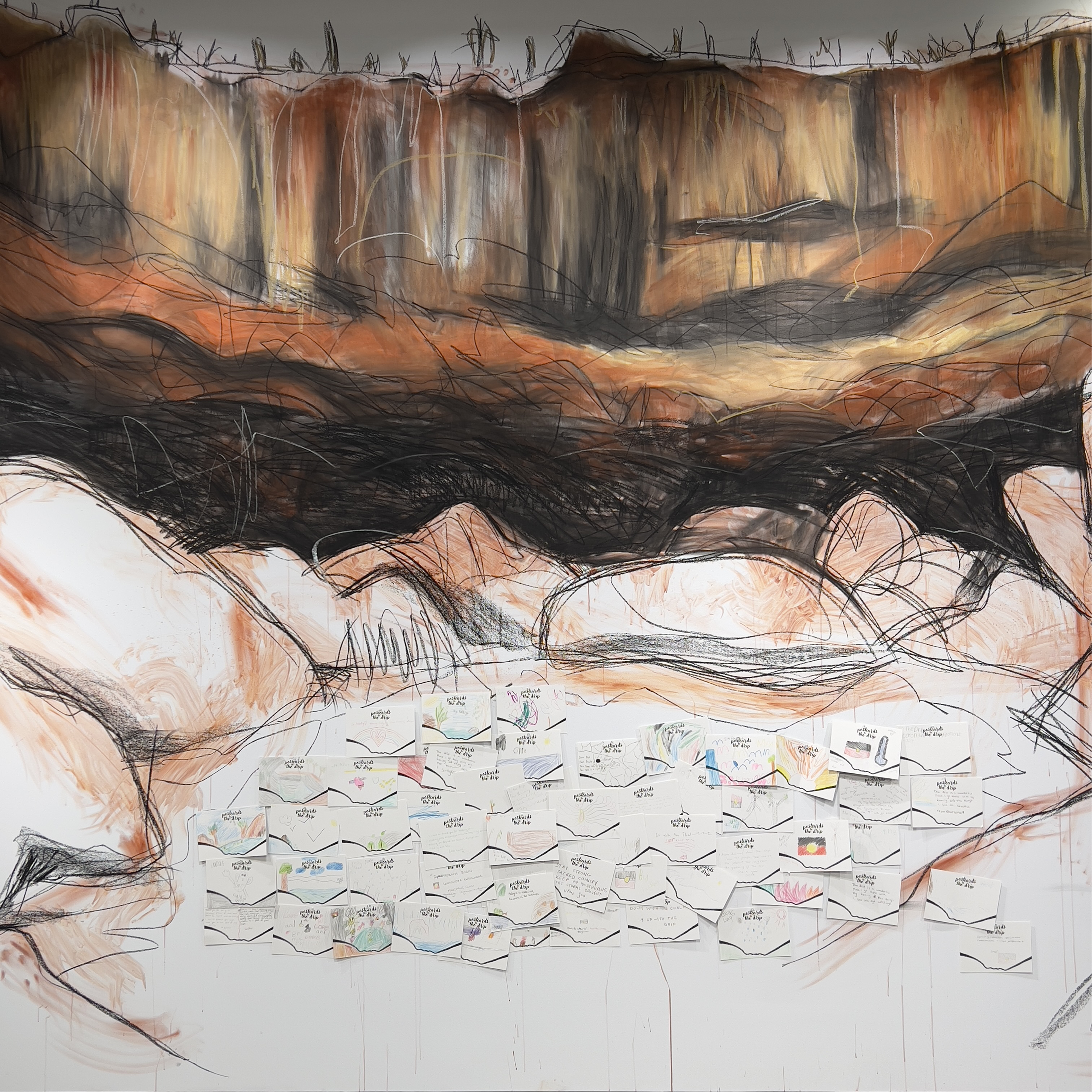
Sam Paine's artwork the drip.
Sam expressed an interest in learning more about The Drip and that his knowledge was partial but that visits to The Drip were crucial to building his piece. Similarly, a sense of experiencing place and understanding context (Kanngieser et al., 2024) was crucial for Jason in developing his artwork. He had not been to The Drip prior to making art for this exhibition and used his encounter with a painting that was masquerading as Aboriginal art to motivate him: The Drip location itself was the starting point. And it is the first time I went to The Drip as a new local and I noticed a traditional looking painting in the distance, and when I climbed further, I soon realized that it wasn't painted by an Aboriginal person I think that was the thing that that captured my attention and that became the source of my artwork.
The foreign piece that Jason felt drawn to is Brett Whiteley's notorious ‘artwork’, on a cliff face upstream from The Drip, which we will return to later in this paper. For now, it is worth noting that moments of inspiration clearly include critique of existing appropriations and prompt others to think about respectful forms of expression of/for Country, in contrast to more extractive forms (Poelina et al., 2023).
Creating a dialogue through Country: Spacetime contingencies and liminality
Each artist has different relationships, experiences and connections to The Drip and, accordingly, variably conveyed this in the Ngayirr Ngurambang: Sacred Country exhibition. For example, in Fiona's piece, photographs from earlier time periods inform her art, bringing to bear historic encounters with The Drip to document how people have used and interacted with this place over time. Fiona says she wanted to highlight that The Drip was a ‘place for leisure and exploration of the environment’ and ‘how other [non-Indigenous] people used that space’. Although Fiona's artwork presents non-Indigenous usage of The Drip, she noted from her experience of interacting with the site that she ‘can tell by the – just its nature – that it would have been a big seriously important site’. From Fiona's reflections of spending time at The Drip, creating her artwork, and from conversation with Aleshia, she has developed a sensory relationship with Country. In this way, it can be seen how ‘[a]rt mediates the reciprocal relationship between person and place, creating a dialogue where one communicates or “sings” a sentient Country that listens, hears, sees and responds’ (Fredericks and Bradfield, 2021: 39).
Video artist Vera echoed this communication between person and place. By experiencing The Drip at different times, Vera noted ‘Country changing overtime was evident in the landscape’ and witnessed ‘what was being protected and cultivated’. Vera articulated that she saw the ‘impacts of that extreme water … that force and the aftermath’ and that The Drip varied according to ‘seasonal and extreme water flows’. Vera also shared how The Drip and surrounds are ‘endless sources of change and learning. It's a huge teaching ground’.
Wiradjuri artist Teresa Yasserie explained how Country informs art and how this can be key in building awareness, knowledge and understanding of Indigenous concepts of place (Harrison et al., 2016). She says being on Country: It's like going to an exhibition, having a look and having a listen to what Aboriginal people have got to say about it. And then, I think, it's like my artwork, you look at it at the first view and you think, what the hell is that? And then once someone tells you what it is, and it's written down what it is … they have to see it, you have to listen … and then you can absorb it better. And then you can go down to the river … it reinstates things. You take that knowledge with you.
Kim's experience of being at The Drip, and from listening to Aleshia's knowledge about Country, is congruent with what Teresa says. Kim shares: I did pick up here [The Drip], and I guess it was my work with Aleshia … was this idea that there is a long history of human association with that place [The Drip] and I guess, it was new to me, but I had to find a way of connecting with that place.
The specificity and variability of water places affect perceptions of Country (Gibbs, 2010). For Indigenous artist Jason, being a part of the exhibition was an opportunity to share new experiences at The Drip, being on Country. Also, feeling ‘drawn’ to the foreign Whiteley ‘artwork’, the environment made an impression: You know, you can also feel like as a disturbance there to like something is about to happen, or something. It's a joyous place, but it's also – you can feel as a bit of unrest because of just, it's a contested territory, I guess.
Fleur McDonald, a non-Indigenous artist, who did not draw inspiration from the Whiteley ‘piece’ commented, ‘I was a bit mortified when I was told that Brett Whiteley had defaced some rock face … I was like, “fucking knob”’. Jason says: I saw it [Brett Whitely painting], and you gotta cross [the river] … I was called to go there, and so I, not having any sort of connection. … So … I feel like I was like guided there to offer criticism – a sort of protest or national discussion.
We see here an iteration of the long history of activist art (Lippard, 1984). Jason was drawn to the Whiteley piece; his experience of being ‘led to that side’ is evocative of his relationship with and responsibility to Country. Jason's actions are an affirmation of his ‘relational ethos [which] means responding and listening to Country’ (Tynan, 2021: 599), connecting to Country. However, this connection can manifest in multiple ways, requiring different responses and actions. Tynan (2021) stated that ‘connection to Country is not always rosy’, that ‘connection to Country also means connecting to unwanted messages’ (p. 599). Unwanted, as well as wanted, messages on Country are found in natural elements and those that are introduced and uninvited.
Values and scope: ‘A landscape exceeded beyond a frame’
A key purpose of the exhibition was encouraging people's awareness of place to stimulate, and/or interrogate, feelings of value and then to consider how actions flow from these values. Unearthing what people connect to, such as with reminders of why they value sites like The Drip, was imperative. Aleshia states: getting people to value places like that [The Drip], it's not just a bush walking spot. That it does have real value and meaning for people and then hopefully that will flow on to getting them to think about protection for places like that … which are under threat from mining, or other industries. Realising that these places are valuable, and it might not necessarily be as valued to them as to someone else in the same way…. (Mudgee Arts Precinct, 2022b)
Bringing attention to the myriad ways that Indigenous and non-Indigenous artists view, interpret and (re)produce meanings of Country and/or landscape was a deliberate appeal to the audience's systems of value. The works in the exhibition raised many concerns relating to The Drip, and Sam's views of the overall exhibition capture some of these: The whole exhibition sort of manages to give voice to all the different conversations that happen around The Drip so that you have the response to the complicated Brett Whiteley mural, you have pieces that are about the environment, pieces that are about the coal mining, pieces that are just about sort of the peace and beauty of the area, pieces that are about nature.
The complications or tensions of differing systems of value are apparent in references to the Whiteley ‘piece’ at The Drip. Interrogating this idea, Jason ruminated: They [mining company] stated that they will protect that mural in stark contrast to our [Aboriginal] priceless culture and artefacts that are being exploded every day. So I thought it was interesting that they were promoting the preservation of this like ‘Aboriginal artwork’.
Kim also pondered a challenge to systems of values on her reflection of the artworks and the exhibition: I think that comes back to this whole concept of more-than-human and a more-than-human intelligence … we hear about the other or non-human, but nobody talks about more-than because we like to see ourselves as the dominant species. And so this idea of the environments or elements of our environment, like rivers being given rights. That is a hugely confronting thing in a culture of ownership … coming from a very conservative White land-owning background … and different concepts of custodianship versus ownership and stewardship, and how time intersects with those concepts.
There are multiple reasons for valuing The Drip; however, the intention behind creating a widespread sense of value for The Drip ultimately was about protection. The artists were invited by Aleshia with a challenge to give and interpret meaning for Country, which meant that the artists, and the eventual audiences, were able to listen/see/hear/feel wanted and/or unwanted messages from Country. An invitation from Aleshia to create and/or view art was through an optimistic approach to entice Indigenous and non-Indigenous peoples ‘to listen to messages we may not want or expect to hear’ (Tynan, 2021: 599). And as Slater (2013) shares, water places affect people, especially in regional Australia, meaning that an exhibition focused on a pressured and precious water place was an opportunity to facilitate connections drawing out this affect.
Thinking about different values and their challenges are core to the exhibition. In reflecting on his finished artwork and the Country that inspired it, Sam felt that The simulated Drip that I've created. … It feels more and more to me like a representation of us [non-Indigenous people] kind of, uh, constructing under and over and around The Drip until it's all – until it disappears. But I don't think that's part of the viewing experience. I think that's part of my experience of it.
Turning to how audiences perceive the artworks in the exhibition, and specifically referencing Sam's artwork, Jason says ‘I think people like the idea that a landscape exceeded beyond a frame’. Jason's words sit at the very core of the exhibition's intention, to get people to think. Similarly, Teresa believes that ‘Once you have knowledge of it [Country] again, you're seeing a lot in that exhibition, it sort of informs you about the caring for cultural things. And that caring is so important for Aboriginal people, caring for the land and the significance of it, it's good for non-Aboriginal people to be aware of that.’
Obligations come with relationality and sensing Country. Indeed, American journalist Dahr Jamail who worked with Cherokee author and academic Stan Rushworth has famously reflected on ‘the difference between a Western settler mindset of “I have rights” and an [I]ndigenous mindset of “I have obligations” (Jamail cited in Atwood, 2019: para 13). Interpreting this, rather than thinking that people are born with rights that must be fulfilled in a Western mindset, Indigenous onto-epistemologies foreground obligations and responsibilities.
Art and Country as an invitation to think, to visit, to feel, to hear, to connect, to learn: Coming together at water places
The last section of our discussion focuses on what those who engaged with the artworks thought and felt about The Drip and Country, drawing on short interviews and survey data. We invited visitors to share their reflections on the Ngayirr Ngurambang: Sacred Country exhibition through a short 10–15 minute survey. The survey was available both online, through a LimeSurvey link posted on the Mudgee Arts Precinct Facebook page, and in hard copy at the gallery, where staff encouraged visitors to take part following their visit. It ran for the duration of the exhibition, and participation was entirely voluntary. Our aim was to learn which artworks resonated most with visitors and how their experience of the exhibition may have shaped their understanding of this important place. While survey responses reflect varying levels of understanding regarding the concepts of sacred Country and water cultures, and how these concepts are represented/reflected in the artworks, visitors continued to demonstrate the power of art to invite connection, evoke feeling and impart knowledge with and about Country.
Relating to diverse values, one exhibition attendee said that ‘the Drip is a geological structure, but it's as important as a temple or anything we would relate to. So, I guess that's the way to think of it’ (Interviewee 4). Visitor responses reflect diverse understandings of sacred Country, ranging from personal connections to broader cultural and environmental considerations, to the recognition of ongoing relationships with Country. Some indicated little understanding of the concept. Overall, there was a recognition of Indigenous relationality, kin and knowledge as well as the intergenerational and historical significance of these connections with Country. Some survey respondents highlighted the cultural significance of The Drip and emphasised the importance of protecting it. This indicated a recognition of threats posed to culturally significant sites and the need to preserve them for future generations.
Survey respondent 1, who has been to the Drip ‘many times over the past 30 years’ with her children and grandchildren, writes about personally feeling the presence of spirits at The Drip and empathises with the ‘unbroken connection’ Indigenous people may feel to their ancestors and Country: As a non-Aboriginal person I have always been moved by The Drip. I can feel the generations of spirits that inhibit The Drip and other parts of the Goulburn. If I feel it, how much more must Aboriginal people feel the presence of their old people?
Survey responses of exhibition participants underscored how some non-Indigenous exhibition visitors perceive Indigenous people valuing The Drip, encompassing spiritual, cultural, environmental and educational dimensions. They highlight the importance of recognising Indigenous connections to Country, heritage and intergenerational storytelling within broader conversations about conservation and cultural preservation. Evidently, the exhibition not only provided a space for Indigenous and non-Indigenous artists to talk to concepts around Country, connection and culture but also enabled exhibition visitors a space to interpret, connect to and learn about Country. For example, Maddison Gibbs’ artwork Female Protector Spirit captured how The Drip is an important women's place and was created on Wiradjuri Country, using seeds, nuts, plants and washed-up reeds from a flood (Gibbs’ artist statement at the Ngayirr Ngurambang: Sacred Country exhibition). The artwork takes people to The Drip and demonstrates continuation of Aboriginal culture from Gibbs’ experience of sitting, listening, watching and being with Country (Figure 4).
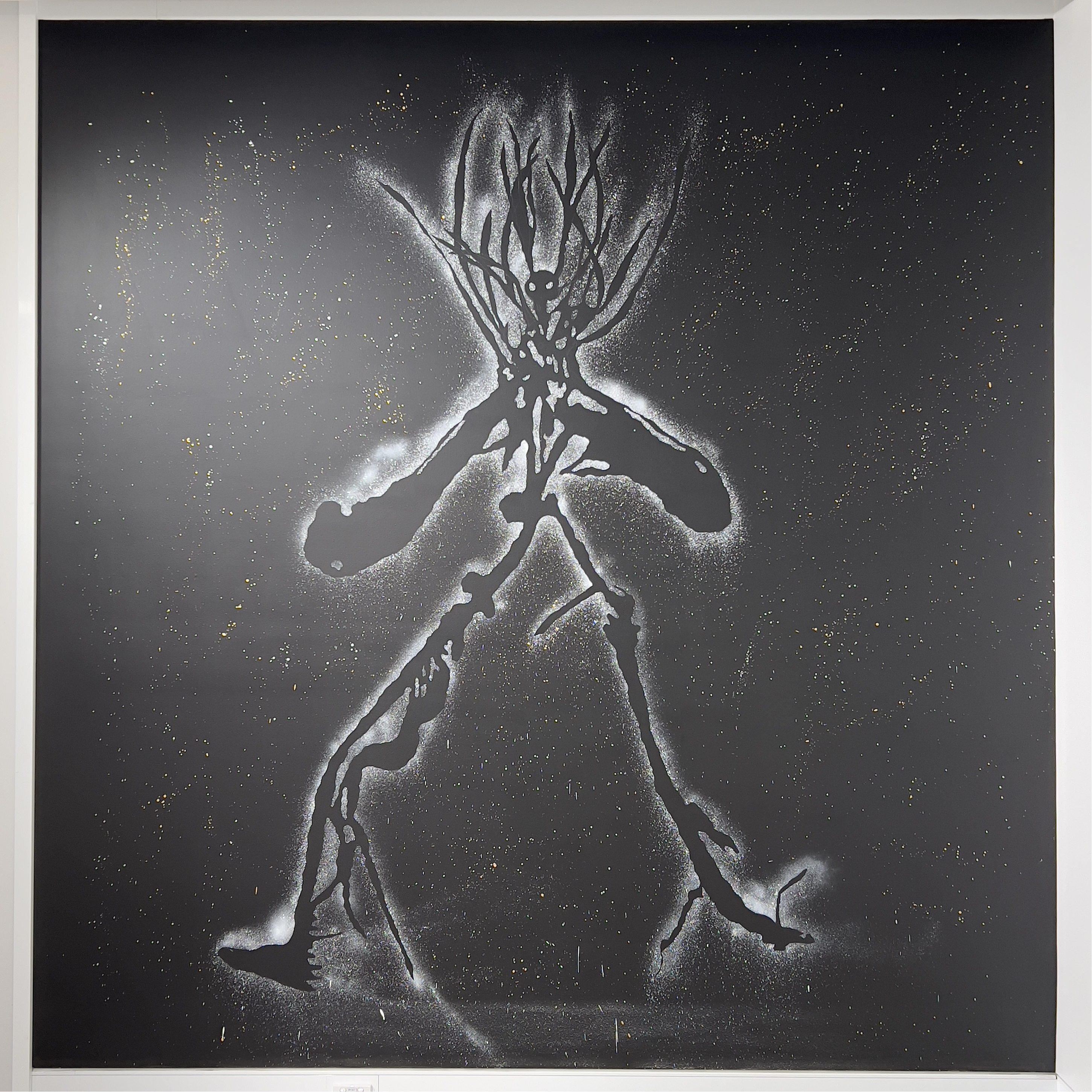
Maddison Gibbs’ artwork Female Protector Spirit.
The ability for Country to speak to, influence and resonate with non-Indigenous artists, like Harrie and her artwork, was also noticed by exhibition visitors, as shown in this quote from an interview: I know the European background of Harrie Fasher's work, the way that the land did speak to her too. (Interviewee 4)
Furthermore, the interviewees discussed their personal experiences of visiting sacred places and how histories can be felt in the body, even without holding strong connections to that place, as Country invites them to learn. This invitation transcends mere observation – it's a call for visitors to develop caring relationships with Country and to develop a deeper appreciation for the cultural significance of place.
Visitors admit to a lack of understanding of the Indigenous knowledges and presences in and around Mudgee but expressed an appreciation for the opportunity to learn and gain insight through the exhibition. Some visitors viewed the exhibition as reflecting a desire of Aboriginal people to share the history and stories associated with The Drip with the wider community. One visitor noted the importance of exhibitions that are reflective of the local community and surroundings: If you go around other country town art galleries, oftentimes they've got exhibitions that have come from the Museum of Contemporary Art … and there's no sense of place, no sense of this is art that belongs to the here and now. (Interviewee 4)
This sentiment underscores the significance of considering the local context and Country in curating exhibitions, resonant with how geographies of art generate meaning (Hawkins, 2011).
The fluidity of people and how water places change over time was a recurrent theme in artworks and how they were received. One interviewee said that: “Aleshia's work in progress (Figure 1) reminds me that waters are not still, stagnant places - rather ever moving, evolving, creating. Like the skin that holds the stories that are being stitched upon it.” This survey respondent offers a metaphoric interpretation of water cultures, focusing on the dynamic nature of water as depicted in Aleshia's work in progress. It draws parallels between the fluidity of water and the stories being stitched onto the artwork, suggesting a connection between water and cultural narratives (Gibbs, 2010), and how these evolve and will continue to evolve over time.
Like Aleisha's artwork, the audio and video pieces (by Kim and Vera) enabled visitors to ‘get a feeling of the place’(Interviewee 4) and reflect on the constant activity that can often go unnoticed - a reminder to be attentive to change and what it might teach us about Country. Even the video loop of the water and then the sounds, it just reminds me that this stuff is just always constantly happening. You're just not there to witness it. It's like things in nature are just always. … It sounds dumb, but it's just always happening and you're either there to capture it or you're not. (Interviewee 3)
In this liminal space, the overlapping of past, present, future, human and non-human, artist and artwork, artwork and visitor, enables a layering of stories, meanings, and memories to coexist and intersect. Here, we can see glimpses of Todd's (2015) hope that art can undo silo-ed ways of knowing and doing, and pave new ways of co-existing and connection to and with places, led by Indigenous knowledges.
Conclusion
The artworks and reflections forming the focus of this paper contribute to Langton's (1983: 8) efforts to ‘find ways to undermine the colonial hegemony’. Curator, artists, exhibition attendees and the authors of this paper share a sense of wanting to care for, value, and better understand, The Drip and Ngayirr Ngurambang. As well as being a highly treasured water place, The Drip is just one part of Ngayirr Ngurambang that has weathered much damage from extractive settler colonial practices, not least from intensive farming and coal mining. As the research presented in this paper shows, these practices are far from over with current coal mining expansion the latest form of intrusive and unsustainable extraction for this water place of Wiradjuri Country.
The artists that Aleshia Lonsdale invited to respond to this water place all attempted to convey complex stances on Country and process, and the exhibition demonstrated a range of ways to understand, and then communicate, Ngayirr Ngurambang. Those who made artworks for the exhibition and were interviewed for this research shared how, from spending time at The Drip and through guidance from Aleshia, their sense of this place transformed their understanding of it. The agency of Country was a theme all exhibition contributors emphasised and wanted to share in their pieces. Differences and tensions reverberated in how Country was understood and engaged with, too, reflecting positionality and opportunities (or lack thereof) for artists to connect with this water place.
Reading The Drip as sacred Country necessitates a different form of relationality and engagement than if it is identified as a part of a National Park, an opportunity to support coal mining, or as a leisure place for settler colonial peoples. For example, Brett Whiteley's ‘artwork’ might be (re)framed as an inappropriate gesture that should be questioned rather than celebrated as worthy of protection within the conservation area. Coal mining expansion may be abandoned as it will place further pressure on the more-than-human worlds in this part of Country; the proposed vegetation removal and increasing water extraction for the mine activities will further harm this water place. Coal mining is a literal undermining of Country.
We do not yet know whether there may be longer term changes with respect to how The Drip is valued and cared for as a result of this exhibition. But we are well aware that this event was, in some ways, transitory: the artists were brought together to capture their knowledge of, and experiences with, Ngayirr Ngurambang and thousands of people saw that work. Then the artworks were taken down, new exhibitions have come and gone since then, and all the while coal mining continues, and those corporations making profit from the fossil fuel substrata are seeking to make more. There are some traces of the exhibition in digital spaces, including the interview with Aleshia Lonsdale and stills of many of the artworks, and perhaps those people that saw the exhibition have been activated to nurture Ngayirr Ngurambang.
The Ngayirr Ngurambang: Sacred Country exhibition punctured the power and presence of extractive regimes in the Mudgee area, as it brought together Indigenous and non-Indigenous artists to share their interpretations and connections with a water place that survives despite significant pressures. The exhibition is an instance of asserting Indigenous presence and resistance but also co-existence between Indigenous people and settlers in this area. By demonstrating multiple and, at times, complicated relations with and reactions to Country, for the first time the broader Mudgee community, and visitors to the area, were invited to look at The Drip as valued Country. And to imagine that another world is possible (Demos, 2016b). This paper documents the exhibition that provided that invitation and multiple perspectives surrounding this event and social process, building on previous geographies of art scholarship. Just like the possum skin cloak for Aboriginal people in the area, Indigenous water places are made and remade over time and space and this paper tracks one instance of that.
Footnotes
Acknowledgements
A massive thank you to Aleshia Lonsdale, curator of Ngayirr Ngurambang: Sacred Country, for all her amazing work in creating the exhibition and inviting us to share aspects of that process in this paper. Thanks to all the artists for their wonderful contributions and allowing us to share their reflections on their works, and especially Maddison Gibbs, Sam Paine and the Mudgee Local Aboriginal Land Council for allowing us to share images of their artworks. Thanks to Mudgee Arts Precinct for helping to facilitate data gathering and hosting this important exhibition, and Lizzy Galloway (Gallery Curator) and Andy Robards (Cultural Officer) for their support. Thanks to the exhibition attendees who agreed to be interviewed or completed a survey about Ngayirr Ngurambang: Sacred Country.

Ethics approval
Ethics was approved through Macquarie University (approval number: 12414).
Funding
The authors received no financial support for the research, authorship, and/or publication of this article.
Declaration of conflicting interests
The authors declared no potential conflicts of interest with respect to the research, authorship, and/or publication of this article.
Data availability statement
The data underpinning this manuscript is not available for share and reuse as it is confidential and contains identifiable information that participants have not approved as being able to be used for any purpose other than this work.