




Abstract
This article discusses the growth of Pentecostal churches in favelas of Rio de Janeiro, Brazil. The author pleads for a systemic inclusion of religious ideas and practices in theoretical reflections on citizenship in the urban contexts of Brazil. Concretely, scholars need to include the explosive rise of Pentecostalism in their reflections on insurgent citizenship this religious movement fuels rights discourses and supports feelings of pride and dignity in the face of structural spatial exclusion. The author highlights two important relations between favela building practices and Pentecostalism. One concerns the affinity between the bottom-up organizational and doctrinal structure of the biggest Pentecostal denomination in Brazil (the Assemblies of God) and the informal building practices of favela residents. The other concerns the elective affinity between autoconstruction in terms of Pentecostal projects of self-fashioning and self-governance and autoconstruction in terms of favela building practices.
Introduction
One afternoon in February 2003 during fieldwork in Visionário, a favela in Rio de Janeiro, I was accompanying two male friends—Ricardo and Leonardo—on their way home, when I noticed an unusual amount of police officers on patrol. 1 We entered the favela, passed the principal temple of the Pentecostal Assembléia de Deus (Assemblies of God/AG), and were nearing the spot where local gang members commonly sell cocaine and marijuana, when we were confronted by five police officers who ordered us to halt. Several were holding a firearm in their hand and all of them seemed agitated. They instructed Ricardo to lift up his shirt so they could check if he was armed. All three of us had to put our hands up high and were ordered to spread our legs so we could be searched, most probably to check if we were carrying drugs. The officer who was about to search me, kicked one of my feet aggressively to spread my legs further and my two friends received the same treatment. In reaction, Leonardo, spoke firmly to the officer: “take it easy man, that is not normal conduct. I studied law and I know I have rights!” The officer did not back down, after which Leonardo told him even more resolute: “Do you know, whose son I am?” The officer did not reply. Leonardo repeated: “Do you know, whose son I am?” and without waiting for an answer, he continued loudly: “I am a son of God!” The officer, who did not find anything incriminating on Leonardo was clearly annoyed by Leonardo’s posture and shouted: “Get out of here.” He pushed him away and signaled that we were free to continue our path. When we arrived at Leonardo’s home, he immediately told neighbors and relatives what had happened and they all congratulated him with his firmness. Ricardo and Leonardo turned to me and said: “This is what happens all the time, they have no right to behave like that. You should not bow your head to them because they don’t respect you and they will take advantage of you.”
Insurgent Pentecostal Citizenship
This encounter brings together a number of social and cultural dynamics that are at the heart of this article and that continue to play an important role in urban struggles in Rio de Janeiro today. The short vignette describes an experience shared by many favela residents in Rio de Janeiro who suffer from police brutality, accompanied by racial discrimination and spatial segregation and by the hardships of low-income, poor education, and limited access to the formal economy.
In his work on citizenship, Holston (2008) analyzes how Brazilian society has managed to reproduce social inequality systematically while maintaining the widely shared (and erroneous) idea that Brazil should be proud of its unique multiethnic society. According to Holston, Brazil’s constitution presents a fairly inclusive citizenship, but Brazilian society reproduces differentiated citizenship by legitimizing different treatments of different types of citizens, categorized on the basis of social dimensions such as education, racial identity, and property. Holston shows how, throughout Brazilian history, the law has been used to legalize the illegal, the unjust, and the unequal. The effect of this differentiated citizenship is that, practically, rights are distributed unequally across the spectrum of different categories of citizens.
According to Holston, such a differentiation does not go unchallenged though. More and more disadvantaged Brazilians engage in “law talk.” Precisely those citizens who came to the cities to work in an industrializing economy and who were marginalized spatially and needed to build their shacks on terrains in the peripheries of the metropoles have sought means to legitimize their self-built homes and neighborhoods. Great portions of the urban population of cities such as São Paulo and Rio de Janeiro live in informal neighborhoods they constructed themselves without governmental aid. This autoconstrução (autoconstruction) as it is called in the Brazilian context and how Holston also calls it involves the building of homes—first from wood and clay and later from brick and cement—and the accompanying building of access roads, alleys, and so on.
By means of resident associations, formed between the 40s and the 60s, residents of marginalized neighborhoods in São Paulo and Rio de Janeiro organized their struggle for social and material services. According to Holston, it was precisely in these marginalized contexts that people learned to communicate their self-defense against eviction attempts in terms of citizen’s rights. These contexts “gave them new understandings of the basis of these rights and of their dignity as bearers of rights” (Holston, 2008, p. 235). For Holston, this sense of dignity was not in the least supported by autoconstruction.
[A]s residents spent decades transforming shacks into finished, furnished as decorated masonry homes, this autoconstruction became a domain of symbolic elaboration . . . Thus autoconstruction turned the peripheries into a space of alternative futures, organizing social movements, participating in consumer markets, and making aesthetic judgements about home transformations. (Holston, 2008, p. 8)
Holston’s analysis that connects self-organization, building practices, and law talk is impressive as it proposes the idea that informal settlement is a positive source of insurgent citizenship practices and struggles for equality in the face of exclusion. Here, I take his work as an inspiration to theorize new urban assemblages (McFarlane, 2011) in another Brazilian megacity. Let me briefly return to my vignette before outlining the argument.
When we encountered the police officers in Visionário, I had been accompanying Leonardo for a period of months. He was (and still is at the time of writing) member of an AG congregation in the favela. I know for a fact that Leonardo did not study law (he was hardly going to school at the time), yet he was a devout congregant, who never missed a church service. One of the striking features of Leonardo’s exclamation in the face of police aggression was his spirited fusion of discourses in the midst of a ritualized encounter with the law.
In his famous work on Brazilian sociocultural rituals, hierarchy, and order, DaMatta (1991), identified the phrase: “Do you know who you are talking to? (Voce sabe com quem está falando?),” as a prominent element of the ritualized exchanges between Brazilians and the law. According to DaMatta, the phrase is commonly used to mitigate the bureaucratic and impersonal application of the law to all citizens equally at all times in a society where power and hierarchy are maintained by means of social ties, intimate connections, and family relations. When confronted with the unwanted consequences of the law—when dealing with state bureaucrats, for example—Brazilians frequently ask this question to signal that it is better not to apply the law so rigidly because there might be consequences based on the person’s power derived from the network of relations.
When Leonardo asked the police officer in the favela, a place where police officers regularly apply the law rigidly or bend it to their will: “Do you know, whose son I am?” he employed this ritualized expression in an unusual ritual context and infused it with a particular Pentecostal model of sovereignty. For a brief moment, the police officer might have thought that Leonardo would identify himself as the son of a powerful police-chief, judge, or attorney, revealing his position in the network and demanding a beneficial treatment. That might have been unexpected given the context but not impossible. However, Leonardo creatively altered the ritualized exchange, instilling it with Christian political theology. In accordance with Leonardo’s firm posture, his statement alerted the policeman that beyond his authority as officer of the state exists a higher authority (God) who ultimately decides the fate of mankind and that he (Leonardo), as born-again Christian belongs to the community of the saved—the children of God—who can call on His power and protection when the state fails to treat him righteously. Strikingly, Leonardo did not negate the authority of the law and the officers as exponents of it. First and foremost, he reminded them that the law itself ultimately derives its authority from God. Marshall (2009) has perhaps said it most cogently when she stated, “the Born-Again conception of sovereignty fails to institute the distinction between power and right, or to put it in religious terms, between grace and works of the law” (p. 211).
This vignette allows me to present clearer the aim and outline of this article. Holston’s insight to connect “law talk” to autoconstruction offers us a number additional perspectives to analyze ways in which citizenship is conceived and practiced bottom up in contemporary Rio de Janeiro, Brazil. As Lazar (2012) noted, citizenship contains much more than a legal status and should be analyzed as a “bundle of practices that constitute encounters between the state and citizens” (p. 360). As such, according to Lazar, it is principally about political agency that is mediated by state and nonstate organizations (see also Koning et al., 2015). These collective organizations, as Lazar calls them, profoundly influence ethical-political self-fashioning that gives content to citizenship.
In the context of Latin America, religious organizations play important roles in such self-fashioning and in mediated citizenship. While scholars have noted that the Roman Catholic church is losing its hegemonic position in many Latin American countries, such a development should not persuade us to think that religion plays a minor or dismissible role in citizenship practices. As Rubin et al. (2014, p. 8) state about Latin American citizenship and religion, All too often, research on social movements, citizenship, and zones of crisis has seen the world through the secular eyes of progressive scholars, eliding the role of religion in shaping what Partha Chatterjee (2006) calls the on-the-ground “politics of the governed.” This is the case even as the hegemony of the Catholic Church has vastly diminished, yielding a new religious landscape that includes rapidly expanding Evangelical movements and increasingly public representations of indigenous and Afro-descendant knowledges. Citizenship as it is lived in Latin America's zones of crisis is permeated by religious symbols and rituals and is frequently influenced by religious leaders and institutions.
While I agree with their complaint, their observation does not tell us yet how citizenship is permeated by religion in specific contexts. In the remainder of this article, I explore the notion of Pentecostal autoconstruction to argue there is an elective affinity between autoconstruction in terms of the Pentecostal project of self-fashioning and autoconstruction in terms of the building of edifices (houses, churches) in marginalized urban spaces of the Rio de Janeiro. Together, these two forms of autoconstruction fuel bottom-up understandings of citizenship and rights, I suggest. Inhabitants who struggle to build their own houses frequently turn to Pentecostal theology and practices that offer future-oriented notions of perseverance and success and demand disciplined behavior and faith. The “evangelical resonance” (Connolly, 2005) between different registers of autoconstruction extends to other domains of favela life, as the oratory style of Pentecostalism and its focus on Biblical codes and norms are important sources of notions of righteousness and authority and feelings of dignity and pride that regularly become entangled with rights discourses and citizenship claims.
The material for this article stems from regular research intervals in Rio de Janeiro for nearly two decades. Much material derives in particular from my research in Visionário, a favela where I have been doing ethnographic fieldwork in 2001, 2002, 2003, 2009, 2011, 2014, 2016, 2018, 2019, and 2022 and from research in a favela called Roda do Vento where I did research in 2011 and 2019. 2 In both favelas, I interviewed residents, pastors, and members of several Pentecostal churches. Besides my research in Visionário and Roda do Vento, I did exploratory research in other favelas, such as the Complexo do Alemão, Prazeres, and São Carlos, and I accompanied gospel artists on route to their performances in churches in peripheral neighborhoods of the Baixada Fluminense (the region north of the city).
The Pentecostalization of Rio’s Favelas
Rio de Janeiro is the second largest urban agglomeration of Brazil, after São Paulo, and has about 12.5 million residents. Rio’s cityscape reflects the socioeconomic inequality in Brazil as gated communities of upper-class residents border impoverished neighborhoods. The socio-spatial opposition between morro (hill) and asfalto (asphalt), in particular, expresses well Rio’s urban segregation and sociopolitical struggles. Many of the morros display favelas, large neighborhoods made up of small, self-built houses of brick and cement, surrounded by residential neighborhoods with high-rise buildings, shops, public transport, etcetera, commonly denoted as the asfalto. I hasten to add that the discursive opposition between morro and asfalto regularly obfuscates the entanglements between favelas and their surrounding neighborhoods and obscures the circulation of people from one to the other, as Perlman (1977) and Valladares (1978) have noted a long time ago.
Throughout the 20th century, urban planning policies have frequently labeled favelas as unwanted urban forms and many favelas have been eradicated throughout the years. Since the 60s, civil organizations have opposed favela eviction policies on a structural level and have fought for favela upgrading programs that could improve the well-being and security of its residents. Beyond economic inequality and infrastructural disparity, favela inhabitants generally face stigmatization and unequal treatment before the law and struggles for equality often address racism and police violence. Despite the relative success of the efforts of civil organizations, resulting in the construction of sewage systems, regular water supply, and garbage collection, the disparities between favelas and middle- and upper-class neighborhoods remain a palpable expression of Rio’s socioeconomic inequalities.
The brick and concrete houses of Rio’s favelas, built close and on top of each other, form large residential areas that generate their own formal and informal economies. These self-built neighborhoods display similarities with urban settlements in other Latin American countries but favelas have their own particularities. For instance, favelas are characterized by specific extralegal violent organizations (faccões and milícias) that display particular historic relations with state institutions and particular enmeshments with cultural expressions (Hirata & Grillo, 2017; Machado da Silva, 2008; Zaluar & Conceição, 2007).
As many people have described, Pentecostalism has become ubiquitous in the favelas of Rio de Janeiro and has permeated all levels of social life (da Cunha, 2009; Lanz, 2016; Mesquita, 2009). Pentecostalism is one of the fastest-growing religious-cultural forms in the world. In general, Pentecostalism emphasizes the gifts of the Holy Spirit (charismata) such as faith healing and speaking in tongues (glossolalia). By and large, Pentecostal practitioners understand the devil and his demons as evil forces that try to lead humans to destruction. The permanence of this evil enforces the so-called duality of the Pentecostal worldview (Droogers, 2001, p. 46): the understanding that the world is divided between those who follow God and those who follow the devil. Accepting Jesus as one’s savior is understood as a fundamental act of conversion. In Brazil, it is common to refer to the cluster of Pentecostal, Protestant Charismatic, and Born-again Christian groups as evangélicos (evangelicals). The Brazilian census of 2010 showed that 22% of the population described itself as evangélico but the majority of Brazil’s 42.3 million evangélicos identify themselves as member of a Pentecostal denomination (on a population of approximately 190 million).
Anyone who is familiar with social life in favelas in Rio de Janeiro has heard and seen the importance of Pentecostal churches of different sizes and denominations (Rivera, 2018). Two Pentecostal churches stand out: the Assemblies of God (AG), the denomination with the most evangelical members in Brazil, and the Igreja Universal do Reino de Deus (Universal Church of the Kingdom of God/UCKG), arguably the most visible Pentecostal church in Brazil. 3 Both churches draw people from lower economic classes in Brazil and one finds many members of these churches in Rio’s favelas and peripheral urban zones. Many leaders of neo-Pentecostal denominations have preferred to build conspicuous church buildings on the asfalto (the UCKG, for example) but denominations such as the AG or independent evangelical/Pentecostal churches have often built churches within the favela territories.
The Roman Catholic church played a large role in the civic organizations that acted in the favelas of Rio de Janeiro and struggled for social services since the 1940s. Nevertheless, the democratic transition in Brazil in the end of the 80s was followed by a declining role of the Catholic Church in the context of favela life and a massive increase of people from the lower classes who adopted born-again lifestyles and joined Pentecostal churches. Some have argued that this transformation diminishes the capacity of favela residents to resist the hegemonic powers that marginalize them. According to Burgos (2005), the individualizing theology and the market logic of the neo-Pentecostal churches weaken the collective territorial identification supported by a communal Catholic ideology. Nevertheless, Burgos also recognizes that “by contributing to the formation of more autonomous individuals, the evangelical churches potentially create favorable conditions for processes that affirm new subjects in the public sphere” (Burgos, 2005, p. 207). I specifically concur with Burgos’s last speculation and want to add that it is important to examine the kind of territorial politics that Pentecostalism helps to produce, instead of focusing what it presumably lacks or demolishes, according to (parts of) its theology.
Pentecostal Autoconstruction
Recurring visits to Visionário showed me the building processes of the families I know since I first did research in the favela in 2000. By and large, people keep upgrading and extending their houses over the years. When they are able, they save money to buy bricks and other construction materials, so they can plaster a wall or build new rooms. Many of my acquaintances also added a number of floors over the years—contributing to what is known as the verticalization of Rio’s favelas. Always when I would return to visit people, they would first show me what they had added or improved to their houses (see also Cavalcanti, 2009; Motta, 2014).
While autoconstruction is not restricted to people of any specific creed, I was struck by the Pentecostal language of battle that my interlocutors employed in the face of residential challenges. Brazilian Pentecostalism is formed by a heterogeneous collection of practices and it is therefore important to identify differences and similarities between the different Pentecostal denominations active in Rio de Janeiro’s favelas. As I will show below, the markedly territorial presence of AG churches produces different entanglements between Pentecostalism, spatial presence, and political agency than the neo-Pentecostal UCKG. Nevertheless, people from both denominations that I interviewed over the years recounted how their struggles to get ahead in life depended on spiritual discipline and hard work. Even though the UCKG is regularly identified as the neo-Pentecostal church par excellence—spreading their prosperity gospel that reproduces a neoliberal, entrepreneurial subjectivity—the AG members that I followed by and large narrated similar discourses and highlighted that if one goes to church regularly and lives a Christian life, one will receive material gain.
For example, in October 2002, I interviewed Carlos, who was in his late forties at the time. Carlos lived with his wife in a concrete and brick favela house in Visionário and he had invited me to interview him at home. He recounted that he had lived a hard life. He was drinking a lot and using drugs, searching for a purpose in life. He had identified himself as a Catholic in the past but recounted that it did not really give him much direction. At a certain point, his spouse started frequenting the UCKG but for a long time he did not want accompany her. However, not long after her conversion, he started going to UCKG services also. Not often at first, but more and more gradually. When he went, he experienced a tremendous spiritual battle. He felt the malevolent spiritual entities moving in him, resisting the powers of the Holy Spirit and trying to hinder his liberation. However, he did not give up and continued going to church: I arrived in church with many debts my brother—I talked to God, and I said, if I am to stay, I need to be able to gain some money. And God heard me. I was working as a life-guard at the beach every other day and God showed me, “if you mount a kiosk here you can sell some soda on those days you are not working as a life guard.” And so I did. I started an association with another life guard and fellow church member and we each worked one day as a life guard and the other day at our kiosk, taking turns so there was always someone there. I worked hard and three years went by as if it was one day. I was getting my life in order—going to church. And then I sold my part of the business and invested everything in this house (barraca) made of bricks that you are seeing here. It used to be made out of wood and parts of the wall had fallen down. Everything had to be built up from scratch. First, I managed to build a roof and then I managed to put up a water tank and then a veranda. It was all done step by step, little by little.
Carlos’s narrating of spiritual and material battles is comparable to the accounts of many other interlocutors who frequented other Pentecostal denominations in Visionário. When I first interviewed Leonardo, who I briefly introduced in the opening vignette, he was still living with his mother, his three sisters, and his brother in a favela house with three small rooms. Four others sisters had already built their own houses elsewhere and no longer lived with them. When I asked Leonardo how he thought about he was going to be able to have a house of his own, he explained, You have to fight (lutar) for it. Nothing falls from the sky. You have to do what you can (correr atrás). You have to ask God and he will give it but you have to work for it if you want to make that happen. If I work hard for a couple of years and save money, I can build my own house. The pastor has helped me, he gave me advice and he arranged a job. It was not easy to find work, he prayed a lot and I also prayed much.
It can take some time before people manage to build their own house in the favela, and some never succeed. In 2022, I spoke extensively with Marcello, whom I first met and interviewed in 2002 when he was in his mid-thirties, living in a small room attached to the principal temple of the AG at the entrance of the favela. At the time, he explained how he had deviated from the right path in his youth. He had started smoking marijuana and sniffing cocaine, while illegally trading barbiturates. About 5 years before our interview in 2002, he had accepted Jesus as his Savior and returned to church. When we met 20 years later, he immediately took me to his house. It had two small rooms at the ground floor, one of which he rented out. After showing me the ground floor, we climbed the small concrete stairs at the side of his house and he proudly showed me the construction work on the second floor. The floor had no walls or a ceiling (yet) but the concrete pillars needed to build a roof were already in place. Also, he had placed a desk at a spot from which he could overlook the city below. “I often sit here to read in the Bible in the morning,” he said. Marcello explained that constructing a house is a providence of God: “I try to live and behave in such a way that God may act in my life. You cannot predict that you get what you want but if you live a good life, chances are higher that God can perform in your life.” Later on, he took me on a small tour through the favela to show me what had changed architecturally. When we passed an old acquaintance that I had not seen in 20 years, we exchanged some thought about the religious changes in the favela and the acquaintance stated, “I am Catholic but I see that the evangelical churches are motivating people much more to take action (correr atrás). It is not criticism but an observation, I should also learn that. These churches stimulate entrepreneurialism (empreendedorismo) much more.”
As Lanz (2016) and Garmany (2010) have also described, the Pentecostal practices that spread in the marginalized urban spaces of Brazil have introduced in these places groundbreaking modes of self-governance. At the heart of the disciplinary religious practices that co-produce Foucauldian forms of governmentality stand born-again theology and practices that envision the possibility of a radical break with perilous lifestyles. Building on the work of Marshall (2009), among others, Lanz notes, “Applied to the Pentecostal movement, the concept of governmentality enables us to understand religious communities as programmes of conversion and redemption and as technologies of governance with which to collectively implement these programmes and anchor them in the individual” (Lanz, 2016, p. 548). In addition, Lanz notes that Pentecostalism has not radically changed the urban informality of the favela but it has permeated all levels of daily life in the favela up to the point that the favelas have been “pentecostalized” and Pentecostalism has been “favela-ized” (Lanz, 2016, p. 553).
We can extend this line of thought and understand better how Pentecostalism became embedded in Rio’s favelas by looking at the connection between autoconstruction in the material sense—the informal practice of building houses and churches—and autoconstruction in the spiritual-subjective sense—the practice of breaking with particular lifestyles, identifying as a born-again and attempting to live according to Biblical norms. Characteristic of the conjunction of these two forms of autoconstruction are the evangelical emblems and stickers I regularly encountered on the doors of favela houses. Many of these emblems displayed the following phrase: “Eu e minha casa serviremos ao Senhor” (Me and my house will serve the Lord) (Figure 1). While this phrase may also signal that the entire household is evangelical, this does not diminish its significance. Visionário residents by and large try to build floor upon floor so that sons and daughters can also have a place to live, and even though Pentecostal ideology dictates that salvation is personal, the family is commonly described as an extension of the self.

Phrase: “Me and My House Will Serve the Lord,” Which Pentecostal Adherents Attach to Their Front Door. 2020. Photo
The two forms of autoconstruction I denote here should be understood as aspirational (see also Burchardt & Westendorp, 2018; Van der Veer, 2015) in the sense that both can be regarded as work in progress and people often narrated this type of work self-reflexively. Even though evangelical converts regularly described themselves as born again and as radically transformed, the same people also regularly described their life in terms of a continuous struggle against temptations and the machinations of the devil (Oosterbaan, 2017).
Organizational and Spatial Differences
While one can discern similarities in the entrepreneurial language of members of the AG churches and those of the UCKG, there are differences between the two churches such as their spatial presence and topographic distribution. The UCKG is organized top-down and the church direction commonly plans where the church should build a new temple. Also, the UCKG generally builds large temples at the fringes of the densely populated favelas or outside of them. In contrast, one may find many AG temples inside Rio’s favelas as there are plenty of born-again favela residents who build or open a church in their own neighborhood and seek a partnership with an AG branch (or another Pentecostal denomination) in a bottom-up fashion. According to Fajardo (2015), who did research on the growth of the AG in São Paulo, there is an affinity between industrialization and urbanization processes and the internal organization of the denomination. The fluid model of AG multiplication based on decentralization and institutional fraying, combined with the accelerated emergence of the city’s peripheral neighborhoods, contributed to the development of AGs, a process also observed in other regions of the country. (Fajardo, 2015, pp. 323–324)
In relation to Rio de Janeiro, Monica Machado noted early as 1997 the unique territorialization of Pentecostal churches such as the AG that proliferated in the peripheries of the city. In her terms, they are characterized by a “fleeting and informal territoriality” that, in contrast to the Roman Catholic church allows people to rapidly establish churches in the same informal spaces (favelas) where they live (see also Mesquita, 2009).
The works of these authors highlights the fact that there are important affinities between the organizational structure of the AG, their doctrinal position, and the autoconstruction practices of the favela residents. Just as people are encouraged to struggle (lutar) to build their own houses, church members are also encouraged to aid in the building process of their local church. As I observed in Visionário, pastors and congregants regularly team up to improve their local church building. In 2002, I occasionally supported pastor Rodrigo with the obra (work) of upgrading his small congregation (Figures 2 and 3) and I witnessed how the presbyter (presbitério) of Rodrigo’s church built concrete stairs that opened up a faster route to the church which subsequently also allowed other residents to reach their houses easier (Figure 4). At the time, I also observed the gradual improvements of another AG church—the church where Marcello congregated—and I witnessed the hard labor of its pastor and congregants (Figure 5). In 2022, Marcello took me back to this AG church and proudly showed me the improvements they made over the years.
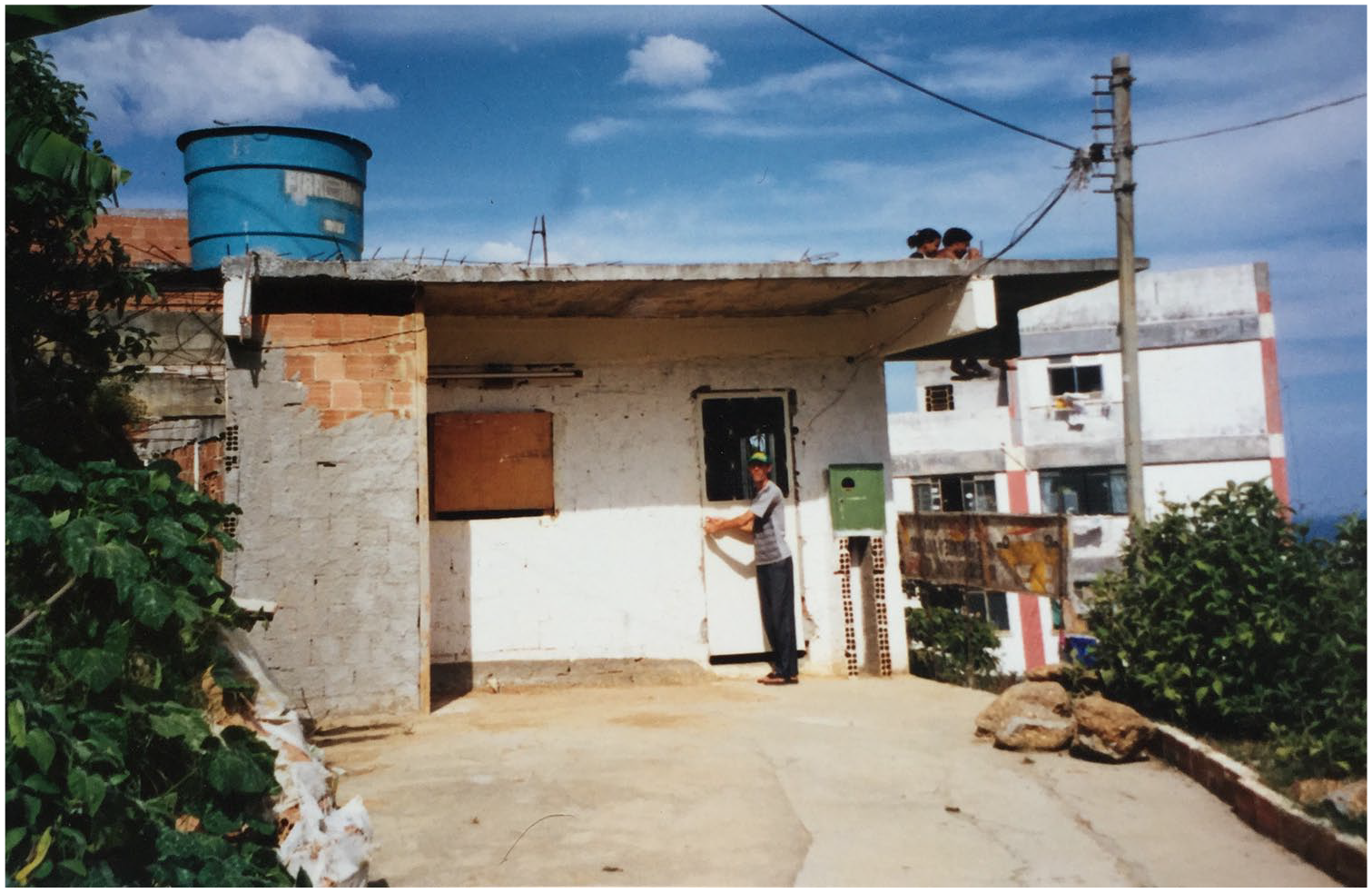
Gradual Upgrading of a Small Assemblies of God Congregation in Visionário. 2002. Photo
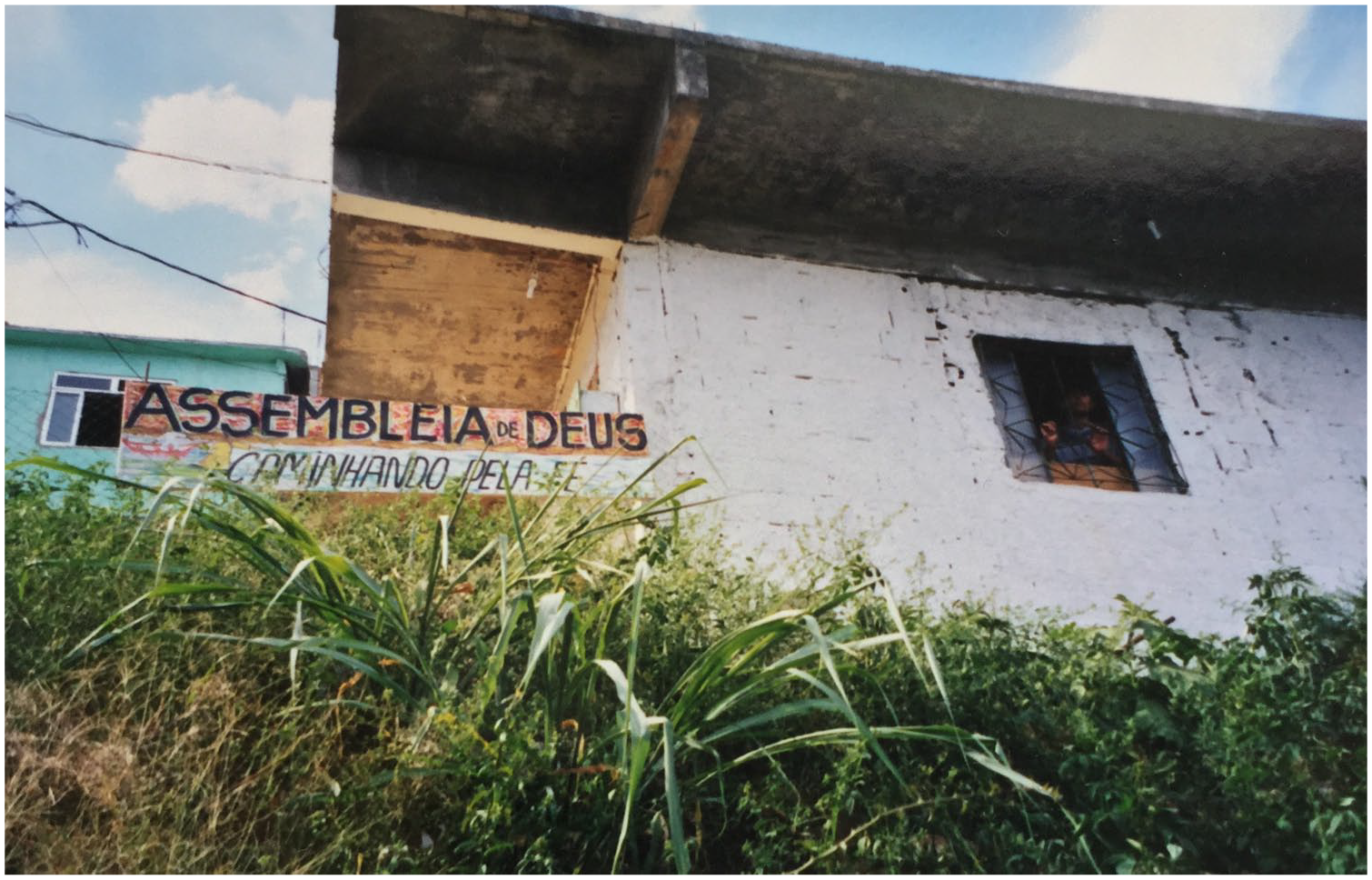
Gradual Upgrading of a Small Assemblies of God Congregation in Visionário. 2002. Photo
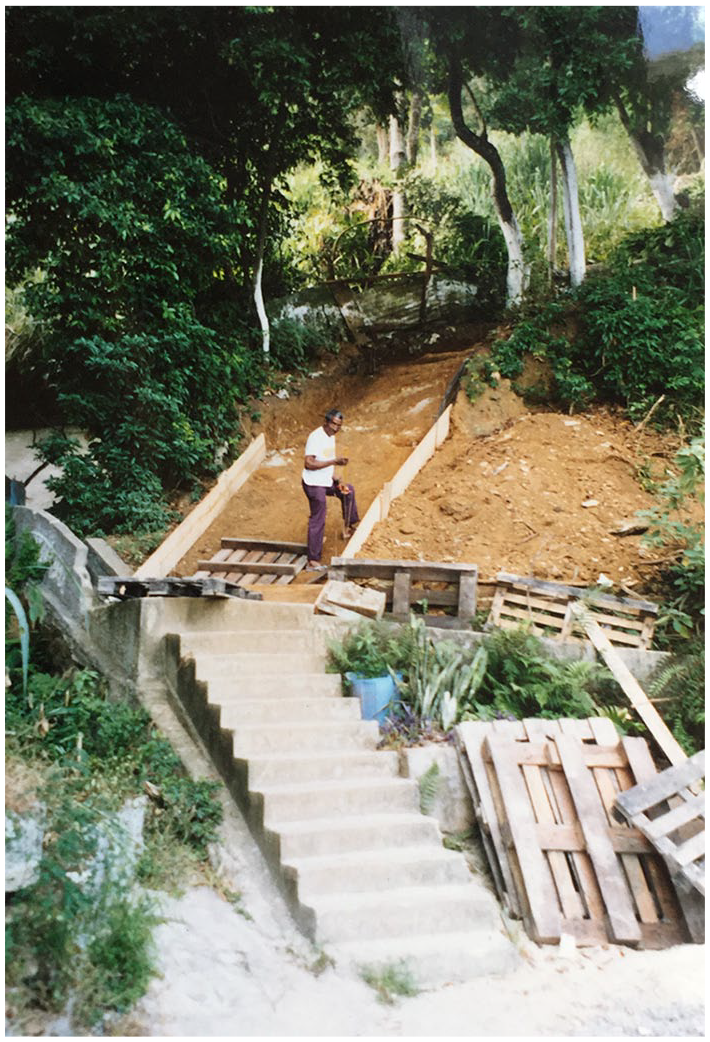
Building of Concrete Flight of Stairs Leading to Assemblies of God Congregation in Visionário. 2002. Photo
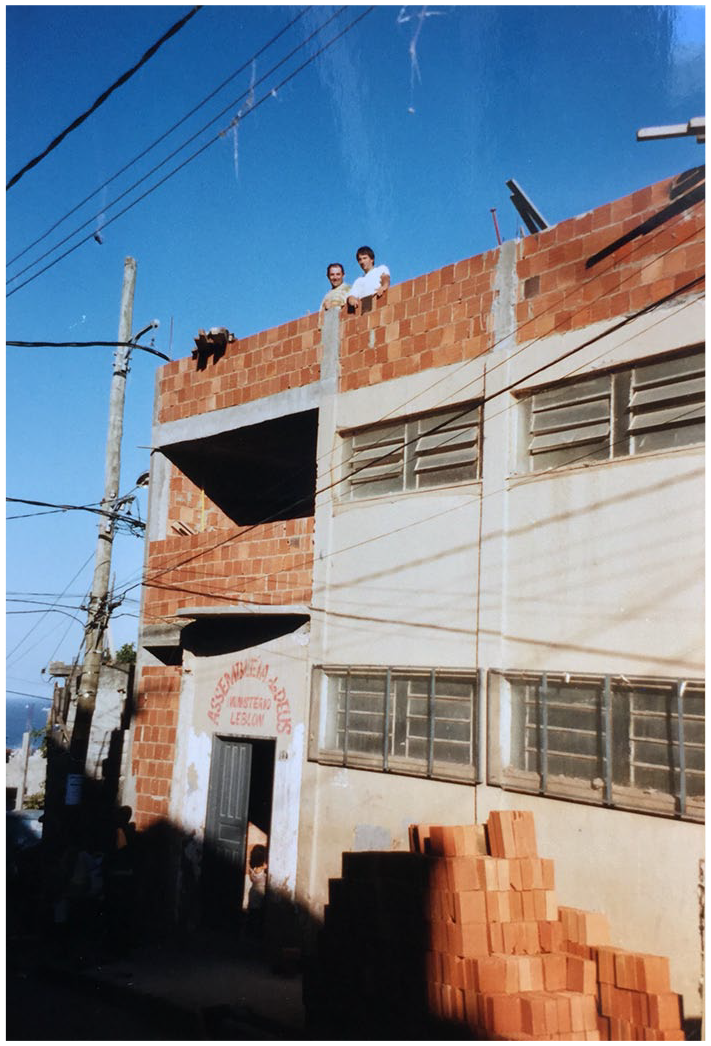
Upgrading of a Larger Assemblies of God Congregation in Visionário. 2002. Photo
Financial contributions to upgrade the churches come from the congregants and sometimes from the larger conglomeration of which a local AG is part. For example, one local AG temple in Visionário is part of the Assembleia de Deus no Leblon (Assemblies of God in Leblon), commonly described as the sede (headquarters/mother-church). The mother-church originally saw the light in the favela Vidigal in 1937. In the decades thereafter, several branches sprouted in nearby favelas including in Visionário. As visible on the church’s website, the mother-church calls the local church improvements “missions” (missões), which they describe in the following manner: “By His grace and mercy, God has provided us with the expansion and renewal of our temples. There are 34 congregations that have been or are undergoing reform or expansion.” 4
Leadership, Presence, and Citizenship
During my research in Visionário in 2002 and 2003, I witnessed how several pastors of local congregations of the Assemblies of God churches rose as important local figures and participated in the regular meetings of the local liderança (governance) that included among others the president of the residents’ association and local NGO directors. The president of the residents’ association was an AG pastor and his secretary, who later became president herself, was also an AG member. By and large, pastors were and are respected in the community. Even the young men that were part of the armed faccão seemed to recognize their genuine calling to help favela residents in the face of urban marginalization. Moreover, pastors regularly approach the young men to tell them that Jesus loves them and to invite them to a church service.
Christina Vital da Cunha (2009, 2014), who did research in the favelas Acari and Santa Marta in Rio de Janeiro, confirms the presence and important role of local Pentecostal leaders in favela governance (liderança). Da Cunha emphasizes that this presence does not necessarily signal the unity of all Pentecostal denominations in favela politics, as each denomination tried to attract followers and often engaged in competition with each other. Moreover, she notes that Pentecostal church leaders did not often engage in political mobilization and action. Nevertheless, da Cunha also highlights the sense of power and protection emanating from grass-roots Pentecostal practices (healing, divine protection, spiritual cleansing, economic opportunity), boosting a common understanding and experience that these congregations offer respectable and concrete answers to the perils of favela life.
During my first fieldwork in 2002, the particular bottom-up, evangelical-political momentum in Rio de Janeiro was strengthened by the reign of two consecutive governors of the state of Rio de Janeiro. During their rule, governors Anthony Garotinho (1999–2002) and Rosinha Garotinho (2003–2007), husband and wife, introduced the governmental welfare program called “Cheque Cidadão” (Citizen’s Check). Families with children below the age of 18 could receive 100 reais per month if they could demonstrate that their child/children were going to school. In Rio de Janeiro, the distribution of the checks was channeled through religious institutions and in the majority of cases through AG churches (M. D. D. C. Machado & Maríz, 2004). As a consequence of this religious-governmental infrastructure, pastor Rodrigo became responsible for the distribution of the checks and I witnessed how he tried to persuade the church members to sign up for this program.
Over the years, the political dynamics in the favela changed, partly due to Rio’s pacification policy (see Oosterbaan, 2021), but evangelical congregants continued to play a major role in the local liderança. In 2018, one of my first contacts in Visionário, a congregant of a small AG, was elected president of the residents’ association. She had started studying law in her thirties, among other reasons to be able to stand up for the rights of favela residents against the extralegal violence of the state she had witnessed from close-by. She resigned as president of the residents’ association not long after her installment when the local faccão members wanted to tax residents who rented out rooms or apartments. According to her, she could never support such a taxation: “residents will never accept this, particularly those who have built these houses with their own hands. Should they be forced to pay? No that is not right.” 5
Conclusion
It should be clear that I do not argue that Pentecostalism is the primary source or only motor that mediates citizenship in the favelas of Brazil. Moreover, Pentecostal doctrines and practices do not necessarily enforce nonviolent liberal governance envisioned by some citizenship theories. As Arias (2014), Lanz (2016), and da Cunha (2014) have shown, for instance, faccões and milícias have also turned to Pentecostalism to legitimize their authority in favelas in Rio de Janeiro and the rigid discursive Pentecostal oppositions between good and the evil and the redemptive powers mediated by Pentecostal pastors do not hamper the rise of born-again violent actors who present themselves as upright people in the muddy context of “fragmented sovereignty” (Davis, 2010). All this does not contradict my point, however. Holston himself acknowledges that criminal faction members in São Paulo employ “rights talk” at times and, as Machado has argued (2014), some Pentecostal congregations in Rio de Janeiro offer redemptive scripts that picture criminals as marginalized subjects who, by way of their evangelical confessions, can reclaim citizenship. In other work (2016), C. Machado has shown how governmental citizenship projects that aim to “pacify” the city interact with Pentecostal projects and groups that reproduce redemptive narratives and techniques (see also Oosterbaan and Machado, 2020).
The material presented here offers a confirmation of Holston’s emphasis on autoconstruction as a powerful source of pride and dignity that stands at the heart of insurgent citizenship and demonstrates that material autoconstuction regularly intersects with spiritual autoconstruction in the Pentecostal sense. Congregational favela communities offer their members spiritual-emotional aid and practical support, and urge them to follow strict Biblical codes so that they can emerge as victors in the face of socioeconomic hardship and urban marginalization. Succeeding to build one’s own house and/or a local church with the help of the Lord supports a strong sense of self-value and dignity, which strengthens a sense of equality when confronted with Brazil’s socioeconomic segregation and stigmatization. Autoconstruction is certainly not always successful or stable. Self-built churches may disappear and residents may accept Jesus at one point and gradually abandon the evangelical regime later. Nevertheless, Pentecostalism as it is lived in the favelas of Rio de Janeiro offers new forms of political subjectivity that mediate citizenship in unprecedented ways.
Footnotes
Declaration of Conflicting Interests
The author(s) declared no potential conflicts of interest with respect to the research, authorship, and/or publication of this article.
Funding
The author(s) disclosed receipt of the following financial support for the research, authorship, and/or publication of this article: The author received financial support for the research for this article from the European Research Council (ERC) under the European Union’s Horizon 2020 research and innovation programme (Grant agreement No. 818707).
