




Abstract
This article examines Pentecostal architecture as an expression and apparatus of “Pentecostal power.” Referencing the “new” auditorium of the Deeper Christian Life Ministries in Gbagada, Lagos, the article analyzes the “architecturations”—expressions, materializations, and activations through iconic Pentecostal buildings—of Pentecostalism’s spatial, political, corporeal, symbolic, and economic power. This article coins and develops the concept of architecturations of Pentecostal power by predominantly undergirding it with Bourdieu’s conceptual tripartite of field, habitus, and capital. It contributes to embryonic sociology of Pentecostal architecture against a backdrop of its relative neglect in the literatures that have begun to recount Pentecostalism as an urban signifier.
Opening: The Inauguration of a Pentecostal Edifice
Our heavenly Father, everything good and beautiful you made them all . . . We thank you for the things that our eyes are seeing. This certainly is the Lord’s doing and it’s marvellous in our sight. We thank you for bringing every one of us together to this historic event . . . We commit to you every facet of this service. . . In Jesus’s mighty name.
By using superlatives such as “beautiful” and “marvellous” on the new DCLM auditorium and on its inauguration, this prayer potentiates and references the “iconicity” of the building. The “iconicity” of a building is qualified by perceptions of its “fame” and “symbolic” or “aesthetic significance” (Sklair, 2010, p. 135). With a seating capacity of 30,000 adult worshippers and 7,500 children, the DCLM auditorium has imposing aesthetics (Figure 1).
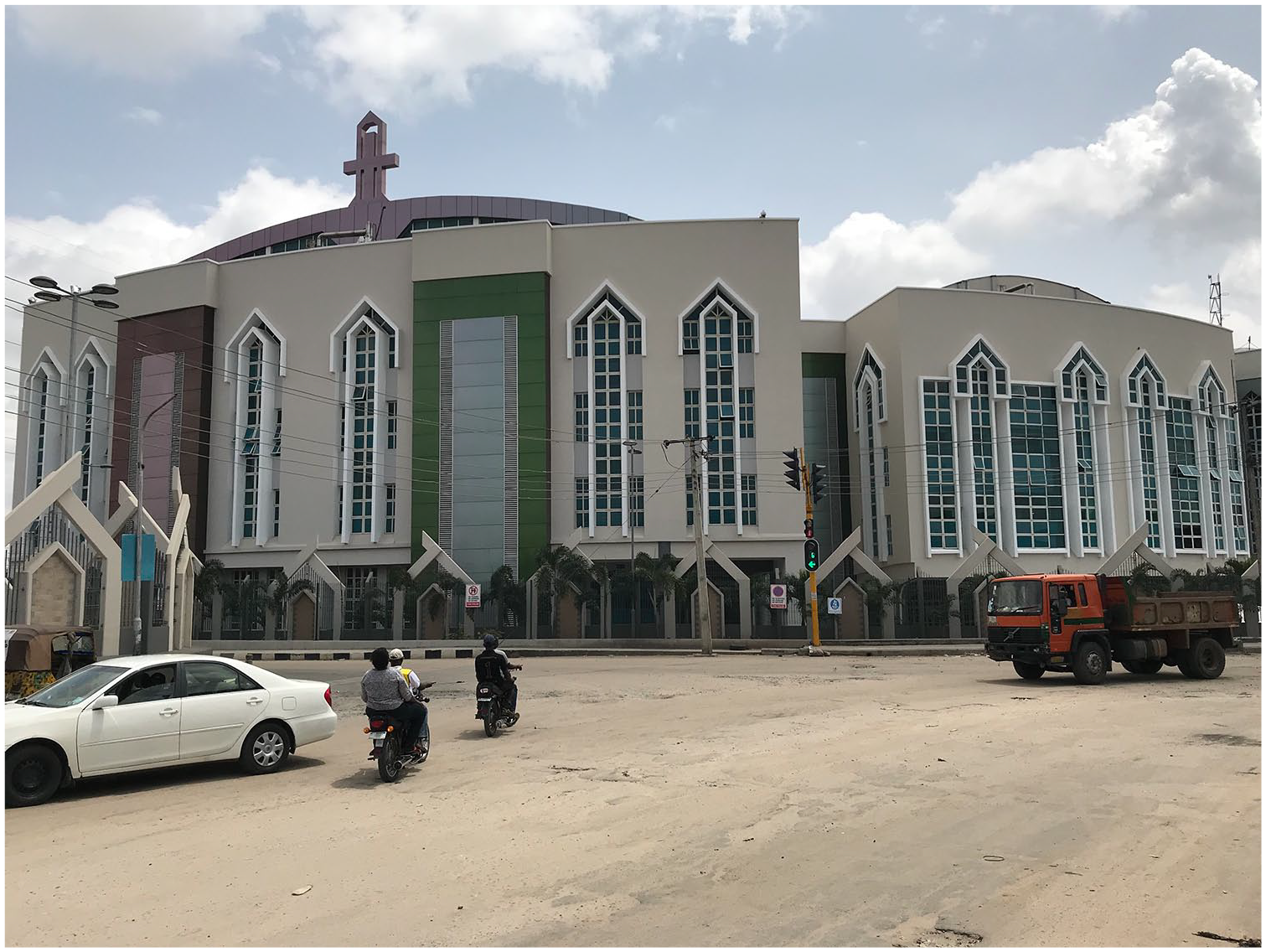
A View of the DCLM Auditorium in Gbagada, Lagos.
The Vice President of the Federal Republic of Nigeria, Professor Yemi Osinbajo described the auditorium: “this is not merely a large building. It is expertly done, built by the best workmen, with the most modern amenities and cutting-edge technology.” 2 This insinuates the auditorium’s local, national, and global iconicity.
The opening prayer invokes the significance of the inauguration, designating the auditorium as a concretization of the history of the DCLM and its founding pastor. The church grew from a bible study group presided over by Mr. William Folorunso Kumuyi from 1973. Mr. Kumuyi was, then, a mathematics lecturer at the University of Lagos. In the early 1980s, the group had developed into a full-fledged formal church and currently into a prominent church reported to have 500 branches in Lagos, 5,000 branches elsewhere in Nigeria, and 3,000 branches in other parts of the world. 3 Confirming the enormity of the project, the building process for the new auditorium started in 2005; taking about 13 years to be completed on April 24, 2018, inauguration. 4 Therefore, the new auditorium is viewable as a commensurate representation of the mission of the DCLM, the pastoral persona of the 1941-born General Superintendent W. F. Kumuyi (hereafter G.S. Kumuyi) and his over four decades of pastoral work. It is also a metaphor for the church’s “corporate perpetuity” (Barshack, 2011, p. 219).
In making sense of the materializations and expressions of Pentecostal agency and power in the icon of the Pentecostal auditorium, this article coins the concept of Pentecostal architecturation undergirded by some Bourdieusian thinking tools and extant literature.
Pentecostal Architecturation: Prefatory Notes
The concept of “Pentecostal architecturation” captures the sociospatial, economic, corporeal, and symbolic agency, actions, workings, and power, in (urban) space, of Pentecostal auditoriums. It treats Pentecostal auditoriums as actively connected to and affecting webs of urban sociospatial processes, relationalities, materialities, and structures (cf. Fallan, 2008, pp. 81, 92; Goss, 1988, pp. 81, 83, 392). The idea of Pentecostal architecturation enables a reading of Pentecostal auditoriums as social, socializing, and “thoroughly socialised” architectural artifacts (cf. Bourdieu, 1998a, p. 73; Appadurai, 1988, p. 6). This article uses the example of the DCLM to demonstrate the workings of Pentecostal architecturation, relying on narratives relating to the DCLM and Bourdieu’s tripartite concepts of field, habitus, and capital. It interprets iconic Pentecostal buildings such as the DCLM auditorium as signifying the spatial architecturation of struggles, contestations, complicities, and mediations—in the Pentecostal field and in urban space—over the accumulation and circulation of spatial, political, symbolic, and economic capitals (currencies or profits). The Pentecostal field is defined as “an arena of struggles” and “contestations”—among Pentecostal churches, buildings, preachers, the laity, other actors, things, and artifacts—for the appropriation of Pentecostal capital (Bourdieu, 1998a, p. 32; Bourdieu, 1998b, pp. 125–126). Pentecostal capital refers to “accumulations of [Pentecostal] labour” and Pentecostal currencies in people, buildings, and organizations (cf. Bourdieu, 1986, p. 241). Following Bourdieusian thought, I define the Pentecostal habitus as Pentecostalized subjectivity—acquired through sustained exposure to Pentecostalism (cf. Bourdieu, 1998a, p. 26; Bourdieu, 1977, p. 72).
In mobilizing Bourdieusian thinking tools to undergird the concept of Pentecostal architecturation, this article contributes to emerging scholarship that excavates and engages Bourdieu’s neglected sociology of religion (Rey, 2014) and his “lost urban sociology” (Savage, 2011). The utility of Bourdieusian thinking tools in the reading of architecturations of Pentecostal power is in their potential to relationally balance Pentecostal architecture (Pentecostal habitat) with Pentecostalized mental structures (the Pentecostal habitus). Pentecostal buildings are understood, here, as spatial objectifications of Pentecostalized social structures, social practices, and social relations (cf. Bourdieu, 2018, pp. 109, 106; Bourdieu, 1977, p. 10). This ties in with a perspective, in studies of “material religion,” that accounts for the relational entanglement of things and humans, buildings, and believers.
Similarly, the focus on Pentecostal architectures complements literatures that have begun to examine the role of infrastructure and “spatiality” in the reproduction of urban religion (see Becci et al., 2013; Burchardt, 2019; Garbin, 2012; Knott et al., 2016; Müller, 2019). In doing so, this article joins in on rising literature on Pentecostalism 5 as an urban signifier (see, for instance, Lanz & Oosterbaan, 2016; Ukah, 2016). These literatures, however, have yet to offer more focused critical sociological analyses of Pentecostal architectures as constitutions of Pentecostal power. This study also converses with literature on “iconic architecture” which have asserted that the iconicity of religious buildings has been overtaken by the arrival of iconic shopping malls and iconic headquarters of transnational corporations, respectively, tagged as “cathedrals of consumption” and transnational private capital (cf. Sklair, 2010, p. 138; Kaika & Thielen, 2006, pp. 59–60). The rise in Pentecostal architecture in cities like Lagos, however, suggests that religion still inspires the construction of iconic buildings in African and other cities. Relying on ethnographic observations, conversations, and photography conducted between 2018 and 2019, this article mobilizes the example of the DCLM’s “new” auditorium in Gbagada, Lagos. Below, I offer empirical and Bourdieu-inspired articulations of the architecturations of Pentecostalism’s intersected spatial, corporeal, political, symbolic, and economic power.
Buildings, Bodies, and Politics
The presence of the DCLM auditorium in Gbagada is noticeable from near and afar, wielding significant “site effects” on the neighborhood and in Lagos (cf. Bourdieu, 1999). As one enters or passes the neighborhood of Gbagada, through the Gbagada Expressway, the DCLM auditorium is a noticeable and distinctive architectural landmark. It towers above every other building in its immediate surroundings, with a high-pitched Christian cross rising from its roof in its front (see Figure 1). Its walls have a glittering whitish and greenish finish. In the context of Gbagada’s relatively high density of buildings, the DCLM auditorium sits large on 7,000 square meters of land. The church also owns a four-level, 400-capacity car park that rises to the surface from the basement. At the back of the cordoned main auditorium premises, the DCLM has acquired two high-rise properties that are used as offices for resident pastors and church administrators. The DCLM also has a library premise, across the road, southwest of its main auditorium. Therefore, the church has established a strong socio-spatial presence in Gbagada. The landmarking attributes of the DCLM auditorium suggest that the Pentecostal field is one of the fields par excellence in Lagos’s urban space.
As the DCLM auditorium strongly inserted itself in the neighborhood of Gbagada, it generated ambivalent relationships with the communities around it. Describing the development of the DCLM headquarters, the chairperson of the Gbagada Residents Association remarked, This church was here for a long time in an older building. Suddenly the place was protected with high zinc, and we could not see what was being constructed there. As its walls became higher, we witnessed the rise of this edifice. There was no serious consideration of the effects of this large edifice on the traffic jamming situation in the area. It is a mess.
6
He goes on to highlight that after a community demonstration against the church, which brought the then Lagos State governor, Mr. Akinwunmi Ambode, to mediate. The church promised to modernize some roads in the neighborhood to create more vehicular entry and exit points and ease traffic. The road project was incomplete during the time of fieldwork, but some progress had been made. The church also built a bridge, which divides the church auditorium and the car park, minimizing human traffic on public roads by enabling people to cross to the church auditorium using an under-the-bridge route after parking their cars. The auditorium, therefore, finds itself in spatial, social, and political oppositions and entanglements with other buildings, people, and communities (cf. Bourdieu, 2018).
The DCLM attracts a high frequency and concentration of human bodies into its Gbagada auditorium. It is a hive of people activities, intensified on Sundays and during special programs. Given its high holding capacity, it hosts crowds of people from multiple DCLM branches every Sunday. These DCLM branch members are ferried mostly by church buses, for the church owns and runs a fleet of buses for this purpose. On the premises, during my visits in 2018, I saw a fleet of 14 new buses said to have been recently bought to complement the fleet of old buses that the church already owned and ran. On July 01, 2018, I took a ride to the church in the DCLM bus from Lagos’ neighborhood of Iwaya 7 to Gbagada, as part of my fieldwork and at the invitation of a member of the DCLM. From the drop-off point to the church auditorium, the road was filled with human traffic as buses coming from different parts of Lagos had dropped people coming to the church service. On September 22, 2018, I witnessed an interdenominational youth program titled “The Gathering of Unstoppable Achievers,” presided over by the DCLM in Gbagada. The theme of this gathering was “Empowering Youths for All Round Success.” Secondary school youths from different parts of Lagos State thronged the DCLM church, for the Word and prayers on matters of success in life. Pentecostal church programs targeting the youth, like the “The Gathering of Unstoppable Achievers” and the recurring Sunday services targeting all age groups instantiate the roles of Pentecostalism in positively reinforcing socialization processes that reproduce and reinforce the Pentecostal habitus. Pentecostal auditoriums are, as such, sites for the reproduction and proliferation of the Pentecostal habitus. For, according to Bourdieu (1999), “the habitat shapes the habitus” and the “habitus also shapes the habitat” (p. 128).
The gathering of people of “high society” at the auditorium inauguration, which is highlighted in this article’s opening remarks, points to the church as a site for the activation of the church’s political influence. Notable among those who spoke at the event are the Vice President of the Federal Republic of Nigeria, Professor Yemi Osinbajo; Dr. Mrs. Lola Akonde 8 who represented the then Executive Governor of Lagos State; the president to the Pentecostal Fellowship of Nigeria and founder to the Gospel Light International Ministries, 9 Rev. Dr. Felix Omobude; and Bishop Mike Okonkwo of The Redeemed Evangelical Mission (TREM). Other notables present were some representatives of Nigerian state governors and prominent Christian outfits. This gathering is comprehendible as a festival for the exchange of essences, trade in political capital, garnering and expositions of the “social capital of connections,” homage payments, and related mutualities between Pentecostal bosses and “state bosses” (cf. Bourdieu, 2018, p. 112; Bourdieu, 1996, p. 300); making the DCLM edifice the dramatic scene for their collusion, complicities, and intimacies. Iconic Pentecostal buildings, thus, reflect the political power and connectedness of Pentecostal churches. They are “politics with bricks and mortar” (Beck, 1998, p. 115). The ceremonialization of Pentecostal architecture by members of high society, including the country’s Vice President, other top politicians, and top clerics, highlights the “structural affinities” or “homologies” between the Pentecostal field and the political field, both being fields of “power,” of “forces” and of “struggles” (Bourdieu, 1993, pp. 30, 41, 44). One can observe, here, the potential for political and Pentecostal bosses to gain from the political and symbolic “profits” or “rents” of the inauguration event, in the form of increased public exposure and political connectedness.
Through the construction of architectural edifices, Pentecostal churches demonstrate the political and spatial power to put themselves on the map of Lagos and to put the Lagos megacity on the world map. A representative of the Lagos State Governor declared, as a government we are proud to be associated with . . . the church as we celebrate this spectacular achievement. . . This beautiful edifice . . . has impacted positively on the aesthetics of this axis of the megacity.
10
This implies the embracement by government authorities, of infrastructural developments—of the “political acts” of city-making, city-mapping, and “urban regeneration”—driven by the church (cf. Jones, 2011, p. 166). G.S. Kumuyi acknowledged “the support and supervision of the Lagos State Government, whose officials showed keen interest in the project.” 11 Therefore, Pentecostal practices of building are occasions for exchanges between “statist capital” (Bourdieu, 1994, p. 4) and “pentecostal capital,” as state officials form relationships of mutuality and collaboration with the pastoral elite. In any case, the construction of “attention-grabbing” (Jones, 2011, p. 115) and “totemic” (cf. Kaika, 2011, p. 970) Pentecostal buildings has become key to the Lagos city “brand” (cf. Jones, 2009, p. 2519).
Pentecostal architecture symbolizes and enforces a bodily politics based on principles, perceptions, divisions, and visions of born-againness and unborn-againness, “purity” and “impurity” (Duschinsky & Brown, 2015, p. 243; Douglas, 2003, p. 7), “inclusion” and “exclusion” (Kong, 2001, p. 213), and sacredness and profanity (Durkheim, 1995). The DCLM auditorium is protected by a boundary wall, gates manned by spy police, pedestrian entrances with automatic body scanners and turnstiles, a panoptic guard room, and surveillance cameras (see Figure 1, for a view of part of the boundary wall).
A Gbagada resident explained: “I am not a member of the church, but I would like to have a feel of the inside. It is not easy to do so because of security, except I visit for the Sunday service.” 12 Nonmembers or rebel members can easily be identified at the DCLM premises based on a dress code that shuns “worldliness” and “indecency.” Women are supposed to wear longer and wobblier dresses and to cover their heads with hats or scarfs, and trousers are prohibited for them. Men are encouraged to dress “formally” and discouraged from wearing tight jeans and tight shirts. Shiny jewelry, including wedding rings, is dissuaded. 13 Security surveillance at the DCLM premises deploys these “doxic” 14 understandings of the “bodily hexis” (bodily dispositions) of dress code and related mannerisms to police access (cf. Bourdieu, 1977, pp. 87, 93). Through “hostile” or “autistic architecture” and dispositional impositions, the DCLM polices “bodily movements”—entrances and “exits”—and denies and grants the “profits” of church membership and visitorship (Bourdieu, 2018, pp. 108, 112; Quinn, 2014; Kaika, 2011, pp. 968, 986; Sibley, 1995, p. 49). The auditorium, thus, is at once a “forbidden” and permitted “temple” (cf. Kaika & Thielen, 2006, p. 874). This highlights Pentecostal churches’ penchant to enforce “social” and “spatial distances” and reproduce relations of domination and restriction among people, places, buildings, and things (Bourdieu, 2018, p. 106; Kong, 2001; Douglas, 2003)—to exercise their “symbolic domination” of urban space through arbitrary architectural and dispositional impositions.
Church, Charisma, and Currencies
The DCLM auditorium concretizes the charismatic vision of the church’s founding and commissioning pastor. This is captured by the words: “this place you are seeing is the very concept that our father in the Lord, put across to the in-house team of architects, and little by little there was a development on that vision.” 15 The auditorium is conceivable as G.S. Kumuyi’s “second body” (Davidson, 2009, p. 332; cf. Kilde, 2008, p. 4), a piece of charismatic architecture that animates his evangelical vision and pastoral habitus. It confers “charismatic qualifications” (Bourdieu, 1996, p. 102) on the founding pastor, while his persona charismatizes and iconicizes the building. Architectural designs of Pentecostal buildings are symbolizations of the power of divinity. Speaking at the building inauguration, pastor Dodo who represented the Anglophone region likened the shiny bluish ceiling of the auditorium to “clouds,” suggesting that it represented the “rain of power,” anointing “glory,” and “the supernatural” (Figure 2A). The DCLM auditorium constitutes “a sign” that expresses spiritual meaning and belief (Goss, 1988, pp. 396, 397; cf. Gordon, 2019). It appeals to the sensibilities of the Pentecostal faith through ecstatic aesthetics. Conceivable as central banks of spiritual currencies—of the Pentecostal word, prophecy, miracle, healing, and deliverance—Pentecostal edifices are sites for an economy of “salvation goods” (Rey, 2014, p. 46). They are “mystifications” of Pentecostal “ministry” (Bourdieu, 1985, p. 215) and “Bourdieuesque” architecturations—spatializations, symbolizations, and concentrations—of spiritual profits and power.
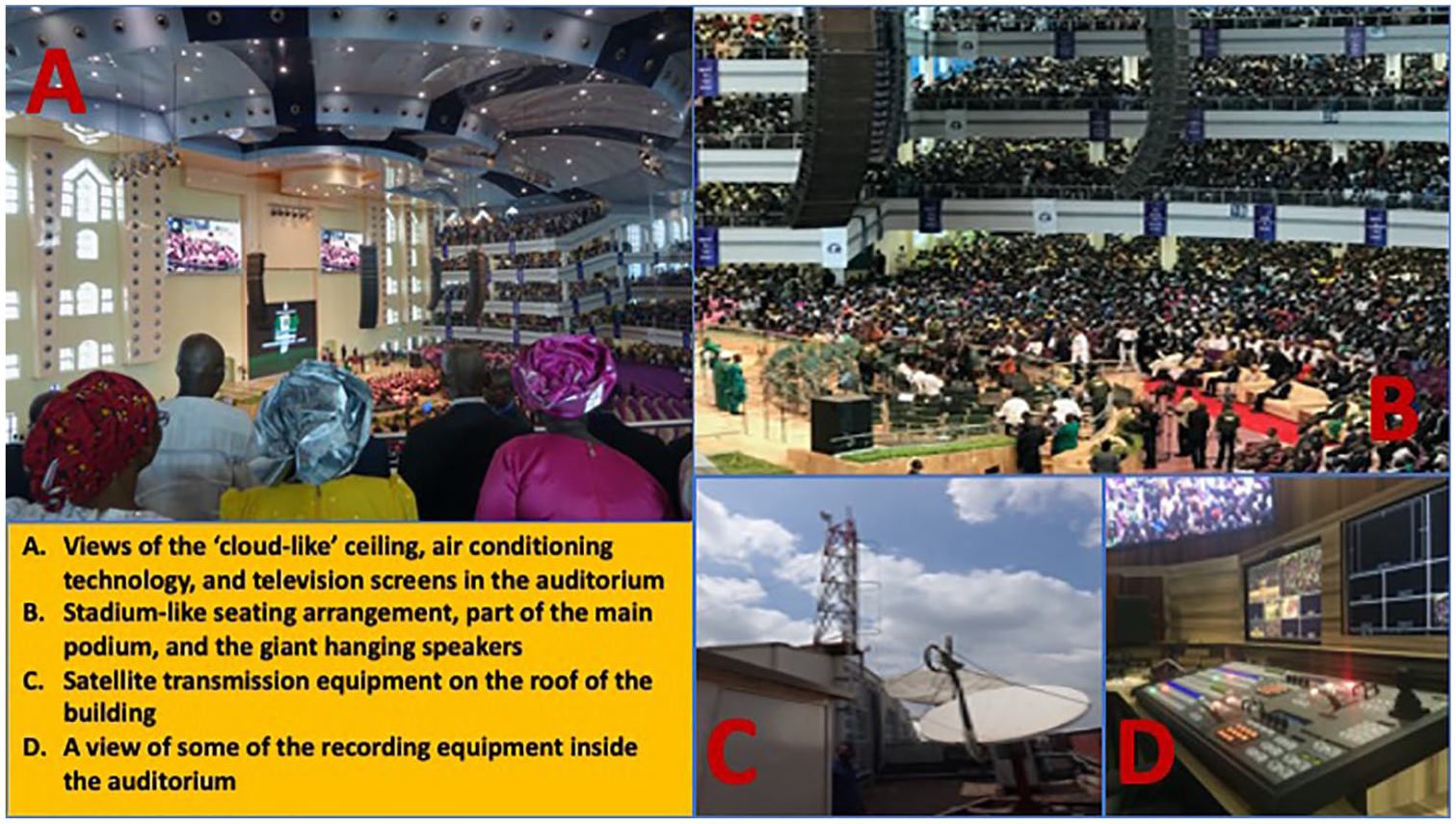
Some Dimensions of the DCLM Auditorium’s Cinematic Architecture.
The cinematic architecture of Pentecostal auditoriums encapsulates the church’s quest to influence modes of symbolic and spiritual reproduction through the transmission of charismatic currents through words, sounds, and images. It gives privilege to decors that accommodate media technology and connectivity. The DCLM auditorium houses high-level recording equipment and media crews working on the audio, visual, and graphic dimensions of broadcasting (Figure 2B, C & D). It is adorned with cinematic apparatuses that include large television projection screens, huge hanging sound systems, state-of-the-art projectors, and “stadium-style” seating galleries (cf. Recuber, 2007, p. 316). These technologies are pitched for the translocal transmission of words, sounds, and images to ensure that, from the cinematic auditorium, the church’s influence reaches far and wide.
The location of the podium, facing the seating galleries, centers the speaker and choir, creating a cinematic and theatrical atmosphere (Figure 2B). The spatial centering of the pastor symbolizes his spatial and spiritual “distance” from the laity (cf. Bourdieu, 2018, p. 107; Bourdieu, 1989, p. 16). As Bourdieu (2018) suggests, “reverence is born out of distance” and “respect is greater from afar” (p. 7). The DCLM’s Gbagada physical address symbolizes Pentecostalism’s powering of, and profiteering from, class aspirations and mobilities, given the neighborhood’s upcoming-middle-class tag. The auditorium is an aspirational site for interclass worship—involving the lower classes (the working class and underclass) and the middle classes and the upper classes—where congregants who are otherwise “very distant in social space” momentarily and recurrently gather in “spatial closeness” (cf. Bourdieu, 2018, p. 111).
The DCLM auditorium highlights Pentecostal accumulation and opulence. That it is estimated to have cost more than 14 million U.S. Dollars and to be “the fourth largest church auditorium in the world,” 16 is a statement of both “conspicuous consumption” and “conspicuous construction” (O’Neill, 2016, p. 672). The auditorium is adorned with state-of-the-art facilities, ranging from expensive media equipment, surveillance cameras, fire sensors, and automatic fire extinguishing systems, to air conditioning technology (Figure 2). Hence, its description as “an edifice with aesthetic appeal befitting of a worship center for the Most High God.” 17 Iconic Pentecostal buildings are architecturations of Pentecostal churches’ economic power. Pentecostal churches’ economic capital of finance is stocked in the size, quality, aesthetics, and primness of their buildings—in their capacity to invest in, “consume,” and appropriate “physical space” (Bourdieu, 2018, p. 107). With its ostentatious design, the DCLM building is an attractive object of Pentecostal desire and worship (cf. Dovey, 2010). The imposing size and aesthetics of the auditorium symbolize high local and global profits of “rank,” “position,” and “prestige” for the Pentecostal church, all of which are “ostentations” of Pentecostal “power” (cf. Bourdieu, 2018, pp. 106–107; Bourdieu, 1999, p. 124). These suggest the church’s strong hand in the competitive economies of aesthetic architectural goods and prime real estate. Designed to woo people through aesthetic awe, Pentecostal auditoriums enliven the prosperity gospel. A participant described the DCLM auditorium as “so beautiful that it makes you believe that it is possible to live good on earth and still make heaven.” 18 The auditorium is meant to leave a lasting positive impression on people who see and patronize it (cf. Haas & Olsson, 2014, p. 59; Kaika, 2011, p. 968). It is directly “injuncted” to the psyche and the “body” (Bourdieu, 2018, p. 108), geared toward soul-winning and regenerating the Pentecostal habitus.
Iconic Pentecostal buildings are products of economic, intellectual, and bodily sacrifices. Their construction often involves the pooling of resources, ideas, labor, and expertise by the church’s laity and leadership. G.S. Kumuyi, in his welcome address at the auditorium inauguration ceremony, said: “we praise the Lord for the leaders and members of the Deeper Life Bible Church within and outside the mission. It is through their sacrificial and willing gifts that this project has now been completed.” The lead architect for this project, Kayode Dada, indicated that he “relocated to Lagos, from Ondo State, for the purpose of pursuing this project.” 19 A series of conversations with ordinary church members suggested the prevalence of the sense that the DCLM headquarters is a common property resource of the laity and all levels of leadership alike. One member of the church remarked: “we built this with our own sweat and blood, to the glory of God. This is the house of God and as His children this is our space.” 20 Iconic Pentecostal auditoriums, therefore, are dramatic concretizations of the power of Pentecostalism’s sacrificial economies of volunteerism and giving, wherein the Pentecostal laity and leadership are groomed to understand and believe that they are stockholders of the buildings. It follows, then, that iconic Pentecostal buildings function as central banks—and the elite pastorate operating from them as “central bankers” or “shareholders” and the patronizing laity as depositors and drawers—of Pentecostal capital, profit, and power. This points to a paradox of the Pentecostal economy as at once of the dispossession and empowerment of the laity and the pastoral elite. Read through Bourdieusian lenses, the sacrificial economy of Pentecostalism can be seen as amounting to the architecturation of Pentecostal illusio (illusion), misrecognition, and domination suffered by the laity and some of the leadership (Rey, 2014, p. 90; Bourdieu, 1989, p. 18); as even the granting of usufructuary rights to Pentecostal buildings does not necessarily or straightforwardly translate to a Pentecostal commonwealth of buildings. The buildings technically belong to Pentecostal body corporates, which to most intents and purposes are extensions of the personas or bodies familial to the founding or executive elite pastors. Echoes, here, of the political work of Pentecostal auditoriums as architectural apparatuses of “symbolic violence” and status quo reproduction (cf. Bourdieu, 2018, p. 108).
Closing: For a Sociology of Pentecostal Auditoriums
Mobilizing the idea of Pentecostal architecturation, this article analyzes the significations and activations of Pentecostal power through iconic Pentecostal architecture. In its analysis, it relies on the example of the DCLM auditorium in Gbagada, Lagos, and snippets of Bourdieusian thought. Iconic Pentecostal buildings are analyzed as central banks and intimations of various dimensions of Pentecostal capital and power; spatial, political, symbolic, and economic.
The article is an offering toward sociology of Pentecostal architecture. This is against the backdrop of the relative neglect of sociological interpretations of iconic Pentecostal architecture in a context of focus on shopping malls and corporate headquarters as capitalist “cathedrals of consumption” and of private capital. Developing a Bourdieusian analysis of Pentecostal architecture, the article is also a contribution toward growing attempts to (conjointly) regenerate Bourdieu’s underdeveloped sociologies of urbanity and of religion. It is a teaser for a “Bourdieuesque” sociology of Pentecostal architecture.
Footnotes
Acknowledgements
The development of this article benefited greatly from early critical comments from Prof. Marian Burchardt. Prof. Kosta Mathey is sincerely thanked for his productive insights during our joint fieldwork in Lagos in December 2019. I would also like to thank Dr. Prishani Naidoo and her administrative team at the Society, Work and Politics Institute (SWOP) at the University of the Witwatersrand for providing administrative support for my research project. This article was written during the time I was on a full-year sabbatical (2020), courtesy of the Faculty of Humanities, the School of Social Sciences, and the Department of Sociology at the University of the Witwatersrand. Despite the valued influences of other people and of relevant institutional set-ups, any failings in this article remain my own.
Declaration of Conflicting Interests
The author(s) declared no potential conflicts of interest with respect to the research, authorship, and/or publication of this article.
Funding
The author(s) disclosed receipt of the following financial support for the research, authorship, and/or publication of this article: I remain grateful to Prof. Brigitte Reinwald and her coordination team, for the unwavering financial and intellectual support they have given to me in my research project—Networked Religiocities: Transnational Urban Religious Flows in Africa—which they are coordinating under the auspices of the Volkswagen Foundation Funding Initiative: Postdoctoral Fellowships in the Humanities in sub-Saharan and North Africa—Knowledge for Tomorrow. This project was funded by the Volkswagen Foundation under funding reference 92055.
