




Abstract
When Google announced, in October 2018, that it would not pursue its plan to open a Google Campus in Berlin-Kreuzberg, the local anti-gentrification protesters were triumphant. The retreat was widely seen to be the result of a 2-year-long fight between the tech company and local activist groups. Next to the usual gentrification issues, the protests had additionally addressed what Google as a company stands for and focused on their data policies and the underlying (economic) rationale. The article asks what role this additional critique played in the protests. It will begin with a brief introduction to the key concepts before retracing the history of the planned Google Campus in Berlin as well as of the protests against it.
Introduction
When Google announced, in October 2018, that it would not pursue its plan to open a Google Campus in Berlin-Kreuzberg, the local anti-gentrification/anti-Google protests were triumphant. This was the—albeit preliminary—end of a 2-year fight between the tech company and local activist groups. Although Google’s retreat was widely characterized as one of the first successful campaigns against a major tech company “taking over the city,” it also triggered fears by local politicians, start-ups, and others alike that these kinds of protests might spread even further and make “innovation” in the city of Berlin more difficult. The focus of this article, however, is less the tension between the protesters and those they protested against than the question what role geomedia potentially played in the protest.
The geomedia focus offers a perspective of interconnection between traditional gentrification protests with other recent concerns about what Lingel has termed “The gentrification of the internet” (Lingel, 2021), a social change that has elsewhere been labeled “surveillance capitalism” (Zuboff, 2019) or “data colonialism” (Couldry & Mejias, 2019). Although geomedia was originally defined as a socio-technological regime based on features such as ubiquity, real-time feedback, location-awareness, and convergence (McQuire, 2016), the emphasis on the social in this regime has since grown (cf. Fast et al., 2018). Calling it a regime implies an understanding of the aforementioned features as normalized affordances, which people tend to expect from their everyday media environments (see Hartmann & Jansson, 2022). The life forms and modes of (re)production in the geomediatized city are in various ways reliant on and embedding geomedia. The emphasis here is on the intertwined nature of these processes. A more detailed debate around this will take place in the latter part of the article.
The geomedia-gentrification connection will be explored below in a three-step approach. The article will first of all deliver a brief introduction to the key concepts (gentrification; protests; “Big Tech,,” data and surveillance). It will then begin to retrace the history of Google’s Campus plans for Berlin as well as the protests against it. In a third step, the article will return to the key concepts and reflect on their interconnection and frame this as an undertaking in geomedia research. The core argument is that a duplication of gentrification is taking place here—in real life, but also online—or rather, thanks to the particular nature of Google’s approach to data. This is embedded in—and potentially caused by—the emergence of a geomedia regime, which newly segregates the social and thereby contributes to feelings of alienation and anxiety among certain groups, but which, at least in this case, also leads to resistance.
The analysis covers three types of sources: (a) the (few) references to Google Campus Berlin in official Google communication (websites, press releases, etc.), (b) the media coverage related to Google Campus Berlin, and (c) the communication of the anti-Google-protests as found on social media and on the web. A systematic search for and within these concepts and texts was conducted several times over until theoretical saturation was reached. Core statements concerning gentrification, tech companies, datafication, and similar concerns were analyzed, to which a small historical component was added (locating the current protests within the larger history of similar protests in Berlin and comparative places). Limitations of this approach will be discussed at the end. The article will begin with brief introductions to some of the key concepts, starting with gentrification.
Gentrification
Gentrification itself hardly needs a long introduction. The concept, first developed in the 1950s, has been applied and developed ever since, primarily dealing with class-related change processes in urban neighborhoods (see e.g., Eckardt, 2018; Lees et al., 2010, 2015; Smith, 1979; Zukin, 1982). It has spread as an academic theme but also as a highly conflictual political debate, accompanied by fairly heated popular discourses. On a general level, gentrification is a description for urban change processes. This change has most dominantly been framed as a gradual process of replacement of existing structures. This takes place in stages, often to the detriment of earlier (and less affluent) inhabitants. In recent years, it has been described as a neoliberal urban policy, which has begun to spread throughout the world, “colonising cities outside the core of global capitalism” (Shin & López-Morales, 2017). We will return to the question of colonization.
The gentrification concept has also been widely used in relation to Berlin and more specifically the district of Kreuzberg (e.g., Holm, 2013, 2021), where our case study is based. In recent years, Berlin has seen an immense growth of investment in its property market. In Kreuzberg, the usual process of displacement of what used to be a working-class neighborhood, however, began long ago. And even if the label “gentrification” is sometimes used too quickly (see, for example, Huning & Schuster, 2015), there is little doubt that especially the central districts in Berlin have been heavily gentrified since re-unification took place (Holm, 2021). However, as Barton (2016, p. 92) outlines, “while there is consensus that gentrification shaped social and physical aspects of neighborhoods, scholars have yet to agree on how gentrified neighborhoods should be identified.” Instead, gentrification keeps being defined and measured in diverse ways.
Traditionally, there was a distinction between production-led and consumption-led gentrification, where the former emphasized the economic drivers behind gentrification processes, as for example, the gap between the currently paid and the potential rent (e.g., Smith, 1979), while the latter focussed on the changes in urban structures and people’s lives (e.g., Zukin, 1982). Later, concepts such as super gentrification were developed, signifying previously gentrified areas that are experiencing new waves of gentrification, replacing even the original gentrifiers (e.g., Lees, 2003). More recently, questions were raised about so-called state-led gentrification, where the state introduces programs and/or laws that intervene in the housing market (e.g., concerning rental contracts and evictions—cf. Mendes & Carmo, 2016; see also Islam & Sakızlıoğlu, 2015).
The particular kind of gentrification we are looking at here usually falls under the label of “tech-led gentrification” (Maharawal, 2017). In these kinds of gentrification, technology companies (Amazon, Apple, etc.) are the main attractors for people to move into certain cities or areas. These companies tend to not only pay well, but often get additionally involved in making the area more attractive for their employees, for example, by offering formerly public services exclusively to their employees (the infamous Google busses). The city most affected by this kind of gentrification is San Francisco. More recently, however, other cities, such as Berlin, have seen similar developments—or at least feared their arrival.
Protests
Gentrification resistance has actually been around for a few decades, albeit not under that name. Particularly in (West-)Berlin, housing has been a contested issue for a long time (see e.g., Holm, 2021; Lang, 1998). One of the reactions to this—as a form of resistance to eviction orders and/or empty buildings—was the squatters’ movement (see Martínez, 2020; Sontheimer & Wensierski, 2018). Nowadays, anti-gentrification movements exist in Lisbon or Seoul, in New York and Tokyo as well as many other places. Increasingly, this is also reflected in research (e.g., Miura, 2021; Tulumello, 2019).
These movements partly continue older arguments, such as the discourse about the “Right to the city” or the “Right to Stay Put,” which imply “recognition of the forces that produce displacement” (Annunziata & Rivas-Alonso, 2018, p. 394). As these forces are often invisible, they need to be uncovered to be shown. Annunziata and Rivas-Alonso (2018) identify quotidian practices of resistance as new additions to an already long list of practices, alliances, and forms of resistance. From their long list, ranging from mitigation to alternative housing, not all apply to the here presented case study. But especially the question of visibility, but also of awareness and counter-narratives, that is, a form of symbolic resistance, looms large in our case study, as will be shown below. This supports Holm’s claim that resistance in Berlin has moved from traditional forms of protest to instead become programs (Holm, 2021), which does not, however, necessarily denote an actual shift in power.
Although the practices of resistance seem to shift, research about them is experiencing a shift, too. Although in the past Lees and colleagues repeatedly had to call for resistance to become a more important part of gentrification studies (Lees et al., 2008, Lees & Ferreri, 2016), these have recently become more common (e.g., Annunziata & Lees, 2016; Annunziata & Rivas-Alonso, 2018; Giband, 2021; Helbrecht, 2018; Holm, 2021; Islam & Sakızlıoğlu, 2015). The link to tech-led gentrification—and particularly to wider frameworks, is, however, rarely made.
“Big Tech,” Data, and Surveillance
Before we turn to the actual case study, I would like to introduce yet another theoretical streak. Above, this was briefly referred to as “surveillance capitalism” (Zuboff, 2019), “data colonialism” (Couldry & Mejias, 2019) and “The gentrification of the internet” (Lingel, 2021). There is not enough room to do justice to any of these (or similar) approaches, but they share some basic features that seem too relevant to miss.
Let’s first turn to Zuboff and her widely discussed notion of “surveillance capitalism” (Zuboff, 2019). Similar to other critiques (e.g., Srnicek, 2017), Zuboff criticizes so-called “Big Tech” (Apple, Facebook, Google, etc.) for changing our social (and political) lives forever. She is rather fundamental in her critique. Capitalism in this new form, so her claim, is more exploitative than ever. Humans and their experiences are the new “raw material” from which profit is made. The official reasons given—for example, the improvement of services for which data is necessary—provide only a thin layer behind which “behavioural surplus” is created through our usage. This will subsequently be (ab)used by the tech companies for things that were not originally related to the product or service we used. Instead, our private data has become commodified, as Zuboff outlines: “our lives are scraped and sold to fund their freedom and our subjugation, their knowledge and our ignorance about what they know” (Zuboff, 2019, p. 466).
Zuboff asks for more regulation in this context but also criticizes Google as one of the key players in these developments: Google invented and perfected surveillance capitalism in much the same way that a century ago General Motors invented and perfected managerial capitalism. Google was the pioneer of surveillance capitalism in thought and practice, the deep pocket for research and development, and the trailblazer in experimentation and implementation. (Zuboff, 2019, p. 16)
Even if Google is “no longer the only actor on this path” (Zuboff, 2019), its role should be critically analyzed. 1 Zuboff’s general argument is also shared by Couldry and Mejias, who use the term “data colonialism” to describe these developments: “An emerging order for the appropriation of human life so that data can be continuously extracted from it for profit” (Couldry & Mejias, 2019, p. xiii). In contrast to Zuboff’s new stage of capitalism, their emphasis is on the continuation of the colonization processes, where extraction is key, but not anymore of natural resources and labor, but datafied human life. This new social and economic order uses data extraction “for a ‘savage sorting’ of the social world” (Couldry & Mejias, 2019, p. 149). The new hegemonic order is naturalized, made possible through the social form of data relation (Couldry & Mejias, 2019, p. 23) and platform technologies. They also emphasize that data colonialism “still awaits its counter movement” (Couldry & Mejias, 2019, p. 150)—a point we will return to below.
The third approach comes from a slightly different angle. Lingel also criticizes basically the same kind of developments and players. She, however, uses the framework of gentrification to do so. Next to “the tech industry’s role in reshaping neighborhoods that host tech company headquarters,,” she adds that “online spaces and relationships are increasingly dictated by corporations instead of being driven by communities” (Lingel, 2021, p. 2). Her critique of this aspect is not quite as radical as the aforementioned, but the combination with gentrification in real spaces makes it a more powerful concept for our purposes (especially if we add the radical critiques above). Lingel sees the main link in the question of displacement: instead of everyone being able to define their online activities and interactions, mainstream platforms get to define the norms and thereby push aside others (Lingel, 2021, p. 3). The question of displacement reemphasizes that different levels of power and resources are at play here. Lingel rightly emphasizes that “Gentrification can’t be fought on an individual level; it takes a community. Because gentrification is bigger than a handful of people, houses, or businesses, challenging it has to combine individual practices with collective action and new regulations” (Lingel, 2021, p. 10). The same applies to the gentrification processes she identifies on the internet: “discrimination, segregation, and commercialization” (Lingel, 2021). These happen through displacement and isolation, so that both existing platforms, but also users, get pushed aside and become isolated: Just like urban gentrification, it’s not the existence of tech companies that creates a gentrified internet, it’s the use of commercial profits to justify decisions that benefit the few at the expense of the many. (Lingel, 2021, p. 16)
Lingel’s emphasis on the potential link between these two spheres and processes is helpful for our analysis, as shall be seen.
Case Study: Google and Kreuzberg’s Umspannwerk 2
The District: Kreuzberg
Our case study is located in the district of Kreuzberg in Berlin. 3 This district is well known for its special character. It has long been an important symbol for left politics and political resistance, especially the squatter’s movement, as well as home for a large group of first-, second- and third generation predominantly Turkish immigrants, with the largest number of Turkish people outside of Turkey (in absolute terms). 4 The specificity of this district—once labeled a Gallic village (Lang, 1998, pp. 153–155)—is historically based, as Kreuzberg used to be part of former West-Berlin and contributed to a large extent to the image of Berlin as a party- and counterculture city. 5 Densely populated and located on the margins of West-Berlin, it offered fairly cheap living conditions. Once the Wall fell, it moved from the outskirts to the middle of the city, reinvigorating its image as a tourist magnet, with a young population and many foreign inhabitants (more than 30%). Kreuzberg is a “place on the margins” (Shields, 1992), whose liminality centered around pleasure and protest alike, fights about space began early on (cf. Lang, 1998). 6
Until 1989, Kreuzberg was a district with a direct border to the East. 7 This centrally located district was both an early example of gentrification in the 1980s but also a latecomer to more recent gentrification processes (Holm, 2013, p. 176). Before, it had not been attractive for investors. Not only was it more or less surrounded by the Wall (in the U.S. American sector of Berlin), but it had always been a working-class area with architecture that was built in the mid- to late-19th century, often with small workshops located in the backyards. In the 1950s and 1960s, when the ideal of a city that catered to individualized transport was looming large, plans for a motorway through the district were drawn up. The idea was still not dropped after the Wall was built in 1961, although the motorway would have ended nowhere (see Hochmuth in Fischer, 2019). It took until the mid-1970s for these plans to be canceled. By then, however, cheap housing was a characteristic of Kreuzberg, since the motorway plans had marked many houses “to be torn down..” The population had begun to shift; more students and artists moved in and the Turkish diaspora grew (cf. Sontheimer & Wensierski, 2018, p. 63ff.). 8 Over the years, many of these inhabitants were protesting against high rents and for other kinds of living spaces. 9
From the beginning of the 1980s onwards, a different kind of politics began to emerge, which led to both heavy investment by the city of Berlin and a protection of the renters. 10 Only in the 1990s an increasing shift in the overall framework, that is, a neoliberal dismantling of housing policies, pushed the doors more widely open for investors, framed as a necessary undertaking in the post-unification years. Since then, Berlin overall and Kreuzberg, in particular, have come under pressure and rents have risen immensely (cf. Holm, 2021). This has also led to a reinvigoration of the protests.
The Building: Umspannwerk
Google Campus Berlin was to be located in what used to be an electrical substation, called Umspannwerk. This impressive old building is located in the middle of Kreuzberg, right on the shores of the (Landwehr-)canal. It was built in 1924 by the architect Hans Heinrich Müller, who was the head of the building department of the BEWAG, Berlin’s electricity provider at the time (and still a large company today). Müller is well known for his industrial architecture. Substations generally serve to transform electrical power so that it can flow between the generating station and the consumers. As such, the Umspannwerk is an expression of its time—a large modernist building that served the expansion of and industrialization within the growing city. It is a mixture of modernist architecture with so-called Brandenburg Brick Gothic, combining diverse styles and elements. This building delivered electricity to Kreuzberg until 1984 but has not served as a substation since. From 1999 to 2002, a core refurbishment took place (see Scheidtweiler, 2010). Since then, the building has been divided into several distinct parts, many of which serve as event locations. There is a restaurant, a bar and a wine cellar. The building also hosts several companies. Google did not buy the entire building, but planned to rent a larger section of it (3.000 square meters, a quarter of the whole place) to host the Google Campus Berlin.
The Planned Project: Google Campus Berlin
Google Campuses are so-called “community hubs” around the world, where Google provides a (temporary) working space as well as support for entrepreneurs and start-up companies. According to Google, “entrepreneurs come to learn, share ideas, and launch great start-ups.” 11 Google provides not only space, but mentoring: “Campuses are where technology start-ups find the best of Google, with free trainings and mentoring, and a diverse community of like-minded problem solvers. Our Campuses have support for teams to make progress on their big ideas.” 12 Such Campuses exist in Warsaw, São Paulo, Seoul, Madrid, Tel Aviv, London, Tokyo—and one was also meant to open in Berlin. Google is generally framing its Google Campus activities as a networking offer plus start-up support, aimed at the creative class and young entrepreneurs. Since neither are necessarily well funded, this gap, so the claim, could be filled by Google. 13
In any Google Campus, competitions and prize money are meant to stimulate development and innovation, offering a set of start-up school events, meetups and residencies, materially based in a Campus Café, meeting/teaching rooms and the residency space. 14 Talks, pitch lunches, experts’ summits (where Google mentors come for 2 weeks) and meetups build the basis for the later matching with investors. For Google, their Campus offers a great chance to experience innovation and pick the best ideas. If one adds the public relations value on top, these are fairly inexpensive investments (see also Schönball, 2017). 15
The plans for the Berlin Google Campus in Berlin-Kreuzberg were first announced at a press conference in November 2016, with support from Berlin’s Mayor, Michael Müller (the social democratic party) and other officials. The Campus was meant to be the basis for 10 Google employees as well as 22 start-ups—little else was officially announced apart from the statement that everything else was meant to emerge from the start-up scene itself.
Google was aiming for an opening in 2017, since the building itself only needed some refurbishing. However, in April 2017, it was announced that the opening had to be postponed. This was due to an unexpected rejection of the construction application in its existing form by the district, which functions as a municipality and oversees the building rights. Google was invited to resubmit after re-designing the application. 16 At the end of August 2017, the doors of the future Campus were opened to the public for the first time, even though the official planning processes had not yet been finalized. Some of the future occupants, that is, some start-ups, were presented on this day (Schönball, 2017). 17 In March 2018, Google still used the future tense: “We are looking forward to Berlin.” However, on October 24, 2018, 23 months after its initial announcement, Google held another press conference and announced that plans for Google Campus in the Umspannwerk had been canceled and that instead two social entrepreneurs—betterplace.org (a donation platform) and Karuna (an organization helping young people, the homeless and others)—would take over the space for the next 5 years, with Google covering the rent. This was a major turn of events, albeit not entirely unexpected.
Google Campus Protests
The timeline reported above is not quite complete: in January 2017, a couple of months after Google’s announcement of its Google Campus plans, the self-proclaimed anarchic library Kabal!k (sic) announced its first “anti-Google-café ‘face-to-face,’” to take place bi-monthly thereafter. 18 This formed the basis for several protest actions and organizations that emerged in the months to follow. Among these was Fuck Off Google, a “decentralized network of people,” 19 but also a widely used slogan in the resistance, highly visible across town. It was used in demonstrations against Google Campus (see Image 1, 2). Similar slogans, but also related networks appeared, as for example, “Google ist kein guter Nachbar” (Google is not a good neighbor—see Image 3) and “googlecampusverhindern” (Stop Google Campus).
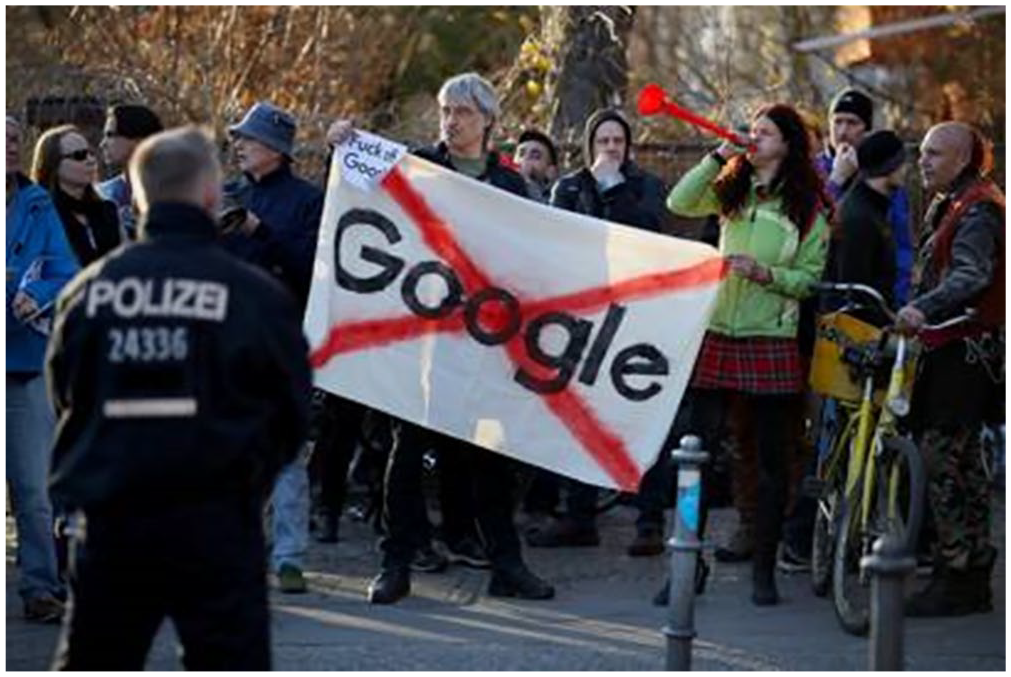
Anti-Google Protests in 2018. https://www.wired.co.uk/article/google-campus-berlin-protests.
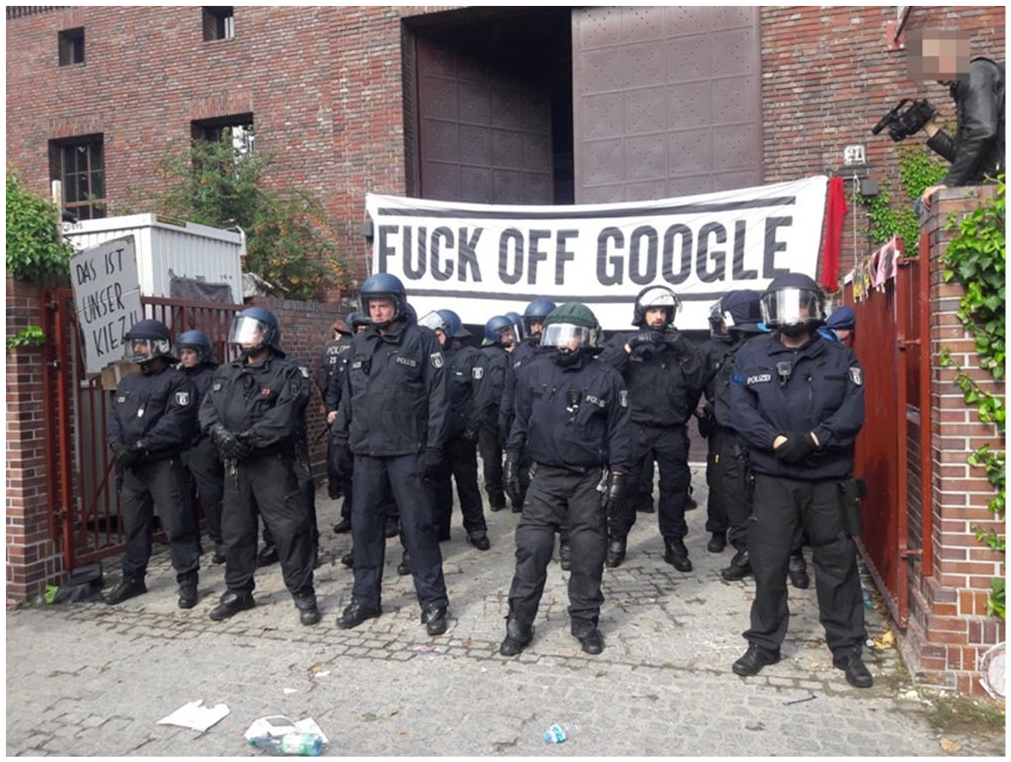
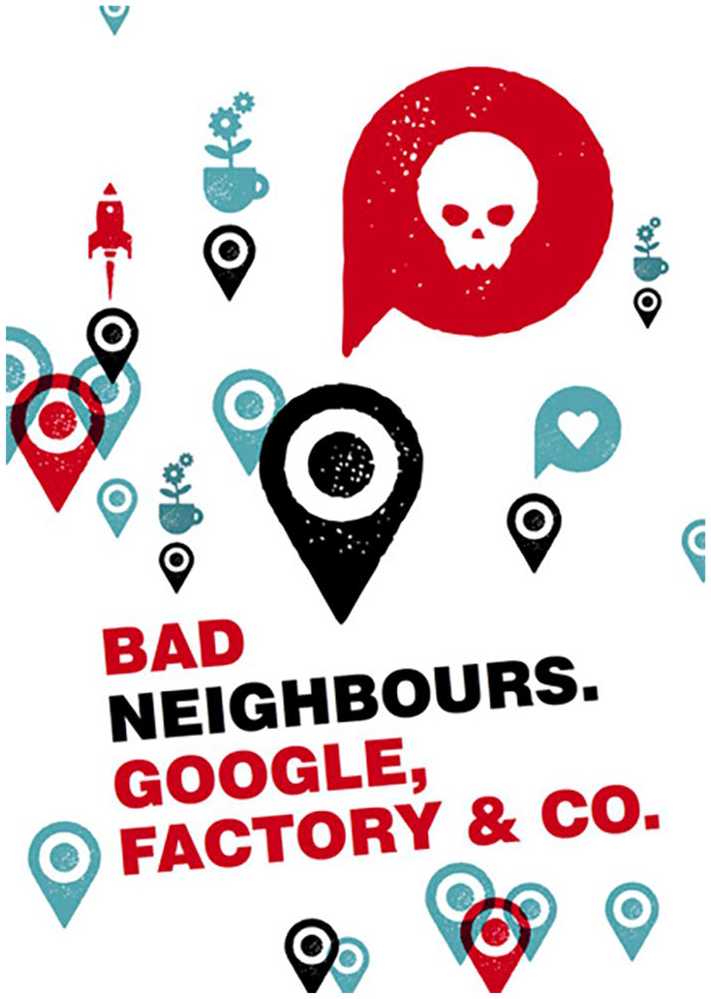
Headlines such as “Google may have a fight on its hands in Berlin” 20 began to appear in newspapers around the world and underlined that the particular location Google had chosen was problematic. Indeed, demonstrations began to take place regularly, writings against Google appeared on walls and in the local papers, protest posters were hung up in Kreuzberg and performances were used to protest. 21 In August 2017, paint was thrown at the Umspannwerk-building and writings were used to deface it. A few months later, in January 2018, a pamphlet was published in which strategies to fight Google campus were discussed (Anonymous, 2018c), similar writings followed soon. In May 2018, a larger panel discussion was held on to the topic. 22 Eventually, in September 2018, the (future) Google Campus building was occupied by left activists. Although they were evicted on the same day, this activity underlined that the protesters were not giving up and the protest was not dying out. A month later, the plans to instead hand over the building to the two charities were publicly announced.
Nothing much is known about the rationale behind Google’s decision to retreat. The media coverage clearly labeled it as a response to the ongoing protests and claimed that Google had underestimated the resistance in Kreuzberg. Google itself framed it as a matter of timing and instead proclaimed that they were happy about the “House for social engagement” (the name given to the new home for betterplace.org and Karuna), which was meant to strengthen civil society in and around Kreuzberg. Google’s spokesperson “insisted that the company had not been driven out by the demos” and that the combination of start-ups and nongovernmental organizations (NGOs) had been on the agenda for a while, wherefore it eventually became clear that handing over the space as a whole made more sense (Knight, 2018). He also emphasized that “There was a small group that was very loud, who didn’t want to speak to us, and they have nothing to do with the concept now, obviously” (Knight, 2018).
Betterplace, however, sees the retreat as a realization on Google’s side that they maybe did not put enough effort into understanding the local area (Knight, 2018). According to them, the decision came rather suddenly, but was obviously welcomed by the NGOs involved. The Umspannwerk has opened since, in October 2019, for bUm, the betterplace Umspannwerk GmbH. 23
The Protest Content
In the fight against the Google Campus different motives come together: displacement from the neighbourhood, data misuse by Google, but also a critique of hegemony and technology. (Anonymous, 2018c, p. 6—translation by author)
The protesters first of all emphasized the usual gentrification critique: Google was renting property in an otherwise less commercialized neighborhood with plans for its development. This would potentially change the neighborhood for good, attracting more affluent people to the area, raising rents and therefore ultimately pushing the existing neighbors aside. The protesters feared for smaller businesses in the area, who would potentially be driven out by those start-ups and similar companies who wanted to be close to Google. Protesters claimed early on “that the company’s Campuses had always triggered massive rent increases wherever they had appeared, pricing local shops and small businesses out” (Knight, 2018).
However, they additionally emphasized that Google was a company whose data collection practices were highly problematic. One of the claims was that Google was increasingly moving toward a “monopoly on data exploitation” (Anonymous, 2018b, pp. 6–7) and thereby developing a “strategy of total appropriation” (Anonymous, 2018b, p. 18). The protests thereby addressed more than “simply” gentrification. Instead, they widened the issue: As well as gentrification, some groups oppose Google’s position on issues such as tax, data collection and what they see as an attempt to bring Silicon Valley ideology to the Berlin neighbourhood. The activist from Fuck Off Google, who goes by the pseudonym Larry Pageblank in a nod to Google CEO Larry Page, promotes decentralised technologies, and has been working to teach locals how to “degooglify” their lives by using alternative, open-source software. (Turk, 2018)
According to one of the protest flyers, Google is doing nothing less than taking control of all of our relationships and actions and of all of our steps. 24 The enemy is definitely not Google only, but politics and businesses that support Google in its “refinement of domination through technology” (Anonymous, 2018c, p. 5). Hence the protests criticize all companies that provide digital services, underlining that their products “make your life easier and are your best friends or give you the possibility to have ‘friends.’” Thereby “they become essential for many people.” The protesters, however, claim that the “positive, enriching, practical, facilitating, new and efficient” is only the surface and that instead, these companies’ open hostility and their unforgiveness is the problem: “that’s what hit Google the hardest: the incessant basically unforgiving scratching of the image of the best friend company” (Anonymous, 2019—translation by author). The protesters did not aim “to solve the conflict politically,” but instead opposed any “pacification” (Anonymous, 2018c, p. 6) and rather aimed to initiate additional conflicts (cf. Anonymous, 2018b, p. 20).
Although the combination of gentrification and tech companies has clearly been addressed in protests around the world, particularly in the United States (see e.g., Gupta, 2019; McClelland, 2018; Opillard, 2016; Walker, 2018), these have rarely focused on the companies’ rationale. The Berlin protests clearly made this part of their strategy. They were thereby not only appealing to people who are afraid of gentrification and its consequences but also to a more general fear of current technological developments, expressed in terms such as surveillance and loss of control—the “gentrification of the internet” (Lingel, 2021). This was one of the particular appeals that these protests had.
The Protest Structure
To not shy away from conflict was one of the strategies used by the protesters. Quite a few diverse groups, such as the above-mentioned “Google is not a good neighbor,,” but also Bizim Kiez, 25 LauseBleibt 26 and GloReiche 27 protested against this global player. These organizations with different aims claim that their division was a great strength. In their own analysis of the success of their campaign, they emphasize that “it was not necessary to agree on a common denominator and force everyone under this dictate. All could act in their own way, which was also reflected in the content and in the protest forms” (Anonymous, 2019—translation by author).
This diversity plus the network strength can best be seen in a mapping exercise that the protest network “Google is not a good neighbor” conducted. They asked smaller businesses and individual neighbors, who were against Google Campus, to be mapped on a digital neighborhood map (see Image 4), thereby underlining the network’s strength and its embeddedness in the local neighborhood as well as its affinity with the online world. They wanted to emphasize that the digital itself is not the enemy (in contrast to how they were portrayed by others). 28
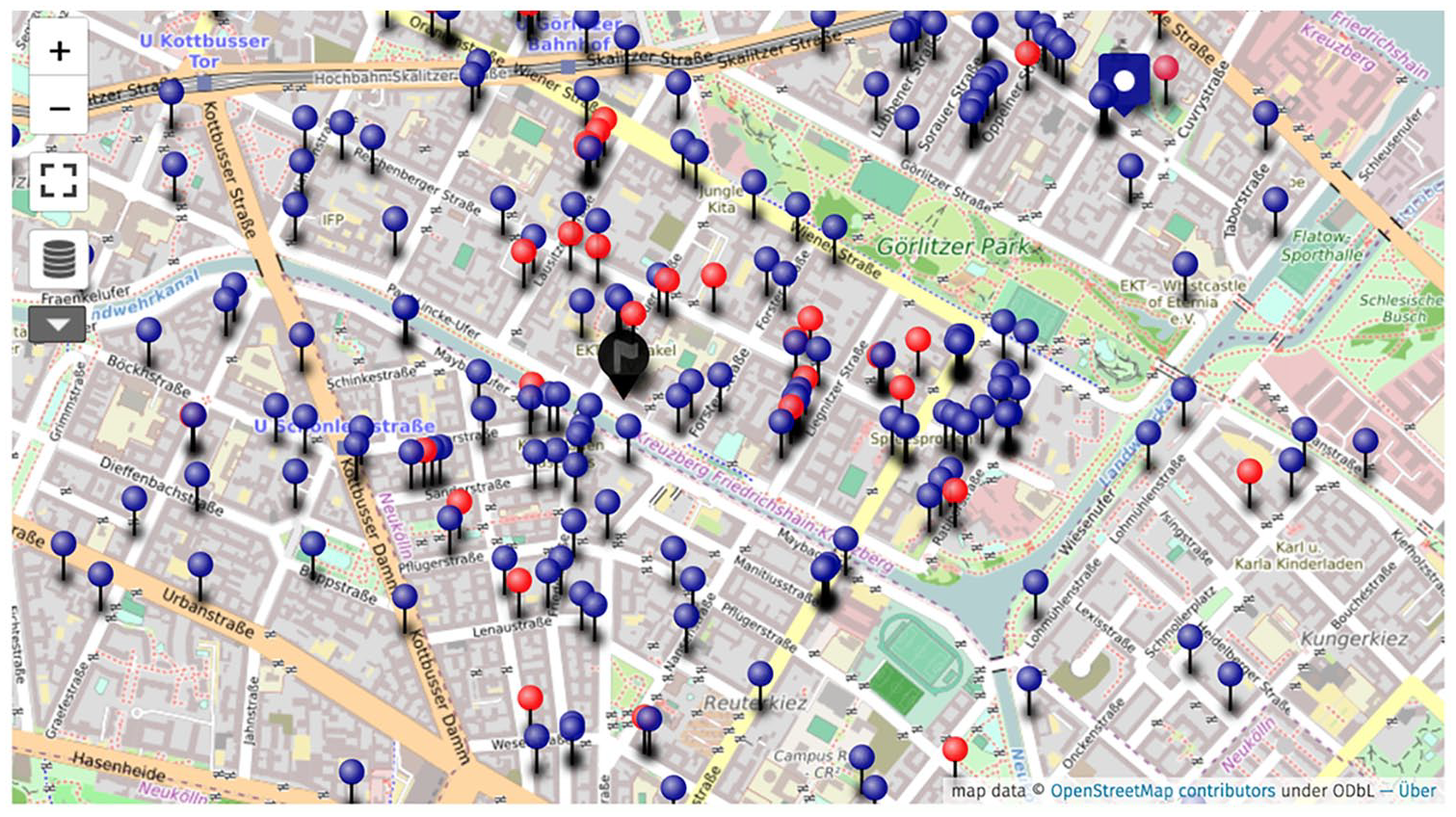
Taken From the Protest Network’s Homepage. https://www.google-ist-kein-guter-nachbar.de/english-1/ (last accessed 02/09/2021).
Not only did they build an impressive local network, they also managed to connect to existing protests against Google elsewhere (Toronto and San Francisco in particular) in a version of connective action (Bennett & Segerberg, 2012). This brought the global into the local, but it also meant that tech-companies became an explicit focus. 29 Hence Google is portrayed as representative of something larger, such as the restructured power of state and capital, as outlined above. This includes “the digitalization of the economy and the flow of goods, technologization of control and repression, commercialization of everyday life, . . . made visible primarily through new construction projects” (Anonymous, 2018c, p. 3—translation by author). 30
Geomedia and the Duplication of Gentrification
Before I turn to the outcomes of this research, let me locate the scope of the study that I presented here. The article is based on a preliminary study of a larger funding application. It does not claim the status of a fully-fledged project. This implies, however, that it has clear limitations. The study relies primarily on journalistic accounts, online publications and the written statements of some of the protesters, who published these anonymously. Hence it remains unclear, whom these voices represent. Additional material (especially ethnographic material and interviews) would be very useful in order to fully understand the role of Google’s data practices in the protests. The planned study would include a broader collaboration with other actors in relation to the question of the specificity of this case.
Although locative media play an increasing role both in gentrification processes (see this special issue and, e.g., Jansson, 2019; Zukin et al., 2015) as well as in the protests against them (e.g., Lee, 2021; Martín et al., 2020), the particular focus on geomedia as a socio-technical or even social regime helps us to focus on the interplay between actual “real-life” gentrification processes—the threat of Google’s Campus to local businesses, local rents, etc.—and wider societal concerns in relation to datafication processes and the consequences of such extractions. If we were to oversimplify the matter, we could describe one as the geo-aspects of geomedia, the other as the media aspects. It is, however, exactly their intertwined nature, the increasing indistinguishability between them as well as their messy reliance on each other, which constitutes the geomedia regime.
This regime—originally defined as a socio-technological regime marked by the four intersecting features ubiquity, real-time feedback, location-awareness and convergence (McQuire, 2016)—affects the conditions for gentrification and related processes in several ways. Media have diverged in terms of hardware, software, but also content. Media have also become more widely available. Nowadays, they often serve as the basis for all kinds of services (in the sense of the platform economy). Real-time feedback has become the norm. This brings with it an additional shift in the social, that is, in social expectations concerning availability and connectivity, which again is also intricately linked to geodata, that is, location-related capabilities. Public (and other) spaces are highly affected by this as are related processes. Hence Fast and colleagues (2018, p. 4) speak of “the fundamental role of media in organizing and giving meaning to processes and activities in space.” They describe geomedia as not primarily a technical (or socio-technological), but a new social regime, “where human subjectivity, media and space/place are co-constitutive of one another” and which “is not limited to specific media technologies . . . but points to the accentuated and socially pervasive interplay of media users, media technologies and the geosocial surroundings on the whole” (Fast et al., 2018, pp. 7–8, see also Kitchin & Dodge, 2011). It is this co-constitution that lies at the heart of our concerns here. The protests against Google have put their finger on the double gentrification aspect that is made possible by Google’s geomedia regime—a datafication and surveillance regime, a gentrification of the internet. As this socio-technical or social regime, geomedia constitutes the condition within—and against—which the Google Campus plans and protests plays out. Geomedia thereby shapes the protest movements (see also introduction to the special issue). This, so the claim here, has given the protests their particular edge, reflected also in the protesters’ definition of their focus: Structures that strive for surveillance and control, which have (enormous) power over others, are enemies of freedom and therefore also my enemies. (Anonymous, 2018a; translation by author)
This article started with a brief introduction to the fields of gentrification, protests and “Big Tech,,” data and surveillance—fields which have been combined in several studies, but not yet in this triple. Subsequently, it applied these to the case study of the protests against the implementation of a Google Campus in Berlin-Kreuzberg. Through the case study, this triple emerged as a potentially powerful theoretical framework, which did, however, leave yet a few questions unanswered. The regime of geomedia manages to frame the triangle into one.
The success of the Umspannwerk-protests, that is, the retreat of Google from its Campus plans, seems to be the result of several aspects. What stands out is first of all the decentralized nature of the organization of the protests: Not one major actor, but a network of actions and actors proved to be a powerful tool. Many of these were actors who had been or still are fighting gentrification in the area for longer, that is, fighting Google was a logical next step for them. The network was strong enough, however, to bring these actors together to appear as a strong force—it managed to get people onto the streets repeatedly over several months. The mapping project underlined and reinforced this. Equally decentralized were the demonstrations, which were not registered with the police in advance and eventually appeared at several places at the same time—all making noise (see Image 5).
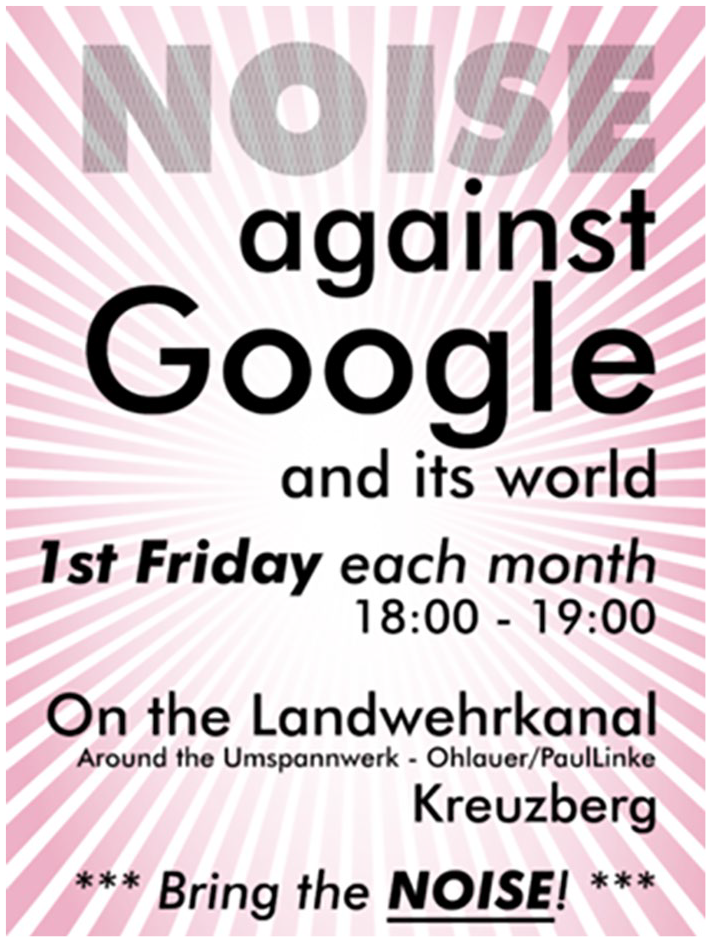
Example of Protest Poster. https://wiki.fuckoffgoogle.de/index.php?title=File: Noise_against_Google_campus_generic_pink.png#filelinks
Next to this organizational structure, the content of the protests also contributed to its success. It managed to combine the specific—this neighborhood, this building, this company, these consequences—with a much broader critique of the company as such and related social developments. It managed to critique surveillance capitalism (Zuboff, 2019), data colonialism (Couldry & Mejias, 2019) or “the gentrification of the internet” (Lingel, 2021), criticizing “the Googlization of everything” (Vaidhyanathan, 2011) without using these terms directly. Hence the claim that “Google is not a good neighbor” 31 was infused with larger fears of where capitalist societies are heading. One could even claim that Google was a double colonizer—colonizing both the actual neighborhood as well as the internet more generally—both the geo- and the media of geomedia, or particularly the new regime that geomedia signifies.
One other aspect should not be disregarded, however: first of all, the local government in Berlin and more specifically in Kreuzberg was slightly divided on the issue. Although there was a general line of support for Google (and a definite desire for attracting such players, since Berlin is not a rich city), the so-called “red-red-green” (R2G) government (which consists of the social-democratic, the so-called “Left” and the Green parties) was internally much more torn about this (see Holm, 2021 for a more extensive assessment of the political context). Hence the support was not carried by strong political decisions. A local Green politician, for example, who is responsible for buildings, was openly against the project. Hence a split political front does not help such undertakings.
In Berlin, the protesters were jubilant after Google’s retreat—but they have not stopped protesting. Instead, they have by now shifted part of their attention to a planned ‘Amazon tower’—this time in Friedrichshain, on the other side of the water. It does not seem that the success can simply be replicated, however, since the tower is currently being built (and Corona stopped many protests). The local elections have also just changed the scene once more. Hence, there might be a trend in these protests, but not a recipe. In terms of our academic viewpoint, the duplication of gentrification in its renewed emphasis on the increasingly intertwined nature of gentrification and geomediatization processes is a useful concept in the analysis of current protests, but also for our—and their—understanding of what they are fighting against.
Footnotes
Author’s Note
The article is part of for the special issue “Gentrification and the right to the geomedia city” (Eds. Maren Hartmann and André Jansson)
Declaration of Conflicting Interests
The author(s) declared no potential conflicts of interest with respect to the research, authorship, and/or publication of this article.
Funding
The author(s) received no financial support for the research, authorship, and/or publication of this article.
