




Abstract
The impact of gentrification in cities is well established. The continuous evolution in geolocation and social media is intensifying the contest between competing stakeholder claims to authenticity about gentrifying places. In this article, we examine the way that different geolocative social media define a struggle over the rights to authenticity in a rapidly gentrifying neighborhood in Brisbane, Australia. Local voices are often submerged by the voices of commercial imperative, particularly when the rent gap in gentrifying neighborhoods begins to attract abstract capital with a vested interest in commodifying local culture. We use Instagram and Facebook to critically examine how the hegemonic influence of social media can construct a gentrifying neighborhood in immaterial space and argue that these constructions work to eradicate the complex array of communities that comprise this neighborhood in material space.
Introduction
As Simmel (1997 [1903]) observed, “the people who first built a path between two places performed one of the greatest human achievements” (p. 170). Ever since that first path, the business of place-making has not been confined to anyone’s bodily presence in a given place. As well as users’ everyday efforts and needs, places grow in the imaginary due to the vagaries of nature, the structural imperatives of prevailing political economies, and with ideologically and discursively constructed reputations through the representations of place by residents, users, and visitors. This article highlights this evolving struggle for place identity in an age of networked digital media that has the (em)placement of content as fundamental to, or enabled by, its logic (McQuire, 2017).
The material disposition of the city has an increasingly reciprocal relationship with the discursive life of the city established through its representation in immaterial space through geo- focused real-time and ubiquitous social media. There is a growing literature on the affordances and transformational potential of what is termed “geomedia,,” which refers to media that locates the user in physical space, most often using Global Positioning System (GPS) technology embedded in smartphones. These applications are described as the location layer of the internet and provide rich and monetizable data about where users are in space and time (Wilken, 2014). There can be a “Bladerunner” complexion to the city when referenced in the quantitative terms of geomedia—a dystopian futurescape where material space is subordinated to needs and affordances of technology and big data (Lapenta, 2011). However, a focus on these technologies can obscure the ways places are collectively mapped on other platforms. This article will extend the reach of existing literature that deals with geomedia to include social media, particularly Facebook and Instagram, as geolocative media. Although most social media applications do not fit the strict definition provided for geomedia, as they do not rely on or demand geolocation as fundamental to their design, their affordances make them central to the active construction and experience of material places in immaterial space by users and their audiences in real-time, regardless of their material location. In this article, we will be using the geomedia literature and developing its arguments to include social media, such as Facebook and Instagram that are also used in a qualitative way to construct places. We will use the term “Geolocative social media” to refer to this medium.
The use of geolocative social media has allowed the struggle for the identity of urban places to become more pervasive and, in many cases, creative. Various stakeholders, including heterogeneous local interests, commercial actors at varying scales and those with an aesthetic interest, and those invested in the symbolic capital of urban places either through stigmatization or reflected “hipness”, now compete for attention in the immaterial space of networked media. These interests conspire to create a new form of relational city space that exposes material space to the glare of the “full horizon” of social relations (McQuire, 2008). This exposure is inevitable and has the effect of creating more open and more abstract relationships with a place—no longer dependent on corporeal presence or local contestation for a politics of place. Using material place as a referent, everyday uses of geomedia and geolocative social media provide an augmented and channeled representation of that place in immaterial space dependent on the viewer and their mode of interest.
There is a growing literature on the place making affordances of social media, particularly Facebook. Unlike more public versions of social media, such as Twitter and (in some manifestations) Instagram, the reach of Facebook posts is limited to known social universes. Facebook can provide a greater degree of security in self-expression than other more anonymous platforms (boyd & Ellison, 2007). The ability to establish closed groups, in this case, place-based groups allows “the digital mapping of people’s real-world social connections . . . in a trusted environment” (Facebook factsheet, in Weir, Toolan & Smeed, 2011, p. 39) reinforces the idea of a virtual “village square” and a relatively sympathetic audience when compared to the unlimited reach of sites, such as Twitter (Smith, 2015).
Social media’s augmented, embellished, and differently grounded representations of place enable and drive the tensions surrounding urban places’ competing interests. When filtered by geomedia, places are at risk of becoming pure representation. Competing media representations can often be understood, particularly in gentrifying parts of the city, as a battle to define and control what passes as authentic (Zukin, 2010) or, in other words, who gets to claim “authorship” of gentrifying places. This authorship can be articulated in the authenticity of the material place or as a search for authenticity of the self, with place forming an appropriate setting for this quest. The everyday constructions of material place in a gentrifying neighborhood enabled and mediated by geolocative and other social media are the focus of this article.
While much literature generalizes to the whole city when discussing geomedia and geolocative social media, we focus on one neighborhood in Brisbane, Australia. We use two geolocative social media platforms, Facebook and Instagram, to compare the constructions of a gentrifying neighborhood by residents, the “insiders,” and a real estate developer, marketing a contentious new residential and retail development, West Village, on social media. The developer represents the incursion of corporate or “abstract” capital into the gentrifying neighborhood. We argue that competing epistemologies of place can obscure the complex array of communities that comprise a neighborhood in material space. The curated image of the neighborhood presented by capital (the real estate developer) can accelerate or further reify the gentrification by shifting the ontology of the neighborhood for outsiders, particularly when the needs of capital capture the discursive control of a place. We highlight the struggle for the right to determine an ontology and a normative intent for a place by interests internal and external to those engaged in everyday life in West End. The effects of this imagined neighborhood can work to prioritize neighborhood aesthetics over local community needs.
Geomedia
Since Simmel’s (1997 [1903]) original observation, places have existed in relation to each other. The advent of modern communication technologies, beginning with the radio and telegraph, allowed people to separate place from time and remotely imagine and reimagine places (Lapenta, 2013). That tendency has only increased in complexity and abstraction. As McQuire (2008) observes: Relational space is the condition of social space shaped by the simultaneous experience of radically different velocities: the overlapping of what Virilio (1995: 144) calls the “metabolic” speed of the body, the relative mechanical speed of vehicles, and the “absolute” light-speed of media and communication technologies (p. 23).
Place is increasingly constructed, experienced, and consumed through new location-based communication technologies (Lapenta, 2013, p. 215). Although the term geomedia has been used for some time in geo and environmental sciences, it has only come into use by social scientists and critical scholars of space and place in the second decade of the 21st century as applications that emplace the everyday user become more ubiquitous.
Geomedia is the latest frontier in a technological trajectory enabling the representation of opinions, fashions, politics and the shaping of places. McQuire (2017, pp. 10–11) describes geomedia with four related trajectories: “convergence,” or the merging of previously separate technologies of broadcasting, computation and telecommunications; “ubiquity,” the availability of these technologies at any time and place; “location awareness” as fundamental to the function of these media and real-time feedback; and “real-time feedback, supporting novel experiences of social simultaneity.”
Geomedia can represent places in their material, symbolic and imaginary manifestations (Falkheimer & Jansson, 2006). Geomedia increasingly shapes the politics of urban space and place where a digital media platform has the (em)placement of content as fundamental to its logic, so that place and time become central. So too is the medium’s popularity, which allows it to host a “market” of contributions about a place based on the moral, emotional, or attractiveness of a place to its users.
Geomedia, in much of the literature, focuses on applications, such as Google Street View (Shapiro, 2018), Google Maps (McQuire, 2019), Yelp, Foursquare (Frith & Kalin, 2016; Wilken & Humphreys, 2019), Facebook Places (Wilken, 2014), and other similar applications (de Souza e Silva & Frith, 2010). In these applications, the geolocation of users or the abstraction of the material into immaterial space is fundamental to their algorithmic logic. Geomedia is about understanding the locative properties of mobile phones and other digital media to create unique maps of places. Places are mapped beyond the most literal application of this word.
In extending geomedia into the realm of social media, Lapenta (2013) describes the role of social media as an interface that mediates the “Geosphere..” This is where the body and the objects of place can be located in physical space and in an “infosphere,” where we can find “images, sounds, and texts, the bits of information, the iconic and symbolic representations of these physical environments that media users produce and share” (Lapenta 2013, p. 217). He builds on this binary by describing the space where these two spheres “reflect each other” as a “third space” of negotiation, neither material nor the realm of pure signs represented by the infosphere. Invoking Foucault’s (1984 [1967]) heterotopia, this third space is open to constructions of space, utopian and dystopian, mirroring but independent of either of the binary spheres.
While all communication occurs in time and space, it is the ability of communication, particularly ubiquitous digital social media, to mediate and qualitatively represent place that interests us in this article. Importantly, and unlike the affordances of purely geolocational applications, the construction of place in social media becomes a social activity where ongoing place construction occurs qualitatively with the assumption of an audience. The ability to form an understanding of place, to consume it and to participate in its reputational form in immaterial space is central to the everyday use of these geolocative social media applications.
We will focus on media that provide each of these elements as we investigate the various influences of geomedia in the contest for representation in a gentrifying neighborhood.
Geomedia and Gentrification
Gentrification is now an established phenomenal process for urban scholars but hardly a settled one. The minimal but generally accepted definition for gentrification is the process by which working-class or low-income migrant communities are displaced from a neighborhood by more affluent residents, attracted by the potential for economic growth, the cultural capital and the “spatial gifts” associated with the neighborhood. The economies of gentrification shift from the everyday needs of original residents to one controlled by incoming residents, then one dominated by abstract capital (Molnar & Walters, 2021; Smith, 1996).
Gentrification does not take a linear path to displacement and “hipsterfication.” It happens in layers or phases, and the incumbents of each layer claim a stake in the neighborhood, which is then perceived by the existing layers as corrupted by the following layer. For this article, we will use three stages of gentrification (Molnar & Walters, 2021; Walters & McCrea, 2014), although not all gentrifying neighborhoods follow this progression as closely. The first wave of gentrifiers, the “renter-gentrifiers” are early pioneers who move into an urban neighborhood attracted by cheap rents, urban character, and location. These early gentrifiers are students, artists, musicians, anarchists, and other nomads and radicals. They are often no more affluent than the existing residents of the area. They have a strong, if ultimately doomed, desire to live in a way that respects the current social and commercial environment, trading on its perceived authenticity (Brown-Saracino, 2010). The renter-gentrifiers are responsible for giving the neighborhood a reputation for alternative music, underground fashions and perhaps an early start-up business culture.
A new second wave of economically better-resourced outsiders, the “bottom-up gentrifiers,” then begin moving into the neighborhood. They share cultural aspirations with the renter-gentrifiers but have the economic capital required to purchase a stake in the neighborhood. They are attracted to an area by the cultural capital created by a burgeoning “cutting-edge” scene already in place. They begin to renovate homes and commercial space, using what has been termed “sweat equity” (Lees et al., 2013), again taking care to preserve the perceived authenticity of the original neighborhood (while gentrifying it).
The land values and reputational value of the neighborhood by this stage have risen to the point where the “rent gap,” or the difference in ground rent between the actual use of land and potential new uses (Smith, 1987) begins the third stage of gentrification. In this stage, an abstract capital “gold-rush” begins, and large-scale property developers and retailers, enabled by growth-focused city governments, enter the area and start building high-density residential development, luxury and franchised retail, and other developments (Walters & McCrea, 2014). These new arrivals pay little regard to the neighborhood’s original character apart from its potential to be appropriated for marketing purposes.
While the stages of gentrification can be identified as temporally distinct, they overlap. In our study site, West End, they are all present and represented in immaterial space through social media. Previous studies of the effects of social media in gentrifying neighborhoods tend to focus on the construction of community within a place (Breek et al., 2018; Gibbons et al., 2018), or how geolocative media contributes to the distribution of spatial capital in the city (Jansson, 2019). In this article, we combine these two approaches to compare an outsider and an insider view of a gentrifying neighborhood. Each perspective has its own interest in the neighborhood and operates in either implicit or explicit opposition to the other. As we shall see below, the exception to this is the original pre-gentrification residents of West End. They take little part in this contest over the exertion of privilege in the consumption of a place (Centner, 2008) and are invoked more for the cultural capital they bestow on others than in their own interests.
Case Study—West End Brisbane
West End in Brisbane, Australia’s third-largest city, is an inner-city neighborhood gradually transformed from its industrial beginnings by gentrification since the early 1990s. It was originally established as a working-class neighborhood in the mid-19th century, servicing industrial and port facilities. The street and retail layout of West End reflect a pre-automobile localized spatiality common to many gentrifying neighborhoods worldwide (Molnar & Walters, 2021; Walters & McCrea, 2014). After World War II, many low-income Greek migrants moved to West End to take up local unskilled work and cheap housing, followed by an influx of Vietnamese and other migrants in the 1970s. West End’s bohemian reputation started in the 1980s when students, artists and other outsiders moved there for cheap rents and access to Brisbane’s universities. The 1988 Brisbane World Expo transformed the adjacent inner South riverside precinct, and properly prices begin to rise. The second wave of gentrification, the “bottom-up gentrifiers,” commenced in the 1990s (Walters & McCrea, 2014). Development remained limited to small-scale residential and retail “regeneration,” largely conforming to the local architectural vernacular. The third wave of “top-down” gentrification comprises mainly high-density and largely placeless apartment developments (Relph, 2016), with little obvious connection to the historical or aesthetic vernacular. These began to encroach in the second decade of the 21st century due to rising inner-city property prices and enabled by government “compact city” policies (Searle, 2010).
The history of West End is one of well-documented staged gentrification (Molnar & Walters, 2021; Walters & McCrea, 2014), with each stage leaving a sedimentary layer, each partially covered by the sediment of those that came after it and each layer with a lingering voice.
The most contentious of these developments for previous waves of gentrifiers has been “West Village”, a development with a 1,350 apartments, 18,500 square meters of retail space and 450 public car spaces built by a global development company in the heart of West End’s main retail precinct, Boundary Street (Sekisui House, 2020). The development is built on a 2.6 hectare site, replacing an used office furniture warehouse.
We need to preface our discussion by observing that there is little that is “real” to any ontology of the social world that social media reflects in these representations of neighborhood in West End. Instead, there is an array of representations that various groups use to pursue their interests through time and space.
Method
Much of the literature on established geolocative social media focus on the idea of users announcing or broadcasting “where people are” at any moment and the effects of this on the construction and representation of place in the city (e.g., de Souza e Silva & Frith, 2010; Frith & Kalin, 2016). In this article, we add to this idea of placemaking in immaterial space to include the conversation about “where people live.” The different affordances of social media allow us to observe competing representations of place from those who have an everyday stake in that place.
We have used Instagram and Facebook as the frames of reference to study how gentrifying place is represented on geolocative social media. Anthropological research has an established tradition of understanding place and culture through social media images (e.g., Miller & Sinanan, 2017; Miller et al., 2016). The focus of the research in this article builds on this work. It acknowledges the cultural importance of visual social media practices, albeit applied to the aestheticized (and often people-less) representations of place (see Smith, 2018) which are the focus of our research. We have focused on perhaps the most controversial and high impact of the “third wave” gentrification developments in West End, West Village. Analyzing the social media output of only West Village offered an incomplete picture of the entanglement of geolocative social media and the process of gentrification. To gain a broader sense of how it operates in the broader context of West End, we also collected data from place-specific Facebook community groups and Instagram hashtags to more fully examine how a place is constructed and understood in these immaterial parochial spaces.
Facebook allows for both the material and the immaterial aspects of place and community to establish themselves and for members to contest various manifestations or ideal types of this community (Halegoua, 2020). As Smith and Yell (2020) highlight, Facebook community groups are important hubs of meaning-making activity for place-based communities, which we can use to help understand the complex affective attachments to place. The resident West End community or, more accurately, communities have a strong presence on Facebook. We have selected the two most popular Facebook sites, “Keep West End Weird” (6798 members at the time of writing) and “West End Rants” (2703 members). These sites are devoted primarily to local issues, with most threads initiated by local people commenting on various topics.
While these Facebook groups reflect the ongoing struggle for space and representation in West End, they only partially represent the neighborhood. They do not capture the marginalized voices, such as indigenous residents, the homeless, and other precarious residents, nor do they adequately represent West End’s aging migrant settlers, such as the Greek and Vietnamese communities. These online groups should be seen as competing representations of a place between the second and third waves of gentrification. We will expand on this theme in the discussion below.
We searched threads from July to October 2020 to loosely categorize popular topics on Keep West End Weird:
Community-related activity (e.g., lost pets, found items, noise, praise for good works, advice on local services)
Complaints (gentrification, construction noise, and minor theft)
Requests for local small-scale help (moving heavy things, recommendations for services, therapies, advice, etc.)
Small business and service advertisements (relatively few)
Other (jokes, memes, and unclassifiable weirdness)
Political (mostly progressive/left)
To identify posts specifically about West Village, we extended the searched posts and threads back to the beginning of 2019.
The second Facebook group, West End Rants, was established for its stated purpose, for people to engage in passionate tirades about a subject of their choice. Topics are overwhelmingly about local events and phenomena; here, some of the most fervent posts about the impact of West Village can be found.
Instagram, as a primarily image-based medium, has a range of specific communicative purposes. Instagram’s introduction of business-friendly features has allowed businesses to adapt to the platform as a way to boost their e-commerce reach. Studies using Instagram have shown that users construct the city with images that appeal to aesthetic and lifestyle ideals that are “sanitized and nearly devoid of negativity. The feeds are full of desirable items, attractive bodies, beautiful faces, healthy foods, witty remarks and impressive sceneries. The messiness and occasional gloom and doom of the city have no place there” (Boy & Uitermark, 2017, p. 622). When Instagram influencers use the backdrop of a particular place to boost their image, they are also working on and intensifying the portrayal and representation of that place as a function of their geomedia reach. However, less is known about how places are fragmented and assembled on Instagram outside of the glare of Instagram influencers.
We used an open-source tool, Instamancer, to collect Instagram data across hashtags, individual posts and user accounts. For example, if one was interested in researching Kim Kardashian’s Instagram content, Instamancer can collect all images, captions and comments and other engagement metrics associated with that account (e.g., @kimkardashian). West End, we used Instamancer to gather data using hashtags related to West End. An initial qualitative examination of the hashtag #westend generated too many false positives. Many of the images were from heterogeneous collections of places, such as London’s West End or Vancouver, Canada. To narrow the search, we focused our data gathering on #westendbrisbane and a combination of #westend and #brisbane, which at the time of research were the most active and locally relevant hashtags on Instagram. As Instamancer does not facilitate the data gathering by geotagged location, these tags were an appropriate proxy.
To put our more targeted study in context, we configured an Instamancer search query to collect 4,500 images over May to October 2020. It returned slightly more, as some Instagram posts contain more than one image. We eventually collected 4,800 images and videos associated with 4,003 posts. The time period is not intentional but an artifact of a volume-based rather than temporally based sampling strategy.
We analyzed data in aggregate, searching for broad themes. We analyzed the images and categorized them in simple terms, according to whether the image was from a personal or business account and the main object of focus in the image. We inductively categorized the visual content of the images as follows:
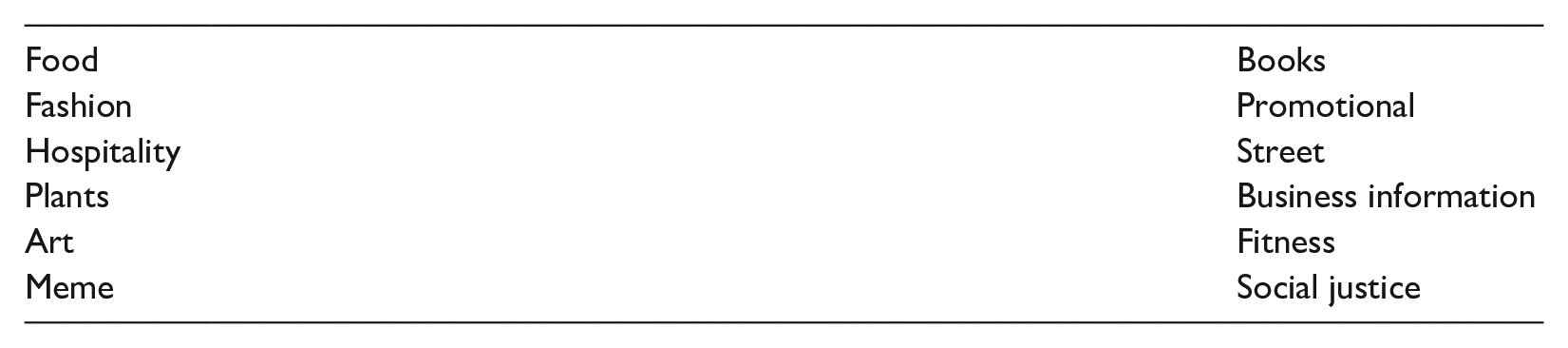
One of the most striking aspects of the Instagram search was the overwhelming proportion of accounts captured in our data collection we categorized as business accounts. A total of 3,278 (82%) were from local businesses. To confirm this, we checked the profile information of the accounts and searched profile names to ensure they linked to businesses located in West End, Brisbane. The remainder was personal, although many of these also appeared to be selling a product or service. There were no influencers posting to this hashtag, indicating that the representation of place on Instagram does not function simply to augment self-presentation. Aside from the images from the West Village Instagram account, none of the images collected from Instagram is reproduced in this article. The West Village images are promotional and feature models and/or actors. This is consistent with the majority of Instagram accounts sampled in this research which are intentionally and deliberately public-facing and do not belong to individuals. The Facebook forums are also public and community-facing and are designed to be a public airing of community issues and news. All posts are de-identified.
The benefit of studying these two social media platforms is that they each serve a different purpose and constituency. Instagram was clearly the preferred platform business and other commercial operators. We used this affordance to narrow our focus on the marketing and placement of the West Village development. We use geocoded posts to interpret the various discourses and commercially influenced constructions of West End that either conform, oppose, or appropriate the representations of insiders with a particular focus on the contentious West Village.
In our findings, we first describe the place branding campaign by West Village, which positions the development in a particular discursive frame. We then contrast this branding frame with the largely negative ways West Village has been received and constructed by residents themselves as expressed through community Facebook groups. Our discussion and conclusion expand on this opposition to highlight the role of social media in the construction of place in immaterial space.
Place Branding and West Village
Place branding as a strategy has reached a new level of sophistication with geolocative social media, with or without the support of the publics integral to those places. According to Falkheimer & Jansson (2006, p. 132): “In a broad sense, a destination image may be defined as the expression of all knowledge, impressions, prejudice, emotions and imaginations an individual or group might have of a particular place” (Lawson & Baud-Bovy, 1977). Sophisticated place branding allows the brander to move away from traditional realist representations of places to a socially constructed or emotively constructed set of moods and images that begin to form a phenomenological spatial frame into which people can imagine themselves. Those people to whom this type of marketing is pitched begin to move away from the place understandings of those more materially embedded in West End.
The most contentious artifact of late-stage gentrification in West End is the large mixed-use residential development “West Village,” described above, on Boundary Street, the main retail thoroughfare. Locals have consistently resisted the development (e.g., McCosker, 2017) for its scale, the cynical addition of privately owned public space, traffic congestion, and fears its sheer scale will have a detrimental impact on the character of the rest of Boundary Street, particularly its independent retail mix. The development company pitches its marketing to a well-heeled aspirational market sector (Figure 1):
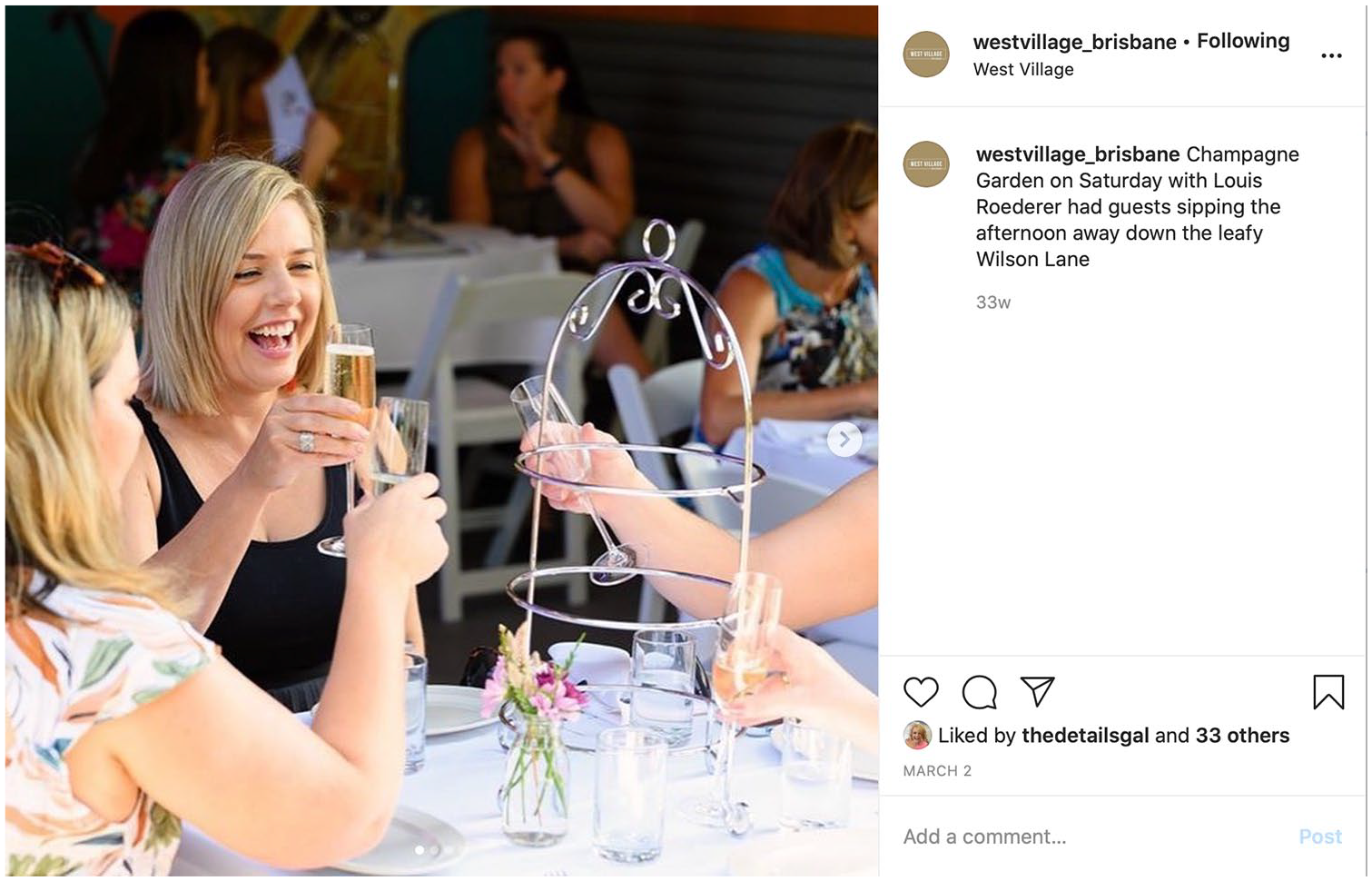
Instagram #westvillage_brisbane.
In its depiction of life in West Village, or the wider neighborhood, Instagram does not diverge from sanitized images, devoid of negativity; characteristics of Instagram more generally. Instagram imagery from #westendbrisbane reflects late-stage gentrification, fashionable restaurants, gourmet groceries, exercise spaces, and other aspirational commercial activities. The branding affordances of Instagram are well suited to West Village’s campaign to reimagine its context for a targeted market: We were thrilled to make the cover of [Brisbane newspaper] Courier Mail’s Home Magazine over the weekend, with a great article celebrating our unique village community (#westvillagebrisbane #westend, June 20, 2020) In line with the Japanese concept of “Satoyama,” our new release luxury residences in Arcadia South Gallery will seamlessly connect residents to ribbons of green. A vitality pool surrounded by a tranquil garden conservatory complements the exclusive outdoor kitchen and will provide future residents with a beautiful subtropical space to unwind (#westvillage_brisbane, October 9, 2020).
The developer’s official hashtag, #westvillage_brisbane, uses a range of text and imagery, heavy with references to an aspirational “localness.” Images of young, attractive people posing as residents take part in developer-sponsored events, such as cosmetics demonstrations where: beauty product lovers had the opportunity to discover the best in makeup, skincare and hair brands from local suppliers while enjoying a gin cocktail and makeup masterclass (#westvillage_brisbane, October 21, 2020).
In another developer-sponsored event, residents and the public are presented with a high culture moment on site: On Friday and Saturday night, our magical garden setting came alive with the debut of “Songs at Sunset” in the Common. Opera Queensland’s Soprano, Rebecca Cassidy, captivated attendees as they indulged in a few glasses of wine and a delicious cheese platter! (#westvillage_brisbane, October12, 2020).
Although the marketers of West Village rely on the reputation of West End as a hip or eclectic neighborhood for branding purposes, the aesthetics of West Village fail to meet this aspiration. Chayka (2016) calls these aesthetics “AirSpace,” an uncanny “everywhereness” filled with a “faux-artisanal aesthetic” which gives selected parts of cities an aesthetic blankness that used to belong primarily to hotel chains (see also Trinch & Snajdr, 2017). This aesthetic has not come fully formed from the corporate imagination. It is a melange of previous markers of urban authenticity that have proved popular on Instagram in both affective and aspirational terms. Jurgenson (2019) argues that in this respect, Instagram is like a Claude glass, an 18th century invention that tourists looked through (with their backs to the view) to frame it more pleasingly. Similarly, geolocative social media allows us to “face ourselves away from the complexities of reality in favour of glowing, well-connected digital glass that renders a filtered and more beautiful representation” (Jurgenson, 2019, p. 42). For these glowing representations, the developer draws heavily on the pre-existing cultural capital of West End in its marketing: West Village is a new global neighbourhood like nothing else. Drawing inspiration from the world’s most engaging precincts yet intrinsically connected to West End’s one of a kind culture, West Village will be a journey of discovery for residents and locals alike. Inspired by the character and history of West End, West Village reimagines urban living. Contemporary apartments are thoughtfully placed and green spaces blur into a relaxed urban culture (Sekisui House, 2020).
Except for the occasional reference to the proximity of the West Village to exclusive schools, there is only a very abstract sense that the materiality of West End provides more than a necessary “bohemian” backdrop into which the developer can insert visions of a postmaterialist lifestyle (Schlosberg, 2019).
In an effort to bring West End closer to its constructed reality, rather than engage with the complex realities of a gentrifying neighborhood and its layers of community, the developer has used the cover of a local business association (WETA) in formulating a plan to have the West End retail and entertainment strip made “safer,” or sanitized (Urbis, 2018, p. 3): Boundary Street is known for its cultural diversity. More recently, the street has suffered from increased crime, anti-social behaviour and increased vacancies, particularly to the Southern end of Boundary Street. WETA are concerned about the increasing levels of antisocial behaviour and the negative impacts it has on the safety of the growing community.
The existence of a ready-made “community” is a common strategy in master-planned property development to provide a signifier of authenticity and belonging to prospective buyers. Developers fund various activities to “kick start” a sense of community in their fledgling developments (Freie, 1998; Walters & Rosenblatt, 2008). The developer offers carefully curated free and subsided community activities, such as farmers markets, street theater, school holiday programs, garden clubs, and dog walking clubs: Last Sunday a few of our residents got together for our monthly Dog Walking Club, led by @doggydaycarebrisbane’s local expert Kaz. A great morning was had by all with lead training advice, coffee from @shawarma_king__, and a chance to mingle with neighbours in the sunshine #westvillagebrisbane #westend (September 30, 2020). There is a sense of family. Meet [husband] and [wife] There is nothing pretentious about the people who live here [resident testimony] (#westvillage_brisbane, December 10, 2019).
The Local View of West Village
For the material, or corporeal, community of West End, the reaction to West Village on West End’s two most popular community Facebook sites is overwhelmingly negative. It contrasts markedly with the representation of West End controlled and curated by West Village. Much of the opprobrium directed at West Village was found in the West End Rants group, where people directed their ire at the symbolic intrusion of West Village from the perspective of its effect on their community: West Village is not part of our West End . . . in fact the less people use that space the better . . . we are a community . . . they do not represent our community! West End is gentrified . . . but we will cling to the little bit they can’t touch and defile—all of us as a community. We have other spaces to use that are welcoming and green and not being used as a commodified elitist shit hole for people who think they are superior to the locals (Keep West End Weird, September 15, 2019)
Much of this contempt was directed at the aesthetic impact of West Village as a “non-place” (Relph, 2016): West Village just gets uglier and uglier. Went for a wander down there the other day during the plant market (not intentionally but they had a good guitarist playing) and it’s so ridiculously soulless (Rants, August 6, 2020) That whole landscaping is a masterpiece of hostile architecture (Keep West End Weird, December 21, 2018)
There was particular opposition to West Village’s provision of privately owned public space in the development. The inclusion of public space as part of the site had been a condition of the development approval process. The deputy premier of Queensland (and local member of parliament) had used her powers to “call in” the development application in 2015 to guarantee public space as part of West Village (Figure 2) (Akers & Wardill, 2016). The developer, in plans lodged with Brisbane City Council (BCC), describes this space as “A gateway place—rich, open, lush—not just West Village’s front door, but a new social heart for West End” (Sekisui House, 2015, p. 12).
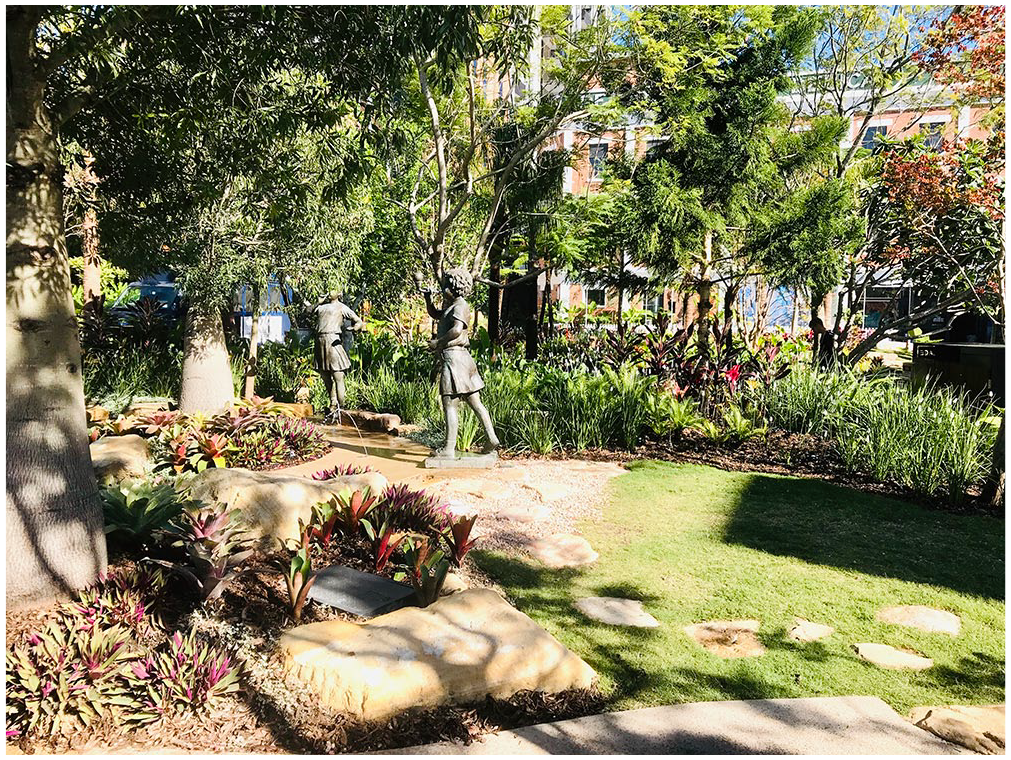
Street Level Photo of West Village Public Space—Much of the Promised Open Space has Been Heavily Landscaped (Author’s photograph).
Once construction of the “common” was complete, it was apparent it differed markedly from the “artists impressions” provided by the developer in its sales and marketing material. Instead of a space fringed by trees, maximizing useable green space, the end product was largely planted out with trees, fountains, and statues. A small pocket of open green space is hidden away at the opposite end to the public street. The residents described this space in uniformly negative ways: The Garden at West Village looks like a Pedo[phile] attempt at Romanesque Art Frolicking with Lewis Carroll (Rants, June 17, 2020) . . . I’m preparing a letter of complaint to the BCC [Brisbane City Council] and would encourage others to do the same. It [the public space] is grotesque in appearance and truly out of place with the aesthetic of West End (Rants, February 5, 2020)
The mocking reviews of the aesthetic and practical impact of the West Village’s public space highlight the essence of what is it to be picturesque, “something that is more pleasing in its mediated representation” (Jurgenson, 2019, p. 41). The picturesque artists’ impressions and the carefully framed, cropped, and filtered photos of West Village jar with the lived experience of place because of Instagram’s constraints, affordances, and standard aesthetic practices. In this post, a member of Rants takes aim at the preponderance of butterflies used on West Village marketing material: Fucking West Village and their fucking butterfly habitat. Who are the morons that are meant to be influenced/enticed by this banner? Paradise on earth (Rants, August 10, 2020).
The contrasting views of West Village manifest in local Facebook groups illustrate how late-stage gentrification appropriates the local culture of a neighborhood, transforms it into something aspirational and desirable and then alienates the very people responsible for much of that local culture. Despite a concerted early effort by the developer to win the “hearts and minds” of locals through consultation and public meetings, the response to this development on social media has been almost uniformly hostile due to broken promises, inappropriate scale and a perceived culture that feeds on, and then sanitizes, local life.
Discussion and Conclusion
Sophisticated place branding allows the marketer to move away from traditional realist representations of places to a socially constructed or emotively constructed set of moods and images that begin to define a place—by setting a phenomenological “frame” into which people can imagine themselves. The people to whom this type of marketing is pitched begin to diverge from the place understandings of those more materially embedded in West End.
Middle class aspirations are generally tied to aspirational places—the construction of West End as an aspirational place is central to the marketing campaigns of developments such as West Village. Marketing creates a simulacrum of the authentic “urban village” with its produce market, art spaces, coffee shops, and attractive patrons (Jansson, 2017). The developer has managed to add a layer of “augmented reality” (Greenfield, 2017) of West End that appeals to its target market, decoupling the possibility of other less desirable frames of reference representing the neighborhood.
The outsider looking in on Instagram constructions of West End, and not just those of West Village, would see a sophisticated yet hip neighborhood filled with interesting food, cool vintage fashions, gym-fit bodies and safe, eclectic street life. Businesses using Instagram’s geolocative properties benefit from the power of selective visual impact to present framed visual evidence to associate a business with a sense of je ne sais quoi or “cool by association.” The power of Instagram as a medium for interpreting a place was on full display by the professional marketers and influencers behind the West Village hashtags.
Marketing campaigns that drive third wave gentrification, particularly in residential development, have an important role in shaping place consciousness. A company can unequivocally position a neighborhood in the eyes of its target market. This is more efficient than leaving an audience to make up its own mind based on the physical evidence presented by the material artifacts of real estate development. The acceleration of consumption-based gentrification allows the socio-economic and cultural logics creating using media technology to play into the production and (re)territorialization of urban space.
Proponents for the protection of gentrifying neighborhoods argue that it is in the entire city’s cultural interest to retain these disappearing artifacts of a pre-automobile spatial logic (Molnar & Walters, 2021; Walters & McCrea, 2014). The rise of the networked city and, in particular, geomedia puts this debate into sharp focus. All phenomena must be observed from somewhere, so if we take the case of West End, then we see place experienced at different speeds, the full range of possible speeds. Power is no longer held by those who occupy material space (places) (McQuire, 2008).
The sharp contrast between the aspirations invoked by the marketers of West Village and the contributors on community Facebook sites underlines a tension between the desire to preserve a neighborhood for a city and the desire to attract people to live there. Upwardly mobile postmaterialist aspirations are central to the marketing campaigns of developments, such as West Village. Many of the second wave gentrifiers, the “bottom up” gentrifiers, active on West Ends local Facebook sites are themselves progressive postmaterialists, employed in the creative and knowledge economies, and are no doubt themselves the prototypes upon which the marketing campaign is constructed. Slater (2006) argued, in an article highly critical of the direction of gentrification research, that it can be useful to focus on boosterism, such as that displayed by many of those on Facebook, to highlight the deficiencies and implicit privilege of the boosters.
We have focused primarily on a struggle between the opposing constructions of lived space in gentrifying neighborhoods, a struggle as old as the distinction between use value and exchange value. However, the existence of social media and particularly the value of Facebook as a medium for community organization and opposition affords the possibility of resistance to the excesses of capital that may not have previously existed. This resistance can be somewhat mitigated, as we have seen, by the power of geolocative social media to work in the interests of capital as well. There probably is no feasible counterfactual to the outcomes we have described.
It is also worth repeating that there are many more residents in West End than members of these Facebook groups. The original residents of pre-gentrification West End, the First Nations people, the working-class Greek and Vietnamese migrants and other groups still live in West End with varying economic statuses. Their voices are seldom heard in the gentrification debate as articulated in this article (Penfold, 2009), and their interests extend beyond a battle for authenticity. Lost in much of this representation are the voices of the marginalized and precarious, who form a part of the neighborhood to be “sanitized” by place marketers to make it fit more readily with the desired image. The “geomedia city,” while it hosts the debate/struggle for what remains of the soul of West End, acts to displace further those who do not have the resources or networks to take part in this conversation in immaterial or relational space.
Places valued for their culture, aesthetics, community, or economic potential are contested in relational space—on those media accused of undermining our relationship with places. However, in much of the geomedia discourse surrounding the spaces and flows of relational space—we can forget that all of these competing voices and representations are still anchored to the materialities of places; the spatial logic of neighborhoods, streets, and public spaces. Places in the city still fall into a hierarchy, reflected by their scarcity and economic, cultural, and aesthetic value or, conversely, to their stigma. Although the spatiality of West End operates in symbiosis with its status in immaterial space, which formed the raw material for the developer’s marketing campaign; the material spatial logic of West End, its emplaced history and cultural transitions are the foundation for local and relational politics, and it is here that resident participants generated the most passion.
Footnotes
Declaration of Conflicting Interests
The author(s) declared no potential conflicts of interest with respect to the research, authorship, and/or publication of this article.
Funding
The author(s) received no financial support for the research, authorship, and/or publication of this article.
