




Abstract
In this article, I approach the Danish digitalization strategy as a Lefebvrian conceived space, focusing on how its ideology and spatial codes denote a normative vision for how citizens should and ought to be. Drawing on the non-media-centric concept of geomediatization and a feminist new materialist approach to gentrification as assemblage, the article explores the lived spaces of older (64+) marginalized citizens living in Sydhavnen, Copenhagen, an area currently undergoing gentrification. By focusing on the interplay between digitalization of the public sector and urban gentrification, the article sheds light on an emergent power geometry in which the potential for belonging is carved out differently for different citizens. In doing so, the article critically explores the more-than-representational geography of the digitalization strategy and contributes to the budding field of geomediatization studies.
Keywords
Introduction
Over the past decades, Copenhagen, capital of Denmark, has been undergoing strategical changes, aiming to cultivate its brand as a “creative city” (Lund Hansen et al., 2001; see also Florida, 2002, 2005). By investing in research, education, and culture and by “revitalizing” (Municipality of Copenhagen, 2013) build environments and digital infrastructures alike, the goal has been to cultivate the financial growth potential of the Copenhagen region and attract tourists, (foreign) investors, and what policy documents label “the economically sustainable part of the population” (Larsen & Lund Hansen, 2008, p. 2433)—the middle-class families. As part of this cultivation and through courting the “sustainable parts of the population,” especially the inner city and the neighborhoods, bounding the inner city, have been gradually “revitalized,” as it is phrased by the Municipality of Copenhagen (2013), over the past 20–30 years, resulting in what Lund Hansen et al. (2001) refer to as “a deportation of marginalized citizens and the original working class population” (p. 853; see also Larsen & Lund Hansen, 2008). In the same period of time, the Danish public sector has become thoroughly digitalized, and Denmark is a country priding itself of being a being a “frontrunner” within public sector digitalization (Danish Agency for Digitisation, 2016) within public sector digitalization.
Zooming out, we can understand gentrification and digitalization through a mutual framework as both being processes of modernization. Quoting David Harvey, processes of modernization have inherent elements of “creative destruction” be it gentle and democratic, or the “revolutionary traumatic and authoritarian kind” (Harvey, 2003, p. 1). We can, this article argues, locate this dialectic of destruction and creation in both processes: Urban gentrification and the digitalization of infrastructure and of the public sector at large can be said to play out in a dialectic of dismantling and rebuilding. This article departs from an interdisciplinary and non-media-centric approach to the role played by (geo)media “in organizing and giving meaning to processes and activities in space” (Fast et al., 2018, p. 4). I employ Henri Lefebvre’s (1974/2008) triadic model of spatial production to explore the interweaving between the digitalization of the Danish public sector and the gentrification of Sydhavnen (the South Harbour), a (former) working-class neighborhood in Copenhagen, Denmark. Drawing on a qualitative study, the article presents an analysis of older (64+) working-class citizens’ “lived spaces” (Lefebvre, 1974/2008) as they move on the margins of practicing their digital citizenship and master skills and tools, which in Lefebvrian terms can be thought of as “spatial codes,” promoted in the “conceived spaces” (Lefebvre, 1974/2008) of mediatized societies, for example, the strategy of digitalization and the ideal of the “digital citizen.” The article points to the transformations currently shaping lived space for these marginalized digital citizens as being not of the gentle kind with reference to Harvey. In doing so, the article contributes in a dual way to debates around social inequalities pertaining to gentrification and smart cities and to mediatization and digitalization at large.
Drawing on observations done at IT-hjælpen (IT-help), a local IT-assistance initiative, and semi-structured qualitative interviews with older (64+) citizens living alone in Sydhavnen, gentrification is analyzed through a new materialist framework (Amin & Thrift, 2009; Delanda, 2006; Latour, 2005), as an “assemblage”: “A type of connection between things that are not themselves social” (Latour, 2005, p. 5; see also Delanda, 2006). As such, I focus on gentrification in its intertwinements with digital public infrastructure and the figure of the digital citizen. I seek to demonstrate aspects of how the rollout of the Danish government’s digitalization strategy is transforming not only digital infrastructures but through the working of “spatial codes” (Lefebvre, 1974/2008) also the material structures for urban everyday life for citizens struggling to practice their digital citizenship. Following Lefebvre’s (1974/2008) humanist Marxism and his triadic model of spatial production, I approach the digitalization strategy as a “conceived space” (pp. 38–41) informed by neoliberal ideologies shaping collective imaginaries (Isin & Ruppert, 2015; Schou & Hjelholt, 2019) and articulating how citizens are to think of and inhabit their digital citizenship. The article moreover shows how qualitative explorations informed by the concept of geomedia (Fast et al., 2018; Jansson, 2019; see also McQuire, 2016) can provide critical insights into the texture of public space as digital, lived, perceived, and conceived (Jansson, 2007; Lefebvre, 1974/2008).
The analysis unfolds in four parts. The first focuses on the strategy of digitalization as a conceived space producing spatial codes. The second part analyzes IT-hjælpen as an “excluded place” (Bataille, 1985, 2018) in the gentrifying geography of Sydhavnen and as a place accommodating the unassimilable. The third part draws on observations at IT-hjælpen in a session, demonstrating the affective investments going into the strive of becoming a digital citizen, understood as an “object of desire” (Berlant, 2006). Finally, the fourth analysis, also drawing on observations at IT-hjælpen, shows through the notion of “spatial capital” (Centner, 2008; Jansson, 2019) how digitalization renders some forms of capital pertaining to the working class unexchangeable. Below I set off by giving a brief presentation of the two intertwining empirical areas explored in this article: Sydhavnen and the Danish digitalization strategy. Afterward, the theoretical framework is outlined followed by methodological consideration, analysis, and conclusion.
Sydhavnen—The South Harbour Area
Sydhavnen is bounded by Vesterbro, the latter being a former working-class neighborhood known for drug deals and prostitution and today a shabby, “revitalized” (Municipality of Copenhagen, 2013) area. Though sounding perhaps gentler than “gentrification” and “urban renewal,” the terminology “revitalization” is itself highly political. It denotes in fact what and who get to be counted as vital, as lively: Which bodies, practices, and ideals are being cast as having the potential to revitalize? And reversely, which bodies, practices, and ideals are cast as those lacking vitality, or at least lacking the right vitality?
In the 1990s, Sydhavnen was targeted for the development of public rental housing (Lund Hansen et al., 2001, p. 865) and today waterfront redevelopment in the area is taking shape as apartment complexes complete with glass balconies and underground parking facilities are being built to house primarily middle-class families (Municipality of Copenhagen, 2013, p. 3). This means that the demographics traditionally characterizing Sydhavnen are changing and it has been dubbed “The most unequal district in Denmark” (stemmerfrasydhavnen.dk). The old Sydhavnen with its many “old, traditional working-class flats” is described as being “detached from the rest of the development in Sydhavnen” (Municipality of Copenhagen, 2013, p. 2). The Danish national newspaper Politiken describes the development and changes in the area in an article, which presents numbers showcasing the clash between “the old” and “the new” Sydhavnen. In the newly build parts of Sydhavnen, one third of all flats have kids. In the poorest parts of Sydhavnen, one out of 10 flats house kids. One out of three citizens living in the newly developed Sydhavnen has a long education. In the not-yet gentrified parts of Sydhavnen, one in 10 has a long education (Christiansen, 2016). Although the gentrification is causing a rise in, for example, income and education levels for the area, Sydhavnen is to this day still characterized by the majority of residents being unemployed (25%), early retirees, or having a lower income compared with the other parts of Copenhagen. Moreover, the majority of the citizens living in the not-yet revitalized parts of Sydhavnen are 65+, two thirds of them are living alone, and the life expectancy in Sydhavnen is lower than in the rest of Copenhagen with a high number of deaths caused by smoking, drinking, and unhealthy living (sammenomsydhavnen.dk).
The Danish Digitalization Strategy
The gentrification of the physical built environment, however, is only one of the several forces shaping the material structures for life in Sydhavnen: the digitalization of the public sector in Denmark (or elsewhere), we may also think of in spatial terms and explore as a spatiality and sociomaterial restructuring of public space. Commenting on the growing focus on digital citizenship, Papacharissi (2010) in fact states that “Access to online technology is as binding to digital citizenship as national geography is to citizenship” (pp. 103–104).
Former Minister of Finance, Claus Hjort Frederiksen, labels Denmark a “frontrunner” in public sector digitisation (Danish Agency for Digitisation, 2016), and the United Nations (UN) has twice in a row (2018 and 2020) elected Denmark as world champion in public digitalization (E-Government Survey, 2020). Moreover, statistics show that the older (65+) part of the population in Denmark is the “most digital in Europe” (Statistics Denmark, 2019; see also Givskov, 2017; Givskov & Deuze, 2018; Givskov & Petersen, 2018). One of the causes behind this high number is the implementation of the digitalization strategy. Since 2010, this strategy has gradually introduced mandatory digital self-service in a constantly growing number of spheres of citizen practices and communication tasks. With the implementation of the strategy, the Danish government passed an act making it mandatory for all citizens above the age of 15 to receive Digital Post (Henriksen, 2015) from public authorities in their personal “eBoks.” Briefly explained, eBoks is a mailbox linked to Danish citizens’ personal registration number and functions as an inbox for mail from both the public sector (state, municipality, hospital) and the private sector (e.g., bank). Citizens can apply for exemption from receiving Digital Post if they have a disability preventing them from receiving post digitally or if they do not have access to a computer with sufficient internet connection in their home. This top-down rollout of digital self-service, I suggest in the following, resembles a sanitation, or gentrification, of the digital public infrastructure in how it implicitly prioritizes digital skills, properties, and tools for communication more pertinent in some groups than others, hereby creating unequal opportunities for citizens to act as citizens. And though Denmark prides itself of its digital older population, the 65+ citizens are still the most challenged when it comes to being online and communicating. Statistics report that 27% of the 65+ year olds are feeling “to a lesser degree” or “not at all” capable of using the internet (Statistics Denmark, 2017) and 29% of the 75–89 year olds have never been online (Statistics Denmark, 2020). Moreover, the majority of the old citizens constituting these 27% are the socially, economically, and health-wise vulnerable citizens (Jensen & Swane, 2013. See also Møller & Klausen, 2018). This places a responsibility on the governments enforcing mandatory digital self-service on citizens, to ensure solutions that secure the opportunity to participate in (digital) society. In Denmark, the government to a large extent outsourced the task of strengthening the media literacy of the citizens in need to volunteers from interest organizations (Bagger, 2018) or relied on “warm experts” (Bakardjieva, 2011).
The bridging between the digitalization of the public sector and Sydhavnen as a gentrifying area is in this article done by viewing gentrification and digitalization as mutually constitutive processes that promote a range of the same neoliberal ideals pertaining to “the digital citizen.” This, I argue, causes a homogenizing of social space in which capacities for belonging are being unevenly distributed to different groups of citizens. I approach the notion of the digital citizen from multiple positions and as being shaped by both state-level forces (e.g., the strategy of digitization) and in processes of gentrification of urban public space in accordance with “smart city” agendas. In doing so, I deploy Kitchin et al.’s (2019) view on E-government systems and E-governance as forming part of the “smart city technologies”-repertoire (p. 3).
Assembling the Geomediatized Urban
Bringing together the burgeoning field of geomedia studies (Fast el al., 2018; Jansson, 2019; McQuire, 2016) with new (feminist) materialism (Amin & Thrift, 2009; Berlant, 2006, 2011; Delanda, 2006; Latour, 2005) paves the way for thinking about the more-than-human worlds (Whatmore, 2006) of gentrification. Within this framework, we may ask how heterogeneous entities (places, discourses, bodies, technologies, power) are folded together in the production and affective charging of (uneven) geographies (Klausen, 2017). Which geographies afford feelings of belonging for which bodies? In this article, I approach gentrification as a process denoting the spatial reorganization, favoring the middle-classes (Ley, 1996) and analyzing it as an assemblage (Delanda, 2006; Latour, 2005) of human and nonhuman actors (technology, matter, discourses, ideals) coming together to shape the material structures for life and belonging through the workings of certain spatial codes (Lefebvre, 1974/2008).
Through the term “new urbanism,” Amin and Thrift (2009) introduce a nonrepresentational approach to and “doing” of cities, where a city is grasped in its multiplicity and as a place of juxtaposition. Cities “gather, mix, separate, conceal, display. They support unimaginably diverse social practices. They juxtapose nature, people, things and the built environment in a number of ways” (p. 3; author’s emphasis). While following the new materialist framing of cities as heterogeneous juxtapositions, it might be fair to question whether thinking of cities as frameworks for supporting “unimaginably diverse social practices” might primarily be an ideal. At least, as discussed in this article, the revitalization of urban and digital public infrastructures can end up favoring homogeneity over diversity, privileging the lifestyles of certain citizens and demographics over those of others. Amin and Thrift (2009) moreover understand urban life as a “product of mixture” (p. 3) and recognize that this mixture increasingly takes place at a distance through digital technologies, which in turn challenges conventional notions of place. Amin and Thrift (2009) urge theoretical “doings” of the city that bring forth the neglected spatialities and invent new ones by exploring cyborgs and assemblages of urban and more-than-human life worlds (p. 4). This article seeks to shed light on such a neglected spatiality, that of the marginalized digital citizen, and it does so by thinking through the notion of geomedia as defined by Fast et al. (2018) and traces the digital citizen’s capacity for belonging in a geomediatized landscape shaped by gentrification and digitalization.
Fast et al. (2018) define “geomedia” in an inclusive, non-media-centric manner as a “relational concept that captures the fundamental role of media in organizing and giving meaning to processes and activities in space” (p. 4). This conceptualization calls for interdisciplinary investigations of the geographical qualities of media at large (texts, technologies, institutions) and invites critical thinking about the development and adoption of communication infrastructures and digital divides. This framing of geomedia draws on mediatization studies as a structural context, understanding mediatization as “a metaprocess” reconfiguring social life and involving the normalizing of certain skills, properties, and tools for communication (Couldry & Hepp, 2013; Jansson, 2013, 2018; Krotz, 2007). Geomediatization is thus not limited to specific media technologies but points to the accentuated and socially pervasive interplay of media users, media technologies and the geosocial surroundings of the whole. Ultimately, geomediatization denotes the coming of a social regime where human subjectivity, media and space/place are co-constitutive of one another. (Fast et al., 2018, pp. 7–8).
The theoretical framework applied in this article thus works through a materialist grounding of (geo)mediatization and bridges cultural materialist mediatization theory (Jansson, 2016) with new (feminist) materialism (Amin & Thrift, 2009; Berlant, 2006, 2011; Delanda, 2006; Latour, 2005). This combination offers to the conceptualization of geomedia a critical analysis of the spatial inclusions and exclusions linked to geomediatization—how digital technologies, at large, play a role in assigning different capacities for belonging to different actors (technologies, bodies, practices, ideals). In the analysis, I draw on new (feminist) materialism (Berlant, 2006, 2011; Delanda, 2006; Latour, 2005; Rose, 2016, 2017) and approach geomedia as posthuman by exploring agency in relation between the social and the technological. Through connecting a capacity for belonging to the practice of digital citizenship for citizens living in a gentrifying neighborhood, I shed light on sociospatial transformations caused by the digitalization of the public sector, hereby meeting the call for “unruly” and interdisciplinary thinking (McQuire, 2018) when exploring our geomediatized life worlds. The article then does not examine questions of “the right to the city” through analyses of the urban material environment in relation to geomedia technologies in any narrow sense. It takes a different route and assembles gentrification through the question of belonging as it explores citizens’ experiences within the digital public sector in sociospatial terms. It thus points to how the ideal of the digital citizen implied in the strategy of digitalization can be thought of as combining with and reinforcing ideals and power geometries pertaining to gentrification processes and the making of “smart cities” and “smart citizens” (Cardullo & Kitchin, 2019; Kitchin et al., 2019; Rose, 2020). The restructuring of physical urban space and of digital infrastructure alike is saturated with neoliberal ideology causing a homogenizing of social space that reduces the capacity for belonging for certain citizens.
This approach to gentrification follows Jansson’s (2019) view on gentrification and geomediatization as mutually constitutive processes and contributes to the ongoing discussion of gentrification as a field for competing epistemological and theoretical positions (Hamnett, 2003). Extending this line of thought and drawing on Centner’s (2008) notion of spatial capital, Jansson (2019) builds the argument that gentrification and mediatization should be grasped as mutually constitutive processes sustaining the spatial interest of some groups rather than others. Research into geomediatization processes should then consider “the multiplicity of ways in which spatial capital is invested and played out in the city” (Jansson, 2019, p. 175). In combining the concept of geomediatization (Fast et al., 2018) with the new (feminist) materialist thinking, I use geomediatization as a concept affording critical explorations of more-than-human worlds and the folding together of the sociospatial with the technological. Below, I give a brief outline of material and method and move on to suggest how Lefebvre’s (1974/2008) notions of conceived space and spatial code (pp. 28–41, pp. 47–48) can inform an analysis of some of the lived spaces of the Danish digitalization strategy.
Material and Method
For this article, I did observations at IT-hjælpen over a period of 2 weeks, observing a total of eight IT-assistance sessions, all of which were with citizens 64+. Below, I give a brief presentation of IT-hjælpen. I also did interviews in Sydhavnen with citizens aged between 64 and 92 years, all of them living on their state pension and all of them living alone in subsidized housing complexes. The 11 research participants who were interviewed (three men, eight women) were all White and identified as heterosexual. The interviews have been transcribed and coded in Atlas.ti. Names have been changed to protect the participants’ privacy. For this article, I mainly draw on the observations, but also include material from one interview. In the coding process as well as for doing and being a part of the observed situations, I relied on a postqualitative approach (Fullagar, 2017; Lather & St. Pierre, 2013) recognizing its performative qualities and focusing on the ways in which in Sydhavnen, both social space and digital technologies emerged in relation to belonging, understood broadly. While observing, I jotted down notes focusing on mood in the room, smells, sentences being uttered and exchanged between the assisted and assisting while using, unpacking, or simply in relation to digital technology as well as on the affective state of the citizen in need of assistance: Do they appear to be calm, frustrated, happy? And what is the role of digital technology and its affordances, if any, in the molding of their wellbeing or lack hereof? The eight observation sessions lasted between 1 and 1.5 hr. While the observations and interviews provide insights into experiences and affects related to practicing digital citizenship and its spatial codes, they do not point in detail to how specific technological affordances (e.g., written, digital asynchronous communication with public authorities) can cause inclusion and/or exclusion. The non-media-centric approach applied can thus be said to point out some general issues emerging in the meetings between marginalized digital citizens and geomediatization at large.
IT-hjælpen, an initiative taken by the South Harbour’s community center, is placed in the below-ground rooms of the community center’s premises. A used clothes store, a pub, and a discount grocery store are its neighbors. IT-hjælpen shares premises with the area’s drop-in-center for abusers and/or homeless receiving welfare benefits/social assistance. At IT-hjælpen, anyone can book a free IT-assistance session. In these sessions, the citizen brings their own laptop or smartphone and sits down with the one employee who is single-handedly running IT-hjælpen, a woman called Kitt, who lives in Sydhavnen and is employed part-time by the community center. Kitt used to work as a waiter but lost her job and after some years of unemployment, she had gotten into the habit of helping out fellow jobseekers with online job seeking–related tasks, and the community center made a temporary position for her for doing just this. Kitt has, as many of the volunteers in charge of strengthening the digital skills of citizens in need (Bagger, 2018), no formal education equipping her for the task. According to Kitt, 90% of the citizens using IT-hjælpen are 65+ and many of them live alone. Before each observation session, Kitt informed the citizen about my reason for being there, without my presence, and asked whether I could observe the session. All of them agreed. I then presented myself and explained my research project and their rights as participants. A couple of the participants at It-hjælpen as well as a few of the ones being interviewed expressed being surprised that their situation could be of interest for researchers or they expressed gratitude that someone was showing an interest in a situation they found challenging. In this manner, the relation emerging between the research participants and I resembled a collaboration (vs. disengaged observing) (Taguchi, 2013, p. 714), and my role was framed as an ally. During the observations, I sat on a chair in the corner, facing the back of Kitt and the citizen being assisted. I observed eight sessions, five with women and three with men.
The Digitalization Strategy as Conceived Space and Spatial Code
Schou and Hjelholt (2018, 2019) have analyzed the citizenship discourses in the Danish digitalization strategies between 2002 and 2015. I suggest that their findings can be transported and put to work in a geomediatization framework. They deploy a discourse theoretical approach to show how the figure of the digital citizen “reproduces neoliberal conceptions of subjectivity, concerned with efficiency, productivity, individualization and collective responsibilization” (Schou & Hjelholt, 2019, p. 3). They demonstrate how the strategies work as “collective imaginaries” (Isin & Ruppert, 2015) and mobilize (digital) citizenship in relation to business, sameness and individuality. Expanding this, I suggest understanding the digitalization strategy as conceived space and thus part of the production of social space.
Conceived space is a planned, abstract space without life and, writes Lefebvre (1974/2008), “is the space of the bourgeoisie and of capitalism” (p. 57). It is the space of the city planner, the architects, the scientists, and—in a geomediatization optic—the app developers, the platform owners, and the digital infrastructure architects. Capitalism is in Lefebvre’s optic founded on an antagonism between conceived space and the lived spaces of everyday life. In this antagonism lies the possibility for a dominant group to organize social space in ways that sustain its own interests over those of others (see also Fuchs, 2019). As conceived space, the strategy of digitalization has an ordering effect on the lived spaces of everyday life. Focusing on the geographies of the strategy affords a tuning into which ideals and norms are being more or less implicitly promoted in the strategy and explore these as spatial codes opening and expanding or diminishing lived space and capacity for belonging for certain groups and not others. A spatial code, Lefebvre (1974/2008) writes, is “not simply a means for reading or interpreting space: rather it is a means of living in that space, of understanding it, of producing it” (pp. 47–48). Thinking through spatial codes turns urban space into a medium for the development of social practice and the collective imaginaries produced in conceived space: “We are concerned with logico-epistemological space, the space of social practice, the space occupied by sensory phenomena, including products of the imaginations such as projects and projections, symbols and utopias” (Lefebvre, 1974/2008, pp. 11–12). It is the role of theory, following Lefebvre to expose emergence, purpose, and disappearance of the spatial codes (Lefebvre, 1974/2008, p. 18). The articulation of the digital citizen in the digitalization strategy is simultaneously a social practice, a symbol, and a utopia. Following this, we need to pay close attention to how different actors (norms, ideals, technologies, bodies) assemble to perform digital citizenship and to which power geometries emerge through these assemblages. Moreover, spatial codes pertain to different modes of production (e.g., capitalism) (p. 46) and constitute the relationship between the subject and its surroundings. Lefebvre notes that codes are “specific to a particular society; indeed they stipulate an affiliation to that society. To belong to a given society is to know and use its codes” (p. 215). Following this, I focus on the potential for belonging and argue that to know, practice, and live with and through digital media in times and spaces marked by geomediatization is then to understand the codes guarding this space. It is to live according to the code of this space, to belong in this space. To be a digital citizen, then, is in fact to practice a primary affiliation with a digital public sphere. And reversely: To not be a digital citizen or to struggle with practicing digital citizenship affords only a partial or secondary affiliation, only partial belonging.
Excluded Space
IT-hjælpen is in geographical placement and as a phenomenon pointing to undergoing spatial and digital transformations. The place has no official sign on the street, only a handwritten piece of paper put up with adhesive tape on the door (Image 1). The place mostly resembles a basement as the rather small rooms are below parterre and the windows have bars. One morning I sit, waiting for Kitt to arrive, in the room serving as the drop-in-center for abusers and homeless. After I have replied to a question of what I am doing there, the man asking answers: “Kitt is great. We all know her out here.”
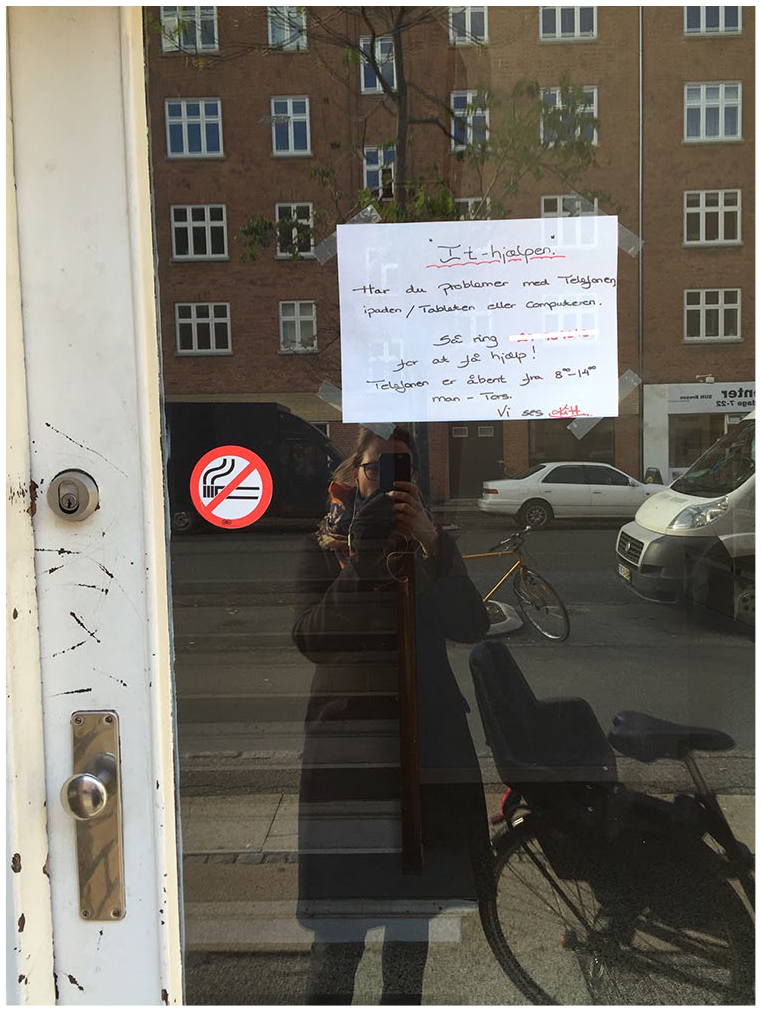
Handwritten Sign in the Door to IT-Hjælpen: “‘IT-Hjælpen’ Do You Have Problems With the Telephone, the iPad/the Tablet or the Computer? Then Ring [Number] to Get Help! The Telephone Is Open From 8am-2pm Mon-Thur. See You! Kitt.”
IT-hjælpen can be understood as a node in the gentrifying landscape of Sydhavnen through its accommodation of marginalized (digital) citizens. In his work on spatial capital, Centner (2008) speaks of the production of “exclusionary places of privilege” (p. 193) arising through the urban practices and overall habitus of the media-savvy citizens, who then shape gentrification to fit their preferences (see also Jansson, 2019, pp. 174–175). In IT-hjælpen, I argue, we find the reverse: It is an excluded place of underprivilege. As a node in the overall eco-system of Sydhavnen as a gentrifying neighborhood, IT-hjælpen receives a traffic of entirely or partly excluded citizens, assisting them in the deciphering of the spatial codes of the mediatized society and digitized public sector. Its functions then as an outlet accommodating a group of citizens whose lifestyle, interests, and practices do not adhere to the norms saturating conceived space. This approach to the production of urban space can be thought of through Bataille’s (2018) notion of heterotology, with its focus on the “excluded parts.” It is an anthropology of the “unassimilable,” or the ”excessive” (Bataille, 1985, 2018; see also Nielsen, 2001): All seemingly homogeneous entities (Bataille’s example is science) have to discharge excess material, that is, that material not compatible with the overall homogeneity. When applied to the production of geomediatized space, it can be argued that gentrification of urban space and the move toward digital citizen self-service together amplify a homogenizing of space favoring interests and practices of the “sustainable parts of the population” and in the process rejecting accommodation of those who do not easily fall under the label “sustainable.” With regard to digitalization as homogenizing and excluding, Andersen (2008, pp. 316–317) has highlighted how there has been a gradual shift from the notion that digitalization must include all citizens to instead first and foremost be “serving the group of citizens who are willing and capable of taking advantage of these new technologies” (Andersen 2008, quoted in Schou & Hjelholt, 2019, p. 8).
The dialectics of this process of homogenization is touched upon in the following interview quote. The interview is conducted in the home of Kirsten, a 67-year old woman, who overall is anxious about digital media and how they might affect us. Her reflective use and what we could call “digital media avoidance” resonates well with Ytre-Arne and Moe’s (2021) notion of “digital irritation”: an emotional engagement and level of knowledge, in Ytre-Arne and Moe’s study around algorithms and in this article around digital media technologies more generally, that differs from the widespread notion of user engagement framed as “digital resignation” (Draper & Turow, 2019). Digital irritation accentuates the feelings of annoyance and frustration and is as such viewed as having potentials for critical user engagements (Ytre-Arne & Moe, 2021, p. 820). During the interview, Kirsten finds a newspaper cut-out from an article with the headline “5 out of 6 people are addicted to their smartphone” (Image 2). She keeps it to remind herself that “this kind of technology is not good for us,” as she puts it. Media use also emerges in the way she experiences the development in Sydhavnen: I suppose they [politicians, architects] are being farsighted and all this building is for the future. They are building houses all over, on every lot. And so densely. Everywhere out here. They build. And are there people who can afford to live in these expensive flats? It’s all prestige projects, right? It’s built so densely that it will be the future ghetto, this “new Sydhavnen” [. . .] I enjoy feeling the wind in my face and going for a walk, people watching, calmness and presence—not starring into a screen. But so much has happened out here, building sites all over, so you have to know where to go.
Kirsten’s lived space is being restructured as the “New Sydhavnen” is sprouting up around her, and digital technologies are omnipresent and by her experienced as threatening. Gentrification has remapped her routes and only because of knowing the area, is she able to carve out space for belonging in the way she prefers to belong—wind in her face in a calm place. The quote moreover illustrates conceived space as a superior space of power and the antagonistic relation between conceived and lived space: The workings of conceived space are automatically assumed to be for the best, hence “I suppose they are being farsighted.” Exploring the places, groups, and spatial codes being included or excluded in the homogenizing process that gentrification is or can be brings to the fore that digital media and the media habits of different socioeconomic groups play not a minor role herein.
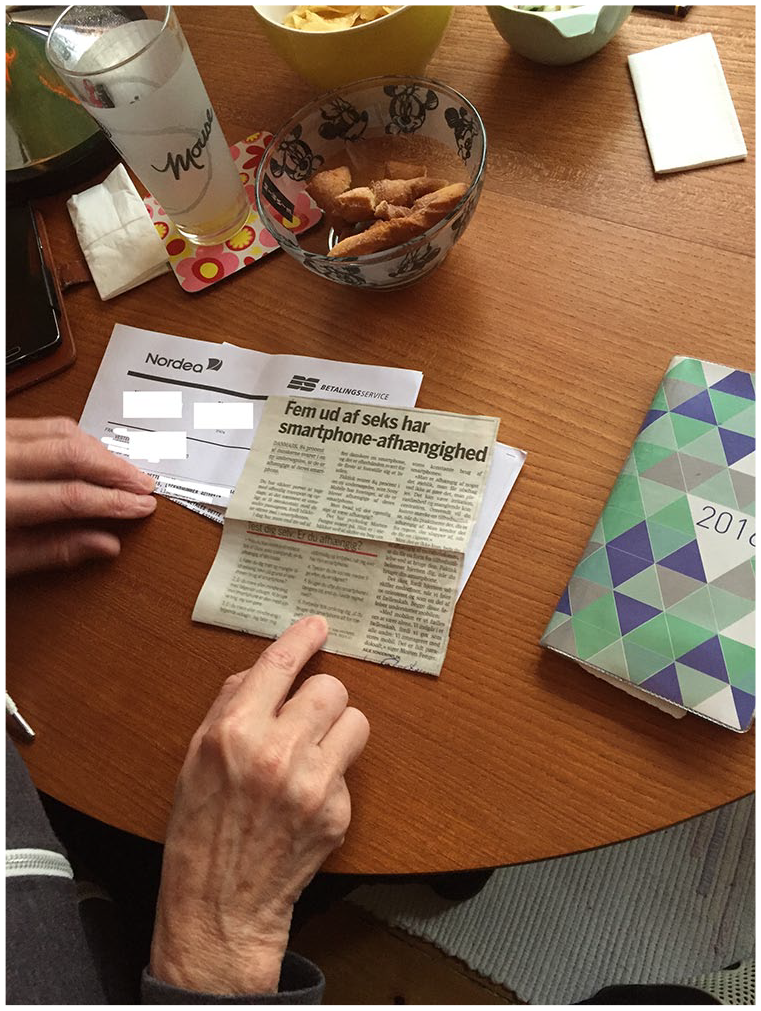
Kirsten Pointing to the Article She Has Cut Out. Headline: “Five Out of Six Has Smartphone Dependence.”
“To Belong to a Society Is to Know and Use Its Codes”
The following two analyses draw on the observations I did at IT-hjælpen. These two sessions with, respectively, Gitte and Per have been chosen out of the eight sessions, I observed, since they contain several of the aspects encountered in the other sessions and thus each in their own manner illustrates some of the general issues pertaining to the practice of digital citizenship.
Gitte is a 79-year-old woman. She drops by IT-hjælpen on a regular basis, twice a month. Kitt introduces me to Gitte, who has in advance agreed to that I could observe the session. They sit down at one of the two desks in the small office. Behind them is a large plastic bag full of empty soda and beer cans, and the smell of beer hangs in the air (Image 3). Gitte carries with her a plastic bag, out of which she takes a mouse, a mouse pad, a laptop, and its charger. Gitte and Kitt get themselves installed at the desk and Gitte turns on her laptop while telling Kitt “I was so happy yesterday. I was able to go on Facebook and everything. But the eBoks and my key card 1 are causing trouble.” This is why she is there: to receive help logging into her eBoks. Meanwhile, her laptop is old and the software, according to Kitt, is not updated, which forces them to turn it off and use Kitt’s laptop instead. Kitt then asks Gitte to log into eBoks herself. Kitt assists by reading out loud the number code with the six digits from the key card while Gitte types them in, one by one and the log on is successful. “You did this yourself” Kitt says and Gitte replies “I did? No, really? I can’t believe it. Yesterday I just couldn’t. How lovely.” The small part of the session described here, I argue, points to the efforts being put into trying to live a digital life as well as to the joy connected to succeeding. This shows how the digital citizen works as an “object of desire” (Berlant, 2006) installed by neoliberal ideology for citizens to strive for. The motivation behind the strive can be partly connected to the practicalities entailed in being able to read and answer mails from public authorities, and partly, I argue, to a desire to be accommodated within and belonging to the mediatized society. Gitte’s lived space as a digital citizen living in Sydhavnen is unfolding and being practiced in part in the basement of the community center, using both technology and skills that belong to someone else. It is through this assemblage of humans, technology, different levels of skills, doubts, and joy that the capacity for (temporary) belonging emerges. “To belong to a society,” Lefebvre (1974/2008) writes, “is to know and use its codes” (p. 215) and in this particular situation to know and use the spatial code installed in and by the strategy of digitalization, Gitte has to perform a range of tasks beginning with trying on her own to log into eBoks, then not succeeding in doing so, followed up by booking an appointment at IT-hjælpen over the phone . Then she will pack her laptop, charger, mouse, and mouse pad into her plastic bag, take the bus to IT-hjælpen where she with assistance logs into her eBoks on someone else’s laptop. The hopes and doubts, affective investments, going into the practice of this digital citizenship, as well as the shifts in location, the moving of body and technologies, and the bringing together of bodies with different capacities, we can see as comprising one of the geographies of the Danish digitalization strategy. A geomediatization approach to the practice of digital citizenship affords in this case a zooming in on the micro-level reordering or molding of everyday lived space and practices for the citizen striving to practice digital citizenship. The molding of everyday lived space is entailed among other things in the inclusion of IT-hjælpen into Gitte’s repertoire of her mundane dwellings. The reordering of practice can be seen in how the new norms and ideals of digital citizenship channel new ways of communicating with the public sector which unfold through new and challenging uses of digital technologies.
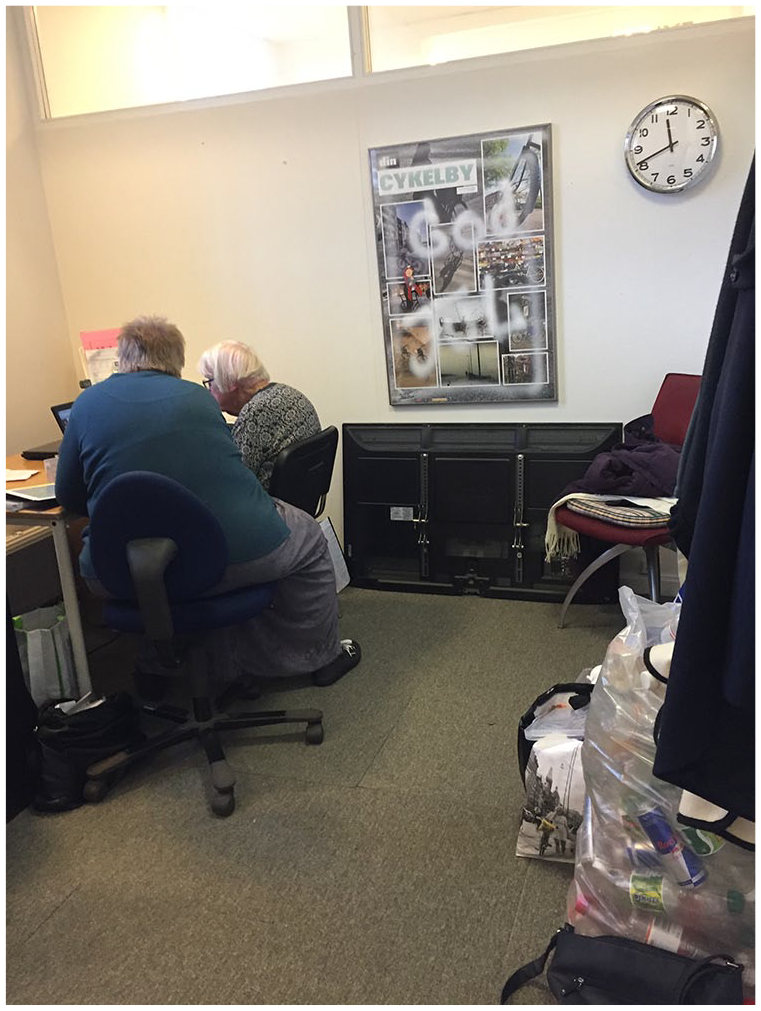
Kitt Assisting Gitte at IT-Hjælpen
Unexchangeable Capital and Pleasing the System
Per is 64 years old and a jobseeker. To receive social benefits, he is required to apply for minimum two jobs a week. To keep track of the job seekers’ activities, they are asked to self-log their job seeking on jobnet.dk and among other things list the jobs they applied for. This is why Per has come to IT-hjælpen: He has had difficulties with the self-logging, experiences the interface as confusing, and is afraid of losing his social benefits this month. “I lose an overview in there [on jobnet.dk]. Then I lose my patience and I’m done! I can’t figure out my new smartphone, I’m not good at it. I can put together a stereo, but not this.” He is clearly frustrated and Kitt suggests that he could go outside for a cigarette before they start the session, which he does. When back in the room, he takes a mouse and an old laptop out from his backpack. They go to jobnet.dk and Per points to a job advertisement he plans to apply for; however, it is in English which requires Kitt to translate. They search for other jobs and Per is cussing about the number of jobs provided by the search: 21807 jobs. This is impossible. I would have been lost already if I had sat on my own trying to do this. If it [the technology] doesn’t work how I want it to work, then I get really hysterical up in my head and then I turn the piece of shit off.
Kitt replies, “Well, not to shame your machine [the laptop] but it was not made yesterday.” With reference to Whiting and Symon (2020), what is being put on display here is the “invisible work” of digital citizenship: the “digi-housekeeping” (p. 1080) that is performed to support and sustain the use of digital technologies which enable practice of digital citizenship. This includes a range of tasks which, like domestic housework, are not considered to be real work, for example, clearing, sorting, troubleshooting, and preparing software, inboxes, and documents (Whiting & Symon, 2020, p. 1079). Kitt goes on suggesting a silver lining: That it after all might be more convenient logging jobs online; “compared to earlier on where you had to fill out a form by hand with 20 jobs applied for.” Per disagrees: “Damn no, it is not. It was a hell of a lot easier way back when you would just walk in and say “Hi, I’m Per, can you use a fit man around here?.” In this case, the frustrations connected to carrying out the mandatory digital logging of jobs applied for, the language skills required for reading the advert and navigating the site, are not counterbalanced by the relief connected to having managed a communication or task, as was the case for Gitte. The skills Per has when assembling a stereo and the approach he used when applying for jobs (simply showing up) are not valid capital when searching for, logging activity, and applying for jobs digitally as he is required to do. This can be thought of through the notion of “spatial capital” (Centner, 2008; Jansson, 2019) understood as assets required to appropriate space. As an older working-class citizen, who is still part of the workforce at 64, Per can only partially and with great frustrations create belonging in the lived space carved out for him by the digitalization of the public sector. His capital is no longer exchangeable and his computer is (too) old.
At the end of the session, Kitt has helped Per apply for the two mandatory weekly jobs, both as warehouse worker: “It doesn’t lead to anything. It’s all for nothing” Per says, and Kitt replies, “But you are pleasing the system, and I think you are becoming better at typing.” This dialogue visibilizes the power geometry (Massey, 1993) between system and agent while pointing to the role digital media technology plays herein. Moreover, this geometry is marked by a cruel optimism (Berlant, 2011) as promises of belonging are conditioned by Per “pleasing the system” through self-improvement and acquisition of skills that will make him count as digital citizen. It is cruel, as the promise of belonging is tied up with the very mechanisms that are marginalizing.
Conclusion
The article highlights the interplay of the mandatory digital self-service implied in the digitalization strategy with gentrification and suggests that this interplay potentially tilts the socio-spatial power geometry in favor of those citizens who can act as and practice digital citizenship—those citizens who know and use the spatial codes inscribed in mediatized societies like the Danish.
This article has argued that to attempt to grasp a broad spectrum of transformations shaping life in Sydhavnen (and other places marked by a joint restructuring of public physical space and digital infrastructure), we may explore the mutual shapings of gentrification and digitalization through Lefebvre’s spatial triad. Through a geomediatization framework (Fast et al., 2018; Jansson, 2019) and an approach to gentrification as assemblage (Delanda, 2006; Latour, 2005) of human and nonhuman actors (technology, matter, discourses, ideals), I explored the (some of the) geographies of the Danish digitalization strategy, as a conceived and lived space (Lefebvre, 1974/2008).
The article points to how the intertwinements of the mandatory digital self-service implied in the digitalization strategy with gentrification potentially tilts an already uneven sociospatial power geometry in favor of those citizens who can act as and practice digital citizenship, or through Lefebvre—those citizens who know and use the spatial codes. The marginalized citizens who can only partially act as digital citizens are deprived of a range of opportunities and capacity for belonging. A geomedia studies approach affords a visibilizing of how and where textures of space and place interweave with media affordances, habits, and preferences of various socioeconomic groups. Geomedia studies is burgeoning as a critical and interdisciplinary lens through which we can attend to power geometries of our contemporary media landscape and trace its positionings of citizens, consumers, rich, poor, old, or young. More research within this field is needed to outline inequalities arising from the geomediatization of our lived spaces, public and private. As pointed out in the section outlining the methodology, this study’s broad non-media-centric approach to examining the social stratification brought on by the interplay of gentrification and digitalization does not provide an in-depth understanding of how specific kinds of digital (geomedia) technologies (e.g., geopositioning systems and place-based services) work to stratify urban social space and alter or sustain power geometries. Therefore, the findings provided by this article could be brought into fruitful dialogue with more media-centric approaches, hereby shedding light on the spatially uneven patterns of access to and adoption of digital technologies and infrastructures.
Returning to Harvey and his view on processes of modernization as having inherent elements of creative destruction “be it gentle and democratic, or the revolutionary traumatic and authoritarian kind” (Harvey, 2003, p. 1), this article shows that the mutual shaping of the Danish digitalization strategy and the revitalization of Sydhavnen can in fact be said to contain traumatic consequences for some of the older working-class citizens—the gentle and democratic elements can most likely be found elsewhere, among other citizens, living in other places. In this transformation process, the spatial codes more accessible to and prominent in some socioeconomic groups than other are being imagined and promoted, which this article has sought to illuminate. The digitalization strategy and the deeply political figure of the digital citizen of course have many geographies and carve out a variety of lived (and perceived) spaces and power geometries. In this article, I have sought to illuminate how older working-class citizens living alone in a gentrifying area navigate, experience, and practice their digital citizenship as part of their everyday lived space. The city as a socially just space, a space supporting “unimaginably diverse social practices” (Amin & Thrift, 2009, p. 3) becomes potentially less just and less diverse as places and digital infrastructures alike are revitalized ideals saturating neoliberal ideology.
Footnotes
Acknowledgements
I would like to thank Kitt at IT-hjælpen and the research participants who so kindly invited my into their lived spaces.
Declaration of Conflicting Interests
The author(s) declared no potential conflicts of interest with respect to the research, authorship, and/or publication of this article.
Funding
The author(s) disclosed receipt of the following financial support for the research, authorship, and/or publication of this article: The study was carried out as part of the VELUX funded project Ageing and old age in the media and old people’s media use, University of Copenhagen (2013–2017).
