



Abstract
Prior scholarship tracing the origins and architecture of prisons has tended to focus on how and why prisons are built—what they are intended to achieve and their construction as an expression of the punitive philosophies of their age. It does not consider how prisons persist as time passes, perhaps beyond their anticipated operational life span, and into “obsolescence.” Focusing on the archetypal Victorian prison, and considering the alteration and inhabitation of such prisons through time, this article critically reinterprets notions of obsolescence in the built environment and explores an enduring cultural attachment to a particular and arguably archaic material manifestation of punishment.
Introduction
Over a quarter of the custodial population of England and Wales, 22,000 (Ministry of Justice, 2019) currently reside in 32 prisons with Victorian-era (1837–1901) accommodation, and because most of these are “local” prisons (holding those awaiting trial or sentencing), few of the remaining 60,000 incarcerated persons will not have spent time in one. Media reports describe their continued operation as a “scandal” (“The Enduring Scandal of England’s Victorian Jails,” 2018) and frequent calls to “tear down the Victorian prisons” have become an enduring motif in debates about prisons and prison reform (Kruger, 2014). A century after, Hobhouse and Brockway (1922) argued that “the only reform to which the buildings can be usefully subjected is dynamite” (p. 91), and despite politicians’ promises to close these outdated “relics” (“New Prisons Planned to Replace Victorian Jail ‘Relics,’” 2015), Victorian infrastructure remains an integral part of the prison estate.
Drawing on early research for an ongoing Economic and Social Research Council (ESRC)–funded research project, this article considers the implications of the continued operation of Victorian prisons in 20th- and 21st-century Britain. Considered outdated for a hundred years, their continued operation now attracts intense policy and media attention, with substantial public resources expended on their maintenance and refurbishment. In current conditions of overcrowding and staff shortage, the built environment of the Victorian prison is implicated in vertical and horizontal lines of power, and in some recent disturbances (e.g., at Her Majesty’s Prisons [HMP] Liverpool, Bedford, and Birmingham), parts of the buildings have even been weaponized. Simultaneously, public perceptions fueled by the popular media indicate that “Dickensian” prison conditions are regarded as “fitting” punishment for those who break the law. Taking these debates as a starting point, we propose a research agenda, identify gaps in the existing literature, and suggest new ways to think about the implications of the Victorian prison for debates about obsolescence, policy making, and the (problematic) centrality of a particular image of the prison in contemporary public life, culture, politics, and prison design.
These issues address a live policy debate about whether Victorian prisons should remain in operation, for how long, and how we will know when they have reached the end of their operational lives. It poses further conceptual questions about the nature of obsolescence, ephemerality, transience, and permanence in the built environment (Clarke, 2008; Henneberry, 2017; Powell, 1993), and the material and conceptual solidity of “obsolete” buildings. It also extends scholarship which has traced the origins and architecture of prisons, both of the Victorian era (Brodie et al., 1999, 2002; Jewkes & Johnston, 2007; N. B. Johnston, 1973, 2000; H. Johnston, 2016) and more recently (Fairweather & McConville, 2000; Hancock & Jewkes, 2011; Jewkes et al., 2019; Jewkes & Moran, 2014, 2017; Moran et al., 2016, 2019; Moran & Jewkes, 2015; Wener, 2012). Much of this literature focuses on prisons as they are or were built—what they are or were intended to achieve, the processes that enable(d) their construction, the ways in which they express(ed) the punitive philosophies of their age, and crucially, their operation in the era of their construction.
Such work is certainly important for understanding why we build (or built), what we do (or did), and how effective new facilities are (or were) at delivering their stated aims, but it does not consider how prisons continue to function as time passes, perhaps beyond their anticipated operational life span, and into “obsolescence.” (Markus, 1993). Most critically, it does not consider either how those buildings have changed over time—or indeed how they have stayed the same—and with what implications. Much critical attention has been paid to the “new” (either what is new now or what is now old when it was new), but the persistence of the old has been overlooked. Although innumerable criminological studies have considered the management, operation, and functionality of prisons dating from the Victorian era, the fact of their age, and the implications of their “oldness” in terms of the materiality of the buildings, their management, and their lived experience, is rarely explicitly considered.
To address these issues, the discussion that follows is organized around three moments in the historical process that frames our project. First, we set out an overview of the construction of the stereotypical Victorian prison, paying particular attention to the rationale for their design and the ideas of reform, character, and discipline materialized in prison architecture. Second, we provide an initial survey of how the material fabric of the Victorian prison has been changed, adapted, and repurposed over the past 120 years, foregrounding the processes of alteration and inhabitation which have enabled their persistence. Third, and finally, we reflect on the wider implications of this persistence, both for the design of new prisons, and notions of obsolescence, and for ideas about what prisons are, or should be, in the collective consciousness. The article concludes by reflecting on the contradictions of the process through which a tranche of Victorian prisons have been identified as of historical or architectural importance by Historic England, using this as a prompt to explore such buildings’ ambiguous and contested position in contemporary public life.
Building the Victorian Prison
“Victorian prison” is a catch-all term hiding a diversity of building styles, dates, and designs. When Queen Victoria came to the throne in 1837, consensus had only just been reached on the question of how prisons were to be constructed to deliver what was considered, at the time, to be the purpose of imprisonment. In the early 1830s, the English prison system was an assortment of facilities of different ages, built and adopted for different purposes. Some were centuries-old gaols, others unventilated dungeons, and there were numerous small cellblocks attached to town halls or workhouses. There were also a small number of “reformed prisons,” built after The Gaol Act of 1823, which formalized a classification system in use since the late 18th century. The system was founded on the principle that prisoners of different “types”—differentiated by age, gender, and type of offence—should be kept apart so they could not unduly influence each other. At the same time, two prison reform ideas which connected punitive philosophy with built environment were gathering force in the United States; the solitary, “separate,” or Pennsylvania system, which advocated keeping prisoners in separate cells day and night, and the “silent” or Auburn system, in which prisoners would congregate for silent work in the day time, returning to separate cells at night (Upton, 1998). Both systems garnered support in England, with advocates seeking to have them adopted both for existing prisons and for any new establishments to be built in the future.
By the mid-1830s, the “separate” system had assumed a dominant position in prison reform debates in England, and in 1835 a government Select Committee ruled that the prisons already in existence would need to be adapted to deliver its intentions, and that all new prisons would be constructed with this system in mind. Zealous supporters of the separate system argued that through separation, prison discipline would be successfully achieved, in that first-time prisoners would not be “contaminated” by contact with repeat offenders. Given the moral and religious underpinnings of penal philosophy at this time, they also argued that solitary conditions would be most conducive to reformation. Introspection, in the presence of the Bible, was thought likely to render the mind receptive to the sermon of the prison chaplain, and thence to repentance and reform.
As Tomlinson (1980) noted, the demands of the separate system necessitated considerable architectural and design planning, to deliver the right environment for this type of carceral practice (p. 54). Prisoners were to spend almost all of their time alone in their cells, and all efforts at communication were to be prevented. Although this was not the “silent” system, soundproofing was considered essential. In preparation for a “model” separate system prison, to be built at Pentonville, design experiments were carried out at Millbank Prison, which had opened 20 years earlier, and at which ventilation shafts were known to be used by prisoners for communication. Tomlinson described the experimentation: The inspectors first tried cell walls 31 inches thick consisting of two 13in jagged walls separated by a 5in space. As these were not totally soundproof, two thicknesses of sailcloth were hung in the 5in space, but this was difficult to accomplish; moreover, the sailcloth rotted in the damp air. The inspectors then tried building two 9in brick walls, with two spaces of 3¾ in divided by a 4½ in brick wall in the middle. This prevented intelligible communication but resulted in considerable reverberation when the side walls were struck, so the 3¾in gaps were filled with sand. Yet, while diminishing the vibration, this experiment made the cells less soundproof. The same experiments were repeated with Bath stone instead of brick; ultimately, the Inspectors settled for 18in walls, double doors, arched ceilings and concrete floors, to prevent the penetration of any comprehensible noise.
At the same time, lessons learned from the deterioration in mental health among prisoners held in separate system prisons in the United States meant that cell spaces needed to be large enough to enable prisoners to comfortably sleep, eat, and work in their cells. It was decided that cells would be “large, light, and airy” enough if they were 12ft by 8ft by 10ft high, or 13ft by 7ft by 10ft high, lit by a window 42in by 11in, but located sufficiently high up in the wall to prevent any view of the outside world. As using the toilet or washing would otherwise necessitate leaving the cell, in-cell sanitation also had to be provided. Therefore, each cell had both toilet and wash basin (Tomlinson, 1980).
The demands of the separate system also precluded the opening of cell windows, so an alternative method of ventilation had to be devised, not least to remove the odours associated with the presence of a toilet. The chosen system of heating and ventilation relied on two vents in each cell, one at the top of the cell and another diagonally opposite at the bottom, through which either fresh or heated air (depending on the prevailing weather) would enter, and stale air would be extracted. As hot air would naturally rise, rather than falling toward the foul air vent, the extraction of stale air relied on a fire continuously burning in an outer foul air flue. Unfortunately the system worked poorly. At Pentonville, it took more than 2 weeks to raise the temperature in the cells and more than 10 days to lower it again once the fresh air was no longer heated. Many prison governors failed to understand the importance of the fire in the foul air flue, and extinguished it in summer, just when it was most vital for ventilation. The only way to make the extraction of air work was by opening the cell doors, which clearly compromised separation. Other design features, such as small openings in cell doors through which meals could be passed, removed the need for prisoners to leave their cells except to attend chapel, school, and for monthly baths and outside exercise. Even in these circumstances, though, separation was initially maintained through the wearing of masks (to prevent recognition) and the construction of walls between individual outside exercise areas.
While new prisons were built to these specifications, preexisting prisons, at which separation was much more difficult to achieve, were earmarked for reconstruction. Local magistrates and councillors, then responsible for local prisons, were not easily convinced of the need for expensive adaptations to their buildings. However, 10 years into Victoria’s reign, the separate system had become an orthodoxy fundamental to the reconstruction and refurbishment of over 50 preexisting prisons. The 90 prisons built or added to during a concerted building program (1842–1877) were also largely constructed to these designs. Internal finishes and exterior styles varied, but most conformed to a radial hub-spoke layout, built in brick and/or stone. All featured small cells intended for single occupancy, arranged along landings, stacked three or more storey high. Galleried spaces and internal atria provided clear sight lines, with officers circulating around the landings, and up and down the iron staircases, able to see and be seen by colleagues on other levels. Small details bore further witness to the era: low, narrow cell doorways fitted the average Victorian body; some cells (such as those pictured in Figure 1 at the former HMP Shrewsbury) were equipped with larger windows, which could be propped open to provide fresh air for prisoners with tuberculosis; and candle alcoves hollowed out of the walls beside cell doors enabled those inside to read the Bible.
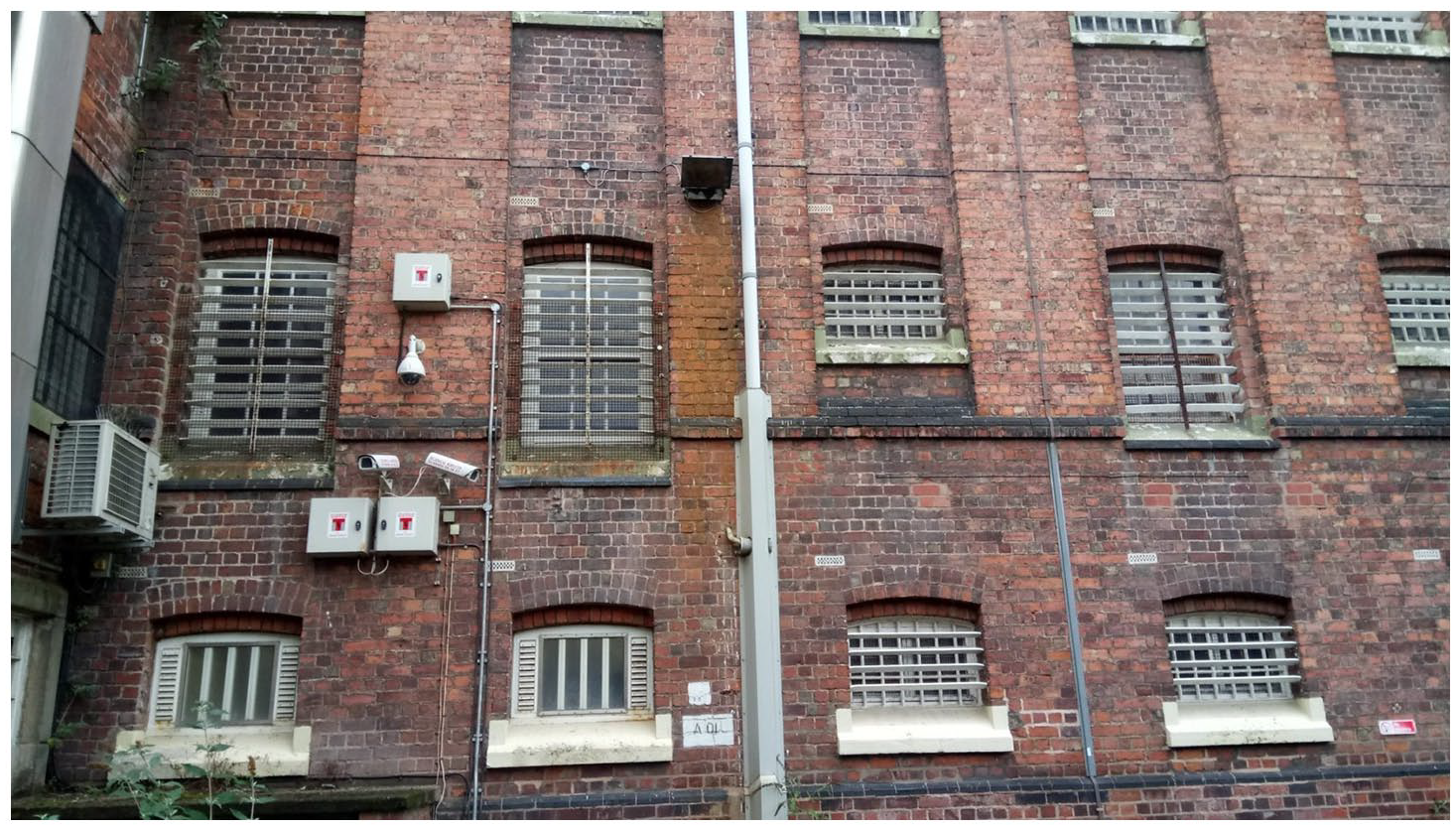
Exterior View of HMP Shrewsbury Showing Different Window Sizes, Security Cameras, and Pipework (Image Credit: Dominique Moran).
Any remaining resistance to the separate cellular system was quashed by an 1865 Act which instituted separation and hard labour throughout prisons in England, with a threat of withdrawal of critical funding from authorities which failed to comply. Finally, in 1877, with the Prison Act, the government transferred the administration and finance of local prisons from local magistrates and councillors to a newly created Prisons Commission. At the same time, the radial pattern favoured through the mid-19th century was superseded by the “telegraph pole” plan, with prison buildings now laid out in parallel blocks. Exemplified at Wormwood Scrubs, the “telegraph pole” became the model for subsequent English prisons such as Bristol and Norwich. The new layout was designed to minimize the spread of infection by allowing maximum circulation of fresh air and light between the buildings. At Wormwood Scrubs, for example, the blocks are aligned North–South to allow sunlight into each cell. Internally, however, little had changed from the early Victorian designs (for an overview, see B. Bailey, 1987; V. Bailey, 1981, 2019; A. Brown, 2003; Davie, 2016; Evans, 1982; Ignatieff, 1989; Wiener, 1990).
Alteration and Inhabitation
Architecture is both a product of culture and implicated in economic structures of development, bearing lasting material “witness” to the specific context of its creation and to the fleeting nature of that moment in time. Walter Benjamin argued that through a physical and material embodiment that resists easy erasure, architecture continues to exhibit styles and functions long after they become outmoded, underlining the transience of the “new” (Morton, 2006). Many Victorian prisons have been erased from the landscape; many others no longer function as prisons. Yet 32 remain and have undergone many material changes. After Giddens (1984), Bourdieu (1963/1979), and Thrift (1983), geographers of architecture understand such alteration as an outcome of the dynamic encounters between buildings, their constituent elements and spaces, inhabitants, visitors, design, workers, planners, cleaners, technicians, materials, performances, events, emotions, affects, and more (Jacobs & Merriman, 2011). Recent work has drawn attention to the “inhabitation” of buildings (Kraftl & Adey, 2008): an awareness of the situated and everyday practices through which they are used and altered. As sites in which users and things come into contact in numerous, complex, planned, spontaneous, and unexpected ways, buildings shape and are shaped by such encounters, which are often resonant of the power structures that exist both within and outwith them, thus shaping their inhabitation.
Given the long operational lives of the 32 Victorian-era prisons, these processes of alteration and inhabitation have encompassed periodic re-purposings. There have been major alterations, in the demolition and replacement of buildings, additions of new sections of buildings, extensions to linear wings, and addition of new floors and replacement of roofs, affecting both the exterior aspects of the buildings and their interior configuration. More incremental changes have come with the internal retrofitting of networks of pipes and cables, bringing sanitation, gas lighting and electricity, as well as telephones, switches, alarms, and signage. Again at former HMP Shrewsbury, alongside the painted Victorian ventilation grilles, Figure 1 depicts the exterior retrofitting of two types of security cameras and a floodlight, each with their attendant electrical wiring, as well as other surface wiring, an air-conditioning unit, steel ducting, a no-smoking sign, a plastic downspout replacing the cast-iron original (and anti-climb casing for this pipework), at least two different types and sizes of windows, and a variety of exterior window bars and meshes. Internally, candle alcoves have been bricked-in and painted over. Steel cell doors replace the wooden originals. Suicide netting stretches across galleried spaces. These prisons have seen more than a century of routine repair and replacement of fixtures and fittings, as well as repetitive cleaning and redecoration. Also a part of their inhabitation are the unintended or unauthorized adjustments of human residents, from the constant attrition of decades of footfall, to surviving traces of graffiti and other lingering material and atmospheric traces of the past. Weathering, natural decay, and activity of non-human life such as moss, mould, and vermin further alter their appearance.
These kinds of temporal alterations are, of course, not confined to prison buildings (Cairns & jacobs, 2014; Schmidt & Austin, 2016), but tracing such changes and processes of inhabitation in “closed” built environments is challenging, and existing sources are scant. However, it is clear that before the Victorian era was over, its prisons had already been subject to numerous material changes. Even the model prison, HMP Pentonville, was substantially altered during the Victorian period, with the addition of 220 cells to B and C wings in 1867, and removal of the vaulted roof to enable a further storey to be added to wings A to D between 1871 and 1890. Subsequent decades brought further changes to this and many other Victorian prisons. At Pentonville, there were alterations to windows in 1910 to 1914, and various episodes of reroofing. The London Blitz of 1941 necessitated the temporary closure of C wing, which in 1958 had a central bomb-damaged section of nine windows rebuilt as a new education block (Historic England, n.d.-c).
Major alterations such as these are detailed in published sources such as Brodie et al. (1999, 2002) who note that the toilets and washbasins which had been installed in cells to enable separation were removed from all but three prisons by 1890 (Brodie et al., 2002, p. 159). The relaxation of the severity of the separation regime by the 1850s presumably contributed to this shift, alongside the need to accommodate more prisoners by sharing cells, meaning that space was at a premium. By this time, there were also anti-suicide measures such as raised wing railings, wire netting extended across corridors, and widespread construction of sanitary annexes for ablutions, taking the place of the now-absent in-cell sanitation.
Details about the nature and extent of changes at individual prisons are not widely known. However, the recent closure of several Victorian prisons which are classified as “listed” buildings (i.e., of historic or architectural importance) has enabled detailed inspections by Historic England, the organization overseeing such buildings in the United Kingdom. These inspection reports are a rare source of information about the state of the buildings at the (presumed) end of their functional lives as prisons. They specify in some detail the changes made to the original fabric of the buildings and identify “surviving” original features.
For example, HMP Reading, built between 1842 and 1844 and closed in 2014, was an example of a radial-plan prison built from scratch to deliver the separate system. Here, Historic England highlights numerous changes from the building’s original design and fabric, with original features removed and a variety of modern fittings and finishes introduced. In the interior of the prison, there had been significant changes to cells and landings. The original brick vaulted cells largely survive but have mostly been doubled up by removing the wall between each pair, whereas “Tudor-arched entrance doorways now have flat concrete lintels, and renewed doors.” The metal gallery structures (supporting the landings outside of the cells) with their curved supporting brackets and cross-braced balustrades had survived in their original form, as had the pointed brick vault ceiling over the galleries, and over the central octagon, “with its moulded stone ribs and corbels, and lozenge-shaped ceiling lights cut through the webs of the vault.” However, a “modern prefabricated cabin” had replaced the “glazed Gothic pavilion structure from which prison staff could keep watch on movements in A, B and C wings and (via the tall side windows) in the prison yard outside” (Historic England, n.d.-d).
Much of the original Reading prison was demolished in the 1970s. Built of red brick with Bath stone dressings, the prison had originally been surrounded by “a high boundary wall with octagonal corner towers and a large, multi-towered gatehouse complex . . . providing accommodation for resident staff” (Historic England, n.d.-d). After 1970s demolition, only the cruciform main prison building remained, displaying the Tudor-Gothic details employed in contemporaneous designs for workhouses and hospitals, combined with castle-like battlements to the entrance block and central octagon. Under the eaves of the building were machicolations—design elements recalling the floor openings between the supporting corbels of a castle battlement, through which stones or other material, such as boiling water or boiling oil, could be dropped on attackers at the base of a defensive wall. All of this had been intended to give a fortress-like impression to the prison. Further alterations in the 1970s greatly altered this external appearance, with the original two-light cell windows replaced with single square openings containing barred double-glazed window units. Most of the stone-dressed window elements were replaced in concrete. Only one unaltered original cell window was reported to have survived, in the basement of D wing (Historic England, n.d.-d).
HMP Shrewsbury was one of the preexisting establishments which had to be altered in the early Victorian era to fulfill the demands of the separate system, and which was later extended. After its closure in 2013, Historic England detailed a multitude of changes to the fabric of buildings dating from the Victorian era: New staircases and balustrade panels have been fitted to the gallery landings c2007. These are heavier than the original iron panels and have required the fitting of new brackets to supplement the originals, which still support the landing floors . . . Scars in the brickwork show where lamp windows allowed illumination of the cells at night by warders . . . Doors are a mixture of wooden doors with bolt-heads, some of which may be original, and steel doors from the later C20 . . . The ablutions annexe at the centre of the south-eastern side was converted to showers when lavatories and basins were fitted to each cell. Some cells have had the dividing walls removed to make them double and one triple cell is used as a servery. (Historic England, n.d.-b)
At HMP Shepton Mallett, another prison pre-dating the Victorian era, there was a major fire in 1904, followed by various periods of closure, with repurposing for storage of valuable documents and as a detention centre for the U.S. military during the Second World War. Following its latest closure in 2013, Historic England noted traces of the mid-19th-century adaptation of the wings, through “internal anomalies such as transverse arches which cut across some of the cells indicating the former wall line of the earlier wing.” Within the wings themselves, they noted some changes to metalwork, with steel replacing earlier iron balustrading over the galleries, but many of the decorative early cast-iron stairs within these wings survived, as did the decorative cast-iron brackets supporting the galleries. Although many cell doors had been replaced, some early plank doors with detail studs and an oval peep hole, lined internally by a thick metal sheet, survived. Despite the various phases of refurbishments to the cells, including the addition of first gas and then electrical lighting, and sanitation, throughout the prison there was also “evidence of the early form of the cells, including the remains of grated air vents and torchlight recesses” (Historic England, n.d.-a).
Very little is known about these more incremental changes characteristic of the long-standing inhabitation of Victorian prisons. Although Historic England’s reports add considerably to the detail provided by the work of Brodie et al. (1999, 2002) in describing the smaller scale, non-“structural” changes to the original fabric of the prison, including the replacement of windows and balustrades, the blocking-in of candle alcoves, and the replacement of doors, these retrospective assessments tell us little about the context and circumstances of those individual refittings and alterations, and nothing at all about what it was like to live or work in these prisons at the time.
Although Brodie et al. (2002) reported that “gas lighting was removed from cells” by 1890, archival records contradict this impression (p. 159). In the last year of the 19th century, there was concern in the Home Office over the quality of the still-widespread gas lighting in prison cells. Surveyors were sent to the former “model” prison HMP Pentonville to consider the best way to retrofit improved gas lighting, but found their efforts hampered by the nature of the building. Having conducted experiments with different types of gas burners and light boxes, they concluded that “the construction of the prison does not afford any suitable opportunity for the use of incandescent gas lamps, on account of the delicacy of the mantels, and the care required in lighting them, and the absence of draughts.” Far from being in a position to remove gas lighting, they recommended an alternative system of new burners that would increase gas consumption to the extent that “if the new arrangement is approved and applied to the whole prison, it will be necessary to enlarge the gas mains as they were, when laid originally, proportioned for a much smaller consumption” (Report from Colonel Beamish, May 9, 1899, National Archives, HO 45/9755/A60545, 1898–1900).
Although provision of electric light was under consideration at the same time, more than 30 years later, the poor quality of light in prisons was still a concern at the Home Office, with HMP Leeds considered “Probably the darkest prison in England” (National Archives HO 45/24866). Eventually, it seems that the deteriorating state of the extant gas lighting precipitated action: For many years the question of installing electric light in various prisons has come up periodically for consideration and been shelved, but the time has arrived to tackle the problem in earnest and to draw up a definite scheme for carrying it out progressively, year by year. Further the condition of the gas piping in some of the prisons is such that early action is imperative. (Report by D. A. Rendle, Lt. Royal Engineers, Home Office, February 25, 1929, National Archives PCOM 9/1894, 1928–1958)
In the late 1920s, before the existence of a national grid for electricity supply, providing electric light meant building a local substation, as well as installing the necessary interior wiring and fittings. These interior changes were not insubstantial and required both professional electrical training and expert knowledge of the prisons themselves: Conditions in a prison being totally different from those in any other public or private building, it follows that the problem of prison lighting is one that can only be tackled by a man who is thoroughly conversant with the peculiar state of affairs and regulations obtaining. If an outside engineer were employed he would require to have attached to him a member of the prison works staff, as he would be unlikely to have any experience of the class of work involved. (Report by D.A. Rendle, Lt. Royal Engineers, Home Office, Feb 25, 1929, National Archives, PCOM 9/1984, 1928-1958)
The installation of electric light was therefore hampered by the availability of suitably skilled individuals among prison staff.
Today, Victorian prisons are still undergoing rounds of refurbishment, in this ongoing process of inhabitation. Following a damning inspection report in 2017, HMP Liverpool was extensively redecorated and refitted. Contractors ISG Ltd, awarded a £6 million package of works on B Wing, “delivered lighting, sanitaryware, electrical and flooring upgrades, as well as replacing 215 windows and doors across the 90 cells, wing offices, servery and staff refresh areas” (ISG, n.d.). Scaffolding was erected in exercise yards to allow the small Victorian window apertures to be adapted to receive new uPVC (unplasticised Poly Vinyl Chloride) casings (manufactured at another prison), and all cells had walls stripped for repainting, and new doors and new electrical socket points fitted. Porcelain sanitaryware was replaced with resin, new vinyl flooring was fitted, and refurbished beds installed. Older light fittings were refurbished on site and reused elsewhere in the prison.
HM Inspectorate of Prisons provides insights into living conditions, suggesting that “we often find conditions in 19th-century local prisons to be worse than other, newer establishments. They often have sanitary facilities which are not fit for purpose and inadequate fixtures and fittings” (HMIP, 2017b, p. 14). In some of these prisons, inspectors find that, just as had been observed when these establishments were first built or adapted for the separate system, “windows could not be opened properly and cells were poorly ventilated” (HMIP, 2017b, p14). In warm weather, some prisoners reported that they took matters into their own hands, breaking windows to provide ventilation.
It is clear that, as well as Victorian prisons being subject to periods of major alteration at a whole-prison or whole-wing scale, inhabitation comprises both more-or-less assiduous interior cleaning, and refitting and refurbishment, at wing, landing, and cell level, alongside micro-scale adjustments made by incarcerated persons, such as graffiti on walls, and windows broken to let in fresh air. In these interior spaces, it is clear that the activity of human inhabitants is constantly shaping and reshaping prison environments. Just as in the 19th century, when prison staff had to do the work of rewiring Victorian prisons, outside of major contracts like that awarded to ISG Ltd at HMP Liverpool, today prisons still turn to the labour of prisoners to remove or cover over the marks left by fellow or previous occupants. Refurbishments themselves seem often to follow critical inspection reports. For example, at HMP Wormwood Scrubs, a 2017 inspection noted that “efforts had been made to paint the wings and cells since the previous inspection [in 2016] but there was still too much grime in communal areas and a lot of graffiti in cells” (HMIP, 2017a, p. 29). By the time of a further inspection 2 years later, most cells had been painted and there was much less graffiti; we saw few broken windows . . . The remaining cells were being repainted by prisoners as part of a prison-funded programme . . . Around 20 prisoners were employed in a successful project to refurbish wing accommodation. Cells were stripped, cleaned and decorated to a good standard by enthusiastic teams who took pride in their work and in maintaining their craft skills. (HMIP, 2020, pp. 14, 32, 47)
Nearly a century later, then, there is still a sense in which those who occupy these spaces, be they staff or incarcerated persons, are constantly at work on the fabric of the buildings, in an oft-repeated cycle of inhabitation in the form of inscription and over-writing.
Obsolescence and Affirmative Design
As Tomlinson (1980) noted, once the cellular system designed to deliver separation had been established in built form, “the system became self-perpetuating” (p. 61). Enabled by robust Victorian buildings constructed for this purpose, separation essentially served as the underlying principle of incarceration until the mid-20th century. By that time, although there was widespread debate about the purpose of imprisonment, and by extension about the kind of buildings that might best deliver that purpose (Fairweather, 1961), very little consensus was reached. As Howard (1960) noted at the time, the legacy of the Victorian prisons was far-reaching: “We do not want at vast expense, to erect buildings which are destined to be as great a handicap to our successors as early Victorian prisons are to us now” (cited in Fairweather 1961, pp. 358–359). It seems that although it was recognized that mid-20th-century prison reform was stymied by the persistence of Victorian prisons, the realization that another similarly costly mistake could potentially be made had a somewhat paralyzing effect on the introduction of new designs.
The Victorian prison may, in this and other ways, have shaped the nature of the “new.” In other words, it may have shaped, both literally and mimetically, the prisons recently built and currently planned. It may also have shaped conceptually, in the collective consciousness, expectations about what prisons should look and feel like. Paradoxically, then, its very persistence may have limited the extent to which the Victorian prison has itself become “obsolete.” In contemporary critique, the precise characteristics of obsolescence are surprisingly hard to pin down. Adjectives such as “ageing,” “ineffective and dilapidated,” “unsafe,” “infested,” “overcrowded,” and “grim” are commonly deployed, but these are just as apt for many more modern prisons. What is it specifically about Victorian prisons that defines them? Why do they serve as an archetype of punishment—celebrated, even fetishized in the popular imagination? How and why does this matter for those who live and work in them today? By paying attention to the ways in which these prisons continue to operate well over a century after their construction—or in other words by tracing in more detail the ways in which processes of inhabitation have taken place within them—we could better understand the permanence of prison buildings, and the future challenges awaiting a system in which more recent prisons, built to similar designs, but far less robustly than their Victorian predecessors, are also likely to be called upon to operate into “obsolescence.”
Addressing this question invites a critical redefinition of obsolescence in relation to affirmative design. Describing building obsolescence as a process of declining performance resulting in the end of the service life, Thomsen and van der Flier (2011) advanced a model intended to diagnose and prevent building obsolescence (p. 353). In this and related work (e.g., Anderson et al., 2018; Bryson, 1997; Nutt & Sears, 1972), obsolescence has relevance primarily to the buildings themselves—to decisions about refurbishment, demolition, and end-of-life processes. We contend that these conceptualizations could be advanced through consideration of the implications of prolonged obsolescence beyond the buildings themselves. In essence, there could be significant implications of the continued operation of “obsolete” prisons for the wider prison estate.
“Obsolescence” is therefore a key factor in what we think of as a latency of the Victorian prison, in terms of the ways in which, through its conceptual and material solidity, it exerts a pervasive influence on the contemporary prison system. The Dickensian gaolhouse, and its persistence as a monolith with “humming, fortress-like invincibility” (Schept, 2014, p. 200) in popular literature and media, shapes our cultural repertoire. As long as Victorian facilities still operate, they pose challenges for the implementation of living standards, for example, as advised in the UN Standard Minimum Rules for the Treatment of Prisoners (2015) with which they cannot comply without difficult and expensive alterations. Recognizing growing criticism in the 1960s, prominent commentators used a special issue of the British Journal of Criminology to try to reinvigorate debate about the whole problem of prison design which, even in this age of modernism, “simply copied Victorian design, thus perpetuating an embarrassing legacy of extremely permanent buildings expressing an outdated and outworn penal philosophy” (Fairweather, 1961, p. 340; cf. Jewkes & Moran, 2017). More recently, architect Roland Karthaus has noted that even in our very newest facilities, we have built Victorian hub-spoke, galleried prisons, just like those built for the separate system, but now in concrete, and with integrated plumbing and wiring; “If you look at them from the air, the house blocks, the wings are organized as Victorian prisons were. They’ve gone back to that layout” (Volpicelli, 2018). Media coverage of new prison design has claimed that “Victorian prison design is coming back”: The layout of Thameside, a privately run prison that opened in 2012, mirrors that of the loathed Pentonville. Wings on the main block radiate out from a central point: seen from the air, it resembles an asterisk. The interior is distinctly Victorian, too. Each four-storey wing is divided laterally in half into two-storey sections, within which cells are arranged around central atriums. (“Design and Punishment; Prison Architecture,” 2014, n.p.)
This repetition is perhaps an example of “affirmative” design, which reinforces how things are now (Dunne & Raby, 2001, p. 58) and, by conforming to cultural, social, technical, and economic expectations, perpetuates existing norms. By 1960, the bleak Victorian prison had become viewed as an obstacle to progressive penal thinking (Pratt, 2002), and the form and fabric of prison buildings was regarded as an impediment to the therapeutic mission pursued within (Jewkes & Moran, 2017). Yet these prisons persisted for a further half century, until in 2016 the then U.K. Prime Minister vowed to close Victorian prisons, describing them as “ageing, ineffective . . . creaking, leaking and coming apart at the seams” (Cameron, 2016). And yet—and despite the prison service’s current drive to embed “enabling environments” and “rehabilitative cultures”—they appear as permanent as ever.
Conclusion
Historic England’s classification of a series of Victorian prisons as listed buildings underscores their ambiguous and contested position in contemporary public life, and encapsulates many of the contradictions we have begun to explore here. Designating decommissioned buildings at Reading or Shrewsbury, for example, as historically or architecturally important, reflects a process analogous to the transformation of at least some institutions into museums and heritage experiences. This designation, however, sits uneasily against the continued use as prisons of other similar blocks and buildings, including those like HMPs Wormwood Scrubs and Manchester which have themselves been listed. While the material fabric of one institution is abstracted from its contemporary penal or experiential context, others continue to be inhabited, used, and repurposed. At the same time, the materiality and cultural prominence of such buildings continue to shape the development of modern penal policy and how politicians, policy makers, and members of the public understand what a prison is and should be. While Historic England’s surveys provide a richly textured account of how and when prisons like Reading or Shrewsbury changed (and had to change) over time, then, these reports are much more than a window onto the Victorian institution’s material afterlives. Rather, these surveys, like the listing process of which they are part, do important work in shifting understanding of the prison and ongoing debates over its significance, use, and policy implications. That some buildings are listed while others remain in constant use is a striking reminder of the contested position of the Victorian prison in contemporary Britain, and what is at stake in debates about obsolescence, affirmative design, and historical importance.
Treating the afterlives of the prison as a case study in debates about the politics of space, culture, and historical memory provides particularly rich terrain for a critical reflection on the contentious place of the “Victorian” in modern and contemporary Britain. In part, as this article has shown, tracing the continued influence of the prison’s material fabric on contemporary approaches to prison design, affirmative design, carceral experiences, and workplace or institutional cultures allows us to see how the persistent impress of Victorian social or cultural ideals can be material, grounded, and everyday. Its influence is evident both in its continued use within Britain’s prison estate and in dominant public images of the prison. Taking this seriously allows us to move beyond simply noting the continuation of Victorian ideas about character or reform by tracing the material processes that underpin that persistence (Kriegel, 2018; Mandler & Pedersen, 1994; Mort, 2010; Southern, 2017; Taylor & Wolff, 2004).
From Stephen Hobhouse’s searing indictment of the 19th-century prison and everything it stood for, through to contemporary penal debates, we can see how the prison, like the workhouse, industrial school, or lock hospital, has been used to focus powerful critiques of the inequalities and hypocrisies of Victorian society, and the structures of power and domination embodied in its institutional archipelago. At the same time, however, prisons have also sustained alternative versions of the Victorian, often associated with the New Right of the 1970s and 1980s, in which notions of discipline, respect, and hierarchy were represented as the antidote to the excesses of permissiveness and the crises of the 1970s (Samuel, 1999). The particular character of the prison disrupts some of these assumptions, though. The arguments we have made about obsolescence and affirmative design played out in adjacent histories of social policy and the institutional responses to old age, poverty, illness, and mental health over the course of the 20th century: For example, the workhouses of the 19th century became the care homes of the 1950s and 1960s (Greenhalgh, 2018). Recent work on collecting Victoriana and gentrification, however, suggests very different configurations of the material relationship between space and culture. That the prison sits uneasily with the material traces of other aspects of the Victorian past underscores the importance of a more nuanced approach to the politics of historical memory.
Victorian prisons have operated for a very long time; generations of prison staff are deeply familiar with them, operational cultures and practices have arguably developed in and for them, and it is perhaps no surprise that newly built facilities resemble them. Their sheer obduracy may complicate operational change throughout the prison estate, but does affirmative design preclude their obsolescence or perpetuate it? Questioning this relationship between obsolescence and latency is critical in understanding the past, present, and future role of prisons, and in informing policy decisions about refurbishing or closing them. It also requires us to think seriously about what kind of buildings, or conceptual alternatives, should replace the Victorian prison.
Footnotes
Declaration of Conflicting Interests
The author(s) declared no potential conflicts of interest with respect to the research, authorship, and/or publication of this article.
Funding
The author(s) disclosed receipt of the following financial support for the research, authorship, and/or publication of this article: Funding was received from the Economic and Social Research Council (ESRC) ES/T005483/1 for the research which underpins this paper.
