




Abstract
Cities and suburbs are often constructed as different socio-spatial entities to afford different ways of life. Although that dichotomy has been challenged, it has maintained its popularity in academic discourse. As with many European cities, the municipality of Oslo—the capital of Norway—is experiencing population growth. To provide sufficient accommodation for its inhabitants, the municipality has adopted a compact-city strategy to prevent urban sprawl. However, in 2018, a major private housing developer launched an advertising campaign that promoted the benefits of living in the suburbs rather than in dense urban environments. Using concepts that were adopted from “social semiotics,” this article demonstrates how specific uses of semiotic resources can create a suburban dreamscape that can potentially attract urbanites to suburbia.
Introduction
The ways in which “the city” and urban living are represented in urban research vary; some concepts or theories can provoke pessimism, whereas others may incite a positive narrative. A city can be an arena where creativity flourishes (Florida, 2002) and where people can enjoy culture through art, movies, music (Currid, 2007) and entertainment, and nightlife more broadly (Chatterton & Unsworth, 2004). Additionally, some claim that cities are better places to live in because people can more easily interact if they live in urban settlements (Glaeser & Gottlieb, 2006). Certain concepts such as segregation and unrest (Malmberg, Andersson, & Östh, 2013), overcrowding (Cage & Foster, 2002), and pollution (Fruin, Westerdahl, Sax, Sioutas, & Fine, 2008; Jerrett et al., 2005) are included in the more pessimistic descriptions. These ideas can, in turn, be linked to a state of “urban malaise” (Fischer, 1973; Knox, 2008, p. 36) and used to explain why some urbanities relocate to an assumed more comfortable life in the suburbs (Andersen, 2014; S. M. Low, 2003).
In several accounts, the dichotomy of the city and the suburb is used to shed light on assumed or observed differences (e.g., Airgood-Obrycki, 2019; Corcoran, 2010). Even if some scholars have questioned the usefulness of this binary opposition (e.g., Gans, 1968), pointing to social and cultural similarities between the urbs 1 and suburbs, there seems to be a need to engage with this particular dichotomy and thus keep it alive (e.g., Bridge, 2001). For instance, through studying gentrification in Norway, Hjorthol and Bjørnskau (2005) claimed that the benefits of living in the suburbs have been reduced vis-à-vis the increased advantages of the inner parts of Oslo. The authors argued that “offers of culture” are a city’s strength compared with what is offered by the suburbs (p. 363). They also point to low levels of crime as well as more “car-free areas [and] new playgrounds” in the inner parts of the city as reasons why urban life is becoming more popular (p. 359). However, more recent studies have demonstrated the attractiveness of suburbia as families continue to move out of the inner city and purchase homes outside Oslo (Lunke, 2014). As we will show below, the idea that the suburbs afford a significantly different way of life from the city is circulated in popular discourse as well.
Oslo is experiencing “substantial population growth” (Municipality of Oslo, 2018b, p. 4). This growth necessitates compact urban development and the restriction of suburban sprawl (County of Akershus & Municipality of Oslo, 2015; Municipality of Oslo, 2018b). Thus, growth is welcomed, but it should take place in urban areas. Whereas Montero (2018, p. 752) demonstrates how “media objects can act as urban governance tools that can help leverage policy change,” we aim to show how semiotic resources can be used to challenge the policy aim of city living by marketing the (assumed) superior qualities of suburban life. The case of Oslo demonstrates that, notwithstanding the “de jure” authority of politicians and city planners (Andersen & Skrede, 2017, p. 590), the seductive capabilities of the advertising strategy employed by Block Watne, a major housing developer, might potentially undermine the growth strategy that has been adopted by public authorities. We will argue that the actions of Block Watne can be considered to at odds with the city’s desire for compact development because the developer advertises a stereotypical U.S. postwar suburbia in Norway. To explain why they launched the campaign, a company manager said, “We do not build houses in the inner parts of Oslo, and [we] have to lure people in the opposite direction” (Velle, 2018; translated by the authors).
Visual Analysis in Urban Studies
For the purpose of this article, we will introduce an analytic method that is rarely used in urban studies—a “social semiotic” approach—to analyze Block Watne’s housing advertisement campaign. A social semiotic approach to meaning making often emphasizes how specific uses of semiotic resources (texts, images, design, etc.) may create and sustain power interests. It draws on both linguistics and social theory (Hestbæk Andersen, Boeriis, Maagerø, & Tønnesen, 2015, p. 98), and it has been used to analyze a range of diverse phenomena, from the ideological content of gendered shampoo bottles (Ledin & Machin, 2019) to the sound of fascist music (Machin & Richardson, 2012). However, the urban context configures less frequently in this tradition (for some exceptions, see Skrede, Hølleland, Risbøl, & Jerpåsen, 2018; Stojiljković & Ristić Trajković, 2018). A significant part of the analysis will include visual images, because of their prominence in this particular campaign, which was displayed on trams, buses, and underground trains in early 2018 in Oslo.
Although social semiotics are uncommon in urban studies, other forms of visual analysis are frequently applied. For example, Gotham (2002), by linking a political economy perspective with “an engagement with language use” (p. 1739, citing Collins, 2000), stresses how images are used in place marketing, and he highlights how the city is “a site for inequality and struggle” (p. 1739). Moreover, C. Johnson, Baker, and Collins (2019) are interested in the potential power of the imaginative dimensions of urban life with reference to “postsuburbia” in Auckland, New Zealand. They discuss visual techniques, such as the distant gaze of photography, aerial surveys, and planning drawings; however, there are no semiotic analyses of these visualizations.
Others have explored how an urban space can be “actively manipulated for commercial and economic ends in the design and production of consumer services and goods” (Degen, Melhuish, & Rose, 2014, p. 4). However, these studies are primarily interested in computer-generated images, and they emphasize the “circumstances of their production that may contribute towards the effect they have” (Rose, 2012, p. 20). In our case, we will “read” the images independently of how they have been produced, because Block Watne’s campaign’s targets—families living in Oslo (Block Watne, n.d.)—would have had no particular knowledge of how technology was involved in the production of the images. There are many analyses of advertisements in media studies, sociology, and studies of consumer behavior; yet analysis of visual advertising in urban spaces has not been prioritized by urban scholars (Cronin, 2006), although Bourdieu’s (2014) study of the French single-family housing market provides one notable exception. Bourdieu’s analysis of advertising strategies and his discussion of some specific illustrations that were used in such strategies are primarily concerned with substantiating his more general claim that housing manufacturers are attempting to persuade potential customers to purchase the companies’ “mass-produced products” (p. 49).
Looking at relatively similar images through the lens of social semiotics affords a more fine-grained analysis. Hence, our intention is not to discuss the workings (i.e., “the cogs and wheels” [Sampson, 2018, p. 9, referring to Elster]) of the Norwegian housing system itself but rather to look closely at how certain semiotic resources are used to create both an effective and an affective narrative of suburbia as a place “of domesticity where the focus is on home, family life and children” (Corcoran, 2010, p. 2551) as well as a safe place that provides a sense of community. We will shed light on how the advertising strategy used by Block Watne, by choosing certain semiotic resources at the expense of others, could potentially “lure” people away from the city and toward the suburbs. The campaign stated that nuclear families should leave their small urban apartments and move to larger houses in suburbia, where children can play in the streets without fear of cars or other threats: “Everything is better in the suburbs: no traffic jams, less stress, more security, more space and value for money” (Block Watne, n.d.). However, our intention is not only to reiterate what the advertisements claimed textually but also to delve into the campaign’s visual aspects to demonstrate how the images operate as a semiotic construct that can inculcate certain values while suppressing others.
Method
Above, we outlined both the structure and the goals of the Block Watne advertisement campaign (i.e., convincing people to buy suburban houses). However, there may be a great deal to gain from examining the advertisements more closely by means of concepts from social semiotics. Abousnnouga and Machin (2011) elaborate on the premises on which this method is based: A social semiotic approach is concerned with what people do with semiotic resources, what they use them for. The aim is to explore the kinds of ideas, moods, attitudes, values and identities that can be signified with these resources. A social semiotic approach is concerned to describe the repertoire of meaning potentials that are available to communicators—a term often ascribed to Michael Halliday. We can study choices of visual representations to reveal discourses not necessarily apparent to the casual viewer. A social semiotic approach is concerned to describe the repertoire of meaning potentials that are available to communicators. What affordances do particular signs and sign-combinations carry? Sign-makers and interpreters select from these affordances according to their communicative needs and interests in a given context. (p. 178)
Because visualizations—which will be used as our main example—cannot represent all the aspects of a case, it is important to ask both what and who have been deleted, including people, actions, settings, backgrounds, contexts, and so on. Visualizations also often add foreground or subordinate elements to communicate certain aspects of a case at the expense of others (Machin, 2013; Skrede et al., 2018). Furthermore, humans use “experiential associations” (i.e., physical experiences of objects and representations—both textual and visual—that carry certain features and qualities). The meaning potentials of these experiences can be used as semiotic resources (Abousnnouga & Machin, 2011), as we will demonstrate via the housing advertisement campaign. We will emphasize the visual in the analysis that follows simply because images were prominent in the campaign we studied. Unlike words, images and pictures are rarely composed of clearly constituent entities. It may therefore be difficult to describe or analyze visual representations linguistically (Kress, 2010). However, images may be said to represent what cannot be said in language (Machin & Mayr, 2012). Pictures are bearers of ideologies, and Kress (2010) notes the unnoticed and nearly invisible social and ideological effects of images, which are often unremarkable and banal. In these images, he identifies discourses and ideologies at work that are more effective within those images than they are in their more visible and therefore resistible manifestations.
To identify how images inculcate certain world views at the expense of others, we can look for several “modality cues” (Hodge & Kress, 1988, p. 128). By considering a diverse array of visual cues, one can achieve an overall assessment of modality (Kress & van Leeuwen, 2006). Kress and van Leeuwen (2006) specify eight forms of modality in images, such as contextualization (a scale running from the absence of any background to the most fully articulated and detailed background) and representations (a scale running from the maximum abstraction to the maximum representation of pictorial detail) (for a schematic overview, see also Machin, 2007).
We may also consider how images are composed, including what is placed to the left, to the right, at the top, and at the bottom of an image (see Kress & van Leeuwen, 2006). Considering how an image is composed by means of semiotic affordances always involves some “evaluation of the social practice that it concerns” (Machin, 2013, p. 353). In our case, this is understood as Block Watne’s negative evaluation of an urban lifestyle. As such, social semiotics is based on critical social theory; however, the “social” in social semiotics is not always sufficiently addressed. Therefore, some scholars have found inspiration in critical discourse analysis and engaged with sociological theory to contextualize the analysis in both the social and the cultural context (Hestbæk Andersen et al., 2015). This has enabled researchers to critically reflect on how semiotics may contribute to sustaining ideologies that are not always favorable to all social groups (see, e.g., Abousnnouga & Machin, 2011, 2013; Machin & Mayr, 2012). Our examination of the Block Watne campaign can be read as a contribution in this respect because it grounds its semiotic analysis in both the social and the cultural context in which the campaign was circulated.
A Social Semiotic Analysis of Block Watne’s Housing Advertisements
We will now consider three images (one with text) from the Block Watne campaign that targeted urban dwellers in an attempt to make them “move out of the city” (Block Watne, n.d.; translated by the authors). The campaign consisted of five images, of which we have analyzed three. The remaining two—a picture of a dog in two settings, happy suburban and sad urban, and a picture of a happy suburban man gardening and an unhappy man on his small balcony in the city (both with the subtext “This could be your . . . but it is not”)—will not be discussed here because they demonstrate the same semiotic pattern as the three images that we chose to analyze.
In the first image, we see two young girls with water pistols (Figure 1). The picture depicts playfulness and a “happy world of positive thinking favoured by contemporary corporate ideology” (Machin, 2004, p. 320). The girls are foregrounded, and they are engaging in effortless play after having moved from the city. The girl to the right is pointing at us with her pistol and establishing eye contact. Kress and van Leeuwen (2006) make a distinction between “demand” images and “offer” images. The first type of image demands, in an imaginary way, that the viewer provide some form of response. A demand can be triggered by, for instance, establishing eye contact. The lack of a demand offers the viewer a chance to look at the image without feeling obliged to respond. Demand images contribute to a stronger engagement with the person or persons involved than offer images, in which the spectator identifies with the topic rather than individuals (Machin, 2007). This semantic choice allows us to create an “interpersonal” (Kress & van Leeuwen, 2006, p. 15) relationship with what is depicted. We then come to believe that if we also choose to move out from the city, we will enjoy as much fun and playfulness as the pictured girls. The background is rather decontextualized: We see some pine trees, which connote the Norwegian countryside, but the setting could be almost anywhere in Norway. Decontextualized backgrounds are particularly marketable because they work in many different settings and people can read their own contexts into the images (Machin, 2004). We see two examples of modern architecture to the left and to the right in the background, invoking a metaphorical association with a distinguished lifestyle that has not been lost despite moving out of the city. Furthermore, the background is slightly out of focus, and we see some refraction from the sunlight, creating a misty impression. The color saturation is lowered and “less than real” considering a naturalistic standard. Such modality cues typically connote an aura that is romantic, eternal, or timeless (Kress & van Leeuwen, 2006), which (the advertisers intend to make clear) can only be achieved outside the boisterous and stressful city. Moreover, “angles” may establish social relationships that are similar to the use of eye contact or a lack of such, and these will typically be metaphorically associated with power (Machin, 2007, p. 113). The girls are placed just above the level of the viewer, which provides a sense of social strength. Consequently, moving out of the city is not represented as a personal defeat; rather, it is a symbol of integrity and strength. Finally, we may ask what has been deleted and subordinated in the picture. There is no interfering visual noise, such as deteriorated woodwork, graffiti, or a mismanaged garden, which we would expect to see in an urban context; this represents a clean environment in which to spend one’s childhood.

Suburban playfulness. © Block Watne.
Many of the same traits that are found in Figure 1 apply to the second image (Figure 2). The background is decontextualized and could be almost anywhere in suburban Norway. The color saturation is below the naturalistic standard, which creates a slightly dreamy atmosphere. However, in contrast to the previous image, there is no one looking directly at the viewer; hence, no eye contact is established, which makes it an offer picture. The viewer is able to look at the scene as an observer who is not called on for a response and can thus associate with the theme rather than the individual (Machin, 2007, p. 112). The scene is composed of three family groups. Most of the participants are looking toward what is foregrounded in the middle of the image: a healthy man with a young boy on his shoulders. The sitting groups are looking toward the man and boy, who display their strength and balance. Vertical angles are associated with power. If you look “up” to someone, that means that he or she is in a stronger position than you are; conversely, if the angle is lowered, the social relationship changes, and the person of focus becomes more vulnerable or even inferior to the onlooker (Machin, 2007). The image here implies that the females are taking care of their children, while the male virtues are presented.

Suburban leisure class. ©Block Watne.
Furthermore, Kress and van Leeuwen (2006) note that what is placed in the upper section of an image—the “ideal”—often visualizes the “promise” of “what might be,” such as the sensory feeling that a product may provide (p. 186). By contrast, the lower section—the “real”—tends to be more informative and practical, showing us “what is.” In this image, the boy is placed in the “ideal” space and demonstrates strength, balance, and self-control, all of which are beneficial personality traits if one aspires to be successful in life. Notably, the groups of families are placed in the “real” area, demonstrating that the nuclear family is taken for granted as the standard social unit. This is quite different from the many family constellations that are seen in urban environments.
In the third image from the Block Watne campaign (Figure 3), it is important to pay particular attention to the picture’s left–right composition. While Kress and van Leeuwen (2006) have identified a certain regularity in how images are composed vertically, they have also identified a horizontal pattern in visual compositions. The left is often the side of the “already given”—what the reader is assumed to know already as part of the culture (Kress, 2010). Correspondingly, the “new” is placed to the right. This is something that is not yet known and thus requires special attention from the viewer. The new may be contestable, whereas the given is presented as componential and self-evident (Kress, 2010), although this does not apply to all images. Anthropologists have notably found left–right symbolism in most cultures. In Western societies, we write from left to right, and in speech, we begin with that we assume is already known before we proceed to the information that we wish to impart (Machin, 2007). Therefore, what is peculiar about this image is that this composition is reversed. The urbanities—the target group—view two kids, a boy and a girl, sitting on a fallen tree in the woods smiling toward the viewer. Both have established eye contact with the viewer, making it a demand image. The “real” section states, “This could have been your kids.” What we are witnessing is not the given, or what we take for granted, but rather what we can achieve if we move out of the city. If we get lost in the dream and move on to the right side of the picture, reality hits. The text in the “real” section says, “But it’s not.” What we see is not a new, untroubled life in suburbia but rather our present life. The reversal of the typical left–right order leaves us with an unpleasant feeling, which is contrary to what is typically evoked in commercials, unless they are produced by, for instance, health authorities aiming to prevent people from smoking. We then witness a scene in which a boy is screaming at a girl. There is a bunk bed, indicating that this is a nursery that is shared by the boy and his sister. There is no eye contact made, making it an offer image, and we are identifying with the topic rather than the individuals (Machin, 2007). The boy is presented to the left in the given area because it is assumed that we know that all boys are noisy troublemakers. He has a crew cut, which invokes a metaphorical association with rebellion. The girl is placed below the boy to indicate uneven levels of social power. She is powerless and seeks comfort in a soft, round toy, suggesting femininity, harmlessness, and innocence. Comparing with Figure 2, we can assume that if we move out of the city, we will not have to place our kids in cramped rooms like this; they can instead relax in the peaceful and healthy environment of suburbia.
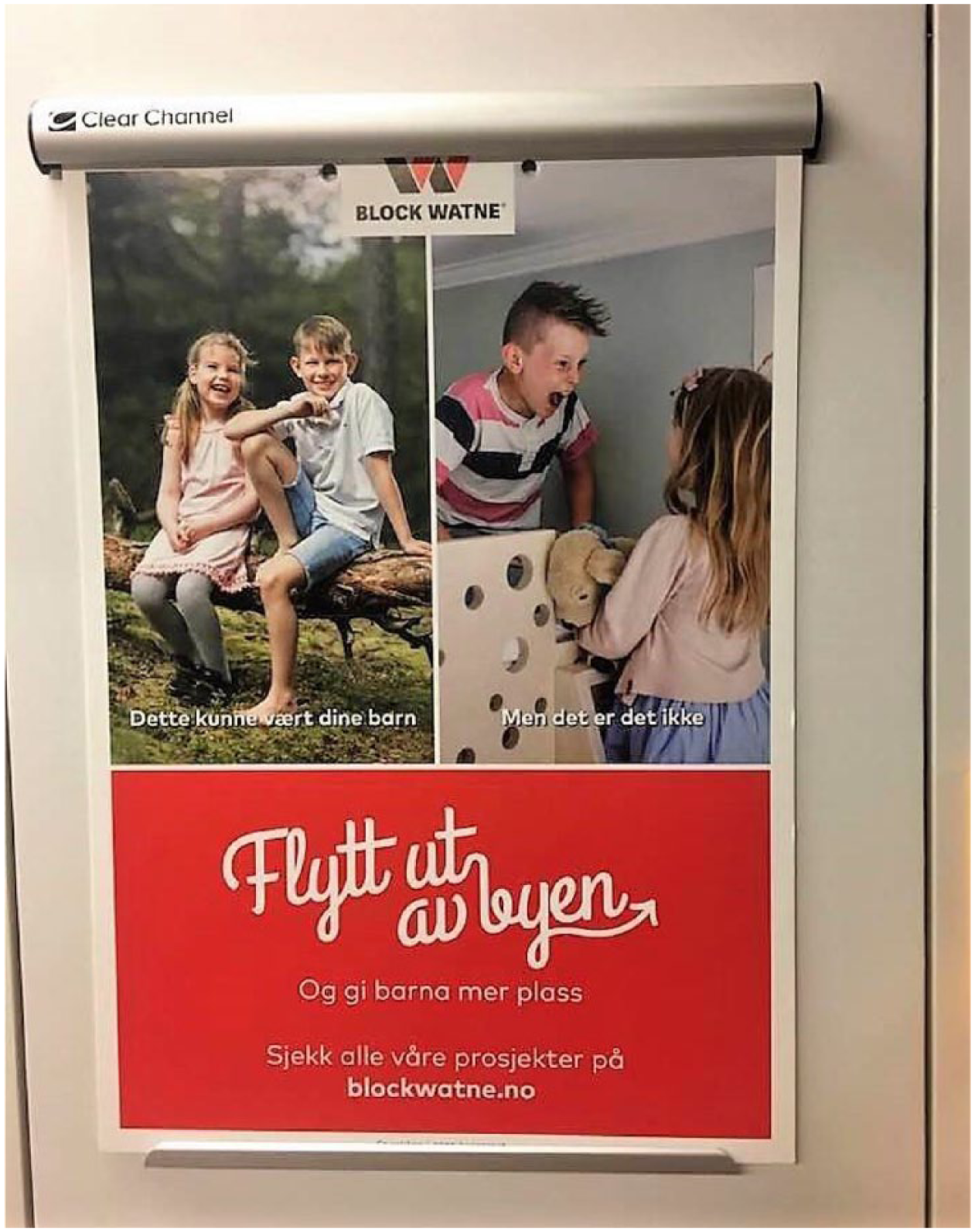
A child-friendly suburbia contrasted to a cramped (urban) nursery. © Block Watne.
This tense social scene is foregrounded against a decontextualized grey background, which signifies that this situation is valid everywhere except in suburbia, where we can assume that there is a separate nursery for all children. Conversely, the boy sitting on the fallen tree has natural hair, which invokes a metaphorical association of something organic. He is in harmony with both nature and the girl and has managed to temper his destructive masculinity because of his expansive and peaceful surroundings. We can even assume that there is no need for siblings to quarrel in the suburbs because they engage in gender-balanced and respectful social relationships, as demonstrated to the left in the picture, or the “given” of suburbia. This is quite different from the girl’s passive and subordinated status in the nursery. Finally, in the “real” we can read the following: “Move out of the city and give the children more space” (Block Watne, n.d.; translated by the authors). The font is curved, round, and partly connected to signify something “smooth,” “soft,” “natural,” and “emotional” (Machin, 2007, p. 99). This is a semiotic choice that creates a sense of nostalgia.
The Ideological Content of the Block Watne Campaign
Thus far, we have shown how we can read a selection of images in the Block Watne housing advertisement via concepts that were adopted from social semiotics. In this section, we will draw attention to the ideological work that such images can accomplish. It is one thing to describe and analyze semiotic choices, including what meaning potential they might afford; however, another interrelated operation is to consider the potential social and ideological effects that different semiotic choices may have (Skrede, 2017). Because language, images, and other semiotic representations are able to (re)produce social life, we can ask what kind of world is being created (Abousnnouga & Machin, 2013) and what kind of imaginary space they offer. The broader ideas that are communicated by the images in our case may be referred to as discourses. Semiotic choices are analyzed to reveal the underlying discourses and ideologies that can be realized within them (Abousnnouga & Machin, 2011). In ideology, certain discourses become accepted in ways that obscure and sustain power relations (Abousnnouga & Machin, 2013). The most manipulative and effective exercise of power occurs when one person is able to get another person to do what he or she wants by controlling the other person’s thoughts and desires (Lukes, 2005).
The analysis of the images above demonstrated that the housing advertisement foregrounds certain semiotic elements while suppressing and removing others. The campaign has reproduced a nostalgic discourse concerning ways of life that we recognize from popular culture representations of 1950s and 1960s U.S. suburbia (e.g., Avila, 2004; Haralovich, 1989), as well as in the design and marketing of today’s suburbia (Andersen, 2001; Knox, 2008). The images suggest a local and close-knit community (see Figure 2) and involve stereotypical gender roles in which the females take care of the children and somewhat passively look up to the male ideals of strength and balance. Returning briefly to Bourdieu (2014) and his analysis of an image that was used in a housing advertisement, he also found gendered roles in a scene where the mother had to sit “on the chair arm” as the father occupied the proper seat (p. 61). Discussions of the social construction of space have demonstrated “the centrality of gender in all forms of place-making” (S. Low, 2017, p. 79). For instance, as stressed in “feminist urban studies” (Bondi & Rose, 2003, p. 231), suburbia has been claimed to enshrine the values of nuclear family–based domesticity. Moreover, several studies have documented how the relationship between urban spaces and “fear” is gendered (e.g., S. M. Low, 2003; Sreetheran & van den Bosch, 2014). The spatial imaginary invoked by Block Watne is one of a safe outdoors in suburbia, where boys and girls alike will thrive. This effect is achieved by an assumption of the city as an unpleasant and potentially harmful environment. The campaign reproduces a much-used trope of inner-city problems. As such, the message is anti-urbanist and suggests an incompatibility between family and children and urban living.
Following Bourdieu (2014), it can be added that a house in the suburbia of Block Watne’s campaign is a family home comprising a mother, a father, and their children (Block Watne, n.d.). No images are offered of single households, which constitute a large part of Oslo’s demography (Municipality of Oslo, 2018a). However, the image of the conventional nuclear family apparently fits the nostalgic representation of the suburbia produced by Block Watne, paraphrasing Knox’s (2008) argument about a phase of U.S. suburbanism. The marketing strategy expresses a compelling vision of proper family life when freed from the ills of the chaotic city; it is “restored to harmony with nature,” endowed with a comfortable home, and (referring to Figure 2) “protected by a close-knit, stable community” (p. 20).
It is also striking how Oslo’s increasingly multiethnic population is seemingly nonexistent in the imagined suburbia of Block Watne. As part of a social semiotic analysis, we may wonder what would happen if we changed things, for instance, if we rearranged the elements in an image. How would that affect the meaning (Hestbæk Andersen et al., 2015)? We may argue that the suburban dreamscape that was invoked in the campaign predates immigration to Norway from the 1970s onward. If Block Watne had included, for instance, people with dark skin in the campaign, it could potentially have led to a more contemporary reading and thus may have undermined the intended appeal to nostalgia.
Concluding Discussion
The concept of policy implementation often erroneously implies a linear progression from an adopted governmental/municipal policy toward its targets. Thus, policy implementation studies often consider whether policy targets follow certain mandates to discover the relative success level of a given policy (D. C. Johnson, 2011). Block Watne may be viewed as one of the de facto city makers (Andersen & Skrede, 2017) who have challenged the adapted growth policy by circulating and reproducing a nostalgic discourse about the “good life” outside the city. We argue that the effect of an advertisement campaign on its readers/viewers does not depend on intentionality. Ideology is not necessarily intentional, yet discourses carry ideologies, and ideologies are reproduced and transformed in discourses. People neither marry to reproduce the nuclear family nor work to sustain the capitalist economy; however, these are unintended consequences of their activities (Bhaskar, 1998, p. 215). Consequently, we must try to understand “discourses in general and assess to what extent (if at all) they cause change” (Sayer, 2000, p. 96). Human activity is conscious, and consciousness affects social change; however, these changes need not be consciously intended to be socially explained (Bhaskar, 2011).
Critical social science is equally engaged with the potential unintentional effects of discourse as it is with the motives behind it. In the classic essay “The Self-Fulfilling Prophecy,” sociologist Robert K. Merton (1948) stated a theorem that has become basic to the social sciences: “If men define situations as real, they are real in their consequences” (p. 193). Based on this theorem, he put forth a parable that is peculiar to human affairs, which tells us that “public definitions of a situation (prophecies or predictions) become an integral part of the situation and thus affect subsequent developments” (p. 195). We can make an analogous argument regarding the Block Watne campaign: It was endowed with the performative power to bring into existence the very realities it claimed to describe—inculcating an alarmist impression of the urban landscape as a dangerous and unhealthy environment in which to raise children.
What the discourse about the suburban dreamscape is not able to do, however, is to turn an illusionary lifestyle from the 1950s, which has become culturally popularized in movies, TV shows, literature, and music, into reality. Yet in the scholarly literature, the urban and the suburban still constitute an analytical as well as empirically relevant dichotomy (Airgood-Obrycki, 2019), even if a continuously built landscape, including transportation networks, intra-urban residential mobility, and other flows, reminds us to consider the metropolitan region as a socio-spatial reality (Andersen & Skrede, 2017; Antrop, 2004; Knox, 2008; Talen, Wheeler, & Anselin, 2018).
As we have demonstrated, the growth strategy may be undermined because there are interests that emphasize more suburban and nostalgic lifestyles. As argued by Røe (2014), places are (in part) “constructed through the circulation of representations” (p. 502), which we have also shown with reference to the social semiotic analysis of the Block Watne campaign. Inspired by Montero (2018), who argued for “the active role that media objects, such as [images], play in shaping urban policymaking” (p. 752), we have illustrated how media objects can challenge urban policy aims, whether they are intended to do so or not. In linguistics, there is a well-established tradition of analyzing the imperatives, adjectives, and personal pronouns to discern the ideological content of advertisements; however, without analyzing the images on which the text is placed, important knowledge could be lost (Abousnnouga & Machin, 2013). As argued by Abousnnouga and Machin (2013), if we see a news report about an issue in a Muslim country and we find an image of a woman in a full burka, used to represent Muslimness, it would not be possible to write, “All Muslims look like this” or “This is representative of all Muslims.” However, an image can impart such an impression. This is because text and images involve different kinds of epistemological commitments, and images are particularly relevant because they may serve certain groups’ interests. Even if it is uncertain that the developer’s suburban dreamscape will be realized, the marketing of a suburban landscape may appeal to people who are invested in that dream.
As previous research has demonstrated (e.g., Andersen, 2014), Oslo-based families who plan to have or already have children often envision a less urban environment as the proper place to raise them (see also Strand, 2018; Lunke, 2014). More precisely, families with children will often exchange their city apartment and urban neighborhood for a single-family home and garden outside the city’s borders. Paraphrasing Lang, Hughes, and Danielsen (1997), we claim that Block Watne, through their housing construction, cater to a relatively large segment of “urban suburbanites” (Lang et al., 1997). Through their strategic use of semiotic resources, Block Watne can be said to have enticed families to leave the unhealthy compact urban world behind by relocating to an environment that seemingly affords a child- and family-friendly way of life. In Oslo, the municipal authorities’ aim is a compact city; however, the authorities will encounter several actors with diverging interests. Here, we have discussed one such interest via Block Watne’s attempt to seduce urban residents to invest in the suburban dreamscape.
Footnotes
Declaration of Conflicting Interests
The authors declared no potential conflicts of interest with respect to the research, authorship, and/or publication of this article.
Funding
The authors disclosed receipt of the following financial support for the research, authorship, and/or publication of this article: This work was supported by The Research Council of Norway, grant numbers 160010/F40 and 259888.
