



Abstract
Wearable technology, especially smart glasses, has emerged as a notable breakthrough in healthcare, presenting disruptive possibilities across several domains, including dentistry. Ray-Ban | Meta smart glasses, a cooperation between Meta and EssilorLuxottica, use augmented reality (AR) and artificial intelligence (AI) to improve healthcare operations, patient engagement, and instructional methodologies. This overview maps the possible applications, benefits, difficulties, ethical considerations, and future prospectives of smart glasses in dentistry. This review elucidates how current research indicates that these devices may transform dental practice accuracy, augment education, and boost accessibility, while also tackling issues pertaining to data privacy and ethical use. Overall, smart glasses have the potential to enhance dental education, training, and clinical practice, offering innovative solutions for both educational and practical aspects of dentistry.
Introduction
Smart glasses revolutionalizes health care by providing hand-free access to critical information, enhancing communication, and improving patient workflow efficiency. As technology evolves, the use of smart glasses is expecting to expand for surgical assistance to telemedicine and teledentistry. The use of smart glasses in healthcare signifies a transformative change to improve efficiency and accuracy. 1 It provide immediate data access, augmented reality enhancements, and AI-driven technologies. Ray-Ban | Meta smart glasses (Meta Platforms, Inc., Menlo Park, CA, USA, in partnership with EssilorLuxottica, Charenton-le-Pont, France; released 2023) epitomize this innovation by merging fashionable forms with sophisticated features, like HD cameras, voice assistants, and augmented reality displays. Originally intended for broad consumer applications, their potential in healthcare, especially in dentistry, is now being intensive exploration. 2 Dentistry often need accuracy and immediate access to visual and textual data. The capacity of these glasses to incorporate data into a practitioner’s visual field is expected to minimize workflow disruptions, augment procedure precision, and boost patient outcomes. Nonetheless, substantial promise entails considerable duty to tackle privacy, ethical, and technological concerns. 3 This study analyzes these aspects, highlighting their ramifications for clinical practice, dental education, and patient care. The aim of this review is to map the possible applications, benefits, difficulties, ethical considerations, and future prospectives of smart glasses in dentistry, particularly, Ray-Ban | Meta smart glasses in dental practice, education and research.
Applications in Dentistry
Smart glasses in dental education underscores remote training, and clinical practice, accentuating their contribution to delivering improved clinical care in underdeveloped nations. These glasses reduce interruptions and allow practitioners to focus on their tasks. With slight modifications and careful selection, both functional and aesthetic roles can be served by them. Ray-Ban | Meta glasses are not specifically designed for dentistry, but their applications make them a versatile accessory in dental practice. The implementation of Ray-Ban | Meta smart glasses in dentistry offers several interesting possibilities. In clinical practice, smart glasses provide hands-free access to patient data, treatment plans, and procedural guidelines, markedly reducing interruptions and enabling practitioners to sustain concentration on their tasks. Augmented reality overlays provide immediate instruction during intricate procedures like dental implant placements, when accuracy is essential. 3 Moreover, these glasses enhance tele-dentistry by providing live broadcasting, allowing professionals to provide remote assistance to regular dentists or students. Moreover, the smart glasses facilitate communication for patients by providing augmented reality visuals of suggested therapies. This enhances comprehension and trust, while the glasses’ capacity to monitor adherence to post-procedural care augments recovery results and overall happiness. 3 Furthermore, Equipped with microphones and built-in speakers, smart glasses can capture images and videos for sharing on social media platforms, providing a unique perspective on dental procedures and practices. In regards to dental armamentarium, dental loupes are magnification tools used by dentists to improve visual accuracy during procedures. Ray-Ban frames, known for their quality craftsmanship and ergonomic design, can be adapted to support dental loupes or magnification devices, allowing dentists to perform procedures with enhanced precision while maintaining stylish eyewear. Some dental practices may use high-end products like Smart glasses, such as Ray-Ban | Meta, could be integrated into premium service offerings to enhance the client experience, reinforcing a sense of quality and care. Direct mounting allows dental loupes to be securely attached to the Ray-Ban frame using specialized mounting hardware, while clip-on options allow loupes to clip onto existing glasses. Custom-made solutions allow dentists to enjoy the benefits of stylish frames without compromising functionality.
Ray-Ban products can also be integrated into a dental practice’s marketing strategy or used to enhance the patient experience. Some dental practices, especially those offering cosmetic or high-end services, might present Ray-Ban sunglasses as complimentary gifts for patients. For teeth whitening, providing Ray-Ban sunglasses not only protects their eyes but also leaves a lasting impression of luxury and care. For loyalty programs, Ray-Bans can be offered as part of a loyalty or referral program, rewarding patients for their continued patronage and advocacy of the practice. Combining functionality, luxury, and aesthetics makes Ray-Ban glasses an excellent addition to modern dental practices, whether for the dentist’s use or as a thoughtful gesture for patients.
In dental education, smart glasses provide exceptional benefits by capturing operations from the practitioner’s viewpoint. This immersive material may provide significant learning experiences for students. Moreover, Augmented reality simulations in these glasses can provide preclinical training settings, allowing trainees to rehearse operations in a regulated virtual context before engaging with patients. 4
Generally speaking, the potential challenges of smart glasses related to infection control, as the close proximity of smart glasses to patients and clinicians necessitates rigorous cleaning protocols. Many current smart glasses models lack designs that accommodate frequent disinfection, which could compromise hygiene in clinical settings. Additionally, weight ergonomics and the potential for battery overheating during prolonged use have been identified as key barriers to adoption. For example, heavier devices can cause discomfort or strain for clinicians during long dental procedures, while insufficient heat dissipation can lead to battery overheating, posing safety, and usability concerns. Studies have reported mixed results regarding comfort during extended wear, with some users experiencing fatigue or pressure points on the nose and temples. Similarly, infection control protocols for wearable devices, such as the use of disposable covers or antimicrobial coatings, have been tested in small-scale trials and warrant further investigation.5-7
On the other hand, Ray-Ban | Meta smart glasses with light weight, provide a unique potential to augment dental education via first-person viewpoints, facilitate remote instruction, and foster immersive learning experiences. These glasses have integrated cameras, microphones, and speakers, enabling teachers to broadcast or record dental treatments from a first-person viewpoint, so offering students a unique, real-time observation of their expertise. The glasses can capture high-quality recordings of dental operations from the practitioner’s perspective, improving clinical case libraries and facilitating the examination and evaluation of techniques or workflows in clinical environments. Future versions of augmented reality may superimpose instructional information in real-time, facilitating student engagement during practical exercises and enhancing diagnostic capabilities.
First-person recordings may aid in evaluating and enhancing student performance, since students can use the glasses while executing operations on mannequins or simulators. Instructors may analyze recordings to provide comprehensive comments and establish an archive of student movies to monitor development over time.
The integrated microphones and speakers provide effortless contact between students and teachers, enhancing group discussions or teledentistry sessions. Patients get a clearer comprehension of processes when presented with first-person recordings or explanations, and using patient-specific recordings (with consent) may enhance knowledge and adherence to treatment programs.
Dental research, as of virtual reality glasses can benefit from the use of smart glasses in relation to dental practice, dental education, or both. Smart glasses serve as a significant asset in dental research.8-10 Recent studies highlighted the improved motor skill acquisition, retention, and engagement facilitated by these technologies. For instance, Azhari et al 8 (2024) examined the acceptability of VR in restorative dentistry training and found overwhelming support for its usability and effectiveness in skill development. Furthermore, Huang et al 10 (2021) conducted a comparative analysis of GoPro and digital cameras in surgical education and demonstrated that first-person perspectives, especially from wearable devices, significantly enhance the clarity and precision of technical demonstrations. Similarly, a systematic review by Shetty et al 9 (2025) emphasized the pedagogical benefits of VR and haptic technology in restorative dentistry training, highlighting improvements in motor skill acquisition, feedback mechanisms, and procedural efficiency.
Huang et al 10 2024 compared employing GoPro cameras to professional digital cameras for filming surgical procedures, notably head and neck flap harvesting surgery. It emphasized the significance of high-quality surgical videography in medical education, particularly in low- and middle-income countries with an increasing demand for skilled surgeons. 10 The results showed that, while GoPro cameras provide a solid first-person perspective and are inexpensive, they lack zoom capabilities, which are required for capturing detailed anatomical features. In comparison, digital cameras provide more image quality and detail but necessitate more manual adjustments. Therefore, merging both technologies could improve surgical video documentation and education, resulting in better surgical training and patient care. 11
Operator ergonomics research may be performed by examining posture and technique during processes via AI-driven diagnostics integration and machine learning models. Telehealth and remote cooperation may be facilitated by live broadcasting of operations, enabling dentists to remotely view clinical trials, or experimental treatments. Behavioral studies may be executed by documenting patient reactions during operations, enabling researchers to analyze behavioral responses to treatments and evaluate dentist-patient interactions. Workflow optimization may be achieved by time-motion studies and study of instrument use. The integration of image processing and large language models, future developments may include augmented reality overlays for the presentation of procedural guidelines or anatomical data during treatments or training through simulations, as well as virtual training modules for research or educational objectives.
The integration of Ray-Ban | Meta smart glasses in dentistry has several advantages. They markedly improve workflow productivity by providing dentists hands-free access to essential information, optimizing processes, and conserving time. Furthermore, if future versions of Ray-Ban | Meta are further customized for dental use and integrated with augmented reality–guided clinical software, such smart glasses could potentially enhance procedural precision by overlaying digital guidance during technique-sensitive procedures such as dental ceramic veneer bonding or implant placement.
Another impact of AR-equipped glasses is improving dentist-to-patient communication. Dentists can project 3D models, animations, or visual overlays to explain procedures in an easy-to-understand way, making patients more comfortable and informed about their treatment options. Real-time visualization during procedures helps bridge the communication gap, making the patient more comfortable and informed about their treatment options. By reducing mistakes, these technologies enhance healthcare results. The augmented communication and visualization features offered by these glasses also improve patient outcomes. Patients are more inclined to comprehend and accept treatment regimens when they can picture operations, resulting in increased satisfaction and adherence. Furthermore, the tele-dentistry functionalities of Ray-Ban Meta smart glasses address deficiencies in underserved regions, facilitating remote access to experts and guaranteeing that a greater number of patients get excellent treatment.
Positioning Ray‑Ban Meta Versus AR/Assisted‑reality Headsets in Dentistry: Devices Classification and Terminology
Ray‑Ban | Meta (Meta Platforms, Inc., Menlo Park, CA, USA, in partnership with EssilorLuxottica, Charenton-le-Pont, France; 2023 model): Camera/audio smart glasses without an optical AR display or head‑up display (HUD). Optimized for hands‑free first‑person capture, livestreaming, audio prompts, and voice assistant (Meta AI). Typical single‑charge use 4 hours; charging case extends total use. Consumer device with not publicly documented medical‑device certifications. 12
Microsoft HoloLens 2 (Microsoft Corp., Redmond, WA, USA; 2019 model): See‑through waveguide AR headset with hand/eye/voice input; widely studied in medical and dental education. HoloLens itself is a general‑purpose compute device (not a regulated medical device); however, third‑party software running on HoloLens can be cleared (eg, FDA 510(k)). 13
Vuzix M400/M4000 (Vuzix Corp., West Henrietta, NY, USA; 2019–2020 models): Monocular assisted‑reality devices used for tele‑mentoring and remote teaching (including dentistry). M400 uses an occluded OLED; M4000 provides see‑through waveguides. Notable durability (eg, IP67) and clean‑room related certifications.14,15
Google Glass Enterprise Edition 2 (Google LLC, Mountain View, CA, USA; 2019 model): Prism‑display assisted‑reality with a lightweight form factor; used across industrial and clinical training contexts. No public medical‑device certification.16,17
Ray‑Ban | Meta are best positioned for hands‑free capture, remote observation, and audio prompts, it is also valuable for education and documentation, but distinct from AR navigation.
Comparative Table 1 was added to compare display type, approximate field‑of‑view (if applicable), camera, weight, battery, inputs, on‑device compute, regulatory notes, and representative evidence.
Comparative Specifications and Evidence for Smart Glasses in Clinical/Educational Settings.
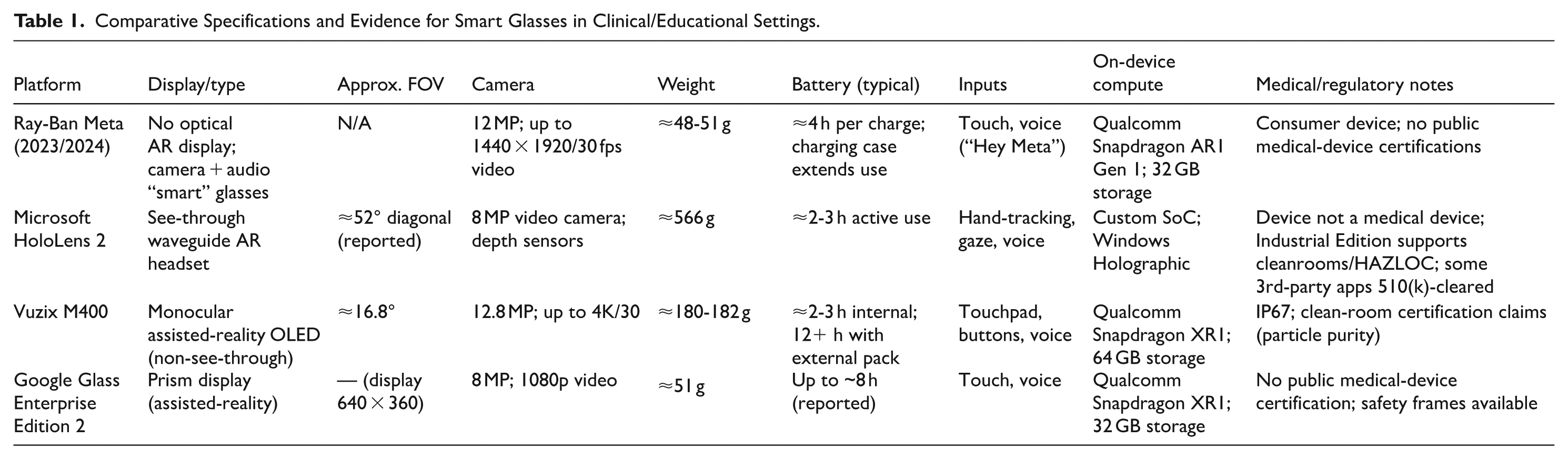
In dental settings, platform selection depends on whether real-time, on-lens visualization is needed. See‑through AR headsets (eg, Microsoft HoloLens 2, Vuzix M4000) enable registered overlays (eg, teeth anatomy, prothesis prep lines) with hands‑free interaction, but carry trade‑offs in weight, heat, and cost. Assisted‑reality devices (eg, Vuzix M400, Google Glass EE2) excel at tele‑mentoring, prompts, and remote supervision with lighter hardware and greater ruggedization. Ray‑Ban | Meta smart glasses do not project visual content in the field of view; their strengths are first‑person capture, secure livestreaming for education, and voice‑driven prompts. Consequently, Ray‑Ban | Meta are best aligned with documentation, observation, and communication use cases, whereas AR navigation and on‑patient guidance remain the domain of true see‑through AR headsets.
Challenges and Ethical Considerations
The use of these smart glasses in dentistry, albeit promising, encounters several hurdles. Technological constraints, such as restricted battery longevity and processing capabilities, may impede sustained use throughout extended operations. Moreover, the display dimensions may limit thorough data visualization, necessitating additional design enhancements. Privacy issues represent a substantial difficulty. The capacity to capture and disseminate films presents challenges to patient confidentiality, particularly in light of legislation like HIPAA and GDPR. 2 Manufacturers must establish stringent security protocols to safeguard user data from unwanted access. Dentists encounter ethical challenges, including the need of obtaining informed permission for documenting treatments and safeguarding bystander privacy. Explicit rules and comprehensive training programs are crucial for properly addressing these difficulties.
From a technical standpoint, edge AI processing presents a viable method by facilitating data analysis and processing immediately on the device, hence minimizing the necessity to transmit sensitive patient data across external networks. This mitigates the risk of data breaches and guarantees adherence to privacy standards. Moreover, on-device anonymization methods, including automatic blurring of recognizable facial characteristics and real-time de-identification of patient information, might enhance privacy protection. These improvements have been effectively integrated into certain clinical investigations, showcasing their potential for wider implementation in dentistry education.
The execution of procedures sanctioned by the ethics board is essential for the institution. This encompasses the utilization of standardized, legally compliant informed consent templates that explicitly delineate the objective of data collection, the intended use of the data, and the safeguards established to preserve patient privacy. Moreover, consistent training for educators and students on ethical considerations and data protection policies helps cultivate a culture of compliance and awareness.
Current Research and Evidence
Studies on wearable technology highlight its potential to revolutionize healthcare. Mai et al 3 (2023) demonstrated the efficacy of augmented reality in improving the accuracy of dental implants. The mean lateral deviation for AR navigation was 0.90 mm (95% CI 0.78-1.02). 3 The mean global deviation was 1.18 mm (95% CI 0.95-1.41). The mean depth deviation was 0.78 mm (95% CI not given). The mean angular deviation was 3.96° (95% CI 3.45°-4.48°). In comparison to the Freehand (FH) approach, AR navigation exhibited markedly reduced positional deviations, with a standardized mean difference (SMD) of −1.01 (95% CI −1.47-−0.55; P < .001). In comparison to the Conventional Navigation (CN) approach, AR demonstrated superior accuracy with a standardized mean difference (SMD) of −0.46 (95% CI −0.64-−0.29; P < .001). The precision of AR navigation was comparable to the Template-based Static Guidance (TG) technique, exhibiting an SMD of 0.61 (95% CI −0.62-0.74; P = .73). The findings indicate that AR navigation offers a clinically satisfactory degree of precision for dental implant placement, especially in comparison to conventional techniques.
Vorguca 18 (2023) similarly highlighted the importance of AI in improving wearable technology such as Ray-Ban Meta smart spectacles, forecasting substantial progress in real-time decision-making and interaction. Research indicates that these glasses might mitigate accessibility challenges. Waisberg et al 4 (2024) demonstrated their use in assistive technology, indicating potential uses for visually impaired individuals. As robotic surgical systems are in experimental phases for maxillofacial surgery, smart glasses may serve as a tool for guided procedures in distant areas with restricted access to specialized dental care. 19 These results highlight the wider ramifications of incorporating such technologies into dental practice.
Punj et al 20 2025 suggested that the use of smart glasses significantly enhances both the learning experience and the effectiveness of oral examination training for medical students. The study involved 10 medical students, divided equally into an intervention group using smart glasses and a control group. The intervention group showed a significantly higher median Read Score (10.0) compared to the control group (4.0), with a P-value of .007. Similarly, the intervention group had a significantly lower median Unread Score (0.0) than the control group (3.0), with a P-value of .025. Participant satisfaction ratings indicated that 60% of the intervention group rated the experience as “Good” and 40% as “Excellent,” whereas 100% of the control group rated it as “Excellent.” Both groups reported 100% overall satisfaction.
The integration of smart glasses in dentistry faces several challenges across technical, ergonomic, operational, and ethical domains. 21 Technically, issues include connectivity and latency issues impacting real-time applications, limited battery life for prolonged use, display limitations for detailed visualizations, software compatibility issues with existing dental systems, and data security and privacy concerns, particularly regarding HIPAA compliance. Ergonomically, prolonged use can cause discomfort, limited customization may hinder adoption for some users, and the AR interface can present visual distractions. Operationally, a significant learning curve exists, high costs affect accessibility, and concerns remain about reliability in clinical atmospheres. Ethically, patient acceptance and consent for recordings are paramount, alongside questions of data ownership and potential misuse. In dental education, telecommunication limitations and the effectiveness of training methods compared to traditional approaches require further investigation. Overcoming these hurdles necessitates technological advancements, improved ergonomics, cost reduction, clear ethical guidelines, and collaboration among stakeholders.
Future Directions
The future of Ray-Ban | Meta smart glasses in dentistry is contingent upon their incorporation of modern technology, including 3D imaging and AI diagnoses. Custom software designed for dental treatments might augment their functionality, facilitating applications such as real-time caries diagnosis and implant planning. Confronting technical and ethical obstacles will be essential for attaining wider acceptance. Moreover, initiatives aimed at enhancing price and accessibility will enable smaller practices to use this breakthrough technology. The future directions of Ray-Ban | Meta glasses in dentistry encompass advancements in remote training, clinical practice, and the integration of augmented reality, while also emphasizing the importance of responsible use and privacy considerations.
Smart glasses offer significant potential for integration with radiographic imaging systems, enabling clinicians to view real-time images like intraoral X-rays, panoramic views, and CBCT scans directly via a heads-up display. This seamless integration allows for improved focus and workflow efficiency by eliminating the need to divert attention from the patient, for instance, by overlaying CBCT images onto patient anatomy for enhanced precision during dental implant placement. Such functionality also facilitates comparisons between preoperative and postoperative imaging, aiding case documentation and patient communication, and can benefit dental education by allowing trainees to visualize live imaging data. Furthermore, smart glasses show promise in guided endodontics, providing real-time navigation and projected pathways based on preloaded CBCT data during root canal therapy to improve accuracy and reduce procedure time. In conjunction with intraoral scanners, they can enhance restorative and prosthetic dentistry workflows by enabling direct visualization of 3D oral cavity models for immediate assessment of scanned data, margin integrity, or prosthetic fit, streamlining procedures such as crown preparation.
Conclusion
Ray-Ban | Meta smart glasses has the potential to revolutionize dentistry by optimizing processes, advancing education, and cultivating patient trust. Smart glasses have the potential to enhance dental education, training, and clinical practice, offering innovative solutions for both educational and practical aspects of dentistry. Although issues like privacy concerns and expenses need to be resolved, their incorporation into dental practice may result in substantial progress. Ongoing research and innovation will be essential for achieving their full potential.
Footnotes
Acknowledgements
Authors would like to thank Dr. Zainab Alsadah and Dr. Khaled Fawaz for their continuous support throughout the project. Also, the authors acknowledge with thanks WAQF and the Deanship of Scientific Research (DSR) at King Abdulaziz University, Jeddah, Saudi Arabia for technical and financial support.

Author Contributions
Conceptualization (WMA, AAA); Data curation (WMA, AAA); Formal analysis (WMA, AAA); Investigation (WMA, AAA); Methodology (WMA, AAA); Project administration (AAA); Supervision (WMA); Validation (WMA, AAA); Visualization (WMA, AAA); Roles/Writing—original draft (WMA, AAA); and Writing—review & editing (WMA, AAA).
Funding
The authors disclosed receipt of the following financial support for the research, authorship, and/or publication of this article: The project was funded by KAU Endowment (WAQF) at King Abdulaziz University, Jeddah, Saudi Arabia. The authors, therefore, acknowledge with thanks WAQF and the Deanship of Scientific Research (DSR) for technical and financial support.
Declaration of Conflicting Interests
The authors declared no potential conflicts of interest with respect to the research, authorship, and/or publication of this article.
Data Availability Statement
The authors confirm that the data supporting the findings of this study are available within the article.