




Abstract
Objectives
Over the past decade, low-intensity transcranial ultrasound stimulation (LITUS) has emerged as a promising non-invasive neuromodulation technique for central nervous system (CNS) disorders. This study aims to chart the current research landscape, uncover key trends and challenges, and offer a reference for future investigations.
Methods
Following PRISMA guidelines, we sourced data from 3 databases and included 454 literature. We conducted bibliometric analyses using R, VOSviewer, and CiteSpace to explore publication trends, journal/region contributions, keyword co-occurrence networks, research clusters, and emerging frontiers.
Results
The United States, China, and South Korea were the most influential countries in the field, while Brain Stimulation was the leading journal. Keyword analysis revealed 7 research clusters, and burst-detection highlighted frontiers such as safety, thalamic stimulation, and frequency. The literature review shows that LITUS is an emerging field with therapeutic promise, but faces challenges in areas like safety and ultrasound parameter standardization.
Conclusion
As the first comprehensive bibliometric and systematic review of LITUS in CNS disorders treatment, this work presents a global picture of publication trends, hotspots, and obstacles—providing valuable guidance for future research and clinical translation of LITUS.
Plain Language Summary
Central nervous system (CNS) disorders—such as Alzheimer’s disease, Parkinson’s disease and ischemic stroke—impose a significant burden on global health. Traditional treatments often have complications or inadequate effects, creating an urgent need for novel therapies. Low-intensity transcranial ultrasound stimulation (LITUS), as an innovative non-invasive neuromodulation technique, can deliver low-energy ultrasound to penetrate the intact skull and precisely target specific brain regions. The unique advantages have made it a promising therapeutic solution for the treatment of CNS disorders. This study analyzed 454 publications (2011–2025) from databases including Web of Science, PubMed, and Scopus using VOSviewer and CiteSpace. Results from the bibliometric analysis show that research on LITUS has grown rapidly since 2017, with the United States and China taking the leading role. Key institutions include the Chinese Academy of Sciences, Shenzhen Institute of Advanced Technology, and Harvard University. Existing studies fall into seven main clusters, where safety, frequency., and more have become the key research focuses and hotspots at present. Further systematic analysis has shown that LITUS has demonstrated efficacy in a range of CNS disorders, including the reduction of amyloid-beta in Alzheimer’s disease, protection of dopamine neurons in Parkinson’s disease, alleviation of depression-like behaviors, and reduction of seizure frequency in epilepsy. It also supports functional recovery in patients with vascular dementia and ischemic stroke. In addition to research on the therapeutic efficacy of LITUS for CNS disorders, existing studies have also conducted comprehensive research on its safety and therapeutic mechanisms, yet many unresolved issues remain, including the lack of standardized ultrasound parameters, individual differences affecting efficacy, insufficient research on mechanisms in humans, limited large-sample clinical trials (especially for special populations), and underdeveloped standardized equipment. Hence, this study conducts an in-depth discussion on the current challenges of LITUS in the treatment of central nervous system disorders and corresponding countermeasures, aiming to provide theoretical references for subsequent relevant research and scholars in this field.
Keywords
Introduction
A study in The Lancet Neurology reports that by 2021, over 3 billion people were affected by neurological disorders. 1 Similarly, a 2022 World Health Organization (WHO) report shows that nearly one billion people suffer from mental disorders. Both highlight the global burden of mental and neurological disorders. Obviously, therapeutic approaches are the foremost and most critical issue that needs to be addressed. Traditional treatments mainly involve surgery and adjunctive medication. However, aside from potentially causing other complications, these traditional methods couldn’t achieve the desired therapeutic effects.
With advances in neuroscience and biomedical engineering, neuromodulation has emerged as a key therapeutic approach for mental and neurological disorders. This approach utilizes various techniques, including electrical and magnetic stimulation, ultrasound stimulation, chemical modulation, and optical control. Notably, LITUS stands out due to its non-invasive, high spatial resolution, and deep tissue penetration, and has shown particular promise in treating these disorders by employing low energy for neuromodulation. Current research indicates that LITUS has been effective in treating Alzheimer’s disease (AD), Parkinson’s disease (PD), depression, essential tremor (ET),2,3 schizophrenia 4 and etc. Furthermore, it has progressed from animal studies to human clinical trials, which attests to its safety. 5
As a novel neuromodulation technique, LITUS has made significant progress in recent years. This study employs scientometric methods to address the following research questions: (i) summarize the current research hot spots in this field, (ii) clarify the knowledge structure (including co-occurrence patterns and collaborative networks) in this field, (iii) identify the main clusters to summarize the research directions, and (iv) predict future research trends through keyword burst detection. Beyond the foundational bibliometric analysis, this study integrates previous research to particularly provide a detailed discussion of the current research hot spots and status of LITUS technology. It also examines the challenges this technology faces in clinical translation and, based on the bibliometric results, predicts future development trends. The aim is to provide comprehensive theoretical references for other researchers.
Materials and Methods
Data Source and Search Strategy
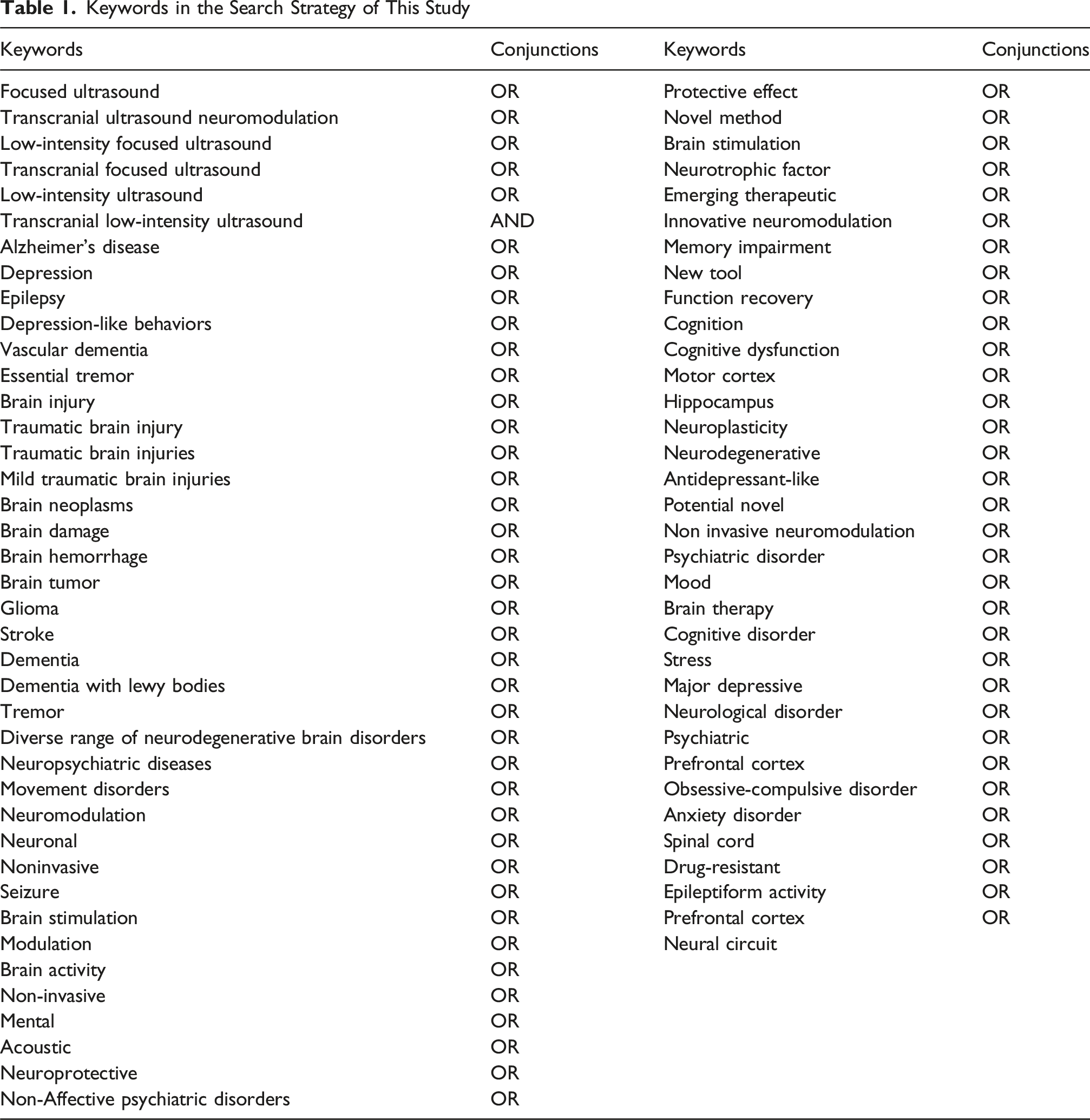
This study selected the Web of Science Core Collection (WOSCC) as the primary source of literature due to its status as one of the most comprehensive and authoritative multidisciplinary databases.6,7 It is worth noting, however, that although the WOSCC was our first choice, in the fields of biomedical and life sciences the database PubMed is widely used; moreover, Scopus 8 frequently employed as supplementary sources when conducting literature reviews. Accordingly, PubMed, and Scopus as additional data sources for this study.
Keywords in the Search Strategy of This Study
Inclusion and Exclusion Criteria
After the keyword-based initial screening, many literature did not meet the study’s requirements. Therefore, the inclusion and exclusion criteria were defined:
Inclusion Criteria: ① Studies focusing on the application of LITUS in the CNS disorders treatment; ② The type of literature limited to reviews, articles, and clinical studies. ③ The language of literature limited to English.
Exclusion Criteria: ① Non-research publication types: Editorials (opinion pieces without data analysis); Letters (short communications not presenting original research); Meeting abstracts (conference materials without full methods/results); News reports, books, and patents. ② Duplicate publications or incomplete data. ③ Records characterized by incomplete information, as well as those for which full-text access could not be achieved. ④ Records that have been converted into retracted. ⑤ Studies other than English. ⑥ Records irrelevant to the search strategy.
Data Extraction
Data extraction was independently performed by 2 researchers, who then cross-validated the selected data. The titles, abstracts, and keywords of the retrieved literature were firstly read to preliminarily screen the literature that met the study criteria. The full text of those literature that could not be filtered by the basic information was further read to determine the final literature included in the study. When inconsistencies arose, a third researcher was consulted to reach a consensus. Ultimately, 454 literature were identified, covering the time range from 2011 to 2025.
“Citation Information,” “Title Information,” “Abstracts and Keywords,” and “Additional Information” of the records were exported in the form of “plain text”, “RIS”, and “PubMed”. Subsequently, These records were imported into CiteSpace, converted to “plain text (WOS)”format, and duplicates removed. Due to the relatively small final literature volume of this study, manual deduplication was used to ensure all the literature included in this study was unique. Figure 1 shows the flowchart of the literature screening process. Flowchart of literature screening
Data Analysis
Visualize Analysis Using VOSviewer
VOSviewer specializes in the graphical visualization of bibliometric maps, making it particularly effective for displaying large-scale bibliometric data in a clear and interpretable format. 9 In this study, VOSviewer (Version 1.6.20) was used to analyze journals, authors, and countries. Additionally, the H-index and impact factor (IF) were employed to assess the productivity and influence of a specific entities. The former indicates that “a particular subject having produced h literature, each of which has been cited at least H times”. 10 It can be abtained via the “Citation Report” option of WoSCC. IF and the ranking of literature cited in this article are sourced from the 2024 Journal Citation Reports (JCR).
VOSviewer is capable of generating 3 types of visualization maps: the network visualization maps, the overlay visualization maps, and the density visualization maps. 9 In the network visualization, both the nodes and the links between them serve as key reference elements: the radius of the nodes is proportional to publication volume or significance by a specific subject. Multiple nodes close together form a cluster. The nodes in each cluster are marked with the same color to distinguish them. The links between nodes indicate the network connections, and the strength of the links can be quantitatively evaluated using the total link strength (TLS), which is “the sum of link strengths of the terms over all the other terms”.11,12
Visualize Analysis Using CiteSpace Software
CiteSpace (Version 6.2.R6) is another commonly used software for bibliometric analysis. It enables visual identification of research hot spots, frontiers, and current status within a specific field through analysis of target literature. In this study, CiteSpace was used for keyword analysis, with the time set from January 2010 to December 2025, and other parameters kept at default values. The initial parameter settings of CiteSpace were as follows: time slicing (2010-2025), years per slice (1 year), node types (author, subject categories, institution, or keywords), and links settings (strength: cosine, scope: within slices).The network visualization view consists of nodes and links, where node size correlates proportionally with the quantity or the frequency of an object, and the links represent the connections between nodes. In our research, betweenness centrality (BC) serves as a key reference indicator that highlights a node’s significance within the network. A higher BC indicates a greater influence of the node on the overall map. 13
Research Ethics
Ethical approval was not required for this study, as all data used in this manuscript were sourced from public databases. No human participants or animals involved in the research.
Result
Analysis of Publications
The annual number and total number of publications illustrated in Figure 2. Literature on the use of LITUS for neuromodulation therapy of CNS disorders first emerged in 2011. That pioneering study demonstrated that LITUS alleviated seizure symptoms in mice, and importantly, no disruption of the blood-brain barrier (BBB) in mice was observed during this process. Though this research has not yet been tested in human trials, it suggests a potential role for LITUS in the treatment of epilepsy. The number of publications in this field has been continually increasing, with a notable acceleration starting from 2017, indicating a consistent growth trend anticipated to continue. Annual and sum publications from 2011 to 2025: A combination chart allows multiple pieces of information to be displayed in a single graph. In this combination chart, the bar chart represents the total number of publications for each year from 2011 to 2025, while the line chart illustrates the cumulative number of publications starting from 2011
Analysis of Countries/Regions
The Most Active Countries in This Field


Analysis of the contributions of different countries or regions to LITUS treatment for CNS disorders. A. This map clearly displays the publication volume of each country along with the geographical regions of the publishing countries. Countries with fewer publications are represented in lighter yellow or orange, while those with higher publication volumes are shown in darker red; B. Only countries with a minimum publication volume of more than 5 literature are displayed in the map
Analysis of Institutions
The top 14 publishing institutions are listed in Figure 4, with universities being the primary research entities. The Chinese Academy of Sciences ranks first in terms of publication output (19 literature), and it also has the highest BC. Harvard University follows with 15 literature. The third is Brigham & Women’s Hospital—located in Boston and one of the main affiliated hospitals of Harvard Medical School. The fourth is Shenzhen Institute of Advanced Technology and University of Toronto, with 13 literature. Based on the above analysis, Chinese Academy of Sciences, Harvard University and its affiliated institutions, Shenzhen Institute of Advanced Technology, and University of Toronto stand as prominent research organizations in this field. Rose Chart of institutions: Different colors correspond to specific countries/regions; The radial length of each “petal” (representing an institution) indicates the number of publications, with longer petals signifying more literature
Analysis of Researchers
The top ten authors by publication numbers are presented in Figure 5A. Statistical analysis of the number of publications by the researchers shows that the most prolific author in this field is Yuan, Yi, with 15 literature, and her H-index in the field of medical ultrasound is 40, which is the highest among all authors. Close behind Zheng Hairong, Niu, Lili and Meng Long. They are the authors who have had a greater impact on the field. Figure 5B illustrates authors’ collaborative networks. All nodes are divided into 3 clusters, each marked with a distinct color. The map contains a total of 17 nodes connected by 57 links. Analysis of the Contributions of authors to LITUS Treatment for CNS disorders. A. The length of the bars represents the publication volume of an author, with authors from the same country represented by bars of the same color; B. Only researchers with a minimum publication volume of more than 5 literature are displayed in the map
Analysis of Co-Cited References
The Top Ten Most Co-Cited Article

Analysis of Journals
The Top Ten Most Active Journals


Co-citation network of references
Keyword Analysis
After merging keywords with similar meanings, a total of 2106 keywords were obtained from the 454 publications. Figure 7A displays keywords with a frequency of occurrence more than 10. Among them, focused ultrasound (93 times), brain stimulation (50 times), neuromodulation (48 times), deep brain stimulation (40 times), and transcranial magnetic stimulation (39 times) ranked in the top 5. Keywords analysis of LITUS treatment for CNS disorders. A. This map displays the frequency of keyword occurrences, with each keyword represented as a node, and the size of the node being proportional to its frequency; B. All the keywords are divided into 7 categories, with each category represented by a different color block; C. This chart visualizes the period during which a particular keyword has received continuous attention, indicating the changing trends in the development of this field
The results of clustering analysis for keywords are depicted in Figure 7B, which identified a total of 7 clusters, namely #0: central nervous system diseases, #1: ,transcranial ultrasound stimulation #2: focused ultrasound, #3: neurotrophic factors, #4: neuroregulation, #5: blood-brain barrier, #6: non-invasive brain stimulation. These clusters represent the hotspots of the research field. Cluster 0 (central nervous system diseases) is the largest, containing 48 keywords primarily related to typical central nervous system such as Parkinson’s disease, Alzheimer’s disease, Depression, and essential tremor. Cluster 1 (transcranial ultrasound stimulation) includes 31 keywords, mainly associated with deep brain stimulation, neural activity, and ephaptic coupling. Cluster 2 (focused ultrasound) contains 26 keywords, related to brain therapy, animal models, low-intensity transcranial ultrasound stimulation, and high-intensity focused ultrasound. Cluster 3 (neurotrophic factors) contains 23 keywords, largely related to brain-derived neurotrophic factor (BDNF), brain stimulation, and channels. Cluster 4 (neuromodelation) contains 23 keywords, mainly related to non-invasive brain stimulation, epilepsy, and central nervous regulation. Cluster 5 (blood-brain barrier) comprises 22 keywords, primarily associated with the opening of blood-brain barrier and neurovascular coupling. Cluster 6 (non-invasive brain stimulation) includes 21 keywords, mainly related to transcranial ultrasound stimulation and neuromodulation.
Figure 7C presents the keywords bursts map. The red segments of the lines represent the periods during which a keyword has consistently received high attention. The left side of the red segment indicates when the keyword began to attract attention, while the right end marks when it ceased to be a focus. The closer the red segment is to the present time, the more likely it is to become a future research hotspot. The map reveals that “frequency”, “low-intensity ultrasound”, “system”, “safety”, “thalamic stimulation” and “human” are currently the primary focal points and cutting-edge areas of the research.
Discussion
Trend of Publications From 2011 to 2025
By analyzing the annual publication output and total publication volume, the development of this field can be roughly divided into 3 stages. The initial stage (2011-2016) was characterized by an annual publication output of fewer than 15 literature, signifying a period of preliminary exploration. The second stage (approximately 2017-2021) saw an annual publication output of fewer than 50 literature. However, compared to the first stage, this period marked a phase of rapid growth. The third stage, which began in 2022 and continues to the present, has witnessed an annual publication output exceeding 50 literature.
Global Research Dynamics on LITUS for CNS Disorders
The United States ranks first among countries in terms of literature publications, followed closely by China. South Korea and Canada have also made notable contributions to this field. Notably, when adjusted by population size, South Korea ranks first with 0.579 literature per million people. This finding is highly consistent with the research results of Chang et al. (2023). 24 Among the top 14 research institutions by publication volume (Figure 4) in terms of publication volume, 6 from China, 4 from the United States, 2 from Canada, and 2 from South Korea. Chinese Academy of Sciences, Harvard University (with its affiliated hospitals), Shenzhen Institute of Advanced Technology, and University of Toronto lead the research, highlighting top-tier institutions’ crucial role in boosting a country’s academic influence.
Why have East Asia, North America, and South America achieved such prominent influence in this field?
First, these regions show relatively higher prevalence rates of CNS disorders, which has stimulated rapid research development. For example, a 2019 study by Patel reported that East Asia had the highest number of CNS cancer cases worldwide in 2016, followed by Western Europe and South Asia. 25 Similarly, Louis and McCreary (2021) found that the prevalence of essential tremor reached 5.42% in South America and 1.36% in Asia among individuals with an average age of 57. 26 Since CNS disorders affect not only adults but also children, countries with strong research capacities have prioritized developing innovative therapies, driving their academic advantage.
Second, aside from China, most high-output countries are developed nations with abundant research funding and advanced infrastructure. Financial stability ensures steady project progress, while strong infrastructure supports experimentation and data collection-key factors in maintaining high productivity.
Third, close cooperation among different countries and scholars has significantly boosted academic output. Such collaboration not only integrates resources and breaks through technical bottlenecks but also accelerates knowledge dissemination, thereby enhancing these countries’ influence.
In conclusion, a country’s research performance is closely linked to its economic strength, team collaboration, and broader socioeconomic conditions. These factors interact to shape the global academic landscape in this field.
Current Research Trends and Hot Topics
In bibliometric analysis, keyword analysis is often used to elucidate the research hot spots and trends in a particular field. In this study all the keywords were grouped into 7 clusters in total. Based on the analysis of keyword frequency and clustering, the following research trends can be identified.
New Approaches to Treating CNS Disorders: NIBS
The treatment of CNS disorders includes both invasive and non-invasive methods. Invasive techniques such as Deep Brain Stimulation (DBS), Spinal Cord Stimulation (SCS) and Vagus Nerve Stimulation (VNS) can directly modulate the brain or nervous system and are particularly effective for movement disorders like Parkinson’s disease, but they require surgical implantation, involve irreversible procedures, carry higher risks, and entail greater cost and follow-up. 27 To mitigate these shortcomings, Non-Invasive Brain Stimulation (NIBS) has emerged: it modulates brain and neuronal activity through physical (electrical, magnetic, optical, ultrasonic) or chemical methods targeting specific brain regions-without the need for tissue incision. In recent years, NIBS has gained increasing attention due to its improved safety profile, ease of use and lower cost, making it an attractive option for neurological disorders.
Transcranial Magnetic Stimulation (TMS) generates high-frequency magnetic pulses that induce neuronal discharge or inhibit neuronal firing, thereby exerting therapeutic effects on certain disorders. 28 Existing studies have shown that TMS, when targeted at the left dorsolateral prefrontal cortex (DLPFC), is effective in treating refractory major depressive disorder (MDD). 29 Additionally, targeting the bilateral anterior cingulate cortex and dorsomedial prefrontal cortex has been approved for the treatment of obsessive-compulsive disorder (OCD). 30 Beyond psychiatric disorders, TMS has also shown benefit in neurological conditions such as Parkinson’s disease (PD). 31 Transcranial Direct Current Stimulation (tDCS) is another commonly used non-invasive brain stimulation (NIBS) technique, which modulates neural activity by applying weak currents via scalp electrodes. 32 Evidence indicates tDCS can alter functional connectivity across brain regions, alleviating symptoms in disorders like schizophrenia and bipolar disorder, 33 and is frequently utilized to enhance cognitive and motor function in neurological disorders such as PD. However, these techniques primarily target the cortical regions, and their spatial precision is limited, making it challenging to precisely modulate deeper brain structures.
LITUS is a novel NIBS technique that, compared to TMS and tDCS, has higher spatial resolution 11 and can precisely target deeper brain regions through neuromodulation.15,34,35 Studies have shown that it can focused ultrasound beams on specific brain regions with millimeter-scale spatial precision. And it can penetrate the intact skull and target subcortical structures deeper than 10 cm. 36 LITUS also produces “offline effects,” with one study showing that 40 seconds of stimulation induced lasting changes in neuronal physiological properties for up to 14 hours-suggesting a capacity to trigger long-term neural plasticity. 37 Meanwhile, the safety of LITUS has been subject to initial validation in preclinical research and early human trials, though further large-scale studies are still needed to confirm its long-term safety. In summary, LITUS, as a new non-invasive neuromodulation technique, has been widely adopted as an effective tool by researchers in recent years. Table A1 describes the LITUS treatment ultrasound parameters and their effects for common CNS disorders.
Mechanism of Neuromodulation Through LITUS
In the 1950s, ultrasound was first used for brain therapy. 38 During this period, high-intensity focused ultrasound (HIFU) was primarily employed to ablate and permanently destroy pathological tissue. 39 Subsequently, researchers combined HIFU with intravenous contrast agents, which could open the blood-brain barrier (BBB)40,41 through mechanical mechanisms, enabling the delivery of drugs to the lesion site for targeted brain neuromodulation. 42 In recent years, a new direction in the treatment of certain neurological disorders has emerged: using LITUS alone, without the need for any additional therapeutic agents, to directly modulate neurons. This technique allows for reversible modulation of targeted regions. 35 Due to its novelty, the precise mechanism of LITUS neuromodulation remains unclear.41,43
There are 3 primary hypotheses regarding the neuromodulatory mechanism of LITUS. The first is thermal effects 43 ; however, the thermal effects of LITUS on tissue are negligible, as the temperature increase induced by LITUS is typically less than 0.1°C.22,36,43 The second possible mechanism is mechanical deformation, 34 where ultrasound can propagate through neuronal tissue and modulate neural activity by altering the permeability of mechanically sensitive ion channels 36 and voltage-gated calcium, sodium, and potassium channel.44-46 While animal and in vitro studies suggest that channels such as Piezo, K2P, and voltage-gated sodium channels may respond to ultrasound stimulation, empirical evidence in human neurons remains scarce and inconsistent. 47 The third hypothesis involves cavitation effects, which can cause microtears or increase the permeability of neuronal cell membranes, activating intracellular signaling pathways and promoting neuronal activation, repair, or growth through localized high-energy oscillations. It be of 2 types: stable cavitation and inertial cavitation. Cavitation is also implicated in transiently opening the BBB, 48 facilitating the entry of drugs or therapeutic agents into deep brain structures. In reality, these mechanisms may operate concurrently in LITUS applications. 34 However, a critical challenge for future studies is to bridge the gap between preclinical findings and human evidence, clarifying the dominant physical and biological pathways that drive ultrasound-induced neuromodulation.
Parameter Optimization and Personalized Treatment
The effects of ultrasound on neuromodulation are influenced by the stimulation parameters applied. The 5 main parameters affecting ultrasound stimulation are fundamental frequency (FF), intensity, sonication duration (SD), pulse repetition frequency (PRF), and duty cycle (DC). 49 The combination of these 5 different parameters can result in various outcomes.
The optimal parameter combination for treating different disorders remains inconclusive. Animal studies show wide variation in parameters-for example, frequencies range from 0.5 to 2 MHz and intensities from 15 mW/cm2 to 3 W/cm2, with stimulation durations also differing between studies. Yoo et al. (2011) found that under mild conditions at fixed frequency, longer ultrasound stimulation may yield inhibitory effects, while shorter durations may produce excitatory effects. 50 In terms of frequency-related effects, higher frequencies seem to target deeper brain regions, though they inevitably result in intracranial attenuation and scattering. Human studies, though far fewer, have used similar frequency ranges and intensities (0.099-3 W/cm2). For example, 2 studies on Alzheimer’s disease in 2015 and 2018 found increased expression of relevant neurotrophic factors and significant improvements in cognitive function in AD models in both animal and human experiments.51,52 Despite many studies attempting to explore the optimal parameters for LITUS neuroregulation, the varying pathophysiological mechanisms of disorders and the different conditions of subjects make it difficult to pinpoint the best parameters for neural modulation.
The rapid development of LITUS has driven demand for more convenient, precise and personalized ultrasound stimulation systems. Recent examples reflect this evolution: a 2025 study developed a head-mounted LITUS system, which can deliver focused ultrasound to target areas in the anterior brain through the forehead, and evaluated its safety and usability. 53 Haeyoung Joe et al. developed a 3D-printed helmet using pre-acquired MRI data, enabling precise stimulation of brain targets without the need for additional equipment. 54 Fontana et al. created a low-intensity pulsed ultrasound system that allows for controlled dosing, ensuring accurate delivery to biological targets and precise regulation of ultrasound parameters. Traditional LITUS methods often require anesthesia or fixed animal models, which limit subject behavior. To address this, Kim et al. proposed a mobile ultrasound stimulation system (Mobile Wireless LITUS System), demonstrating its ability to modulate brain circuits in freely behaving rats. 55 These studies illustrate the growing trend toward the development of more convenient, low-cost, and purpose-specific systems, with a particular focus on personalized treatment. This trend is likely to continue, which is also the reason the term “system” appears prominently in the burst map.
Safety of LITUS
As a newly emerging neuromodulation technique, the safety of LITUS is one of the most concerning factors, aside from its efficacy. 56 LITUS operates primarily through non-thermal mechanisms by emitting ultrasound waves to targeted brain regions, allowing for precise neuromodulation. 5 This characteristic determines that LITUS has higher safety compared to other NIBS methods. So far, no “serious adverse events” have been attributed to LITUS, and even the occurrence of “mild/moderate adverse events” such as headaches cannot be clearly attributed to the application of TUS. 34
In a 2012 study involving both animals and humans, researchers found no adverse reactions in animals treated with LITUS, while only a few human subjects reported reversible symptoms such as headaches, nausea, and vomiting. 5 This indicates that LITUS treatment does not produce significant side effects and has a high level of safety. From 2015 to 2017, 120 participants took part in one of 7 ultrasound neuromodulation studies at the University of Minnesota, with 64 completing symptom report questionnaires; none reported severe adverse reactions. 15 A recent study specifically assessed the safety of LITUS in human neurostimulation through participant reports and neurological evaluations. In this study, 64 participants completed a questionnaire, with symptoms including headache, neck pain, itching, drowsiness, inattention, toothache, muscle spasms, and anxiety. After a one-month follow-up, none of these symptoms persisted, and no new symptoms were reported, further supporting the relative safety of LITUS. 57
In summary, existing research and early clinical trials indicate that LITUS could have a relatively favorable safety profile as a brain stimulation technology under strict parameter control. While initial safety-related findings have been observed in both preclinical (animal) and early human trials—highlighting its potential in this domain—further large-scale, long-term studies are still needed to confirm its consistent safety across diverse populations.
Challenges, Limitations of LITUS
Although the safety of LITUS has been validated in recent years, certain subtle inflammatory changes are often difficult to detect through behavioral performance alone and instead require histological analysis. In animal models, obtaining biopsies or tissue samples is more feasible than in humans, 34 making them an ideal tool for safety studies. As a result, animal studies continue to dominate in safety verification, although this trend has gradually shifted toward human studies in recent years. The safety of LITUS has also been validated in specific patient populations, such as those with brain injuries 58 and depression. 59 However, the majority of studies still focus on healthy human subjects. It is undeniable that with improving living standards, the prevalence of cardiovascular disorders, such as hypertension, has increased, rendering patients more susceptible to acoustic injury. 43 Therefore, the safety of LITUS in such patient requires particular attention.
The ultrasound transducer is the core component of the ultrasound stimulation system, 2 as it focuses ultrasound waves on the target area, enabling precise positioning of the target region. However, existing ultrasound devices in current research are assembled by different research teams, leading to a lack of standardized parameters for ultrasound stimulation. Additionally, LITUS requires ultrasound waves to pass through the skull and affect brain tissue. Since the acoustic impedance of bone is greater than that of air, 60 ultrasound waves experience varying degrees of attenuation as they pass through the skull, resulting in a reduction in both the intensity and energy of the waves reaching the target region. All of these difficulties present additional challenges for the clinical application of LITUS.
Research has already demonstrated the neural modulation effects of LITUS, but its precise mechanisms remain to be explored. In conclusion, understanding the specific mechanisms of LITUS is crucial for ensuring its safety and efficacy. More research is needed to better understand the underlying mechanisms of LITUS treatment effects, which will help accelerate the clinical application of this technology.
Implementation Challenges in the Treatment of CNS Disorders Through LITUS
Most current LITUS studies either rely on animal models or involve small human samples. 34 However, central nervous system disorders often coexist with other conditions, such as chronic pain, 61 and recent research has even explored the potential of focused ultrasound in treating childhood epilepsies. 62 These findings suggest that patients with neurological or psychiatric diseases represent a highly heterogeneous population across age groups and comorbidities. Therefore, large-scale clinical trials are essential to verify LITUS efficacy in diverse human populations and to facilitate the development of more precise therapeutic guidelines. 63 Furthermore, the therapeutic principle of LITUS lies in delivering focused ultrasound waves through the skull to act on specific brain regions. Humans, however, exhibit substantial individual differences related to this principle: variations in skull thickness, skull shape, the location of target brain regions, and the severity of neural damage may all affect the penetration depth and focusing accuracy of ultrasound waves. Consequently, simulation-based modeling to explore and adjust personalized LITUS parameters before treatment is necessary. 64 Extending safety assessments to a wider range of patient groups-especially those with vascular or metabolic vulnerabilities and special populations like children-will help establish a more comprehensive risk profile.
Currently, different research adopt distinct ultrasonic parameters when targeting the same disease, which makes it difficult to conduct comparisons of research results. Hence, establishing standardized technical protocols and stimulation parameters is essential to ensure reproducibility and cross-study comparability. Collaborative efforts between engineers, neuroscientists, and clinicians can facilitate the development of uniform ultrasound systems optimized for safety and precision. Additionally, a centralized data platform could be established to collect and integrate technical and biological information from multiple studies. This platform would allow researchers to upload key parameters such as ultrasound frequency, pulse duration, intensity, focal depth, stimulation targets, skull models, and observed therapeutic and safety outcomes. By systematically organizing these data, the platform would enable comparative analyses, identify parameter-effect relationships, and support the optimization of stimulation protocols across studies.
In advancing Low-Intensity Transcranial Ultrasound Stimulation (LITUS) toward clinical translation, careful attention to ethical and regulatory frameworks is essential. From the ethical perspective, researchers must ensure that informed consent clearly reflects the novel status of LITUS, communicates uncertainties about long-term effects and potential off-target brain impacts, and distinguishes between healthy volunteers and patients with comorbidities. The design of clinical trials must give due weight to the principles of autonomy, beneficence and justice. 65 On the regulatory and data governance side, a clear policy is required because neuromodulation may affect cognitive, emotional or identity-related processes: issues of privacy, data access, device de-commissioning (if needed), 66 and post-trial follow-up are non-trivial. Finally, ongoing safety surveillance combined with transparent reporting of outcomes-including inadvertent effects-is key to building confidence among regulators, clinicians and patients. By embedding these regulatory pathways and ethical safeguards from the outset, the translation of LITUS can proceed with both scientific rigour and ethical integrity.
Limitation
This study has several limitations that should be acknowledged and rectified. To meet the requirements of bibliometric analysis, this study excluded many non-English literature-due to the absence of English abstracts or difficulties in obtaining full texts-which potentially introduces bias in our results. Although 2 researchers independently screened the included studies, subjectivity in the selection process remains inevitable. Additionally, we focused on key bibliometric analyses, such as co-citation and co-authorship, while other relevant analyses, like bibliographic coupling, should be explored in future research. This study provides a comprehensive analysis of the existing research in the field of LITUS, systematically outlining the current research hotspots, trends, and challenges. However, it lacks robust clinical trial data to support the findings. In the future, we plan to design more observation.
Conclusions
This study represents the first comprehensive bibliometric and systematic investigation of LITUS in the treatment of CNS disorders. Our visual-analytic framework revealed robust global interest in the field, an accelerating publication trend, and strong leadership from China and the United States. Though LITUS has demonstrated encouraging therapeutic potential across neurological conditions such as epilepsy, essential tremor (ET), Parkinson’s disease (PD) and Alzheimer’s disease (AD), the discipline remains in a formative and rapidly expanding phase. Notably, the overall volume of human‐subject studies remains limited, and substantial heterogeneity persists in stimulation parameters, target sites, and reporting standards. Moving forward, the field should focus on addressing remaining translational challenges by conducting larger, disease-specific clinical trials, building consensus on optimal stimulation targets and dosing parameters, and deepening our mechanistic understanding of ultrasound-mediated neuromodulation. Taken together, our findings offer a global roadmap of hotspots, frontiers and unmet needs, thereby equipping new entrants with a clear understanding of the current landscape and guiding future inquiry aimed at accelerating the safe and effective clinical translation of LITUS.
Supplemental Material
Supplemental Material - Unlocking a Novel Therapeutic Modality: Low-Intensity Transcranial Ultrasound as a Key to CNS Treatment — A Bibliometric and Systematic Review
Supplemental Material for Unlocking a Novel Therapeutic Modality: Low-Intensity Transcranial Ultrasound as a Key to CNS Treatment — A Bibliometric and Systematic Review by Fuqiang Qiao, Yingao Guo, Yajie Dong, Kunying Song, Bingzi Yan, Jie Zhou in Journal of Central Nervous System Disease
Footnotes
Acknowledgements
The authors thank Kunying Song and Yajie Dong for polishing the expressions of this study, and Qianru Yang for providing constructive suggestions for it.

Author Contributions
Fuqiang Qiao: Writing-review & editing, Conceptualization, Funding acquisition, Project administration; Yingao Guo: Writing-original draft, Conceptualization, Formal analysis, Investigation, Visualization, Writing - review & editing; Jie Zhou: Writing-review & editing, Conceptualization; Funding acquisition; Bingzi Yan: Writing-review & editing.
Funding
The authors disclosed receipt of the following financial support for the research, authorship, and/or publication of this article: This research was funded by The National Education Research Project of China: An experimental study on the improvement of children’s mathematical cognitive ability by sensori-motor spatial training (grant no. BBA190026), National Natural Science Foundation of China (grant no. 82302199), the Key Research and Development Project of Sichuan Science and Technology Plan Projects (grant no. 2023YFG0322), the Young Fund of Sichuan Natural Science Foundation (grant no. 24NSFSC8075), the Post Doctor Research Fund of West China Hospital, Sichuan University (grant no. 2024HXBH181), the Sichuan Science and Technology Program (grant no.2023NSFSC1712).
Declaration of Conflicting Interests
The authors declared no potential conflicts of interest with respect to the research, authorship, and/or publication of this article.
Data Availability Statement
Original data sets for this study can be found in the manuscript and supplementary material. Any further questions can contact the corresponding author.
Supplemental Material
Supplemental material for this article is available online.
References
Supplementary Material
Please find the following supplemental material available below.
For Open Access articles published under a Creative Commons License, all supplemental material carries the same license as the article it is associated with.
For non-Open Access articles published, all supplemental material carries a non-exclusive license, and permission requests for re-use of supplemental material or any part of supplemental material shall be sent directly to the copyright owner as specified in the copyright notice associated with the article.
