




Abstract
Background
Post-stroke upper limb (UL) motor improvement is associated with adaptive neuroplasticity and motor learning. Both intervention-related (including provision of intensive, variable, and task-specific practice) and individual-specific factors (including the presence of genetic polymorphisms) influence improvement. In individuals with stroke, most commonly, polymorphisms are found in Brain Derived Neurotrophic Factor (BDNF), Apolipoprotein (APOE) and Catechol-O-Methyltransferase (COMT). These involve a replacement of cystine by arginine (APOEε4) or valines by 1 or 2 methionines (BDNF:val66met, met66met; COMT:val158met; met158met). However, the implications of these polymorphisms on post-stroke UL motor improvement specifically have not yet been elucidated.
Objective
Examine the influence of genetic polymorphism on post-stroke UL motor improvement.
Design
Systematic Review and Meta-Analysis.
Methods
We conducted a systematic search of the literature published in English language. The modified Downs and Black checklist helped assess study quality. We compared change in UL motor impairment and activity scores between individuals with and without the polymorphisms. Meta-analyses helped assess change in motor impairment (Fugl Meyer Assessment) scores based upon a minimum of 2 studies/time point. Effect sizes (ES) were quantified based upon the Rehabilitation Treatment Specification System as follows: small (0.08-0.18), medium (0.19 -0.40) and large (≥0.41).
Results
We retrieved 10 (4 good and 6 fair quality) studies. Compared to those with BDNF val66met and met66met polymorphism, meta-analyses revealed lower motor impairment (large ES) in those without the polymorphism at intervention completion (0.5, 95% CI: 0.11-0.88) and at retention (0.58, 95% CI:0.06-1.11). The presence of CoMT val158met or met158met polymorphism had similar results, with lower impairment (large ES ≥1.5) and higher activity scores (large ES ranging from 0.5-0.76) in those without the polymorphism. Presence of APOEε4 form did not influence UL motor improvement.
Conclusion
Polymorphisms with the presence of 1 or 2 met alleles in BDNF and COMT negatively influence UL motor improvement.
Registration
Plain language summary
This research paper focuses on the impact of variations in DNA sequence in certain genes on improvement seen in the arms in people who have had a stroke. In this study, we studied the role of 3 genes previously identified as having variations in DNA sequence. The authors searched published research articles from 2000 onwards and selected articles that satisfied certain criteria. We then checked the quality of the selected papers. Next, we combined common data from same tests used to examine motor improvement in the arms to check if there was an overall effect. A total of 10 papers were found. The selected articles were either good or moderate in quality. Variations in DNA structure in 2 out of the 3 genes studied affected the ability to improve the use of the arms in daily life after a stroke. Such information can have important implications in the extent of recovery that is possible after a stroke. It can also be helpful to decide the best rehabilitation options that can be offered to help maximize their ability to use the arms after a stroke.
Keywords
Introduction
Stroke continues to be a leading cause of adult morbidity in the United States. 1 One of the most disabling aftereffects of a stroke is the presence of upper limb (UL) hemiparesis. A large proportion of stroke survivors present with UL sensorimotor impairments on the paretic side, reduced independence in performance of daily life activities (ADL) and restricted participation. 2 Along with spontaneous recovery mechanisms, 3 motor improvement of the paretic side enabling successful task-performance is attributable to adaptive neuroplasticity and motor learning. 4
Successful task-performance entails an interaction of the individual, environment, and the task to be performed. 5 The role of the environment6,7 and intervention-related factors influencing task-practice 8 have been extensively studied. Recently, there is a renewed focus on the role of individual-specific characteristics such as levels of motivation,9,10 mood 10 and the role of biomarkers. 11 Bernhardt et al 12 defined biomarkers as “indicators of disease state that can be used clinically as a measure reflecting underlying molecular and cellular processes that may be difficult to measure directly in humans and could be used to predict recovery or treatment response.” Biomarker studies within the realm of neurorehabilitation include those based on biology (eg, genetics), structural and/or functional imaging 13 and neurophysiological markers 14 of central nervous system excitability and electrical activity.
The role of imaging-based biomarkers of structural and functional corticospinal tract connectivity alone 13 or in combination with neurophysiological markers (eg, motor evoked potential amplitude) 14 has been extensively studied. The role of genetics-based biomarkers is slowly gaining prominence, 15 with studies focusing on single nucleotide polymorphisms (SNPs). 11 These SNPs alter the basic functioning in cellular and molecular processes 16 and can influence functional improvement produced by (i) environmental interaction and (ii) in response to rehabilitation interventions. 17 Genetics-based biomarkers pertinent to stroke recovery include SNPs in Brain Derived Neurotrophic factor (BDNF), Catechol-o-Methyltransferase (COMT) and Apolipoprotein (APOE). 11
An activity dependant 18 neurotrophin, BDNF is important for neuroplasticity and protection after injury. It facilitates synaptic transmission and long-term potentiation important for motor learning. 19 A common SNP that occurs in BDNF is substitution of 1 or 2 valines at codon 66 (rs6265) with methionine (val66met or met66met) due to substitution of adenine in place of guanine at nucleotide 196. 20 This polymorphism reduces activity-dependent BDNF release, 21 and results in altered learning and neuroplasticity in healthy controls 22 and after a stroke.23,24
The COMT enzyme helps degrade and thus influences the availability of Dopamine in the central nervous system. 25 Dopamine can influence post-stroke motor learning and improvement.26,27 A commonly observed SNP (rs4680) results in a substitution from valine or methionine at codon 158 (in the membrane form) and codon 108 in the soluble form. This results in a 3-4-fold decrease in COMT activity.28,29 The role of COMT polymorphism has primarily been assessed on motor learning in Parkinson’s disease30,31 and severe Schizophrenia. 32 Given that COMT is found in areas essential for motor learning, 33 such as striatum and motor cortex, 34 the effects of COMT polymorphism on post-stroke motor improvement need to be addressed.
Although involved in lipid transport between cells, APOE helps modulate neuronal repair and regeneration of nervous tissue. One of the alleles of APOE is the Epsilon-4 form (ε4) with arginine at positions 112 and 158 in place of cystine (rs429358 and rs7412). Presence of APOE-ε4 can cause reduced hippocampal volume and cortical thickness, cognitive impairments 35 and lower recovery levels after traumatic brain 36 and spinal cord 37 injuries. After a stroke, previous meta-analyses38,39 on the effects of APOE-ε4 revealed lower improvement after sub-arachnoid hemorrhage in those with, compared to those without the ε4 form. However, no association was reported with improvements noted after ischemic strokes. In both studies,38,39 motor improvements were assessed using generic scales such as the modified Rankin Scale (mRS). Improved scores in assessments such as the mRS does not specifically represent UL motor improvement. 40 As presence of cognitive impairments influence UL motor improvement, 41 the effects of the APOE-ε4 form on post-stroke UL motor improvements needs to be systematically evaluated.
The influence of polymorphisms in BDNF and APOE on global stroke recovery has previously been reviewed.11,16,24,39,42,43 These studies were either narrative reviews11,16,24,43 or meta-analyses including global stroke outcomes like National Institutes of Health Stroke Scale and/or mRS.39,42 Post-stroke UL motor improvement continues to remain variable and less than optimal in many cases. 44 Evaluation of whether and to what extent genetic polymorphisms influence the extent of improvement may help explain some of the observed variability. Using a systematic review and meta-analysis, we examined the influence of genetic polymorphisms on UL motor improvement. The question guiding our review was “In individuals with post-stroke UL hemiparesis, does the presence, compared to the absence of genetic polymorphisms, influence motor improvement?” Preliminary results have previously appeared as an abstract. 45
Methods
This systematic review followed the PRISMA (Preferred Reporting Items for Systematic Reviews and Meta-Analyses) guidelines. The protocol was registered on the Open Science Framework (https://osf.io/wk9cf/).
We searched the literature for studies involving human subjects published in English between the years 2000 and 2023. The last search was conducted in November 2023. Key search terms used included: stroke, cerebrovascular accident, upper limb, arm, rehabilitation, impairment, activities of daily living, recovery, polymorphisms, gene*, neuroplasticity, and motor learning. The * sign after the word gene was used as a wildcard symbol which helped in searching for different words starting with gene including gene, genes, genetic and genetics. Databases searched included: PubMed and ISI Web of Science and the Google Scholar repository. We included studies that used clinical assessments of UL motor impairment and/or ADL and provided data for individuals with and without polymorphisms. We excluded studies focusing exclusively on lower limb or on only cognitive outcomes. We also excluded other reviews, although we searched the reference lists of these excluded reviews for pertinent citations. To identify additional relevant articles, we also searched reference lists of each retrieved study. The searches were initially conducted by 3 authors (RTM, CR and KMS). A separate search was run by the first author (SKS) at the same time, which was repeated again before the manuscript was submitted for publication. No major differences were found in these searches.
Data abstraction
We grouped the retrieved articles according to the polymorphism examined. We developed and used a data abstraction form to extract data from the selected articles. Data were initially extracted by RTM, CR and KMS. The first author (SKS) then verified that all relevant data were obtained from the selected articles. The extracted data included details about chronicity, distribution of sample based upon those with and without polymorphism, details about the intervention, outcomes used to assess change and the study results.
Study quality assessment
We assessed the quality of the selected articles using the modified version 46 of the reliable and valid Downs and Black (D&B) checklist. 47 The modified D&B checklist can be used to assess the quality of both randomized and non-randomized study designs. The total scores of this assessment and PEDro scale are highly correlated in studies involving post-stroke participants. 48 According to available guidelines, 49 we classified the scores as “excellent” (score 24-28), “good” (score 19-23), “fair” (score 14-18), or “poor” (score ≤13). The quality of each study was independently evaluated by RTM, CR and KMS, with discrepancies, if any, resolved by SKS and CLL.
Risk of bias
The risk of bias (ROB) was estimated using the Cochrane ROB tool 50 and ACROBAT-NRSI (A Cochrane Risk of Bias Assessment Tool: for Non-Randomized Studies of Interventions) 51 for randomized and non-randomized studies respectively. The Cochrane ROB tools assesses the following domains: sequence generation, allocation, concealment, blinding of participants, personnel and outcome assessors, incomplete outcome data, selective outcome reporting, and other sources of bias. For each domain, we assigned a judgment: Yes - indicating low ROB, No - indicating a high ROB, and Unclear - indicating unclear or unknown ROB where reported details were insufficient to reach a conclusion. The ACROBAT-NRSI tool assesses bias that can arise because of confounding, study participant selection, intervention measurement, departures from intended interventions, missing data, outcome measurement and reported result selection.
Statistical analyses
Descriptive statistics of the study populations were calculated as percentages of the total sample. When an article reported the effect of a particular polymorphism at both the motor impairment and activity limitation levels, they were considered separately. Meta-analyses (RevMan 5) examined differences in only Fugl-Meyer Assessment (FMA) scores in groups with and without BDNF polymorphism. Pooled effects of the BDNF polymorphism were quantified with standardized mean differences. 52 If at least 2 studies reported the effects of the BDNF polymorphism on change in FMA scores, we included them in the meta-analysis.53,54 I2 scores helped assess heterogeneity. 55
Given that a variety of interventions were employed in the different studies, we used the random effects models (irrespective of I2 values). Effect sizes were categorized as small (0.08 - 0.18), medium (0.19 - 0.40) and large (≥0.41), in accordance with the Rehabilitation Treatment Specification System recommendations. 56 Sensitivity analysis was carried out to assess the effect of provision of rehabilitation interventions. We conducted an additional analysis on the effects of the BDNF polymorphism excluding any study that did not report details of rehabilitation interventions provided.
Results
The search and selection results are shown in the Preferred Reporting Items for Systematic Reviews and Meta-Analyses (PRISMA) flow diagram. In total, 319 citations were identified through database and registry searches (Figure 1). After removing duplicates, 132 citations were screened, of which 16 were excluded. We sought 116 reports for retrieval and assessed 31 for full text eligibility, which were experimental studies including outcomes related to rehabilitation. We further excluded 21 studies, as they included lower limb and/or gait outcomes or used generic measures such as the mRS, NIHSS and Barthel Index. Ten articles assessing the effects of genetic polymorphisms on UL motor impairment and ADL performance were included in the qualitative synthesis (Figure 1). The reference lists of these ten articles did not yield any additional citations. These studies compared the differences between the dominant (BDNF: val66val; COMT: val158val; APOE: ε4 negative) and co-dominant (BDNF: val66met; COMT: val158met; APOE: 1 ε4) or recessive (BDNF: met66met, COMT: met158met; APOE: both ε4 forms present) genotypes. Preferred Reporting Items for Systematic Reviews and Meta-Analyses (PRISMA) flow diagram.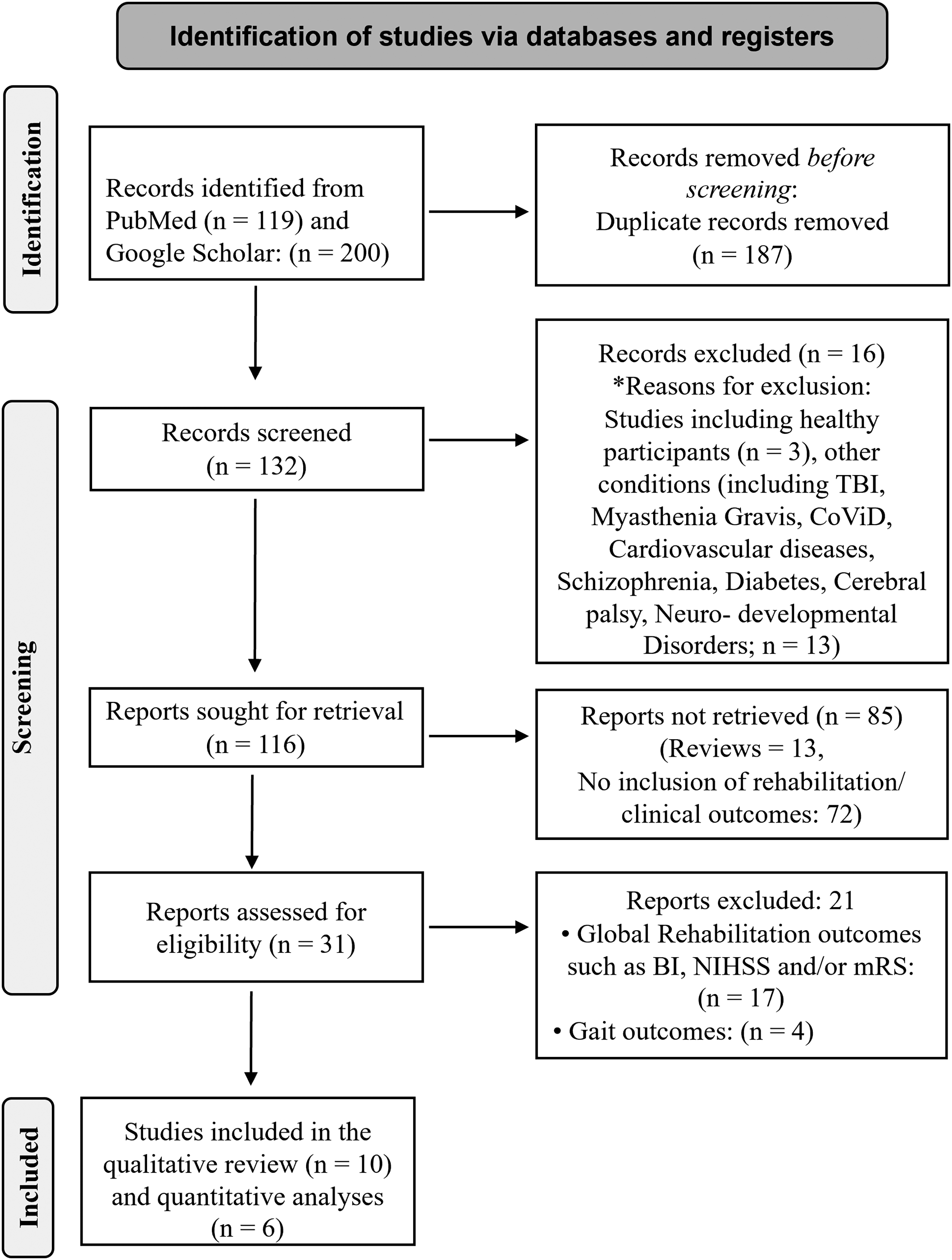
Out of the 10 studies, 8 examined the influence of the presence of 1 or both met alleles in BDNF and 2 addressed the effects of 1 or 2 met alleles in COMT. Two of the 8 studies assessing the effects of 1 or 2 met alleles in BDNF additionally examined effects of the presence of the APOE ε4 isoform. Six23,57-61 of the 8 articles addressing effects of 1 or 2 met alleles in BDNF had available FMA scores assessed at the end of the intervention to be used for a meta-analysis. Two of these studies59,60 also included a retention assessment, with that data being included for a second meta-analysis.
BDNF polymorphism (val66met and/or met66met)
In total, 598 individuals (59.2% men, 40.8% women) sustaining a stroke participated in the 8 studies included in the qualitative analysis. The average age of the participants (mean ± SD) was 58.4 ± 3.2 years. A greater proportion of participants had sustained ischemic strokes (79.7%) compared to hemorrhagic strokes (20.3%). The distribution of the more-affected side was almost equal (50.7% right, 49.3% left). Three57,61,62 of the included studies were ranked as ‘good’ and the remaining five23,58-60,63 ‘fair’ (Supplemental Table 1). Participants were either in the acute57-60,63 or chronic23,61,62 stage post-stroke. All participants had moderate-to-severe 64 UL motor impairment (FM score ≤49/66).
Effect of BDNF val66met and/or met66met polymorphism.
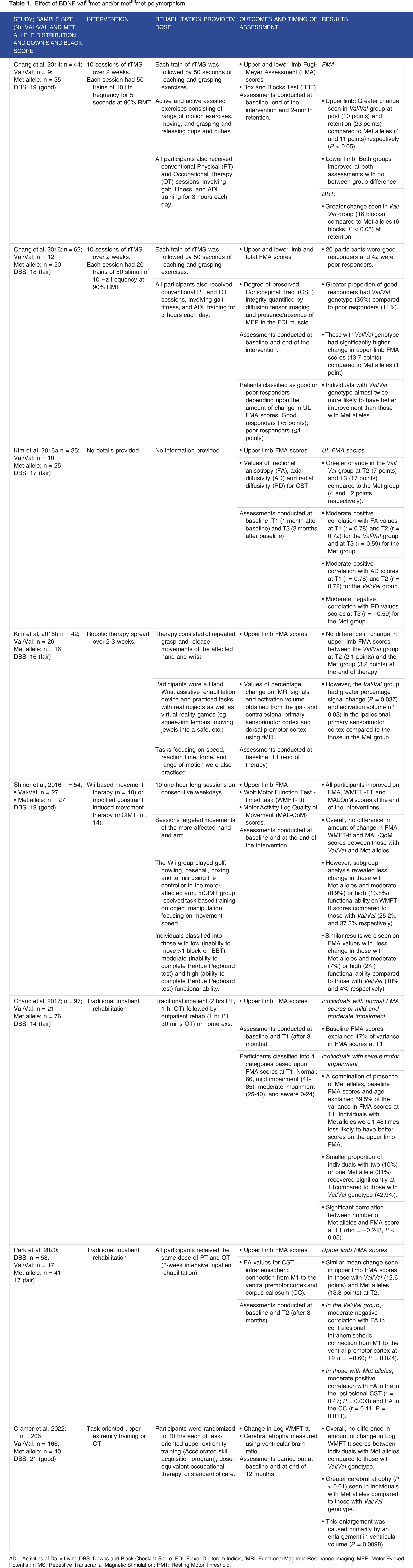
ADL: Activities of Daily Living;DBS: Downs and Black Checklist Score; FDI: Flexor Digitorum Indicis; fMRI: Functional Magnetic Resonance Imaging; MEP: Motor Evoked Potential; rTMS: Repetitive Transcranial Magnetic Stimulation; RMT: Resting Motor Threshold.

Results of meta-analyses examining influence of genetic polymorphisms on upper limb motor impairment quantified using the Fugl-Meyer Assessment, at the end of the intervention period. Larger squares indicate bigger study effect sizes. The diamonds represent pooled effects of results of individual studies. The location of the diamond indicates the estimated effect size and precision of the estimate is indicated by the width of the diamond.

Results of meta-analyses examining influence of genetic polymorphisms on upper limb motor impairment quantified using the Fugl-Meyer Assessment, at retention testing. Larger squares indicate bigger study effect sizes. The diamonds represent pooled effects of results of individual studies. The location of the diamond indicates the estimated effect size and precision of the estimate is indicated by the width of the diamond.
In addition to UL FMA scores, other assessments at the body structure and function level included use of functional magnetic resonance imaging (fMRI), diffusion tensor imaging (DTI) and MRI. In terms of fMRI outcomes, lower ipsilesional activation volume and percentage signal change were noted in individuals with the Met alleles as compared to the Val homozygous individuals. 23 Use of DTI revealed differences in radial and axial diffusion 59 and fractional anisotropy 60 between individuals with and without Met alleles. Individuals with Met alleles also had greater cerebral atrophy on MRI. 62
Sensitivity analysis included an additional meta-analysis being conducted with data from 5 studies included in this analysis. The only excluded
59
study provided no details on whether and if so, how many sessions of any form of rehabilitation were provided to the participants. The sample size used for this meta-analysis was 260 (no polymorphism: 91, polymorphism:169). Analysis revealed a large (0.43, 95% CI: 0.01 - 0.86, P = 0.046, I2 = 57%, random effects model; Figure 4) effect size at the end of the intervention period for improvement in UL FMA scores in those without compared to those with the polymorphism. Results of sensitivity analysis (meta-analyses) examining influence of genetic polymorphisms on upper limb motor impairment quantified using the Fugl-Meyer Assessment, at the end of the intervention. Larger squares indicate bigger study effect sizes. The diamonds represent pooled effects of results of individual studies. The location of the diamond indicates the estimated effect size and precision of the estimate is indicated by the width of the diamond.
APOE ɛ4 polymorphism
Effect of APOE and COMT polymorphism.
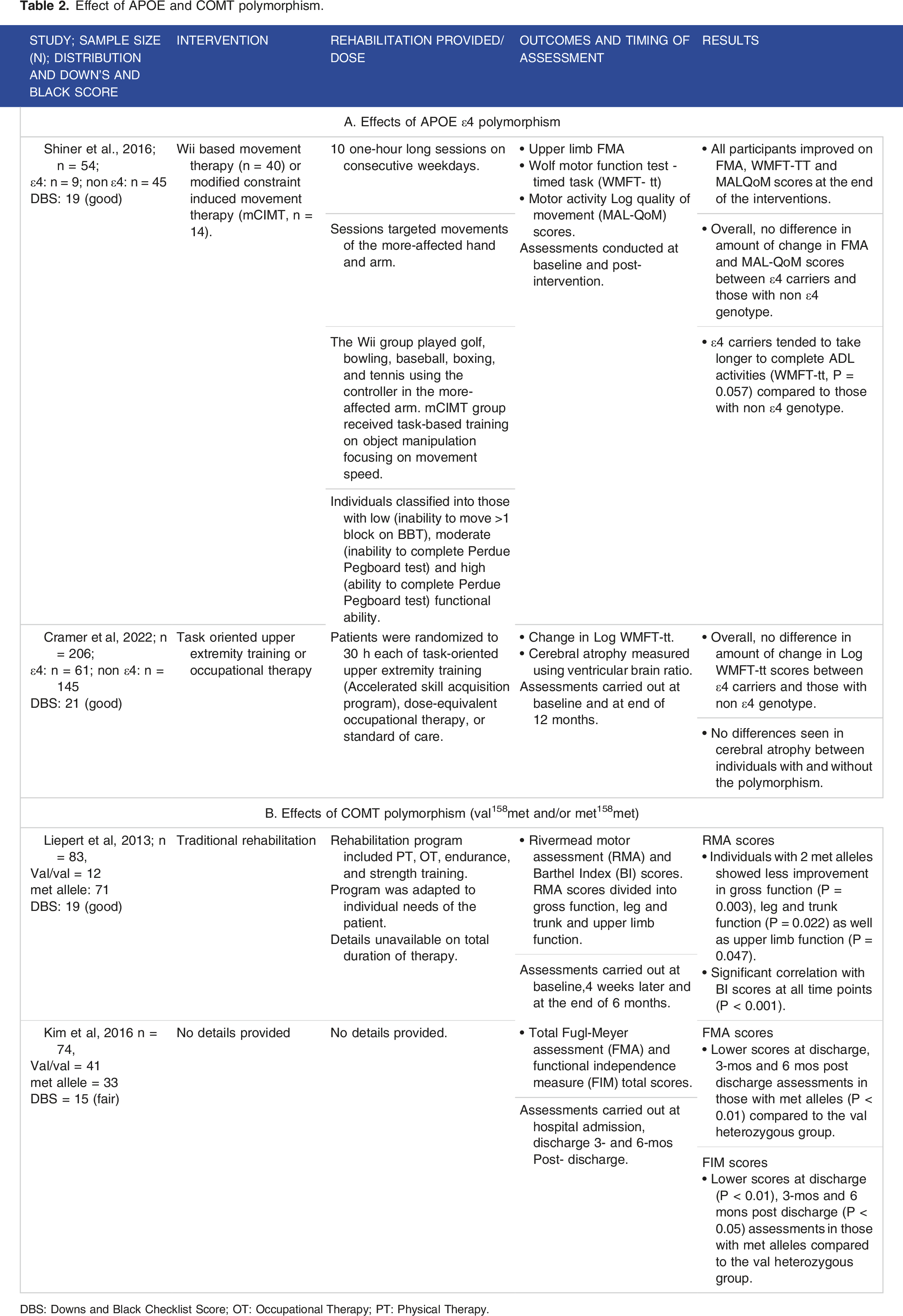
DBS: Downs and Black Checklist Score; OT: Occupational Therapy; PT: Physical Therapy.
Both studies used the Wolf Motor Function Test - timed test (WMFT-tt) as the primary outcome. No differences were noted between individuals with and without the APOE ε4 forms on WMFT-tt scores (Table 2A). In addition, groups did not differ on the amount of change seen in UL FMA scores and self-reported levels of UL quality (assessed using the Motor Activity Log) 61 or in the amount of cerebral atrophy noted between groups. 62
COMT polymorphism (val158met and/or met158met)
Two studies (1 good 65 and 1 fair 66 quality) including 157 participants (59.7% men, 40.3% women) examined the influence of COMT val158met or met158met polymorphism (53: no polymorphism, 104: polymorphism). A greater proportion of participants had sustained ischemic strokes (83.8%) compared to hemorrhagic strokes (16.2%). The distribution of the more-affected side was 46.8% right side, 51.9 %, left side and 1.3% of the participants had bilateral strokes. The studies used either the UL section of the Rivermead Motor Assessment (RMA) 65 or the FMA. 66
Compared to those with met158met, participants with val158met allele (ES = 0.51) or val158val (ES = 0.76) distribution had greater recovery with large effect sizes on the UL section of the RMA, at the end of the intervention period. 65 Individuals with val158val distribution had greater recovery on the total FMA at the end of the intervention period (ES = 2.69), and at 3 (ES = 1.51) and 6 months (ES = 1.98) retention testing. 66 In addition, participants without the polymorphism improved more on other components of the RMA scores 65 including gross function, leg, and trunk function and higher Functional Independence Measure (FIM) scores. 66 Lack of available data from 2 or more studies using the same outcome measures precluded us from conducting a meta-analysis on the effects of APOE ɛ4 and COMT (val158met, met158met) polymorphisms.
Risk of bias
Overall, the risk of bias was low for all studies (Supplemental Figure 1, Supplemental Table 2), except one. 59 The ROB for this 1 study could not be ascertained for the domains of measurement of interventions and departures from intended interventions, as information on whether the participants received any intervention or not was missing.
Discussion
Results from this systematic review and meta-analysis (on the effects of BDNF val66met and met66met polymorphism) indicated that the presence of some genetic polymorphisms negatively influence post-stroke UL motor improvement. The meta-analyses revealed that presence of BDNF val66met and met66met polymorphism negatively impacted UL motor improvement assessed using the FMA, immediately after the end of the intervention period as well as at retention testing. Overall, majority of the studies had low risk of bias, which lends further credence to these results. Sensitivity analyses revealed that results continued to remain significant even with the exclusion of the study where information on some domains of bias was not available.
These results are in agreement to those found previously, 42 and extend those findings more specifically to UL motor improvement and not just general recovery from a stroke. We also found that while APOE ɛ4 polymorphism does not influence UL motor improvement, presence of COMT val158met and/or met158met polymorphism has a negative impact. Our results for APOE ɛ4 agree partially with those found previously, 39 and go beyond those results by focusing on UL motor improvement. To our knowledge, this is the first review which has systematically investigated the effects of COMT polymorphism on post-stroke UL motor improvement.
Study quality assessment
Of the ten articles included in the review, four57,61,62,65 were ranked as ‘good’ and the remaining six23,58-60,63,66 ‘fair’. None of the articles were categorized as being of ‘poor’ or ‘excellent’ in quality. We used the modified D&B checklist in this review, as both randomized and non-randomized study designs were included. The modified D&B checklist score includes an assessment of internal and external validity, reporting standards and sample size. Commonly non-reported details across studies in this review include information on external validity (3 questions) and on power/sample size analysis. Inherent word limitations in manuscript length may often preclude exclusion of such information in the main text. It is suggested that such information be reported at least as supplemental material to provide a better overview of the rationale behind participant selection in the studies.
Interventions used and number of sessions
A variety of interventions were used amongst the various studies included in the review. The interventions used included the use of rTMS along with traditional physical (PT) and occupational therapy (OT) sessions,57,58 provision of traditional PT and OT sessions alone,60,63,65 virtual reality platform along with robotic assistive devices, 23 commercial gaming solution (ie, Nintendo Wii), 61 modified constraint induced movement therapy, 61 and task-oriented UL training. 62 No details were provided for 2 studies.59,66 The above-mentioned interventions were delivered at different intensities. Time spent in therapy was the most common metric used to denote intensity in the included studies. Time spent in therapy was either 60 minutes/day,61,62 90 minutes/day (outpatient rehabilitation phase) 63 or 3 hours/day.57,58,63 Therapy was provided for 10 sessions over 2 weeks,57,58,61 2 - 3 weeks23,60 or 30 sessions. 62 Information on exact number of sessions was not provided for the other studies.
Although time spent in therapy is 1 metric of intensity, 67 other metrics include numbers of repetitions 68 as well as “amount of physical and/or mental work put forth by the client”. 69 Previous work involving healthy controls with BDNF polymorphism has shown that employing a high number of repetitions (about 800 repetitions/session) for about 5 days can cause significant changes in short-term plasticity even in those with the polymorphism. 70 The minimal number of repetitions/session in individuals with BDNF and other polymorphisms that have also sustained a stroke are currently unknown. Approaches similar to those used previously could be employed to estimate the minimal number of repetitions to achieve a plateau in motor performance in a single session.71,72 Whether using a fixed number of repetitions results in better UL motor improvement in post-stroke individuals with polymorphisms remains to be estimated.
Outcomes used to assess improvement
A variety of outcomes were used to assess the effects of the different polymorphisms. At the body structure and function level, in addition to the FMA, the RMA, MRI, fMRI and DTI were used. Only the FMA scores were used for the meta-analysis. At the activity level, Box and Blocks Test, WMFT and Motor Activity Log helped specifically assess UL activity performance, while outcomes including Barthel Index and FIM helped assess general activity performance. All the selected outcomes have well established psychometric properties. 73 However, no study used any assessment at the participation level. Hence the effects of the polymorphism at the participation level remain unknown.
There is preliminary evidence that better UL FMA and total FMA scores are associated with higher participation levels (measured using Stroke Impact Scale; SIS). 74 Similarly, preliminary evidence is also available that better mRS scores at discharge are linked to greater autonomy and family role performance domains of another measure of participation (Impact on Participation and Autonomy-English version). 75 Given that val 66 met and/or met 66 met polymorphisms negatively influence recovery of FMA and mRS 39 scores, it can be speculated that it could also negatively impact participation. However, this will have to be separately verified in future studies.
The outcome of choice would be the SIS, which is recommended as a measure of choice by previous consensus papers. If select core measures such as those recommended by previous publications76-78 are used, the effects across the different levels of the ICF could be better understood. These measures include the FMA at the impairment level, WMFT or Action Research Arm Test at the activity level and SIS at the participation level. In addition, the UL part of the FMA does not account for the use of altered movement patterns. 64 It is currently unknown whether individuals with genetic polymorphisms use compensatory movement patterns for task completion.
Influence of ethnicity
Majority of the studies in this review emerged from Asia, particularly from Southeast Asia, with only 4 studies23,61,62,65 being conducted outside Asia. Amongst these 4 studies, three23,61,62 had detailed demographics available on ethnicity of the participants. Individuals belonging to Asian ethnicity have poor outcomes after a stroke. 77 There are some reports that individuals of Asian ethnicity tend to receive less rehabilitation services compared to individuals from a Caucasian ethnicity and have higher rates of hospital readmission.78-80 In addition, in all the 3 biomarkers examined in this meta-analysis, individuals with Asian ethnicity have higher rates of polymorphisms.81-83 The presence of high rates of the polymorphisms can be an additional factor explaining the lower rates of post-stroke motor improvement seen in this population. This information can likely play an important role in prediction of prognosis after a stroke. Furthermore, it can also help make decisions as to whether and if so, the extent to which provision of rehabilitation interventions need to differ for this population.
Limitations
We only included studies involving adult participants published in English (since no one in the team was proficient in other languages). It might be possible that we missed studies published in other languages. None of the studies had an explicit sample size calculation. Information on baseline levels of depression and/or intake of anti-depression medication was available in only 2 studies.23,65 Information on the presence of depression is essential, as the presence of genetic polymorphisms is an additional risk factor84–86 for post-stroke depression and can influence the extent of UL motor improvement. 10 None of the 4 studies23,61,62,65 published from outside Asia conducted an analysis on the rates of recovery assessed using clinical and/or radiological outcome measures between different ethnicities. Future studies will also need to address the effects of ethnicity on stroke rehabilitation outcomes.
Conclusion
Results of our review suggest that presence of genetic polymorphisms in BDNF (val66met and met66met) and COMT (val158met and/or met158met) negatively impact post-stroke motor improvement. This was confirmed at the body-structure and function domain of the ICF for the UL using the meta-analysis on the effects of BDNF val66met and met66met polymorphism. Our findings may contribute to the understanding of 1 of the underlying mechanisms to help explain some variability in post-stroke UL motor improvement. This is valuable information for the means of tailoring a plan of care, creating realistic goals, and providing relevant, individualized rehabilitation to every patient. In addition, new questions have been identified including does the (i) use of a fixed number of repetitions result in similar or better levels of UL motor improvement in individuals with genetic polymorphisms; (ii) presence of COMT val158met and/or met158met continue to influence motor improvement at retention testing; (iii) presence of genetic polymorphisms influence participation levels and (iv) do individuals with genetic polymorphisms use altered movement patterns and if so, to what extent. Answers to these emergent questions can help better understand the influence of genetic polymorphisms on post-stroke upper limb motor improvement.
Supplemental Material
Supplemental Material - Genetic polymorphisms and post-stroke upper limb motor improvement – A systematic review and meta-analysis
Supplemental Material for Genetic polymorphisms and post-stroke upper limb motor improvement – A systematic review and meta-analysis by Sandeep K. Subramanian, Riley T. Morgan, Carl Rasmusson, Kayla M. Shepherd, and Carol L. Li in Journal of Central Nervous System Disease.
Ethical statement
Ethical approval
Ethics approval was obtained from all particpants for all the included studies.
Footnotes
Author contributions
Declaration of conflicting interests
The author(s) declared no potential conflicts of interest with respect to the research, authorship, and/or publication of this article.
Funding
The author(s) disclosed receipt of the following financial support for the research, authorship, and/or publication of this article: This project was funded by a Pilot Grant by the Center for Biomedical Neurosciences, UT Health San Antonio.
Acknowledgments
The authors would like to acknowledge the UT Health San Antonio Briscoe library for access to numerous databases.

Supplemental Material
Supplemental material for this article is available online.
References
Supplementary Material
Please find the following supplemental material available below.
For Open Access articles published under a Creative Commons License, all supplemental material carries the same license as the article it is associated with.
For non-Open Access articles published, all supplemental material carries a non-exclusive license, and permission requests for re-use of supplemental material or any part of supplemental material shall be sent directly to the copyright owner as specified in the copyright notice associated with the article.
