



Abstract
Background:
Mental illness and stress are increasing at work. Sick leaves escalate. It is suggested to be due to organizational factors. There are a few methods to identify the organizational factors creating the negative psychosocial atmosphere at work. In Sweden, the work-related diseases have increased by 70% since 2010.
Methods:
Munik is a validated assessment instrument to identify psychosocial status among employees and find weak and strong organizational factors involved in the individual psychosocial well-being. We measure psychosocial well-being as mental energy, work-related exhaustion, and work satisfaction.
Conclusions:
In this study, we evaluate the treatment of employees at risk with low values on mental energy, high risk for developing work-related exhaustion, and reporting poor work satisfaction.
Originality:
We used Ben Furman’s positive solution-based coaching/therapy. This resulted in a more satisfied work group, and even though this group showed a large risk of developing work-related exhaustion in the start, none of the participants got on sick leave during the coaching/therapy period. After 3 months, 8 of 10 reported higher values on all 3 psychosocial levels measured.
Keywords
Introduction
In previous studies, we identified organizational settings to be important in creating healthy individuals and healthy work environments. 1
There is a need to improve the work environment for employees especially in Sweden. In 2013, the Organisation for Economic Cooperation and Development (OECD Report 2013) stated that nearly 20% of Sweden’s workforce has psychosocial illness, and 1 of 5 workers reports problems with anxiety, depression, or sleep disorders. Young people are particularly vulnerable. Nearly 1 of 4 Swedish youths between 16 and 18 years of age has psychological disorders due to increasing stress and dissatisfaction in the work situations. “This is extremely expensive for the society,” says OECD and it is suggested to due to the work environment.2,3 In Sweden, €7 billion are spent a year in income loss and health costs; this is 3% of the gross domestic product. According to the Swedish Work Environment Authority, the work-related diseases have increased by 70% since 2010, 4 and the Government has given permission to the Swedish Work Environment Authority regulations and general recommendations to promote a good work environment on organizational and social work environment from March 31, 2016. 5
It is therefore important to identify health risks at an early stage to prevent sickness leading to suffering and higher social costs.
At the same time, it is suggested that the impact of organizational change in individual well-being is difficult to measure,6–8 and the employee surveys are hardly criticized in Sweden.9–13
The purpose of this study, therefore, was to develop a method to identify healthy workplaces. We created a Web-based survey called Munik. The Munik method is briefly described previously. 14 The main task was to identify how organizational parameters such as social climate, skills development, mental energy, work-related exhaustion, self-esteem, participation, goal clarity, efficiency, feedback, workload and leadership, influence, authority, and contact with supervisor affect individual well-being.
Results from the organizational parameters are calculated as personal values on the individual level and reported as 3 indices:
Mental energy;
Work-related exhaustion;
Work satisfaction.
Munik reports these indices as bars in 3 different color areas: green—all is well, yellow—alert, and red—something has to be done. 15 Furthermore, Munik reports the strong and weak organizational factors for each index. The organization can then act by eliminating weak areas or strengthening the strong ones.
We have worked with the Munik method in different groups, and this article shows how an organization can work with the Munik results.
This article shows how identifying the weak and strong organizational factors can be used among employees to improve individual well-being. We worked with a form of Cognitive Focus–Based Solution coaching/therapy, invented by Dr Tapani Ahola and Dr Ben Furman.16,17 After 3 months, the group reported better psychosocial well-being and no one went on sick leave even though they reported poor values on mental energy and work satisfaction in combination with high risk of developing work-related exhaustion in the start.
Methods
Based on a larger survey conducted in a company undergoing significant organizational changes, the supervisors identified employees with stress symptoms and poor well-being. Ten persons were selected into a group participating in a therapeutic intervention—Reteaming. A behavioral therapist guided this therapy. The therapy was conducted once a week for approximately 3 months. Every session had lasted about 4 hours. The theme for the group meetings focused on the reported strong and weak organizational factors which the Munik survey had identified.
The Reteaming rehabilitation method is based on positive solutions coaching. Using the identified strong and weak organizational factors, the group was focusing on the solutions to the problem. No negative thoughts were allowed. Munik had identified 10 strong factors to work with and 7 weak factors (see Table 1).
Organizational weak and strong factors analyzed by Munik before and after intervention.

This is a compilation of the entire group participating in the positive solution therapy/coaching group. The number of participants is 10.
Each participant had to select 3 different potential actions to change in the work environment on each session. It could be either week or strong factors.
The participants were encouraged to acquire 3 mentors for the task as discussion partners, from work, from home, and among friends.
The participants then got an individual task until the next week on how to make a difference. The next meeting analyzes the performance on the tasks they had selected the week before, and the performance was evaluated. The week after the 3 tasks was analyzed and performed. Ten individuals worked together to find a solution for all participants. In this way, the group moved forward and identified several different areas to work with to improve their own work environment.
Finally, conclusions were drawn by a final Munik mapping.
Results
After the 3-month evaluation, we observed that almost all participants achieved higher values on their individual bars.
The mean value of the indices and ±SEM is reported in Figure 1 on group level.
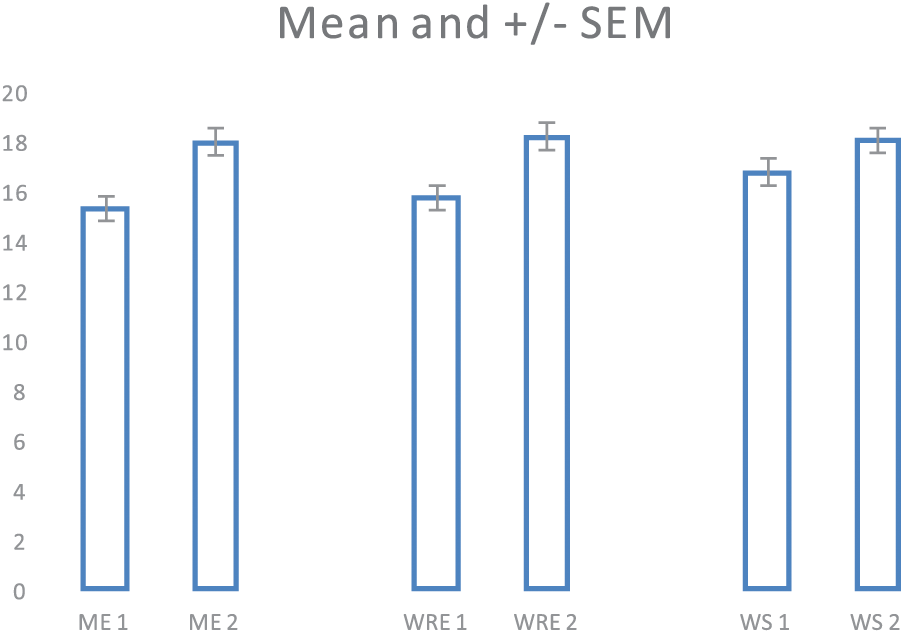
Change in the 3 indices on group level. Mean and ±SEM before and after interventions. ME indicates mental energy; WRE, work-related exhaustion; WS, work satisfaction.
The change in each participant’s results specified in each index before and after rehabilitation is shown in Figure 2.

Munik result before and after the intervention for all 10 persons participating in the program.
This result pointed out the following:
In 10 participants, 7 reported higher values in mental energy, 2 reported decreased values, and 1 was unchanged.
In 10 participants, 8 reported decreased risk of developing work-related exhaustion and 2 reported increased risk.
In 10 participants, 6 reported higher work satisfaction and 4 reported lower.
No one went on sick leave during this period.
Discussion
Our study aimed to find a tool to measure workers’ psychosocial well-being in terms of mental energy, work-related exhaustion, and work satisfaction. The aim was also to identify which factors in the work environment create healthy or unhealthy work environment. If the responses are similar, then it is a homogeneous organizational problem and applies equally to most of the employees. If responses to the organizational factors are divided, then it might be due to individual problems.
Regardless, we found that the work environment affects employee’s mental health, and the psychosocial unhealthy environment is due to organizational factors because poor psychosocial health seems to be easy to rehabilitate by the Reteaming intervention.
To create a healthy work environment, it is important to identify unhealthy behavior in the organization. The Munik method points out work satisfaction and dissatisfaction and highlights the contributing factors; this is a strong method to evaluate the effect of rehabilitation and rehabilitation potential by showing changes both positively and negatively, and even the degree of change, so it will be possible to change rehabilitation method early and evaluate whether another form of rehabilitation may be of interest. Consequently, managers can strengthen employees’ healthy work environment factors and reduce unhealthy work environment factors.
Munik is an easy way to identify work structures, employee mental states, and job satisfaction. It gives managers a simple and inexpensive tool to improve the work environment for all employees. If managers undertake the survey every third month, then they get timely information about changes that need to be improved in the organization and an early awareness of any employee at risk.
This article shows the possibility to create and maintain healthy workplaces in social terms to keep employees satisfied and decrease work-related exhaustion causing poor health. It also shows that detecting risky work environment factors and creating a healthy workplace are relatively easy when the organizational and social situation is defined.
The Munik method in combination with Reteaming coaching seems to be one solution for eliminating negative factors for the coworkers. From the Munik method, they get easy identification of the strong and weak factors in work situation and can hastily eliminate unhealthy organizational behaviors.
This will furthermore protect the society from unnecessary costs for health care in a situation where Swedish health care is under a large strain in terms of humanitarian behavior and economical resources.
This group, however, is small and the conclusions should be interpreted with care. The results need to be assessed in a larger study.
Footnotes
Funding:
The author(s) received no financial support for the research, authorship, and/or publication of this article.
Declaration of conflicting interests:
The author(s) declared no potential conflicts of interest with respect to the research, authorship, and/or publication of this article.
Author Contributions
PvV reviewed and approved the final manuscript.
