




Abstract
Background:
Human being needs sunlight for physical and mental well-being. Sunlight helps the body to produce vitamin D, an important vitamin for skeletal development, immune function, and blood cell formation. So, the community should be counseled to get sufficient sun exposure and vitamin D supplementation to uphold the serum 25 (OH) D levels. This study designed to assess the mothers’ knowledge, practice, and factors affecting the sunlight exposure of their infants.
Methods:
A facility-based cross-sectional study was conducted at governmental health facilities in Dessie Town, 2021. A total of 398 mothers were interviewed using semi structured questionnaires. Data were entered into the EPI data version 3.1 and analyzed using SPSS 23. Binary and multivariate logistic regression analyses were also performed. In multivariate analysis, a significant association was considered at P-value of <.05.
Results:
Response rate was 98.9%. About 76.6% and 58.9% of the mothers had poor knowledge and poor practice regarding sunlight exposure of infants respectively. Mothers’ occupation (aOR = 0.124, 95% CI = 0.042, 0.365), mothers’ source of information (aOR = 18.604, 95% CI = 7.564, 45.75), and attitude (aOR = 2.773, 95% CI = 1.474, 5.215) had showed a significant association with mothers’ knowledge. On the other hand, mothers’ age (aOR = 3.191, 95% CI = 1.334, 7.633), mothers occupation (aOR = 4.226, 95% CI = 2.321, 7.694), and baby age (aOR = 1.989, 95% CI = 1.260, 3.140) had a significant association with their practice about sunlight exposure of infants.
Conclusion:
Mothers’ knowledge and practice of sunlight exposure of infants are poor in Dessie Town. Hence measures should be taken to increase and improve mothers’ responsiveness of sunlight exposure of infants.
Background
Sunlight is important for the physical and mental well-being of humans. 1 Being exposed to sunlight helps the body to make vitamin D, an essential vitamin for skeletal development, immune function, and blood cell formation. It is recommended by an expert group of Turkish pediatricians to instruct/educate mothers to sun their infants for at least 20 minutes per day outdoors. 2
Insufficient sun exposure has become a major public health concern. The degree of change needed is minor but critically important. The community should be instructed to gain sufficient sun exposure and vitamin D supplementation to maintain a serum 25(OH) D level of at least 30 ng/mL. 3 In all age groups, vitamin D deficiency becomes an international public health problem, predominantly those from the Middle East. 4 In many parts of the world, clinical vitamin D deficiency (rickets and osteomalacia) becomes prevalent with a reappearance of rickets in children of ethnic minority groups in Europe and Australasia. 5
In low- and middle-income countries (LMICs), dietary foods that are the source of vitamin D are often not readily available. 6 A systematic review and meta-analysis conducted to assess the prevalence of vitamin D deficiency in Africa showed a high prevalence of vitamin D deficiency in African populations. 7 Hypovitaminosis D is highly prevalent in China, Mongolia, Sub-Saharan Africa, the Middle East, and Latin America, particularly in children, the elderly, and women. 8
In low- and middle-income countries, inadequate accessibility of population-representative 25(OH)D data hinders the efforts to assess the vitamin D status of populations mostly for those vulnerable to the skeletal and potential extra skeletal consequences of low vitamin D status, like exclusively breastfed infants, children, adolescents, pregnant and lactating women, and the elderly. 6
In pediatric population, VDD is associated with prematurity, obesity, mal-absorption, and lifestyle characteristics, like clothing, extreme latitudes, low consumption, and little sun exposure. 9 As it is recommended by the integrated management of newborn and childhood illness 2015 (IMNCI) guideline of Ethiopia sunning of neonates starting from the first 2 weeks of age is very important. 10
In Ethiopia, VDD rickets becomes prevalent and increases the morbidity and mortality of children below 5 years of age. 11 A study in Jimma Town showed that about 25 (4%) of children were found to have rickets with a uppermost rate (11%) occurring in infants. 12 Additionally, a 3 years retrospective analysis of rickets in Jimma University Specialized Hospital showed a 10.5% prevalence of rickets with the uppermost rate 98 (57.6%) found in children aged 3 to 24 months, 13 and another study conducted in under 5 children also showed the magnitude of rickets to be 7.8%. 14
Mothers’ have a significant role in exposing their infants to adequate sunlight to prevent rickets and vitamin D deficiency: however, there are few studies to assess the mothers’ knowledge, practice and the factors that affect the sunlight exposure of infants in Ethiopia especially in this study area. Therefore this study is proposed to assess mothers’ knowledge and practice on sunlight exposure of infants, and the factors affecting it in Dessie Town. It is very important to find areas for improvement regarding sunlight exposure and to improve the health of the community.
Methods
Study design, area, and period
A facility-based cross-sectional study was conducted to assess knowledge, practices, and factors affecting sunlight exposure of their infants among mothers at governmental health facilities in Dessie Town from November 1 to 15, 2021. The town is located 401 km from Addis Ababa; 480 km from Bahirdar. Its astronomical location is 11°38′ North latitude and 37°15′ East longitude. The town has a national total population of 382 912. The town has 5 sub cities and 18 kebeles. There were a total of 4 health centers, 1 referral hospital, and 4 private hospitals.
Population
The source population consisted of mothers with infants and those receiving child care services at governmental health facilities in Dessie Town. The study population consisted of mothers with infants who receive child care related service at the governmental health facilities at the time of data collection. Mothers with infants who receive child care related service at each governmental health facilities in Dessie Town were included in the study. Mothers with difficulty of communicating (hearing problem) were excluded from the study.
Sample size determination
Single population proportion formula was used to calculate the sample size by assuming the prevalence of 62.2%, from previous study, 15 Z value of 1.96 and marginal error of 5%, sample size was calculated as:

By adding 10% for non-respondents, the total sample size to be taken was 398.
Sampling procedure
All governmental health facilities in Dessie Town were included in the study. The overall sample was proportionally taken from all governmental health facilities in the town. This means that a proportional numbers of mothers were included in the sample from each health facility to make up the total sample size. Study participants were selected using a systematic sampling technique in which every second client interviewed at each health facility. The proportional allocation of the study subjects to the 5 health facilities was shown as follows:

Where n in health facility = proportion of mothers with infants to be taken from a given health facility
nt = total sample size to be taken from all health facility
N in a health facility = number of mothers with infants in a given health facility
N total = total number of mothers with infants in all health facilities.
Data collection instrument and procedure
Data were collected from mothers through face to face interviews using a semi structured pre-tested questionnaire (16). Two days training was provided for all data collectors and supervisors about their responsibilities for describing the purpose of the study, how to collect the data and telling clients the importance of honest and genuine reply toward the questions. The principal investigator and supervisors strictly follow the overall activities of the data collection on daily base to ensure the completeness of questionnaire and to give further clarification
Study variable
Dependent variables
Knowledge and practice on sunlight exposure of infant.
Independent variables
Socio-demographic factors
Source of information
Attitude of mother on sunlight exposure of infant.
Operational definitions
Knowledge: Eight questions were used to assess the mothers’ level of knowledge on sunlight exposure of infants. The median score for these knowledge questions were 5 and those mothers with score of above the median were considered to have adequate knowledge and those scoring below the median were considered to have inadequate knowledge about sunlight exposure of infants.
Practice: Eight questions were used to assess the mothers’ level of practice on sunlight exposure of infants. The median score for these practice questions were 5 and those mothers with score of above the median were considered to have adequate practice and those scoring below the median were considered to have inadequate practice about sunlight exposure of infants.
Data quality assurance
Training was given both to data collectors and supervisors. Pretest was done at Haik Health Center by taking 5% of the total sample size to check the questionnaire for its clarity, understandability, and simplicity in collecting for what it is aimed. Then, amendments were made based on the inputs and comments generated at the pretest. Then duplication of the final questionnaires was done. The principal investigator checked every questionnaire to ensure the quality of the data collected at the evening of the date of collection.
Data analysis procedure
Epi Data version 3.1 was used for data entry and exported into SPSS version 23 for analysis. To assess the association between independent and dependent variables, binary and multiple logistic regression analysis were done. Significant association was declared at P value of <.05.
Result
Socio-demographic characteristics of respondents
From the sampled 398 mothers, 394 (98.99%) responded to the interview. About 188 (47.7%) were between age 21 and 26 years. And 242 (61.4%) of the infants were aged less than 6 months. About 55.3% of the participants were of Muslim religion. Majority 378 (95.9%) of mothers were married and 174 (43.7%) of mothers was grade 1 to 8 in their educational status. Most 294 (74.6%) of the respondents were housewives and 334 (84.8%) of mothers had a child of 1 to 3 and in regard to their husbands, 124 (31.5%) of husbands had diploma and above educational level (Table 1).
Distribution of socio-demographic characteristics of mothers’ in Dessie Town, Ethiopia, 2021 (n = 394).

Mothers’ source of information about sunlight exposure of infants
Out of the total 394 participants, 332 (84.3%) of them had information about sunlight exposure of infants and the majority 178 (45.2%) of them got this information from neighbors and 82 (20.8%) from physician (Figure 1).

Distribution of mothers by their source of information about sunlight exposure of infant at governmental health facilities in Dessie Town, 2021.
Knowledge of respondents about sunlight exposure
Concerning the benefit of sunlight exposure, about 374 (94.9%) of participants stated that sunlight exposure is beneficial for infants. From those, about 190 (48.2%), 126 (32%), and 50 (12.7%) of the participants stated sunlight exposure beneficence to strength body, to strength bone, and to produce vitamin D respectively. From all respondents, only 52 (13.2%) believed that sunlight exposure had harmful effect for the infant and the most commonly mentioned harmful effect of sunlight exposure was 18 (4.6%) blackness. About time of sunlight exposure, 388 (98.5%) of mothers thought the good time to expose infants on sunlight was in the morning (Table 2).
Knowledge of mothers’ on sunlight exposure of their infants in Dessie Town, Ethiopia, 2021.

Mothers’ knowledge level about sunlight exposure of infants
Based on the questions used to assess the level of knowledge, the median value was calculated as 5. About 302 (76.6%) of participant scored less than or equal to 5. Thus, based on the operational definition 76.6% of mothers had poor knowledge about sunlight exposure of infants (Figure 2).

Distribution of mothers by their knowledge level about sunlight exposure of infants at governmental health facilities in Dessie Town, Ethiopia, 2021.
Practice of mothers about sunlight exposure of infants
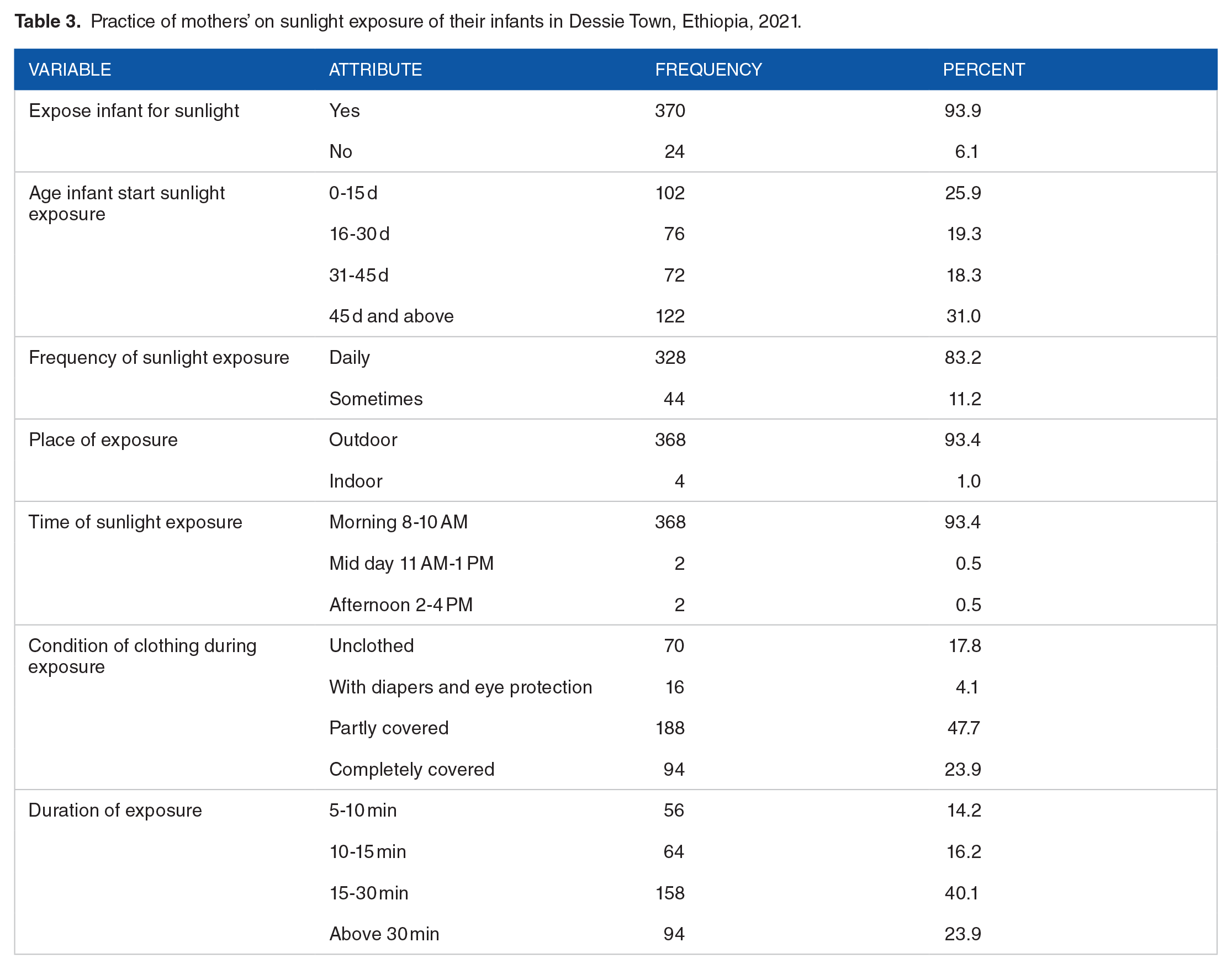
Among 394 respondents, 370 (93.9%) of them exposed their babies to sunlight. From these, 102 (25.9%) underwent sunlight exposure of their infants from 0 to 15 days, and 122 (31.0%) of mothers started after 45 days. From those mothers exposing their infant to sunlight, only 328 (83.2%) exposed daily. About 368 (93.4%) of the participants exposed their infants outdoors (outside the house), with 368 (93.4%) of the participants exposing their infants in the morning (8-10 AM). Regarding the condition of closing during exposure, 188 (47.7%) of them expose their infants on sunlight partly covered and 94 (23.9%) of mothers exposed their infants completely covered (Table 3).
Practice of mothers’ on sunlight exposure of their infants in Dessie Town, Ethiopia, 2021.
Mothers’ practice level about sunlight exposure of infants
Based on the questions used to assess practice level, the median value was calculated as 5. So, out of 394 respondents, 232 (58.9%) of respondents scored less than or equal to 5. Hence, based on the operational definition 58.9% of mothers had poor practice on sunlight exposure of their infants (Figure 3).

Distribution of mothers by their practice level about sunlight exposure of infant at governmental health facilities in Dessie Town, Ethiopia, 2021.
Application of lubricants on the infant body
Concerning the use of lubricants, about 256 (65%) apply lubricant to the infants body. From these, 180 (45.7%) apply during sunning, and 48 (12.2%) of mothers apply before sunning. Regarding the material used for lubrication, 240 (93.75%) mothers apply baby Vaseline and 16 (6.25%) of mothers apply lotion on the infants’ body (Table 4).
Application of lubricants on the infants’ body at governmental health facilities in Dessie Town, Ethiopia, 2021.

Association of independent variables with knowledge of mothers on sunlight exposure of infants
Significant association was detected between maternal occupation and knowledge of mothers, as employed mothers were less likely to have poor knowledge than housewife (aOR = 0.124, 95% CI = 0.042, 0.365).
Similarly, mothers with another occupation (such as merchant or student) were also less likely to have poor knowledge about sunlight exposure of infant than housewife others (aOR = 0.193, 95% CI = 0.038, 0.980).
Those mothers who did not have any source of information about sunlight exposure of infants were 18 times more likely to have poor knowledge than mothers who describe their physician as their source of information (aOR = 18.604, 95% CI = 7.564, 45.75).
Similarly mothers who have poor attitude on sunlight exposure of infants were 2.7 times more likely to have poor knowledge than about sunlight exposure of infants than mothers with good attitude on sunlight exposure of infants (aOR = 2.773, 95% CI = 1.474, 5.215) (Table 5).
Association of independent variables with knowledge of mothers on sunlight exposure of infants at governmental health facilities in Dessie Town, Ethiopia, 2021.

The bold is to shows variables having significant association with dependent variable.
Association of independent variables with practice of mothers on sunlight exposure of infants
Significant association was detected between maternal age and practice of mothers, as mothers aged 22 to 27 years were 3.1 times more likely to have poor practice on sunlight exposure of infant than mothers aged 34 and above years (aOR = 3.191, 95% CI = 1.334, 7.633). And, mothers aged 28 to 33 years were also 4 times more likely to have poor practice on sunlight exposure of infant than mothers aged 34 and above years (aOR = 4.000, 95% CI = 1.610, 9.935).
Mothers having infant age of less than 6 month were 1.9 times more likely to have poor practice on sunlight exposure than those having infants of age 7 and above months (aOR = 1.989, 95% CI = 1.260, 3.140). Employed mothers were also 4.2 times more likely to have poor practice on sunlight exposure of infants than housewife mothers (aOR = 4.226, 95% CI = 2.321, 7.694) (Table 6).
Association of independent variables with practice of mothers on sunlight exposure of infants at governmental health facilities in Dessie Town, Ethiopia, 2021.

The bold is to shows variables having significant association with dependent variable.
Discussion
This study was aimed at assessing mothers’ knowledge and practice on sunlight exposure of infant and associated factors that affect their knowledge and practice.
The study finding shows that 302 (76.6%) of mothers have poor knowledge on sunlight exposure of infant. This result is higher than the studies conducted in Farta district, Debremarkos, Jimma and Aleta Wondo Health Center, in which only 49.9%, 60%, 24%, and 38.8% mothers have poor knowledge about sunlight exposure respectively.12,15 -17 This variation may be due to socio-cultural difference between the study sites.
Regarding practice of mothers, the finding shows 232 (58.9%) of mothers have poor practice on sunlight exposure of infants. These findings were lower than the study done in Aleta Wondo Health Center, SNNPR that shows about 68.4% of mothers have poor practice on sunlight exposure of infants. 15 This discrepancy may be due to the socio-cultural differences between the 2 regions.
But these results were higher than the study conducted in Farta district, St. Paul’s Hospital and Yirgalem hospital, Sidama regional state, which shows about 45.5%, 40%, and 45.7% of mothers have poor practice on sunlight exposure of infants.16,18,19 This discrepancy may be due to geographical difference between the study sites.
The percentage of respondents who reported that they had the information (knowledge) about sunlight exposure was 332 (84.3%). These findings were in line with the study done in Debre Markos town, that showed that 86.1% of mothers had information about sunlight exposure. 17
Significant association was observed between mothers occupation and knowledge of mothers, employed mothers were less likely to have poor knowledge than housewives (aOR = 0.124, 95% CI = 0.042, 0.365). This may be because employed mothers may have an opportunity to update themselves more than housewife mothers.
Similarly, mothers with another occupation (such as merchant or student) were also less likely to have poor knowledge about sunlight exposure of infant than housewives (aOR = 0.193, 95% CI = 0.038, 0.980). This may be because these groups of mothers may have an opportunity to update themselves more than housewife mothers.
Those mothers who have no any source of information about sunlight exposure of infants were 18 times more likely to have poor knowledge than mothers who describe physician as their source of information (aOR = 18.604, 95% CI = 7.564, 45.75). This may be because having no information makes an individual to have poor knowledge.
Similarly mothers who have poor attitude on sunlight exposure of infant were 2.7 times more likely to have poor knowledge than about sunlight exposure of infants than mothers with good attitude on sunlight exposure of infants (aOR = 2.773, 95% CI = 1.474, 5.215). This might be due to having a poor attitude toward sunlight exposure of infants and may reduce an individual’s interest to update themselves and to gain knowledge about sunlight exposure.
A significant association was also observed between maternal age and practice of mothers, as mothers with age of 22 to 27 years were 3.1 times more likely to have poor practice on sunlight exposure of infant than mothers with age group of 34 and above years (aOR = 3.191, 95% CI = 1.334, 7.633). And, mothers with age of 28 to 33 years were 4 times more likely to have poor practice on sunlight exposure of infant than mothers with age group of 34 and above years (aOR = 4.000, 95% CI = 1.610, 9.935). This may be due to as being young in age may make an individual to be careless.
Mothers having baby age of less than 6 month were 1.9 times more likely to have poor practice on sunlight exposure of infants than mothers infant having of 7 and above months (aOR = 1.989, 95% CI = 1.260, 3.140). This may be because mother having infant with age less than 6 month may fear to expose the infant for sunlight because of the infants immaturity.
Employed mothers were 4.2 times more likely to have poor practice on sunlight exposure of infants than housewife mothers (aOR = 4.226, 95% CI = 2.321, 7.694). This might be attributed to employed women have no sufficient time to expose their infants to sunlight when compared to that of housewife women.
Conclusion
According to the result of this study, 76.6% of the mothers had poor knowledge about sunlight exposure of infants, and 58.9% of mothers had poor sunlight exposure practice. This infers the information provided about sunlight exposure of infants at antenatal, natal, postnatal period, and immunization follow up is inadequate. Mother’s occupation, mother’s source of information, and mother’s attitude had showed a significant association with mothers’ knowledge and mothers’ age, mothers’ occupation, and baby age had showed significant association with mothers practice about sunlight exposure of infants. In general both the knowledge and practice of mothers on sunlight exposure of infants in this study area was poor. So, this result shows mothers knowledge and practice of exposing an infant to sun light in Desssie Town needs improvement. All possible opportunities, that is, the mass media, antenatal visits, natal visits, post natal visits, and immunization or sick baby visits, should consider to explore about mothers awareness and skill on sunlight exposure of infants.
Footnotes
Acknowledgements
We are thankful to the Dessie Town community, particularly those mothers who participated in this study. We also acknowledge our data collectors and supervisors for their involvement in the study. We are appreciative to Wollo University for supporting us to research.
