



Abstract
Background:
The aim of the study was to determine and compare the clinical and social characteristics of minors using alcohol and drugs for inebriation, and the same for those using them for suicide.
Methods:
This study includes an analysis of case histories of adolescents hospitalized in the Pediatric Intensive Care Unit because of acute alcohol or/and drug intoxication in 2015 to 2017. Two groups (group I: inebriation, and group II: suicide) were compared on age, sex, severity of intoxication, used substances, presence of other self-harm evidence, and social status.
Results:
A total of 390 cases were registered: 78.21% in Group I and 21.79% in Group II. The Glasgow-Coma-Scale scores showed that patients from Group I were more severely intoxicated, with an average score of 11.47, whereas patients from Group II averaged 13.45 (P < .001). Self-harm was more prominent among minors from Group II, with an incidence of up to 65.09%. The most common substance used to become inebriated was alcohol (72.79%), and for committing suicide was medication (88.24%). Patients who were living in children’s care homes composed 13.33% of all cases included into the study, despite the low frequency of these minors in Lithuania (0.8%).
Conclusions:
The substance used for deliberate intoxication was mostly alcohol. Minors experiencing inebriation were hospitalized in worse clinical condition in comparison to those who had attempted suicide. Other signs of self-harm were significantly more common among suicidal minors. Living in children’s care homes is a possible risk factor for deliberate intoxication among young people in Lithuania.
Introduction
Alcohol consumption and drug use among minors is a sensitive issue in many parts of the world. The consumption of such substances at an early age can cause various psychosocial problems during the period of use, and may also lead to issues with physical health or social difficulties in adulthood.1-3 Alcohol consumption and drug use among Lithuanian minors is higher than the average in the European Union (EU). A surprising 87% of minors in Lithuania have consumed alcohol at least once during their lives, whereas the average percentage in the EU is 80%. Moreover, 20% of Lithuanian minors have tried drugs, while the EU average is 18%. 4
There are no clinical studies about the incidence and actuality of this problem in Baltic countries at all. An increase in hospitalizations of such patients in the intensive care units has been registered in Germany, Slovak Respublik, and the Netherlands.5-7
Furthermore, it must be mentioned that large amounts of money are spent on the treatment of and psychological help for those who have become intoxicated deliberately 8 ; that is, to solve an issue that can be prevented.
Teenagers who have intoxicated themselves with alcohol or other substances are not the only ones being admitted to Pediatric intensive care units (PICU) due to deliberate intoxication—minors who have attempted suicide by overdosing on medication or other chemical substances are also brought to these units. Suicide among minors is an especially relevant issue in many countries. According to research, suicide is the fifth leading cause of death among children aged 9 to 13, and the third leading cause among adolescents aged 14 to 18, in the United States of America. 9 Overdosing of medication as a method of suicide is one of the most popular among minors. However, it is also one of the least effective methods. 10 When minors have suicidal thoughts and attempt suicide, the frequency of recurring actions increases, and so does the probability of committing suicide. 11 This is an extremely important issue in Lithuania, as suicide is responsible for up to 20% of deaths among 10 to 19 year old adolescents. 12 Additionally, the behavior of teenagers attempting at suicide by overdosing on medication lacks scholarly research.
For clarity reasons, the terms intoxicate and intoxicated shall refer to the act and fact of self-poisoning of an individual, and inebriated shall refer to the feeling of being inebriated (as in high) throughout this article.
The aim of this study was to determine and to compare the clinical and social characteristics of both minors who overdose on substances for inebriation, and minors who intoxicated themselves with the intention of committing suicide.
Methods and Materials
A retrospective study was performed in the PICU of the Clinic of Children’s Diseases. Vilnius and district is the largest region and the capital of Lithuania (home to approximately 122 000 minors under the age of 18), and Vilnius district is the largest district in Lithuania. Pediatric patients suffering from any kind of acute intoxication are generally admitted to this Clinic from the entire region.
Ethical approval was obtained from The Regional Ethics Committee of Vilnius University Hospital (protocol No. 18VVR-6304). All procedures in the current study were in accordance with ethical standards with the Declaration of Helsinki (1964) and its later amendments.
Signed Consent Form of the Informed Person was not use performing this retrospective study. Only depersonalized data used for the study evaluation. However, everyone patient or his/her parent/representative tutor (patients under 16) signed the official form of consent to take part in the study and teaching processes, as regular procedure before the hospitalization in the University Hospital of Lithuania. All these signed forms (in Lithuanian) are safely stored in patient’s files.
This study includes an analysis of case histories of children and adolescents (aged <18) who were treated in the PICU of Clinic of Children’s Diseases after the acute deliberate intoxication with alcohol and/or drugs over a period of 3 years (January 2015-December 2017). The analysis considered the following aspects: the age of the study participants, their gender, the intention of intoxication, severity of the clinical condition based on the intention of intoxication, substances used for intoxication, any signs and symptoms of deliberate self-harm (scars after cutting or burning in various parts of their body), the season of intoxication, psychosocial environment (living at home vs to those in foster care) and adjustment. Data pertaining to said factors were manually collected from medical records.
Patients meeting the deliberate intoxication clinical criteria were divided into 2 groups: the Group I consisted of those who used alcohol, drugs, and medication with the intention of becoming inebriated, whereas the Group II consisted of teenagers whose intention of intoxication was obvious suicide attempt. These groups were compared based on age, gender, season of the incident, severity of intoxication (Glasgow Coma Scale (GCS) scores and blood alcohol content, observed and recorded during the primary physical examination), substances used for intoxication, presence of other self-harm signs (eg, self-cutting, burning), and place of residence (family, foster care, children’s care homes). Relapsed minors were compared to minors who were hospitalized once within a span of 3 years, based on gender, other self-harm, and the social living situation.
The data were analyzed using Microsoft Office Excel 2013 and IBM SPSS Statistics 21. Continuous variables were expressed as the mean ± standard deviation and qualitative data were reported as numbers and percentages. The normality of the variable distribution was tested by the Kolmogorov–Smirnov test. The significance of differences between groups with a normal distribution of parameters was assessed by the Independent Samples t-test. Associations between qualitative parameters were tested using the χ2 test or Fisher’s exact test. P < .05 was considered a statistically significant value in all statistical analyses.
Results
During the aforementioned 3-year period (2015-2017), 390 cases of 356 patients met the inclusion criteria and were analyzed in our study. Among these, 28 patients were readmitted twice or even 3 times during the investigation period; therefore, the 390 medical records of 356 patients were analyzed.
The population consisted of 186 (52.25%) boys and 170 (47.75%) girls. The average age of intoxicated minors at the moment of hospitalization was 15.02 years (SD 1.5). Table 1 indicates the distribution of the studied cases of minors based on year of hospitalization, gender, age, and signs of any self-harm.
Distribution of studied cases of intoxication based on year of hospitalization, gender, age, and self-harm.

The Group I consisted of 305 (78.21%) cases (271 patient) of acute deliberate intoxication with the intention of becoming inebriated, while Group II contained 85 (21.79%) cases (85 patients) of deliberate intoxication obviously motivated by suicide. These 2 groups were compared with each other, and the resulting data is presented in Table 2.
Comparison of study groups based on gender, age, severity of intoxication, other self-harm, and residence.
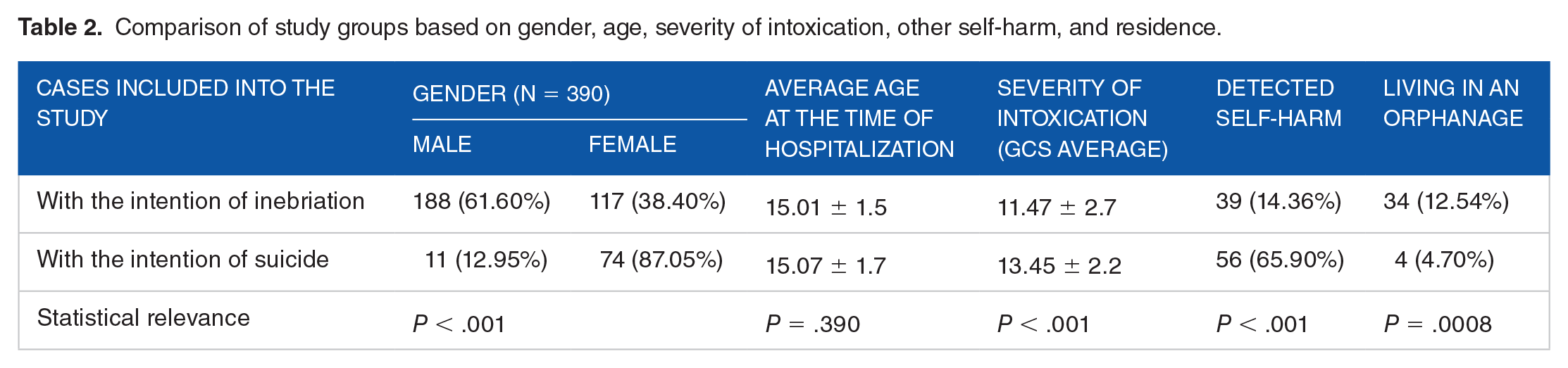
The severity of intoxication was compared on the basis of GCS scores in both groups. The lowest score in Group I was 5, while that in Group II was 6. The highest score in both groups was 15.
We compared both groups based on the season of intoxication. In Group I, the dominant season was winter with 31.2%, while the most uncommon season was autumn with 20.2%. In Group II, the dominant season was spring with 30.9%, and the most uncommon season was autumn with 18.5%. No significant difference was detected.
In the majority of cases, the cause of intoxication in Group I was alcohol with 222 (72.79%) registered incidents, whereas drugs as the cause of inebriation was detected in 69 (22.62%) cases. Other causes included a mix of alcohol and drugs in 11 (3.31%) cases, and a mix of nicotine and volatile substances in 3 (0.98%) cases.
The main substance of intoxication in Group II was medication (only) with 75 (88.24%) incidents, a mix of medication and alcohol with 8 (9.41%) incidents, and a mix of medication and drugs with 2 (2.35%) incidents. The most common choice of drugs for inebriation and suicide attempt in our study are presented in Figure 1, and their distribution based on the year, is presented in Figure 2.
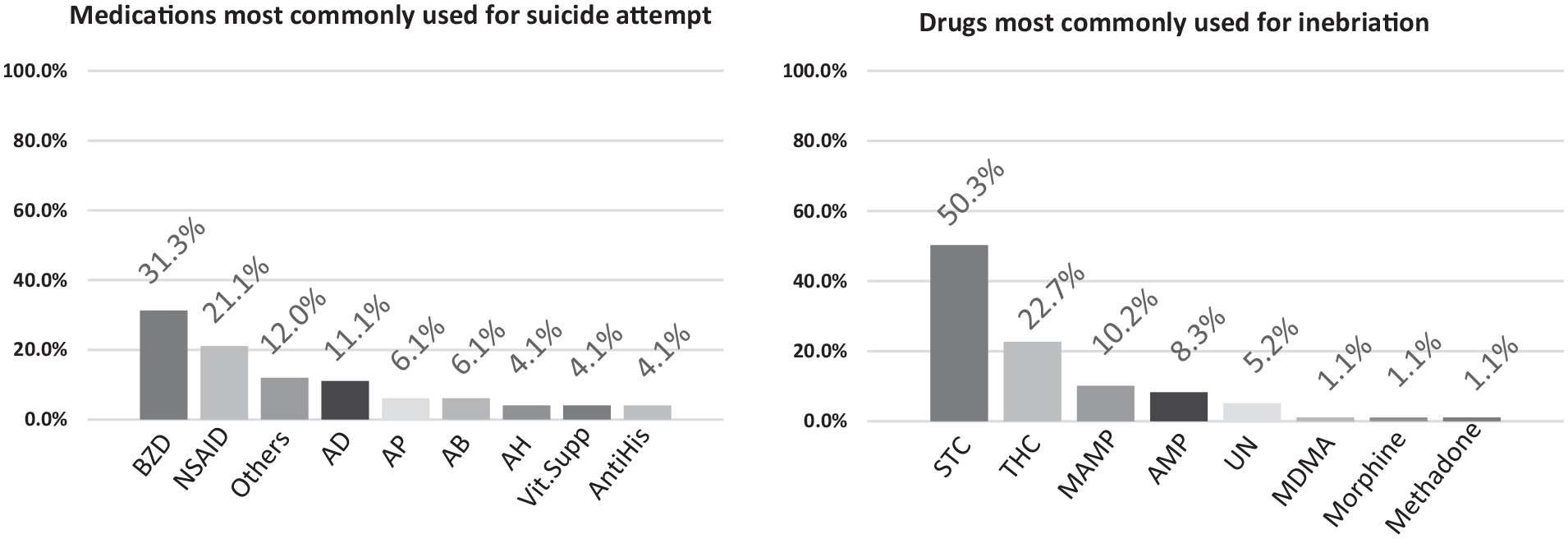
The substances most commonly used for suicide attempt and for inebriation during the study period.
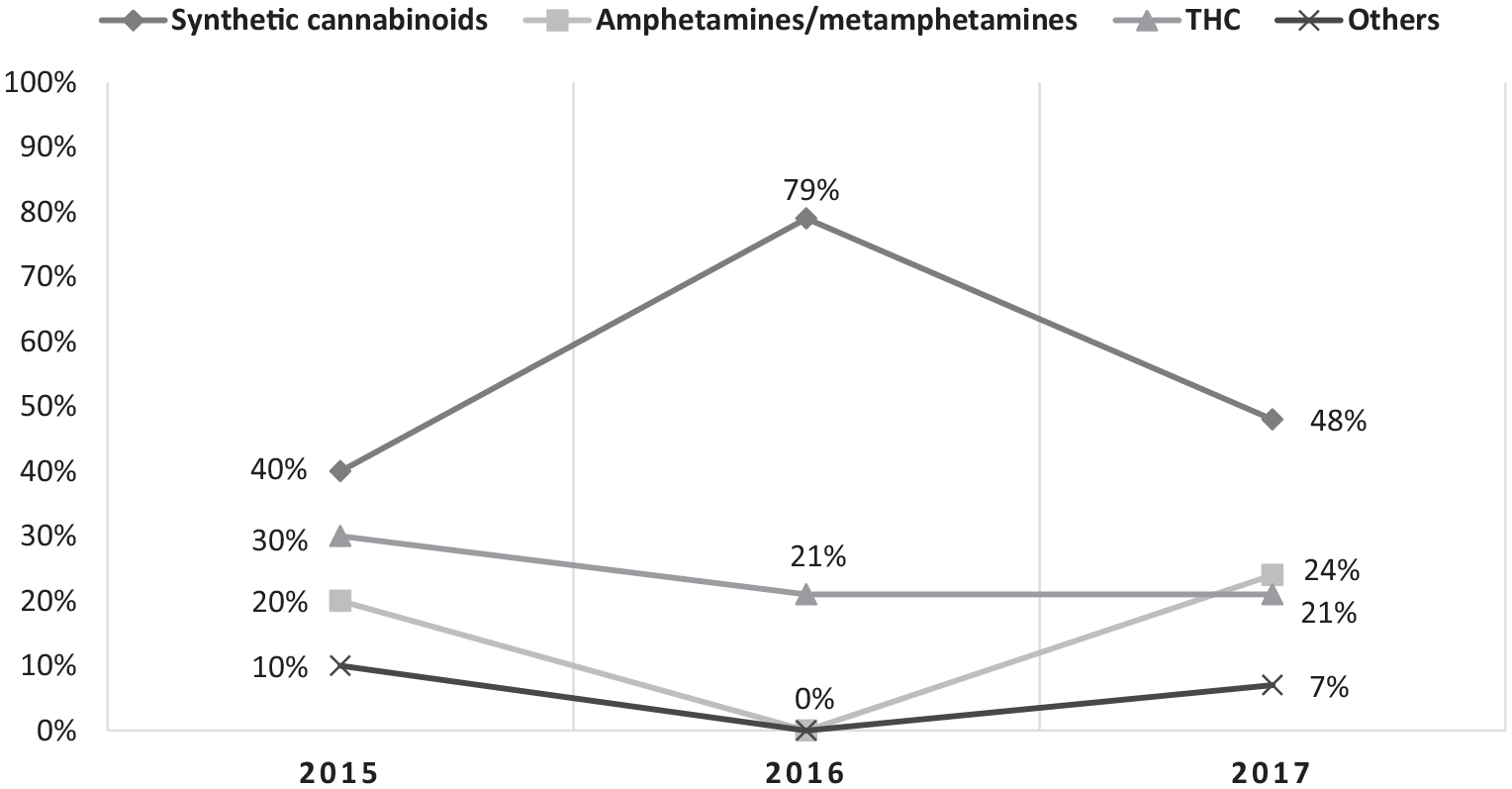
Tendencies of drugs usage during study period.
In the 390 cases included into the study, 240 cases were associated with alcohol consumption. A total of 231 cases were intoxicated with alcohol form Group I. The average blood alcohol content in Group I was 45.67 ± 14.22 mmol/l (min. 8.9 mmol/l; max. 98.75 mmol/l). Eight minors from Group II (n-85) consumed alcohol too. Their average blood alcohol content was 35.29±23.98 mmol/l (min. 1.20 mmol/l; max. 77.30 mmol/l). The significance value was P = .110, which means that there was no statistically significant difference in the alcohol consumption amount between minors with the goals of inebriation and suicide.
A total of 28 adolescents from Group I were hospitalized more than once: 22 of them were hospitalized twice (44 hospitalizations) at the PICU over the course of 3 years, while 6 of them were hospitalized 3 times (18 hospitalizations). The results of the comparison between relapsed minors and those who were hospitalized once within a span of 3 years based on gender, other self-harm, and social living situation are presented in Table 3. Among the 28 relapsed minors, the most common reason for intoxication during the first hospitalization was alcohol (60.7%) and drugs (28.6%); in the second hospitalization, these values were 53.6% and 32.1%, respectively; in the third hospitalization, alcohol was the reason for intoxication in 83.3% of cases. There were no relapsed patients in Group II.
Comparison of patients hospitalized once or multiple times based on gender, other self-harm, and residence.
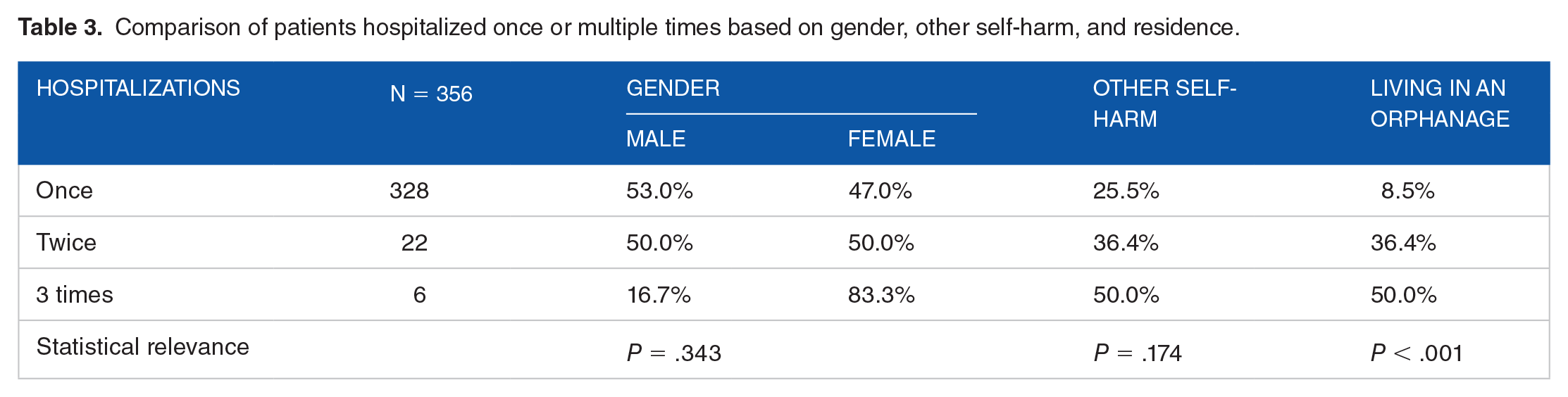
Patients who were living in children’s care homes composed 13.33% of all cases included in the study. Relapsed intoxications among patients living in children’s care homes increased to up to 50% of cases, despite the low frequency of minors living in children’s care homes in Lithuania (0.8%).
Discussion
According to the collected data, the average age of minors who were inebriated and who were attempting suicide was 15. Having compared these data to the statistics of other countries, we noticed a similar trend: the average age of minors who were deliberately intoxicated ranged between 14.5 and 16.0.6,7,13
The gender distribution was as follows: boys were more often hospitalized due to deliberate intoxication with the intention of becoming inebriated, whereas girls were more often hospitalized due to deliberate intoxication with the intention of committing suicide. Similar data can be found in other countries. In the Netherlands and Slovakia, boys were more often the ones attempting to become inebriated using alcohol7,13 and, in Australia and the Czek Republic, girls were more often the ones attempting to commit suicide.10,14
Moreover, during our research, we noticed that the highest numbers of attempts at intoxication with the intention of inebriation were recorded during the winter time, while attempts at committing suicide using medication were most frequent during the spring. A study conducted in the Czech Republic also showed that most minors attempted to commit suicide using medications in the springtime. 10 This coincides with several literature reviews regarding suicide seasonality, suggesting attempts at suicide become more frequent in the spring season.15,16
The severity of intoxication was evaluated based on the GCS scale and the blood alcohol content. This study determined that minors who were intoxicated with alcohol and drugs were in a worse condition. We believe that the reason behind this is that the minors who were inebriated with alcohol overdid it without understanding their own limits. Minors who were attempting to overdose on medication with intention of possible suicide attempt likely sometimes wanted to attract attention to their problems; they eventually confessed this to their relatives out of fear of death, which is possibly, why their GCS scores were higher.
GCS scores in other studies researching minors attempting to become intoxicated have been similar to those of our results: the median GCS score of studies conducted in Germany was 12.21, 17 while the median GCS score acquired through research conducted in Melbourne was 12, with the average blood alcohol content in this study was 45.67 ± 14.22 mmol/l. 14 The blood alcohol content ranged from 1.76 to 1.98 g/l in the other studies, or 38.4 to 42.9 mmol/l.6,7
We would like to mention that during the period 2015 to 2017, synthetic cannabinoids were a dominant substance among those intoxicated with drugs—this is a drug that is difficult to identify. In order to determine what the patient is intoxicated with, specialists must attain the patient’s medical history, the accuracy of which can be questionable. Since there may be no way of accurately identifying what the minor has consumed and what chemical substances were in the compound, it can be difficult to assign treatment. Considering data collected in Lithuania and other countries, synthetic cannabinoids are rising in popularity and are often the cause of serious health problems.18,19
In this study, minors who intoxicated themselves using medication often consumed benzodiazepine-type drugs. According to a study conducted in Australia, the most common drugs used in an attempt of self-poisoning were paracetamol and non-steroidal anti-inflammatory drugs, whereas sedatives and hypnotics were used by only 5%. 14 In a study conducted in the Slovak Republic, it was determined that 39% of cases, when a medication was used in an attempt to commit suicide, involved medicine that affected the nervous system. 7
Minors who were attempting to intoxicate themselves using medication were most often the ones who also harmed themselves cutting. Research conducted in other parts of the world on the issue of self-harm suggests that both self-harming adults and minors tend to seek to extinguish anxiety, stress, and bad feelings with alcohol or other psychoactive substances. 20 According to multiple authors, deliberate self-harm among minors who attempted to commit suicide is a very frequent occurrence. 21
The currently conducted study included 28 minors who were hospitalized recurrently. The results show that as the number of hospitalizations of the same minors’ increases (girls were more often hospitalized recurrently than boys), the ratio of hospitalized minors living in orphanages (s. children’s care homes) also increased. Furthermore, deliberate self-harm was also more frequent.
Another very significant aspect is that a significant number of minors admitted to the hospital due to deliberate intoxication were from children’s care homes. Considering that approximately 4000 minors in Lithuanian live in non-family situations, which constitutes 0.8% of people less than 18 years of age, we are able to assess the scope of this problem. Most minors become intoxicated with the intention of becoming inebriated, which is why caretakers should ensure the psychosocial health of minors being raised in orphanages.
At the moment, the Lithuanian Child Care System is undergoing reform, the aim of which is to close down all children’s care homes by 2030 and to relocate orphans to live with small families in a natural home setting. Having collected results from a study that was conducted prior to the reform, it will be interesting to study how the situation changes after implementation of the reform.
Research conducted in the Netherlands determined that only 1.5% of minors admitted to the hospital due to alcohol poisoning were from orphanages. 22 Most studies show that the presence of a stable and supportive family reduces the risk of dangerous minor behaviour. 23 Studies also suggest that minors living in families with close social ties and support are less likely to suffer from mental disorders. 24 This type of relationship is exactly what minors living in orphanages lack.
This study revealed also the importance and very sensitive problem of alcohol misuse in Vilnius region among adolescents. Some kind of alcohol usage problem among family members in Lithuania was evaluated interviewing 23 children from social risk families in 2018. The analysis showed that when children reveal parental alcohol problems, there is no inquiry, follow-up, or management of the children’s problems related to the caregivers’ drinking, but protective factors such as social support and positive experiences may enhance children’s resilience in adverse conditions. 25 Also, there is a need for services and specialized clinical programs adjusted to the child’s age and disorder in Lithuania. 26 The World Health Organization strategy plan is promoting and supporting global and regional activities aimed at identifying and managing alcohol-use disorders in health-care settings and enhancing the capacity of health-care professionals to address to their patients associated with harmful patterns of alcohol consumption. 27 Analyzing and summing up data of our study and data of other authors, we suggest that creation of services explicitly targeting alcohol and drug dependency problems is essential to improve the mental health of the youth population. European School Survey Project on Alcohol and Other Drugs (ESPAD) report concluded that young people are an important target group for many drug and addictive behavior prevention interventions. 28
Conclusions
Deliberate intoxication is equally common among female and male minors in the Lithuanian capital. The substance most often used for deliberate intoxication is alcohol. Minors with inebriate intoxication tend to be hospitalized in worse condition than those who attempted suicide through taking medication. Other signs of self-harm were significantly more common among suicidal minors. Living in children’s care homes could be a risk factor for recurrent deliberate intoxication in children and adolescents. The problem of minors harming themselves using alcohol, drugs, and medication is a very significant and relevant one.
Footnotes
Funding:
The author(s) received no financial support for the research, authorship, and/or publication of this article.
Declaration of conflicting interests:
The author(s) declared no potential conflicts of interest with respect to the research, authorship, and/or publication of this article.
Authors’ Note
The study was presented as oral presentation in the annual plenary conference in June 2018, and at The 4th International Conference “Evolutionary Medicine: health and Diseases in changing Environment” in Vilnius, June 2018.
Author Contributions
Odeta Kinciniene: study design, data interpretation, writing the manuscript.
Auge Lesinskaite: literature search, data collection.
Rokas Sambaras: data collection, statistical analysis of data, figures.
Ramune Vankeviciene: literature search, data analysis.
Asta Dervinyte-Bongarzoni: literature search, data collection.
Sigita Lesinskiene: study design, data interpretation, discussion, conclusions.
