




Abstract
This study aimed to review and examine the tools used to assess psychomotor performance of children with visual impairment. Databases, such as SCOPUS, MEDLINE/PubMed, Medline/EBSCO, Web of Science, LILACS, CINAHL, and ScienceDirect, were searched using Mesh terms. Data from manuscripts fully available in these databases between 1994 and 2017 (except CINAHL—2014) concerning the evaluation, tool development, or intervention for the improvement of motor skills in children (age, 7-10 years) with visual impairment were collected. The Critical Review Form—Quantitative Studies was used to evaluate the quality of the articles. As a result, 1113 articles were found, but only 24 met the inclusion criteria; 66.7% of the articles had moderate quality, with unsatisfactory results regarding the validity and reliability of the tools used to assess these children, as well as the absence of clinical importance and practical application in such studies. Only the Test of Gross Motor Development-2 and Movement Assessment Battery for Children-2 described data on the validation and reliability in visually impaired children. To minimize systematic errors and improve the quality of the investigations, increasing the number of studies regarding the tools, functionality of their activities, and testing the adaptions is necessary.
Introduction
Visual information serves as a stimulus for a child to move and as a feedback through which a child learns to correct and improve his or her movement. The perception of visual stimuli affects the organization of human motor actions, and its absence constrains the child to the space that his or her body occupies, restricting his or her exploration to the area closer to him or her and to the objects in which the child is in direct contact. 1
Thus, motor development in children with visual impairment is expected to be different from that in typically developing peers. 2 All movements, especially those involving limb coordination-dexterity and visual motor control, may be modified by the reduced visual stimuli. 3 In addition, other factors can interfere in their development, such as intellectual and cognitive skills, presence of other disorders, and home and learning environments. 4
Some motor skill difficulties found in children with visual impairment include difficulties in gait acquisition and postural problems; changes in spatial orientation and temporal structuring; difficulty in coordinating perceptual information and its adjustment to external reality; problems in the perception of the surroundings; delay in the construction of the corporal scheme and in the acquisition of functional habits, such as dressing and eating. 5 In addition, studies have discussed changes in the maintenance of orthostatic posture and the speed of postural adjustment,6,7 postural control, 8 manual dexterity,9,10 normal gait parameters,11,12 and gross motor skills.10,13 In some studies, poor motor performance in children with visual impairment is related to vision, but not to the severity of the disability. These studies showed that modifications in the environmental and task contexts are important to optimize motor performance.14,15 Adaptations include extra time, stable environments, and use of sensory cues (visual and auditory). 15 However, there is no consensus regarding this association between the level of visual impairment and motor performance, and only some authors acknowledge the existence of this relationship.10,12,16
Studies have shown that the motor performance of children with visual impairment can be improved by engaging in specific activity programs.3,17–20 Hence, early identification of motor problems is crucial because inadequate performance can result in long-term consequences.21,22 Thus, reliable instruments are essential for professionals to identify children with motor deficits, to evaluate the development and effectiveness of interventions, and to help in mitigating the consequences of these problems. Nevertheless, the literature reviews by Skaggs and Hopper 16 and Houwen et al 15 on motor performance in children with visual impairment draw attention to the evaluation tools used in research. Some of the tests applied have undergone changes, such as the use of materials with vibrant colors, increased contrast of materials, permission for children to feel the test material before test conduction, or even the presentation of additional instructions before performing the task test.14,15
A literature review was conducted that aimed to assist the diagnosis and evaluation of intervention programs for children aged 7 to 10 years in a recognized institution of ophthalmic care in Brazil. This research aimed to describe the tools used in the literature to assess motor skills in children with visual impairment. The study assesses in detail the possible adaptations made and performed a critical analysis of the characteristics of these adaptations for assessing motor development in these children. Aspects of validation and reliability were also discussed.
Methods
A systematic literature review was conducted using the following electronic databases: SCOPUS, MEDLINE/PubMed, MEDLINE/EBSCO, Web of Science, LILACS, CINAHL, and ScienceDirect. The consultation included articles published between 1994 and 2017 (except CINAHL, that comprised articles until 2014) with the use of Mesh terms: “visually impaired persons” AND “ child ” AND “motor skills”; “visually impaired persons” AND “child” AND “postural balance”; “visually impaired persons” AND “child” AND “movement”; “low vision” AND “child” AND “motor skills”; “low vision” AND “child” AND “postural balance”; “low vision” AND “child” AND “movement.” Only articles in English or Portuguese available in full text were included.
To be included articles should deal with the assessment or the development of tools, or motor skill interventions in children with visual impairment; evaluate children aged 7 to 10 years; and use standardized assessment procedures. The age range was defined based on a project with the main objective of following up the intervention programs in children with visual impairments aged 7 to 10 years. Researches evaluating children with neurological, attention and hyperactivity disorders, and orthopedic injury, or assessing cognitive or speech skills, or that did not clarify the information for inclusion were excluded.
The query was conducted in each database, using the keywords and evaluating the search results with respect to the inclusion criteria. When the title and abstract were not conclusive regarding the fulfillment of the inclusion criteria, the full-text article was assessed. For those articles meeting the inclusion criteria, data regarding the sample, country of study, objectives, method, and instruments were used, and the main conclusions of the study were collected with an individual form.
Motor skill was defined as a complex, voluntary, and guided movement of one or more body parts performed to achieve a particular goal. 23 This review included those articles dealing with the functional categories of motor skills: stability, locomotion, and object control. Stability skills were those involving the maintenance of balance in the individual against gravity; locomotion skills, those tasks dealing with the change of position of the individual, considering a fixed point; and object control skills, tasks including the act of applying force to an object, or receiving it. 23 Likewise, gross and fine motor skills were defined as actions using large and small muscle groups, respectively. 24
For this study, the World Health Organization 25 criterion was used, which establishes that moderate (visual acuity < 6/18 ⩾ 6/60) and severe visual impairments (visual acuity < 6/60 ⩾ 30/60), together, comprise the group of individuals with low vision. Low vision along with blindness represents all visual impairments.
The quality of the articles meeting inclusion criteria was evaluated with Critical Review Form—Quantitative Studies, 26 adapted by Houwen et al. 18 The items of the study that were evaluated included study objective, literature review, suitability of the study design, sample, outcomes, intervention, results, conclusions, and clinical implications, with 16 items (15 when no interventions were involved). If the article met the criterion of the question, it was scored 1; 0, when the criterion was not fulfilled; NA when the criterion was not applied to the research; ?, in cases where the item was not clearly described. Those articles with scores ⩾12 and ⩽7 were considered as having low and high risk of bias, respectively. 18
Results
The search in the databases resulted in 1113 files, of which only 24 met the inclusion criteria. The files were sometimes indexed by more than one database, causing a redundancy in the results (Figure 1). Despite the number of files in the various databases, most of them were excluded because they did not discuss the motor skills and/or did not include the age group of interest and/or included children with multiple disabilities and/or without visual impairment.
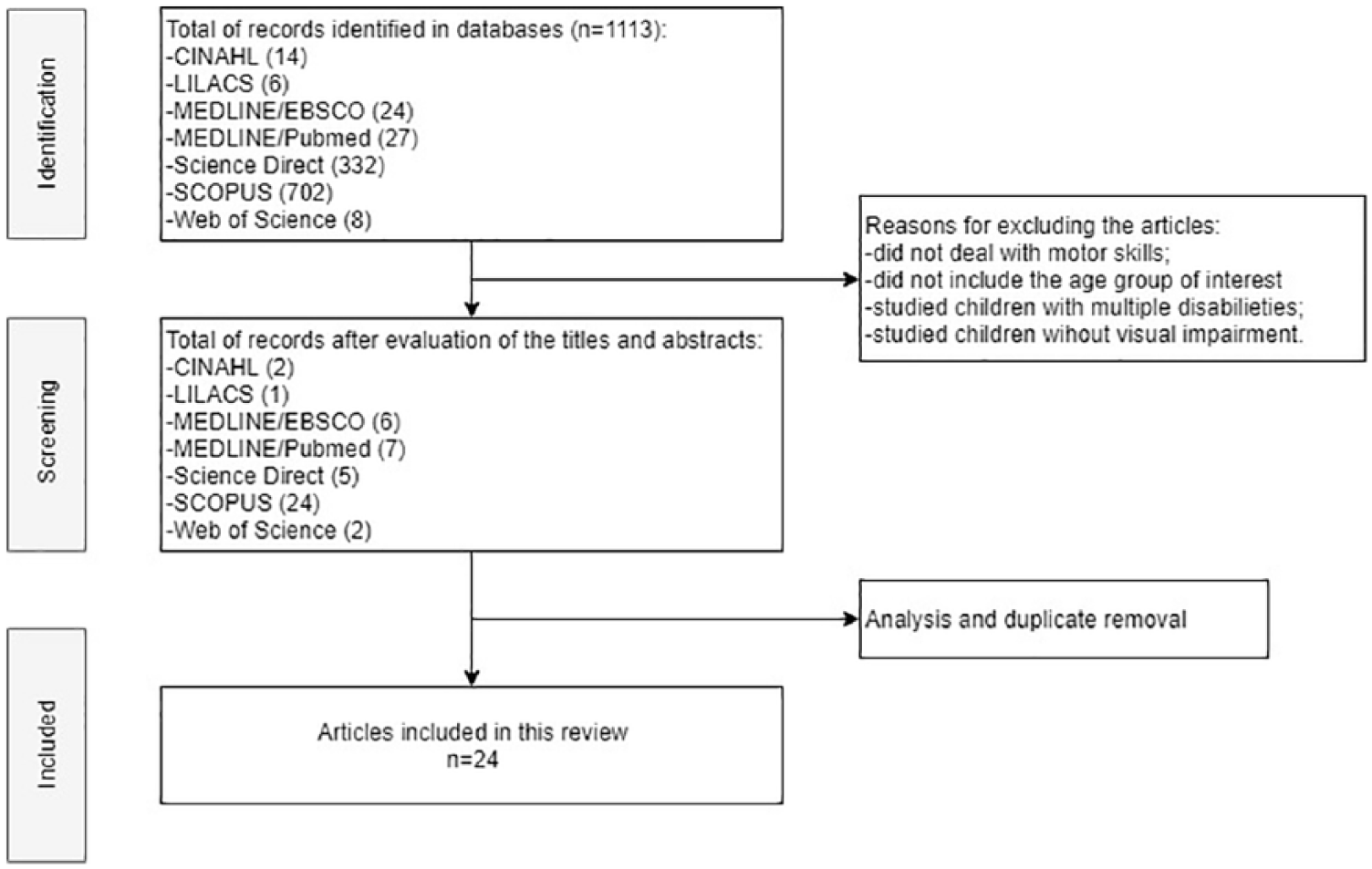
Steps in database search process.
Data extraction from 24 articles regarding the study objectives, participants, instruments, and results, and the qualitative evaluation can be found in Chart 1 and Table 1, respectively. In 10 studies, the authors claimed to have assessed the children applying modifications in the tools that included changes in materials and their colors and in procedures, such as allowing children to feel the objects to be manipulated.
Data on the literature search for articles on motor skills assessment in children with visual impairment.

Qualitative evaluation of articles that assessed motor skills in visually impaired children with the Critical Review Form—Quantitative Studies.

Questions: 1 = Was the purpose stated clear? 2 = Was relevant background literature reviewed? 3 = Was the design appropriate for the study question? 4 = Were there any biases present? 5 = Was the sample described in detail? 6 = Was the sample size justified? 7 = Was informed consent obtained? (if not described, assume no); 8 = Were the outcome measures reliable? (if not described for children with visual impairment, assume no); 9 = Were the outcome measures valid? (if not described for children with visual impairment, assume no); 10 = Was intervention described in detail? 11 = Were results reported in terms of statistical significance? 12 = Were the analysis methods appropriate? 13 = Clinical importance was reported? 14 = Conclusions were appropriate given the study methods? 15 = Are there implications for clinical practice given the results of the study? 16 = Were limitations of the study acknowledged and described by the authors? Scores of items: 0 = does not meet criterion; 1 = satisfies criterion; ? = not clearly described; NA = not applicable.
The article by Houwen et al 18 has not been evaluated because it is a review article.
Most of the studies presented a moderate risk of bias (n=16; 66.7%), with satisfactory results regarding the definition of the study objectives, review on the subject, sample described in detail with their ethical rights ensured, and results expressed in terms of statistical significance (Table 1). However, few articles reported having conducted studies on the validity and reliability of the tools in visually impaired children or demonstrated the clinical importance and practical application of the final study conclusion.
Table 2 shows that the most frequently used tools were Bruininks-Oseretsky Test of Motor Proficiency (BOTMP), Test of Gross Motor Development-2 (TGMD-2), and walkways/platforms. However, only TGMD-2 14 and Movement Assessment Battery for Children 2 (MABC-2) 27 were considered valid and reliable in children with visual impairment.
Absolute and relative frequency of the use of tools to assess motor skills in visually impaired children in this systematic review.
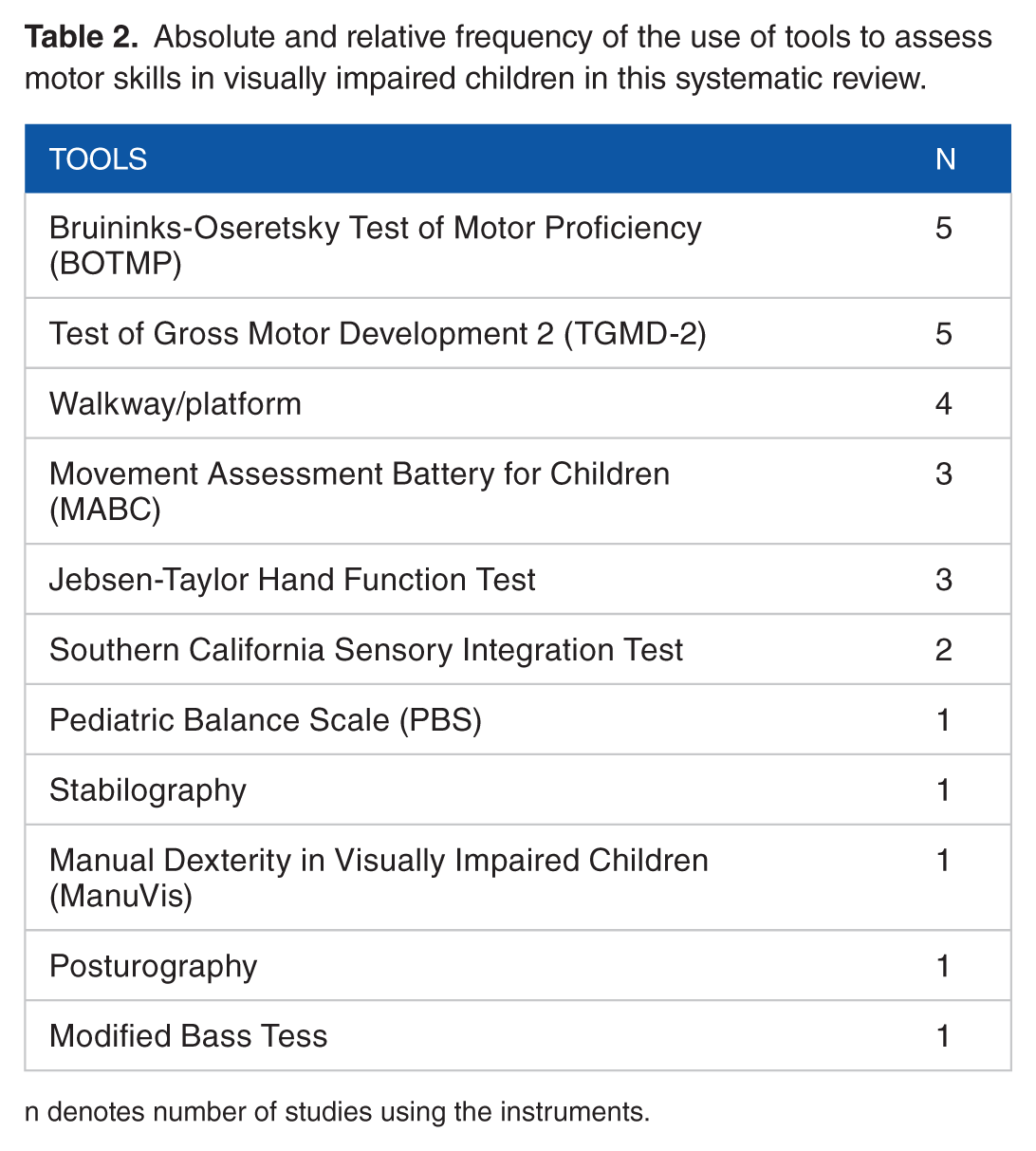
n denotes number of studies using the instruments.
Discussion
This study found that the researches evaluating motor skills in children with visual impairment have important limitations, such as methodological aspects were less frequent to fulfill the evaluation criteria according to the Critical Review Form (adapted from Houwen et al 28 ). Some problems detected included not using valid and reliable measures, and the absence of justification of the sample size (Table 1). The instruments used with visually impaired children are generally valid and reliable in children without disability,16,18 but there is no specific evaluation material for these children according to some authors.3,10
Among the tools surveyed, some evaluated manual dexterity (ManuVis and Jebsen-Taylor Hand Function Test), gross motor skills (TGMD-2), balance (stabilography-static equilibrium, and Pediatric Balance Scale (PBS)-static and dynamic), and those that evaluated a combination of skills (MABC-manual dexterity, ball skills and balance; BOTMP-fine and gross motor function; Ayres Southern California Sensory Integration Tests-sensory integration with tests of sensorial discrimination, sensory responsiveness, fine and gross motor function and praxis). The only tests that presented validity and reliability of data in children with visual impairment were the TGMD-214 and MABC-2. 27 The reproducibility of other evaluation methods, such as the first version of MABC14,15 and the wooden walkway, 29 had been evaluated in these children, but there was a lack of studies on the validity of the applied methods.
The lack of instruments for children with visual impairment resulted in the need for adaptations of the tests, which indicates the inadequacy of the original test. The modifications included the use of colors providing high contrast,13–15,19,27,30 permission to feel the material before the task was performed,13–15,27,30 the use of additional information and/or instructions,14,30,31 increasing the size of objects,13,14,29 using other senses (hearing, touching),10,27,30,31 and performing/feeling the movement before performing the task.13,14,27,30,31 However, the authors suggested that the adaptations did not influence the skills required to perform the activities.14,15
According to Topor, 32 the visual function of people with visual impairment can be maximized by adjusting color, contrast, lighting, space or distance, and time. The use of primary colors with a high degree of contrast between the work area and manipulated object, stimulation of several senses (touch, smell, hearing), and the simplification of the environment eliminating the excess of information are encouraged. According to the authors, the accuracy and speed of performing an activity generally decrease when the child has low vision, which suggests the possibility of increasing the time allocated to the task.
Adjustments in the environmental and task contexts are also important to optimize the motor performance. 14 Children with low vision usually have difficulty perceiving objects when the tasks are conducted in poorly lit environments (very dark or very light) with little use of contrast, the representation of complex, three-dimensional shapes that have depth, or use of figures that do not correspond to their potential of vision. Thus, the use of the remaining senses in addition to their residual vision should be stimulated. 14
Furthermore, the validity and reliability observed for a tool are only applicable when the instrument is used as established in the protocol. Modifications to these instruments may require, in addition to the authors’ permission, the study of validation as if it was a new tool. 32 That is, the changes used in the assessment tools may have compromised the validity and reliability of the results. Thus, studies on the standardization of changes in the tests for children with visual impairment can help minimize systematic errors in research and enhance the possibility of making more accurate comparisons between data from different studies.
The functionality of some activities evaluated in the tests is another important point worth raising; some may not be part of the daily routine of children with visual impairment. Therefore, this study underlines the importance of the development of instruments with better ecological validity for children with visual impairment, 18 along with reinforcing the need for studies in these children, as well as adequate tools for them.
Conclusions
Research on motor skills in children with visual impairment is limited because of a shortage of instruments for assessing motor function in these children. In the past 23 years (1994-2017), only 24 articles were found in seven databases (SCOPUS, MEDLINE/PubMed, MEDLINE/EBSCO, Web of Science, LILACS, CINAHL, and ScienceDirect) investigating motor skills in children with visual impairment. Although this review detected the use of varied tools that evaluate fine, to gross motor and locomotor, functions, as well as batteries of tests that examine a combination of these, only TGMD-2 (gross motor development) and MABC-2 (manual dexterity, balance and object control) demonstrated validity and reliability in this population.
Data from this review suggest the need to expand the studies on the tools, as well as on the functionality of the activities for application in children with visual impairment. The discussion on the changes made in the activities will result in systematic error minimization and better research quality.
Footnotes
Acknowledgements
The authors acknowledge The Brazilian National Research Counsil (CNPq), the Human Motor Behavior and Cognition Lab from the Physical Education Course at UPE, and Anna de Fátima Teotonio Irmão. Part of the results of the manuscript are found in a thesis at UFPE (Programa de Pós-Graduação em Saúde da Criança e do Adolescente) that was published in the institutional digital repository.
Funding:
The author(s) disclosed receipt of the following financial support for the research, authorship, and/or publication of this article: The authors would also like to state that the research project was partially sponsored by the National Research Council in Brazil (Conselho Nacional de Pesquisa, CNPq), The financial support did not influence the outcome.
Declaration Of Conflicting Interests:
The author(s) declared no potential conflicts of interest with respect to the research, authorship, and/or publication of this article.
Author Contributions
HAB (corresponding author—
