



Abstract
Objectives:
Non-coding RNA (ncRNA) plays a role in the development of diabetes and coronary heart disease. However, there is limited research on the association between ncRNA and these conditions. This study aims to conduct a bibliometric analysis and visualization of existing research to provide a comprehensive reference for future investigation in this field.
Methods:
We searched the China National Knowledge Infrastructure (CNKI) and Web of Science Core Collection (WoSCC) databases for articles published from 2012 to 2024. We analyzed publication volume, country of origin, authors, and keywords using Microsoft Office Excel, CiteSpace, and VOSviewer.
Results:
A total of 414 papers from 56 countries/regions, involving 298 authors, were analyzed. China had the highest number of publications (177), followed by the USA (90) and Italy (28). The number of publications generally shows an increasing trend. Collaborative research efforts were prevalent, with Katare Rajesh being the most cited author on average. International Journal of Molecular Sciences emerged as the most prolific journal in this field, while the article “MicroRNA profiling unveils hyperglycaemic memory in the diabetic heart” was identified as the most frequently cited. The analysis of keywords and literature indicates that current research predominantly focuses on the expression and mechanisms of ncRNA in disease, as well as its potential as a biomarker.
Conclusion:
Research on ncRNA in the context of diabetes and coronary heart disease has made notable strides, although it warrants further exploration. Through bibliometric and visual analysis, we elucidate the collaborative relationships among researchers, which can facilitate the identification of potential collaborators. Additionally, we delineate the key areas and emergent trends in this field, providing valuable insights that can guide researchers in selecting future research directions.
Plain Language Summary
This research explores the connection between a type of RNA called ncRNA and two common diseases: diabetes and coronary heart disease. We used a method called bibliometrics to analyze over 400 research papers published on this topic from 2012 to 2024.
What we found:
• The number of studies on ncRNA and diabetes with heart disease has been increasing over the past 12 years, indicating growing interest in this area.
• China and the United States have published the most research on this topic, but international collaboration could further enhance the impact of these studies.
• Some scientists, like Rajesh Katare, have made significant contributions to this field with their research on miRNA as a potential biomarker for heart disease in diabetes patients.
• The most common journals publishing research on this topic include the International Journal of Molecular Sciences and the Journal of the American College of Cardiology.
• The main focus of current research is understanding how ncRNA is expressed and functions in these diseases, and its potential as a biomarker for early diagnosis and treatment.
Why this is important:
• Diabetes and coronary heart disease are major health problems worldwide, causing significant illness and death.
• ncRNA has the potential to be used as a biomarker for these diseases, which could lead to earlier diagnosis and better treatment options.
• Understanding the role of ncRNA in these diseases could also help develop new treatments that target the underlying causes of the diseases.
What’s next:
• Future research should focus on understanding the role of long noncoding RNA in diabetes and heart disease, as this type of RNA is thought to be important in regulating genes related to these diseases.
• Increased international collaboration could. help further advance the field and improve the impact of research findings.
Keywords
Introduction
Diabetes mellitus (DM) is a chronic metabolic disease characterized by disturbances in insulin secretion and/or glucose metabolism, resulting in elevated blood glucose levels. Prolonged hyperglycemia can cause chronic damage and dysfunction of various tissues, especially the eyes, kidneys, heart, blood vessels, and nerves, posing a serious threat to human health. Global reports indicate that approximately 537 million adults (aged 20-79) worldwide had diabetes in 2021, with projections estimating this number to rise to 643 million by 2030 and 783 million by 2045. 1 While diabetes cannot be completely cured, it can be managed through various treatment methods to prevent disease progression. The most common long-term complication of diabetes is coronary heart disease (CHD).2,3
Cardiovascular disease, specifically CHD, also known as ischemic heart disease, accounts for the majority of deaths. More than 500 million people worldwide continue to be affected by cardiovascular disease. 4 Cardiovascular diseases accounted for 20.5 million deaths in 2021—close to a third of all deaths globally. The number of deaths from cardiovascular disease was 12.1 million in 1990 and 18.6 million in 2019. In 2019, cardiovascular disease accounted for 33% of all deaths worldwide, of which ischemic heart disease (9.1 million deaths) and stroke (6.6 million deaths) accounted for 85% of all global cardiovascular disease deaths. Ischemic heart disease 3 is currently the leading cause of premature death in men in 146 countries and in women in 98 countries. 5 The China Cardiovascular Health and Disease Report 2021 reveals that the incidence of cardiovascular disease in China is progressively on the rise, affecting an estimated 330 million individuals, including 11.39 million instances of CHD. 6 The coexistence of DM and CHD is a common and recurring clinical condition, characterized by high mortality and disability rates, significantly impairing patients’ physical function and jeopardizing their overall well-being.
Non-coding RNA (ncRNA) pertains to RNA molecules which do not encode proteins, namely microRNAs (miRNAs), long non-coding RNAs (lncRNAs), and circular RNAs (circRNAs). These RNAs possess the shared characteristic of being transcribed from the genome, but they are not translated into proteins. In the past for a long time, they are regarded as transcriptional “junk” or “noise” without biological function. However, studies have shown that ncRNAs are endogenous regulators that are widely involved in regulating almost all aspects of life activities and play crucial roles in various biological processes. They perform their biological functions at the RNA level and regulate gene expression in various physiological and pathological processes, including cell differentiation, metabolism, stem cell maintenance, immune response, and cancer, etc.7 -10 In addition, ncRNAs can exert their effects by regulating protein function and activity and targeting signaling pathways. 11 Furthermore, ncRNAs have been associated with the development of major diseases (eg, cardiovascular diseases, cancer), chronic diseases (eg, diabetes, hypertension), and neurodegenerative diseases (eg, Parkinson’s disease, Alzheimer’s disease). Many ncRNAs hold promise as potential therapeutic targets.12 -14
Scientific literature serves as a repository of knowledge, reflecting the outcomes of scientific research. The quantity and quality of literature provide insights into the level of scientific advancement. Bibliometrics, an interdisciplinary science, focuses on analyzing the distribution, quantitative relationships, and patterns of change within the literature using mathematical and statistical principles. Enhanced by the power of information visualization, bibliometrics serves as an invaluable tool to chart the vast expanse of research output in any given field. This methodology allows for the exploration of the rich historical trajectory of scientific research and provides invaluable insights into potential future research directions, as well as exciting collaboration opportunities. 15
Moreover, identifying cooperative interactions or clusters facilitates further collaboration by highlighting existing networks and potential partnerships. Despite the growing body of research exploring the relationship between ncRNA and DM combined with CHD over the past decade, there remains a gap in the application of bibliometric and visual analyses to this literature. Bibliometric analysis helps research by quantitatively assessing publication trends, citation patterns, and collaborative networks, thereby identifying influential studies, key researchers, and emerging topics. Visual analysis, on the other hand, aids in elucidating dimensions of research by providing graphical representations of data, such as co-authorship networks and keyword co-occurrence maps. These visual tools make it easier to identify research hotspots, trends, and gaps, thereby guiding future research directions and fostering interdisciplinary collaboration.
Firstly, these analyses can identify specific research trends by examining the frequency and context of ncRNA studies in DM and CHD. For example, our analysis reveals that miRNAs are the most frequently studied ncRNAs in this context, with significant focus on their roles as biomarkers and their involvement in disease mechanisms. Additionally, lncRNAs and circRNAs are emerging as important areas of research, particularly in their potential regulatory functions and therapeutic applications. These trends highlight the evolving focus of the field and provide a roadmap for future research directions. They can also pinpoint the evolution of research topics over time, identifying emerging areas of interest that may not yet be well-explored. This trend analysis can guide researchers in targeting their future studies more effectively, ensuring that they address the most pressing questions in the field. 16
Moreover, bibliometric and visual analyses can map out collaborations between researchers and institutions, which is highly relevant for advancing the field. By revealing the networks of co-authorship and institutional partnerships, these analyses can identify leading research hubs and influential groups driving the field forward. 17 Such insights are crucial for fostering new collaborations and partnerships, encouraging a more interdisciplinary approach to tackling the complex interplay between ncRNAs, DM, and CHD. This can lead to more comprehensive and innovative research outcomes, as well as the efficient allocation of resources.
Additionally, these analyses can spotlight influential studies and highly-cited papers, providing a clearer picture of seminal works that have shaped the current understanding of ncRNA’s role in DM and CHD. This can be particularly useful for newcomers to the field, offering a curated roadmap of foundational literature. 18
Finally, by identifying gaps in the current literature, bibliometric and visual analyses can guide funding bodies and policy makers in directing resources toward under-researched areas. This can lead to more comprehensive studies that cover a broader range of ncRNAs and their mechanistic roles in DM and CHD. Funding opportunities can thus be aligned with the emerging needs of the research community, fostering innovative studies that have the potential for high impact. 19
In conclusion, while the research linking ncRNAs with DM and CHD is expanding, the application of bibliometric and visual analyses can significantly complement scientific evaluation by providing a broader context. These methodologies can highlight research trends, collaborations, and influential works, thereby offering a comprehensive overview of the research landscape. This, in turn, can guide researchers in identifying gaps, prioritizing research questions, and fostering a more interconnected and progressive research environment. By integrating these insights with rigorous scientific evaluation, researchers can enhance their understanding and drive the field forward.
Thus, this study aims to fill this knowledge gap by conducting a comprehensive analysis of the literature related to ncRNA and diabetes combined with CHD over the past 12 years. Through bibliometric analysis, we seek to reveal research hotspots in this field, predict potential research trends, and provide valuable insights and references for researchers interested in this area of study.
Materials and Methods
Data sources
The data for this study were obtained from 2 sources: China National Knowledge Infrastructure (CNKI) and the Web of Science Core Collection (WoSCC). The retrieval period was set from January 1, 2012, to April 1, 2024. Different search strategies were employed to ensure relevant results.
Search strategy
In CNKI, the search formula consisted of the following terms: DM combined with CHD, along with the names and abbreviations of known ncRNA species, including lncRNA, miR, microRNA, circRNA, circular RNA, small RNA, small nuclear RNA (snRNA), small interfering RNA (siRNA), and single-cell RNA (scRNA). The search strategy used in WoSCC is outlined in Table 1.
Search strategy.

Abbreviation: TS, topic.
Inclusion and exclusion criteria
To ensure the accuracy of the collected information, certain criteria were employed for inclusion and exclusion. Scientific and technical achievements, book chapters, announcements, conference papers, and papers lacking authors or relevant information were excluded. The types of articles included in the analysis comprised dissertations, journal papers, and reviews.
Data analysis
Data collection and organization were performed using Microsoft Office Excel 2019. The volume and trends of publications over the past 10 years were analyzed. VOSviewer 1.6.19 was utilized to examine authorship, publication profiles by country/region, and collaborations. Citespace 6.2.R2 was employed to identify keywords and visualize research hotspots by clustering them into different categories.
Results
General data literature development trends
Between 2012 and 2024, a total of 414 research papers were published on ncRNAs in the field of DM combined with CHD, as determined through CNKI and WoSCC. The total number of publications has shown an overall increase over the past 12 years (Figure 1). The first relevant research in this field appeared in 2012, with the highest number of publications recorded in 2021, accounting for 15.98% of the total publications. A linear fit analysis demonstrated a significant correlation between the year and the number of publications (R 2 = .9141), indicating a consistent growth in research interest and output in this field over time. This trend is relevant as it highlights the increasing recognition of the importance of ncRNAs in DM and CHD, suggesting that this area of research is gaining momentum and attracting more scientific attention. Understanding this growth can help researchers and funding bodies anticipate future research needs and allocate resources accordingly.

Annual publications of research on ncRNAs in diabetes mellitus and coronary heart disease from 2012 to 2024.
The distribution of publications between Chinese and international sources is presented in Figure 2, with depicting the volume of domestic publications from China and representing those from other countries. The number of articles published internationally is notably higher than those published in China. This comparison highlights the global interest and contributions to the field of ncRNAs in DM and CHD, emphasizing the importance of international collaboration and knowledge exchange.
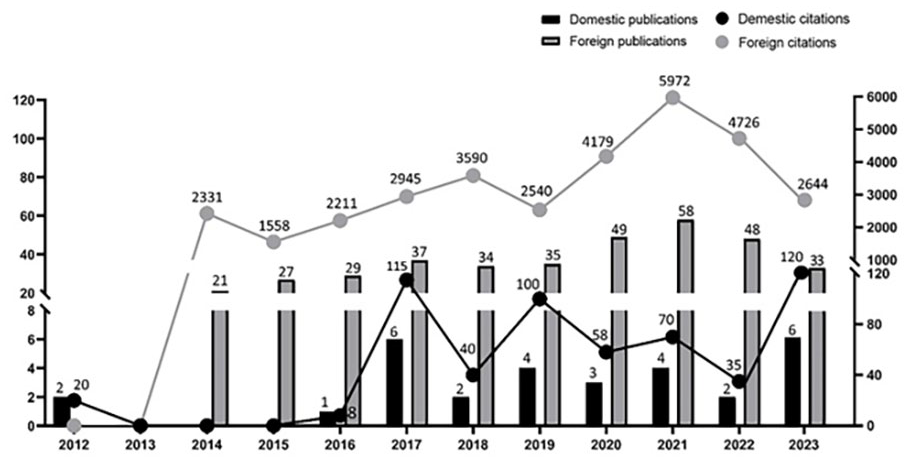
Trends in publications and citations.
Geographic distribution
The literature on ncRNAs in the field of DM combined with CHD was distributed across 56 countries/regions. The top 5 countries in terms of publication count were China (P = 165, 39.86%), the United States (P = 90, 21.74%), Italy (P = 28, 6.76%), Germany (P = 23, 5.56%), and Iran (P = 18, 4.35%), as shown in Table 2. Additionally, a comprehensive analysis was carried out to investigate the yearly national publications and citations of each nation. The foremost 3 nations with the greatest average citation counts were England (average citations = 81.71), Australia (average citations = 63.75), and Italy (average citations = 62.21). China (H = 33), the United States (H = 32), and Italy (H = 17) emerged as the top 3 countries in terms of the H-index, indicating the impact and influence of their research. The study of ncRNA in the context of DM with CHD has garnered attention from scholars worldwide. Norway, South Africa, Belgium, Serbia, Ecuador and Argentina have only started research in this field in recent years. Moreover, China and the United States exhibit strong collaboration within the network of countries/regions, followed by the United States and the England (Figure 3).
Top 10 countries/regions by publications, H-index and citations.


Collaborative relationships in countries/regions.
Impact analysis of Chinese research on ncRNA
While China leads in the volume of ncRNA publications, our analysis included data from both Chinese and international sources, ensuring a comprehensive overview of the research landscape. Our analysis of citation metrics and international collaborations suggests that the global influence and recognition of these publications can be enhanced through increased collaborative efforts and a focus on high-impact research areas. By identifying key researchers and institutions involved in ncRNA research, our study highlights opportunities for international collaboration, which can lead to more robust and impactful research outcomes. This approach encourages the integration of diverse perspectives and expertise, ultimately advancing the field.
Authors
A total of 298 authors have contributed to studies on ncRNA in the context of DM with CHD. In the author cooperation network (Figure 4), authors in the field mostly publish articles cooperatively. Among them, the maximum number of individual publications by an author is four. The authors with 4 publications in this field are Katare Rajesh, Pulakat Lakshmi, Franco Oscar H, Dehghan Abbas, Ghanbari Mohsen, Ghafouri-Fard Soudeh, Kotlabova Katerina, Krofta Ladislav, Kretowski Adam and Bielska Agnieszka (Table 3). In terms of author cooperation, Kochiadakis george, kalomoirakis petros, kalogerakos paris and maragkoudakis spyros have a close cooperative relationship.

Cooperation network of authors.
Authors by publications, citations and H-index.

Journal analysis
A comprehensive analysis of 216 journals was conducted and the top 10 with the most publications were summarized in Table 4. The journal that published the largest number of articles in this field was the International Journal of Molecular Sciences, with a total of 17 articles. Among the top 10 journals, 5 journals had an impact factor (IF) exceeding 5, indicating their significance in the field. Furthermore, the journal with the highest SJR (SCImago Journal Rank) indicator was Journal of The American College of Cardiology, with a score of 8.762. It was followed by Cardiovascular Diabetology with an SJR of 2.621, and Atherosclerosis with an SJR of 1.461. These indicators highlight the prominence and influence of these journals in the field of ncRNA research in the context of DM with CHD.
Top 10 journals with the most publications.

Cluster analysis of co-occurrence keyword
To determine the research focus of ncRNA studies in DM with CHD, we performed a parallel keyword clustering analysis using VOSviewer. Synonymous groups of keywords were merged, and only keywords that appeared more than 5 times were selected for analysis. The resulting keyword map consisted of 126 nodes and 2700 links (Figure 5).
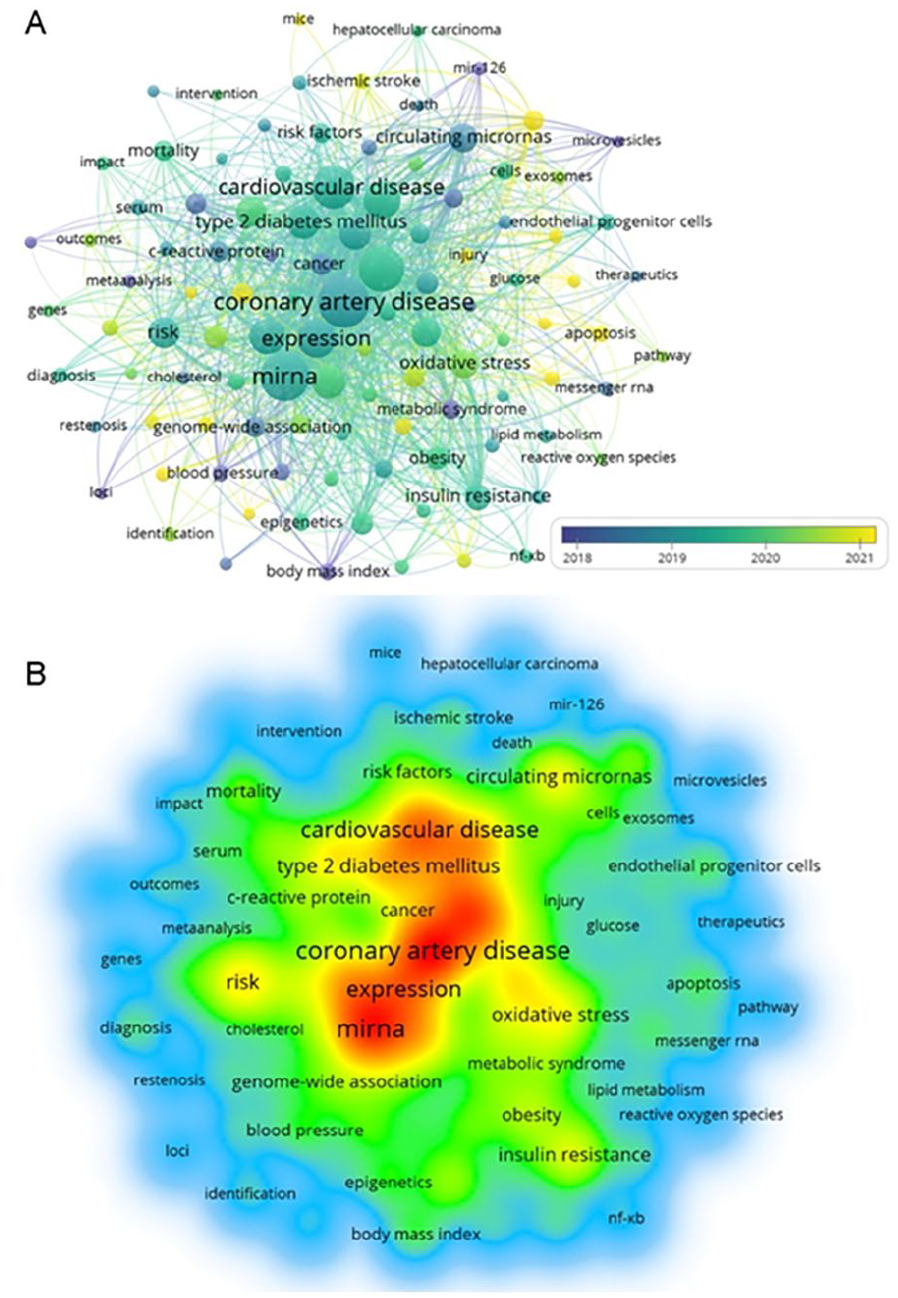
Analysis of keywords of diabetes with coronary artery disease: (A) visualization map of co-occurring keywords and (B) the density map of keywords.
The top 10 most frequently occurring keywords in the field are summarized in the Table 5. To visualize the timing of keyword occurrences and highlight the latest research hotspots, keywords such as “coronary artery disease” “cardiovascular disease” “expression” “coronary heart disease” “diabetes mellitus” “risk” “myocardial infarction” “type 2 diabetes mellitus” “heart failure” and “oxidative stress” were identified. These keywords represent areas of active research and current focus in the field.
Top 10 co-occurrence keywords via Citespace.

Furthermore, Citespace analysis identified 8 clusters for keywords that appeared more than 3 times (Figure 6). These clusters are categorized as follows: diabetic cardiomyopathy, anril, cardiovascular risk, acute coronary syndrome, impact, reactive oxygen species, cardiovascular disease and atrial fibrillation. These clusters provide further insights into the thematic areas and subtopics within the field of ncRNA research in the context of DM with CHD.

Cluster analysis of co-occurrence keywords: (A) keywords clustering analysis based on Citespace and (B) timeline development of keyword clustering.
Cocited reference
We conducted a cluster analysis of references for studies of ncRNAs in DM with CHD (Figure 7). Clusters with smaller numbers had more articles, and the top 3 clusters are #0 diabetic complications, #1 ischemic heart disease, #2 review. From these 9 clusters, we found that references roughly revolve around the expression and mechanism of ncRNAs in various complications of diabetes mellitus and/or coronary heart disease, which is almost the same as the research content of articles in this field. Highly cited references often indirectly show the core research content in this field, and we listed the top 10 highly cited references (Table 6).

Cluster analysis of co-cited reference: (A) co-cited network of references and (B) top 20 references with the strongest citation burst.
Top 10 highly cited references.

Discussion
DM with CHD is a prevalent and significant clinical condition, characterized by a high mortality and disability rate, posing a serious threat to patient health. NcRNAs have emerged as crucial players in the context of diabetes and CHD, and researchers worldwide are actively investigating their role in this field. In this study, we employed bibliometric methods to analyze the relevant literature, both domestic and international, spanning the period from 2012 to 2024, aiming to provide a comprehensive reference for scholars globally.
In terms of general data, our review encompassed the published literature on ncRNAs in the context of DM with CHD. Since the first research publication in 2012, there has been a gradual increase in scholarly attention toward this field. Notably, in 2014, the number of published articles rose to 21, and the total number of publications has shown an overall increase over the past 12 years. Although the total number of publications peaked in 2021, the continued interest and advancements in ncRNA research in the context of DM and CHD highlight the ongoing relevance and potential of this field. The increasing recognition of ncRNAs’ roles in disease mechanisms and their potential as therapeutic targets underscores the importance of further research to enhance our understanding and develop novel interventions. This continued exploration is crucial for translating scientific discoveries into clinical applications that can improve patient outcomes.
Analysis of domestic and foreign publications, as well as citation data, reveals a greater international interest in the study of ncRNAs in the context of diabetes and CHD compared to China. Foreign countries have contributed significantly to the body of research in this area, with a considerably higher number of publications. China and the United States have been at the forefront of ncRNA research in DM and CHD. China holds the highest H-index of 29 among all countries, followed by the United States with an H-index of 33. These 2 nations share a robust collaborative network and account for a substantial portion (61.60%) of the total literature publications in this field. Notably, the United States stands out as a key international collaborator. Despite China’s substantial publication output, there remains room for increased international cooperation.
Turning to the analysis of authors’ publications, in the authorship cooperation network, exchanges and cooperation between scholars have been enhanced. Scholars can consider multi-party cooperation to improve the quality of research when conducting relevant research in this field in the future. The close cooperative relationship also strengthens academic exchanges in the field and promotes the development of the discipline. The authors under intensive study in this field are Rajesh Katare, Lakshmi Pulakat, Oscar H Franco, Abbas Dehghan, and Mohsen Ghanbari. They have the highest number of publications and a relatively large number of citations. Among the authors, Katare Rajesh has the highest average citation count of 43.25. His articles in this area began with research on miRNA as a biomarker for diabetic heart disease in 2014 and continued until 2022, when he carried out research on exosome miRNAs in DM with CHD. 20 Dehghan Abbas and Franco Oscar H consistently collaborate in this field. One of their reviews with the impact factor of 13.6 is mainly about the role of DNA methylation in dyslipidaemia. 21 Similar patterns of collaboration are observed for Hromadnikova Ilona, Kotlabova Katerina, and Krofta Ladislav, all affiliated with Charles University Prague. They published 4 articles with a clinical bias, particularly in relation to gestational diabetes, 3 of which were included in the International Journal of Molecular Sciences. They studied changes in miRNA expression levels in preterm, pregnancy, and postpartum mothers, and investigated the role of miRNAs in assessing the risk of developing diabetes and cardiovascular disease based on expression profiles.22 -24
Our analysis of journals reveals that the International Journal of Molecular Sciences is the most frequently published journal, with 17 articles. The articles with the highest total citation and annual citation mainly analyzed the relationship between dietary patterns and disease risk. 25 While keeping up with the latest advances in molecular basis, it focuses on the role of diet in anti-inflammatory, antioxidant and anti-atherosclerotic effects in humans. The article suggests that it would be a good option to explore disease prevention and control research at the level of ncRNAs. Among the top 10 journals with the highest number of publications in the field of ncRNAs and diabetes with CHD, nearly all are high-quality journals. All journals have an impact factor greater than 3, and 5 of them have an impact factor greater than 5. Journal of The American College of Cardiology, with an impact factor of 24, stands out as the journal with the highest impact factor and has published 4 articles in this field. Cardiovascular Diabetology, which has published 6 articles, has an impact factor of 9.3, making it the second highest journal with an impact factor. These 6 articles mainly focus on the expression of miRNA, the exploration as diagnostic biomarkers and its role in clinical treatment. Jansen et al, studied the alteration of vascular endothelial miRNA expression in circulating endothelial microparticles by diabetes 26 Shen et al outlined possible optimal blood pressure levels in patients with type 2 diabetes mellitus (T2DM) with coronary artery disease, taking into account factors related to the renin-angiotensin-aldosterone system and pancreatic beta-cell-specific miRNAs. 27
When considering publication quality, the Scientific Journal Rankings (SJR) - SCImago Journal Rank indicator can assist researchers in identifying high-quality journals within their field. In general, the SJR indicator exhibits a positive correlation with journal impact factors, as journals with a higher number of citations are more likely to be cited by other reputable publications. Journal of The American College of Cardiology, which possesses the highest impact factor in this field, also boasts the highest SJR value of 8.762. The International Journal of Molecular Sciences is also one of the high-quality journals in this field. A recent paper published in the journal focuses on the relationship between insulin resistance and diabetes mellitus in diabetic vasculopathy and related cardiovascular disease, highlighting epidemiology and clinical characteristics, pathophysiology, and molecular mechanisms, as well as management strategies. 28 Therefore, researchers planning to publish their findings may consider journals such as the Journal of The American College of Cardiology, Cardiovascular Diabetology, and International Journal of Molecular Sciences as suitable choices.
Regarding research hotspots and frontiers, keyword co-occurrence and clustering analysis of high-frequency keywords helped identify preliminary research hotspots in the field of ncRNAs in diabetes with coronary artery disease. The co-occurrence frequency of keywords “coronary heart disease,” “cardiovascular disease,” “expression,” “coronary heart disease,” and “diabetes” were all more than 40 times. These keywords suggest that the research hotspots in this field primarily revolve around the expression and mechanism of ncRNA in diseases. This aligns with the overall research trend in the field, as the understanding of pathogenesis, clinical diagnosis, and treatment in the realm of disease research remains essential. To gain a deeper understanding of diseases, enable early and accurate clinical diagnosis, and facilitate improved disease management, it is crucial to explore the expression profiles of various ncRNAs in DM with CHD. This exploration aids in elucidating the roles played by different ncRNAs in the development and progression of these conditions.
Biomarkers hold great significance in clinical practice for early diagnosis, identification, and monitoring during disease prevention and treatment. Diagnostic biomarkers help detect the presence of a disease, while pharmacodynamic biomarkers indicate the effects of medical products or environmentally harmful substances on biological activity, serving as measures of potential harm and guiding patient treatment. Predictive biomarkers are used to determine the likelihood of a patient responding to a specific treatment or intervention, while prognostic biomarkers reflect disease prognosis characteristics and identify the likelihood of disease recurrence or progression in individuals already affected by the disease. Susceptibility biomarkers indicate an individual’s potential to develop a disease. However, the discovery and clinical translation of biomarkers is a challenging and time-consuming process. The identification of significant biomarkers, especially, holds immense value for the diagnosis, monitoring, evaluation, and prediction of DM with CHD.
Furthermore, it can drive advancements in medical diagnosis and treatment. In recent years, numerous studies have been published exploring different ncRNAs as biomarkers in DM with CHD. For example, Szydelko Joanna and Matyjaszek-Matuszek Beata conducted research on micRNA as a biomarker for T2DM combined with CHD, analyzing 122 differentially expressed miRNAs. 29 The researchers were able to identify a total of 14 miRNAs that hold great promise as biomarker candidates for both T2DM and coronary artery disease. These include miR-135/-a, miR-148a/-b, miR-375, miR-486, miR-191, miR-195, miR-197, miR-766, and miR-770 for T2DM, and miR-32, miR-206, miR-208/-a, miR-378, and miR-765 for coronary artery disease. Additionally, the study found that miR-1, miR-9, miR-15a, miR-30, miR-92a, miR-126, miR-133a, miR-155, miR-210, and miR-342 have the potential to be utilized for miRNA-based risk stratification and early, non-invasive diagnosis of coronary artery disease in patients with T2DM. These miRNAs are involved in key processes underlying atherosclerosis induced by T2DM, primarily endothelial dysfunction, vascular smooth muscle cell proliferation/migration, inflammation, and hyperplatelet activity. These findings offer valuable suggestions for further research on novel miRNA-based biomarkers and treatment strategies for patients with diabetes and CHD.
It’s also worth mentioning that ncRNAs encompass various categories, including lncRNAs, circRNAs, and small RNAs. In the field of diabetes and coronary artery disease, one of the most cited articles on lncRNAs is the function of lncRNAs and their role as biomarkers of cardiovascular diseases. 30 Shi et al investigated the involvement of multiple ncRNAs in the development of T2DM through insulin and AGE-RAGE signaling and analyzed the processes leading to vascular complications. 31 Studies are expected to explore their roles in diabetes combined with CHD in the future.
Cluster analysis using Citespace identified 8 clusters for keywords occurring more than 3 times. Clusters with smaller numbers contain more keywords. Cluster analysis aids in summarizing and categorizing keywords, visually displaying research hotspots in the field. The research hotspots identified in this field mainly revolve around “diabetic cardiomyopathy” “ANRIL” “cardiovascular risk” “acute coronary syndrome” “impact” “reactive oxygen species” “cardiovascular disease” and “atrial fibrillation.” Diabetes is a crucial risk factor for CHD, contributing to vascular endothelial cell damage and dysfunction, ultimately leading to the development of CHD. 3 When diabetes and CHD coexist, diabetes can accelerate atherosclerosis, 32 exacerbate coronary artery lesions, and increase the likelihood of complications. Research in this field focused on exploring the cardiovascular aspects of diabetes complicated by CHD around 2015, with recent years witnessing increased focus on diabetes complications. By observing the clustering in recent years in timeline development of keyword clustering, “diabetic cardiomyopathy,” “cardiovascular risk,” “acute coronary syndrome,” and “reactive oxygen species” may still are the research emphasis of the future.
To a certain extent, the frequency with which the literatures are cocited by other articles at the same time can indicate the centrality of the literature to the research content in the field. The higher frequency the literature has, the closer it is to the core content of the field. The 3 most frequently cited references pertain to miRNA, specifically focusing on the expression traits of miRNA in individuals with T2DM, the marked reduction in levels of vascular and inflammation-related miRNAs in CHD patients, and the conjecture that heightened heart-specific miR-208a in plasma may serve as an innovative biomarker for prompt identification of human myocardial injury.33 -35 We can find that among the top 10 highly cited references, miRNA-related literature has a high proportion. This suggests that miRNA is one of the core research contents in the study of ncRNA and diabetes with CHD.
To the utmost extent of our comprehension, the present investigation embodies the initial bibliometric scrutiny within the realm of ncRNAs and DM in conjunction with CHD. However, the study does have some limitations. The data utilized were extracted from CNKI and Web of Science databases, which, although reliable and highly recognized, may not provide a comprehensive analysis. Considering databases such as Scopus or PubMed could be beneficial for a more comprehensive study. Additionally, the search strategy employed might not retrieve all relevant literature in the field, which is an inherent limitation of bibliometric analysis. Furthermore, as the year 2024 is not yet over, it is not possible to accurately analyze this year’s research hotspots. Thus, further analysis of citations from recent publications is warranted in the future.
Conclusion
The field of ncRNA research in DM and CHD has witnessed significant progress and offers promising development prospects. While China leads in the volume of ncRNA publications, our analysis of citation metrics and international collaborations suggests that the global influence and recognition of these publications can be enhanced through increased collaborative efforts and focus on high-impact research areas. The United States stands out as the country with the most extensive international collaboration. The main research focus in this field revolves around the expression and mechanism of ncRNAs in diseases and their potential as biomarkers. Future research should delve deeper into the roles of long noncoding RNAs, which are pivotal in gene regulation related to DM and CHD. Understanding these mechanisms may reveal novel therapeutic targets and improve disease management strategies.
In conclusion, our study highlights the significance of ncRNAs in the context of DM with CHD, attracting the attention of researchers worldwide. The international landscape of research publications and citations underscores the need for enhanced international cooperation, particularly for China, despite its prominent position in terms of article output. The identification of highly cited authors and their collaborative patterns further emphasizes the importance of interdisciplinary collaboration in advancing the understanding of ncRNAs in the context of diabetes and coronary heart disease.
