



Abstract
Background:
Alpha amylase inhibitors are used in the treatment of type II diabetes mellitus. Allium sativum and Allium cepa, widely consumed as spices have several medicinal uses which include their traditional use in the management of diabetes. This study was conducted to investigate the alpha amylase inhibitory potential and mode of inhibition of A. sativum and A. cepa oils.
Method:
Oil was extracted from dried bulb of A. sativum and A. cepa by Soxhlet extraction. The α-amylase inhibitory potential of the 2 oils were evaluated. The mode of inhibition of the oils were determined from the lineweaver-burk plot and the kinetic parameters obtained from the lineweaver – burk plot.
Result:
A. sativum oil had 58.13 ± 1.09 and 69.8 ± 1.11 percent inhibition at 5.0 and 7.0% concentrations respectively while A. cepa oil had 55.45 ± 1.35, 59.73 ± 1.11 and 65.21 ± 1.11 percent inhibition at 5.0, 7.5 and 10% concentrations respectively. The IC50 values for A. sativum oil, A. cepa oil and acarbose were 3.0 ± 0.02%, 4.4 ± 0.03% and 14.1 ± 0.09% respectively. The lineweaver – burk plot showed that the Vmax of the 2 oils did not change when compared with that of the no inhibitor (no oil) but the Km increased.
Conclusion:
These findings indicate that A. sativum and A. cepa oils are competitive inhibitors of α- amylase and can both be used in the treatment of type II diabetes mellitus. A. sativum oil is a better inhibitor than A. cepa oil.
Introduction
Diabetes mellitus is a non-communicable metabolic disorder.1,2 It is a genetically multifactorial disease characterized by abnormally elevated blood glucose and dysregulation of carbohydrate, protein and lipid metabolism. 3 In diabetes mellitus, homeostasis of carbohydrate and lipid metabolism is altered due to defects in insulin production, secretion or action.2,4 The global prevalence of diabetes mellitus in 2019 is estimated to be about 9.3% of the population and was responsible for about 4 million deaths globally in 2017.5,6 There are 3 different types of diabetes; type 1 diabetes mellitus (T1D), type 2 diabetes mellitus (T2D) and gestational diabetes mellitus (GDM). 5 Type 1 diabetes mellitus also known as insulin dependent diabetes mellitus results from chronic autoimmune destruction of the insulin producing pancreatic beta cells. 7 Gestational diabetes mellitus is defined as glucose intolerance of various degrees that is first detected during pregnancy. 8 In type II diabetes also reffered to as non insulin dependent diabetes mellitus, the body does not use insulin effectively resulting in elevated blood glucose. 9 It accounts for approximately 90% of the total occurrence of diabetes mellitus. 5 An effective therapeutic approach for controlling blood glucose level is to inhibit or suppress the activities of carbohydrate hydrolyzing enzymes such as alpha amylase and alpha glucosidase.10,11 Alpha amylase catalyzes the first step in the breakdown of starch by hydrolyzing the polysaccharide (starch) into 3 major products; maltose, maltriose and limit dextrins while α- glucosidase catalyzes the end step of digestion of starch and disacharides.12,13 Thus, inhibitors of α-amylase delay the breakdown of carbohydrates in the small intestine thereby diminishing postprandial blood glucose in T2D. 14 Carbohydrate hydrolyzing enzyme inhibitors used in clinical treatment of type 2 diabetes include acarbose, miglitol and voglibose. These inhibitors have side effects such as flatulence, diarrhoea and liver disorder.15-17 Besides, most of these inhibitors contain sugar moieties and their synthesis involves tedious multistep procedures. 1 Thus, the need for inhibitors from non-sugar sources with lesser side effects.
Allium cepa L (onion) and Allium sativalum L (garlic) (shown in Figure 1) are perennial plant of the Alliaceae family. They are grown all over the world and are commonly used as spices. 18 The most active component of fresh A. sativalum (garlic) is allicin while A. cepa (onion) have a unique combination of 3 compounds; fructans, flavonoids and organo-sulphur compounds. 19 Tannins, flavonoids, sterols and triterpenes are present in all varieties of onion oil but absent in all varieties of garlic oil. 19 Garlic oil have the highest phytochemical content when compared with the juice or dry forms and is thus recommended for medicinal use. 19 They oils from garlic and onion are dominated by sulfur containing compounds. 20 These organo-sulphur compounds are responsible for their smell and taste. 19 The organo-sulphur compounds have antidiabetic property and antioxidant property.21,22 Wu and Xu, 23 reported that aqueous extract of onion bulb has no α-amylase inhibitory potential but has α- glucosidase inhibitory activity. Their ethanolic extracts have been reported to have alpha amylase inhibitory activity. 24 It is possible that the α- amylase inhibitory activity of onion and garlic is present in the organo-sulphur containing oils. This study, therefore investigated the α- amylase inhibitory potential of oils from onion (Allium cepa) and garlic (Allium sativalum).

Picture of garlic (Allium sativalum) and onion (Allium cepa). (a) Garlic (Allium sativalum). (b) Onion (Allium cepa).
Methodology
Plant collection and identification
The cloves of garlic (Allium sativalum) and bulb of red onions (Allium cepa) were obtained from Mubi market, Adamawa State, Nigeria. The plants were authenticated by a botanist of the Department of Biology, Adamawa State University, Mubi, Nigeria and was deposited in the herbarium of the Department.
Preparation of plant sample
The outer layer of the garlic and onions were removed manually. The cloves/ bulbs were separately washed clean with distilled water, chopped into small pieces and then dried for 2 weeks. They were grinded separately with mortar and pestle and stored in a covered sample bottle.
Oil extraction
The extraction of garlic and onion oils was carried out with Soxhlet extractor using n-hexane (boiling point of 40°C-60°C) for 6 hours. After extraction, the solvent in the oil was removed under reduced temperature and pressure and refluxed again at 70°C so as to further remove excess solvent. The extracted garlic and onion oils were stored in refrigerator at 2°C. 25
Alpha-amylase inhibitory assay
This assay was carried out using a modified procedure of McCue and Shetty. 26 Serial dilution of the oil (ranging from 1.25%-10%) was prepared with dimethyl sulfur oxide (DMSO). An aliquot amount (250 µL) of the various concentrations was placed in separate testtubes and 250 µL of 0.02 M sodium phosphate buffer (pH 6.9) containing α-amylase solution (0.5 mg/mL) was added. This solution was pre incubated at 25°C for 10 minutes, after which 250 µL of 1% starch solution in 0.02 M sodium phosphate buffer (pH 6.9) was added and then further incubated at 25°C for 10 minutes. The reaction was terminated by adding 500 µL of dinitrosalicylic acid (DNS) reagent. The testtubes were then incubated in boiling water for 5 minutes and were cooled to room temperature. The reaction mixture was diluted with 5 mL distilled water and the absorbance was measured at 540 nm using spectrophotometer. Similar procedure was also used for the standard drug, acarbose. A control was prepared using the same procedure replacing the oil with DMSO. The α-amylase inhibitory activity was calculated as percentage inhibition:

Concentrations of oil resulting in 50% inhibition of enzyme activity (IC50) were determined graphically.
Mode of α-amylase inhibition
The mode of inhibition of α-amylase by the oils was done according to the modified method described by Ali et al 27 Briefly, 250 µL of the oil (5% oil in DMSO) was pre incubated with 250 µL of α-amylase solution for 10 minutes at 25°C in 1 set of testtubes. In another set of testtubes, α-amylase was pre incubated with 250 µL of phosphate buffer (pH 6.9). Starch solution (250 µL) at increasing concentrations (0.30-5.0 mg/mL) was added to both sets of reaction mixtures to start the reaction. The mixture was then incubated for 10 minutes at 25°C and then boiled for 5 minutes after the addition of 500 µL of DNS to stop the reaction. The amount of maltose released was determined spectrophotometrically using a maltose standard curve and converted to reaction velocity. The Michealis-menten plot was obtained by plotting reaction velocity against substrate concentration, A double reciprocal plot (1/V vs 1/[S]), where V is reaction velocity and (S) is substrate concentration, was plotted. The type (mode) of inhibition of the oil on α-amylase activity was determined by analysis of the double reciprocal (Lineweaver-Burk) plot. This plot was used to determine the Michaelis-Menten parameters.
Statistical analysis
All the experiments were performed in duplicate and results were expressed as mean ± S.D. Data were analyzed by analysis of variance (ANOVA). A value of P < 0.05 was considered significant.
Results
The % alpha amylase inhibition of oils from A. sativum and A. cepa is shown in Figure 2. The % inhibition of oils from A. sativum and A. cepa at higher concentrations (5.0%,7.5% and 10%) were greater than 50%; 58.13 ± 1.09%, 69.80 ± 1.11%, 51.30% ± 0.04 and 55.45 ± 1.35%, 59.73 ± 1.12%, 65.21 ± 1.11% respectively. Acarbose at 7.5% and 10% had a percentage inhibition of 59.93 ± 0.15% and 68.90 ± 1.19% respectively. At these concentrations, the percentage inhibition for acarbose was not significantly different from A. cepa oil.

Percentage alpha amylase inhibition of Allium sativum oil, Allium cepa oil and acarbose.
Table 1 shows the IC50 values for oils from A. sativum, A. cepa and acarbose. The IC50 value for A. sativum and A. cepa oils and acarbose was 3.0 ± 0.02%, 4.4 ± 0.03% and 14.1 ± 0.09% respectively.
Inhibitory concentration (IC50) values of Allium sativum oil, Allium cepa oil and Acarbose.
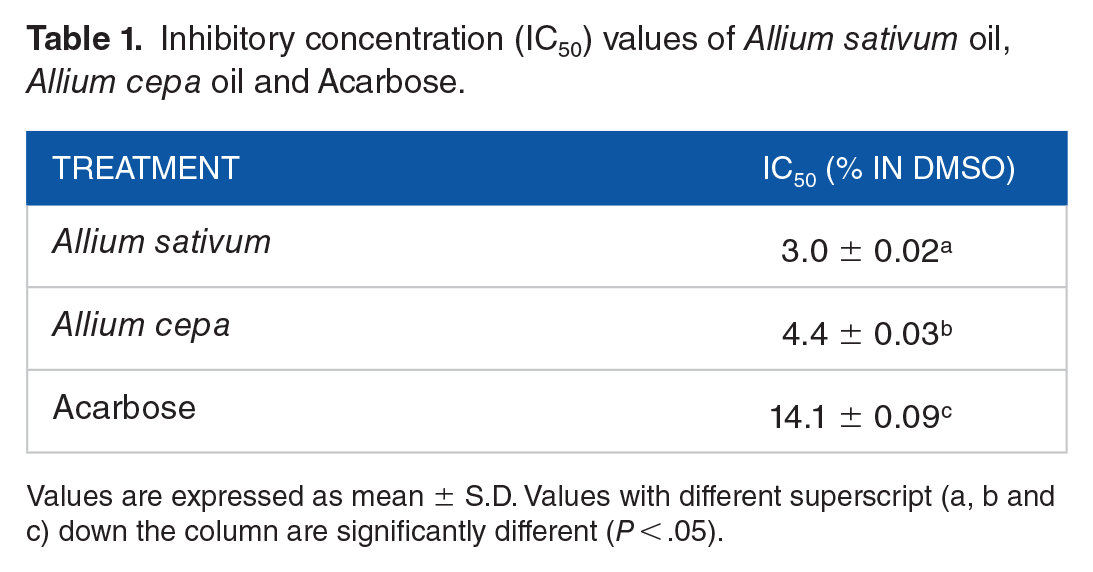
Values are expressed as mean ± S.D. Values with different superscript (a, b and c) down the column are significantly different (P < .05).
The Michealis-Menten plot (Figure 3) shows that the oils from A. sativum and A. cepa had decreased velocity at substrate concentration of 1 to 5 mg/ml when compared to the no inhibitor (no oil). The velocities of alpha amylase at various concentration, (when there was no inhibitor) was between 0.43 and 0.71 mM/min while that of A. sativum and A. cepa were between 0.32 and 0.46 mM/min and 0.32 to 0.48 mM/min respectively. The lineweaver-burk plot of both oils and that of the no inhibitor (no oil) were at the same point that is, their Vmax was the same but the Km of the 2 oils increased when compared to the Km when no inhibitor was present as shown in Figure 4. The values of the kinetic parameters obtained from the Lineweaver-Burk plot are shown in Table 2. The Vmax for A. sativum oil, A. cepa oil and the no inhibitor are 0.71 mM/min while their Km are 2.0 mg/ml, 1.8 mg/ml and 0.67mg/ml respectively.

Michaelis-Menten plot of Allium sativum oil, Allium cepa oil and acarbose.

Mode of inhibition of alpha amylase by onion oil and garlic oil using Lineweaver Burk plot.
Kinetic parameters of Allium sativum oil and Allium cepa oil obtained from lineweaver-Burk plot.

Discussion
The greater than 50% inhibition of α-amylase indicates that both oils are inhibitors of α-amylase and thus, can be used in the treatment of type II diabetes mellitus. The inhibition of α-amylase is important in the treatment of type II diabetes mellitus because its activity in the small intestine correlates to an increase in postprandial glucose levels. 28 Alpha amylase inhibitors prevent the breakdown of carbohydrate and are therefore effective means of lowering postprandial hyperglycemia. 23 It therefore impairs glucose metabolism without promoting insulin secretion in non-insulin dependent diabetes mellitus. 18 These oils can also be useful for other diabetic patients taking oral antidiabetic drug but need to keep their blood glucose level within a safe range.27,29-32 The non significant difference between A. cepa oil and acarbose in percentage alpha amylase inhibition at higher concentration suggests a similar mechanism of inhibition. This might be due to the presence of flavonoids in A. cepa oil. 13 Flavonoids have been reported to have alpha amylase inhibitory potential and its mechanism of action is similar to acarbose.33,34 The α-amylase inhibitory potential of garlic oil might be due to the sulfur containing compounds reportedly present in the oil. 35 These compounds have been reported to have alpha amylase inhibitory activity. The lower IC50 value of these oils indicates that the oils are more potent than acarbose, the standard drug. A. sativum oil is more potent than A.cepa.
The decrease in velocity observed in the Michealis-Menten plot indicates that the oils decreased the enzyme activity. This further suggests that they oils are inhibitors of alpha amylase. The Lineweaver-Burk plot and the kinetic parameters obtained from it, indicates that Vmax of they 2 oils and the no inhibitor remains the same while the Km of the oils increased. This is characteristic of competitive inhibition. The standard drug, acarbose, is a competitive inhibitor of α- amylase. 36 Competitive inhibitors are effective because they are structural analog of the substrate and thus can bind to the active site of the enzyme. When they bind, they form an EI complex instead of ES complex, which prevents the enzyme from acting on its substrate (starch) and thus prevents it breakdown to smaller molecules and ultimately prevents the breakdown to glucose.
Conclusion
Allium sativum (garlic) oil and Allium cepa (onion) oils are competitive inhibitors of alpha amylase. Allium sativum oil is more potent than Allium cepa oil. Both oils can be used in the treatment of type II diabetes mellitus.
Footnotes
Funding:
The author(s) received no financial support for the research, authorship, and/or publication of this article.
Declaration of conflicting interests:
The author(s) declared no potential conflicts of interest with respect to the research, authorship, and/or publication of this article.
Authors contribution
MUA designed the experiment and drafted the manuscript, AI and NJD carried out the experiment, HSM participated in drafting the manuscript. All authors read and approved the final manuscript.
