



Abstract
Infective endocarditis is a deadly disease, associated with high mortality and morbidity. We present a case of a 14-year-old boy with antibiotic-resistant infective endocarditis who was treated with classical homeopathy. The case is analyzed according to the general reactivity of the organism and the Levels of Health theory.
Introduction
Infective endocarditis (IE) is an infectious-inflammatory disease of the endocardium and/or heart valves due to invasion with bacteria or fungi, resulting in a polypous—ulcerative lesion of the heart structures, involving systemic inflammation, accompanied by thrombohemorrhagic and immune complex extracardiac manifestations. 1 Infective endocarditis is a deadly disease2,3; its annual incidence ranges from 1.5 to 15 cases/100 000 inhabitants, displaying a significant international variation. 4 Despite improvements in its management, IE remains associated with high mortality (8.2%) and severe complications. 5 The in-hospital mortality rate of patients with IE varies from 15% to 30%.5 -7
The complications of IE include cardiac (heart failure, perivalvular abscess, pericarditis, myocardial perforation etc.), metastatic, neurologic, renal, musculoskeletal, and pulmonary complications, as well as complications related to systemic infection (including septic embolization, metastatic infection, and mycotic aneurysm). The neurologic complications include embolic stroke, brain abscess or cerebritis, purulent or aseptic meningitis, acute encephalopathy, meningoencephalitis, cerebral hemorrhage (due to stroke or a ruptured mycotic aneurysm), seizures etc. Symptomatic cerebrovascular complications occur in up to 35% of patients. Silent cerebrovascular complications (including ischemia and microhemorrhage) may occur in up to 80% of patients, whereas more than one complication can occur simultaneously. 8
Staphylococcus aureus is the most common pathogen (57%), followed by the viridans group of streptococci (20%), other streptococci (5%), and coagulase-negative staphylococci (14%). 9 Blood culture negative IE (BCNIE) refers to IE in which no causative microorganism can be grown using the usual blood culture methods. BCNIE can occur in up to 31% of all cases of IE. 10 Echocardiography, either transthoracic echocardiography (TTE), or transoesophageal echocardiography (TOE), is the technique of choice for the diagnosis of IE, and plays a key role in the management and monitoring of these patients. 11
As this is a particularly complex pathological condition, its treatment requires the close collaboration of a multidisciplinary team, which will determine the initial diagnostic investigations and conservative treatment, as well as the selection of patients who will undergo surgery to repair the damage that has already been caused. In any case, the decision on the type of therapeutic intervention should be individualized. 12 To our knowledge, no other case of successful treatment of the disease with the help of classical homeopathy has been published.
Levels of Health Theory
The Levels of Health Theory was developed by the author of this paper (Prof. George Vithoulkas), whose clinical observations were proven by many other physicians—homeopaths,13 -17 who have shown that patients suffering from severe degenerative pathology rarely develop ordinary acute diseases with high fever. According to the Levels of Health Theory, there are 4 groups and 12 levels of health (LH).18 -20
Group A consists of people possessing high reactivity and who have the strongest resistance of the body. The chronic diseases in this group are mild, and acute diseases which are accompanied by high fever and usually cause no complications, appear rarely.
In group B, the reactivity increases and acute inflammation becomes necessary for the organism to prevent or to fight chronic pathology. Patients in group B suffer from deeper chronic diseases, with more frequent acute states, followed by complications requiring treatment.
However, beginning with the seventh level of group C, downward to the levels 8 and 9 of this group and to the levels of 10 to 12 of group D, one can observe a significantly different state of the organism. A number of deep chronic pathologies develop against the background of drastically lowered reactivity. Either patients no longer get the common cold, flu, otitis, and so on, or diseases that are normally acute present with unclear characteristics with no febrile temperature.
Patients belonging to group D are incurable sufferers with unfavorable treatment prognoses and have the shortest life expectancies 18,20.
Today LHT is a scientific basis for the prognosis of further development of the disease, patient reactions during treatment and estimation of the therapeutic efficiency. It is impossible to overestimate the importance of LHT in the daily practice of modern physician-homeopaths.
Case Presentation
Patient A. M., a 14-year-old boy, was brought to Novosibirsk Center of Homeopathy by his mother and attending physician—homeopath on 24.03.12 complaining of hectic fever which varied from 37.5°C up to 40.5°C every day, during the prior 6 months.
Case history
The boy was born healthy and received all the scheduled vaccinations during the first 2 years of his life (Figure 1). At 2.5 years old he started developing frequent acute infections. He suffered from pneumonia twice in November 2000 (2.5 y.o.) and in March 2001 (3 y.o), he was treated with antibiotics. When he was between the ages of 3 and 5 years he had recurrent bronchitis again and was treated with antibiotics. At the age of 9 years the boy fell ill with scarlet fever. Then, in November 2007 (9.5 years old) he developed severe sinusitis, was hospitalized, and was again treated with many antibiotics. A few months later (January 2008) he developed fever up to 40°C, every day along with dyspnea while walking stairs. Those symptoms continued for approximately 2 months; therefore on 04.03.08 (9 years 8 months old) the boy was hospitalized in the cardiologic department of Novosibirsk Paediatric City Hospital.

The development of the disease.
Ultrasound showed new and some old bacterial vegetations on the mitral valve leaflets. The boy was diagnosed with infective endocarditis, and received a prolonged antibacterial treatment. His tonsils and adenoids were removed. After being discharged, the boy received bicillinum for 1 year. Nevertheless, the sub febrile state continued and the vegetations on the mitral valve remained. The boy was observed by the cardiologists in the Novosibirsk Scientific Center of Heart Pathology (from 10 to 12 y.o.) and received a few courses of antibiotics with very short effects. Nevertheless, the boy had low energy, fits of weakness with vertigo and dyspnea while walking stairs; his face was always very pale, and he could not attend physical training lessons at school. The bacterial vegetations on the mitral valve leaflets remained unchanged on ultrasound (Figures 2 and 3).

Unchanged bacterial vegetations on the mitral valve leaflets.

Unchanged bacterial vegetations on the mitral valve leaflets.
The patient’s mother decided to stop conventional treatment and commenced homeopathic treatment when the boy was 12 y.o. (October 2009). The boy received Arsenicum album CH30 and CH200 a few times, Lycopodium and some other remedies and felt better. However, in November 2011, he developed an acute enteric infection with diarrhea. After that the fever up to 39°C reappeared. Despite the fever the boy and his mother refused antibiotics and continued with homeopathy (Rhus toxicodendron 30CH, 200CH; Phosphorus 200CH; Natrum muriaticum 200CH, without any effect). In March 2012, the fever increased up to 40.5°C every day. Therefore, the doctor-homeopath applied for a homeopathic consultation that included 25 doctors on 24.03.12 in the Novosibirsk Center of Homeopathy.
Individualized homeopathic treatment
According to the principles of classical homeopathy the remedy must be similar to the totality of the most prominent physical and mental-emotional symptoms. At the same time, the remedy must have the most important general and local modalities of the patient, such as strong desires or aversions of some food, drinks an desire or intolerance of warmth/coldness, of the sun, craving for open air, etc. In case a physician manages to find the similimum to the actual symptoms and modalities of the patient, the defense system of the patient with the help of the correct remedy normalizes its reactivity and, by increasing the level of health, becomes resistant to the microorganisms affecting the body on the present health level. According to the LHT, the boy was born in the first LH, but went down the scale to the fifth level at the age of 2.5 y.o, and then to the sixth LH at the age of 9 y.o. (Figure 4). During correct homeopathic treatment we immediately expect that there will be an improvement of the health level and the termination of the process of the inflammation of the endocardium. Eventually, we expect this patient to return back up to first LH. The computer program for searching the homeopathic remedy (Radar software upgraded with Vithoulkas Expert System) gave 2 top remedies: (1) Lachesis and (2) Pulsatilla. Lachesis was prescribed as the first remedy (Figure 5), but it turned out to be a mistake. The next remedy, Pulsatilla, finally treated this patient. The process of homeopathic treatment and the reactions of the patient’s organism in detail are presented in Table 1.
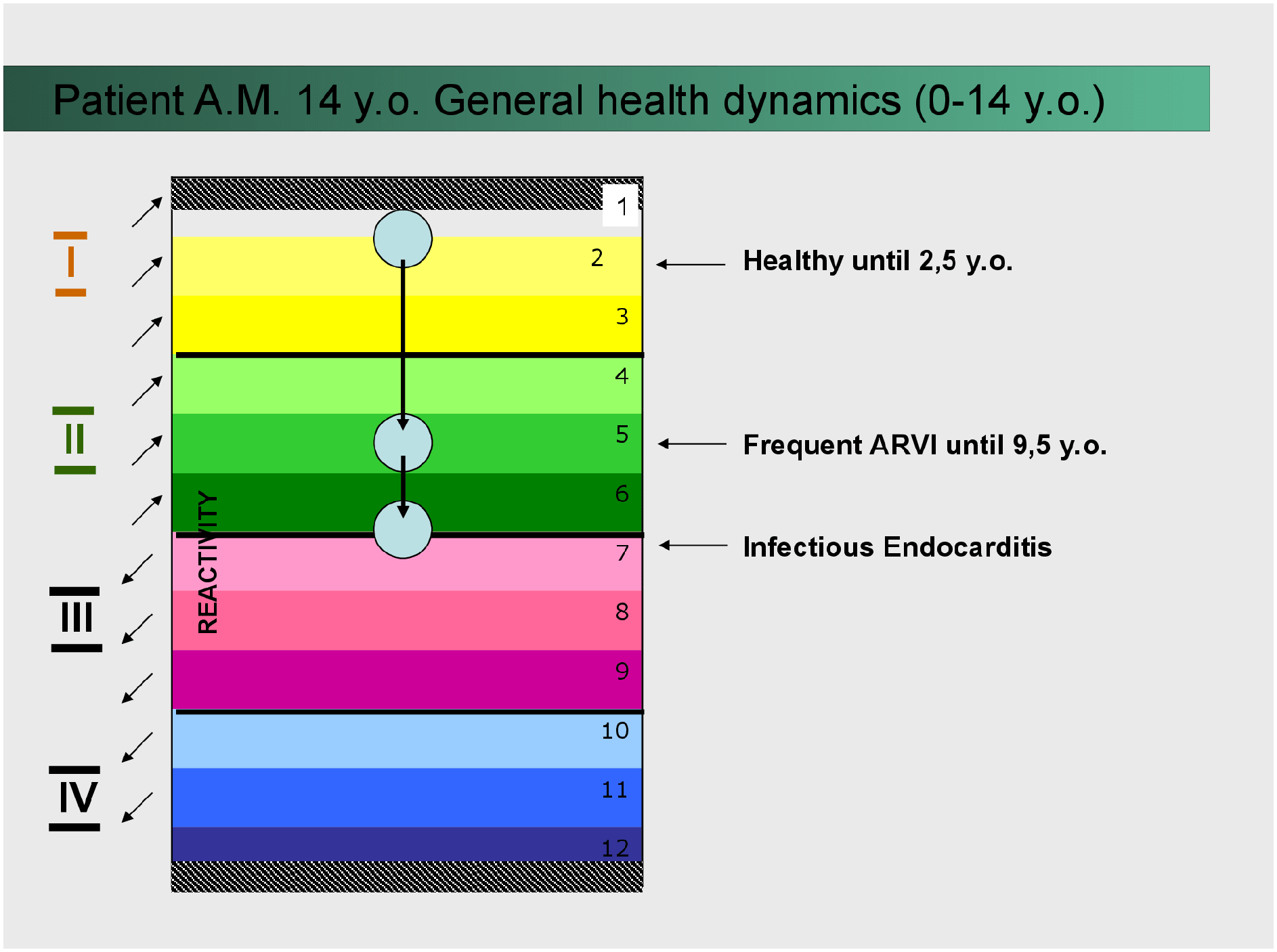
Patient’s general health dynamics.

The repertorization of the case.
The process of homeopathic treatment and the reactions of the patient’s organism.

Outcome
After the first remedy (Lachesis) the patient’s fever decreased from 40.5°C to 38.5°C to 39.0°C, and in some days the patient’s temperature was even lower than 37.2°C. However, we didn’t see further positive dynamics; moreover, the boy himself did not generally feel better. The attempt to prescribe higher potency of Lachesis (200CH, 1000CH) failed, no further amelioration occurred, but it produced its proving symptom—sharp pain in the region of heart, suggesting that the patient receive Spigelia to eliminate this disturbing pain. Proving symptoms occur as a result of some functional disturbances, which sometimes appear after administrating of homeopathic remedy, are always temporal, not dangerous and vanishing on its own, but if bothering the patient could be eliminated with another homeopathic remedy Therefore, the patient was hospitalized and received a 1 month treatment of antibiotics. The fever decreased to an almost normal temperature. Nevertheless, the patient the patient still did not recover. First, he was discharged with the same bacterial vegetations on the valves (Figure 6); second, the patient’s temperature was not completely normal during the next 4 months; and the dyspnea continued. Therefore, after the first acute respiratory infection (in September 2012) the temperature increased to 37.5°C. In this case we did not understand that Lachesis was similar but not the exact remedy, and we supposed that the potency was too high for the patient. Therefore, we decided to repeat the same remedy in lower potency, CH12. However, this aggravated the situation; the fever immediately increased to 39.6°C and the general condition of the patient worsened abruptly. Thus, we had to give another remedy and chose Pulsatilla keeping in mind the marked amelioration of the boy’s condition with cold open air, and his strong desire to open the window or to go outside. Such craving for open air is a famous and strong symptom of Pulsatilla together with others. In addition, Pulsatilla was the second suggestion of Homeopathic software (Radar, Archibel, Belgium, 10th version, on the basis of Synthetic Repertory maintaining VES—Vithoulkas Expert System), (Figure 5).

Unchanged bacterial vegetations on the valves.
Pulsatilla proved to be the correct remedy; the fever decreased immediately, and after 1 week of treatment the boy’s temperature and general condition completely normalized. Thus, a clinical recovery was achieved in just a few weeks; an ultrasound in April 2013 (6 months after Pulsatilla) still showed that there were some vegetations on the valves. However, 3 months later, in July 2013, an ultrasound showed some consolidation in the edges of leaflets, but no vegetations (Figure 7). Therefore, 10 months after Pulsatilla was given, recovery was proven by ultrasound examination. The follow-up of the case reached 10 years. The young man has been completely healthy until now and has had no need for retreatment with any remedy. The latest ultrasound examinations confirmed recovery (Figures 8 and 9).

No vegetations after the correct homeopathic remedy.
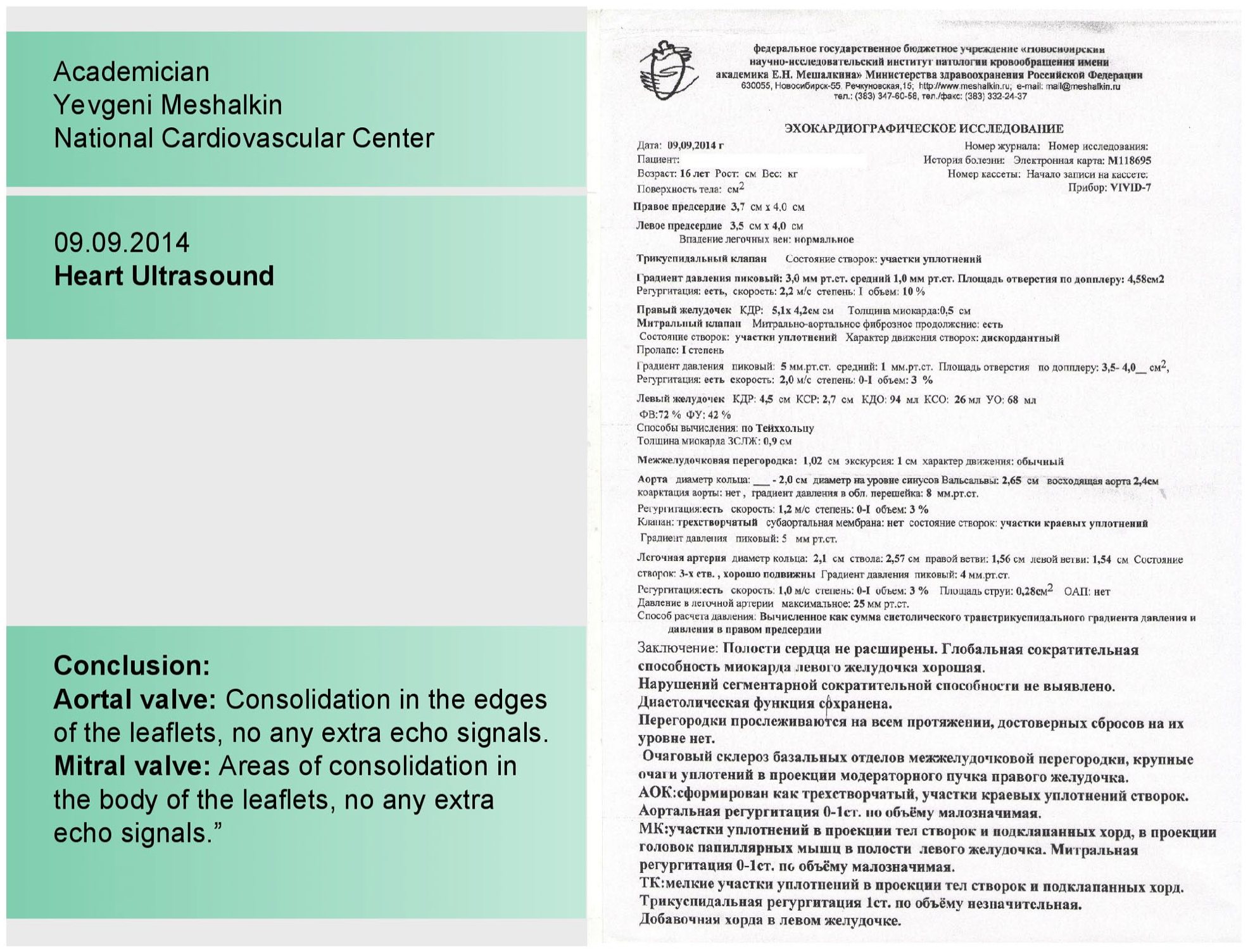
Latest ultrasound examinations.

Latest ultrasound examinations.
Discussion
There are a few interesting points to discuss in this case. First, the possibility is not only to treat such a serious pathology as IE, which was resistant to antibacterial therapy with persistent valvular vegetations during 5 years of preceding treatment. However, there is also the possibility of homeopathic remedy to completely restore the health of a patient, who had a very compromised immune system even before IE. This patient was born healthy to healthy parents (first level of health), but because of some external stressors (which we cannot discuss in the framework of this article), at the age of 2.5 years old, his immune system was affected, and the boy started to have different and frequent acute infections. Thus, even before he developed IE, his LH dropped down to level 5 (Figure 4). After the correct remedy, his immune system was immediately restored, was cured from IE and had only a few mild acute infections during 9 successive years of observation. That means his LH was lifted up to the one on which the boy was born (Figure 10).

Patient’s general health dynamic under treatment.
Obviously, the first prescribed remedy (Lachesis) turned out to be incorrect in this case. It did not prevent hospitalization with regular antibacterial treatment and eventually had no effect. All the local and general symptoms of the patient were the same after 6 months. The second attempt with low potency of Lachesis failed again. However, the correct remedy (“similimum”) Pulsatilla treated the patient immediately. From the point of view of the general reactivity of the organism, the interesting fact is the difference in the effect of the incorrect homeopathic remedy at the beginning of the treatment and after 6 months. Lachesis was not the exact remedy needed but was very much a similar remedy fitting all the main symptoms of the patient. After the first prescription of Lachesis Q30 every day and then C200 the patient improved—his fever went down from 40.5°C to 38.5°C and even less (20%-30% better). However, when we tried the higher potency (C1000) of the similar remedy, we did not see further amelioration. Instead, a new symptom developed that was quite disturbing for the patient (severe stitching pains in the heart region—a proving symptom of Lachesis). When we gave the Lachesis 12CH again after 6 months, an aggravation immediately followed, the fever increased to 40°C and the general condition worsened. Another attempt with Lachesis Q30 in this situation resulted in further aggravation without any subsequent amelioration. The situation became quite dramatic.
The question is why the same remedy (similar but not a similimum) produced so much different reactions in the same patient having the same symptoms and the same modalities. The most likely answer is because of the different initial states of the disease. When we gave a similar remedy at the peak of the disease (high fever), we obtained an amelioration of 20%. However, when we gave the same similar remedy in the low phase of the disease (fever 37.5°C), we obtained aggravation. However, this assumption needs further observations.
Homeopathy is individualized treatment. Each case of disease needs its individual remedy. Very often it’s difficult for the doctor to find the right remedy (exact “similimum”) in the very beginning of the treatment. Like in this case the first remedy Lachesis was wrong and didn’t benefit the patient. Pulsatilla was the right remedy. This is just observation, which could be useful for homeopaths who see different reactions when administrating not exact remedy to understand that the remedy was not exact.
Conclusion
LHT gives the possibility to assess the depth of compromise of the immune system of a patient, in order to make a prognosis of the further development of the disease and the patient’s reactions during treatment and to estimate the efficiency of therapy. Restoration of the initial LH of the patient confirms the correct treatment.
The curative effect of classical homeopathy in a serious case of antibiotic—resistant IE was demonstrated. Thus homeopathy is a useful approach to be considered among patients with infective endocarditis.
Footnotes
Funding:
The author(s) received no financial support for the research, authorship, and/or publication of this article.
Declaration of conflicting interests:
The author(s) declared no potential conflicts of interest with respect to the research, authorship, and/or publication of this article.
Author’s Contributions
Dr Chabanov was responsible for the treatment of the patient and the writing of the paper.
Dr Tsintzas contributed in the formatting and the submission of the paper.
Pr. Vithoulkas supervised the patient’s treatment along with the writing of the paper.
Informed Consent
The patient of the case report has given informed consent in order to publish the details of his medical history
