



Abstract
Objective
Modified risk tobacco products are emerging that potentially reduce risk or exposure to harmful chemicals compared to cigarettes. Strategies to communicate the risk of using these products can include using quantitative information. Numeracy, the ability to understand and work with numbers, can impact the how people consume and act upon this information. There is a paucity of information on how numeracy affects perceived risks of and tobacco product use.
Methods
In 2023, participants 18 or older (N = 1072), were recruited from a commercial survey panel and completed an online questionnaire that assessed numeracy-related variables, tobacco use, and experiential, affective, and deliberative aspects of perceived cancer risk. Mediation and logistic regression models were conducted to examine the interrelationships between numeracy, risk perception, and tobacco use.
Results
The relation between numeracy and tobacco use was mediated by experiential, affective, and deliberative aspects of cancer risk (eg, increasing preference in numbers when being told the chance of something happening was associated with lower deliberative and higher affective/experiential risk perceptions, which translated into lower (for deliberative) and higher (for experiential) likelihood of no past 30-day cigarette use (ab = 0.014, P = 0.005)). The association between numeracy and risk perception differed by tobacco use status.
Conclusion
Results suggest that numeracy-related variables, and specifically individuals’ preferences in how they obtain risk information, are associated with risk perception which in turn is associated with tobacco use. These findings provide evidence to inform the development of educational programs designed to incorporate different numeracy levels that target specific constructs of risk perceptions associated with tobacco use.
Introduction
As the prevalence of smoking cigarettes has declined, 1 there has been remarkable increase in the use of alternative tobacco products, including electronic nicotine delivery systems (ENDS), smokeless tobacco, and oral nicotine products. 2 Some of these products have received the modified risk tobacco products (MRTP) designation, meaning the product significantly reduces harm and the risk of tobacco use-related disease among individuals and likely the population as a whole. 3 Currently authorized MRTP include General Snus, Copenhagen moist snuff, and IQOS heated tobacco. No ENDS products, to date, have received the MRTP designation.
Strategies to communicate the risk of using tobacco products often include the use of quantitative information to explain the likelihood that using a product will result in disease or to explain the reduction of disease risk when quitting or when switching from cigarettes to another product.4-6 The nature of these communications require skills and abilities related to numeracy can impact the way in which people consume or apply this information. 7 Numeracy is the ability to understand and work with numbers, including the ability to compare numerical magnitudes. 8 Objective numeracy is the ability to solve mathematical problems while subjective numeracy reflects attitudes and preferences for consuming math and statistics, 9 which can include data related to the perception of risk.
Previous literature has demonstrated that numeracy can affect risk perception. People with lower subjective numeracy (eg, difficulty understanding medical statistics) often demonstrate lower levels of knowledge about cancer risk and prevention, and express more worry about getting cancer compared to people with higher subjective numeracy. 10 Numeracy also significantly influences the effects of risk perceptions. 11 Specifically, individuals with lower scores on a numeracy scale perceive medication as less risky when the risk information is in a percentage vs frequency format. 11 Individuals with higher scores on this numeracy scale perceive similar risks in both formats. 11
Risk perceptions impact initiation, cessation, and the frequency and intensity of tobacco use, as well as the propensity to switch from one tobacco product to another. 12 Numbers and probabilities are often used to influence risk perceptions through advertising, packaging, warning labels, and educational interventions. 12 People who have lower numeracy or lower subjective numeracy are likely to consume and apply this information differently than people with higher numeracy. Risk perceptions can be categorized differently.13-15 The TRIRISK model divides risk perception into 3 latent constructs and has been shown to have improved predictive validity compared to models with 1 or 2 risk perception constructs. 16 Deliberative risk perceptions are arrived at through systematic, logical, and rule-based thought or discussion. 12 Affective risk perceptions are grounded in an emotional response associated with risk. Worry or anxiety about a threat is considered to be an affective response. 12 Experiential risk perceptions are rapid judgments made by integrating deliberative and affective information. 12 The TRIRISK model was previously validated for use in the tobacco research context 17 and allowed for consistent use of a risk perception measure.
Because numeracy can impact risk perception, and risk perception is known to be associated with tobacco use behaviors,18,19 there is a possibility that differences in numeracy may have a significant indirect (or mediated) effect on tobacco use. The objectives of this study are to determine the role of numeracy on tobacco use by: (1) examining whether numeracy exerts its effect on tobacco use through affective, deliberative, and/or experiential components of risk perception; and (2) examining whether the relationship between numeracy and risk perception differs by tobacco use status. Understanding the possible mediating role of risk perception could inform the development of educational programs designed to incorporate different numeracy levels and how risk perception constructs can be targeted with tobacco product use risk messaging. Such insights could lay the foundation for more nuanced educational and intervention strategies, ensuring they are effective for both groups. While numerical risk estimates for many novel tobacco products remain limited,20,21 understanding how individuals interpret and apply numerical information is still critical. Regardless of the source or reliability of specific risk statistics, individuals can encounter numeric data in the form of comparative risk claims, marketing materials, or health education messages. As such, research on numeracy can inform how people cognitively engage with these messages, even when risk estimates are evolving or incomplete. This is particularly important in a dynamic regulatory environment, where communication may influence perceptions of harm and subsequent tobacco-related behavior.
Methods
Data
The data for this secondary analysis were obtained from a web-based survey sample collected in 2023. The purpose of this study was to learn about consumer perceptions and intentions to use various tobacco and nicotine products (including cigarettes, ENDS, heated tobacco products, and oral nicotine products (ONPs, which includes smokeless tobacco and nontobacco nicotine products). The survey was conducted fully online and included participants from commercial consumer panels recruited from across the U.S. (Prime Panels through Cloud Research). The study protocol was approved by the Institutional Review Board (IRB) and a review committee on the protection of human participants. Click through informed consent was obtained from the study participants where they did see an information sheet that explained risks/benefits per the IRB protocol, and they had to confirm they’d read that to move on. More information on the survey design can be found elsewhere. 22
Sample
Panelists were invited by email and completed a brief screening survey to measure tobacco use status. The survey was opened to participants on February 15, 2023, and closed on February 26, 2023. 22 Regarding inclusion and exclusion criteria, the survey aimed to recruit a total of 1020 participants across the following tobacco use groups (170 in each group): no tobacco product use, cigarette use, ENDS use, smokeless/ONP use, multiple product use. Sample size was based on a power calculation using one-way ANOVA, which is a special case of GLM. One-way ANOVA was used to assess the effect of ONP ads on risk perception. A 6 × 6 (tobacco status X ad) two-way ANOVA was tested to examine whether the effect of the ad is moderated by tobacco use status. Of the 1526 participants who began a survey, a total of 1132 participants completed a survey (179 who use cigarettes only, 174 who use ENDS only, 195 who use ONPs only, 232 who use multiple products, and 352 who use no products). 22 The sample for this secondary analysis consisted of adults (n = 1072) who responded to all the numeracy questions. A priori power analysis based on a small-to-moderate effect size (Cohen’s f = 0.20) indicated that a sample size of 1000 would provide >98% power to detect main effects and 83% power to detect interactions (α = 0.025) in a 6 × 6 two-way ANOVA design; the final analytic sample (n = 1072) met this threshold.
Measures
Demographics and Other Covariates
Age (18-24, 25-36, 37-50, 50+), gender (man, woman, Nonbinary, Transgender, prefer not to answer), race/ethnicity (Non-Hispanic White, Non-Hispanic Black, Hispanic, other), income (living comfortably, getting by, finding it difficult, finding it very difficult), and education (less than h12 years, no diploma, HS or GED, Post HS other than college, some college and no degree, Associates degree, Bachelor’s degree, Advanced degree), were examined.
Numeracy-Related Measures
This study included 3 subjective and 2 objective numeracy-related measures. For the objective measures, participants were asked “Which of the following represents the biggest risk of getting a disease?” with response options of 1 in 100, 1 in 1000, and 1 in 10. Participants were also asked “Imagine that we roll a six-sided die 1000 times. Out of 1000 rolls, how many times do you think the die would come up even (2, 4, or 6)?” with an open-ended response accepting any number between 0 and 1000 measures were recoded for analysis purposes. Because these objective measures are either correct or incorrect, the responses were dichotomized for the mediation and moderation models. Overall objective numeracy scores created by averaging the sum number correct (final scale is 0 to 1, with 1 indicating higher objective numeracy).
Subjective numeracy was assessed by 3 items (modified from measures used in the Health Information National Trends Survey (HINTS)- a nationally representative data set 23 ): “In general, I feel comfortable with health information that has a lot of numbers and statistics.” with response options being on a 0 to 5 scale where 0 was strongly agree and 5 was strongly disagree; “When people tell you the chance of something happening, do you prefer that they use words (it rarely happens) or numbers (there’s a 1% chance)?” with response options on a scale from 0 to 6 where 0 was always prefer words and 6 was always prefer numbers; and “When you hear a weather forecast, do you prefer predictions using percentages (eg, there will be a 20% chance of rain today) or predictions using only words (eg, there is a small chance of rain today)?” with response options on a scale from 0 to 6 where 0 was always prefer words and 6 was always prefer percentages. The subjective measures were recoded so that higher ratings represented greater preference for or comfort with numbers. No overall subjective measure was created due to the low inter-relatedness of the subjective items (Cronbach’s Alpha = 0.35).
Risk Perception Measures
The TRIRISK model, was of interest (modified from a validated questionnaire16,17). A full list of the questionnaire items can be found in Supplemental Table 1. For the mediation analysis, the TRIRISK model was used in its original and intended form, as a latent construct. Prior approaches were replicated for the factor analysis16,17 of the TRIRISK model. More details on this, along with the factor loadings, can be seen in the Supplemental Table 1. However, for the moderation analysis, observed variables for each of the 3 risk perception constructs (deliberative, affective, and experiential) were created and used. More detail on how the TRIRISK constructs were converted to observed variables can be seen in the supplemental materials.
Tobacco Use Measures
There were 3 measures of past 30-day current use vs non-current use for cigarettes, ENDS, and ONPs. There was one measure of products used in the past 30-days with response options of cigarettes only, ENDS only, ONPs only, multiple products, or no products. While past 30-day use of cigarettes, ENDS, and ONPs was measured independently and not mutually exclusive, the ‘multiple product’ variable was created to classify participants into 5 mutually exclusive categories: cigarettes only, ENDS only, ONPs only, multiple products (more than one product), or no products, consistent with prior tobacco surveillance research.
Analysis
All analyses were done in SAS. Statistical significance was determined based on an alpha value of less than 0.05.
Descriptive statistics were analyzed for the demographic, tobacco use behavior, and numeracy variables. Chi square and ANOVA tests were used to examine the associations between these factors. The associations between the demographic variables and numeracy were explored to determine which covariates should be included in the models of interest. Specifically, a demographic variable was included in the model of interest if it was significantly associated with the respective individual numeracy measure (P < 0.05).
Mediation Analysis
Mediation models were used to examine whether numeracy exerts its effect on tobacco use through affective, deliberative, and/or experiential components of risk perception. A mediation model links a putative cause to a presumed effect at least in part through one or more additional variables. The relations between the numeracy measures and the TRIRISK model (in its latent form) was examined using the ‘calis’ command in SAS. Specifically, models were run for all 5 numeracy questions individually (3 subjective, 2 objective) and for the overall objective numeracy measures developed. Each of these were included as covariates with each of the 3 tobacco use variables as the outcomes (cigarette, ENDS, ONPs past 30-day current vs noncurrent use). The past 30-day use of multiple product questions was not used as an outcome for these models since ‘proc calis’ cannot be used with nominal variables with more than 2 categories. 24 These models adjusted for age, gender, race, education, and income. To ensure the model converged, 500 iterations were specified. For the purposes of this paper, the models examined are those with a significant unstandardized indirect effect term. The effects and P-values for the relationships of interest in these models are presented as such: c = total, c’ = direct, ab = indirect.
Moderation Analysis
Moderation is another potential relationship that could exist between numeracy, risk perception, and tobacco use. Moderation models, operationalized as models with an interaction effect between 2 variables, examine whether or not the effect of the putative cause depends on the value(s) of another variable, the putative moderator. 25 The relationship between the numeracy variables and the observed scales for deliberative, affective, and experiential risk perceptions (separately) were examined with the tobacco use variables as the moderator. To examine these models, logistic regression models were run where the risk perception variables were the outcomes and the numeracy measures, smoking status, and the interaction between the numeracy measure and smoking status were the covariates of interest. These models also adjusted for the covariates of interest (age, gender, race, education, and income). The estimates for the relationships between numeracy and risk perceptions for people who currently AND formerly smoke were examined. A significant interaction term suggests that the effect of the numeracy variable on the risk perception variable differs depending on which tobacco use group is of interest.
Results
Descriptive Statistics
Sample Descriptive Statistics

aResponses on a slider scale.
Numeracy and Smoking Status Mediated by Risk Perception
The indirect relationship between preferring weather as words or percentages and no past 30-day cigarette use mediated by the TRIRISK model was significant (Figure 1A-F) (Figure 1A, ab = −0.012, P = 0.012). This can be interpreted as 2 individuals who differed on preferring weather as words or numbers are estimated to differ in past 30-day cigarette use as a result of an increasing preference of numbers being associated with increasing deliberative responses and decreasing affective and experiential responses (a = 0.080, P < 0.001/a = −0.159, P < 0.001/a = −0.186, P < 0.001, respectively), which in turn (for deliberative and experiential) are related to lower likelihood of not using cigarettes in the past 30-days (b = −0.244, P < 0.001/ b = −0.044, P < 0.001). The relationship between preferring weather as words or percentages and past 30-day cigarette use was statistically significant for both direct (c’ = -0.027, P = 0.004) and total (c = −0.039, P < 0.001) effects. The other models can be interpreted in a similar fashion but for brevity purposes, the main results of these models can be summarized as follows: • Figure 1B: Increasing preference in chance as numbers was associated with lower deliberative risk perceptions and higher affective and experiential risk perceptions which is associated with lower (for deliberative) and higher (for experiential) likelihood of no past 30-day cigarette use (ab = 0.014, P = 0.005). • Figure 1C: Increasing comfortability with health information that contains statistics was associated with higher deliberative risk perceptions and lower affective/experiential risk perceptions which translated into lower (for deliberative and experiential) likelihood of no past 30-day cigarette use (ab = −0.016, P = 0.037). • Figure 1D: Increasing preference in chance as numbers was associated with higher affective/experiential risk perceptions which translated into lower (for deliberative and experiential) likelihood of no past 30-day ENDS use (ab = 0.009, P = 0.045). • Figure 1E: Increasing preference in weather as percentages was associated with higher deliberative risk perceptions and lower affective/experiential risk perceptions which translated into lower (for deliberative, affective, and experiential) likelihood of no past 30-day ONP use (ab = −0.009, P = 0.014). • Figure 1F: Increasing preference in chance as numbers was associated with lower deliberative risk perceptions and higher affective/experiential risk perceptions which translated into lower (for deliberative) likelihood of no past 30-day ONP use (ab = 0.010, P = 0.011). Mediation Models.

Numeracy and Risk Perception Moderated by Tobacco Use
Regression Results
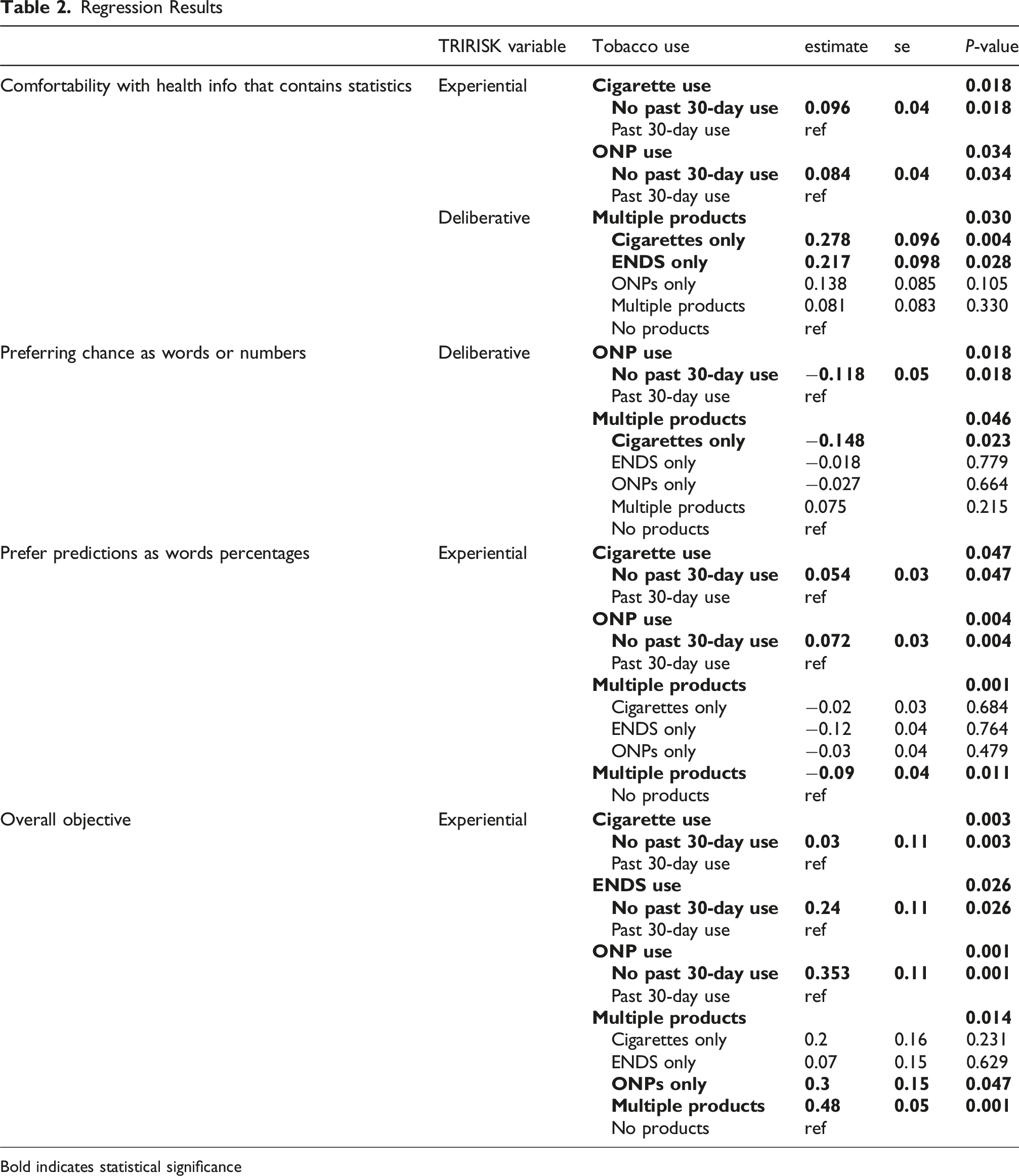
Bold indicates statistical significance
The relationship between preferring chance as words or numbers and deliberative risk perception differed by ONP use. The association was negative for those who have not used ONPs in the past 30 days compared to those who have (B = −0.118, P = 0.018). Regarding multiple product past 30-day use, the relationship between preferring chance as words or numbers and deliberative risk perception was negative for those who have used cigarettes only (B = −0.15, P = 0.023) in the past 30 days compared to those who have used no products. There was no statistically significant difference between those who have not used any products in the past 30 days and those who have used ENDS only (B = −0.02, P = 0.779), ONPs only (B = −0.03, P = 0.664), and multiple products (B = 0.08, P = 0.215) in the past 30 days.
Regarding past 30-day product use, the relationship between preferring weather predictions as words or percentages and experiential risk perceptions was positive for those who have not used cigarettes (B = 0.05, P = 0.047) and ONPs (B = 0.07, P = 0.004) in the past 30 days compared to those who have. Regarding multiple product past 30-day use, the relationship between preferring weather predictions as words or percentages and experiential risk perceptions was positive for those who have used multiple products in the past 30-days compared to those who have used no products in the past 30 days (B = 0.04, P = 0.011). There was no statistically significant difference between past 30-day only cigarette (B = −0.02, P = 0.684), ENDS only (B = −0.12, P = 0.764), and ONP only (B = −0.03, P = 0.479) use compared to no past 30-day product use.
Regarding past 30-day product use, the relationship between overall objective numeracy and experiential risk perceptions was positive for those who have not used cigarettes (B = 0.03, P = 0.003), ENDS (B = 0.24, P = 0.026), and ONPs (B = 0.35, P = 0.001) in the past 30-days compared to those who have. Regarding multiple product past 30-day use, the relationship between overall objective numeracy and experiential risk perception was positive for past 30-day ONP only (B = 0.30, P = 0.047) and multiple product (B = 0.48, P = 0.001) use compared to no past 30-day product use. There was no statistically significant difference between past 30-day only cigarette (B = 0.20, P = 0.231) and ENDS only (B = 0.07, P = 0.629) use compared to no past 30-day product use.
The moderation results for the individual objective numeracy measures can be seen in Supplemental Table 2. The results for the overall objective measure are similar to that of the individual measures.
Discussion
Overall, the results suggest that deliberative, affective, and experiential aspects of risk perception, based on the TRIRISK model, mediate the relations between subjective numeracy and current cigarette use. The relations between both subjective and objective numeracy and the TRIRISK constructs differed by current tobacco use status. However, the relationship between past 30-day ENDS use/past 30-day ONP use and the individual subjective numeracy measures was not consistently mediated by the TRIRISK mode. Specifically, increasing preference in chance as numbers was associated with lower deliberative risk perceptions and higher affective/experiential risk perceptions. Given that deliberative risk perceptions are more logical while affective is emotional, and experiential integrates the two, this finding emphasizes the importance of distinguishing not only between objective and subjective numeracy, but also the specific type of subjectivity. An individual’s specific preference in obtaining certain types of risk information can influence risk perception which in turn can influence cigarette use. While preferring weather as percentages can suggest a person’s feelings towards numbers generally, preferring chance as numbers can suggest a person’s feelings towards numeric risk communication more specifically. Preferences of risk information as numbers was associated with a greater likelihood of no past 30-day ENDS use, but the association with preferring weather as percentages was not statistically significant. Being comfortable with health statistics was associated with a lower likelihood of no past 30-day cigarette use. These findings, and the finding that objective numeracy did not mediate the relationships of interest, illustrate a complex interplay between different manifestations of numeracy and risk perceptions.
Higher scores on subjective and objective numeracy (specific to the type of numeracy) tended to be associated with higher experiential risk perceptions among individuals who have not used tobacco products in the past 30 days. There were no statistically significant results for affective risk perceptions and only a few for deliberative. Together, these results reveal that while numeracy has complex and indirect relationships with tobacco use status. Individual measures demonstrate different patterns of associations, but still have the potential to be used to improve targeted risk communications. Subjective numeracy seems a diffuse concept with multiple measures not strongly intercorrelated, whereas an overall objective numeracy measure can be representative of the individual measures. Key findings emphasize the importance of distinguishing between objective and subjective numeracy and the type of subjective measures being examined. Preferences for risk information in numerical formats was associated with a higher likelihood of not using tobacco products, while comfort with health statistics was associated with past 30-day cigarette use. Understanding these nuanced relationships can help inform the design of effective communication strategies that resonate with individuals at different numeracy levels and that potentially address different aspects of risk perception.
These findings build on prior work suggesting that numeracy is an important, but complex, factor in health risk communication and behavior.11,26,27 and extend this literature by demonstrating that subjective numeracy preferences, especially those reflecting comfort and format preference, are differentially associated with risk perception dimensions and, in turn, tobacco use status.
The implications of this study include potentially informing public health strategies and educational interventions that decrease tobacco use or initiation. These findings have relevance even in the context of ongoing scientific and regulatory uncertainty regarding tobacco product risks. While numerical risk estimates, particularly for newer products like ENDS or heated tobacco, may be limited or debated, individuals can still be exposed to quantitative or qualitative risk messages in various forms. This underscores the importance of understanding how numeracy interacts with perception and behavior. Rather than assuming numeric information is uniformly interpreted, this study highlights that individual numeracy preferences and skills may shape how such information is received, trusted, or acted upon. These insights can guide the development of communication strategies that are transparent about uncertainty while remaining sensitive to diverse numeracy profiles. By examining how risk perception may mediate the relationship between numeracy and tobacco use, these insights can inform the development of educational programs designed to cater to diverse numeracy levels. These results suggest that targeting specific types of risk perceptions—such as deliberative, affective, and experiential, can be impactful. For example, increasing preferences for chance as numbers was associated with lower deliberative risk perceptions but higher affective and experiential risks. This then translated into lower (for deliberative) and higher (for affective and experiential) likelihood of no past 30-day cigarette use. By identifying which types of risk perceptions can be effective at influencing specific behavior change, interventions can be tailored to address differing numeracy levels and the target specific types of risk perceptions.
Strengths, Limitations, and Future Research
This study combined numeracy, risk perception, and tobacco use variables together in a cohesive analysis so that influences of these relationships on one another can be examined. This analysis was cross sectional in nature; the results were interpreted as associations and no clear pattern of influence could be established. Given that this is a novel area of research, these associations are informative and can provide a foundation for future studies. There are limitations associated with the model used to examine mediation. There is not a clear foundation for defining causal mediation effects, interaction effects cannot be examined effectively, and binary outcomes and binary mediators are not treated in a unified fashion. Given that this analysis used a general model, these limitations are not a concern. For mediation and moderation analyses, there were multiple models run, but multiple tests were not adjusted for. Strengths of this study include that the risk perception model examined here extended a previously validated model of risk perception. The results combined indicate that not only is the TRIRISK model an appropriate risk perception to model in the context of tobacco control, but that is also is related to numeracy in the context of tobacco use. Future studies should continue to examine these interrelationships and should examine how specific numeracy and risk perception constructs can be targeted for effective tobacco risk communication.
Conclusion
This study adds to the field of tobacco control because to our knowledge, this is the first study to examine both mediation and moderation in the specific context of objective and subjective numeracy, risk perception, and tobacco use. The interrelationships of these factors individually have been studied but we combine them into a cohesive flow to examine whether the associations are related on one another. While we acknowledge that a stronger foundation of independent and robust quantitative risk estimates for tobacco products, particularly newer ones, remains an important public health priority, our findings are relevant in the context of individuals already being exposed to numerical risk information in existing communications, policy documents, and media. Understanding how people interpret and act on such information, even amid uncertainty, is essential for designing more effective, equitable, and transparent tobacco risk communications. This study offers an important early contribution to that effort by illuminating how numeracy and risk perception interact in shaping tobacco-related behaviors.
Supplemental Material
Supplemental Material - Exploring Interrelationships Among Numeracy, Cancer Risk Perceptions, and Tobacco Product Use
Supplemental Material for Exploring Interrelationships Among Numeracy, Cancer Risk Perceptions, and Tobacco Product Use by Destiny Diaz, Maansi Bansal Travers, Brian V. Fix, Kristopher Attwood, Christine E. Sheffer, Andrew Hyland, and Richard J. O’Connor in Tobacco Use Insights.
Supplemental Material
Supplemental Material - Exploring Interrelationships Among Numeracy, Cancer Risk Perceptions, and Tobacco Product Use
Supplemental Material for Exploring Interrelationships Among Numeracy, Cancer Risk Perceptions, and Tobacco Product Use by Destiny Diaz, Maansi Bansal Travers, Brian V. Fix, Kristopher Attwood, Christine E. Sheffer, Andrew Hyland, and Richard J. O’Connor in Tobacco Use Insights.
Footnotes

Author Contributions
DD contributed to the analysis, interpretation of the results, and to the writing of the manuscript. RJO and BVF contributed to the data collection and revision of the manuscript. MBT, KA, CES, and AH contributed to the revision of the manuscript.
Funding
The authors disclosed receipt of the following financial support for the research, authorship, and/or publication of this article: DD was supported by National Cancer Institute (1F99CA274655-01). Data collection was supported by a grant from the Roswell Park Alliance Foundation.
Declaration of Conflicting Interests
The authors declared no potential conflicts of interest with respect to the research, authorship, and/or publication of this article.
IRB Protocol
The study protocol was approved by the Institutional Review Board (IRB) at the Roswell Park Comprehensive Cancer Center (I 1389821).
Supplemental Material
Supplemental material for this article is available online.
References
Supplementary Material
Please find the following supplemental material available below.
For Open Access articles published under a Creative Commons License, all supplemental material carries the same license as the article it is associated with.
For non-Open Access articles published, all supplemental material carries a non-exclusive license, and permission requests for re-use of supplemental material or any part of supplemental material shall be sent directly to the copyright owner as specified in the copyright notice associated with the article.
