




Abstract
Background
In India, tobacco use is a serious public health concern that affects many adults and teenagers. Tobacco sales to minors continue despite strict laws under the Cigarettes and Other Tobacco Products Act (COTPA). Strengthening enforcement and lowering teenage tobacco exposure need an understanding of tobacco sellers’ knowledge, attitudes, and practices (KAP) regarding these restrictions.
Objectives
The purpose of this study is to evaluate tobacco vendors knowledge, attitudes, and behaviors around selling tobacco products to school-age children and teenagers in Jaipur, India.
Design
A cross-sectional study was conducted among tobacco vendors in Jaipur, India.
Methods
A scheduled method was used to recruit 50 tobacco vendors in total. A systematic questionnaire created by the investigator was used to gather data, and a scoring system was used to evaluate KAP. SPSS version 29 was used to conduct statistical analyses, with significance set at P < 0.05. These analyses included the Kruskal-Wallis test, Spearman correlation, and chi-square test.
Results
While the attitude score was very high (19.76 ± 2.58), showing a favorable opinion of smoke control laws, the mean knowledge score was 6.64 ± 1.27, indicating modest awareness. But there was a discrepancy between awareness and actual compliance, as indicated by the practice score (14.76 ± 2.08). Age-related declines in knowledge scores (P = 0.26) and practice scores (P = 0.03) were significant. Weak correlations between KAP components were shown by correlation analysis, indicating that awareness and attitude had little impact on regulatory compliance.
Conclusion
Upholding children against tobacco exposure requires more education, behavioral treatments, community awareness campaigns, and more stringent enforcement of tobacco legislation.
Introduction
Tobacco, a historically significant commodity, has long influenced the development of major empires, facilitating trade and strengthening economic interactions between states and global markets. 1 However, the peril of tobacco use, its control and regulations, and the economic burden of tobacco-related diseases have become a public health emergency in the past few decades.
India, now the world’s most populous country, ranks second in tobacco production and consumption. The Global Adult Tobacco Survey reports that 29% of Indian adults (267 million) use tobacco, primarily in smokeless forms like gutka, khaini, and paan, or smoked as bidis, cigarettes, and hookah. 2 The addiction to tobacco for most adults begins in the years of their adolescence. 3
The Global Youth Tobacco Survey (GYTS-4, 2019) reported that 20% of Indian adolescents (13-15 years) used tobacco, with higher prevalence among boys (9.6%) than girls (7.4%). Usage varied by region, reaching 58% in Arunachal Pradesh and Mizoram. 4 In 2011, the economic burden of tobacco use in India exceeded INR 1 lakh crore (USD 22.4 billion). Males accounted for 91% of this cost, while females contributed 29%. Cardiovascular diseases constituted the highest economic impact at INR 3600 crore, followed by respiratory diseases (INR 2800 crore), tuberculosis (INR 2300 crore), and cancers (INR 1400 crore). 5
In Rajasthan, respiratory diseases furthered the highest at 32% of the total medical cost in men. Among women, cancer due to smokeless tobacco accounted for higher medical costs. 6 Oral cancer being on sixth rank in terms of prevalence among all cancers, accounts for nearly one-third of all cases, and India has the second-highest number of cases globally. 7
The Government of India has implemented regulatory measures to control and prevent the illegal retail of tobacco. Six key ministries—Agriculture, Commerce, Finance, Industry, Labour, and Rural Development—oversee various aspects of the tobacco industry. Due to growing concerns over its production, sale, and consumption, the Central Ministry of Agriculture has not introduced any new developmental policies for tobacco since the Seventh Five-Year Plan (1985-1990). 8
The Cigarettes and Other Tobacco Products Act (COTPA), 2003, regulates tobacco production, packaging, and sales. Health Warnings Labels (HWL), covering 85% of packaging, effectively raise awareness, particularly among low-literacy populations. Additionally, all tobacco advertising is prohibited across media platforms. 9 COTPA (2003) disposes tobacco vendors to certain laws prohibiting tobacco from being sold to the population under 18 years, not to sell tobacco products within a radius of 100 yards of any school, college, or university, with a fine of 200 INR to any defaulter caught in such activities. 10
There exists little information about tobacco vendors and their modus operandi. Therefore, the purpose of this study is to inundate the paucity of data available and make an effort to assess the knowledge, attitudes, and practices of tobacco vendors regarding the sale of tobacco to any school-going child or adolescent in the city of Jaipur.
Methodology
Permission to conduct this cross-sectional study was obtained from the college authorities of NIMS Dental College and Hospital, Jaipur, and the protocol was presented to the institution’s review board with reference number NIMSUR/IEC/2024/1391. The cross-sectional study was carried out within a 5 km radius of NIMS University among the tobacco vendors operating near the university. Tobacco vendors were briefed about the study’s aims and objectives, and data were collected using a scheduled method after securing written informed consent. To protect the confidentiality and anonymity of the participants, no identifying information was recorded, and all data were stored securely with restricted access.
Within a 5-kilometer radius of NIMS University, 200 tobacco vendors were found; 50 of these were chosen using a simple random sample technique. Age, gender, place of residence, and years of tobacco sales experience were among the sociodemographic characteristics of the sellers that were gathered. Furthermore, eight merchants declined to provide their consent.
A sample size of 50 tobacco vendors was calculated using Gpower software version 3.1.9.4 keeping the alpha value as 0.05, the power of the study as 0.80, and an effect size of 0.46 from previous literature. However, given the limited geographical scope of the study (a 5 km radius of NIMS University), the findings may not be generalizable to the broader vendor population of Jaipur. This limitation is discussed further in the discussion section to contextualize the study’s findings. To ensure that both morning and evening sellers were included, the tobacco vendors were recruited in July 2024, and data collecting took done between 9:00 AM and 6:00 PM. To gather information from a wide range of suppliers, time-location sampling was employed.
The investigator-developed questionnaire, which used closed-ended questions, assessed the participants’ knowledge, attitudes, and practices toward the sale of any sort of tobacco product to children and adolescents. At the start of the questionnaire, demographic details of the participants like age, gender, and place of residence, were collected. To improve understanding and answer accuracy, the questionnaire was given out in Hindi, which is the vendors’ native language. The questionnaire was developed by collecting data from sources such as research articles, national tobacco rules and regulations, and expert opinion. The instrument included 10 items on knowledge, 5 on attitudes, and 4 on practices. A 5-point Likert scale was used to assess the attitudes with options ranging from “strongly agree” to “strongly disagree,” while practices were assessed using options from “always” to “never.” The scoring ranges were as follows: knowledge from 0 to 10, attitude from 5 to 25, and practice from 4 to 20. Each correct answers to knowledge questions were awarded one point, while zero for incorrect answers. For attitude, a score of five was awarded for the most positive response while only a score of one was awarded for the most negative response, and for practice, a score of five was awarded for always and only one for never. (Supplementary file)
The KAP framework’s tenets—that higher scores signify more adherence to laws and regulations and health-conscious behavior—were used to support the scoring system. In order to ensure that more favorable replies received proportionate acknowledgment, the weighting was applied to represent the relative relevance of each category in influencing tobacco sales behavior. This justification improves the validity of the study findings and supports the interpretation of the results.
Five specialists in tobacco control and public health participated in a content validation process to verify the questionnaire. To evaluate the tool’s reliability, ten tobacco sellers who were excluded from the final research sample participated in a pilot study.
A total of ten questions on the sale of tobacco products focused on knowledge of the places banned for smoking, the legal age to buy tobacco products, the radius of buffer to be maintained around educational institutes for the sale of tobacco, the penalty for selling tobacco to minors and selling tobacco products without a HWL and the diseases associated with tobacco consumption. Questions related to attitude included whether the vendors agreed with the decision to ban tobacco consumption in public places, whether health warning labels on tobacco packs were effective, if they agreed with the ban on tobacco advertisement, and whether the buffer radius around educational institutes reduced the early tobacco exposure among children. Questions related to practice assessed how often the respondents sold tobacco to children, whether they have ever requested age verification documents from children, and whether they have sold tobacco to children who claimed they were purchasing it for a relative.
Tobacco sellers were required to meet three requirements in order to be included: (1) actively selling tobacco products within a 5-kilometer radius of NIMS University; (2) being ready to give informed permission; and (3) having operated their business for at least a year. Vendors who were not directly involved in the sale of tobacco (such as wholesalers or distributors) and those who declined to participate were excluded.
The data were entered into a spreadsheet using MS Excel Office 2021, and statistical analysis was conducted with SPSS version 29. Mean and standard deviation values were computed, and significance was determined with a significance level set at 0.05%. The normality of the data was checked first using Kolmogorov-Smirnov test and the data was found to be not normal (P value was <.05) indicating that non parametric tests would be used. To evaluate differences in knowledge, attitudes, and practices based on various age groups, a Kruskal-Wallis test was employed. Spearman correlation analysis was employed to examine the relationships between knowledge, attitudes, and practices of the study participants. Additionally, the chi-square test was utilized to assess the significance of individual questions. To guarantee scientific rigor and transparency, the study complies with the STROBE principles for publishing cross-sectional studies. (Supplementary File)
Results
Mean Scores of Knowledge, Attitude & Practice Among the Study Population.

Mean Scores of Knowledge, Attitude, and Practice Across Various Age Groups.

Correlation Between Knowledge, Attitude, and Practice Scores.

Frequency Distribution of the Questions on the Knowledge Domain.

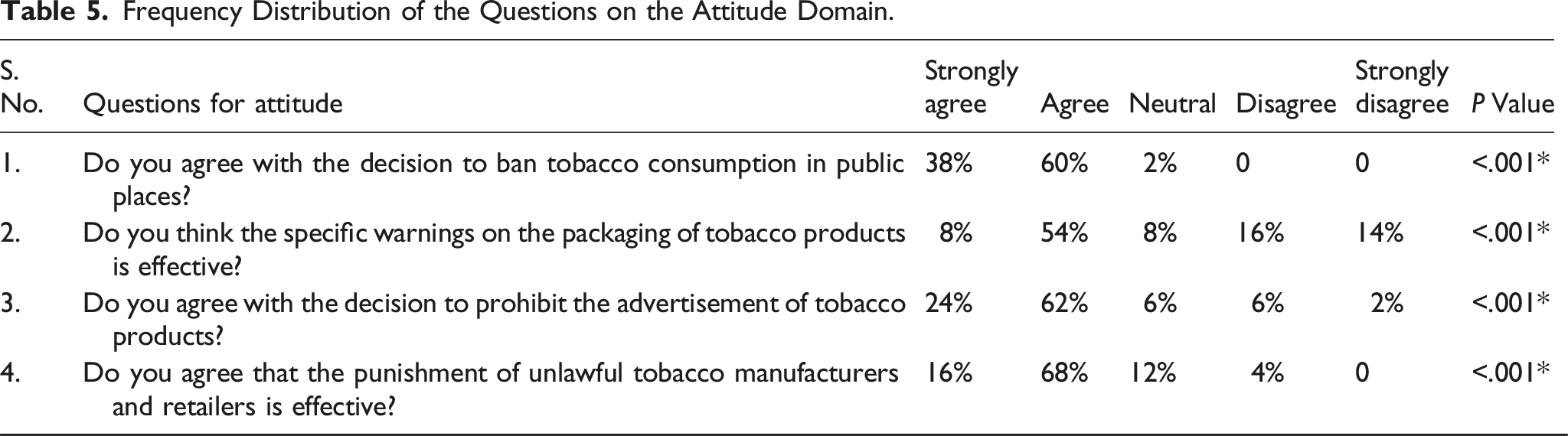
Frequency Distribution of the Questions on the Attitude Domain.
Frequency Distribution of the Questions on the Practice Domain.

Discussion
The laws formed against the use of tobacco products, along with its manufacturing and advertisements; serve not only to protect us from the consumption of tobacco and its related products but also to delay the exposure of children and the youth to the horrors of it. The COTPA, 2003 was put into action with this primary objective. 11 Therefore, it became essential to measure the awareness, attitude, and practices of tobacco sales by vendors to ensure the proper and appropriate implementation of these regulations.
The purpose of this research is to provide information about the age distribution and features of participants as well as their knowledge, attitudes, and practices (KAP) pertaining to the sale of tobacco products to minors. With an average knowledge score of 6.64 out of 10, research participants demonstrated a modest degree of comprehension of the regulations governing the sale of tobacco products. The average attitude score was 19.76 out of 25, which suggests that people have a largely favorable opinion of the laws governing tobacco use, advertising, illegal sales, and the prohibition of tobacco use near educational institutions. With an average practice score of 14.76 out of 20, participants showed a modest degree of compliance with these laws.
Similar to Kumar M study, 12 found that 69% of participants were aware of the COTPA laws that prohibit smoking in all public areas, and 66% of participants correctly recognized all public venues, hospitals, and hotels when questioned about these locations. The findings of Kumar M study 12 in Chandigarh showed that 54% of sellers in this survey were aware that the minimum age to purchase tobacco products in India is 18 years old. Only 24% of individuals were aware that a 100-yard buffer zone must be kept surrounding educational institutions; in contrast, 78.6% of participants were aware of this requirement in LRT study. 11
Compared to LRT study, 11 where 62.5% of respondents were aware of the same punishment, 40% of respondents were aware that supplying tobacco goods to minors would result in a fine of 200 INR. In contrast to Kumar M study, 12 who found that only 58% of vendors were aware of the need for all tobacco product packages to include health warning labels like “SMOKING KILLS” or “TOBACCO CAUSES MOUTH CANCER,” 82% of vendors in our research were aware of this requirement. The majority of participants (98%) were aware of the negative consequences of tobacco use, including lung and oral cancers, which is in good agreement with research by LRT 11 (97.5%) and Rao A.R. 13 (85.8%). Every participant in the research was aware of the many types of tobacco products that are available in the
In line with the findings of Rao V. and Chaturvedi P. 14 study, 82% of respondents thought that those who use tobacco were more likely to be men than women. Similar to LRT study, 11 82% of respondents knew that selling tobacco products lacking statutory warnings on the package carries legal repercussions. This stands in stark contrast to Rao A.R., 13 who just 37.9% knew of such penalties. The need that establishments selling tobacco goods to post signs prohibiting smoking was known to all participants.
When it came to tobacco control measures, 60% of respondents supported the decision to outlaw tobacco use in public areas, and 38% strongly agreed. In contrast, 52% of respondents to Kumar M study 12 supported the prohibition. Furthermore, 53% of respondents to Kumar M study 12 agreed that some health warnings on tobacco product packaging helped encourage individuals to stop smoking, compared to 8% who strongly agreed, 54% who agreed, 8% who were neutral, 16% who disagreed, and 14% who strongly disagreed with this efficacy in our study.
The survey conducted by LRT 11 found that 84.83% of participants were in favor of prohibiting tobacco product ads. According to this research, 62% of respondents agreed with the prohibition, 24% strongly agreed, 6% disapproved, 6% were indifferent, and only 2% strongly objected. 68% of participants agreed that punishments for illegal tobacco makers and merchants were effective, and 16% strongly agreed. Overall, participants’ opinions were favorable. In contrast, 4% disagreed and 12% were neutral. About buffer zones surrounding schools, 32% strongly agreed, 64% agreed, 2% were indifferent, and 2% disagreed that keeping a 100-yard buffer zone around schools lowers children’s exposure to and use of tobacco.
Ninety-two percent of respondents said they never sell tobacco goods to minors, and eight percent said they do it sometimes. In comparison, 56% of Chandigarh vendors acknowledged selling tobacco products to kids, according to Kumar M study 12 results, while 41.7% of Central Delhi vendors never refused to offer tobacco to youngsters, according to Verma AR study. 15 In contrast to Verma AR, 15 where none of the research participants asked for age verification from the children, 66% of vendors in this study reported routinely asking proper age verification from minors.
When asked if they had ever been asked, intimidated, or coerced into selling tobacco to youngsters, 96% of vendors said they had never done so. On the other hand, Verma AR 15 discovered that 76.7% of vendors have experienced this kind of approach. Also, according to Verma AR, 15 36.7% of tobacco vendors stated that children and adolescents purchase tobacco products on behalf of their relatives, whereas 6% of vendors in this study stated that children always purchase tobacco for relatives, 52% stated occasionally, 4% frequently, 20% rarely, and 18% stated never.
Vendors may continue to sell tobacco to minors despite being aware of the regulations because of economic and social pressures; financial reliance on tobacco sales, fear of losing customers, and competition among vendors can all contribute to non-compliance, as restricting sales may result in revenue loss; some vendors also receive incentives from tobacco companies, which further influences their behavior; social norms, lax law enforcement, and pressure from regular customers or community relationships may make it difficult for vendors to refuse sales; and in some cases, minors purchase tobacco on behalf of family members, which blurs ethical lines. Furthermore, dealers may not be completely aware of the seriousness of the legal consequences or the long-term effects of tobacco use on children. A multifaceted strategy is needed to address these issues, including increased enforcement, economic alternatives for vendors, and community-based awareness initiatives to reduce demand and reinforce compliance with tobacco control laws.
Higher knowledge is associated with more optimistic attitudes, according to the positive correlation (0.265). Superior knowledge does not always equate to better practices, as seen by the weak and negative correlation (−0.049) between knowledge and practice. Although favorable attitudes are linked to improved practices, the association is weak, as seen by the negative correlation (−0.194) between attitude and practice. The weak correlation between knowledge and compliance, suggests that socioeconomic factors, vendor education levels, or enforcement intensity could be influencing factors. This gap indicates that raising awareness alone may not guarantee compliance. Socioeconomic status can affect access to necessary resources, while vendor education levels influence their capacity to understand and apply guidelines effectively. Furthermore, the rigor and consistency of enforcement mechanisms are critical in shaping compliance behaviors which might have contributed for the weak correlation.
Law enforcement must keep a close eye on suppliers’ compliance with regulations to counteract this disparity in their application. Police must conduct routine inspections of tobacco sales locations. With parental help, school officials must regularly check the institutions’ surroundings for Pos. Section 77 of the Juvenile Justice Act of 2016 outlines harsh penalties for marketing tobacco to children. Furthermore, as part of the Guidelines for Tobacco-Free Educational Institutions (ToFEI) initiative, which aims to protect young people from tobacco use, the Ministry of Health & Family Welfare, Government of India, has put a prohibition on such sales.
Strengths of the Study
By carefully analyzing the knowledge, attitudes, and actions of tobacco sellers about the selling of tobacco to children and adolescents in the city of Jaipur, this study seeks to close the current research gap. The study aims to identify discrepancies and contradictions between vendors’ knowledge of tobacco-related topics, their own opinions, and their actual activities by concentrating on this particular subject.
The objective is to present a thorough examination of tobacco vendors’ knowledge of the laws and health hazards related to juvenile tobacco use, how well their attitudes match those laws, and how these elements affect their actions while selling tobacco products. Finding these gaps will be essential to creating focused plans and treatments that will better shield youth from the negative effects of tobacco use.
Ultimately, this study will deepen our understanding of the difficulties in implementing tobacco control policies and emphasize the significance of all-encompassing initiatives to protect young people’s health.
Limitations of the Study
The study has a few constraints. It was impossible to determine if the answers provided were true or consistent with their actual practices. Furthermore, the study was conducted within a limited geographical area (a 5 km radius of NIMS University), with a relatively small sample size of 50 vendors. As a result, the findings may not be fully representative of the broader vendor population in Jaipur or rural settings. This limitation affects the generalizability of the results, and caution should be exercised when applying the findings to a larger context. Furthermore, because this study was carried out in an rural environment, it might not accurately reflect the situation in the state’s urban districts.
Recommendation
To make sure that the laws governing tobacco production, marketing, and sales are followed, law enforcement must keep up its efforts. Direct and indirect advertisements must be restricted, and anyone found in violation should face harsh punishments. To make people think that using tobacco is even worth the cost, a high tax on tobacco goods is necessary. Parental support is required, and school administrators must pay attention to everything that occurs on school property. It is important to educate kids and teenagers about the dangers of tobacco usage. In addition to providing the necessary care and resources for their rehabilitation, an effort must be made to comprehend the psychology underlying tobacco use for individuals who have previously been exposed to it.
Conclusion
Although there was a generally favorable attitude and reasonable understanding of tobacco laws and regulations, there was only modest adherence to these measures. Individuals in the over-50 age range have less robust practice habits. Therefore, it is indicated that numerous tobacco rules for tobacco merchants require constant and strong reinforcement.
Footnotes
Acknowledgements
I thank the participants for taking part in the study.
Ethical Statement
Consent to Participate
A written consent was obtained from the participants.
Consent for Publication
Along with the verbal consent, a consent for publication was also obtained.
Funding
The authors have received financial support for the research, authorship, and/or publication of this article from Nims University Rajasthan, Jaipur, India.
Declaration of Conflicting Interests
The author(s) declared no potential conflicts of interest with respect to the research, authorship, and/or publication of this article.