



Abstract
Background
Smoking places a significant burden on healthcare systems, necessitating effective tobacco control measures. Pictorial health warnings (PHW) and tax increases have demonstrated great efficacy, yet their impact on cessation treatments and unintended shifts toward electronic nicotine delivery systems (ENDS) remains elusive. This study analyzes changes in public interest following these measures using online search volume for search terms regarding three categories: cessation, treatment, and ENDS.
Methods
An interrupted time series analysis was conducted. First, an online survey in Germany determined relevant tobacco control measures and search terms related to the three categories. Participants (n = 487) were ≥18 years old, with German as their first language. Second, the relative search volume (RSV) of Google for Germany regarding the identified search terms was analyzed around the enactment of the determined measures. This data is an anonymized aggregate of all Google users. Autoregressive integrated moving average models were used to estimate the change in RSV.
Results
The survey identified tax increases and PHW as the most relevant tobacco control measures among selectable options. The tax increase in 2022 elicited a greater shift in RSV than the implementation of PHW in 2016. Substantial peaks in RSV only occurred following the tax increase, with no significant anticipatory effects. After the tax increase, interest in cessation-related terms seemed to rise (week 1: smoke free 6.53% [95% CI −6.78%-19.84%], quit smoking 12.17% [95% CI −0.15%-24.49%]), alongside a significant rise in searches for ENDS (week 2-3: e-cigarette 9.15% [95% CI 1.12%-17.19%], e-waterpipe 18.7% [95% CI 6.43%-30.96%]).
Conclusion
A tobacco tax increase may lead to increased online interest in ENDS. Policymakers should concurrently educate the public about the harms associated with ENDS and promote evidence-based cessation aids. This may discourage both the initiation of ENDS and their use for smoking cessation while redirecting public interest toward medically recommended alternatives.
Keywords
Introduction
Smoking and associated health concerns pose significant challenges to the Western healthcare system. In Germany, 127.000 yearly deaths are associated with tobacco consumption. 1 A national longitudinal survey lately revealed an uptick in the population’s share of people smoking and indicated a decline in cessation attempts. 2 There is an imperative for countries to adopt cost-effective tobacco control measures. These comprise policies, regulations, and interventions designed to reduce tobacco use and its associated health risks. However, prioritizing interventions and assessing their efficacy remains a complex endeavor.
The presented study utilizes Google Trends data to analyze the online response in Germany to the tobacco tax increase in 2022 and the implementation of pictorial health warnings (PHW) in 2016. The focus is on online interest in smoking cessation, as well as shifts in interest toward electronic nicotine delivery systems (ENDS) and available treatment options.
Tax Increase is the Most Cost-Effective Tobacco Control Measure to Reduce Smoking Prevalence
The World Health Organization’s report on the Global Tobacco Epidemic MPOWER underscores the effectiveness of tax increases, as a pivotal intervention to mitigate smoking prevalence. Previous studies estimated the price elasticity of demand for tobacco products to be −0.4 in high-income countries.3-5 A substantial body of research including Germany has validated the observed pattern of tax increases leading to smoking reduction.6,7
Despite Germany’s position among the above-average countries in terms of monitoring (prevalence data) and warnings (health warnings on cigarette packages) according to the MPOWER study, tobacco taxes remain comparatively modest. 3 In Germany, there were eight gradual tax increases over 20 years (2 × 2004, 2005, 2011, 2012, 2013, 2014, 2015). From 2022 to 2027 there will be a yearly gradual tax increase for tobacco products. This study will focus on the first tax increase on January 1, 2022.
Pictorial Health Warnings are the Most Widely Implemented MPOWER Intervention
Alongside tax increase, the introduction of PHW represents the most widely embraced policy among all MPOWER interventions. 3 PHW effectively deter smoking initiation, enhance motivation for cessation efforts, and support the maintenance of abstinence among people who formerly smoked.8-12
In Germany, the enactment of PHW was effected on May 20, 2016, following regulations passed by the European Union. The regulations require PHW to cover the top 65% of the front and back of the package. Image motifs and text warnings are rotated annually. 13
Use of Electronic Nicotine Delivery Systems Due to Tobacco Taxes and Pictorial Health Warnings
Previous studies have analyzed online search trends following tobacco tax increases and have demonstrated shifts in interest toward various tobacco products. 14 A tobacco tax increase may potentially drive greater interest in alternative nicotine products, thereby weakening the intended effect of the tax. However, few studies have examined the effects of tax increases and PHW on interest in ENDS.
In Germany, the highest share of ENDS users is noted in the demographic group of 18 - 24-year-olds. 2 ENDS are most often used by people who formerly smoked and dual users (simultaneous use of tobacco products) in an attempt to reduce the harmful health effects of cigarettes.15,16 However the health-related risks associated with ENDS remain poorly understood. 17
The sparse evidence consistently revealed a correlation between increasing cigarette taxation and elevated e-cigarette consumption, and conversely.18-20 No studies examining the impact of PHW on tobacco packaging and subsequent changes in ENDS consumption were identified by the authors in the PubMed database. Research on PHW on e-cigarette packaging suggests a reduction in e-cigarette consumption.21,22
Online Data as a Supplementary Source of Information for Assessing the Efficacy of Interventions
The predominant methodological approach across numerous investigations concerning PHW has been survey-based. Meta-analyses have consistently highlighted methodological limitations in this field, emphasizing the need for greater methodological diversity.23,24 Research on the correlation between tax increases and smoking cessation shows similar shortcomings, as it primarily consists of retrospective, cross-sectional survey studies.25-28 These studies provide limited time-related detail, as participants are typically surveyed at only a few time points.
Recently, Google Trends data have proven to be a valuable tool in smoking-related research. So far, plenty of studies investigated various tobacco control measures and positively demonstrated their impact on search engine volume.14,29-32 Google Trends data are an anonymized aggregate of all Google users. Google Trends continuously updates and offers publicly accessible data on the relative search volume (RSV) of specific search terms over time. The RSV reflects the evolution of interest in a particular search term relative to all other search terms on Google. These data make the retrospective analysis of temporally high-resolution information possible. Noteworthy, studies on online data yielded inconclusive or contradictory findings when compared with traditional survey methodologies. 32
Aims and Hypothesis of the Presented Study
Given the fragmented evidence, further research is needed to determine whether individuals who smoke are interested in quitting in response to tobacco tax increases and PHW. This could potentially lead to greater online interest in cessation aids, such as ENDS, or other treatment options. A comprehensive understanding of these dynamics is essential to anticipate and mitigate potential adverse public health effects. Particularly considering the limited understanding of the health risks associated with ENDS. The time-detailed RSV data could offer valuable insights into short-term changes in online interest in cessation, treatment options, and ENDS. These findings may help assess the effectiveness of the tobacco control measures investigated, as indicated by online interest, while also identifying potential shifts in interest toward ENDS and treatment options.
Specifically, it is hypothesized that interest in cessation will peak following the implementation of PHW in 2016 and tax increase in 2022. As a consequence, cessation strategies, including treatment options but also ENDS, may attract greater interest, as reflected by increased RSV.
Material and Methods
Collection of Online Survey Data
The study comprised two steps of data collection. First, relevant tobacco control measures and search terms in the fields of smoking cessation, treatment options, and ENDS were determined using an online survey. Second, the RSV on Google Trends concerning the identified search terms was collected around the period of the respective tobacco control measure to be statistically analyzed as later described.
In the online survey participants were asked to rate the subjective relevance of tobacco control measures and search terms categorized under smoking cessation, treatment options, and ENDS. Each search term and tobacco control measure had to be scored on a scale with seven levels (unknown = 1, −−− = 2, −− = 3, − = 4, + = 5, ++ = 6, +++ = 7) in rating questions. The predefined tobacco control measures and search terms as listed in Figure 1 were chosen based on expert consensus. Average Number of Points Awarded to Different Search Terms. Error Bars Indicate the Standard Error.
To account for potential search terms meaningful but missing within the predefined lists, open-ended questions were required as an additional item. The questions comprised three dimensions of smoking behavior dealing with smoking cessation, treatment options, and tobacco control measures.
The survey was conducted from 9th April 2020 - 5th August 2020 on the Prolific platform. Among various online survey platforms, Prolific is noted for high participant quality. 33 On the platform, participants are paid money to take part in surveys. 34 In this study, participants had the opportunity to earn 13.09 USD per hour. The region was limited to Germany, participants had to be at least 18 years old and their first language had to be German. The survey was designed using the UmfrageOnline platform. 35 Demographic data was collected concerning sex (male, female, or diverse), age, educational background (university degree, vocational training, high school diploma, specialized high school diploma, or no school diploma), and smoking status (multiple answers possible to account for combinations of current and/or former use of tobacco products and/or ENDS, or never smoked).
The investigated study population comprised n = 508 participants, n = 21 participants had to be excluded due to incomplete filled-in surveys or incorrect answers to the test question. The remaining study population comprised n = 487 participants, of which n = 194 (39.8%) identified as female, n = 291 (59.8%) as male, and n = 2 (0.4%) as diverse. The median age was 28 years, see suppl. Figure 1. Concerning education n = 344 (70.6%) earned a university entrance qualifications certificate or university degree. Among the total study population, n = 97 participants (19.9%) reported prior or current use of only tobacco products, while n = 51 (10.5%) reported the same for ENDS. Additionally, n = 81 (16.6%) participants had experience with smoking and ENDS, see suppl. Figure 2.
Collection of Google Trends Data
After identifying relevant tobacco control measures and search terms through an online survey of the study population, Google Trends was accessed to extract the RSV for these search terms. Google Trends is an online service run by Google. 36 The data provided here represents population-wide, aggregated, and anonymized search volumes over time, allowing analysis of the dynamics of search terms in a specified region. The data is presented as RSV which reflects the evolution of interest in a particular search term relative to all other search terms on Google. The value at the time of peak interest in a certain search term is set at 100. Other values are expressed relative to this maximum. Following the recommendations of Nuti et al. for Google Trends studies, the date of data retrieval, the queried period, the specific search terms, and the rationale for search term selection are reported below. 37
In anticipation, tax increase and PHW were determined as relevant tobacco control measures in the survey. Other measures, that scored higher, had to be excluded from the analysis due to their implementation in the distant past and insufficient search volume for newer terms like e-cigarette and e-waterpipe during that period, see suppl. Figure 3 and suppl. Figure 4.
The introduction of PHW took place on May 20, 2016. The German government passed a law to gradually increase tobacco taxes from 2022 to 2027 The first increase on January 1, 2022, was investigated. Google Trends Data was accessed on September 10, 2024, and included from April 1, 2012 - December 25, 2016, and from November 26, 2017 - July 31, 2022. The previously downloaded RSV was trimmed to 130 weeks before and 26 weeks after each intervention, cumulatively spanning three years for each intervention. RSV was then adjusted by dividing all remaining data points by the maximum of the respective series and multiplying with 100.
These periods were chosen to ensure a reasonably long observation period around the political measures and to retrieve weekly data from Google which is not supported for longer periods. Weekly data were commonly used in similar studies to provide sufficient temporal resolution.31,32 An arbitrary number of approximately 60 or more data points in time (here weeks) is suggested by literature for later autoregressive integrated moving average analysis (ARIMA). 38
Based on survey answers, search terms were determined. Consequently, data was downloaded for the following search terms without quotation marks: Rauchen aufhören (transl. quit smoking), Rauchfrei (transl. smoke free), Nikotinpflaster (transl. nicotine patches), E-Zigarette (transl. e-cigarette), E-Shisha (transl. e-waterpipe). In the following, it is only referred to the English translation of each search term. All query categories were used and Germany was set as the location.
Statistical Analysis
First, the rating questions were evaluated descriptively by average score and standard error for each search term grouped by category, see Figure 1. Open-ended questions were analyzed using word frequency and results are displayed as word clouds, see Figure 2. The highest-ranked search term by the average score in each category of the rating questions was selected. Additionally, the most frequently mentioned search term in the open-ended question responses was included. However, several high-scoring search terms had to be excluded due to insufficient RSV for analysis or lack of specificity to smoking-related searches, see suppl. Figure 3 and suppl. Figure 4. Concerning ENDS it was hypothesized that in public discourse, the term e-cigarette is used synonymously for a range of ENDS due to its role as the market-leading device. Therefore, the open-ended question was omitted, as it was expected, that e-cigarettes would be the most frequently mentioned term, while other terms would likely be overshadowed. Consequently, participants were asked to score relative to e-cigarette in rating questions and the second-highest-scoring search term would be included as well. Word Clouds With the Frequency of Mentioning Depicted by Word Size. (A) Terms Linked to Smoking Cessation, (B) Terms Linked to Treatment Options, and (C) Tobacco Control Measures.
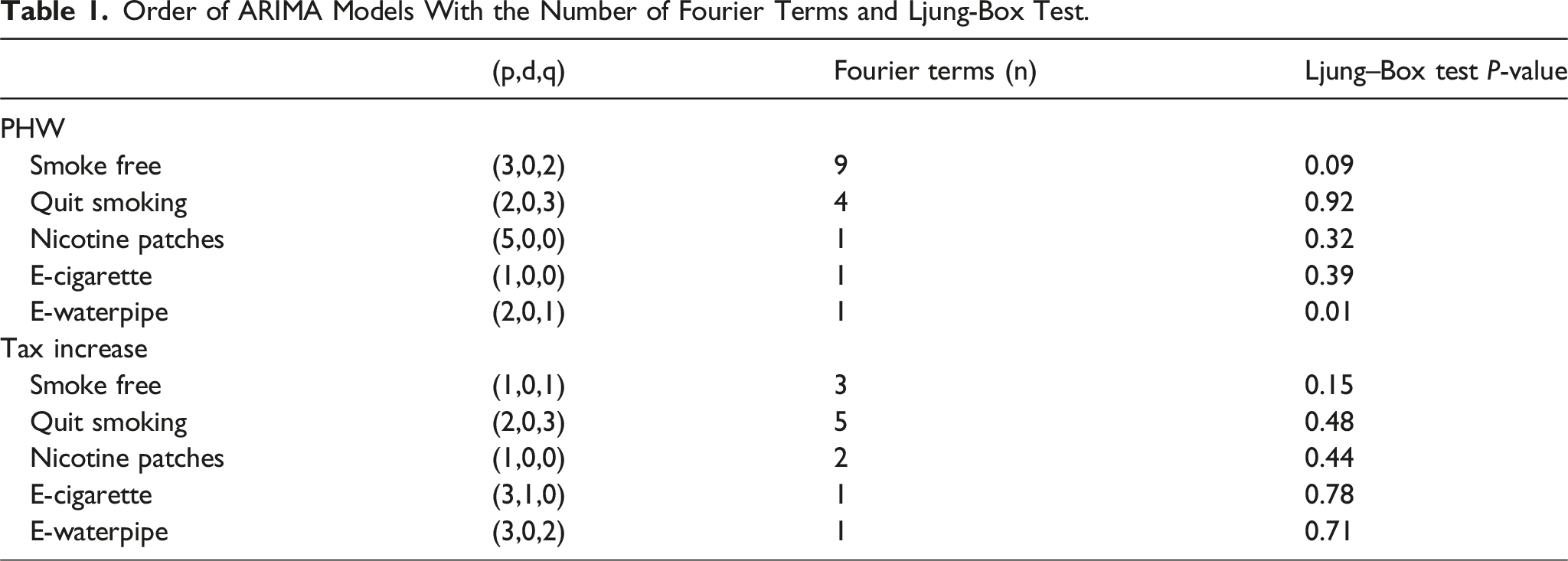
Following, an interrupted time series analysis (ITS) using ARIMA models was conducted on the RSV of the selected search terms. ARIMA approach is commonly used in ITS to retrospectively estimate the effect of an intervention on the observed variable.31,32,39 Recommendations by Schaffer et al were followed for model implementation. 38 First, outliers were removed as suggested by Hyndman and implemented in the R forecast package. 40 To control for covariates of seasonality and long-term trends further external regressors were added to the model as follows: To control for seasonal patterns for smoking-related search terms Fourier terms were included. The number of Fourier terms was determined iteratively by minimizing the Akaike Information Criterion.41,42 To account for long-term trends a regressor of one-step increments from the first week onwards was included. 32
To screen for the co-occurrence of major events related to the identified search terms Google News was used. A filter was set for the investigated periods and the first three result pages for each search term if applicable were inspected. No substantial events were identified.
Eight effect periods were specified at one, two to three, four to five, and six to seven weeks before and after the intervention. Regarding previous literature effects much earlier or later were not anticipated and might only be loosely linked to the intervention. 30 The number of effect periods was limited to avoid the risk of multiple testing.
Only step changes were considered for the expected changes in RSV based on the literature review.30,32 Hence effect periods were coded as one, else as zero. These variables were simultaneously included in the model as further external regressors to display the effect of the intervention.30,32 The results were obtained as the absolute change in RSV attributed to the introduction of the intervention.
Order of ARIMA Models With the Number of Fourier Terms and Ljung-Box Test.
Results
Results From the Survey
The first tobacco control measure investigated was the tax increase on January 1, 2022, selected based on the results of the rating questions (considering the constraints outlined in the Methods section), see Figure 1. Since tax (transl. Steuern) was also the most mentioned term in open-ended questions, the second most mentioned term was included, which was pictures implying pictorial health warnings (transl. Bilder), see Figure 2.
Terms associated with intended smoking cessation were selected to be smoke free based on rating questions, and quit smoking (transl. rauchen aufhören) based on open-ended questions, see Figures 1 and 2.
For treatment options, nicotine patches had the highest rank and were also most mentioned in open-ended questions (transl. Nikotinpflaster), see Figures 1 and 2. No second term was chosen since other high-ranked items (nicotine gum and nicotine replacement therapy) had insufficient RSV to be analyzed, see suppl. Figure 4. Other items or frequently mentioned terms such as talk therapy and hypnosis were too unspecific and were not exclusively searched for in the context of smoking cessation.
Regarding ENDS e-cigarette and e-waterpipe were determined as the highest and second-highest-ranked search terms on the list, see Figure 1.
Online Interest in Search Terms Around the Implementation of Pictorial Health Warnings and Tax Increase
Search terms showed category-wise comparable RSV dynamics. The original RSV and the RSV fitted by the ARIMA models are displayed in Figure 3. For smoking cessation, the terms smoke free and quit smoking displayed a seasonal pattern with peaks around New Year. RSV During the Investigated Period With Fitted RSV Estimated by the ARIMA Model. The Dotted Lines Indicate the Day of Implementation for the Respective Intervention.
For treatment options, the RSV of nicotine patches rather resembled a white noise process with strong but constant variability.
For ENDS RSV for e-cigarette exhibited a long-term upward trend until 2016. E-waterpipe showed a sharp peak in interest around 2014, followed by lessened interest. For the observed time window regarding the effects of tax increase, both search terms showed a rapid surge in RSV in the fall of 2021.
The analysis of changes in RSV, as estimated by the ARIMA models, is presented in Figure 4. Two trends can be identified within the data. First, following tax increase larger changes in RSV were detected compared to PHW. Second, regarding the time around the intervention significant peaks in RSV are only seen after tax increase. Change in RSV Regarding the Predefined Effect Periods. Errorbars Indicate the 95% CI.
For smoke free and quit smoking, a slight increase in RSV was observed in the first month after the introduction of PHW. However, the rise was not significant. For the period around the tax increase, a peak was noted in the first week after the implementation (smoke free 6.53% [95% CI −6.78% - 19.84 %], quit smoking 12.17% [95% CI −0.15% - 24.49%]). Before the intervention, there was a significant decrease for both search terms.
For nicotine patches, no significant changes were observed after either investigated tobacco control measure. Only a decline in interest was observed before the tax increase in 2022 (−20.23% [95% CI −40.64% - 0.17%]).
For e-cigarette and e-waterpipe only modest positive changes in RSV were detected after the introduction of PHW during weeks two and three. However, RSV for both search terms significantly rose from week two to seven, respectively five, following the tax increase, see Figure 4 (e-cigarette: week two to three 9.15% [95% CI 1.12% - 17.19%], week four to five 9.1% [95% CI 1.69% -16.5%], week six to seven 6.97% [95% CI 0.02% - 13.92%]; e-waterpipe: week two to three 18.7% [95% CI 6.43% - 30.96%], week four to five 12.73% [95% CI 1.9% - 23.56%]).
Discussion
The study was conducted to expand the understanding of the interaction between smoking cessation and tobacco control measures by analyzing online search volume. Relevant tobacco control measures and search terms within the categories of smoking cessation, treatment options, and ENDS were identified through a survey. It was hypothesized that peaks in RSV would follow the implementation of the investigated tobacco control measures, underscoring the effectiveness of attracting public attention to smoking cessation. Additionally, the study expands the current body of research and provides insights into shifts in online interest toward ENDS and treatment options in response to the examined tobacco control measures. The findings would have implications for public health policy, which are discussed in the following sections.
Results of the Survey and Interrupted Time Series Analysis
Tax increase and PHW were identified through the survey as the most relevant tobacco control measures among the study population. Evidence from both interventions demonstrates their effectiveness in reducing tobacco use, as outlined in the Introduction. Within the cessation category, smoke free and quit smoking were identified as the highest-scoring and most frequently mentioned terms. This finding is consistent with previously published studies.30,32,44,45 The term nicotine patches received the highest score and was most mentioned among treatment options. Concerning ENDS, e-cigarettes ranked highest, followed by e-waterpipes. The results regarding nicotine patches and e-cigarettes are consistent with previously published data on cessation aids in Germany. 16 However, only sparse data are available for e-waterpipe. 46
Following the survey an ARIMA analysis was conducted to retrospectively estimate the population-wide effects of exposure to PHW and tax increase on online interest in the search terms indicated above.
Tax increase is known to be the most effective tool for smoking cessation within the MPOWER interventions.3,6 RSV data displayed a short-lasting impact on cessation-related search terms that faded after one week. This is in line with real-world data where most relapses occurred within the first weeks.47,48 Further evidence suggests that the motivation to quit peaks shortly after a tax increase before returning to previous levels. 49 Sustained effects on cessation might be counteracted by prize-minimization strategies employed by people who smoke. 4 A large survey study in Germany has already demonstrated motivation to quit in response to taxation. 50 The study presented here complements prior findings and shows increased online interest in smoking cessation immediately following the tax increase. Consecutively, people who smoke might turn their heads to alternatives. Here choices comprise treatment options and ENDS. Nicotine patches are FDA-approved and effective. 51 They demonstrated improvements in cessation rates in unassisted abstainers. 52 However, the data presented revealed no significant changes in RSV following the tax increase. Interest in ENDS on the other hand rose significantly after the tax increase. The same trend is mirrored by real-world data as e-cigarettes are becoming more popular as a reaction to the taxation of tobacco products.25,53 This effect may, in part, be mediated by marketing activities from companies in the ENDS sector attempting to capitalize on the momentum. However, news screening did not reveal any large-scale marketing campaigns. Nonetheless, the diverse range of advertising channels for ENDS, such as social media, complicates the tracking of advertising expenditures over time and may confound the results. 54 E-cigarettes in Germany are commonly used by dual users, frequently in an attempt to cut tobacco consumption. 16 They are among the most effective cessation aids, while people who smoke recognize them as less harmful and often continue their use after successfully quitting smoking.55-57 RSV regarding e-waterpipes after the tax increase displays dynamics comparable to e-cigarettes. They might serve in similar ways to dual users to cut tobacco consumption. These ENDS are way less studied. 46 This is extremely worrying as they appear to be well known among the participants of the survey but virtually no specific data regarding demographics of consumption or health risks are available.
In contrast to the tax increase, the shifts in RSV were less pronounced concerning the implementation of PHW. These results might be explained by a different mechanism of action for PHW in contrast to tax increases. PHW are effective in increasing the number of quitting attempts among people who smoke.58-60 There is a wear-out effect after public exposure while the time point remains unclear.24,61 Follow-up studies that bolster evidence of long-term abstinence are missing. A previous study found increased motivation to quit after three months of exposure in young adults but the mediators by which motivation turns to successful cessation remain elusive. 62 PHW do not appear to alter risk perception directly but may exert their effect through repetitive exposure. Paradoxically PHW even caused warning avoidance which did not hinder cessation but might even be a surrogate for quitting motivation. 60 Market penetration might also have played a role as interest in PHW peaked shortly after introduction, see suppl. Figure 4, perhaps attributed to news coverage but stores still had text warning packages for sale. Besides studies indicate that in Germany, compared to other European countries, PHW were least effective in improving smoking cessation and increasing awareness of health consequences. 63 In conclusion, PHW exert their effect more slowly than tax increase since beneficial changes in smoking habits occur due to lasting accumulative exposure, which might explain the small effects on RSV. This finding is consistent with a prior study investigating PHW and online cessation interest. 32
Concerning anticipatory effects, RSV for the terms smoke free, quit smoking, and nicotine patches decreased in the week preceding the tax increase, which may not be directly attributable to the intervention. The underlying trigger may lie beyond the scope of this study. Studies with comparable designs have not reported anticipatory effects with heightened online interest either.30,31 The most common intrinsic factors to quit smoking are personal health and costs.64,65 Thus, it is unlikely that individuals who smoke adjust their behavior in anticipation of future price increases.49,50,66 It might also explain why the tax increase had a more pronounced impact on RSV compared to PHW.
Strengths of the Study
The selection of search terms poses a critical bottleneck in Google Trends studies. This process often relies on expert consensus and literature review. This study circumvented arbitrary search term selection with an online survey that included open-ended questions to account for missing words within the rating questions. Expanding the current knowledge, the study examined not only cessation-related search terms but also terms related to treatment options and ENDS, thereby revealing potential coping strategies gaining interest in response to the investigated tobacco control measures. The survey was designed with expert consensus. However, due to the specific search terms used no validation with established surveys was feasible.
The potential of Google Trends data for such an assessment was demonstrated in previous research.14,30-32,67-69 Using RSV has significant advantages. Most people have internet access and feel especially comfortable seeking health advice anonymously. 70 The data provide immense temporal resolution at the population level and are freely downloadable. This makes RSV very suitable to investigate the short-term impacts of public health interventions. However, external events beyond the scope of the research may confound the RSV. For this purpose, a news screening, as described in the Methods section, was conducted to identify any significant events related to smoking cessation around the intervention dates. No such events were found.
To analyze the RSV, the presented study employed an ITS approach using ARIMA models. ARIMA models have been used to assess the impact of various population-level health interventions..30-32,39,42 A notable advantage of ARIMA models is their ability to control for seasonal trends, enhancing the accuracy of the estimates. To account for seasonality Fourier terms were used. As expected, models for search terms with strong periodicity incorporated more Fourier terms. Only the ARIMA model regarding e-waterpipe and PHW showed a non-random distribution of the residuals as determined by the Ljung–Box test. The presented approach aligns with the methods commonly reported in previous research on smoking-related topics.30-32,38
Limitations of the Study
The study population exhibited imbalances in age distribution, education, smoking status, and sex compared to the general German population, which likely distorted the survey results to some extent.
The study population was younger and better educated. In Germany, the median age is 46 years, with only 48.4% obtaining a university entrance qualification, whereas in the study population, the median age was 28 years, and 70.6% had at least earned a university entrance qualification.71,72 It is well-documented that younger, well-educated individuals are more likely to use Internet resources for health-related information.73,74 RSV data is likely subject to an inherent bias concerning users’ age. The younger study population may more closely reflect the demographic of search engine users, thereby providing a more accurate representation of the distribution of search terms on Google.75,76 However, in the absence of substantial evidence, this remains speculative and warrants further investigation. Besides, smoking cessation is more prevalent among individuals with higher education, potentially due to more financial and psychological resources and fewer smoking cues in their social environment. 77 In the context of the investigated tobacco control measures, PHW have a consistent impact on quit intentions across education levels, while tax increases primarily raise the likelihood of quitting among individuals with lower levels of education.78,79
Regarding smoking status, 36.5% of the study population reported experience with smoking, which is lower than the 54.5% prevalence of current or former people who smoke in the general German population. 80 This disparity may be mediated by age and education biases in the study population. The proportion of individuals who have ever smoked or currently smoke tends to be lower in the younger, more highly educated demographic. 80 People who report no current or past smoking however were deliberately included. Their inclusion provided a broader societal perspective, offering valuable insights into public perceptions of smoking cessation. Furthermore, people who never smoked may play a pivotal role in supporting smoking cessation among those who engage in smoking.81-83 From a policy perspective, understanding the views of people who do not smoke is crucial, as tobacco control measures aim to promote cessation but also prevent initiation. Previous studies indicate that PHW mainly support smoking cessation but also play a key role in preventing initiation.3,58,84 Tobacco taxes are implemented to encourage cessation and prevent initiation and have been proven effective in achieving both objectives.3,85-88
Concerning sex distribution, there was a notable difference, with a higher proportion of men participating in the survey, approximately three-fifths. This disparity may be attributed to the sex distribution of people who smoke, with a higher prevalence of smoking among men leading to greater engagement with the survey.89,90
In addition to imbalances in the study population, Google Trends data also presents limitations. The quality of RSV data declines from a population level to an individual level and due to the limited accompanying demographic data provided by Google, an analysis of specific subgroups is not feasible. Lastly, online interest in smoking cessation cannot be equated with successful quitting attempts. So far, there is limited evidence suggesting that online interest in tobacco products may be correlated with actual usage of these products. 91 Larger studies involving diverse populations are lacking.
Implications of the Study
The implementation of PHW did not result in a significant increase in RSV concerning cessation-related search terms. The adoption of best practices PHW with greater package coverage and single cigarette labeling might draw more attention to smoking cessation.58,59,92,93 It is crucial for future studies to assess how the willingness to quit translates into successful cessation upon picture-based warnings and to determine the time of wear-out effects that make adjustments to warnings necessary.
An increase in interest for cessation-related search terms and ENDS was observed following the tax increase, potentially reflecting strategies employed by people who smoke to reduce tobacco consumption. These changes in online interest should be cautiously monitored as ENDS pose new health risks and are not recommended for smoking cessation by medical associations.17,94 Nevertheless, political campaigns exist to encourage people who smoke to switch to ENDS, while the consequences for public health remain poorly understood. 95 As smoking rates decline, the assumed public health benefits of e-cigarettes as a cessation aid may diminish. Evidence indicates that more young people who have never smoked are using e-cigarettes for recreation. 96 The public health impact of e-cigarettes depends on how many people would have started smoking without them, compared to those who would have avoided all harmful nicotine products. 97 In the here presented study, e-cigarettes were commonly misperceived as a valid treatment option and ranked within the top third within the treatment category, above hotlines, doctor offices, and pharmacological treatment. The distinct qualities of cessation aids must be emphasized. ENDS use is associated with potentially adverse health consequences. 17 Healthcare professionals play a pivotal role in helping people who smoke to select appropriate cessation aids, as consultations with healthcare providers are among the most common extrinsic triggers for smoking cessation. 64 For policymakers, two key implications arise from the findings of the study. First, the timing of increased motivation to reduce consumption shortly after a tax increase should be capitalized on, with concurrent measures implemented to effectively support the cessation process. Second, people who smoke should be educated and protected from negative coping strategies such as ENDS. There is a need to promote evidence-based cessation aids alongside tobacco control measures. These include varenicline, cytisine, and the combination of nicotine patches and gum, as well as behavioral counseling all of which demonstrated comparable efficacy in smoking cessation compared to e-cigarettes.56,98 Notably, the survey results from the study at hand indicate that pharmacological options such as varenicline and cytisine are relatively unknown, as they received the lowest rankings within the treatment category. Additional policy measures concerning ENDS could include extensive advertising bans, increased taxation, and package labeling.21,22,99 The rising trend for ENDS from the fall of 2021 onwards might spark discussions about an escalation of these policies.
Conclusion
The study suggests a trend of increased online interest in smoking cessation following the tobacco tax increase in 2022, but not after the introduction of PHW in 2016. In addition, a significant rise in online interest in ENDS was observed following the tax increase. These findings suggest that a tobacco tax increase can trigger a public response, as reflected in the heightened online search volume. Notably, the surge in ENDS searches may reflect an unintended consequence, with ENDS gaining interest as a coping strategy in response to higher tobacco taxes. Addressing the overlooked effects of tobacco control measures is essential to improve the cessation of all harmful tobacco and nicotine products. Early identification and intervention are crucial, with potential strategies including public awareness campaigns, education efforts, and the promotion of evidence-based cessation aids.
Supplemental Material
Supplemental Material - Google Trends Analysis of Interest in Smoking Cessation, Treatment Options, and Electronic Nicotine Delivery Systems Following Tax Increase and Introduction of Pictorial Health Warnings in Germany
Supplemental Material for Google Trends Analysis of Interest in Smoking Cessation, Treatment Options, and Electronic Nicotine Delivery Systems Following Tax Increase and Introduction of Pictorial Health Warnings in Germany by Tobias Jagomast, Imke Tangemann-Münstedt, Mareike Lüthgen, Henrike A. Faesser, Thorben Lueg, Daniel Drömann, Klaas F. Franzen in Tobacco Use Insights
Supplemental Material
Supplemental Material - Google Trends Analysis of Interest in Smoking Cessation, Treatment Options, and Electronic Nicotine Delivery Systems Following Tax Increase and Introduction of Pictorial Health Warnings in Germany
Supplemental Material for Google Trends Analysis of Interest in Smoking Cessation, Treatment Options, and Electronic Nicotine Delivery Systems Following Tax Increase and Introduction of Pictorial Health Warnings in Germany by Tobias Jagomast, Imke Tangemann-Münstedt, Mareike Lüthgen, Henrike A. Faesser, Thorben Lueg, Daniel Drömann, Klaas F. Franzen in Tobacco Use Insights
Footnotes

Author Contributions
The authors confirm contribution to the paper as follows: study conception and design: Tobias Jagomast, Klaas F. Franzen, Imke Tangemann-Münstedt, Daniel Drömann; data collection: Klaas F. Franzen, Imke Tangemann-Münstedt, Mareike Lüthgen, Henrike A. Faesser, Thorben Lueg; analysis and interpretation of results Tobias Jagomast, Klaas F. Franzen, Imke Tangemann-Münstedt; draft manuscript preparation: Tobias Jagomast, Klaas F. Franzen, Imke Tangemann-Münstedt. All authors reviewed the results and approved the final version of the manuscript.
Funding
The authors disclosed receipt of the following financial support for the research, authorship, and/or publication of this article: The authors disclosed that they have not received any financial support for the research and publication of this article. This work was financed by the Medical Clinic III – University of Lübeck.
Declaration of Conflicting Interests
The authors declared no potential conflicts of interest with respect to the research, authorship, and/or publication of this article.
Supplemental Material
Supplemental material for this article is available online.
Appendix
References
Supplementary Material
Please find the following supplemental material available below.
For Open Access articles published under a Creative Commons License, all supplemental material carries the same license as the article it is associated with.
For non-Open Access articles published, all supplemental material carries a non-exclusive license, and permission requests for re-use of supplemental material or any part of supplemental material shall be sent directly to the copyright owner as specified in the copyright notice associated with the article.
