



Abstract
In June of 2024, I was asked by the Environmental Health Officer of Galway, Ireland, to recount my endeavors in support of the 2002 push to ban smoking in Irish workplaces, led by The Office of Tobacco Control (OTC) for The Republic of Ireland. At that time, OTC’s smoke-free campaign was being vigorously opposed by publicans as well as the Irish tobacco industry. Their opposition had downplayed any effects of secondhand smoke on pub workers’ health. As a researcher, I had published 46 peer-reviewed papers on the hazard, exposure, dose, risk, and control of secondhand smoke since 1980. In 1998, I had become a secondhand smoke consultant, assisting entities in the U.S. and abroad who were attempting to enact workplace smoking bans. In 2002, OTC’s then Director, Tom Power, had contacted me to request my technical assistance to the Irish government in their campaign to enact a workplace smoking ban in Irish pubs. Accordingly, I asked for any local data that might aid me in my effort. He provided me with measurements of carbon monoxide from secondhand smoke in 14 Galway Pubs, performed by the Irish researcher Maurice Mulcahy in support of his Master’s Thesis. Using a pharmacokinetic model that enabled mapping secondhand smoke carbon monoxide to its equivalent nicotine metabolite body fluid cotinine, I estimated that based on the Galway pub data, secondhand smoke exposures of nonsmoking Irish pub workers were at the upper extreme for nonsmokers when compared to a study of cotinine in London pub staff relative to the general population. Further, using a dose-response relationship, I was able to estimate that the working-lifetime risk of mortality from workplace secondhand smoke exposure would produce an estimated 150 deaths per year among the ∼28,000 full-time Irish pub workers. I presented this information to the Health Minister and Members of Parliament at the Dail, and in numerous multi-media interviews. These estimates rebutted bogus tobacco industry assertions that ventilation could control secondhand smoke, fired up the effort championed by Health Minister Micheál Martin to ban smoking in pubs, and helped to protect pub workers from being forced to trade their health for a pay cheque.
My initial research on secondhand smoke began in 1980, when Lowrey and I published a seminal paper in the Journal Science: Indoor Air Pollution, Tobacco Smoke and Public Health. 1 We performed real-time measurements of fine particle air pollution levels inside and outside smoky venues such as restaurants and bars, bowling alleys and bingo games, weddings and waiting rooms, lodge halls and dinner theaters, and nightclubs and emergency rooms. We compared those levels to measurements made in automobiles on busy commuter highways, in nonsmoking libraries, nonsmoking homes, and in a church during nonsmoking services. These results demonstrated that smoky venues were polluted to levels far in excess of the levels on busy commuter highways. They also demonstrated that contrary to tobacco industry claims, that ventilation did not control secondhand smoke. Our study received a great deal of international scientific attention. Subsequently, I was contacted by several workers who had been suffering from on-the-job smoking, which made me realize that smoking was pre-eminently a workplace issue. At that time I was serving as an air pollution policy analyst and staff scientist at the U.S. Environmental Protection Agency (EPA) in Washington DC. 2
In 1985, Lowrey and I published a paper estimating that 5000 nonsmoking Americans died each year from lung cancer from passive smoking at work and at home. 3 This paper received a great deal of scientific, public and legislative attention, and led to 1986 reports by the National Academy of Sciences 4 and the U.S. Surgeon General 5 indicting secondhand smoke as a cause of lung cancer in nonsmokers. I began to lecture widely on secondhand smoke in the U.S., and served as an expert witness in several workplace secondhand smoke injury cases. I also lectured in the U.S. and abroad in Greece, Portugal, Spain, Australia, New Zealand, Canada, Cyprus, and Hong Kong.
By the time that I retired from the EPA in 1998, I had published 46 papers on various aspects of secondhand smoke pollution indoors and outdoors. I then began a new career as a secondhand smoke consultant. Soon after New Year’s day in 2002, I received a phone call from Mr. Thomas Power, who identified himself as Director of the Office of Tobacco Control for The Republic of Ireland. Tom invited me to lecture to various governmental and private organizations in Dublin in support of smoke-free workplace legislation in Ireland. In preparation for my trip, I asked Tom whether he was aware of any data that had measured secondhand smoke in Irish venues. He soon provided me with stunning set of data measured by Maurice Mulcahy of the Western Health Board, performed for his master’s degree in environmental heal. It reported measurements of carbon monoxide (CO) levels in 14 pubs in Galway.
In Figure 1, 8 ppm of CO from ETS is also equivalent to a serum cotinine level of 9.9 ng/mL (Repace et al, 2006), which was at the upper extreme of passive smoking.
8
Is a plot of Maurice Mulcahy’s real-time carbon monoxide data that was used to estimate the bartenders’ risk.
6
.
Figure 2 plots the CO levels above background measured in all 14 pubs, mapped into an estimated working lifetime excess heart disease and lung cancer mortality risk from workplace environmental tobacco smoke (ETS) exposure.
Carbon monoxide from environmental tobacco smoke (ETS-CO) measured in all 14 Galway pubs had mean levels of 6.36 ppm (St. Dev. 4.36 ppm), and median levels of 6.00 ppm. Peak CO concentrations exceeded 63 ppm in two premises. Passive smoking at the level of 6 ppm of ETS-CO for 30 minutes is known to induce as much dysfunction of the coronary circulation as that in cigarette smokers. Exposure to ETS-CO levels equivalent to 6 ppm for 40 years carries an estimated combined excess mortality risk from heart disease and lung cancer sufficient to cause the premature death of 1 out of 5 bar staff. Of the 78,000 workers in alcohol-licensed premises throughout Ireland in 1999, about 56,000 were employed in pubs. Assuming only half were employed full-time, this translates into an estimated 150 deaths per year in the full-time pub workers alone. Figure 3 shows that bar workers tend to spend more than a decade employed in the pub trade. A plot of data from 2002 showing the employment duration for Galway pub workers.
6
.
In 2007, I published a paper in JOEM summarizing the group of equations relating the conversion of atmospheric measures of secondhand smoke (PM2.5, nicotine, and CO) to cotinine in blood serum, saliva, and urine. The predictive power of these atmospheric and pharmacokinetic “Rosetta Stone Equations” is discussed in detail, and shown to agree with experimental chamber studies of secondhand smoke exposure and dose, and to accurately predict the levels in national probability samples of serum cotinine in the U.S. population. 7
So, in early February 2002, My wife, Hilarine, and I flew from Washington DC to Dublin. We were booked into an elegant hotel in downtown Dublin by Tom Power, Director of the Office of Tobacco Control, who ran a first class operation. Tom was a witty and urbane man, technically competent and very PR savvy. Tom, a true trencherman, entertained us royally with gourmet dinners. I presented lectures in seminars on Environmental Health, and Health & Safety as well as to a group of academics at Dublin Castle, while Hilarine enjoyed the sights. I briefed Health Minister Micheál Martin, and Members of the Environmental Committee of Parliament at the Dail. The Committee members treated me to a magnificent seven course banquet replete with fine wine, and afterward I regaled the dozen and a half or so members of the committee with an impromptu if not totally sober lecture on secondhand smoke. It was well received. Armed with Mulcahy’s data and my analysis, during 11-13 February 2002. I authored an Op-Ed in the Irish Times; I did several media interviews: on Six One TV News (RTE); TV3 Breakfast Show; a Talk Radio Interview, and gave a presentation to members of the Board of the Office of Tobacco Control. (Figure 4). Personnel involved in the effort to pass the smoke-free pub legislation. Back Row, left to right: Maurice Mulcahy, Mary McDonnell, Tom Beegan, Tom Power, and Fergus Whelan. Front Row, Left to right: Dr Michael Boland, Health Minister Michael Martin T. D, and James Repace.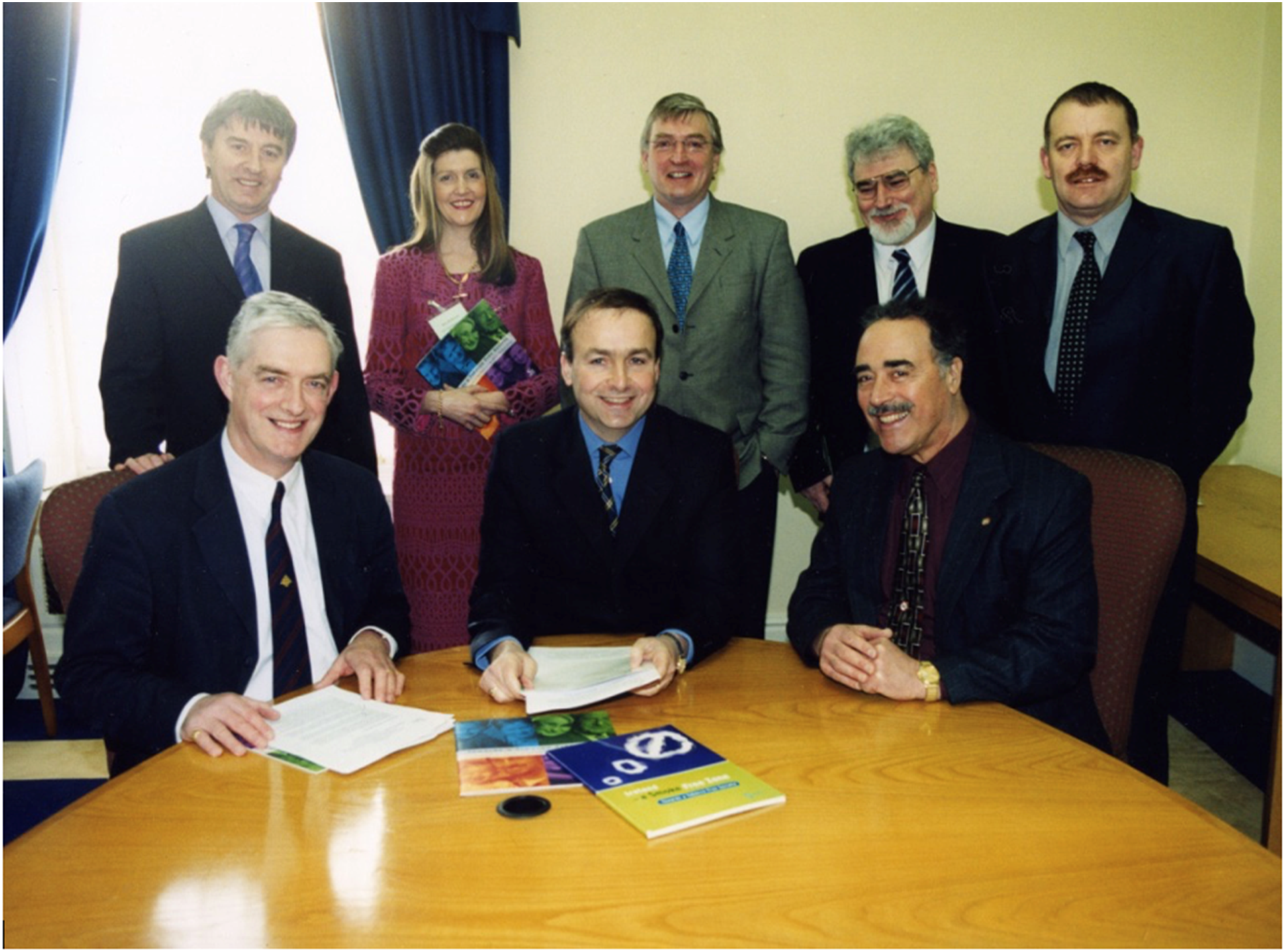
My op-ed article in The Irish Times (Monday 11 Feb. 2002) is reproduced below.

Restaurateurs and publicans are worried about a smoking ban. However, the experience of such bans in America suggests that business increases when people do not have to endure passive smoking, writes James Repace.
The debate initiated by Micheál Martin in recent days about smoking in pubs has been energetic and at times a little clouded and lacking in light. As a result, passive smoking, or involuntary smoking or environmental tobacco smoke (ETS), or as we say in the US, second-hand smoke - call it what you will - is an issue that is now firmly on the public health agenda in Ireland.
However, for this debate to be conducted properly, it is vital that it is premised on the facts about ETS. It is important that people realise that passive smoking has real and detrimental effects on their health. Working or relaxing in a smoky environment, such as a bar, poses grave health risks.
ETS is now classified as a known human carcinogen and a cause of fatal heart disease in the US. For example, the average excess risk of lung cancer for passive smoking spouses is 24%. For non-smokers heavily exposed to second-hand smoke the risk can be considerably greater.
Ireland’s own Dr Luke Clancy has estimated that people exposed to passive smoking run an increased risk of heart disease of 30% over those not exposed to it. Passive smoking, which is an entirely avoidable public health risk, has been shown to carry a staggering 82% increase in the risk of stroke. Passive smoking also can kill or cause permanent health problems in the unborn and infants. Ironically, the people exposing non-smokers to these frightening risks are primarily unwitting work-mates, spouses and family-members.
The area that has caused most debate around the current Tobacco Control Bill is the granting of a power to the Minister for Health and Children to issue a ban on smoking in places such as bars, hotels and restaurants. Much of the comment to date has been about the end of the “traditional Irish bar” or even civilisation as we know it. However, this ignores the grave health effects of passive smoking on people who work in these locations.
Ireland’s Western Health Board conducted a study on the levels of smoke in bars in its area. Based on this study and my own studies of the effects of ETS on such workers in Hong Kong and Boston, I would estimate that approximately 150 bar workers a year in Ireland will die from ill health caused by ETS.
Irish people have to ask themselves is this a price they are willing to pay? Should workers be forced to trade their health for their pay cheque? On the potential loss of earnings in the industry due to the introduction of smoking bans, it’s worthwhile to consider the experience in the US in areas where such bans have applied.
In California, with 34 million people, hospitality industry revenues increased significantly following smoking bans in both restaurants and bars.
In New York City in 1995, smoke-free laws were introduced for eating and drinking establishments. A study conducted in 1999 showed that sales in bars and restaurants had increased by 2.1%, while they had increased by 37% in hotels in the city. This compares with a decline in sales in the rest of the State, which did not introduce such laws.
In Massachusetts, more non-smokers avoided smoky restaurants and bars, according to a recent University of Massachusetts study, than the sum total of all smokers in the state.
Most smokers know that each cigarette they smoke is robbing them of life. When faced with a combination of hospitality industry and workplace smoking bans, they are often induced to quit. This is why the tobacco industry opposes these bans.
Because this industry manufactures a product which, when used as intended, causes one out of two of its consumers to die 16 years prematurely, it has no credibility. Because of this, Big Tobacco has recruited the hospitality industry to carry its water. It has also employed legal challenges and public relations strategies: usually seeking to raise questions about the legal competence of the person to conduct the research or to challenge the motives of the authors.
During recent hearings before the Joint Oireachtas Committee, the industry refused to discuss its research or to provide the Oireachtas with copies of its findings. During the course of litigation in the US many secret documents were discovered in court which would suggest that the tobacco industry is well aware that secondhand smoke kills and has sought to create an artificial controversy surrounding it.
It is important that we debate the question of environmental tobacco smoke in a rational manner and that we base our conclusion on the harm or otherwise posed by passive smoking on science. In the US, a national consensus has emerged among occupational health, environmental health and public health authorities that second-hand smoke kills more than 60,000 people annually and that workers and the public should not be exposed to this involuntary hazard.
However, because of the determined opposition of Big Tobacco and its hospitality industry bedfellows, the political system has not kept pace with scientific knowledge in many places. How this debate develops and is concluded is essentially a political question. Society needs to determine the degree to which it will or will not tolerate the risk posed by second-hand smoke or how it will otherwise manage or reduce the risk. The rights of every life supersedes the right of other individuals to pollute.
Some commentators have suggested that smoking is a fundamental right and to deprive or restrict someone in this practice is an infringement of their civil liberties. However, bar workers have a right to a safe and healthy workplace. And it is the duty of their employers to provide it. This obligation is ignored at an employer’s peril.
The right to a safe and healthy workplace may not be abrogated by an employer who seeks to cater to patrons who consume a poisonous product in public. • James Repace is a health physicist in the United States and is speaking at a seminar hosted by the Office of Tobacco Control, in Dublin Castle on Ash Wednesday, No Smoking Day.”
Driving the smoke out of Ireland’s pubs
Maurice and I presented a paper summarizing our conclusions at International Indoor Air Conference later that year. 11
Dr Bolland was Chair of the Board of the Office of Tobacco Control. Mary McDonnell was with ISIDA, the Irish Sudden Infant Death Association, Maurice Mulcahy was with the Western Health Board, Tom Beegan was the Director General of the Health and Safety Authority, and Fergus Whelan was the Industrial Health Officer at the Irish Congress of Trade Unions, Tom Power was Director of the Office of Tobacco Control, and yours truly, James Repace, who was introduced by Tom Power as a “World-renowned health physicist and leading international expert on ETS.”
An internal Philip Morris memorandum
12
summarized my article in the Irish Times as a matter of concern: “U.S. expert claims 150 Irish bar workers per year will die from ETS, the Irish press reports. The Irish Office of Tobacco Control organized a seminar on ETS featuring former US Environmental Protection Agency scientist and ETS expert Mr. James Repace, the Irish press reports. According to the Irish Times, Mr. Repace said that in Ireland ‘about 150 bar workers a year in Ireland will die from ill health caused by ETS.’ Reportedly, Repace estimated that 800 to 900 deaths a year could be caused by ETS among the wider population (Irish Times, The Irish Independent, 12/02/02).”
The Tobacco Manufacturer’s Association reported the alarming news in greater depth: “Date: 13-Feb-2002; Source : Irish Examiner; Title : Refusing To Butt Out, Minister Vows To Stub Out Smoking HEALTH Minister Michael Martin has vowed to press ahead with further restrictions on smoking in pubs, despite opposition from publicans. Mr. Martin said he was determined to introduce stricter smoking controls on pubs because of the clear evidence that passive smoking causes serious illness. The Tobacco Bill being debated by the Dail this week will give the minister powers to introduce smoking bans by regulation on public places not specified by existing legislation. Speaking at an Office of Tobacco Control conference in Dublin yesterday, Mr. Martin promised to implement extra controls on ‘a whole range of places’ following the anticipated enactment of the legislation by Easter … Mr. Martin said he was heartened by positive public reaction to his proposals. He pointed out that there was clear evidence about the dangers of environmental tobacco smoke, ETS, or passive smoking, as highlighted by one study at the conference that estimated that around 150 Irish bar workers will die from an ETS-related illness each year. The Minister said people had to recognise that pubs were workplaces for thousands. He said: ‘The health threat from ETS cannot be linked with legal or ethical arguments used by the tobacco industry about the 'right to smoke’. Meanwhile, the trade union which represents bar staff in Ireland called for a total ban on smoking in the workplace. Mandate spokesperson John Douglas said such a measure was necessary as experience had shown that voluntary codes to reduce smoking in the workplace did not work. International smoking expert and physicist James Repace told the conference that the risk of ETS for non-smokers was ‘grossly underestimated’.”
13
My activities on behalf of Irish tobacco control did not go undenounced by the Irish tobacco industry. Phil Mason, the managing director of P.J. Carroll & Co Ltd of Dublin, wrote the Irish Times on February 21, 2002 in response to an article I had authored in that publication on February 11th, entitled, “Right to live overrides right to smoke.” Founded in 1824, Carroll’s was Ireland’s oldest tobacco manufacturer and had become a subsidiary of British American Tobacco. Mason complained in a long letter, that “before your readers can begin to take a view on whether it is sensible to ban smoking in public places,” they needed “a little more clarity, both in respect to the author and the science he used to support his views.” Mason averred, on the basis of the U.S. Osteen Decision on the US EPA ETS Report and the failed attempt by OSHA to regulate secondhand smoke in the workplace, that “In short, the assertions by Mr. Repace – particularly his scaremongering ‘estimate’ that approximately 150 bar staff lose their lives each year due to ETS – such claims have not been backed up by any independent objective scientific research and it is misleading for Mr. Repace to contend otherwise.” Despite Mr. Mason’s protests, Health Minister Micheál Martin had the ear of Prime Minister Bertie Ahern, the leader of the ruling Fianna Fáil party, and the axe would soon fall on the tobacco industry’s efforts to prevent workplace smoking bans in Ireland.
In an editorial published in BMJ in April 2004, Dr Fenton Howell observed that “On 29 March 2004 Ireland became the first European country to implement legislation creating smoke-free enclosed workplaces, including bars and restaurants. Norway (June 2004) and Sweden (2005) are on schedule to introduce similar lgislation. Though there are some minor exemptions in the Irish legislation, this move is ground breaking and is of immense public health importance. The legislation shines as a beacon for other jurisdictions that might want to follow Ireland’s lead.” 14
In 2005, Maurice Mulcahy and colleagues authored a paper documenting the reduction in secondhand smoke exposure and risk for Irish hotel workers by comparative measurements of the air nicotine levels in a random sample of 20 bars and the salivary cotinine levels in 35 hotel workers in 15 Galway hotels pre-and-post smoking ban. Post-ban cotinine concentrations were reduced by 69% relative to pre-ban levels. Overall 74% of subjects experienced decreases (range 16%-99%), with 60% showing a halving of exposure levels at follow up. Self-reported exposure to SHS at work showed a significant reduction from a median 30 hours a week to zero (p, 0.001). There was an 83% reduction in air nicotine concentrations. 11
A history of my experiences as a researcher, secondhand smoke consultant, and tobacco industry antagonist is given in my memoir, in which I recount my decades-long multiple battles with the tobacco industry in New Zealand, Australia, Hong Kong, the USA, Canada, the UK, and Norway as well as Ireland. 2 For those who are interested in the arcana of translating measurements of carbon monoxide from secondhand smoke in 14 Galway pubs into 150 pub worker deaths per year, I outline the methodology in Appendix A.
Footnotes
Declaration of conflicting interests:
The author(s) declared no potential conflicts of interest with respect to the research, authorship, and/or publication of this article.
Funding:
The author(s) received no financial support for the research, authorship, and/or publication of this article.
Author’s Note:
Author contributions Conceptualization, methodology, validation, formal analysis, data curation, writing original draft preparation, writing review, and editing, project administration. The author has read and agreed to the published version of the manuscript.
