




Abstract
Introduction
Over the past few years, the range of available tobacco products has increased, including the introduction of oral nicotine pouches (ONP). 1 ONPs are small pouches designed to be discreetly placed between the lip and gum, offering a convenient nicotine delivery mechanism without spitting.1-3 ONPs are marked as “tobacco-free” or “tobacco leaf-free” and are considered relatively safer than conventional tobacco products without any supportive evidence. However, ONP also includes some carcinogens like tobacco-specific nitrosamines (TSNAs), including nicotine. For instance, a study from Germany identified alarmingly higher levels of nicotine (ranging from 1.79 to 47.5 mg/pouch) and TSNAs (13 ng N-nitrosonornicotine/pouch) in ONPs. 4 This requires further investigation to explore the short-and long-term health issues associated with using ONP.
The ONP market is experiencing exponential growth, with global sales estimated at US$2.33 billion in 2020 and projected to reach US$21.84 billion by 2027. 5 This rapid increase in sales is attributed to strategic tobacco marketing approaches, including incentive programs that mandate prominent placement, promotional efforts, discounts, and targeted distribution of tobacco products within retail settings. 6 The ONP-selling companies mainly influence the exchange of information and products between manufacturers and consumers. They actively promote and distribute the product and encourage consumers to buy ONP that is aligned with their preferences through media marketing. 7 Additionally, they do extensive advertisements across various social media platforms.8,9
Studies also explored the role of marketing strategies in using ONP, specifically among youth.10-12 For example, a recent scoping review reported that ONP was primarily promoted through television, radio, and online advertisement, incorporating headlines such as “freedom,” “flavor,” “brand,” and “innovation” to attract specifically younger population. 10 Additionally, ONP was available in approximately 98% of the convenience stores in the US. 11 Another study from the US found that 45% (n = 1700) of the study participants were aware of ONP, and 17% used it. In addition, advertisements in shops and social media, brand-sponsored events, new stories on television/radio, print media, and direct emails from brand ambassadors were some of the marketing channels that enhanced awareness among participants. 12
As the landscape of these novel nicotine products like ONPs is rapidly evolving, it is challenging to understand how new products affect nicotine intake. For instance, a study conducted in Italy by Farsalinos K.E et al found an increase in nicotine consumption among those who use or switch between various types of products compared to those who stick to a single product. 13 The increase in the consumption of nicotine may be due to products like ONP, which allow consumers to discreetly use nicotine in areas where smoking is prohibited, 14 or they are accessible to those below the legal age for tobacco consumption. 15 Other factors that may influence ONP consumption include fewer ashes or smoke, 16 cost less than combusted cigarettes, or convenience. 17
Some studies explored perceptions of ONP among consumers; however, these studies were based in the West.13,18,19 In addition, none of these studies explored seller perceptions or evaluated the point-of-sale (POS) environments for ONPs. For instance, a qualitative study from the US found that consumers perceived ONP as a situational substitute due to its cleaner, acceptable, and discrete nature. 18 Another study from the US surveyed 942 young adults and reported ONP as less harmful and less addictive than other traditional tobacco products. In addition, flavor, peer influence, ease of use, and discrete nature were significantly associated with using ONP among youth. 19
ONP was introduced in Pakistan back in 2019 and gained popularity among youth. For instance, an online study from Pakistan reported that one-third of the respondents (n = 1749) were aware of ONP, with the internet (63.4%) being the primary source of information, followed by friends (25%). In addition, 17.2% of respondents (mean age 20.6 years) used ONP, while the majority (68%) were unaware of the ingredients of ONP. 20 Considering the growing increase in the use of ONP, it is imperative to investigate how these new products influence people’s behaviors and perceptions related to tobacco consumption. Therefore, our study aimed to assess the availability of ONP, marketing strategies related to ONP at point-of-sale (POS), and understand consumer’s and seller’s beliefs, perceptions, and knowledge of ONP in Karachi, Pakistan.
Materials and Methods
Study Design, Setting, and Duration
We used a mixed-methods study design to assess the marketing strategies and consumer’s and seller’s perceptions regarding ONP in Karachi, Pakistan, from July 2022 to January 2023. In the quantitative approach, we used a cross-sectional study design to collect data through observation and survey. In the qualitative approach, we conducted in-depth interviews with ONP consumers and sellers to assess the marketing strategies and perceptions of ONP using a semi-structured interview guide. We conducted the study in three areas of District East, Karachi, one of the six districts of Karachi, with a population of about 3.92 million. 21
Mapping the POS
Before starting our data collection within District East, we mapped the POS of ONP in the three selected neighborhoods based on the socioeconomic status (SES) as high, medium, and low. SES was determined based on the financial characteristics of each area and the economic standing of the local population of these areas. 22 We purposively sampled 90 POS of ONP (30 in each area), with a higher density of markets and offices.
Observation at POS
We developed a detailed observation checklist to capture essential information about ONP availability and marketing tactics. The observation checklist encompassed six items, including advertisements, product placement, products on display, and associated promotional aids. During observation, two trained members of our research team observed the POS of ONP and acted as regular customers to complete the observation checklist. It took approximately 20 to 30 minutes to complete the observation checklist at each POS. The same team members completed the observation in all three areas to maintain consistency in data collection.
Questionnaire-Based Survey
After completing the POS observation, the same data collectors approached the consumers and sellers. We developed a questionnaire to collect information from sellers related to perspectives on the marketing strategies employed by ONP manufacturers and the impact of these strategies on their ONP selling behavior (refer to Supplemental material). The ONP sellers were surveyed to collect firsthand information about the marketing and promotion of ONP products at the POS. On the other hand, ONP consumers were surveyed to understand their reasons for using ONP, their perceptions about the product, and the factors influencing their purchasing behavior. The questionnaire included a series of questions focused on the marketing tactics associated with ONP products, product placement, advertising, and promotional activities of ONP products for sellers (refer to Supplemental material). The survey comprised two primary participant groups: consumers and sellers of ONP. We purposively selected 30 consumers and 30 sellers from all three neighborhoods, i.e., total 90 consumers and 90 sellers. Current consumers of ONP aged 18 years and above who agreed to participate and provided written informed consent were included in the study. Similarly, POS owners who can provide 10 to 15 minutes of their time for the interview and provide written informed consent were included. The data collectors approached the participants and collected the data using a structured questionnaire. The data collectors provided complete study details to the participants before the interview, and written informed consent was obtained from those who agreed to participate. The data collection took approximately 10 minutes for each participant to complete the survey questionnaire.
In-Depth Interviews
We invited both consumers and sellers of ONP, who participated in the survey questionnaire for in-depth interviews to develop a deeper understanding of using and selling ONP products. Those who agreed to participate and provided written informed consent were interviewed. In addition, we identified and enrolled additional sellers and consumers using the non-probability snowball sampling technique until we reached data saturation. We interviewed 12 sellers and 12 consumers.
A trained interviewer conducted the interviews using a semi-structured interview guide. The interview guides included questions about the use and availability of ONP, consumer’s and seller’s knowledge about tobacco laws, attitudes towards cessation, and perceived health effects and marketing strategies. We conducted these interviews to gain valuable insights into consumer behavior, market dynamics, and the broader social and health implications of ONP, helping to inform future policies and public health strategies. We employed an open-ended approach during the interviews, encouraging interviewees to freely discuss their experiences and perceptions of ONP products. In addition, we conducted the interviews in a small cafeteria at the POS and provided them with a confidential and comfortable environment to promote unbiased responses. All interviews were audio-recorded with the consent of the participants.
Data Analysis
We analyzed the respective data sets using an explanatory mixed-methods design. We compared the quantitative and qualitative data, ensuring multiple sources and methods supported the insights generated. This triangulation provided a comprehensive view of ONP marketing, the perspectives of sellers and consumers, and the various factors influencing product use and perceptions. This approach also strengthened the conclusions of the study and increased the utility of findings for policymakers and other relevant members.
Quantitative
We calculated descriptive statistics for the data collected through observational work and questionnaire-based data collection from the consumers and sellers. For example, we calculated the frequencies and percentages of shops that carried ONP, displayed ONP products, and featured ONP advertising and/or promotions for each of the three areas separately and for the entire sample. We also reported the frequencies and percentages of shops that displayed ONP next to candy and at the child’s eye level. The data was analyzed using Excel version 2408.
Qualitative
We analyzed the qualitative data using the manual Thematic Analysis approach. 23 All interviews were audio-recorded, and identifiable information was removed during the transcriptions. The investigators transcribed the interviews verbatim into Roman Urdu. The quotes used in the paper were translated into English. The data were coded and organized thematically using Excel version 2408. Two team members examined the codes independently and then matched and organized them into macro themes. After discussion with the study team, the macro themes were finalized and presented with the corresponding micro themes. We then grouped the main themes and findings using the inducted thematic analysis method. Coding categories were based on the research objectives, including marketing and advertisement for ONP, reasons for ONP use, perceived health effects, and attitudes towards the product (refer to Supplemental material).
Ethical Considerations
Approval was sought from the Ethical Review Committee of the Aga Khan University (Ref: 2022-7005-21074). We obtained written informed consent from all participants before data collection.
Results
Mapping of POS of ONP by SES.

SES = socioeconomic status, POS = point of sale, ONP = oral nicotine pouches.
Figure 1 presents the overall observation survey findings as well as based on the SES categories. In 20% (n = 18) of the 90 POS observed, ONP shops were located within 200 meters of schools, with a slightly higher proportion (23%, n = 7) from medium SES. Visible ONP advertisements were found in 63% (n = 57) of the POS, with an equal proportion (73%, n = 22) of POS from low and high SES. Fifty-nine percent (n = 53) of the POS displayed ONP next to candy, with a higher proportion reported from low and medium SES (63% each). In 70% (n = 63) of the POS, ONP displayed at child’s eye level, with a higher proportion from high (77%, n = 23) followed by medium (73%, n = 22) SES. Observation survey of POS in Karachi.
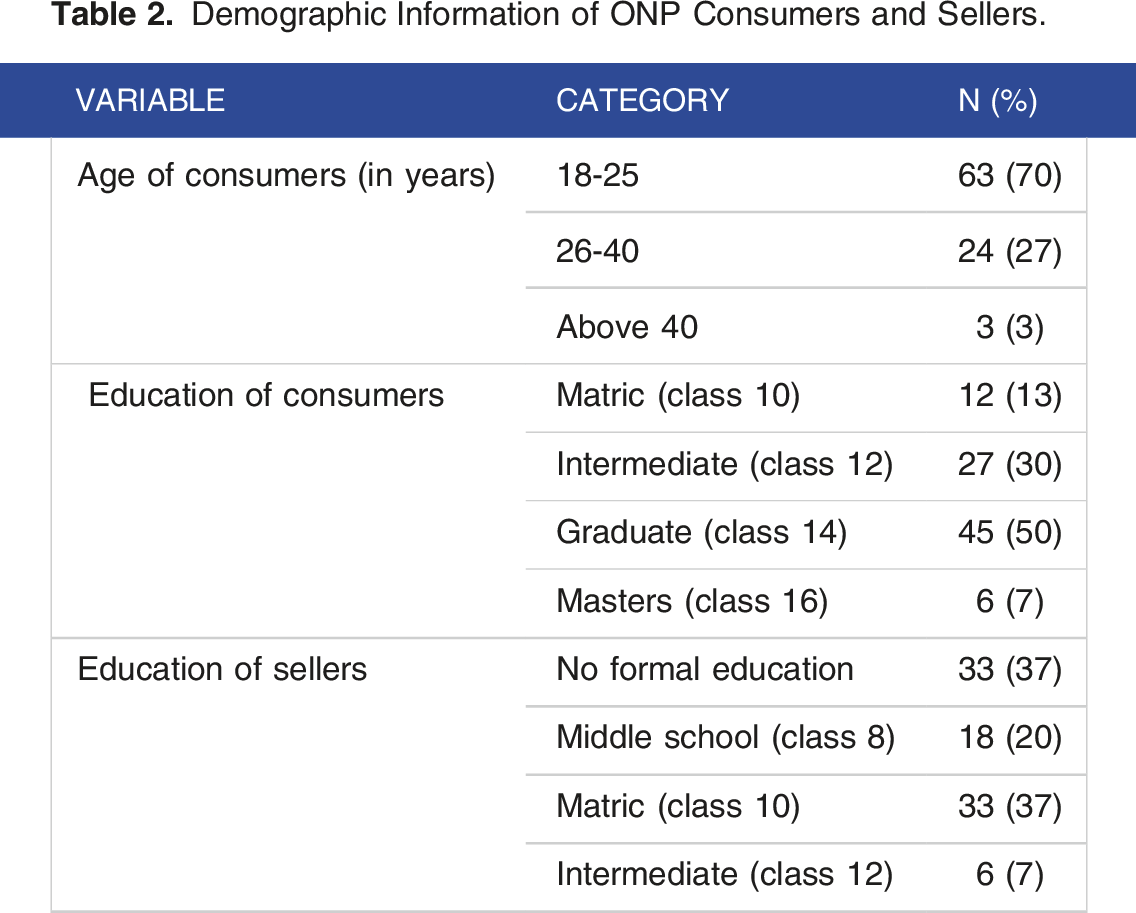
Demographic Information of ONP Consumers and Sellers.
Consumer’s Knowledge, Perceptions, and Use of ONP.

Seller’s Knowledge and Attitude Toward Selling ONP.

Qualitative Interviews
The qualitative analysis of in-depth interviews conducted with ONP consumers and sellers revealed three major themes: marketing strategies, knowledge, attitude, and preferences, and factors associated with ONP consumption, as shown in Figure 2. Factors associated with increased popularity and use of ONP.
Theme 1: Marketing Strategies
The analysis revealed that the ONP selling company employs four distinct marketing strategies, as shown in Figure 2. Firstly, ONP companies incentivize sellers by offering profits and creating mutually beneficial arrangements. Secondly, these companies strategically target areas with more potential consumers. These areas are typically characterized by dense populations, commercial activity, and proximity to offices and schools, indicating a targeted approach to distribution, maximizing visibility, and accessibility of ONPs. Thirdly, a significant emphasis is placed on extensive advertising through both social media platforms and mainstream media to attract consumers, especially youth. Lastly, celebrity endorsement, exemplified by the collaboration with a famous singer in Pakistan, emerged as a prominent promotional tactic. Respondents attested to the effectiveness of these strategies, underscoring their impact on consumer awareness and brand visibility.
A 23-year consumer who was doing a marketing job in a company expressed about social media marketing and celebrity endorsement to advertise the ONP products, “Their last advertisement that I watched, they have launched a song with (Actor name), so I watched that marketing video on FB (Facebook), insta, and YouTube. And there was a lot of branding of (name of ONP product) in the commercial (advertisements) on our (regular TV) channels etc.”
Moreover, sellers reported that the companies provide them with commissions based on the volume of ONP sold. This financial incentive encourages them to promote and distribute ONP products actively.
A 43-year-old seller who was selling tobacco products for 13-14 years stated, “The Company gives profit; they do the deal. It is that we get a commission on these, if we sell 200 or 250 pouches in a month then we get a commission on it.”
Theme 2: Knowledge, Attitude, and Preferences for ONP
Participants, specifically consumers, demonstrated a comprehensive understanding of ONP as a source of nicotine, recognizing its addictive properties. Notably, there was a consensus among sellers that ONP usage is restricted to individuals above 18 years of age, highlighting a collective awareness of regulatory guidelines. Comparisons between ONP and other nicotine-containing products, such as niswar, cigarettes, and chewable tobacco, emerged as a recurrent theme. Most consumers regarded ONP as a premium choice, attributing its superiority to factors such as sophisticated packaging and enhanced convenience.
Participants articulated their preferences for ONP, emphasizing its unique benefits. A 25-year consumer reported about his ONP consumption experiences, “At least for 2 hours after taking (name of ONP product), you do not feel that nicotine need or you 'don't feel that you 'haven't smoked a cigarette.”
Another consumers who was a university student said, “In comparison to (names of SLT products) and the dirty (name a snuff like SLT product) that are available at cobbler, in comparison to these it (name of ONP product) is better.”
Theme 3: Factors Associated with ONP Consumption
Consumers and sellers identified several key factors contributing to the growing popularity of ONP. Participants acknowledged the convenience of ONP as a prominent driver of its uptake. The product was viewed as a viable substitute for traditional cigarettes, particularly in settings where smoking was restricted, such as university premises and office environments.
A university student stated, “Smokers cannot smoke in university premises as it is not allowed in there, or you see for people working in offices, (name of ONP product) makes it easier for them to fulfill their nicotine needs”.
Another 33 years employed consumer emphasized the satisfaction derived from ONP use, stating, “When we put it on our gums or under our lips, after a while the need for nicotine is satisfied|”.
Moreover, participants perceived ONP as a less harmful alternative to cigarettes due to its smoke-free nature, further contributing to its appeal. A 27-year-old employed ONP consumer aptly summarized this sentiment, “Look, there is a huge difference. Cigarettes have smoke that you inhale, it goes into your lungs. Therefore, it is more damaging. In comparison to cigarettes, (name of ONP product) does not have smoke, so it is less damaging than a cigarette”. Notably, an increased demand of ONP among consumers was attributed to peer influence, with social circles playing a pivotal role in shaping consumer behavior.
Discussion
As the landscape of novel nicotine products such as ONPs continues to evolve, it is imperative to investigate how these new products influence people’s behaviors and perceptions related to tobacco consumption. Our study aimed to assess the availability of ONP, marketing strategies related to ONP at POS, and understand consumer’s and seller’s beliefs, perceptions, and knowledge of ONP in Karachi, Pakistan. Of the 90 POS observed, ONP was sold in 20% of POS within 200 meters of schools. Furthermore, 59% of POS displayed ONP next to candy, and 70% kept ONP at the child’s eye level. More than fifty percent of ONP sellers were approached by companies to sell ONP, with 40% of them receiving commissions while achieving the targets on ONP sales. Moreover, marketing strategies, peer influence, ease of use in tobacco-restricted areas, and the perception of reduced harm compared to cigarettes are the key drivers of ONP consumption.
ONP is present in various retail settings, including general stores, local shops, kiosks, and medical stores in all three SES categories of POS. Notably, 20% of these shops were located within 200 meters of schools, with a slightly higher proportion from medium SES (23%) raising concerns about the accessibility of ONP to children. This proximity to schools is particularly alarming and has been documented in another study as a key factor in promoting early initiation of tobacco products among youth. 24 In addition, we found the placement of tobacco products at' ‘children’s eye level (70%), with slightly higher proportion at the POS from high (77%) followed by medium (73%) SES. Furthermore, ONP displayed next to candy (59%) is another marketing strategy to attract younger consumers. These marketing strategies have also been seen in promoting various tobacco products in Western literature.25,26
Studies suggest that young adults are the primary target for new nicotine products. 27 This aligns well with our study findings as most ONP consumers (70%) were young, between 18 and 25 years old. In addition, our study found that most of the ONP consumers were cigarette smokers and perceived ONP as a less harmful alternative to other tobacco products. Our qualitative findings also support this as most ONP consumers confirmed that they use ONP in places where they are not allowed to smoke, for example, on university premises or in indoor office settings. Furthermore, the ONP users perceived ONP as a cessation aid, which may contribute to the increasing popularity of ONP among them. Other studies also highlighted that perceptions of reduced harm among tobacco users can drive the adoption of alternative nicotine products.28,29
Marketing strategies and peer influence play a significant role in the adoption and continued use of tobacco products, particularly among younger populations. 30 Likewise, our study found that more than 50% of the consumers reported knowing about ONP from print media (n = 49, 55%), followed by friends (n = 25, 27%). Our qualitative findings also support extensive ONP advertisement through social media and mainstream media, often featuring celebrity endorsements as the major factor reported by consumers and sellers. In addition, many consumers, particularly students, acknowledged that peer pressure is another significant factor influencing their decision to use ONP. Other studies have also found these marketing strategies to be highly effective in increasing the popularity of ONPs among consumers and shaping their behavior toward adopting other nicotine products.31,32
Sellers’ knowledge and attitudes towards ONP revealed that many were motivated by company approaches and customer demand. Many sellers reported receiving commissions for achieving sales targets, indicating a financial incentive to promote ONP. In addition, the sale of ONP to students under 18 years old by 23% of sellers in our study is particularly concerning and calls for strict enforcement of age-related sales restrictions. Our qualitative findings also revealed that financial incentives for ONP and targeted distribution of ONP in high-demand areas are attributable to the popularity of ONP among sellers. In addition, these tactics highlight broader issues in the tobacco retail environment where financial incentives and regulatory gaps contribute to underage sales. 33
Our study has several strengths. To the best of our knowledge, this is one of the first studies to examine the marketing strategies and perceptions of consumers and sellers of ONP in Pakistan. We employed a mixed-methods approach by conducting surveys and interviews with ONP sellers and consumers. This comprehensive methodology provides a holistic approach to exploring the marketing strategies and perceptions of ONP among consumers and sellers. In addition, we mapped the POS of ONP at three different SES categories, providing insights into the availability and distribution of these products across varying socioeconomic contexts. Furthermore, we included POS of ONP from various socioeconomic statuses; hence, our study findings are representative of a diverse socioeconomic sample. However, we purposively sampled high-density commercial areas to provide valuable insights, which may limit the generalizability of findings to areas with these specific characteristics. In addition, schools may be more common in these densely populated areas, which might reflect characteristics of the sampled areas rather than a broader trend applicable to other settings, requiring a cautious interpretation of the results.
Our study does have some limitations. First, we did not calculate a formal sample size due to the lack of resources, and a lack of power calculation limited our ability to draw strong inferences. However, our study provides preliminary insights that can inform future studies with a formal sample size to employ rigorous statistical methods. The questionnaire used in this study is not validated, which might have affected our findings. However, the questionnaire has face validity as it was being reviewed by subject experts before implementing it. In addition, we relied on self-reporting data from both ONP sellers and consumers, which may be subjected to social desirability bias. To mitigate this, we assured participants that their responses would be kept confidential, and their identities would remain anonymous to help create a safe environment for participants to provide more honest and accurate responses. We did not collect data on the seller’s age, as it was not identified as a key variable for the analysis. However, future research incorporating this variable would help enhance the depth of the study. Another limitation could be the variation in question phrasing between sellers and consumers regarding the perceived harm of ONP compared to other tobacco products, which could contribute to the observed discrepancy in harm perception between sellers and consumers, indicating the importance of consistency in future research
Conclusion
Our study identified various concerns related to ONP marketing and use as one-fourth of ONP shops were located within 200 meters of schools, with more than half displaying ONP next to candy and at child’s eye level. In addition, we found most of the ONP consumers were young (18 to 25 years), were cigarette smokers, and the majority used ONP multiple times daily. Many sellers reported receiving commissions for achieving ONP sales targets, and approximately one-fourth sell ONP to students under 18. Qualitative insights from our study highlight several factors influencing ONP consumption, including marketing strategies, peer influence, the convenience of use in tobacco-restricted areas, and the perception that ONPs are less harmful than traditional ones. Our study addresses a significant public health issue and provides valuable insight that could inform policies to regulate tobacco sales, including measures to restrict sales to adults and prohibit the sale of tobacco products near schools.
Supplemental Material
Supplemental Material - Marketing Strategies and Consumer and Sellers Perception About Oral Nicotine Pouches in Karachi, Pakistan
Supplemental Material for Marketing Strategies and Consumer and Sellers Perception About Oral Nicotine Pouches in Karachi, Pakistan by Ghazala Akhlaque, Muhammad Muneeb Ullah Siddiqui, Romaina Iqbal, Abid Ali Vancy, Javaid Ahmed Khan, and Sabahat Naz in Journal of Tobacco Use Insights.
Supplemental Material
Supplemental Material - Marketing Strategies and Consumer and Sellers Perception About Oral Nicotine Pouches in Karachi, Pakistan
Supplemental Material for Marketing Strategies and Consumer and Sellers Perception About Oral Nicotine Pouches in Karachi, Pakistan by Ghazala Akhlaque, Muhammad Muneeb Ullah Siddiqui, Romaina Iqbal, Abid Ali Vancy, Javaid Ahmed Khan, and Sabahat Naz in Journal of Tobacco Use Insights.
Footnotes
Acknowledgements
We would like to thank all study participants for their participation. We also thank our dedicated data collectors for their hard work.
Author Contributions
RI and JAK were conceptualized the study and secured funding. GA, MMUS, and AAV were involved in the analysis and interpretation of the results and wrote the first draft of the manuscript. SN, RI, and JAK reviewed and provided scientific revisions to the manuscript. All the authors have read and approved the final manuscript.
Declaration of conflicting interests
The author(s) declared no potential conflicts of interest with respect to the research, authorship, and/or publication of this article.
Funding
The author(s) disclosed receipt of the following financial support for the research, authorship, and/or publication of this article: This work was supported by the Campaign for Tobacco Free Kids (CTFK), Bloomberg USA (Paksitan-25-15).
Ethical Statement

Supplemental Material
Supplemental material for this article is available online.
References
Supplementary Material
Please find the following supplemental material available below.
For Open Access articles published under a Creative Commons License, all supplemental material carries the same license as the article it is associated with.
For non-Open Access articles published, all supplemental material carries a non-exclusive license, and permission requests for re-use of supplemental material or any part of supplemental material shall be sent directly to the copyright owner as specified in the copyright notice associated with the article.
