



Abstract
Introduction
Smoking is linked to an increased risk of adverse health consequences such as tobacco dependence, respiratory and cardiovascular disease, cancer, and diabetes.1-3 According to the World Health Organization (WHO), tobacco kills up to 7 million first-hand smokers and about 1.2 million non-smokers who are exposed to second-hand smoke yearly. 4 Among common non-pharmaceutical interventions that help with smoking cessation, there is a growing interest in the general population for the use of hypnotherapy. Hypnosis is defined as “a state of consciousness involving focused attention and reduced peripheral awareness characterized by an enhanced capacity for response to suggestions” and hypnotherapy is defined as “the use of hypnosis in the treatment of a medical or psychological disorder or concern.”5(p6) In a recent study, hypnotherapy had mostly positive and neutral views and expectations across a large, nationally-representative sample. 6 Furthermore, among complementary treatments for smoking cessation, hypnosis is one of the most frequent interventions utilized to quit smoking.7,8 In fact, group hypnotherapy and group cognitive-behavioral therapy (CBT) for smoking cessation have been found to be similar in terms of efficacy. 9
The most recent meta-analysis providing synthesized findings on hypnotherapy for smoking cessation across randomized controlled trials (RCTs) reported that hypnotherapy was statistically significant in its capacity to increase the success of smoking cessation. 10 However, the wider literature presents mixed evidence on the efficacy of hypnotherapy for smoking cessation 11 and a recent systematic review that included only RCTs concluded that “…current evidence suggests the benefit [of hypnotherapy for smoking cessation] is small at most.”12(p2) An explanation for the difference in efficacy is the variations in the intensity, length, and frequency of hypnotherapy programs.13,14 In programs with minimal hypnotherapy sessions, the efficacy rates were lower, but those with more intensive hypnotherapy programs (i.e., increased length and frequency of sessions, personalized hypnotic suggestions, complemented with informative readings and support through counseling to the patient) had significant and higher efficacy rates.15-17 Finally, participants across numerous studies self-report hypnotherapy to be the most effective method for smoking reduction that they have tried.6,18
The use of mobile-based interventions for smoking cessation provides a range of potential benefits such as accessibility, ease of use, cost-effective delivery, and the ability to link users with others for social support. 19 Moreover, both the demand for virtual and remote clinical care 20 and the prevalence of virtual, mobile applications offering mind-body interventions are predicted to increase significantly. A recent prospective, single-arm study investigating a smartphone app for smoking cessation in India found high, prolonged abstinence rates from the end of the first week of the program up until 30 days following completion of the program. 21 The authors note that the collected data were based on surveys completed voluntarily by study participants. In a recent report by Abroms and colleagues, 22 their content analysis found that among all the iPhone apps focusing on smoking cessation available at the time of publication, hypnosis-based apps were the most frequently downloaded, with apps utilizing hypnotherapy for smoking cessation accounting for more than half of the downloads. 22 A recent study by Paige and colleagues 23 examined 100 mobile smoking cessation apps downloaded through the Apple App Store, 17 of which were hypnotherapy apps. Their content analysis found that apps that were hypnotherapy-based and informational in nature incorporated a greater number of behavioral change processes compared to apps that had a variety of attributes. They concluded that many of the smoking cessation apps that were investigated did not include components to increase patient engagement. 23
The Finito app is a mobile-based health (mHealth) app developed by Mindset Health (https://www.tryfinito.com). It provides an evidence-based hypnotherapy intervention for smoking cessation. 14 Finito users can subscribe to a personalized, three-week self-hypnosis program designed for smoking cessation. This app purports to target the root causes of an individual’s smoking behavior through the use of positive hypnosis suggestions. These suggestions are provided through 15-minute daily self-hypnosis sessions and aid in dealing with cravings, feelings (such as irritability and anxiety), and engrained behaviors. The Finito program aids in smoking cessation by decreasing stress via powerful imagery. In addition, the app facilitates decreases in stress via suggestions aimed at increasing an individual’s self-efficacy to overcome any worries or concerns about stopping smoking and heighten their likelihood of successfully coping with cravings. The Finito app also works by increasing an individual’s desire and intention to quit smoking. The app does not need to be used in conjunction with pharmacotherapy for smoking cessation (e.g., nicotine replacement therapy, varenicline, bupropion), but app users have the option of doing so.
The first week on the app involves preparation for the treatment program and reducing cigarette use. The second week of the program involves establishing a “stop date” as well as managing cravings. The final week consists of learning relapse prevention skills, deep breathing techniques, and incorporating new habits into daily life. Within this program, users also have access to educational readings and a toolkit designed to help individuals manage and stop cravings. Educational readings are on a variety of topics, including managing weight gain and social situations, the relationship between smoking and sleep, and relapse prevention. The app also includes a cigarette tracker, which allows the user to record the number of cigarettes they have smoked on a daily basis over the course of the treatment program. Chat support with actual individuals is an additional feature provided by the app. After the three-week program, users can continue with a reinforcement program for maintenance of abstinence. Mindset Health is an Australian technology company that consults with licensed experts to develop apps that deliver hypnotherapy. Other apps by Mindset Health include Evia for hot flashes and Nerva for irritable bowel syndrome.
To date, there are no articles evaluating the use and efficacy of a hypnosis-based, smoking cessation app. The objective of this study is to analyze preliminary online survey data from individuals who have downloaded and used the Finito app to quit smoking. This will be used to inform the development and implementation of a larger study investigating successful cessation rates in users of the Finito smoking cessation app.
Method
Participants
Our study population included individuals living both inside and outside of the U.S. who had enrolled in and finished the Finito program via the smartphone app developed by Mindset Health. Respondents needed to be at least 18 years old to participate. No other inclusion or exclusion criteria were applied. The study was determined to be non-human subject research by the authors’ university institutional review board because it used only pre-existing data from a de-identified data set. Survey respondents were provided with a written statement of informed consent before beginning the survey and were instructed that proceeding to take the survey was indicative of consent.
Survey
The online survey consisted of 32 possible questions that were presented variably to participants based on their responses. For example, if a participant indicated that they successfully reduced their smoking, a follow-up question was presented which asked about their satisfaction regarding their reduction. The survey questions inquired about participants’ experience with smoking cessation, current smoking habits, app use, program completion, secondary benefits, satisfaction, and changes in quality of life. The last question of the survey was optional and provided respondents the opportunity to freely write about what they found most helpful with the Finito app.
Proceedure
All individuals who had previously enrolled in and finished the Finito program received an initial email and a follow-up email from Mindset Health inviting them to participate in an online survey. To prevent fraudulent participation, unique email links were distributed to ensure surveys could only be completed once and by those who were associated with enrollment in the three-week program. Answers were recorded with a unidentifiable but unique ID number and sent to Mindset Health who provided data to our research team for analysis and interpretation.
Data Analysis Strategy
The de-identified data was analyzed to determine descriptive and inferential statistics. Analytic procedures included the calculation of means, standard deviations, frequencies, and chi-square tests of independence. Free-response data were sorted and coded based on theme. All calculations were carried out via Statistical Package for the Social Sciences (SPSS).
Results
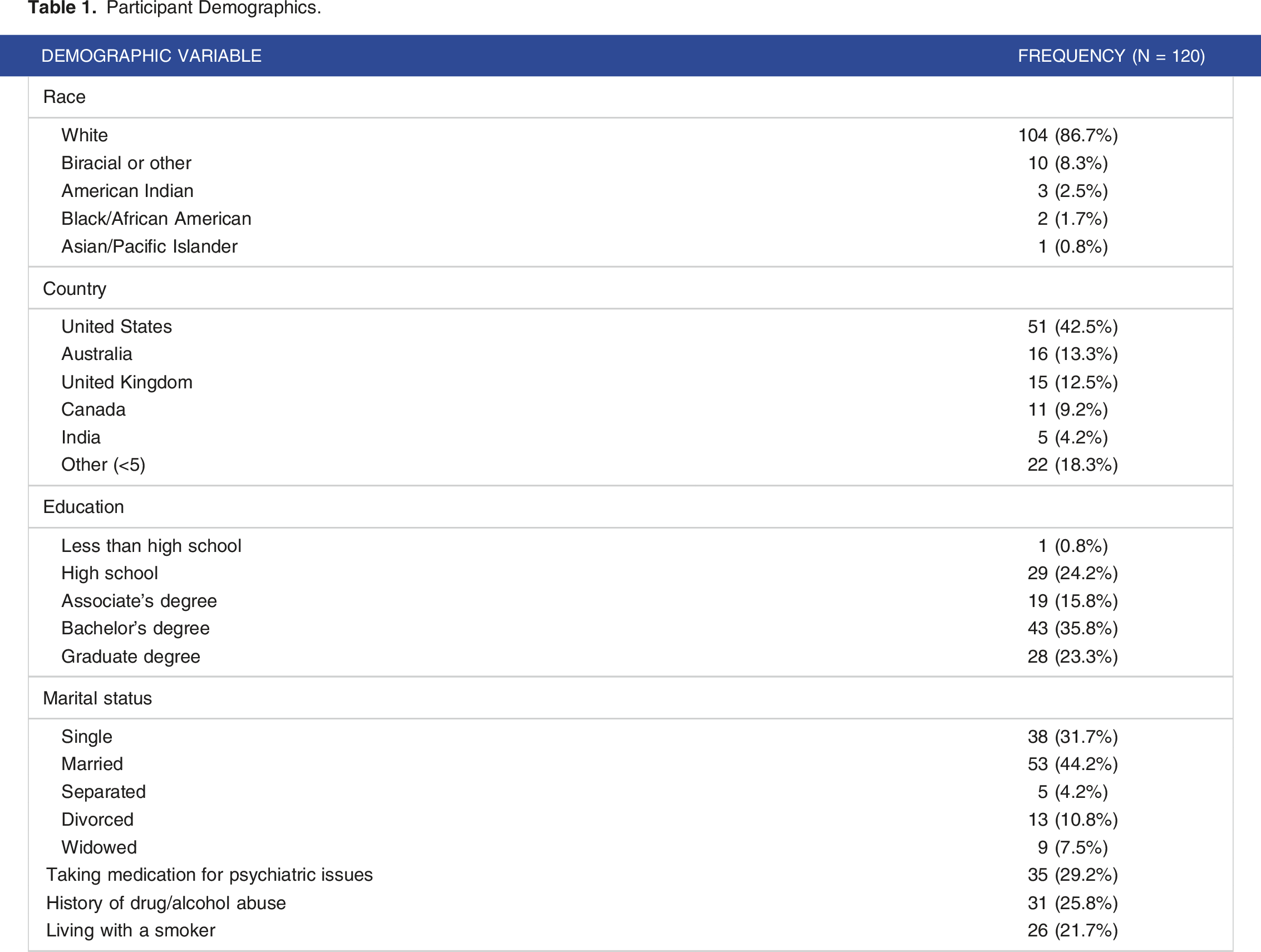
Participant Demographics.
Secondary Outcomes Related to Wellbeing.

Respondents were asked a number of questions regarding satisfaction with the app itself and the overall user experience. When asked how likely they were to refer Finito to someone else on a scale of 1-10, exactly one-third of participants responded with “10” and the average likelihood rating was 7 (SD = 3.4). When rating how user-friendly the Finito app interface is on a scale of 1-10, 36.7% of participants responded with “10” and the average rating was 8.1 (SD = 2.18). When respondents were asked how likely they were to use hypnotherapy for other concerns on a scale of 1-10, the average rating was 7 (SD = 3.19) with approximately 27.5% of participants providing a rating of “10”.
Qualitative Data on Participant Report of Most Helpful Aspects of the Finito App.

Chi-Square Tests of Independence for Variables Associated With Self-Reported Achievement of Smoking Habit Goals.

Discussion
The present study provided a retrospective analysis of user data for Finito, an mHealth resource for smoking cessation or reduction using a hypnotherapy program. Our preliminary results from an online survey suggest that Finito is a useful, pleasant, and cost-effective tool in a patient’s journey to quit smoking. Users reported minimal to no relapse after quitting smoking, and a satisfactory reduction of smoking by those stating they have not quit completely. Given that not all users of Finito’s three-week program had the initial goal to quit smoking, but rather focused on smoking reduction, the Finito app demonstrated effectiveness in meeting the majority of the goals of diverse expectations. A total of 76.6% reported reducing or stopping smoking. More specifically, just over half (50.8%) of respondents reported that they quit smoking and an additional 25.8% reported a reduction in smoking habits. In addition to the main outcome of smoking reduction and cessation, participants also reported promising ratings within various aspects of well-being. The highest ratings included saving money, breathing better, reduced stress and anxiety, and improved overall health. When asked about the most helpful aspects of the program, 20.7% and 18.1% of respondents, respectively, indicated that the hypnotherapy and relaxation components of the intervention helped them the most while using the app.
We examined the association between three variables and the self-reported achievement of smoking habit goals. Two variables, age (whether older or younger than the average age) and whether or not someone was living with a smoker, were not associated with goal achievement. Interestingly, whether or not a respondent indicated that they completed the full Finito program was associated with goal achievement. This points to the importance of users engaging fully with the program and completing all steps during the three-week intervention. It also demonstrates the program’s efficacy in helping users reach desired results regardless of their age and whether or not they are living with someone who smokes.
Finito user ratings for user-friendliness and likelihood to use hypnotherapy again in the future (for conditions other than smoking) were high, with 36.7% and 27.5% of the participants giving the highest possible rating, respectively. This complements the high completion percentage reflected among respondents and suggests favorable patterns in user engagement. These results align with previous reports regarding consumers' preference of hypnosis apps for smoking cessation across wider mHealth literature. 22 While a recent study of mobile smoking cessation apps concluded that these apps do not often include components to increase patient engagement, 23 our findings regarding the Finito app suggest favorable patterns in user engagement. Similar to a recent study conducted in India that found high and prolonged smoking cessation rates from using an app, 21 our study was also based on a survey that was completed voluntarily by app users.
Limitations of the present study include its retrospective nature, lack of power analysis, reliance on only subjective self-report, absence of biochemical markers, low response rate, and limited generalizability. While it is understandable that response rate to the survey would be low considering only two emails were sent and no financial incentive was provided, approximately 10% of those who received an email responded to the survey. The survey itself was a pilot questionnaire and used for the first time in the current study. Although respondents represented many different countries, the U.S. made up 42.5% of the representation and the vast majority of respondents identified as White. It is also important to note that approximately 75% of respondents reported having secondary education, which limits generalizability to those who may have only received a high school degree or less. The survey also did not specifically inquire about any potentially unfavorable elements of the app or program.
Directions for future research include additional data collection on usage metrics (i.e., usage patterns, adherence, and report of program progress such as sessions completed) for the further analysis of associations between user characteristics, outcomes, and Finito app usage patterns, engagement, and adherence. Future studies with these additional metrics can examine possible moderators for changes in self-reported cigarette use at baseline, completion, and follow-up. It is also advisable to explore how hypnotizability may moderate the effects of the Finito program and to expand sample populations to provide a more generalizable view of outcomes across different races and backgrounds. The survey data provides encouraging support for further study, including the need for a fully powered randomized controlled trial of the Finito app for smoking cessation.
Conclusion
The present retrospective analysis of survey data from users of the Finito app underscores its potential as an effective delivery method of a clinical hypnosis intervention for smoking cessation and reduction. Over half of respondents reported complete smoking cessation and a notable proportion reported a reduction in smoking habits. The high user satisfaction and report of adjacent improvements further highlights the program’s appeal and effectiveness. Importantly, the association between program completion and goal achievement emphasizes the need for full engagement to maximize desired outcomes. Overall, the Finito app expands accessibility to an effective treatment for smoking and aligns with broader trends in mHealth literature, which positions the app to be a valuable resource for those seeking to quit or reduce smoking. Future research should examine the Finito app’s efficacy in a fully powered randomized controlled trial.
Supplemental Material
Supplemental Material - Preliminary Survey Data From an App-Delivered Hypnosis Intervention for Smoking Cessation
Supplemental Material for Preliminary Survey Data From an App-Delivered Hypnosis Intervention for Smoking Cessation by Cameron T. Alldredge, Vanessa Muniz, Vindhya Ekanayake and Gary R. Elkins in Tobacco Use Insights.
Footnotes
Author Contributions
Declaration of Conflicting Interests
Dr Gary Elkins is a consultant for Mindset Health and worked with app developers to create the Finito app.
Funding
The author(s) received no financial support for the research, authorship, and/or publication of this article.

Supplemental Material
Supplemental material for this article is available online.
References
Supplementary Material
Please find the following supplemental material available below.
For Open Access articles published under a Creative Commons License, all supplemental material carries the same license as the article it is associated with.
For non-Open Access articles published, all supplemental material carries a non-exclusive license, and permission requests for re-use of supplemental material or any part of supplemental material shall be sent directly to the copyright owner as specified in the copyright notice associated with the article.
