



Abstract
Introduction
The tobacco industry intends to ensure continuing marketing of tobacco products by influencing and interfering in tobacco control policies. This paper assessed trends of tobacco industry interference (TII), the level of implementation, and the government’s response to enforcing Article 5.3 guidelines in India to safeguard tobacco control efforts from commercial and other vested interests of the tobacco industry.
Methods
We conducted a descriptive comparative analysis of four consecutive India TII Indexes (January 2018-December 2021) based on the seven key 5.3 recommendations and twenty indicators to capture (i) the Level of Industry Participation, (ii) Corporate Social Responsibility (CSR) Activities, (iii) Benefits to the Tobacco Industry, (iv) Forms of Unnecessary Interactions, (v) Transparency, (vi) Conflict of Interest, and (vii) Preventive Measures. The Southeast Asia Tobacco Control Alliance’s (SEATCA) TII Index was used to undertake this assessment.
Results
The comparative analysis showed that the overall score of the India TII Indexes over the years decreased from 72 (2018) to 57 (2021). Improvements were shown over the years in adherence to Article 5.3 for limiting unnecessary interactions with the tobacco industry, avoiding conflicts of interest, and having preventive measures. However, major gaps were observed in restricting industry participation, regulating their so-called CSR, providing benefits to the industry in the form of incentives, exemptions, and maintaining transparency.
Conclusion
The study provides the status of implementing Article 5.3 and its guidelines in India. Given the gaps in the existing measures, India needs to comprehensively adopt Article 5.3 guidelinesin all states and union territories adopting whole-of-government approach. There is an urgent need to establish an observatory for periodic compilation of the TII indexes to monitor the tobacco industry and report violations at the national and sub-national levels.
Introduction
Tobacco use is a global epidemic that kills nearly 8 million people every year worldwide, due to tobacco-related diseases. 1 With 267 million adults tobacco users, India ranks as the world’s second-largest consumer and producer of tobacco. Tobacco use significantly increases the risk of chronic illnesses such as cancer, lung disease, cardiovascular disease, and stroke. In India, tobacco use is one of the leading causes of death and disease, resulting in around 1.35 million deaths annually, 2 with 9.5% of total deaths. 3 Tobacco use is responsible for huge economic losses across the globe, annually. 4 Public health emergencies underline the need to accelerate actions and efforts for effective implementation of the World Health Organization’s Framework Convention for Tobacco Control (WHO FCTC), especially in Low-and low-middle-income countries (LMICs), which are burdened with massive health bill from tobacco-related diseases and death. A recent example has been the COVID-19 pandemic, in which protecting people from the ill-health effects of tobacco use became even more pertinent.4-6 Lockdowns during COVID, with no sale of tobacco showed an increase in cessation among tobacco users. 7
One of the major roadblocks in policy development and effective implementation of tobacco control measures has been the tobacco industry interference. 8 The tobacco industry, during all times, aims to hook a new generation of tobacco users, especially adolescents and youth through continuing marketing of tobacco products. 9 In India, the tobacco industry has invested aggressively in the past in marketing and advertisement of tobacco products to lure vulnerable populations, especially women and youth. 10 Recent literature shows that various tobacco companies partnered with the state and national government in India during the pandemic to contribute to and support the public healthcare system of the country through their Corporate Social Responsibility (CSR) funds. 11 Nonetheless, CSR by the tobacco industry is an inherent contradiction. 12
In the Indian tobacco products market, 98% of sales in the cigarette sector were made by the tobacco industries in 2022. In the chewing tobacco/gutkha market, the tobacco industries contributed around a quarter of sales in 2010. Moreover, literature indicates that the tobacco industry has affiliations with the Federation of Indian Chambers of Commerce and Industry (FICCI), with a history of opposing tobacco control measures in India. 13
Consequently, to protect public health policies from the commercial and vested interests of the tobacco industry, the Conference of Parties (COP) in 2008 adopted detailed guidelines for implementing Article 5.3 as a part of WHO FCTC to assist Parties in counteracting tobacco industry interference. 14 The detailed guidelines for WHO FCTC Article 5.3 recommend the Member States to adopt specific measures, such as limiting interactions with the tobacco industry, rejecting partnerships, maintaining transparency, no preferential treatment of the tobacco industry, avoiding conflicts of interest for government officials and employees, denormalize and to the extent possible, regulate activities described as “socially responsible” by the industry. Aligning with the WHO FCTC Article 5.3, many countries, including LMICs such as India, Brazil, Philippines, and Uganda are undertaking measures to prevent tobacco industry interference, which is mostly in the form of general principles embodied in the legislation. 15
India is recognized as a global leader in tobacco control, implementing rigorous and effective policy measures such as regulating tobacco use exposure on screen and in movies, 16 as well as leading the ban on the manufacture and sale of widely used smokeless tobacco products 17 like Gutkha. In addition to the measures mentioned above, India’s efforts in combating the influence of the tobacco industry on public health policies, at both Asia and global levels also improved over the period 2018-21.18,19 Since 2016, fourteen Indian states and union territories have adopted Article 5.3 guidelines and protocols in their jurisdictions. 20 The Ministry of Health and Family Welfare, Government of India (MoHFW, GoI) issued a Code of Conduct in 2020 for its officials and affiliated institutions to prevent tobacco industry interference. 21 It is crucial to regularly monitor and assess the implementation of Article 5.3 guidelines to ensure industry interference is kept under check.19,22 The first Tobacco Industry Interference Index (TII Index) for India was developed by tobacco control experts in 2018. 23 This paper analyzes the trends in tobacco industry interference, the level of implementation of Article 5.3 and its guidelines, and the government’s response in implementing these guidelines to protect tobacco control efforts from commercial and other vested interests of the tobacco industry in India during 2018 to 2021. The objective is to highlight achievements and identify gaps for strengthening the implementation of Article 5.3 at the state and national level in India.
Research in Context
Evidence Before This Study
Understanding the health and economic impact of tobacco is crucial. The literature outlines the burdern of tobacco-related diseases and the economic costs associated with tobacco consumption, underscoring the urgency of effective tobacco control policies. However, Tobacco Industry Interference is a major roadblock to implementing tobacco control policies.
To counteract Tobacco Industry Interference, World Health Organization’s Framework Convention on Tobacco Control recommends enforcing Article 5.3 guidelines to Member States for “protection of public health policies from the commercial and other vested interests of the tobacco industry”. Despite this recommendation, existing evidence on the implementation of Article 5.3 across various countries, especially LMICs highlights barriers, facilitators and gaps in policy enforcement and implementation. Previous research has explored the tactics employed by the tobacco industry to undermine tobacco control measures, such as lobbying, misinformation campaigns, and strategic alliances with policymakers. By examining these factors, the study aims to contribute insights into enhancing the implementation of Article 5.3 guidelines and strengthening tobacco control efforts.
Added Value of This Study
The study compiled and analyzed the trends in Tobacco Industry Interference, the level of implementation of Article 5.3 and its guidelines, and the government’s response in implementing these guidelines to protect tobacco control efforts from commercial and other vested interests of the tobacco industry in India during 2018 to 2021.
Implications
To highlight achievements and identify gaps for strengthening the implementation of Article 5.3 in India, the study findings underscored the critical need for systematic institutionalized efforts for periodic monitoring of TII.
Methods
To assess the implementation of WHO FCTC Article 5.3 in India, we compared four TII Indexes conducted between January 2018 to December 2021. These TII Indexes were assessed, collated, and computed by leading Civil Society Organizations (CSOs).18,23-26 The comparative analysis provides estimates about the frequency (number) and severity (intensity) of tobacco industry interference in India and the government’s response to it, based on publicly available data over four consecutive years. The detailed methodology of calculating the India TII Index, which was compared for this paper, is published elsewhere. 23
The comparative analysis of the four TII Index was based on seven key recommendations: (i) Level of Industry Participation in Policy Development; (ii) Industry-related CSR Activities; (iii) Benefits to the Tobacco Industry; (iv) Forms of Unnecessary Interactions; (v) Transparency; (vi) Conflict of Interest; and (vii) Preventive Measures; with 20 indicators. All the incidents of TIIs in the four India TII Indexes were compared by each recommendation and indicator to identify major policy gaps for action, to effectively implement the WHO FCTC Article 5.3 guidelines.
As all four India TII Index used the same method (based on SEATCA guidelines) and focused (national level) over four consecutive years, scores provided in these TII Indexes were compared to evaluate trends and estimate the progress in WHO FCTC Article 5.3, based on measures such as limiting interactions with the tobacco industry, maintaining transparency, etc. A higher score indicated poor implementation of Article 5.3 measures, and a lower score denoted better implementation of Article 5.3. The analysis also considered the expansion of Article 5.3 guidelines from the state to a national level in India while evaluating the incidents of TIIs. This paper does not reflect upon any statistical analysis or comparison but provides index score and descriptive trends of WHO FCTC Article 5.3 implementation in India since 2018.
Results
The comparative analysis showed that the overall score of the India TII Index progressively decreased from 72 (2018) to 69 (2019) to 61 (2020) and finally 57 in 2021, indicating improvement in the implementation of Article 5.3 in India.
Level of Industry Participation in Policy Development
The overall score for the level of Industry participation slightly increased over four years from six in 2018 and 2019 to seven in 2020 and 2021 (Figure 1), indicating decreased adherence to Article 5.3 in this respect. Trends in - level of industry participation in policy development.
Indicator 1 i.e., the government accepting, supporting, or endorsing any offer for assistance by or in collaboration with the industry for implementing tobacco control policies, witnessed a progressive change in scores with increased commitment by the government to ban and limit tobacco products. In June 2017, the decision to increase taxation on previously unlevied tobacco products, such as bidi wraps (tendu leaves) and tobacco leaf, was delayed due to the active involvement of the front groups and tobacco industry representatives. In 2021, however, data and reports demonstrated the firm stand of the government on banning ENDs (Electronic Nicotine Delivery System), with the government stating “public interest” as a reason to support the stance. 27
Indicator 3 on the government allowing/inviting the tobacco industry to sit in government interagency/multi-sectoral committee/advisory group body that sets public health policy, witnessed an increase in the score, due to increased involvement of Tobacco Industry officials in government bodies and sub-committees.
The other two indicators, Indicator 2 (government accepting, supporting, or endorsing policies or legislation drafted by or in collaboration with the tobacco industry) and Indicator 4 (government nominating or allowing representatives from the tobacco industry, including state-owned, in the delegation to the Conference of the Parties (COP) or other subsidiary bodies or accepting their sponsorship for delegates) have not witnessed any change.
There is no evidence of direct industry participation in policymaking related to tobacco, however, some incidents pointed to the involvement of the industry, potentially influencing policies on non-tobacco sectors (which may not relate directly to tobacco). 24
Tobacco Industry-Related Corporate Social Responsibility (CSR) Activities
The score for the Tobacco Industry Related CSR activities was consistently high during 2018-2021 (Figure 2). Evidence collated in the four TII Indexes showed that tobacco companies in India invest widely in primary education, sanitation schemes, health promotion programs, women empowerment, and overall development at state and national levels.26,28-32 The tobacco industry took the COVID-19 pandemic as an opportunity to build its positive image by donating to central and state government funds.18,33 Trends in - tobacco industry-related CSR activities.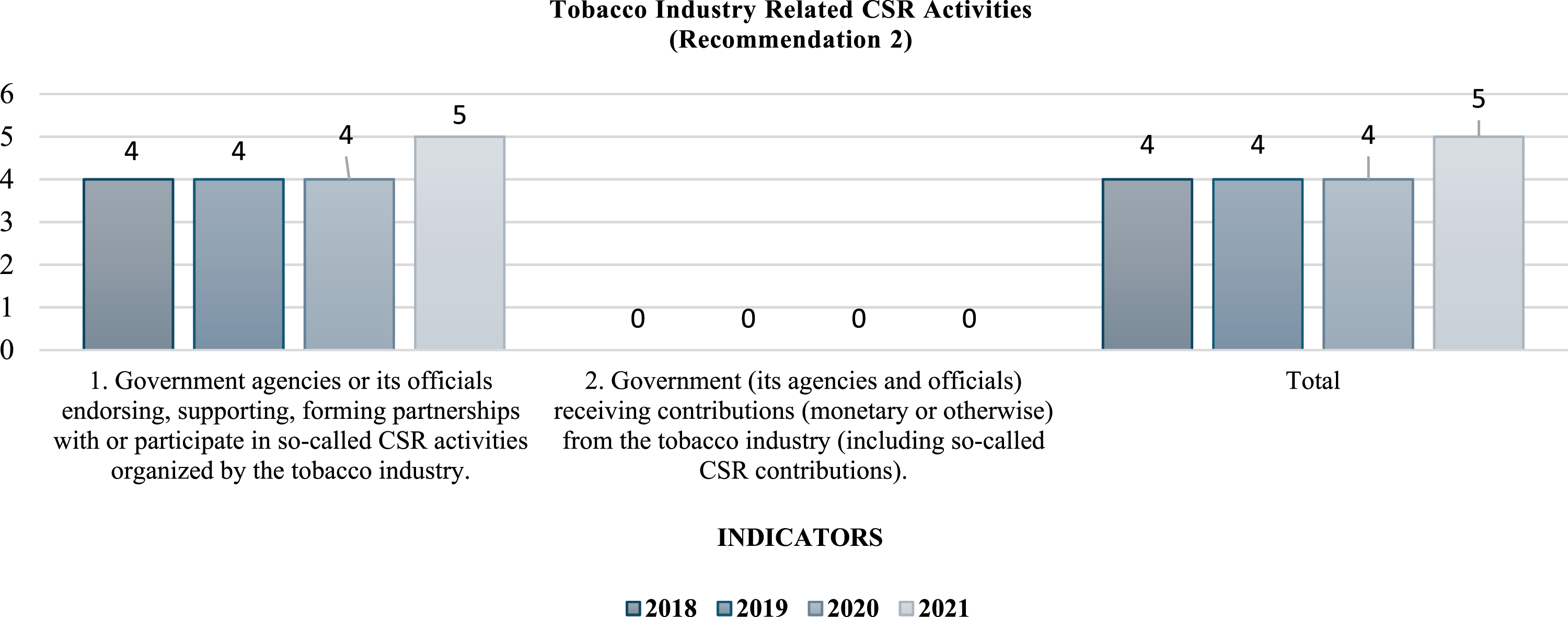
In addition to the donation to State and Central Relief funds, the companies also provided equipment to healthcare facilities, professionals, government officials, organizations, and charitable. 18 There have been reports of tobacco companies pursuing vaccines for the pandemic and supporting social distancing and handwashing. 18
Benefits to the Tobacco Industry
Data from four consecutive India TII Indexes suggested that though the government was able to thwart industry efforts at delaying tobacco legislation be the pictorial warning case (2017) or the ban on ENDs (2021), the tobacco industry continued getting benefits. These benefits were in the form of exemption from additional cess on bidis (2018), and through government programmes, including the Export Promotion of Capital Goods, Service Export from India Scheme, and Merchandise Export from India Scheme.21,26 This resulted in a maximum score of 5 across all four India TII Indexes. (Figure 3) Trends in - benefits to the tobacco industry.
Unnecessary Interactions With the Tobacco Industry
While there was an improvement from 2018 and 2019 (score of 12 each) to 2020 (score of 9), the score again increased to 11 in 2021. (Figure 4) The indicator-wise analysis further highlights that, while an improvement was specifically seen with respect to Indicator 8 between 2018 (Score 3) and 2020 (Score 2), interactions increased during the pandemic resulting in an increase in the score, i.e., 3 in 2021.
32
Over the past four years, data demonstrated increasing instances of government collaborating with industry in the measure on eliminating Illicit Trade in Tobacco Products in June 2018 to tackle illicit tobacco trade.34,35 Trends in - Unnecessary Interactions with the tobacco industry.
Transparency Measures
The score on the need for transparency in interactions between the government and the tobacco industry has been consistently high in the last four years. Data collated over the four India TII Indexes, point out the lack of any law/policy regarding public disclosure about meetings/interactions with the tobacco industry, contributing to a maximum of five scores across all the Indexes. (Figure 5) Trends in - transparency measures.
Conflict of Interest
From 2018 to 2021, an overall decrease (from 15 to 9) in the trends of Conflict of Interest with the tobacco industry is noted. (Figure 6) In the TII Index 2018, it was highlighted that the chairman of a leading tobacco company served as a Director on the Central Board of the Reserve Bank of India (RBI), GoI, and as a Member of the National Foundation for Corporate Governance (NFCG).
24
In 2018 and 2019, there is evidence of several officials from governmental organizations holding positions like Chairman and Managing Director in tobacco companies.24,31 Recent evidence suggested the presence of senior retired IFS and IAS officials as Directors in tobacco companies, resulting in a maximum score of five.26,36 Data from 2018 to 2021 reveal an encouraging trend of lack of presence of government officials and relatives holding consultancy positions in the industry. Trends in – conflict of interest.
Preventive Measures
Data across the four TII Indexes suggested while a national policy to guide interactions with the tobacco industry continued to be missing, the MoHFW GoI introduced a code of conduct for its officials and associated institutions in accordance with Article 5.3.21,24,26 The Code of Conduct released in 2020 provides public officials with guidelines to which they should comply while dealing with the tobacco industry.
21
This is seen as a positive step in the direction of restricting interactions with the tobacco industry. This has led to an overall decrease in the score, from 21 in 2018 to 10 in 2021, (Figure 7) which indicates greater disclosures about meetings, interactions, agendas, and meeting outcomes between the government and industry representatives. Trends in – preventive measures.
Information about political donations continues to be elusive across the four years, especially since the introduction of electoral bonds,37,38 which are interest-free bearer bonds that can be purchased by individuals and corporate groups in India from authorised branches of the State Bank of India (SBI), to donate unlimited amounts of money to any political party anonymously. 39 This provides periodic information about the lobbying, philanthropy, and other activities of the industry.37,38 While there is no evidence, across the four years, of specific intervention for raising awareness within its departments on policies relating to FCTC Article 5.3 Guidelines, as part of the National Tobacco Control Programme (NTCP), awareness activities (workshops and training) are being organized about the provisions of the Cigarette and Other Tobacco Products Act (COTPA), other tobacco control regulations in India,40,41 keeping the score of the indicator more or less consistent.
Discussion
This paper compares the findings of four consecutive TII Index in India that were conducted since the year 2018 to 2021. The trend analysis including the comparison of TII across four years underscored a progressive decline in industry interference from 72 in 2018 to 57 in 2021, owing to the introduction of policy measures. These measures include Article 5.3 guidelines at the sub-national level and a code of conduct issued by the MoHFW, Government of India at the national level. However, the study further highlights that the tobacco industry attempts to interfere in policy development through its involvement in non-health sectors: commerce, food, and other industries. Similar tobacco industry tactics have been documented in countries like Japan, China, and the Lao People’s Democratic Republic.33,42 In these countries tobacco industries have a say in the development of tobacco control measures. 33 Unlike the findings from India, countries such as the Netherlands, Gabon, Nigeria, Thailand, Brunei Darussalam, Kenya, Nepal, and Uruguay do not accept any recommendations or drafts of the tobacco industry in the policy development and reject collaboration with the tobacco industry in implementing public health policies.18,24 It can therefore be suggested that policy-making spaces in India, as a whole, are not insulated from tobacco industry interference and can benefit from increased stringent measures.
The study findings also highlight that tobacco industries have utilized CSR as an effective political and PR strategy to improve their public image and gain support for policy positions that benefit the tobacco industry. The COTPA enforces a complete ban on all forms of direct and indirect tobacco advertising. 11 However, the Government of India revised its Companies Act in 2013, requiring significant enterprises including the tobacco industry to devote at least 2% of net profits in the previous three years to CSR activities11,43 which is contradictory to Article 5.3 guidelines. This conflict between the Companies Act and anti-tobacco laws, alongside the FCTC’s recommendation to ban tobacco industry CSR activities, was brought to the attention of the Madras High Court in 2016 by the Tamil Nadu Peoples’ Forum for Tobacco Control. 44 In response, the Ministry of Corporate Affairs issued a circular stipulating that all companies’ CSR initiatives must align with existing laws such as COTPA, including the prohibition on direct and indirect tobacco advertising, promotion, and sponsorship.11,45 This allowed the tobacco industry to engage with the health sector with its CSR activities during the COVID-19 pandemic. Consistent with this finding, in countries like Lebanon, Malaysia, Myanmar, Tanzania, and the Philippines, there were instances of government accepting charity from tobacco industries including making donations to high-risk communities, handing out personal protective equipment (PPE), and supplying medical equipment to hospitals by tobacco industry during COVID-19 pandemic.27,33 Like India, in countries such as Kenya, Georgia, Pakistan, and Turkey, tobacco industries donated money to national COVID-19 funds during the pandemic. 18 However, countries like Chile, Cote d’ Ivoire, Ethiopia, Gabon, New Zealand, Netherlands, and Norway received no tobacco-related CSR charity 18 while countries like Thailand and Sri Lanka completely banned CSR activities of the tobacco industry. 25
In the interest of public health, mandatory CSR activities, under the Companies Act, need to be banned for tobacco companies in India. Drawing inspiration from Thailand,11,19,44,46 the surcharge mechanism could ensure a substantial pool of resources for tobacco control and broader public health efforts. Tobacco taxes should be at levels consistent with the approach taken in the FCTC, and appropriate funding allocated to tobacco control programs and activities.
The findings highlight the consistently high interference scores of India under the themes of ‘benefits to the tobacco industry’ and ‘transparency measures'. Unfortunately, there are no national guidelines in India that require government officials, except officials from the Ministry of Health and Family Welfare and tobacco industry representatives to disclose their interactions. It needs to be pointed out that, several countries across the globe like Ukraine, Philippines have effective transparency measures in place, informing the public about the meetings with the tobacco industry and requiring periodic disclosures from the tobacco industry about its activities and practices.18,47
This paper reveals the improvement in limiting unnecessary interactions in the tobacco industry in India, owing to the sub-national leadership in formulating inter-sectoral committees and issuing guidelines and protocols, that require the disclosure of records of interactions with the tobacco industry. 21 When it comes to disclosures, tobacco companies report on the Business Responsibility Reporting framework, which only aids them in bolstering their public image, rather than enabling disclosure about the human and health costs of their products. Also, given the generic reporting that only covers the top 1000 companies, based on the market cap, many small unlisted companies, with a large unorganized workforce, are able to operate thereby overshadowing the transparency measures.19,24,26 While the implementation guidelines for Article 5.3 acknowledge the significance of ensuring public officials’ involvement at various levels, the academic and policy literature has largely been silent on the opportunities and challenges faced while addressing industry interference. India does not have a clear policy to limit TII and government interactions to “only when strictly necessary for regulation purposes.” This policy is urgently required in the country to protect public health policies being influenced by industry interventions. 19
The adoption of a National Code of Conduct for Public Officials has been hailed as a key step in fostering compliance with Article 5.3 implementation guidelines and limiting tobacco industry interference in India. While the Code may serve as a starting point for further national developments and offers a more comprehensive strategy to de-normalize partnerships, collaboration, or agreement with the tobacco industry, it is not sufficient to strengthen tobacco control governance in a multilevel system.19,21 While the Code of Conduct presents an excellent opportunity and can act as a preventive measure to limit government and industry interaction, a nationwide policy across departments and ministries continues to be missing. 21 Evidence showcases that the tobacco industry uses indirect means to enter and influence policy spaces, and this can only be restricted via a government-wide policy on lobbying and interaction.18,19
This study has some distinct strengths. It is the first descriptive comparative analysis that provides India’s status and positive progress in implementing Article 5.3 from the year 2018 to 2021. Second, it highlights the gaps in existing provisions that can be plugged into to strengthen the multi-sectoral response to accelerate tobacco control in India.
The study does have certain limitations. Even though the SEATCA TII Index has been standardized and in use for many years, there is some degree of subjectivity involved in the study. The findings were based on information in the public domain, hence one ought to be careful in reading these scores as just a close proxy of TII and not an authoritative reflection of TII in India. Moreover, the interpretation of incident or scoring of all four indexes is done by 3 different entities with possible differences in efforts or literature reviewed, affecting what all got captured.
Conclusion
India needs to comprehensively adopt Article 5.3 guidelines in all states and union territories adopting a whole-of-government approach. The study underscored the critical need to establish an observatory for periodic compilation of the TII index to monitor the tobacco industry and report violations at the national and sub-national levels in India. There is a need to regulate CSR by developing a multisectoral policy framework. There is also an urgent need for mandatory disclosure of TI activities in the public domain with the development of a policy framework on Article 5.3 of the WHO FCTC at the national level to have uniformity across the Indian states.
Footnotes
Acknowledgements
The authors would like to thank Dr. Mary Assunta, Southeast Asia Tobacco Control Alliance (SEATCA), and Partners in Change (PIC) for providing technical advice in conducting this study.
Ethical Statement
Declaration of Conflicting Interests
The author(s) declared no potential conflicts of interest with respect to the research, authorship, and/or publication of this article.
Funding
The author(s) disclosed receipt of the following financial support for the research, authorship, and/or publication of this article. This comparative analysis was conducted for four consecutive India TII Index, which was based on the SEATCA TII Index methodology and was supported by UK Research and Innovation (UKRI) with funding from the Global Challenges Research Fund (MR/P027946/2). The Tobacco Control Capacity Program (TCCP) is a program of capacity development and research coordinated by the University of Edinburgh, Scotland, and involves 15 partner institutions from Africa, South Asia, and the United Kingdom. Funding from TCCP was received only for the time efforts of TCCP authors (AC, SB, MC, SD, GPN, and MA) for undertaking this study. Technical inputs were received from the non-TCCP Indian colleagues (UB, CA, PL, and PCG) without any provision of funding from TCCP or any other support. UB was supported for his time spent on this article through the DBT/Wellcome Trust India Alliance Fellowship (IA/CPHI/17/1/503346).
Disclaimers
The views expressed in the submitted article are own and not an official position of the institution or funder.
Data Availability Statement
Data related to the study will be shared on request as per organizational policy.