




Abstract
BACKGROUND
Smoking leads to many smoking-attributable diseases. The promotion of quitting tobacco smoking is urgent as it has significant and immediate health benefits and improves the impacts of other tobacco control strategies. Intention to quit smoking is considered the first step before quitting smoking.
METHODOLOGY
This paper used data from Vietnam provincial GATS 2020 on 80,166 participants who were 15-year-old or older. Data were collected from 34 provinces and cities throughout Vietnam and managed using REDCap.
RESULTS
Among those who were current smokers, 50.3% (95% CI: 49.1%–51.4%) had the intention to quit smoking. Some predictive factors found to be positively associated with the intention to quit smoking were age (from 45-64), education level, received information about harmful effects or encouragement to quit smoking from media channels (from 6 channels), hearing about the Tobacco Control Law and noticing health warnings on the cigarette package. There was no significant difference in intention to quit smoking between current smokers from urban and rural areas or among different age groups to start smoking.
CONCLUSIONS
Interventions or health promotion programs on smoking cessation should be focused on current smokers who have low education levels as they have a higher smoking rate and are less motivated to stop smoking. Received information about harmful effects or encouragement to quit smoking from media channels is also associated with stopping smoking in the future. The importance of health warning pictures on tobacco packages should be maintained and promoted as it has a specific effect on one’s intention to stop smoking.
Introduction
Smoking leads to several non-communicable diseases such as cardiovascular diseases, cancer, chronic respiratory diseases, and gastrointestinal disorders. 1 There are approximately 8 million mortality cases annually due to smoking-attributable diseases worldwide. By 2030, this figure would be up to 10 million each year, 80% of which would be from developing countries. 1 The most common form of tobacco use in Vietnam is smoking manufactured cigarettes. According to the Global Adult Tobacco Survey (GATS) 2015, 22.5% of adults were smoking (lower than this rate in GATS 2010, i.e., 23.8%), in which the proportion of male smokers (45.3% in 2015, 47.4% in 2010) was significantly higher than female smokers (1.1% in 2015, 1.4% in 2010).2,3
Recently in Vietnam, tobacco control activities started to attract much attention. Vietnam’s government signed the World Health Organization (WHO) Framework Convention on Tobacco Control and implemented legislation 4 to prevent tobacco harm, including community education; prohibition on tobacco promotion; health-effect forewarning; taxing; cessation; and public smoking restriction. However, the promotion of quitting tobacco smoking (tobacco cessation) is recommended as it has significant and immediate health benefits and improves the impacts of other tobacco control strategies. 5 Intention to quit smoking is considered the first step before quitting smoking behavior 6 and varies across different smokers’ characteristics. This intention was found to happen more frequent among older, current smokers with appropriate knowledge of harmful effects of smoking on health,7,8 had a higher education level, 9 or who smoked their first cigarette within 6-30 minutes of waking up, 10 or someone who had nicotine dependence, 8 or received anti-smoking messages through mass media.9,11 In contrast, those who smoked 10-19 manufactured cigarettes per day 8 or were not interested in receiving advice 12 were less likely to have the intention to quit smoking.
GATS 2010 and GATS 2015 in Vietnam provided valuable information for the advocacy for developing the Law on Prevention and Control of Tobacco Harms. Since the enactment of the law, the provincial GATS (abbreviated PGATS, using the same GATS questionnaire, but conducted at each of 34 provinces/cities throughout Vietnam) deployment in 2020 brought a valuable advance in monitoring and assessing the interventions on tobacco control and Vietnamese trends during the 2010-2020 period, as well as for the comparison with other countries in the region and the world. The results of this study are the basis for proposing the development of a national strategy in the new period, proposing and advocating for policies to improve relevant legal documents and have appropriate interventions in the field of prevention and control of tobacco harm in Vietnam. This paper used data from PGATS 2020 in Vietnam to describe intention to quit smoking and explore the association between intention to quit smoking and other individual characteristics among current smokers.
Methods
Data source and study population
This paper used data from Vietnam PGATS 2020, which was collected from 34 provinces and cities of Vietnam. The questionnaire was similar to the previous GATS implemented in 2010 and 2015. In PGATS 2020, the survey was conducted by the Vietnam Tobacco Control Fund (VNTCF) - Ministry of Health, Hanoi University of Public Health, and with technical support from WHO and 34 Provincial Center for Diseases Control. Study participants in this survey were Vietnamese citizens who were 15-year-old or older. The sample size was designed to estimate important variables by sex and region in each province/city. The sample size in each province/city was 2400 people (1200 were males, 1200 were females). The total sample size was 81,600 people in 34 provinces and cities.
In each province/city, a list of administrative units was formed based on economic status, and then one city/town and two districts with medium and under-developed economic status were chosen using the simple random sampling method. In each city/town/district, we randomly selected two communes from the list of communes; 600 households were randomly selected from these communes (300 households each). In each district with medium and under-developed economic status, 900 households were randomly chosen from three communes which were chosen by using the simple random sampling method. One member in each household whose age was from 15-year-old or above was invited to participate. There were 80,166 completed interviews with a response rate of 98.2%.
Used variables
The dependent variable, intention to quit smoking, in this study was coded from the question “During the past 12 months, what are your plans (intention) to quit smoking?” Respondents who were current smokers and chose “Planning to quit next month”, “Thinking about quitting in the next 12 months” or “Will quit someday, but not in the next 12 months” were considered to have the intention to quit smoking. Respondents who responded “Do not care” or “Do not know” were considered not to have the intention to quit smoking. This way of classification was used in previous studies using GATS data not only in Vietnam
7
but also in other countries.8,9 Figure 1 The study screening process to select current smokers who made an intention to quit smoking based on PGATS 2020 data
Independent variables included (1) Sex (male/female); (2) Age groups (15-24, 25-44, 45-64, 65+); (3) Region of accommodation (rural and urban areas, in which respondents from cities/towns were classified in urban areas, and the others from districts were classified in rural areas); (4) education level (Primary education or lower, secondary education, high school education, tertiary education); (5) Occupation (knowledge worker (who worked long-term in public/private sector), freelancer (who worked as a short-term and independent laborer), Housekeeper/Student/Retiree, Unemployed); (6) Marital status (Single, Married, Divorced/ separated/ widow); (7) Received anti-smoking messages from media channels (including: newspapers/magazines, television, radio, billboards, website, social network (Facebook/Zalo/Instagram, etc.), local radio stations, posters, leaflets/brochures and cellphone messages); (8) Heard about the Tobacco Control Law; (9) Notice of health warning in cigarette package during the 30 days before the interview; (10) Age to start smoking. These selected independent variables were commonly used in previous studies regarding the intention to quit smoking using GATS data.8,11,13-15
Data collection
This survey was coordinated by the VNTCF of the Ministry of Health. VNTCF supported 34 provinces and cities in research while cooperating with the Hanoi University of Public Health regarding technical support and field supervision during the survey implementation phase. All interviews were conducted in Vietnamese and face-to-face using Android tablets or smartphones for data collection using the REDCap application. This application was used in recent studies as a better effort in designing, developing, and deploying questionnaires as well as collecting data 16 Data was transferred immediately to the research headquarters for quality management, data monitoring, and data cleansing.
Data analysis and statistical method
STATA 16 was used for data analysis. Descriptive statistics were performed to estimate frequencies and percentages for dependent and independent variables. The prevalence of intention to quit smoking was estimated for different categories of individual characteristics. For bivariate analysis, the Chi-square test was used with a significant level of 95%, while the multivariate logistics regression model was applied to adjust the associations among independent variables. The strength of associations was estimated using unadjusted odds ratio (OR) in bivariate analysis and adjusted odds ratio (aOR) in multivariate logistic regression model combined with 95% confidence intervals (95% CI). Weight values were calculated for every participant in the dataset and included in all analyses.
Ethical considerations
The Ethics Committee of Hanoi University of Public Health approved this study under Decision No.318/2020/YTCC-HD3 dated July 30, 2020.
Results
General characteristics of study participants
The overall percentage of smoking among Vietnamese aged 15 and over was 21.7% (95% CI: 21.2%–22.1%).
Weighted percentage of intention to quit smoking among current smokers by participants characteristics in PGATS Vietnam 2020

1“Primary education or lower” level includes: have never gone to school, not graduated from primary school, and graduated from primary school. “Lower secondary education” includes graduating from secondary schools. “Upper secondary education” includes graduating from high school. “Tertiary education” includes a bachelor’s or higher.
2“Knowledge worker” includes civil servant, foreign organization employee. “Unemployed” includes not currently in work, incapable of working.
Bivariate and multivariate analysis showing correlates of intention to quit smoking and individual characteristics among participants in PGATS Vietnam 2020
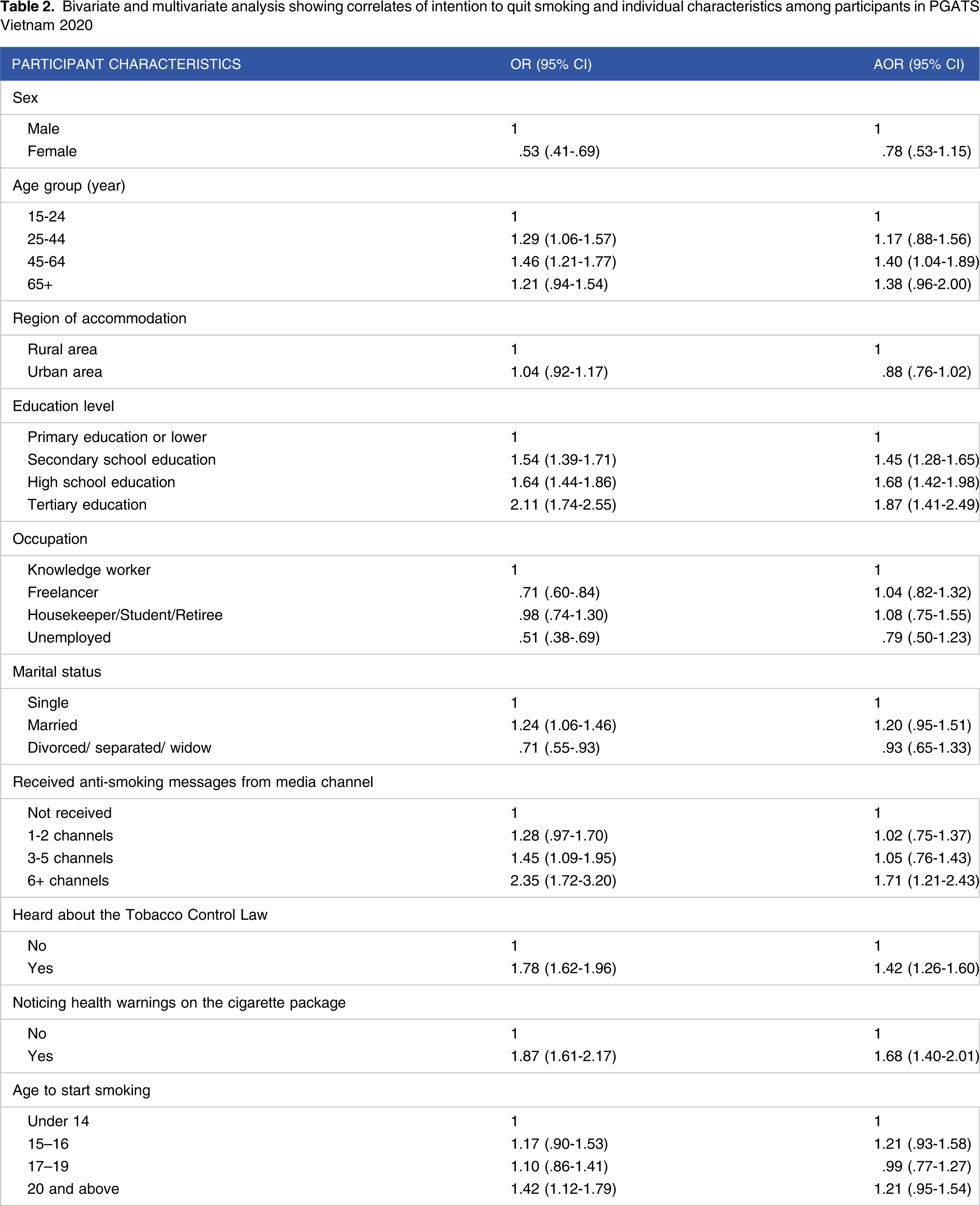
Compared with current smokers aged 15-24, those aged 45-64 had 1.4 times higher (95% CI: 1.04-1.89) intention to quit smoking. Participants who had tertiary, high school, or secondary school education had 1.87 times (95% CI: 1.41-2.49), 1.68 times (95% CI: 1.42-1.98), and 1.45 times (95% CI: 1.28-1.65), respectively, a higher chance of intention to quit smoking than those who had primary education or lower level. Current smokers who received six or more media channels with information about harmful effects or encouragement to quit smoking had a chance of 1.71 times (95% CI: 1.21-2.43) higher than those who did not receive any information. Those who heard about the Law on Prevention and Control of Tobacco Harms or noticed health warnings on the cigarette packages also had a positive association with intention to quit smoking, with aOR=1.42 (95% CI: 1.26-1.60) and 1.68 (95% CI: 1.40-2.01) than those who did not. However, no significant difference in intention to quit smoking was observed between current smokers from urban and rural areas or among different age groups to start smoking.
Discussion
In this study, the proportion of current smokers who had the intention to quit smoking (12 months before the interview) was 50.3%. This figure was in line with results from India (52.2%) using GATS data to report 9 or results from the U.S (49.5% among males, 50.4% among females) using National data. 17 Since the launch of the Law on Prevention and Control of Tobacco Harms in 2012 by the Vietnamese Congress, 4 many tobacco control initiatives have been implemented, such as: stipulating places where smoking is not allowed, applying health warnings both in text and pictures on cigarette packs, completely ban of tobacco advertising, promotion, and sponsorship, and establishing the VNTCF. So, the increase in intention to quit smoking might be attributed to these tobacco control interventions. Besides, as the intention to quit smoking was a predictive factor of making a quit smoking attempt, 18 this result could explain higher the rate of smokers who attempted to quit tobacco smoking in the PGATS 2020 (38.6%) when compared with the previous GATS 2015 round (37.1%). 7
Our study showed that older smokers were more likely to have the intention to quit smoking than those younger smokers. Since age had been identified among positive key predictors for willingness to quit among tobacco users,9,17 our results were in line with these studies. Other studies showed results on the opposite side when older smokers had lower odds of quitting intention than younger ones.8,15,19 It could be explained by the differences in age groups when the influential age group in our study was smokers from 45–64 while other studies considered older smokers were from 60 and above; at that age, they perceived themselves as less vulnerable to smoking’s harms, did not concerned about smoking’s health effects, and they were confident to quit smoking easily. 20
Higher education level in this study was positively associated with having the intention to quit smoking. Previous studies8,9,13,15 also supported our results; it was understandable that smokers could easily approach tobacco-related with higher education levels but not those who had only primary education or lower levels. This figure also highlighted the need for health education and promotion on aspects of harmful effects of tobacco smoking for those who had low education levels in a community. Along with education, our study also pointed out the need for mass media to motivate intention to quit smoking when current smokers who received anti-smoking messages from six or more media channels had a higher chance of intent to quit smoking than the others. This result, which was affirmed by other studies,9,15 has indicated the need for mass media to spread anti-smoking messages, therefore encouraging current smokers to think about quitting smoke and make quit attempts. 11 Among these media channels, the Internet and social networks should be considered since 70.3% Vietnamese population were Internet users and spent an average of 6.75 hours per day on the Internet, and mainly used Youtube, Facebook, Zalo (a Vietnamese social network) as their favorite channels (estimated on Jan 2021). 21
Our study indicated the contribution of the Law on Prevention and Control of Tobacco Harms in encouraging smokers to have the intention to quit smoking when those who heard about this law had a higher intention to quit than those who did not. When hearing about the Law on Prevention and Control of Tobacco Harms, 4 it could be explained that current smokers tended to think more about barriers that prevent them from buying and using tobacco, such as smoking bans in public places, and raising the tobacco tax, reducing tobacco sale-points. These difficulties might help them to have more intention to quit smoking. Another explanation that could be considered a contribution of the tobacco control law was the increase in the proportion of intention to quit smoking from 37.1% in GATS 2015 7 (3 years) to 50.3% in PGATS 2020 (8 years since the Law’s implementation). This study also showed that smokers who noticed health warnings on the cigarette packages were more likely to have the intention to quit smoking than others; this association has been proved in the previous round of Vietnam GATS 2015 7 as well as in other studies.11,14
This study still had some limitations. Firstly, due to financial shortage, the PGATS 2020 could only investigate 34 out of 63 cities/provinces in Vietnam; therefore, our results were only represented the participated cities/provinces, and as a result, it was unable to be put under complete comparison with the results of GATS 2010 and GATS 2015. Secondly, due to the self-reported nature of every GATS survey and how we assessed intention to quit smoking by only one question, our findings might carry a certain amount of inaccuracy.
Conclusions and Recommendations
Findings from this study bring some suggestions for the authorities. Thanks to the Law on Prevention and Control of Tobacco Harms, various strategies and interventions being implemented in Vietnam, almost half of current smokers had the intention to quit smoking. Interventions or health promotion programs on smoking cessation should be focused on current smokers who have low education levels as they are less motivated to stop smoking. Results also add to the body of evidence that received information about harmful effects or encouragement to quit smoking from media channels associated with quitting smoking in the future. Lastly, the importance of health warning pictures on tobacco packages should be maintained as it affects on one’s intention to stop smoking.
Footnotes
Acknowledgement
The survey of tobacco uses among adults at 34 provinces/cities in Vietnam in 2020 (PGATS 2020) was successfully implemented with the valuable contribution from many organizations, including WHO office in Vietnam, the Vietnam Tobacco Control Fund, Hanoi University of Public Health, and the proactive collaboration from provincial CDCs. We also valued the collaboration and supports of both governmental, non-governmental organizations, and experts in tobacco harm prevention in Vietnam.
Author contributions
TTTH, PVC, HVM, LNK, PTH, NTL, DTA, KQL, and LTH conceived and designed the study, agreed with the results, conclusions and came up with arguments for the manuscript. TTTH, LNK, PTH, NTL, DTA, PVC, KQL, LTH and HVM coordinated data collection and analysed the data. LTH, TTTH, and HVM wrote the first draft of the manuscript. All the authors made critical revision and agreed on the final versions of the manuscript. LTH, TTTH, LNK, PTH, and HVM reviewed the final manuscript and approved it for submission, which was done by TTTH.
Declaration of conflicting interests
The author(s) declared no potential conflicts of interest with respect to the research, authorship, and/or publication of this article.
Funding
The author(s) received no financial support for the publication of this article.
