



Abstract
BACKGROUND
E-cigarette products have become more popular due to the marketing campaigns on various sources but caused adverse health impacts to users, especially adolescents and youths. This paper aims to describe the situation of exposure to e-cigarette advertisements of youth and adolescents living in two cities of Hanoi and Ho Chi Minh in 2020 and identify the associated factors of e-cigarette marketing with e-cigarettes use in these groups.
METHODOLOGY
This was a cross-sectional study. The study participants were 1211 youth and adolescents aged 15-24 living in Hanoi and Ho Chi Minh City during the time of data collection (from January 2020 to September 2020). Two primary outcome variables included the ever e-cigarettes use and the intention to use e-cigarettes. Multivariate logistic regression models were used to assess the association between the outcome variables and e-cigarette marketing exposure.
RESULTS
The proportion of participants who ever use e-cigarettes was 7.4% and a proportion of 4.8% have intention to use e-cigarettes. The most popular source of exposure to e-cigarettes advertisements was social network (Facebook, Twitter, Instagram, Youtube, etc.) and this source had positive association with the odds of e-cigarette smoking among youth and adolescents (OR = 3.38, 95% CI: 1.59-7.14). In addition, referral marketers also contributed to making the participants more likely to smoke e-cigarettes (OR = 2.68, 95% CI: 1.03-6.95). Attractive color and free sample of e-cigarettes were also found to be the motivated factors associated with smoking behaviour among youth and adolescents.
CONCLUSIONS
New policies should be considered to oppose the impact of youth-oriented e-cigarette advertisements which include regulating and restricting e-cigarette advertisements on social media, as well as through referral marketers.
Introduction
Electronic cigarettes (e-cigarettes) were first introduced about 3 decades ago. 1 The first and second generation products of e-cigarettes failed to attract users. Until the last decade, the third and fourth generation of e-cigarette products became more popular due to the marketing campaigns on various sources such as Internet/social media, retail stores, TV/movies, news etc.2,3 The consequences of these advertising tactics were the global boom of e-cigarette use among the adolescents in recent years.4-6 The long-term impacts of e-cigarette to human health have not been studied thoroughly compared to traditional tobacco cigarettes. However, some recent studies have provided strong evidences that e-cigarettes use could lead to adverse health impacts to users,7,8 especially adolescents and youths, such as oral carcinoma, respiratory and lung injuries, etc.9,10 Currently, young people are using vape or e-cigarette as a new hobby and an alternative method for traditional cigarette use. 11 Recognizing this global trend, e-cigarette companies promote their advertising and marketing activities towards the youth group. Their message emphasized that e-cigarettes which have lower harm than traditional cigarettes can be an alternative way to reduce or quit smoking the combustible cigarettes. 12 This will cause the misconceptions about e-cigarettes for traditionally smoking users and the adolescents and youths.
Previous studies in the US, Germany and China had shown the impacts of advertisements and marketing on the e-cigarette use and intention to use or e-cigarette trial of adolescents and young people.2,3,12-17 In the US, the data of 2014 National Young Tobacco Survey revealed that exposure to e-cigarette advertisements from internet, newspapers/magazines, stores, and TV/movies was prevalent among youth, with the respective percentages of 38.6%, 29.6%, 53.2% and 35.4%. The current use of e-cigarettes among middle and high school American students in that survey was associated statistically with frequent exposure to e-cigarette advertising from those 4 sources of information. 2 A cross-sectional survey with 6902 German students had shown that 38.8% of them were exposed to e-cigarette advertisements, and the exposure was positively related to ever and past 30-day use of e-cigarettes and other types of of cigarettes of this youth group. 13
Vietnam is one of the countries with high prevalence of tobacco users. 18 In 2012, the National Assembly of Vietnam promulgated the Law on Prevention and Control of Tobacco Harms with 35 articles, which was enacted on 1st May 2013. Amongst, Article 9 in the Law states that advertising and promotion of tobacco products and direct marketing to the users of tobacco in any forms is strictly prohibited. However, this Law is focused only on the traditional tobacco products while Vietnam currently has almost no legal restrictions for the new tobacco products, including e-cigarettes. 19 Although Vietnam National Assembly brought the legal restrictions related to e-cigarettes advertisements for discussion in recent years, no final decision was made. It led to the fact that e-cigarettes have been quietly and illegally introduced into Vietnam for years.
Compared to the traditional tobacco users, e-cigarette users account for a significant smaller percentage. However, the prevalence of e-cigarette users is increasing considerably, especially among young people. In 2015, the e-cigarette use rate among Vietnamese adults was .2%. 20 Till 2022, the recent published findings of an online survey showed that 8.2% among 368 participants were using e-cigarette. 1 For the adolescents and young adults, some studies also revealed the growing trend of e-cigarette use from .1% in 2015 20 to approximately 2.5% in 2019 and 2020.21,22 Hanoi and Ho Chi Minh are the two biggest cities located at northern and southern regions of Vietnam. These two cities are economic hubs with the rapid development of technology and marketing tricks. Therefore, it is easy for adolescents and young adults to be exposed to e-cigarette advertisements from numerous channels or sources of information. Our previous findings showed that 7.3% of young adults aged 15-24 in these cities were currently smoking e-cigarette products. 23 Additionally, with the increasing market size of e-cigarette users, the number of vape and e-cigarette specialty shops is growing rapidly. These providers also used Internet and social media platforms including YouTube or Facebook as the main sources to promote e-cigarettes for their users. 24 It may lead to the misconception about e-cigarette and potentially increase the e-cigarette users. In Vietnam, there is limited research on the prevalence and impacts of e-cigarettes exposure among the youth group. Hence, this paper aims to describe the situation of exposure to e-cigarette advertisements of youth and adolescents living in two cities of Hanoi and Ho Chi Minh cities in 2020 and identify the associated factors of e-cigarette marketing with e-cigarettes use in these groups.
Methods
Study setting
Analyzed data were extracted from a research study named “Current situation and viewpoints of e-cigarette smoking among youth and adolescents aged 15-24 in Hanoi and Ho Chi Minh City, 2020”. The general objective of this study was to enhance knowledge about e-cigarettes to reduce e-cigarette use, thereby contributing to reduce tobacco use among youth and adolescents aged 15-24 in Hanoi and Ho Chi Minh City in 2020.
Study design and study participants
This was a cross-sectional study, in which the study participants were youth and adolescents aged 15-24 living in Hanoi and Ho Chi Minh City during the time of data collection (from January 2020 to September 2020).
Sample size and sampling method
The sample size was calculated using the formula to estimate a population proportion with specified relative precision:

The multi-stage cluster sampling method was used. At first stage, we chose 1 urban district and 1 suburban district in each city, 300 participants were selected randomly in each district. At second stage, we chose randomly 6 clusters (each cluster could be a neighbourhood or a residential group) in each selected district. In each cluster, we chose randomly 50 households based on the provided list of local authority. In each household, a participant from the age of 15-24 was randomly selected using the KISH method. 26
Data collection method
Data was collected using self-administered questionnaire. All participants were instructed by the data collectors before completing the questionnaire. Those who were not capable of self-understanding and participating in the study or those with poor health were excluded from the study. In fact, data was collected from 1211 participants.
Study variables
Outcome variables
We used two primary outcome variables in this analysis including: ever e-cigarettes use (participants who answered
Independent variables
We also used other independent variable groups, including: 1. General information of participants: age, gender, educational level, occupation, marital status, living status with family members, household economic situation, and living status with other smokers. 2. Variables on whether the participant exposure to various sources of exposure to e-cigarette advertisements or not (Yes/No binary questions): (1) Grocery stores, supermarkets, retail stores, railway stations, airports, piers; (2) Social network; (3) TV, radio; (4) Newspaper, electronic newspaper; (5) Restaurant, hotel, cafe, bar; (6) Sports/Music events, fairs, community events; (7) Outdoor posters/billboards; (8) Movies/music videos; (9) Referral marketer invitation. 3. Characteristics of received e-cigarette advertisements: colors, images, participation of celebrities, singers, actors, models. 4. Type of received e-cigarette advertisements: (1) Free sample of e-cigarette; (2) Discount e-cigarette products; (3) Discount voucher; (4) Free gifts or other special promotion on other products; (5) Clothing or other items with an e-cigarette brand logo or image.
Data analysis
Data analysis was conducted using Stata 16.0 software. Continuous variables are described by means and standard deviation, while categorical variables are represented by frequency and percentage. All used statistical tests were applied with the significance level (α) of .05. The Chi-square test was used to find out the univariate association (if any) between independent factors (participants’ characteristics and their exposure with e-cigarettes advertisements) and their current situation of using e-cigarettes as well as their intention to use e-cigarettes. Any univariate association with p value under .05, or larger than .05 but smaller than .1 was included in the multivariate models.
Two multivariate logistic regression models were developed to assess the relationship between the predictors (e-cigarette marketing exposure) and two outcome variables after adjusting for other independent variables. In both univariate and multivariate logistic regression models, the odds ratio (OR) and its 95% confidence interval (95% CI) were presented to estimate the strength of the association between e-cigarette marketing exposure and the primary outcomes when adjusted to other covariates. For the included variables, missing data due to non-response were both under 1%. Therefore, the sample size for each model varied minimally.
Ethical considerations
The Ethics Committee of Hanoi University of Public Health approved the “Current situation and viewpoints of E-cigarette smoking among youth and adolescents aged 15-24 in Hanoi and Ho Chi Minh Cities, 2020” study under the Decision No. 102/2020/YTCC-HD3 dated 19 March 2020. All participants were ensured to completely read and understood the consent form before answering the self-administered questionnaire.
Results
General characteristics of study participants
Characteristics of study participants.

It is illustrated that 1 – quarter of participants were under 18, while approximately 75% were aged 18-24. Most participants lived with their parents, about 15% lived with friends, the rest lived with only their father/mother, grandparents, or alone. In this study, almost 80% of participants were students or high school students, and the percentage of officers or freelancers was about 15%. The percentage of participants who lived with a smoker was 55.9%, while 46.9% of participants had any friends as a smoker. Regarding the use of e-cigarettes, only 7.4% of participants reported having ever used, while 4.8% of them had the intention to use among those who never used e-cigarettes.
Sources of exposure to e-cigarette advertisements
The sources of exposure to e-cigarette advertisements of the study participants is presented in Figure 1. Sources of exposure to e-cigarettes advertisements among participants who ever used e-cigarette (n = 89) and those who had intention to use (n = 54).
Figure 1 shows that among those who ever used e-cigarettes, the most common source of exposure to e-cigarette advertisements was the social network (Facebook, Twitter, Instagram, You Tube, etc.) (73%), followed by exposure to e-cigarette advertisements at grocery stores, supermarkets, etc. (48.3%). The least exposed source of exposure to e-cigarette advertisements among this group was at sports/music events, fairs, or community events with the percentage of only 22.5%.
Among participants who intended to use e-cigarettes, the most common source of exposure to e-cigarette advertisements was also the social network (about half of the participants reported having this exposure), followed by advertising in movies or music videos (approximately 39%). These participants had the lowest proportion of exposure to e-cigarette advertisements through referral marketers who invited them to use tobacco.
Association between exposure to e-cigarette advertisements and the status of using e-cigarettes among adolescents and youth
Univariate association between participants who ever use e-cigarette and those who have intention to use and exposure to e-cigarettes advertisements.

Statistically significant with p < .05.
Statistically significant with p < .001.
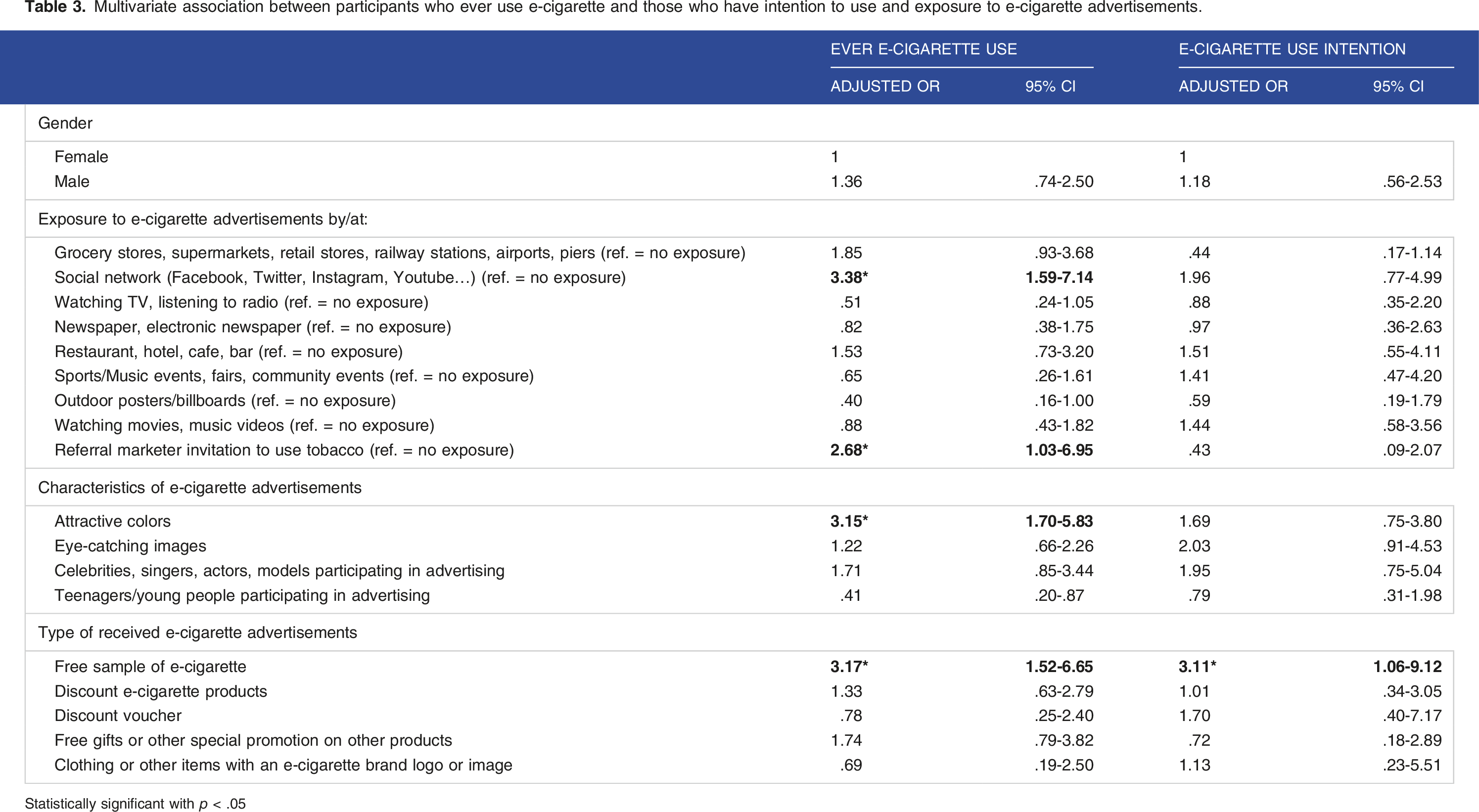
Multivariate association between participants who ever use e-cigarette and those who have intention to use and exposure to e-cigarette advertisements.
Statistically significant with p < .05
We found male participants were more likely to be an ever-smoker than female participants (OR = 2.09, 95% CI: 1.27-3.42). Participants exposed to e-cigarette advertisements on social networks were 3.45 times (95% CI: 2.08-5.73) more likely to smoke e-cigarettes than those who did not. Other sources of e-cigarette advertisements which also increased the odds of e-cigarette smoking were referral marketers (OR = 2.79, 95% CI: 1.69-4.62), the restaurant, hotels, cafeterias, bars (OR = 2.3, 95% CI: 1.43-3.70), at grocery stores, supermarkets, retail stores, railway stations, airports, piers (OR = 1.95, 95% CI: 1.24-3.07), by watching movies, music videos (OR = 1.95, 95% CI: 1.23-3.09), and by outdoor posters/billboards (OR = 1.70, 95% CI: 1.07-2.70). We also found that when exposed to at least 1 source of exposure to e-cigarette advertisements, participants were at 4.63 times (95% CI: 2.12-10.13) more likely to smoke e-cigarettes than those who were not. Attractive colors, eye-catching images, and the appearance of celebrities, singers, actors, and models in the advertisements increased the odds to smoke e-cigarettes among study participants.
We also found similar results when participants exposed to e-cigarette advertisements on different sources including social networks, at restaurants, hotels, cafeterias, and bars, and by watching movies and music videos were more likely to have intention to use e-cigarettes than those who did not. Exposing through a referral, marketers were positively associated with the odds of having intention to smoke e-cigarettes. Otherwise, the color of e-cigarette advertisements (OR = 2.6, 95% CI: 1.57-4.30) and free samples of e-cigarettes (OR = 2.7, 95% CI: 1.42-5.13) also increased the odds of having intention to smoke e-cigarettes among participants.
When adjusted to other factors in the multivariate model, we found that social networks, again with referral marketers, made study participants to be more likely to smoke e-cigarettes (OR = 3.38 and 2.68, respectively). Results also showed that the attractive colors of advertisements and free samples of e-cigarettes had motivated the study participants to use e-cigarettes (OR = 3.15, 95% CI: 1.70-5.83 and OR = 3.17, 95% CI: 1.52-6.65, respectively). Besides, we found only 1 source of exposure to e-cigarette advertisements was associated with the risk of smoking. In detail, participants who received free sample of e-cigarettes were more likely to have intention to smoke e-cigarettes than those who did not receive (OR = 3.11, 95% CI: 1.06-9.12).
Discussion
Our study findings contribute to the literature and provide the evidence to the policy makers for future interventions and policies in preventing e-cigarette advertisements in Vietnam.
Exposure to sources of e-cigarettes advertisements among adolescents aged 15-24
The study pointed out that social network was the most popular source of exposure to e-cigarette advertisements to the participants who ever used e-cigarettes and intended to use e-cigarettes. In the technology era, the number of social network users is booming, 30 especially in the urban areas where Internet is easily accessible to the people. Vietnam is one of the countries with high proportion of 72.1 million Internet users. 31 Therefore, there has been high possibility of exposure to e-cigarette advertisements among the young people. Our result was in line with other research from Shanghai, China. 3 In that study, young adults mostly exposed to e-cigarettes information via the Internet including online social media and website. However, one study in the USA showed that the exposure to e-cigarette advertisements in store was more prevalent than Internet or TV among youth. 2 In our study, this source was the second and third common ways of advertising exposure for adolescents who ever used and intended to use e-cigarettes. Notably, movies and music videos were another favorable advertising sources that the young adults had contacted with. Nevertheless, they reported that they are less exposed to e-cigarette advertisements in sports/music events, fairs, community events. This should be considered by the policy makers to include in any regulations related to e-cigarette advertising from entertaining producers.
In Hanoi and Ho Chi Minh cities, young people often come to restaurants/coffee shops/bar/karaoke after working/studying hours in the evening as a local culture. Therefore, the customers were being invited to use tobacco products, including e-cigarettes in these places. In our study, there was a moderate percentage of participants who ever used and intended to use e-cigarettes exposed to those advertisements. It is hard to control the marketing activities in those kinds of locations. However, it should not be ignored if Vietnam would like to ban e-cigarette advertising.
While other studies mainly grouped e-cigarette advertising into 4 sources, including internet, newspaper/magazines, retail stores, and TV2,14,16,17; our study divided into more various advertising sources including from restaurant/hotel/café/bar; sports/music/community events; outdoor posters/billboards; watching movies/music videos or from invitation of referral marketer, which was relevant to other studies conducted in Vietnam on tobacco advertising exposure among various age groups.21,25 The absence of the advertising ban of new tobacco products including e-cigarettes, as well as the hesitation in banning new tobacco products in Vietnam could be explained for the challenges in controlling the advertisement of e-cigarettes in Vietnam. Therefore, by identifying these specific advertising sources, interventions can find the most appropriate way to interact with the young people to reduce their exposure to e-cigarette advertising, and therefore contributing to reduce access to and use of e-cigarettes. In addition, the Government should consider updating existing regulations which include the ban of e-cigarette advertising, and/or ban the use of new tobacco products, including e-cigarettes in Vietnam.
Association between exposure to e-cigarette advertisements and the status of using e-cigarettes among adolescents and youth
Our study assessed advertising exposure by self-reported measures that were similar to previous studies.16,17,32 Although studies indicated the association between exposure to e-cigarette advertising on the internet and smoking behaviour among adolescent and youth,16,17 but few pointed out the particular source of exposure. In this study, we found the role of social networks (Facebook, Twitter, Instagram, Youtube, etc.) in enhancing youth and adolescents to smoke e-cigarettes. Despite Vietnam Laws against any tobacco ads and commercial activities as well as social network bans on sponsored tobacco-related contents, recent studies showed influencers still collaborating with e-cigarettes companies in promoting brand-related content on many popular social network.33,34 That is the reason why our result indicated that youth and adolescents were still experiencing e-cigarettes advertising among these modern sources when comparing with other traditional sources. Therefore, policies to counteract the impact of youth-oriented e-cigarette advertising can include regulating and restricting e-cigarette advertising online and social media, as in findings in previous studies.33,35 This study also pointed out that referral marketer invitation also motivated e-cigarettes use. Although this source was strictly banned in Vietnam, but the violation could still be easily seen in public places with many young people, suggesting policies and regulations that restrict this type of youth-oriented e-cigarette advertising may be warranted. Our suggestion is in lined with other studies. 35
Visual optimization such as color may influence and draw attention of readers on e-cigarette advertisements, 36 this study also showed that attractive color of e-cigarette advertisements increased the risk of smoking. This is consistent with findings from previous studies14,16,34 when some media sources like TV, the Internet, magazines, etc. could transfer the trendy e-cigarette advertisements fully colored and, therefore, might have certain impacts on youth and adolescents’ decision to smoke e-cigarettes. Although there was still no specific study on Vietnam, study on Southeast Asian youth showed that this vulnerable population are targeted with a wide variety of flavours, trendy designs and point of sale e-cigarette promotions. 37 Among these, free sample of e-cigarettes is the most common way of promotion in Vietnam, which usually come along with referral marketers. Our results showed that free samples of e-cigarettes also increased the risk of smoking as well as intention to smoke among participants. New policies should focus on the prevention of these types of e-cigarette marketing, especially in populous country with weak law compliance. Besides, regulatory action is needed to prevent e-cigarette use from becoming entrenched into these young people.
Limitations of this study
This study had some limitations. Firstly, our study sample was not fully representative of all e-cigarette users in Vietnam due to the selection of participants aged 15 to 24 only. Besides, the two chosen cities were not adequately represented for the whole country. Therefore, this was only a snapshot on the exposure to e-cigarette advertisements among youth and adolescent in the most two populous cities in Vietnam. Secondly, although recall bias was existed and the measure of the frequency of exposure is still limited, measures of advertising exposure and e-cigarette use were self-reported exposure in the last 30 days, which reduced this bias at minimal level as in other studies.14,38 The cross-sectional findings couldn’t determine the causal association between exposure to e-cigarette advertising and the ever-use/intention-to-use e-cigarettes among the participants. Additionally, the multivariate model did not control all potential confounders, such as peer influence or type of received messages. With these mentioned points, further studies in representative sample should be implemented in the future.
Conclusions and recommendations
Our results showed that the proportion of participants who ever use e-cigarettes was 7.4% and a proportion of 4.8% have intention to use them in the future. The most popular source of exposure to e-cigarette advertisements was social network (Facebook, Twitter, Instagram, Youtube, etc.). This source was positively associated with the odds of e-cigarette smoking among youth and adolescents. Referral marketers also contributed to making the participants more likely to smoke e-cigarettes. Attractive color and free sample of e-cigarettes were found to be the motivated factors associated with smoking behaviour among youth and adolescents. It is recommended that novel policies should counteract the impact of youth-oriented e-cigarette advertising which include regulating and restricting e-cigarette advertising on social media, as well as through referral marketers.
Footnotes
Author Contributions
LTTH, LMD, NTT and LTH conceived and designed the study, agreed with the results, conclusions and came up with arguments for the manuscript. LTTH coordinated data collection and LTH analysed the data. LTH wrote the first draft of the manuscript. All the authors made critical revision and agreed on the final versions of the manuscript. LTTH, LMD, and NTT reviewed the final manuscript and approved it for submission, which was done by LTH.
DECLARATION OF CONFLICTING INTERESTS
The author(s) declared no potential conflicts of interest with respect to the research, authorship, and/or publication of this article.
FUNDING
The author(s) disclosed receipt of the following financial support for the research, authorship, and/or publication of this article: This work was supported by the Vietnam Tobacco Control Fund as part of Grant No. 13/2020/HD-QPCTHTL-HYTCC.