



Abstract
Objectives:
To determine the conjunctival flora of human immunodeficiency virus (HIV) patients on antiretroviral treatment (ART).
Methodology:
A total of 104 conjunctival swabs from 104 HIV patients on ART underwent microbiological evaluation to describe the flora.
Result:
There were 71 (68.26%) women and 33 (31.74%) men. The mean age was 42.9 ± 9.77 (range: 22-70) years. Negative cultures were found in 39 (37.50%) cases. Bacterial growth occurred in 65 (62.50%) cases. Coagulase-negative Staphylococcus was found in 59 eyes (90.76%), and coagulase-positive in 3 eyes (4.61%). There was a significant correlation between the duration of ART, the degrees of immunosuppression, and bacterial growth.
Conclusions:
Knowledge of the conjunctival flora in HIV patients may provide a better guideline in the choice of antibiotic for the management of ocular surface infections.
Keywords
Introduction
Human immunodeficiency virus (HIV) infection is a health problem worldwide. The advent of highly active antiretroviral therapy (ART) has reduced the morbidity and mortality and changed the type of clinical manifestation and timing of the classic opportunistic complications due to HIV infection. 1 As a result of this increase in life expectancy, there is an increased prevalence of ocular disorders, and many of these patients are now coming for cataract surgery. In a hospital-based study, Assefa et al 2 reported that ocular manifestation was found in 60% of HIV-infected patients. Anterior segment HIV-related complications are dominated by tumours and external infections, whereas posterior segment involvements are mostly opportunistic infections of the retina and the choroid. 3 The normal conjunctival bacterial flora are the non-infectious microorganisms living in the conjunctival tissue of healthy subjects. These microorganisms have an important role in the maintenance of normal conjunctival functions and in the prevention of ocular infections. 4 Under normal conditions, bacteria of the conjunctival flora do not cause infection. However, changes in local or systemic immunity, ageing, ocular trauma, surgical procedures on the eyes, seasonal variations, and environmental exposure can lead to a modification of the conjunctival flora, causing ocular surface infection.5,6 This study aimed to investigate the conjunctival flora in HIV-infected patients undergoing ART in Cameroon. The study also sought to assess the relationship between the conjunctival flora and the degree of immunodepression, as measured by the CD4+ T-cell counts, and the relationship between the conjunctival flora and the length of ART, to provide baseline information in the management ocular infections of HIV-positive persons.
Patients and Methods
This prospective, noncomparative, consecutive case series study consisted of sampling the inferior conjunctival fornix of patients with HIV on ART who were seen in the HIV clinic of the University Teaching Hospital of Yaoundé between January and May 2015.Written informed consent was obtained from each subject prior to the study. The research proposal was approved by the institutional ethics committee of the University Teaching Hospital. Patients with current diagnoses of ocular or systemic infection, topical or systemic use of antibiotics or antifungal in the last 2 weeks preceding the sampling, chronic use of eye drops, or dry eye, as well as those who had had any ophthalmic surgical procedure less than 3 months before, were excluded from the study.
Patients underwent a standard ophthalmologic examination to rule out the presence of ocular surface infection or an ocular disease. Information on sex, age, duration of ART, CD4 cell count, and current general condition were also collected. Only 1 eye of each patient was randomly selected for the study. Specimens were obtained by swabbing the inferior conjunctival fornix and inferior tarsal with a sterile cotton swab without touching the eyelid margins or eyelashes and without the use of topical anaesthetic.
Specimens were immediately sent to the microbiology laboratory and seeded on following media (Oxoid SAS; Thermo Scientific, Dardilly, France): blood agar, eosin methylene blue (EMB), lactose-sucrose agar, Sabouraud dextrose agar (SDA), and chocolate agar. Cultures on blood agar, chocolate agar, and EMB were incubated at 37°C for 24 hours; cultures on SDA were incubated at 25°C for 2 weeks. Coagulase tests were done to identify different species of Staphylococcus.
Statistical Analysis
Data were recorded in Microsoft Excel 2010 and exported to IBM-SPSS Version 21 for statistical analysis. Quantitative variables were reported as number (%). Continuous variables deviating significantly from normality were reported as median with interquartile range (IQR), otherwise reported as mean ± SD. Associations were quantified with odds ratios with 95% confidence intervals from simple logistic regression models. Correlations between non-normally distributed continuous variables were measured by the Spearman ρ correlation coefficients. Comparisons of mean values between negative and positive cultures were made by the Student t test, whereas comparisons of medians were assessed by the non-parametric Mann-Whitney U test. Spearman correlation was used for continuous variables. P values less than .05% were considered statistically significant.
Results
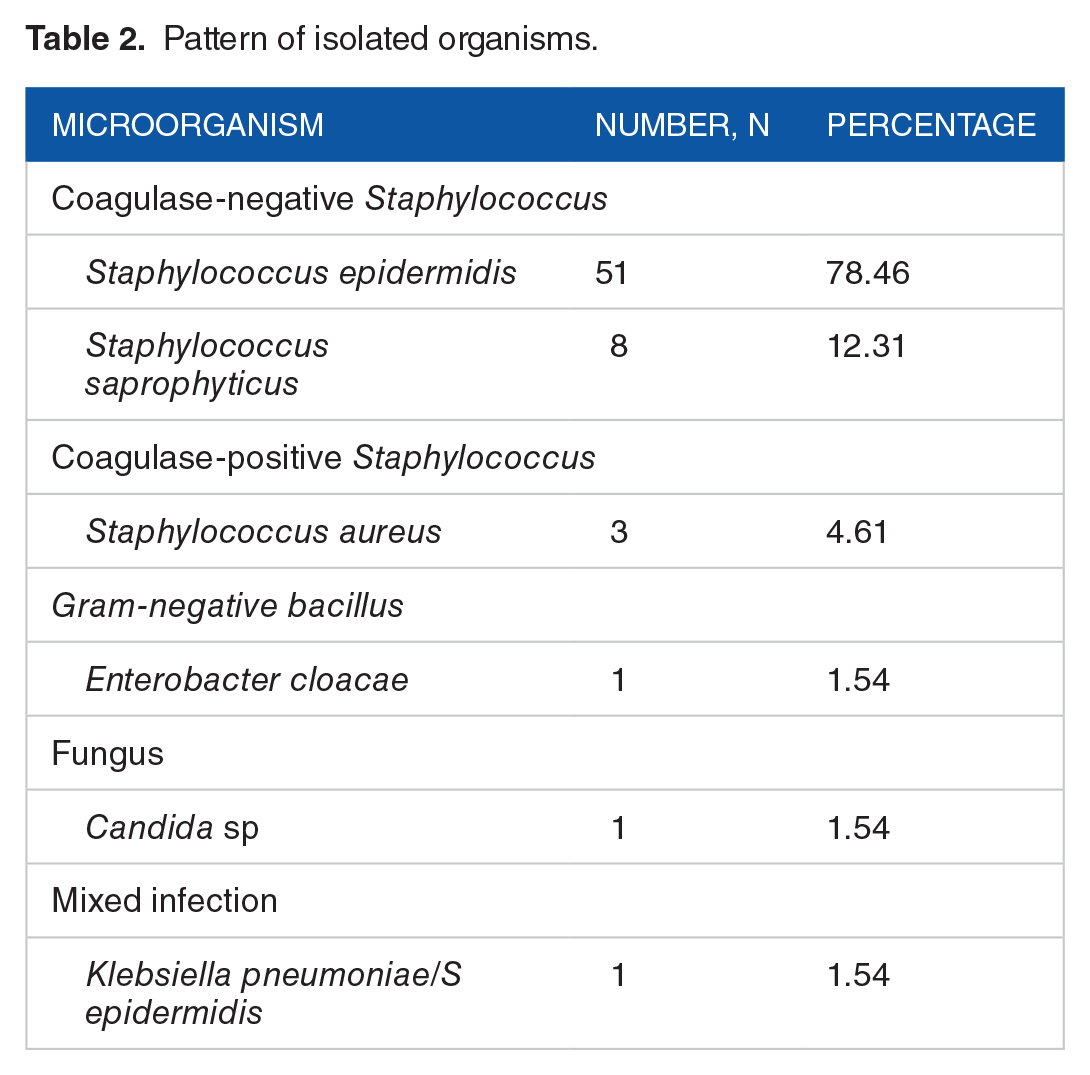
Our sample consisted of 104 HIV patients who fulfilled our inclusion criteria. In all, 71 (68.26%) were women and 33 (31.74%) men. The mean age was 42.90 ± 9.77 (range: 22-70) years. Negative cultures were found in 39 (37.50%) participants; bacterial growth occurred in the conjunctival cultures of 65 (62.50%) individuals (Table 1). Details on isolated organisms are summarized in Table 2. The commonest flora isolated consisted of gram-positive cocci (95.37%). Of those, coagulase-negative Staphylococcus (CoNS) was found in 59 swabs (90.76%), and coagulase-positive Staphylococcus (CoPS) in 3 swabs (4.61%). A case of mixed infections with more than 1 pathogen (Klebsiella pneumoniae and Staphylococcus epidermidis) was found in 1 swab (1.54%). One case of Enterobacter cloacae (1.54%) and one case of Candida sp (1.54%) were also observed. The median ART length was 2 years (IQR: 1-7) but significantly higher (P = .004) for patients with sterile cultures (5, IQR: 2-8 years) compared with those with positive cultures (1, IQR: 1-6 years). The median CD4 count was 374 (IQR: 196-579) but higher for sterile cultures (458, IQR: 202-643) compared with positive cultures (336, IQR: 164-558), with a statistical significance of P = .06 (Table 1).
Demographic and clinical characteristics of 104 participants.
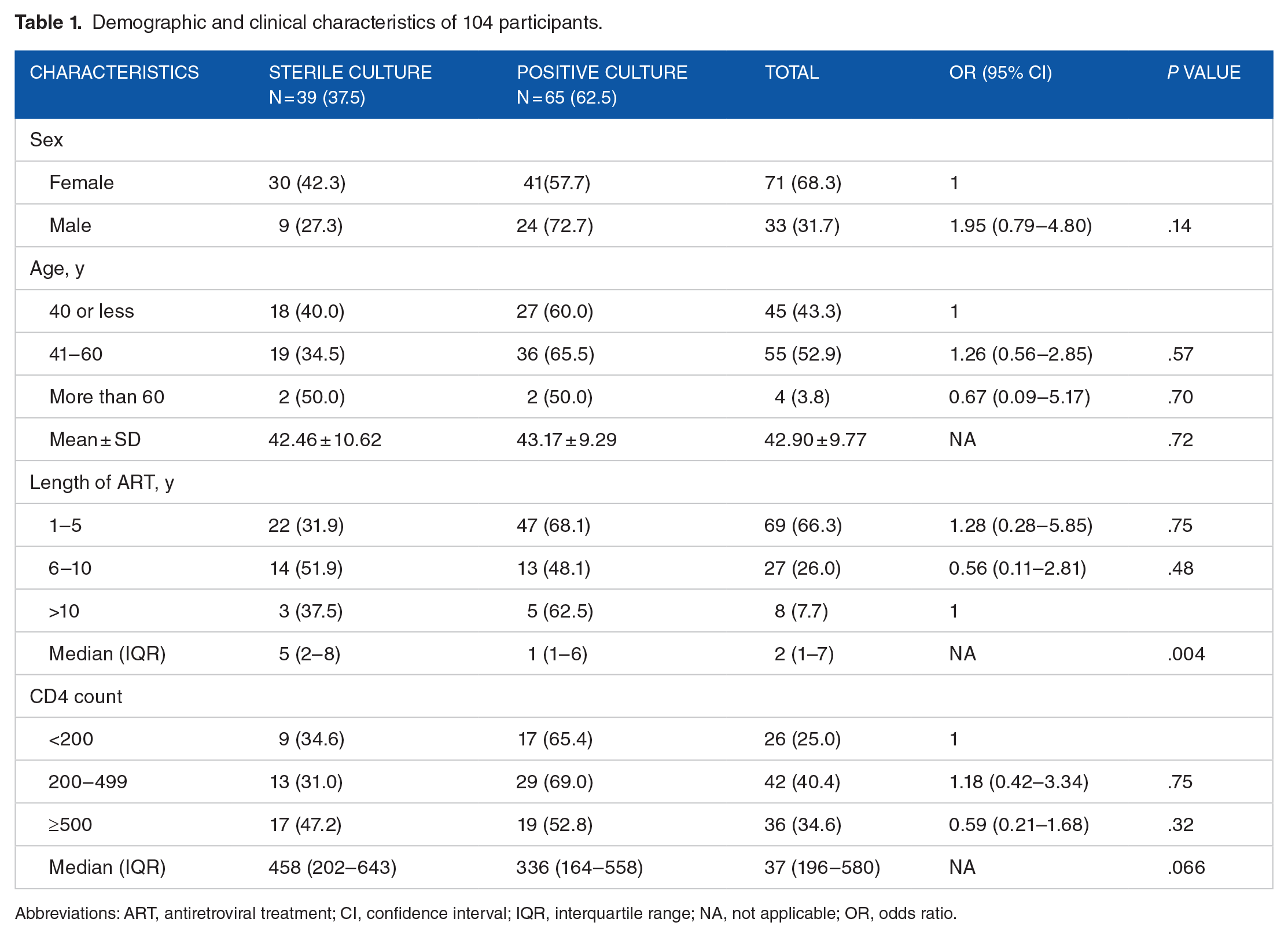
Abbreviations: ART, antiretroviral treatment; CI, confidence interval; IQR, interquartile range; NA, not applicable; OR, odds ratio.
Pattern of isolated organisms.
Discussion
Antiretroviral therapy has dramatically improved the prognoses of patients with HIV infection. 7 This study evaluated the conjunctival flora of HIV patients on ART. The female predominance reported in our series is in accordance with the proportion of infected women in the general population. 8 The rate of sterile conjunctiva was 37.5% in this study. Our results are similar to the 33% reported by Fontes et al in their series. 9 In our study, positive cultures were recorded in 62.50% of cases. The positive rate varies largely in the literature. Yamauchi et al 10 reported 48.50% positive cultures in a series of 66 HIV-infected patients. Sahin et al 11 found 85% positive cultures in immunocompromised patients hospitalized in an intensive care unit. Coagulase-negative Staphylococci were the most frequent bacteria isolated (90.77%). Coagulase-negative Staphylococci are the most frequent component of the normal skin flora.12,13 They include some of the major nosocomial pathogens, with S epidermidis and Staphylococcus haemolyticus being the most significant species. 14 In our series, S epidermidis represented 78.46% of CoNS. Intraocular infections caused by CoNS are particularly associated with the use of implanted foreign bodies such as intraocular lenses in modern cataract surgery. The high prevalence of positive cultures can be explained by disturbances that occur in the conjunctival defence mechanism of patients living with HIV. Comerie-Smith et al 15 reported a decrease in lactoferrin levels in the tears of HIV-positive patients. In the current series, a coinfection of germs (K pneumoniae and S epidermidis), a case of E cloacae, and a fungal species (Candida sp) were observed in patients with CD4 counts less than 200 cells/mm3. Gumbel et al 16 also reported a case of fungal and gram-negative bacteria in the conjunctival flora of HIV-positive patients in an advanced stage. The median CD4 count was 374 (IQR: 196-579) but higher for patients with sterile cultures (458, IQR: 202-643) compared with those with positive cultures (336, IQR: 164-558), with a statistical significance of P = .06. Our study shows that long-term ART and an increase in CD4 cell counts may have positive effects on the bacterial growth frequency in HIV patients. The rate of bacterial growth was high for patients who had taken ART medication for less than 5 years. These patients were 1.28 times more at risk to have positive cultures compared with those with ART durations of more than 10 years. Long-term ART induces the suppression of plasma viral load below detection levels and facilitates immunologic recovery in the form of rising CD4 cell counts.
Antimicrobial susceptibility tests were not performed in this study due to the lack of resources; this constitutes one limitation. However, the antibiotic susceptibility pattern of CoNS and CoPS has been largely evaluated in other studies. Coşkun et al 17 reported that more than 91% of conjunctival isolates of CoNS and CoPS were sensitive to ofloxacin and ciprofloxacin. Keshav et al 18 reported that ciprofloxacin, gentamycin, vancomycin, and chloramphenicol were found to be most effective on CoNS. Another limitation of this study is its hospital-based setting and the lack of a control group. Further studies should investigate this issue in a population-based setting using a comparative group.
Conclusions
This study reveals that CoNS and CoPS are the most common components of the conjunctival flora of HIV-infected patients on ART. There is a significant correlation between the degree of immunodepression, the length of ART, and the positive culture rate. Special care should be taken for patients with low CD4 cell counts who are at high risk of developing opportunistic infections. Preventive measures such as broad-spectrum antibiotics administration should be considered a few days prior any intraocular procedure in this group of patients.
Footnotes
Author Contributions
KG, BY, and ESR contributed to the study design, analysed the data, and performed critical revision of the manuscript for important intellectual content. KG and DAV wrote the paper. All authors contributed to data analysis, drafting, and revising the paper; read and approved the final manuscript; and agree to be accountable for all aspects of the work.
Peer review:
Two peer reviewers contributed to the peer review report. Reviewers’ reports totalled 1120 words, excluding any confidential comments to the academic editor.
Funding:
The author(s) received no financial support for the research, authorship, and/or publication of this article.
Declaration of conflicting interests:
The author(s) declared no potential conflicts of interest with respect to the research, authorship, and/or publication of this article.