




Abstract
Objective:
There is a plethora of theories about the pathophysiology behind a sport-related concussion. In this review of the literature, the authors evaluated studies on the pathophysiology of sport-related concussion and professional athlete return-to-play guidelines. The goal of this article is to summarize the most common hypotheses for sport-related concussion, evaluate if there are common underlying mechanisms, and determine if correlations are seen between published mechanisms and the most current return-to-play recommendations.
Methods:
Two authors selected papers from the past 5 years for literature review involving discussion of sport-related concussion and pathophysiology, pathology, or physiology of concussion using mutually agreed-upon search criteria. After the articles were filtered based on search criteria, pathophysiological explanations for concussion were organized into tables. Following analysis of pathophysiology, concussion protocols and return-to-play guidelines were obtained via a Google search for the major professional sports leagues and synthesized into a summary table.
Results:
Out of 1112 initially identified publications, 53 met our criteria for qualitative analysis. The 53 studies revealed 5 primary neuropathological explanations for sport-related concussion, regardless of the many theories talked about in the different papers. These 5 explanations, in order of predominance in the articles analyzed, were (1) tauopathy, (2) white matter changes, (3) neural connectivity alterations, (4) reduction in cerebral perfusion, and (5) gray matter atrophy. Pathology may be sport specific: white matter changes are seen in 47% of football reports, tauopathy is seen in 50% of hockey reports, and soccer reports 50% tauopathy as well as 50% neural connectivity alterations. Analysis of the return-to-play guidelines across professional sports indicated commonalities in concussion management despite individual policies.
Conclusions:
Current evidence on pathophysiology for sport-related concussion does not yet support one unifying mechanism, but published hypotheses may potentially be simplified into 5 primary groups. The unification of the complex, likely multifactorial mechanisms for sport-related concussion to a few common explanations, combined with unique findings within individual sports presented in this report, may help filter and link concussion pathophysiology in sport. By doing so, the authors hope that this review will help guide future concussion research, treatment, and management.
Introduction
According to the Centers for Disease Control (CDC) and the Brain Injury Research Institute, approximately 1.6 to 3.8 million individuals face sport-related concussions in the United States every year and the CDC estimates that roughly 10% of all contact sport athletes suffer from at least 1 concussion yearly, with brain injuries taking the top spot in causes of sport-related injuries and the cause of death in children and young adults. 1 Contact sports can be broken down into either full or limited contact classifications. 2 Full contact describes sports such as football, hockey, soccer, basketball, and boxing, whereas limited contact describes sports such as baseball, softball, cheerleading, and volleyball. The sport and position played within the sport may be a contributing risk factor for sport-related concussions which given the number of participants in such activities may help support the statistics of increasing frequency of sport-related concussion.
Neurodegenerative conditions may be linked to repetitive concussion, with 1 potential neuropathological sequela being chronic traumatic encephalopathy (CTE).2,3 Repetitive concussions may be a risk factor for cognitive decline and neurodegenerative disease such as CTE, and therefore return-to-play (RTP) guidelines play a pivotal role in player development. Rapid return to play, an underdiagnosis of the problem, may place the participant at a “health risk.” Delayed return to play, an overdiagnosis of the problem, may place the participant at an “opportunity for success risk.”
Currently, a plethora of concussion literature exists; however, theories are variable, information is not consolidated for easy future investigation, and no article has yet attempted to concisely summarize the breadth of knowledge on sport-related concussion. The variability in theories on concussion pathophysiology and mechanism is the result of the medical and scientific community’s high output of research attempting to elucidate the complex, largely unknown pathophysiology. Given the unknown nature of sport-related concussion, in combination with American culture’s love for sport, a firestorm of opinions have been expressed in America’s media platform.4-6 No clear pathologic definition or description of concussion exists, leading to a lack of consensus in the use of the term, lack of agreement on the neuropathological progression of brain damage associated with a concussion, and, ultimately, difficulty deciding how to clinically distinguish and treat a concussion compared with other traumatic brain injuries (TBIs).7–8 As evidenced by the confusion that still exists among even experts in sport-related concussion, the understanding of concussion is still a problem in the modern day.
In this article, the authors systematically analyzed the current literature for theories on the pathophysiological process underlying a sport-related concussion, as well as the RTP guidelines instituted within different contact sports where players are at risk for concussion. Through review of the literature, the authors of this article sought to collect pathophysiological explanations and management guidelines for different sport-related concussions, concisely present the information, and identify commonalities and differences that may shed light and coherently synthesize opinions on sport-related concussion.
Methods
Overview
For this study, there were 2 sets of information that were collected: (1) pathophysiology of sport-related concussion and (2) RTP guidelines following concussion associated with different contact sports. Thus, the methods consisted of 2 separate protocols for information collection (see section “Search”). Our methods for this study of concussion pathophysiology in sport followed the Preferred Reporting Items for Systematic Reviews and Meta-Analyses guidelines.
Search
For information set 1 (pathophysiology), a review of the literature was performed by the authors to identify studies that investigated pathophysiology of sport-related concussion. For information set 2 (RTP guidelines), websites for major league sports concussion protocols (eg, Major League Soccer [MLS], National Hockey League [NHL], National Basketball Association [NBA], National Football League [NFL], and Major League Baseball [MLB]) and National Collegiate Athletic Association (NCAA) concussion protocols were referenced for RTP guidelines. As this study primarily looked into sport-related concussion in college and professional athletes, analysis of NCAA and professional sport guidelines was deemed appropriate.
The PubMed database was used to collect information set 1. In PubMed, MeSH term “concussion” was used to find all articles in records that were indexed under or related to concussion. To further narrow down the search, under the “concussion” MeSH search, “pathophysiology,” “pathology,” and “physiology” checkboxes were selected to identify articles that mentioned pathophysiology of concussion. Finally, the keyword “sports” was added to the search to only select published articles related to sport-related concussion (see Figure 1).

Article search criteria for review of the literature on sports-related concussion.
After clearing the previous search history on Google, an incognito window was used to collect information set 2. To obtain RTP concussion guidelines for major league sports, a Google search was completed using the phrase “2018 concussion return to play guidelines” followed by the name of the major league for each sport (see Figure 1). To obtain RTP concussion guidelines for NCAA sports, the same phrase “2018 concussion return to play guidelines” followed by “NCAA” was completed.
Inclusion criteria
For information set 1, because the authors’ goal in this article was to conduct a recent review of the literature on the pathophysiology of sport-related concussion, specific criteria were incorporated into the search strategy through PubMed to take into account publication date, publication language, publication full-length text availability, and publication content (see Figure 2). Only articles published in the past 5 years were included in this review to summarize and offer an analysis of the most recently published and up-to-date literature.
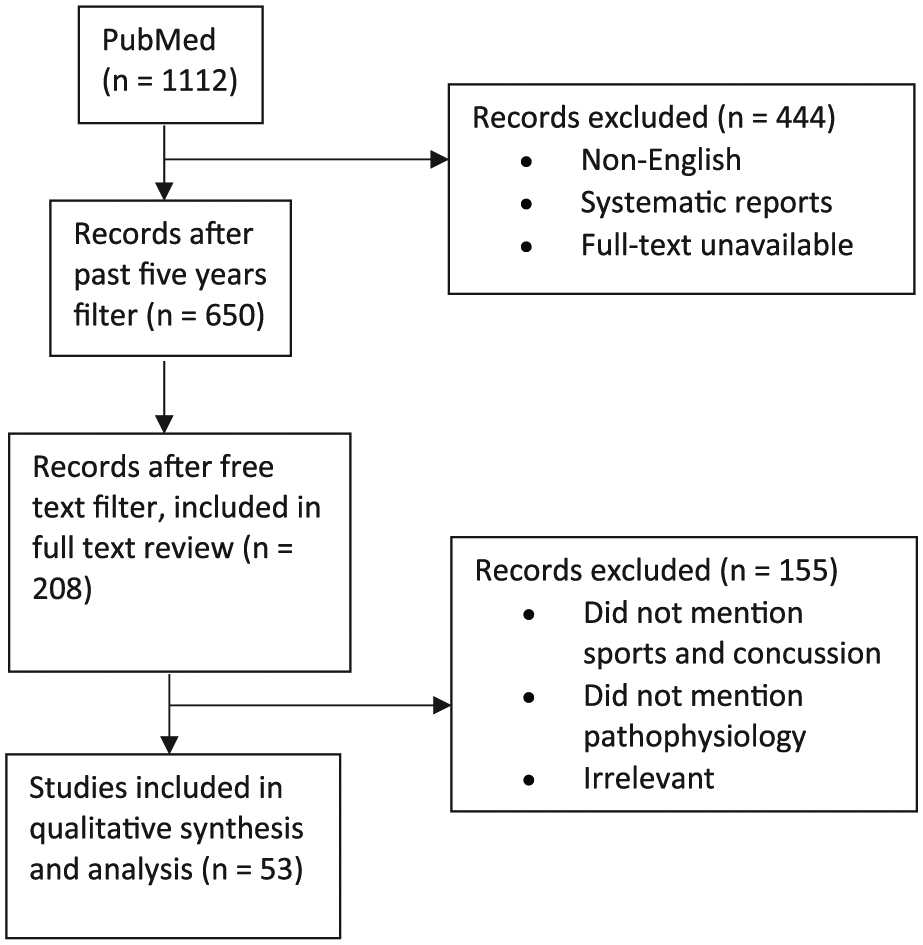
Article selection for review of the literature on sports-related concussion.
For information set 2, the most recent RTP guidelines from the official websites of the major league sports and NCAA were collected. If the most recent RTP guidelines were not viewable through the official websites, publically available data from media articles reporting the concussion policies were used. Obtaining the most up-to-date concussion RTP guidelines was prioritized.
Full-length article criteria
For information set 1, after using the search strategy and filtering further articles out through the inclusion criteria, 208 full-length articles were identified and read by both the primary and senior authors. Studies that did not mention both sports and concussion were excluded. Because the authors wanted to identify primary literature on concussion pathophysiology, systematic reviews, and other review articles that had not been eliminated via application of the inclusion criteria were excluded. Studies that discussed sports below the collegiate level were excluded, as the goal of this article was to review sport-related concussion at the collegiate and professional levels. Data were extracted from the articles independently based on an agreed-upon format for the tables in section “Results.” Pathophysiology of concussion was the primary finding sought, along with the mentioned sport in each article, lead author, and date of publication.
Results
For information set 1, comprehensive screening of 208 full-length articles resulted in 53 articles for analysis. The 53 studies were summarized for pathophysiology of concussion and categorized by sport (see Tables 1 to 7). The articles summarized in the tables cover concussion pathophysiology in individual sports, including football, hockey, basketball, soccer, baseball, boxing, fighting, and rugby, as well as multiple sports.
Summary of football articles on sports-related concussion.

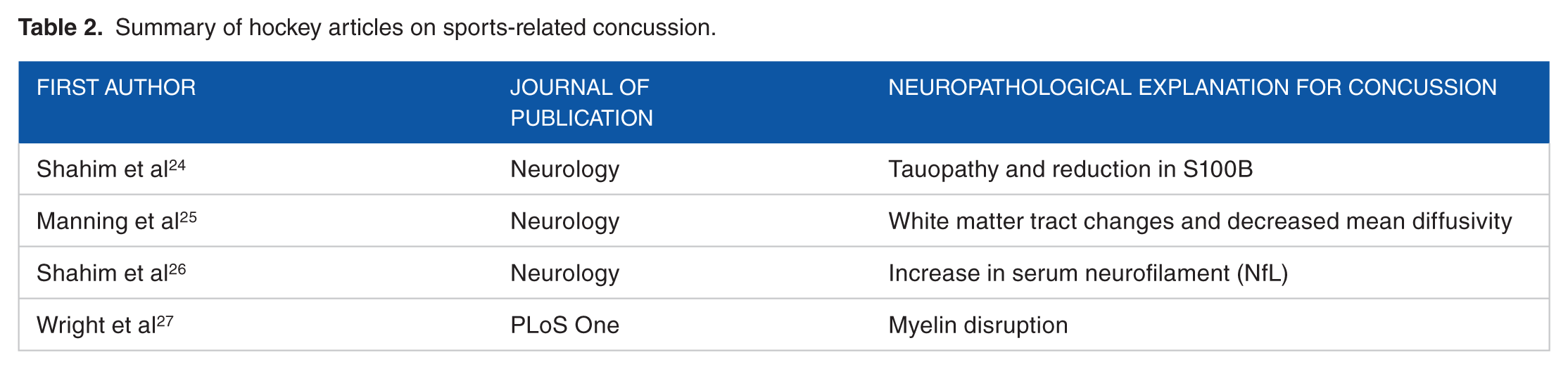
Summary of hockey articles on sports-related concussion.
Summary of basketball articles on sports-related concussion.

Summary of soccer articles on sports-related concussion.

Summary of baseball articles on sports-related concussion.

Summary of other sports (boxing/fighting/rugby) articles on sports-related concussion.

Summary of articles on sports-related concussion referencing all sports.

As illustrated in the final summary table of all of the articles analyzed in our study, the primary neuropathological explanations for sport-related concussion are (1) tauopathy, (2) white matter tract changes, (3) neural connectivity alterations, (4) reduction in cerebral perfusion, and (5) gray matter atrophy (see Table 8). Several articles mentioned multiple of the 5 concussion mechanisms listed above. Of these articles, 32% highlighted tauopathy, 28% highlighted white matter tract changes, 25% highlighted neural connectivity alterations, 19% highlighted a reduction in cerebral perfusion, and 11% highlighted gray matter atrophy. Note that the percentages add up to over 100% because several articles mentioned more than 1 neuropathological explanation for sport-related concussion.
Primary neuropathological explanations for sports-related concussion.
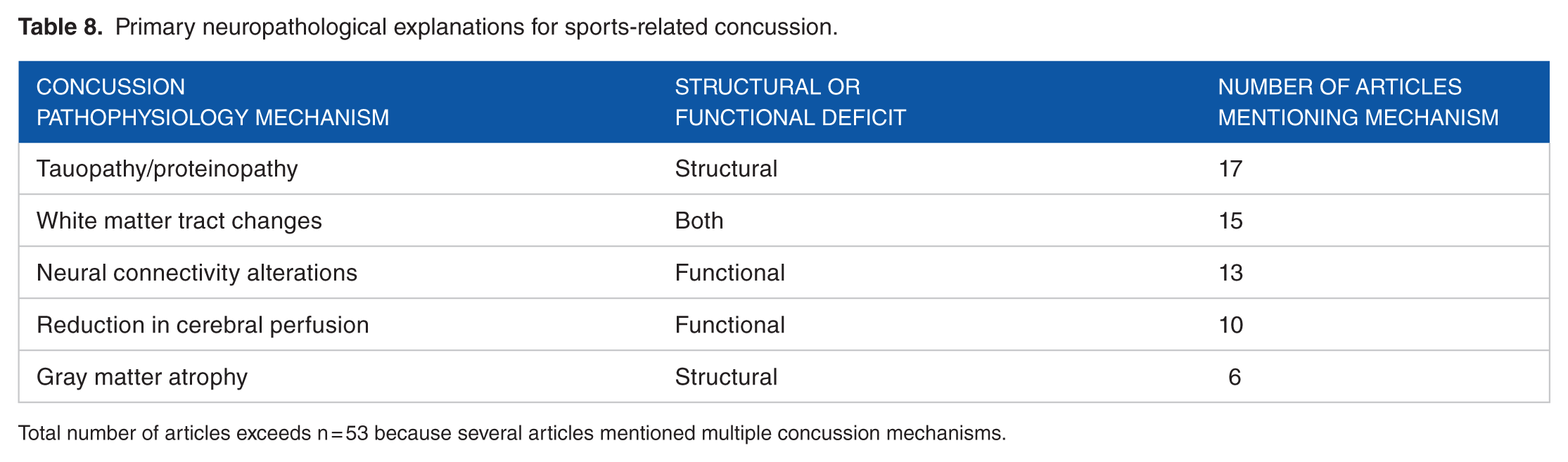
Total number of articles exceeds n = 53 because several articles mentioned multiple concussion mechanisms.
There was also variability in pathophysiological explanation for concussion across different sports. Pathology may be sport specific: white matter changes are seen in 47% of football reports, tauopathy is seen in 50% of hockey reports, and soccer reports 50% tauopathy as well as 50% neural connectivity alterations.
For information set 2, concussion RTP guidelines from the NFL, NBA, MLS, MLB, and NHL were summarized, along with the NCAA concussion RTP guidelines (see Table 9). Across all the major sports leagues, concussion RTP protocols, regardless of the number of specific steps and unique intricacies, include 3 common stages: (1) rest, (2) re-exertion, and (3) return to play.
Summary of concussion RTP guidelines.

RTP, return-to-play; NFL, National Football League; NHL, National Hockey League; MLS, Major League Soccer; NBA, National Basketball Association; MLB, Major League Baseball; NCAA, National Collegiate Athletic Association.
Discussion
Concussion awareness is now mainstream with numerous, often polarizing, viewpoints.5–8,67 The pathophysiology of concussion remains unknown but robust active research may soon elucidate a mechanism. This unknown, along with the potential link of repeat concussion to CTE, has been the fuel to these polarizing viewpoints. In a recent 2017 study of concussion, researchers suggested the presence of CTE in more than 90% of the studies of deceased National Football League (NFL) players. This link has, however, been convincingly contested by Castellani and colleagues68,69 This ambiguity is problematic because there are potentially severe negative consequences related to concussive impacts and repeated concussions on athletes across all levels of play. Without a better understanding of sport-related concussion, the overdiagnosis and underdiagnosis of concussion can be detrimental to athletes and sport as a whole. For example, overdiagnosis of concussion can cause athletes to unnecessarily miss games, lose training time, and even suffer reduction in pay. On the other hand, underdiagnosis of concussion becomes a public health concern with concussed and sub-concussed athletes continuing to play which may lead to neurodegenerative processes later in life.68–70
The exact pathology of concussion is not known and its sequel, such as CTE, debatable among leaders in the field.7,67–69 For this reason, a list of identifiable risk factors is dynamic. Potential risk factors for concussion include prior concussion, participation in full or limited contact sports, the position played in a sport, female sex, older age, occurrence of migraines, alcohol/drug abuse, dementia, motor-neuron disease, depression, and several psychiatric disorders. 71 Further potential consequences of concussion include the onset of headache, cognitive deficits, balance and coordination problems, behavioral issues, and neurodegenerative disease such as CTE. 67 If one accepts CTE as a neuropathological entity, then potential links have been made to behavioral and emotional changes such as agitation, apathy, aggressiveness, suicidal ideation, and poor impulse control.2,10 CTE may also be associated with disease processes such as depression, Parkinsonism, and dementia.2,10,70
After examining concussion publications, the authors’ confirm that the literature is vast and not yet ready for simplification into 1 neuropathological explanation. However, our review of the literature did simplify the existing literature and did surface several findings that may show trends in concussion literature, concussion across sports, concussion pathophysiology, and future direction in concussion research and management: (1) there are potentially 5 primary explanations for concussion pathophysiology amidst the plethora of theories described in the reviewed literature; (2) concussion pathophysiology is a both structural and functional phenomenon; (3) concussion pathophysiology may vary across individual sports; (4) concussion RTP guidelines have a similar structure across different sports.
Theories of concussion pathophysiology
Although sport-related concussion has been loosely defined as neurological symptoms and cognitive problems that result from direct blow to the head, face, neck, or other body parts that transmits force to the head, there are many areas of debate regarding the pathophysiology producing these symptoms on head trauma. 70 By simplifying the voices in the literature, our first finding indicated the presence of 5 predominant pathophysiological explanations for sport-related concussion. These pathophysiological findings may help elucidate the true mechanism and definition of a concussion. Our survey of the literature identified 53 studies that clearly explained a pathophysiological explanation for sport-related concussion. The studies either looked at concussions across all different sports or focused on concussions in a specific sport (see Tables 1 to 7). Analysis of the individual concussion pathophysiological processes across all sports and within individual sports shows both commonalities and differences. In all of the articles systematically reviewed across all sports, (1) tauopathy, (2) white matter tract changes, and (3) alterations in neuronal connectivity showed up as the top 3 explanations for concussion symptoms, followed by the less common explanations of (4) reduction in cerebral perfusion and (5) gray matter atrophy (see Table 8).
Each of the 5 primary neuropathological explanations for sport-related concussion identified in our systematic literature review has pathophysiological theories: (1) The tauopathy explanation is centered on the abnormal accumulation of abnormally phosphorylated tau protein in the depth of cortical sulci on concussion trauma. 72 The tau protein normally stabilizes microtubules in axons necessary for neuronal communication. The distribution of hyperphosphorylated tau in the brain leads to the accumulation of neurofibrillary lesions, a loss in the neuronal network connectivity, and mass cell death and dysfunction. 68 Tau hyperphosphorylation is characteristic of normal aging, but in athletes who suffer concussions abnormally phosphorylated tau is stained at an early age. (2) The white matter change explanation is centered on the alteration of myelin, a lipid-rich substance that insulates axons and is responsible for coordinating neural communication. 73 In this theory, athletes who suffer concussions undergo multifocal axonal varicosities involving the subcortical white matter microstructure, leading to delayed action potentials and signals. 69 Examples of changes in white matter interfaces include widening of frontal and occipital cortical sulci, damage that leads to release of neural proteins that injure the brain, reduced diffusivity and total brain volume, and diffuse axonal injury. 74 (3) The neural connectivity explanation relies on neuroimaging to show a reduction in regional and global neuronal networks. 75 Such a reduction leads to delayed coordinated communication between brain regions, a loss in cognition, and other neurological symptoms. (4) The cerebral perfusion explanation models the vascular hypothesis described previously, emphasizing concussive symptoms resulting from obstruction or trauma resulting in a change in cerebral blood flow and potentially ischemia. 71 (5) Finally, the gray matter atrophy explanation attributes concussion symptoms to trauma leading to overall shrinkage of cortical and subcortical structures, like the thalamus and hippocampus. 76 These structures are crucial for memory and cognition, processes that are reduced as a result of sport-related concussion.
Concussion: a structural and functional phenomenon
Even though these theories behind concussion may be shared, there is still ongoing debate and constant generation of new theories. One of the major controversies is whether a concussion is caused by functional or structural damage. 8 Our second finding indicated that concussion pathophysiology cannot be reduced to one or the other, and has both structural and functional mechanisms. Structural damage refers to changes in brain structure that may be related to concussion symptomology. Functional damage refers to changes in cellular or neuronal connections and functions that produce concussion symptoms. The finding that structural and functional deficits results from concussion is no surprise. Concussion is a complicated disease of the most complex organ in the body. Various structural and functional factors go into a concussion. For example, different players have different brain structures and functional situations before a concussion that affect brain pathology. Point of impact may be different. Risk factors are present for different individuals. Factors like the analysis of tissue samples post concussion are constantly prone to error through the variable brain fixation process that can produce both functional and structural changes in brain pathology. 8 With such factors attributing concussions to both functional and structural origins along with the same finding in the review of literature, further investigation of concussion requires looking at the problem from a heterogeneous and multifactorial lens.
Pathophysiological differences across sport
The third finding in our study is that concussion pathophysiology may vary among sports and have specific trends within individual sports. In football, studies attributing concussions to white matter changes predominated (7 out of 15 studies). In hockey, tauopathy explanations predominated (2 out of 4 studies). In soccer, the neural connectivity alteration (2 out of 4 studies) and tauopathy (2 out of 4 studies) explanations predominated. Basketball and baseball both only had 1 study in the primary literature over the past 5 years that mentioned pathophysiology of concussion. An explanation for the lack of literature may be that, among all sports, baseball and basketball consistently have the lowest incidence of concussion. In articles that looked at the concussion pathophysiology in all sports, tauopathy (7 out of 21 studies), white matter changes (6 out of 21 studies), and neuronal connectivity alterations (6 out of 21 studies) were the most predominant explanations. The presence of these 3 theories in the studies that mention all sports aligns with the overall systematic review identification of these 3 theories as the most common explanations for sport-related concussion pathophysiology.
Concussion RTP guidelines
Finally, we identified that RTP guidelines between sports may share common ground. Despite the differences in concussion by the sports listed above, there may be a clear commonality among theories regarding concussions across all sports. Through collection of concussion RTP guidelines in sports at the professional and collegiate levels (see Table 9), the authors of this study identified different concussion protocols for individual sports. Despite the different number of steps between protocols, a common pattern of rest until concussion symptoms disappear, exert and exercise, and return to full contact play exists among different concussion RTP guidelines. This brings up a major question of whether concussion RTP guidelines should be standardized or adjusted to better manage athlete symptoms and recovery. The mechanism of trauma to the head in sports can differ; however, across all sports, signs and symptoms of concussion remain shared. A further analysis of concussion pathophysiology, prevalence, relapse of symptoms, and long-term consequences across different sports may shed light on this question.
By unifying existing theories on sport-related concussion pathophysiology, summarizing risk factors/comorbidities associated with sport-related concussion, and identifying sport-specific concussion findings, the authors of this review article simplify sport-related concussion into a more concise and approachable subject. By investigating the consequences of concussion, diagnosis of concussion, and sport RTP guidelines, the authors shed light on the importance of future studies that can help connect concussion management with the concussion mechanism and pathophysiology. Using the simplified information collected in this review article, future studies can further unravel pathophysiology and ideal management of sport-related concussion. As the literature on sport-related concussion becomes clearer, player- and sport-specific guidelines can also be instituted for better management of concussion in sport.
Conclusions
The continued study of concussion pathophysiology across all sports and within individual sports at all levels of play is important and should be continued. The output of new theories and knowledge, the growing medical concern of increasing concussions, the creation of new evaluation rules and protocols, and the overall uncertainty that still exists regarding the topic make this a subject that deserves attention and a focused effort toward improvement. Further investigation, using the information provided in our simplifying literature review of sport-related concussion, will hopefully help shape concussion management and sports in general.
Footnotes
Acknowledgements
The authors would like to give special thanks to Anthony N Pass, Assistant Athletic Director for Sports Medicine and Head Football Athletic Trainer, The University of Texas at Austin and John S Kuo, MD, PhD Chairman Department of Neurosurgery, Dell Medical School, The University of Texas at Austin for their critical review of the article and editorial comments.
Funding:
The author(s) received no financial support for the research, authorship, and/or publication of this article.
Declaration of conflicting interests:
The author(s) declared no potential conflicts of interest with respect to the research, authorship, and/or publication of this article.
Author Contributions
MTK- conception, design, review, and supervision. PS- Acquisition of data, drafting article, critically revising article, drafting revision. All authors- Critically revising article.
