



Abstract
The aim of this study was to investigate whether plasma serotonin (5-hydroxytryptamine [5-HT]) was associated with the presence of foot pad dermatitis (FPD) in laying hens. FPD birds (n = 20) and healthy individuals (n = 22) were included. Plasma 5-HT was investigated. FPD laying hens showed significantly higher 5-HT levels (median = 6 µmol/L) compared with healthy individuals (median = 4.28 µmol/L, P < .001). When present, FPD were scored as either 1 (n = 12) indicating mildly to moderately abnormal or 2 indicating severely abnormal (n = 8). The subjects whose lesions scored 2 had higher plasma 5-HT levels than those whose lesions scored 1. Inflammatory mechanisms seem to be related to plasma 5-HT levels in laying hens. Assessing plasma 5-HT could be useful to evaluate chicken welfare.
Serotonin (5-hydroxytryptamine [5-HT]) is a neuromodulator involved in many physiological functions. 5-HT plays a modulatory role in temperature regulation, feeding, sexual behavior, painful stimuli response, flight, and stress. 1 In birds as in mammals, 5-HT is produced not only in the neuronal system but also independently in peripheral tissues. 2 Surprisingly only about 1% to 2% of the total amount of serotonin is produced by serotonergic neurons in the brain, whereas close to 95% of the 5-HT in the body is synthesized, stored, and released by cells in the intestinal mucosa known as enterochromaffin cells. 3 5-HT can be detected in several non-neuronal tissues of the cardiovascular and renal systems, as well as in blood. 4 Mammalian enterochromaffin cells release 5-HT into the blood, where platelets have evolved a highly efficient 5-HT uptake and transport system. 5 Approximately 95% of 5-HT in blood is carried in platelets. 6 Similar to mammals’ platelets, avian thrombocytes contain serotonin. 7 In chickens, whole-blood 5-HT is mainly distributed among the following cell types: thrombocytes (50%), lymphocytes (25%-29%), and polymorphs and monocytes (19%-25%). 8 Lymphocytes appear to possess the ability to synthesize, transport, store, and/or respond to 5-HT. 9 Circulating 5-HT is considered an accessible model for the investigation of the central serotonin system. 10 In particular, the similarity of platelets and central serotoninergic synaptosomes indicates that the first ones can represent a noninvasive model to study modulation of 5-HT (release and/or uptake) in neurons. 11 In homeotherms, such as mammals and birds, circulating 5-HT plays a major role in reducing heat loss when the environmental temperature is lower than the core temperature. 12 The amino acid tryptophan (TRP) is used for the synthesis of central and peripheral 5-HT. 13 Both central and peripheral serotonin levels can be influenced by TRP availability and enzymatic activity of tryptophan hydroxylase (TPH). Stress factors, such as social stress, can influence peripheral 5-HT in chickens. In young chickens, exposure to elevated corticosterone during incubation resulted in lower whole-blood 5-HT and higher platelet 5-HT uptake as compared with controls. 14
A deficient serotonergic system, potentially due to low TRP availability and/or reduced TPH activity, was found to be associated with psychopathological behaviors in various species, among which feather pecking has been described in chickens. 15 Feather pecking is a repetitive oral behavior in which individuals peck repetitively at another bird’s feather cover. Severe feather pecking influenced hens’ plasma TRP. 16 In the peripheral system, the biological roles of 5-HT in behavioral adaptation and motivational regulation are unclear. 17 In the genetic selection for low productivity group hens, higher blood 5-HT levels were associated with lower survivability resulting from higher cannibalism. 18 Among various physiological functions of peripheral 5-HT, it is becoming increasingly more evident that it plays an important role in many different contexts, including inflammation and immunity. 19 Although footpad dermatitis (FPD) has gained considerable attention in broilers, little attention has been paid so far to FPD in laying hens. 20 As FPD are painful for the hens, they can have negative effects on their welfare. If the lesions become ulcerated, they can affect standing and walking ability. Therefore, the aim of this study was to conduct a pilot study to investigate the concentration of plasma 5-HT in laying hens and to evaluate the possible relation between 5-HT levels and FPD.
Materials and Methods
Subjects
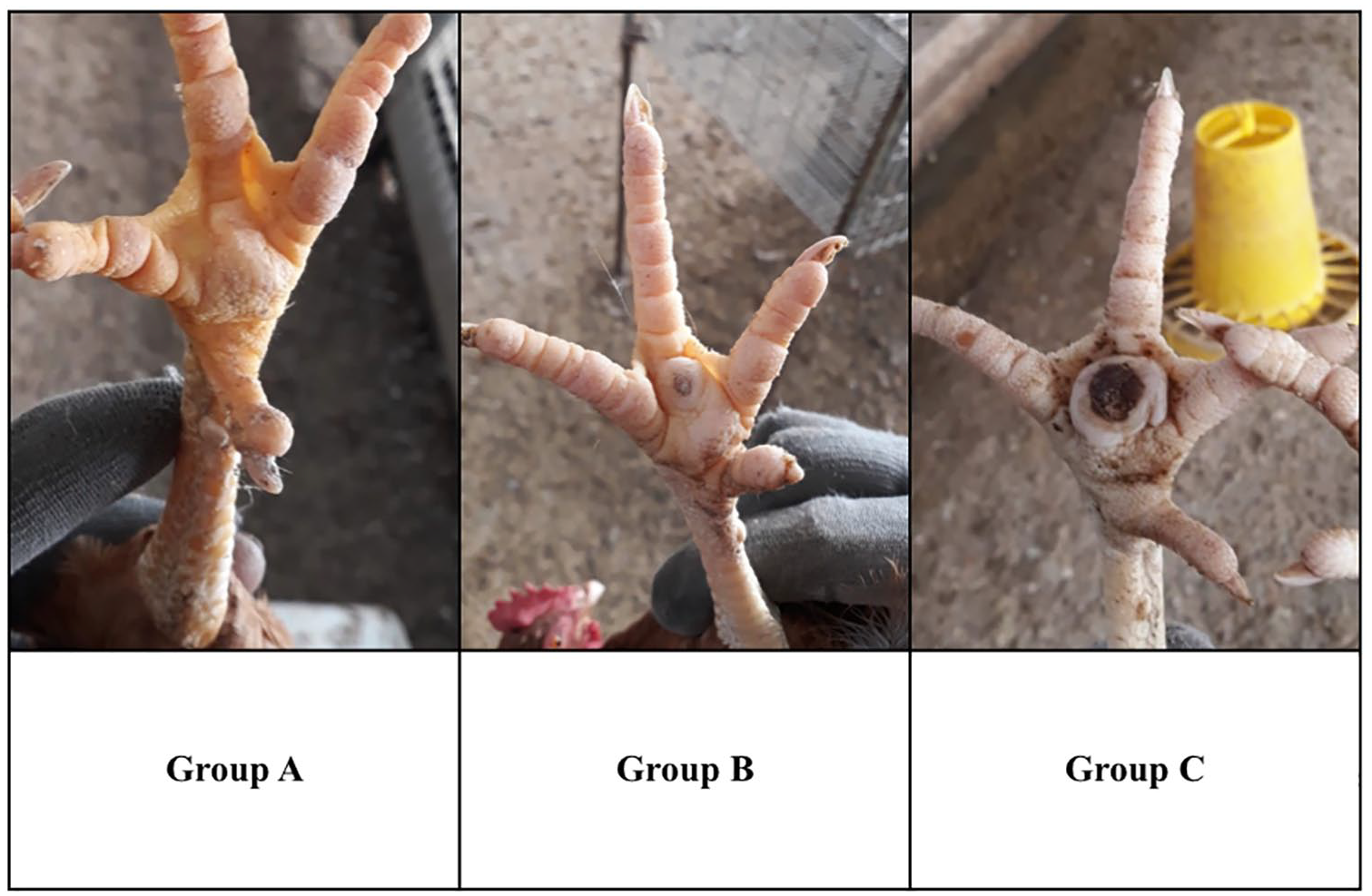
Siciliana breed laying hens (n = 42), kept in non-cage system at a commercial farm, were kept under standardized conditions. At week 45, a general health check was carried out. Individuals without FPD (n = 22) and with FPD (n = 20) were included in the study. Lesion scoring was performed using the photographic system described in Welfare Quality Assessment (WQ) protocol for poultry. 21 Individuals without FPD were assigned to group A. When present, FPD were scored as either 1, indicating mildly to moderately abnormal (n = 12), or 2, indicating severely abnormal (n = 8), and the subjects were assigned to groups B and C respectively. The birds were taken out of their home cage individually and, within 2 minutes, a blood sample (1.5 mL) was collected from the wing vein. The samples were stored into EDTA tubes and centrifuged (1.785g for 10 minutes). Protocols of animal husbandry and experimentation were reviewed and approved in accordance with the standards recommended by the Guide for the Care and Use of Laboratory Animals and Directive 2010/63/EU.
Plasma serotonin assessment
The plasma aliquots obtained from each sample were transported to the laboratory in a cooler with an ice block within 1 hour of being drawn. Plasma for 5-HT analysis was stored frozen at −20°C. Samples were analyzed within 1 month of collection. As 5-HT occurs at extremely high levels in birds, 22 plasma was diluted in a 1:10 ratio with distilled water before 5-HT measurement. A commercially available ELISA kit (analytic range 10.2-2500 ng/mL, 5-HT ELISAFast Track, LDN GmbH & Co. KG) was used to measure plasma 5-HT levels, following the manufacturer’s instructions as previously described. 23 Intra- and inter-coefficient of variation (CV) were 5.6% and 9%, respectively. The amount of 5-HT in the sample was estimated with the calibration curve, multiplied by 10 and expressed in µmol/L.
Statistical analysis
The Mann-Whitney test was used to compare 5-HT differences between individuals with FPD and healthy individuals. The significance of the differences between the 3 groups was tested with the 1-way analysis of variance Kruskal-Wallis test on ranks with Dunn’s multiple comparison post hoc test. A probability level of P < .05 was considered significant. Data were analyzed using the software STATISTICA 7.5 (StastSoft Inc., Tulsa, OK, USA).
Results
Plasma 5-HT differences between healthy individuals and birds with FPD were significant (P < .01; 4.24 ± 0.41 and 6.88 ± 0.59 µmol/L respectively). The comparison among the groups showed significant differences (Kruskal-Wallis, P < .01). Group C had higher 5-HT plasma levels compared with Group A (P < .01; Figure 1) when all groups were compared.

Plasma 5-HT levels (µmol/L) in 3 experimental groups of laying hens based on foot-pad dermatitis. 5-HT indicates 5-hydroxytryptamine.
Discussion
The aim of this study was to evaluate whether plasma 5-HT in laying hens could be influenced by a chronic inflammatory condition such as FPD. Serotonin in chicken has been studied in plasma27-29 and in whole blood.24-26 The use of the peripheral 5-HT system as a less invasive model for central 5-HT system activity has been proposed after discovering the correlation between whole-blood 5-HT and brain 5-HT in laying hens. 18 Unfortunately 5-HT cannot be analyzed in whole blood by ELISA. As indicated in the manufacturer’s description, this kit is used for the quantitative ultra-sensitive determination of 5-HT in any species and on various biological samples (serum, plasma, urine). The present study shows that high plasma 5-HT concentrations are associated with FPD in laying hens. Similar findings were encountered in horses, where subjects with bowel disorders showed higher plasma 5-HT than healthy horses. 30
We hypothesized that it would be more reliable to assess an inflammatory response by measuring 5-HT in plasma than in whole blood because the massive 5-HT release from platelets/thrombocytes and lymphocytes into systemic circulation concurs to generate inflammation.
Assessing plasma 5-HT could be useful to evaluate chicken welfare. Further studies and the standardization of the ELISA method are likely to guide future investigations.
Footnotes
Acknowledgements
We would like to thank Dr. Bruno Scalia for his advice and help in English correction and Dr. Concetta Saoca and sig. Giuseppe Bella for their help in the preparation of the manuscript.
Funding:
The author(s) disclosed receipt of the following financial support for the research, authorship, and/or publication of this article: This work was supported by Funds for Financing Basic Research Activities (FFABR 2017).
Declaration of Conflicting Interests:
The author(s) declared no potential conflicts of interest with respect to the research, authorship, and/or publication of this article.
Author Contributions
Conceived and designed the experiments: DA, AP, MP.
Performed the experiments: VB, FG.
Analyzed the data: DA.
Wrote the paper: DA.
