




Abstract
Meat and nicotinamide acquisition was a defining force during the 2-million-year evolution of the big brains necessary for, anatomically modern, Homo sapiens to survive. Our next move was down the food chain during the Mesolithic ‘broad spectrum’, then horticultural, followed by the Neolithic agricultural revolutions and progressively lower average ‘doses’ of nicotinamide. We speculate that a fertility crisis and population bottleneck around 40 000 years ago, at the time of the Last Glacial Maximum, was overcome by Homo (but not the Neanderthals) by concerted dietary change plus profertility genes and intense sexual selection culminating in behaviourally modern Homo sapiens. Increased reliance on the ‘de novo’ synthesis of nicotinamide from tryptophan conditioned the immune system to welcome symbionts, such as TB (that excrete nicotinamide), and to increase tolerance of the foetus and thereby fertility. The trade-offs during the warmer Holocene were physical and mental stunting and more infectious diseases and population booms and busts. Higher nicotinamide exposure could be responsible for recent demographic and epidemiological transitions to lower fertility and higher longevity, but with more degenerative and auto-immune disease.
Keywords
‘. . . we essay to create a second world within the world of nature’. ‘. . . thoughts about food in prehistory are changing with a proper combination of the theoretical and the technical . . .’.
Introduction
Scholars from the 18th century, namely, Turgot, Montesquieu, de Tocqueville, Adam Smith, and later Childe, McNeill, Crosby, and Diamond recognised an interesting set of correlations involving the basic mode of food subsistence (including alcohol, psychedelic and medicinal compounds) and a broad set of human characteristics. Their insights and speculations were derived primarily from observing hunter-gatherers, farmers and pastoralists, the ‘Columbian exchange’, and modernity.2–8 Such characteristics included population density, divisions of labour, the economy and technology, social norms, rituals and institutions, and the emergence of disease and war. How key dietary variables work proximally to effect success or failure through individual metabolism and physiology has not been elucidated, although mitochondria and the need for prodigious amounts of adenosine triphosphate (ATP) get a mention.9–14
Nicotinamide and Evolution
Nicotinamide and nicotinamide adenine dinucleotide (NAD)-based hydrogen (H) metabolism can be traced to the origins of life, specifically multicellular life with the symbiotic acquisition of mitochondria and the preferential use of oxygen (as electron acceptor) for maximal ATP production. NAD can be synthesised from tryptophan, but the preferred source is dietary nicotinamide. Nicotinamide has a detoxification pathway via NNMT that links to methyl metabolism. Nicotinamide adenine dinucleotide consumers control metabolism, and NAD sensors drive the quest for food and construction of an NAD world15–19 (Figure 1).

Scene setters are not a given but oxygen varies little (except by altitude) and is free. NAD supplies, by contrast, required brains and overcoming dangers in hunter-gatherer days and now have high (financial) costs that can be prohibitive. NAD indicates nicotinamide adenine dinucleotide.
An evolutionary account of the nicotinamide supply may be an ecological flashlight to explain our history. Brillat-Savarin’s aphorism states ‘The destiny of nations depends upon the manner in which they nourish themselves’ as others have also implied.20–27 Quests for meat and plants, based on communal knowledge and manipulation of nature, is one of our defining features.28–68 Nowadays, money hand-outs to the poor get preferentially spent on meat and trump other welfare programmes, as Engel first pointed out happens whenever wages rise69–73 (Figure 2).

Engel curve showing increased proportion spent on meat as wealth increases.
Early hominids speciated in an unstable climate, driven by solar radiation and tectonic activity, that produced rifts with varied and varying habitats. We left shrinking forests for savannahs, lakes, and shorelines that allow for more game and plant produce. Food drove our global expansion, perhaps at some cost to Megafauna, and later drove empires and colonial settlers for lands to farm to secure dietary balance33,74–96 (Figure 3).
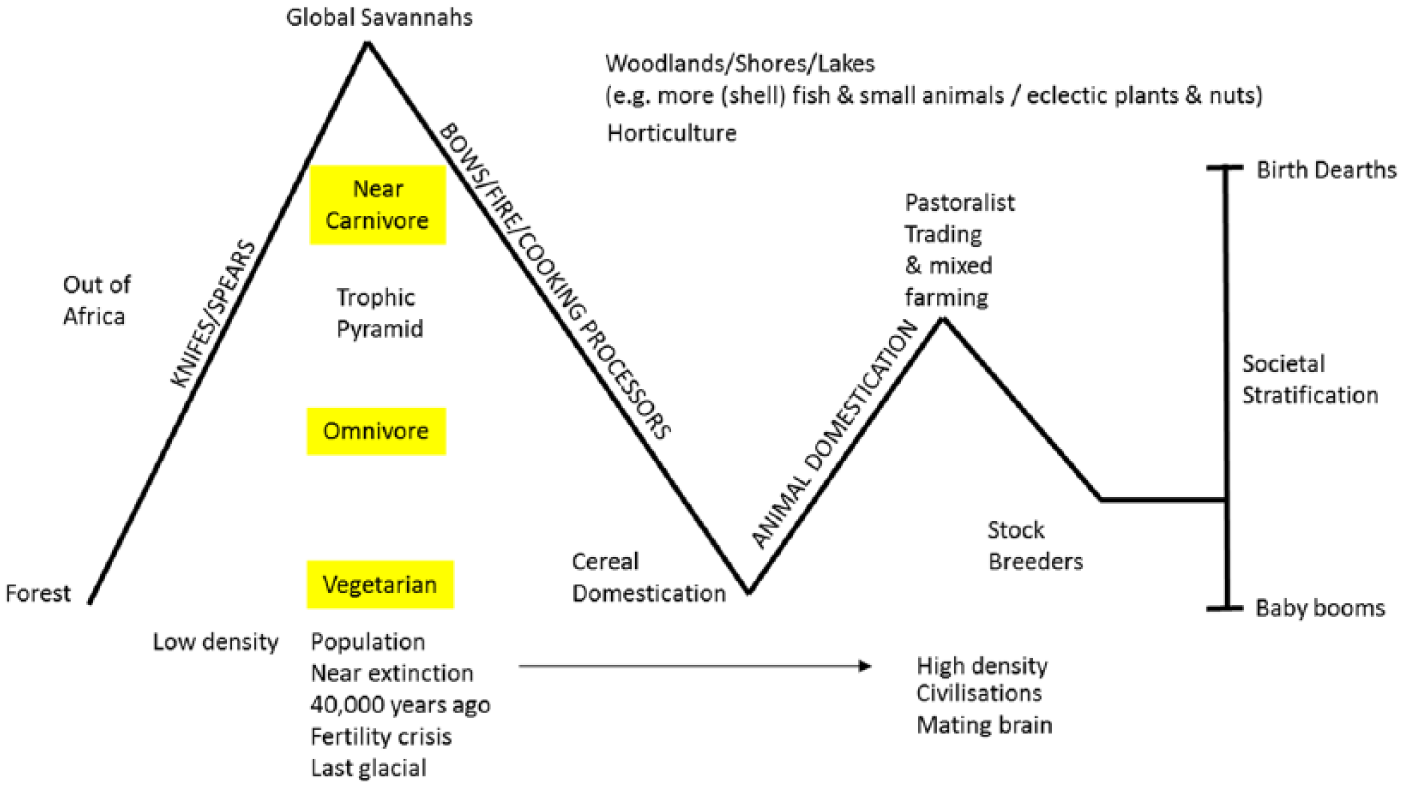
Early ‘Up’s and Down’s’ and then oscillations on the trophic pyramid. Every move alters nicotinamide/tryptophan metabolism.
If population densities had remained at hunter-gatherer levels of 0.05 per km2, global population would now be 7 million, not 7 billion and rising. Much of the evidence about the fertility (and disease) explosion at the time of the Neolithic is derived from skeletal and genetic data.27,97,98 No form of contraception, infanticide, or extended breast feeding explains easily these low fertility states or, for that matter more recent declines in fertility that tellingly start with high meat intake whether by country or by social strata.99–128 Our trophic level is highly variable. We argue the variances that emerged as we moved down the food chain originally had positive reasons by creating small intellectual classes and larger labour i.e. work-forces with higher fertility, but such variances are now too extreme, no longer necessary, and may be dangerous129–153 (Figure 4).

Meat: cereal/vegetable variances over our history. These variances are now extreme going beyond homeostatic controls even with the help of symbionts.
Omnivore or Super-Omnivore
We are (super) omnivores as much of our culture, creative minds, behavior, and many local riddles over food preferences and taboos, can be seen in the light of omnivory.154,155 Anthropologists have deciphered that the preferred diet is a very simple A + 2B (meat and 2 vegetables). 156 There have always been considerable variances depending on season and latitude being less plant-based at the poles – (economics now, however, being more important than geography). Local conditions favoured a variability package aided by technology and tools, use of fire, fermentation, cooking, and xenobiotic biochemistry to cope with toxins or nutrigenomic developments to deal with lactose in adult life and more starch.157–160 ‘Pharmacophagy’ included hallucinogens and medicines allowed some control of fertility. Triangulating diet with detailed environmental information and social collaboration led to further experiments with fertility and its trade-offs.161,162 Societies created (neuro)chemical and endocrine profiles as nicotinamide and tryptophan affect dopamine, serotonin, immunologic, and reproductive pathways163–167 (Figure 5).

Prosocial personality and neurochemical evolution involving serotonin and dopaminergic was driven by diet. An early emphasis on ‘K’ selection in our line was later balanced by a change back to a more plant based diet enabling ‘r’ selection when required.
First: Meat Obsessed
Endurance running and technology with problem-solving, social skills, and language helped to capture meat.168–170 Consciousness helped create ‘a second world within the world of nature’ by allowing a sense of purpose in sourcing our supplies. Even recognising the inevitability of death and the need to reproduce for a communal after-life helped to concentrate minds using high-energy interneurons and pyramidal neurones with their oscillating networks (that are lost in cases of pellagra).171–175
Our primate dietary history previously tacked between insectivores, frugivores, herbivores, and near-carnivores back to omnivores. Hunting and sharing meat between the sexes and ages was a feature of all early societies. 176
High Intelligence Was Originally Necessary to Survive
Separating foraging cognition, ecological, domain-specific intelligence, and social brain hypotheses may be unhelpful dichotomies as our general intelligence may seamlessly span all functions necessary for food and reproductive needs. Spatial memory, reasoning power, and patiently solving complex ecological challenges to put meat on the shared menu served at a central-place in a risky and fluctuating environment was required.177–181 ‘The Great Acceleration’ putting us in charge of the ‘Anthropocene’ is based on an omnivorous diet and domesticated ‘Walking Larders’ with a central role for adequate nicotinamide and high intelligence.182–185
Nicotinamide Deficiency
Nicotinamide is sourced from meat and milk with contributions through gathering sea-shell foods, eggs, insects, and nuts. Both meat and carbohydrate hungers are accepted, but the real drive may have been for a ‘Goldilocks’ balance between animal and plant produce. Nicotinamide adenine dinucleotide deficiency was recognised as causing arrested evolution and atavistic degeneration by the Italian pellagra specialist Lambroso in 1860 and responsible for down-shifts in culture and behaviour. The earlier move down the food chain in the Neolithic indeed led to a decline in height and the emergence of many infectious diseases and bone and oral ill-health. Both the pellagra epidemics and observations on hunter-gatherers denied their right to hunting demonstrated the profound de-humanisation of human beings and their social networks under these circumstances that also resulted in cases of cannibalism – some sanctioned by states and religions where the meat supply was poor such as the Aztec empire.186–189 Changes from pastoralism to reliance on a maize crop or imports have been recapitulated in many parts of Africa with similar effects on health and behaviour. However, ‘rabbit starvation’ described in Artic explorers shows that meat and excess protein can also be toxic and needs to be balanced with adequate carbohydrates.
Chronic meat and therefore nicotinamide deficiency was likely at the time of the Neolithic transition, allowing the rise of symbionts that can act as back-up, including TB and perhaps leprosy and malaria that later disappear.190–197 Unsuccessful quests may have led to stunting of Homo naledi (not found with evidence of hunting) or Homo floresiensis (as islands have restricted availability of meat), as happens to forest pygmies.198–208
Plague After Plague and Still Plagues of Corn
The pellagra literature includes evocative titles such as ‘A Plague of Corn’ or ‘Maize for the Gods’ suggesting that cereals are a mixed blessing. Defined epidemics of pellagra, diagnosed by a characteristic rash with gut infections and a full gamut of neuropsychiatric disease, occurred from the 18th century, notably in Southern Europe and America, up till the modern day; usually now relating to war and refugees, but all these epidemics may be the tip of an iceberg. Earlier, pellagra may have been responsible for the reports of ‘leprosy’ in the Old and New Testaments on poor ‘manna’ diets – and modern leprosy is of interest as nicotinamide can cure it (as it can also cure TB). Later, pellagra may be underdiagnosed or called ‘environmental encephalopathy’ or simply mental or physical stunting and a poor constitution. Reliance on cereals affects those in (meat) poverty, particularly in Africa where the ‘hidden hunger’ of micronutrient deficiencies is rife that conspires to exacerbate other insults (such as TB and HIV) to cause disease.209–236
Recently, talk has been about integrating diet and the microbiome, concentrating not so much on specific foods or taxonomical identities as their functional competencies, and contribution to providing micronutrients, including vitamin B3, as meta-genomic units of selection and fitness. The epidemics of pellagra are a good example of what can happen when this co-operation goes wrong, leading to dysbioses and uncontrolled autophagy and consequent degeneration. Influential human ecologists have long warned of cereals’ pervasive influence that links population and disease explosions in a series of plagues.237–243
Pellagra Yet Cereal Reliance
On the plus side, fertility goddesses, creation myths, and harvest festivals are linked with cereals, perhaps explaining cereals’ real attraction in encouraging fertility (as does their fermented derivative, alcohol). Meat, however, remains a common aversion when pregnant and is thought to have its adverse effects via the immune system. Later came pastoralism, and with it monotheistic ‘Big Gods’ with (almighty) shepherds and dominion over the animal kingdom, suggesting that attitudes changed in favour of a more balanced diet perhaps once the initial fertility crisis was over. Here, we may have the explanation of why plants became popular despite the costs244–252 (Figure 6).

Original population bust 30 to 50 kya was on high meat diet and nearly caused our extinction. Neolithic and later booms were cereal dependent with busts triggered by harvest failures, poor constitution leading to plagues or wars over the meat supply. ‘Goldilocks’ mixed diets are the sustainable solution.
Second: Co-evolution of Plant (and Later Animal) Domestication
Selective gathering and plant exploitation harnessed both their sexual and asexual reproduction. Gardening developed with tending, weeding, pruning, and burning and then selection of phenotypic traits, availability, growth, resistance, productivity, and ease of processing or in a word nutritional yield. 253 Horticulture, agriculture, and domestication of cereals and later animals are an example of convergent evolution as they happened independently and fairly quickly in different parts of the old world (later in the New World) at cultural and genetic levels, enabling better crops and digestion of starches, lactose, and meat.254–258 Cooking was important as it reduces toxicity of cyanogens in tuberous plants – and in the case of nicotinamide, cooking meat by roasting or boiling helps availability and cooking maize with alkali also increases bioavailability (but the practice was not always imported) as can fermentation by yeasts and germination of foods. 259
The evolution of Village life around hearths and Quorn stones, mutual understanding and allo-parenting with sexual division of labour (it takes a village to raise a child) can be seen as enabling a descent down the food chain and increasing fertility. Subsequent horticulture-based populations, such as the Incan or the Songhay empires, were an order of magnitude lower than the cereal-based Roman or Chinese empires, and hunters have lower fertility than those on a more plant-based diet. The Agricultural revolution happened at a time of affluence, and some theoretical advantages such as storage guarding against fluctuations in climate look dubious given frequent crop failures and raids or pests attacking granaries. Farming was hard work with less leisure and many disadvantages for health other than perhaps a reduction in trauma from hunting, but overall may also have increased given intergroup warfare over meat-related resources. Evidence for poor health comes from bone and tooth pathology and is attributed to little animal protein and micronutrient deficiency, including pellagra.260–267
The obsessive interest with death, ancestors, deliberate burial with valuable supplies, and the after-life suggests much interest in life history and the need to procreate. Matriarchal societies may have been common reflecting that women bear the main costs of reproduction. Women may have driven both the need and best use of plant resources. Neanderthals (discussed later) could change to a more plant-based diet as fall-back foods and self-medication with similar cultural starts but with little signs of active gardening, and they may not have moved fast enough to the best sites.
Such sites enabled niche construction using stands of grasses and (tuber) plots leading to early population increases. Plant-based diets included hazelnuts, chestnuts, and acorns. Later came ‘domus’ settlements with gardens, then hydraulic systems, pottery, grinding stones, and cooking. Some used shellfish and other seafood rather than terrestrial meat, although fishing later declined, even in coastal areas, contributing to lower meat consumption. The pull towards plants is clear with much microlithic technology being for plant processing and use of vegetation for manufacture of textiles, cordery, dwellings, and basketry as part of the new culture. These old world data are replicated in the New World where hunter populations settled to horticulture and fishing and only then agriculture.262,268–278 However, the driving force for domestication has never really been explained and must be strong as it evolved independently yet diffusely in heterogeneous societies in interactive mosaics.279–281
‘r-selection’ – Population Size Matters
Evolutionary theory has not been applied in the form of a discussion over whether the Neolithic agricultural revolution led to ‘r-selection’ for quantity over ‘K’ selection for quality.282–285 Formerly favoured reasons involve a response to, rather than the cause of, population pressure despite much evidence to the contrary as populations were, in fact, low with no sign of consistent food shortages. Other species can opt for quantity or quality depending on environmental context.104,105,108,286–290 We argue that a lower nicotinamide dose increases immune tolerance of the foetus and fertility and that is why the move to a higher plant diet was a survival mechanism (Figure 5). The tools that we developed reflected ‘r’ selection with sickles, scythes, and grinding stones. This also explains why we moved further down the biodiversity and food chain to the restricted number that we domesticated as these cereals, particularly maize, are of even lower tryptophan/nicotinamide value than garden plants. The rise of Bronze and Iron Age populations may have been driven by further ‘r’ selected tools whether ploughs, metal scythes, and flails, axes to fell trees or cauldrons for cooking. Our environment can be intrinsically ‘inadequate’ in nicotinamide, but this may have been ‘on purpose’, leading to a decline in individual human capital but an increase in human numbers. Cereals that became staples, such as maize and rice, may have started off as luxury items, but then became linked with remarkably convergent creation and fertility myths.291,292
Reproductive Control of Domesticates and Ourselves
Many have considered the Neolithic in terms of controlling reproduction of domesticates rather than ourselves, other than suggesting that sedentism with less need to transport children or more calories allowed women to have more children. We suggest that the change in diet increased fertility through this low nicotinamide biochemical-immunologic mechanism (Figure 7). Small increases in biological fertility compounded over thousands of years lead to very different trajectories. The fundamental question is why did cultures change their mode of subsistence? The clue, we feel, is that these events are all linked with nicotinamide metabolism – pellagra being the archetypal ‘disease of agriculture’ and maize being the archetypal crop of ‘ecological imperialism’ and population explosions.

The nicotinamide switch: higher doses, we speculate, switch off the ‘de novo’ tryptophan to NAD pathway increasing a bias to immune intolerance with consequences for diseases and fertility. NAD indicates nicotinamide adenine dinucleotide.
High Meat: Low Fertility
Low fertility on luxurious high meat diets was noted in ancient folklore and was a theory in preindustrial prefamily planning societies with documented correlations within countries and across the globe. Correlations of low fertility and high meat were subsequently noted in hunter-gatherers.125,293–295 Natural regulation of other animal populations has intrinsic controls, not reliant on starvation or predation, even if the mechanism is unknown. Human population growth may depend on the balance between cereals and meat – get this wrong and subgroups flirt with degeneration or extinction. Recent evidence, whether from genetic, cemetery skeletal, or radiocarbon data, suggests very small early populations that we emerged from before the advent of horticulture. Sustained increases can be surprisingly modest with slight changes in fertility, linked with survival, decreasing doubling of populations from thousands to hundreds of years (Figure 6). Despite earlier suggestions that sedentism increased fertility, there is little support from recent studies. Contemporary accounts of reduced fertility in affluent populations in men as well as women may also have a dietary rather than toxic explanation.
An Archaic Fertility Crisis Triggered the Dawn of Civilisation?
The common belief that the Neolithic agricultural revolution was a mistake with cultural evolution being at odds with biological evolution is unlikely given the speed at which it was adopted at independent sites – and that agriculturalists outreproduced hunter-gatherers, even if it came at a price. The price included hard work, deteriorating health and height, and even brain size with retrenchment on symbolic skills and language; even the spiritual connection with nature gained during the Mesolithic, as the first signs of scientific thought with shamans as ‘ecological brokers’, whether of natural history of flora and fauna or of astronomy may have reversed.296–299 These events all date to around 40 000 years in Europe and a population bottleneck that has been attributed to volcanic catastrophe followed by a beneficial neurological mutation, although no such thing has ever been identified. A similar scenario may have unfolded in Southern Africa much earlier also involving a population bottleneck, an adverse climate, and a move to a broader but more reliable coastal diet.300–304 We think it is plausible that a high level of carnivory was involved, adversely affecting fertility that we solved in different geographies and time-frames through a combination of dietary and cultural approaches leading to behavioural modernity.
Sex, Conception, and Care Obsessions Underpin Creative Explosions
We propose that a fertility crisis occurred that was solved by initially a broad-based then a lower biodiversity dietary response with progressive lowering of nicotinamide intakes. A parallel profertility and promating culture is suggested by ‘Gravettian Venuses’ as fertility symbols and body ornamentation (‘Venus-wear’) and even the dawn of conversational languages and stories. 305 Hunting and incipient domestication was, for a while, illustrated in cave drawings combining meat quests with sexual symbolism.306–342 Such art was only made over a few thousand years and miles; the obesity often depicted reflecting or perhaps advertising the reproductive advantages of a high carbohydrate diet.343–346 The first musical instruments, flutes, and rituals involving psychedelics and alcohol encouraging social and sexual interactions simultaneously evolved. Our conscious and emotional minds became weighted towards mating and child-care and, as long as reproduction and food were catered for, a wide variety of cultural and religious responses that could all work.347–353
Climate at the time of the Last Glacial Maximum 27 000 years ago triggering flora and fauna change contributed by forcing dietary experimentation after the golden age of big game hunting and Megafaunal extinctions in a restructuring of the food web. ‘Over-kill’ and ‘Over-chill’ may both be implicated in the now seasonal and more plant-based food web. Caves and settlements were super-sites often by seashores (expanded by record low sea levels) or rivers and woods with varied ecologies and formed interconnected networks extending social reach and choice of both cultures and partners.278,339,354–361 Sexual selection for a mating brain perhaps took over from selection for survival. Matriarchal societies and goddesses (in a controversial literature confused with feminist debates) may have even begun before the connection between coitus and births was recognised. The first constructed settlements were temples, not houses, used for meeting, mating, feasting, and worship of fertility gods. Female depictions concentrated on reproductive apparatus. Later, the fertility goddesses, Ceres, and many equivalents across the world, represented cereals, rites of passage, and women commonly of the plebeian and more fertile class.362–366
The Mesolithic has emerged as a crucial pre-adaptation to the Neolithic. Unexploited plant and small animal/shellfish were used with multistep collecting, storage, and processing using grinding and pounding stones as their technocomplex, producing flours from both oats and underground plant storage organs as part of a behavioural package. Higher fertility overcame the localised extinctions, preceded by contractions in to refugia particularly in areas where biodiversity was low, that could have heralded the complete extinction of Homo sapiens, as happened to other hominins.115,367–375
Fate of the Neanderthals Add to the Argument
Population implosions extinguished the Neanderthals (and Denisovans) nearly led to our demise (perhaps as low as 600-10 000 breeding pairs worldwide at times); but in the eventuality we somehow demographically and genetically swamped all other hominids. The near simultaneous timing of their demise and our creative and population explosion would be an extraordinary coincidence favouring a common mechanism. The Neanderthals were successful, outside the tropics, but were always ‘thin on the ground’, suggesting a fertility constraint also making cumulative cultural development more difficult. Their population mini-explosions have been linked with climate changes that allowed for more plants though still low by our standards (5%-30% of caloric intake) and did not stop them developing meat-related hypervitaminosis A. Interbreeding with Homo suggests high fertility drives, but this became their genes, but not their individual, mechanism for survival as their diet and cultural change were, as it turned out we say, not radical enough.262,276,376–397
Critical Masses: ‘Foecunda virorum/Paupertas fugitur’
Population increases and sedentism encouraged division of labour and social stratification based on meat elites. Meat elites drove innovation and controlled power over the more fertile classes in a fragile social contract. The rich elite was an intellectual force, not a primate dominance structure: meat was not another material good to show off, but a need, not just a want – just as a lack of meat enabled a more fertile and labour class (who even may appreciate their children more).398–401 Observations that ‘proles’ (by definition) outreproduced the rich go back to at least Roman times in writings by Pliny and laws by Augustus entreating the rich to produce more children.402–404
Insight has been poor with intellectuals often deriding the proletarian masses let alone being the breeding ground for eugenics and other forms of class warfare, including opposing rather than appeasing revolts by the poor when starvation threatened. Such hierarchies are most obvious where meat was scarce such as South America and Africa, whether from lack of domesticates or cattle diseases. High population sizes with functioning classes develop and maintain new ideas and technology – Tasmania’s isolation and low poulation being the classic study of civilisations moving backward.405–408 Fecund agriculturalists and their cultures prevailed. Such cultures included writing that aided cereal collection, taxing, and trading. Writing may have been triggered partly by poorer memory even as higher collective intelligence overcame some loss of individual skills. Agriculturalist languages in general are intimately linked with specific cereals. Arithmetic and trading meat for cereals is the basis of many ethnic groups and plural societies: the main surviving Indo-European languages were pastoralist inventions. Even a modern metropolis, such as Chicago, was founded on grain and meat markets and good physical communications – so little has changed with the recipe for our success.409–411
Demographic Transitions Spawn Civilisation
Demographically speaking, the gap as diets descend the trophic food chain between fertility rising and disease rising later (a mirror image when diets ascend) is critical to population explosions – we argue that these demographic patterns relate to the slope and direction of the meat/nicotinamide dose.412–422 (Figure 8).

Dose of nicotinamide, above a minimal starvation level, we propose, negatively correlates with fertility but positively with longevity up to a point. Variable times to changing average doses, largely dependent on the meat supply, is responsible for the degree of any population boom. As the dose falls as in the Neolithic fertility rises followed by a delay then a rise in the death rate. As the dose rises, as in recent transitions, death rates fall followed after a variable delay by fertility.
Hygiene or Diet?
The interlinked epidemiological transition and ‘Hygiene’ hypothesis though much modified has enduring confirmation that it is important in understanding disease transitions from infections such as TB to allergies.423–433 However, a convincing metabolic explanation has not been developed. The tryptophan/IDO pathway and links to TB that excretes nicotinic acid may be key to this puzzle for these transitions (reversed at times such as war when increases in TB coincide with drops in allergy).434–436 The symbiont microbiome (rather than childhood acute infection) and the key involvement of Tregs mediated by tryptophan metabolism in the switch to auto-immune disease are likely players422,437–441 (Figure 5). Undernutrition, after all, is the commonest cause of immune-deficiency relevant to many infections, including TB with nicotinamide having anti-microbial activity against many classes of chronic infections; and overnutrition may be the driver and intersection for dysbioses and immune intolerance affecting Tregs interacting with metabolic, energy, and amino-acid sensors.442–462
Conclusions
The ‘Chinese Malthus’ Hong Liangji (1793) noted high fertility on the American import, maize. In retrospect, all population explosions and increases in biological ‘fitness’ (even as health deteriorated) were probably caused by a move down the food chain. Many original hunter-gatherer populations may have ‘tottered’, and to prosper the (more fertile) egg needed to come first. Sowed cereals and agriculture were not ‘invented’ because of population pressures, as there was no pressure, but the exact opposite of relative infertility. Now, we are reaping the downside as some populations, such as in Africa, continue to boom but will bust, or exacerbate climate change, but if the pendulum swings too far towards meat infertile populations, such as many in Europe, become equally problematic for healthy economics and the need for migration.463–481
Meat originally drove brain evolution and survival, but at the price of low fertility. The move to more plants and then more cereals solved low biological fertility by steadily increasing immune tolerance of the foetus. This came with profertility cultures influencing our unusual life history and the way people farmed, mated, cooked, recorded, interacted, bonded, and believed.442,482,483 The ‘sapient paradox’ of the delay before behavioural modernity explained by the need get the dietary, life-history, and social base, along with genetic modifications, to drive multifaceted profertility cultures in a concerted evolutionary approach with exponential consequences that shape the modern world.484–489
Our genome includes profertility genes dating from this time. These genetic signatures are as close as we are likely to get to proof that an early fertility crisis drove our dietary, nutrigenomic, and cultural evolution.490–492 Such genes now show up as examples of ‘antagonistic pleiotropy’ aiding fertility and growth early in life, but later are risk factors for cancer and neurodegeneration. Alongside preventing extremes in nicotinamide dosage and boosting the dose at times of stress, these trade-offs may be preventable by personalising nicotinamide dose depending on genomic and environmental background, and age-arguments we develop in our companion article.394,493–501
Footnotes
Funding:
The authors disclosed receipt of the following financial support for the research, authorship, and/or publication of this article: This study was funded by QEHB Charity, Birmingham, UK.
Declaration of conflicting interests:
The author(s) declared no potential conflicts of interest with respect to the research, authorship, and/or publication of this article.
Author Contributions
AW and LJH drafted, proofed and submitted the final manuscript.
