




Abstract
University students are often exposed to various stressors related to academic demands, which increases their susceptibility to psychological distress. Intake of omega-3 fatty acid (N-3 FA) has been found to be negatively correlated with both depression and eating disorder symptoms in non-Saudi individuals. The objective of this study was to evaluate the following among female undergraduate students in Jeddah, Saudi Arabia: (1) prevalence of psychological distress and binge eating disorder (BED); (2) Association between intake of N-3 FA sources and psychological distress; (3) Association between intake of N-3 FA sources and BED. This is a cross-sectional study including 149 female students enrolled in King Abdulaziz University. Participants completed an online questionnaire consisting of previously validated questions that evaluate psychological distress (Kessler 10), BED (Eating Disorders Diagnostic Scale), and N-3 FA intake. Descriptive statistics and logistic regression analysis were performed to analyze the data. The prevalence of mild, moderate, and severe psychological distress was 21.5%, 28.9%, and 28.20%, respectively. The prevalence of BED was 3.40%. Participants who consumed fish at least once per week for 6 months had significantly lower odds of moderate or severe psychological distress (odds ratio (OR): 0.34, 95% confidence interval (CI): 0.13, 0.86, P-value: .02). We did not detect significant associations between intake of N-3 FA sources and BED. Prevalence of psychological distress was higher what has been previously reported in other studies. However, prevalence of BED in our Saudi sample was lower than what has been previously found in other samples. Intake of N-3 FA from fish sources might be associated with lower odds of psychological distress but not with BED. Future studies are needed in order to further establish the need for developing educational programs to enhance N-3 FA intake for promoting mental wellbeing particularly among female young adults.
Introduction
College students have an increased susceptibility to psychological distress as a result of their elevated exposure to various stressors, such as academic demands. 1 Eating disorders, including binge eating disorder (BED), are also relatively highly prevalent among college students. 2 Females, in particular, have been found to be at greater risk for experiencing psychological distress and/or disordered eating.3, 4 Psychological distress and disordered eating are closely related. Disordered eating behaviors and attitudes are linked to depression, anxiety, and low self-esteem. 5
Psychological distress is characterized by symptoms of depression and anxiety. Depression and anxiety often coexist and are then described as emotional suffering. 6 Mental health problems and psychological distress are considered among the 11 leading causes of reduced quality of life and disability in Saudi Arabia (SA) over the past 10 years. 1 Mental disorders and psychological distress increase the risk of poorer general health and morbidity and mortality. 7 Among undergraduate students aged 18 to 24 years, many studies have reported high rates of mental health problem worldwide. 8 Psychological distress is a broad concept that includes not only mental disorders but also other mental health problems that may not fall into the typical diagnostic criteria. 9 Mental health problems have implications for many aspects of health, including academic achievement, social relationships, future employment, substance abuse, and marital life. 10
BED is considered to be a severe but treatable eating disorder. It is characterized by recurrent episodes of ingesting large quantities of food, usually very rapidly, and to the point of discomfort. 11 During a binge episode, Individuals suffering from BED experience feelings of loss of control, shame, and distress; They feel guilty or remorseful afterward, and they do not regularly associate the binge with purging, fasting, or excessive exercise. 12 Eating disorder symptoms were found to be correlated with body dissatisfaction, current body perception, depression, and feelings of ineffectiveness and insecurity. 12
Although genetic predisposition contributes to the etiology of psychological distress and disordered eating, 13 environmental influences have also been linked to the development of these psychological conditions. 14 Nutritional status and intake of various nutrients have received ample attention in its relationship to mental health and mental disorders. 15 For example, inadequate consumption of animal sources of protein has been found to be associated with depressive symptoms 16 ; Some research studies found that deficiency in zinc and B-vitamins may alter the production and function of neurotransmitters. 17 Dietary fat composition has also been suggested to influence mental function and mental health. 18 The degree of saturation of FAs has been identified as an important characteristic influencing neuronal function.19,20 Specifically, the number of double bonds in the FA provides greater benefit to neuronal function, as this contributes to the maintenance of adequate fluidity of cell membranes leading to efficient transmission of nutrients and compounds inside and outside the cell. 21 Another mechanism by which FAs may affect brain activity includes its antioxidant effects. 21 Polyunsaturated fatty acids (PUFA), such as omega-3 FAs (n-3-FAs) and omega-6 FAs (n-6-FAs), have been found to be negatively correlated with eating disorder symptoms as well as depressive symptoms. 22
Docosahexaenoic acid (DHA) and eicosapentaenoic acid (EPA) are long-chain PUFAs (n-3-FAs) that have been shown to play a role in various body functions and affect several health outcomes. 23 For example, DHA and EPA are fundamental constituents of cell membranes and play a vital role in anti-inflammatory processes and in the viscosity of cellular membranes. 23 Additionally, DHA and EPA are essential for fetal brain development; In particular, DHA is found abundantly in the brain and retina. 23 Meanwhile, deficiency in n-3-FA was found to be linked to depression in adolescents with eating disorders. 24
Although both psychological distress and BED have been found to be highly prevalent among college students in various countries,25,26 they have not been sufficiently investigated among Saudi individuals.27,28 Furthermore, the association of n-3-FA intake with psychological distress and BED among Saudi female students have not been established. Therefore, the objectives of this study were to: (1) Evaluate the prevalence of psychological distress and BED among female college students in Jeddah, SA (2) Investigate the association of n-3-FA intake with psychological distress among female college students in Jeddah, SA; (3) Investigate the association of omega 3-FA intake with BED among female college students in Jeddah, SA.
Materials and Methods
Sample and procedure
A cross-sectional study of female students enrolled in King Abdulaziz University was conducted. The estimated sample size was 151 based on an expected n-3-FA consumption prevalence of 15%, with total width of confidence interval (CI) of 15% and confidence level of 99%. One-hundred and forty-nine students participated in this study. A link to an online questionnaire was sent through the social media platform “WhatsApp.” WhatsApp is a free messaging application that allows sending of texts, voice call, and video calls. Studies have shown that females in SA use social media for expression of ideas and beliefs. 29 WhatsApp in particular was shown to be the most widely used platform for communication among college female students. 30 Students in King Abdulaziz University participate in WhatsApp groups according to their major or department. Thus, the link was sent to WhatsApp groups for various college majors.
The link to the questionnaire was accompanied with a brief text summarizing the aim of the study and inviting individuals for a voluntary participation. The text also stated that information provided will remain confidential and anonymous. Inclusion criteria included being a female student currently enrolled at King Abdulaziz University. Exclusion criteria included being pregnant at the time of the study. The protocol of the present study was approved by the Ethics and Research Committee at the Faculty of Applied Medical Sciences, King Abdulaziz University.
Study questionnaire
The study questionnaire included 3 main sections, each adapted from previously developed questionnaires and translated (from English to Arabic) using a forward-backward translation process conducted by bilingual professionals. 31
Section one of the questionnaire: Psychological distress screening
Adapted from the Kessler Psychological Distress Scale (K10), which was validated in 2012 in a sample of individuals aged 15 years or older and living off Métis and Inuit. 32 The Kessler Psychological Distress Scale contains 10 items intended to assess the degree of psychological distress experienced over the past 4-week period based on questions measuring anxiety and depressive symptoms. Questions included evaluation of feelings of tiredness, nervousness, hopeless, worthlessness, depression, effort, and fidgetiness. Response options ranged between 1 and 5, where 1 = none of the time and 5 = all the time. The summed score of the 10 items ranged between a minimum of 10 and a maximum of 50, indicating low and high levels of distress, respectively. 33
Section two of the questionnaire: Eating disorder screening
Adapted from the Eating Disorders Diagnostic Scale (EDDS), which was developed and validated in 2000 in a sample of female participants with and without eating disorders. 34 EDDS contains 22 items assessing the diagnostic criteria for anorexia nervosa, bulimia nervosa and BED. Responses can be used to generate diagnoses for the 3 eating disorders. Questions measured perception of body image, episodes of overeating and loss of control, frequency of these episodes and dieting and exercise patterns. Response options included yes or no format, a scale ranging from 0 to 14 and a 5-point Likert response scale ranging from “not at all” to “extremely.” Scoring was completed in order to allocate participants into eating disorder categories following previously established criteria. 35
Section three of the questionnaire: Intake of n-3-FA
This section consisted of 17 items adapted from the National Cancer Institute’s Diet History Questionnaire which was previously validated to assess n-3-FA intake over the last 6 months among a sample of patients with major depressive disorder as well as healthy participants. 36 The Items in this questionnaire assess the intake of fish and seafood as well as walnuts, cod liver oil and canola oil, flaxseed, and flaxseed oil. The questionnaire included additional questions about type and dosage of n-3-FA dietary supplements, which were ultimately not included in this analysis due to a very low response rate. Participants were asked about frequency of intake of each food item over the past 6 months with response options ranging from “never” to number of times “each month,” “each week,” or “each day.” 36
Statistical analysis
Statistical Packages for the Social Sciences (SPSS), version 24.0 (Armonk, NY, USA), was utilized to analyze the data. Prevalence of psychological distress, any eating disorder, binge eating disorder, and intake of various n-3-FA sources was calculated.
Logistic regression analysis was conducted to examine associations of intake of n-3-FA sources with any eating disorder (yes vs no), binge eating disorder (yes vs no), and moderate or severe mental disorder (yes vs no). Odds ratios and 95% confidence intervals were calculated, and significance level was set at alpha level 0.05.
Results
As shown in Table 1, the prevalence of mild, moderate and sever psychological distress were 21.5%, 28.9%, and 28.2% respectively, while the prevalence of any eating disorder was 38.9% and the prevalence of BED was 3.4%. About 44% reported fish intake of at least once per week during the past week, 15.4% reported fish consumption at least once per week during the past 6 months. About 11% reported consuming a handful of walnuts at least once per week, 12.1% reported using canola oil at least once per week, 7.4% reported consuming a handful of flaxseeds at least once per week, and 20.8% reported taking n-3-FA or fish oil supplements at least once per week.
Prevalence of psychological distress, eating disorders, and intake of omega-3-FA sources among study sample.

As shown in Table 2, participants who consumed fish at least once a week for 6 months had significantly lower odds of moderate or severe psychological distress (odds ratio (OR): 0.34, 95% CI: 0.13, 0.86, P-value: .02). Consumption of fish at least once during the past week and intake of a handful of walnuts at least once per week were each associated with lower odds of moderate or severe psychological distress (OR:0.59, 95% CI: 0.31, 1.15, and OR: 0.54, 95% CI: 0.19, 1.56, respectively). However, these associations did not reach statistical significance. We did not detect significant associations between intake of n-3-FA sources and BED. There was a marginally significant negative association between eating a handful of walnuts at least once a week and any eating disorder (OR: 0.33, 95% CI: 0.09, 1.20, P-value: .07).
Associations of intake of omega 3- FA sources with any eating disorder, binge eating disorder, and moderate or severe mental disorder.
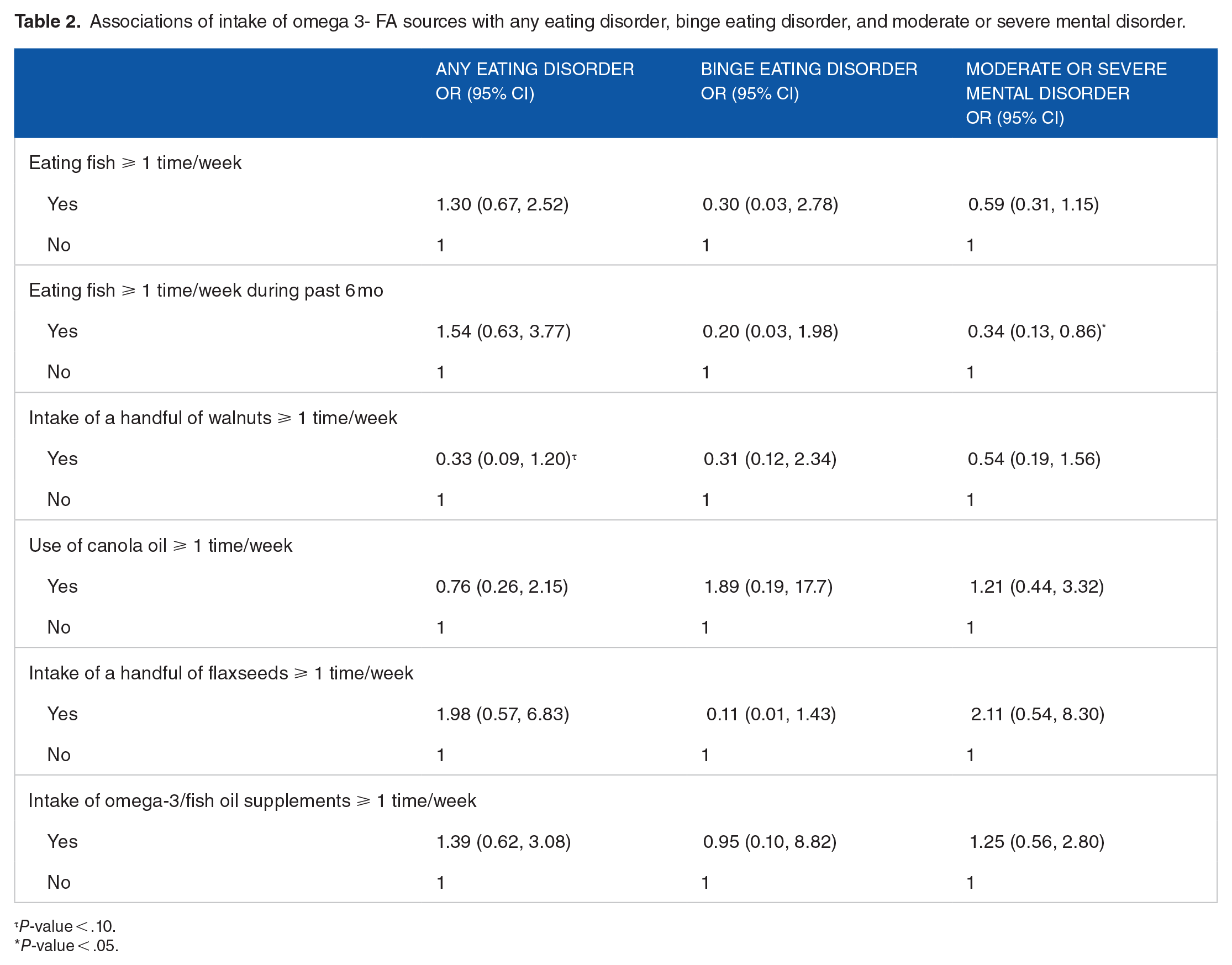
P-value < .10.
P-value < .05.
Discussion
Findings from our study suggest that intake of n-3-FA might be associated with psychological distress. When examining the relationship between fish consumption and level of psychological distress we found a link only when evaluating intake over a longer period of 6-months. This suggests that associations may be more evident with habitual fish consumption. Although we did not detect any association between n-3-FA and BED, our findings suggest that there is a marginally significant association between regular consumption of walnuts and any eating disorder. It is worthy to mention, however, that the large effect size (OR: 0.34) of the association between eating fish at least once a week during the past 6 months and moderate or severe mental disorders might be partially attributed to the small sample size and the low number of students who consumed fish at least once a week during the past 6 months (n = 23). Future studies may further establish the magnitude of the effect of fish consumption on mental health.
Our finding are consistent with previous studies conducted in Canada and the United States (US) which found that low levels of n-3-FA intake is associated with higher odds of psychological distress.37,38 Our study suggests that the prevalence of psychological distress among college students in SA might be higher than what was reported among college students in other countries, such as Australia where a study found 19.2% of participants had mental health problems using the same screening tool used in the present study. 39 However, the prevalence of psychological distress in our sample is comparable with what was previously reported among Canadian college students, in which 30% of participants reported elevated psychological distress. 40 Our sample’s overall prevalence of varying degrees of psychological distress was higher than what was reported by a previous study among Saudi medical students (78.6% vs 63.7%, respectively) 41 and a study conducted in Jazan, SA (psychological distress prevalence of 31%). 1 On the other hand, our results suggest that the prevalence of BED in our sample (3.80%) might be relatively low when comparing to findings by a study among Irish college students (BED prevalence of 10.8%), 42 as well as US college students (BED prevalence of 49%). 43
Our results showed a low percentage (15.4%) of participants consuming fish regularly, which might reflect low intake of n-3-FA in female college students. Overall, college students are at higher risk for poor eating habits and disordered eating behaviors are particularly high among females. 44 For example, a cross-sectional study among college student in SA found irregular meal consumption in 63.3% of students; Vegetables and fruits were not regularly consumed, and about half of the participants (46.8%) reported fried foods consumption at least 3 times a week. 45 However, it is also possible that students who reported low intakes were also allergic to fish. Although studies investigating prevalence of food allergy in the Middle-East, and particularly in SA, are scarce, fish has been considered among the most common food allergens.46,47 Consumption of n-3-FA is important throughout the lifecycle and a dietary necessity, as a growing body of evidence confirms the role and importance of n-3-FA on mental health. 48 Nonetheless, there is a lack of awareness among the general public in SA regarding n-3-FA; its roles, benefits, and dietary sources. 49
Findings from the present study suggest that adequate screening and intervention programs might be needed in order to prevent psychological problems among college students. Increasing awareness regarding n-3-FA is warranted and can be accomplished through educational campaigns about the various health benefits of n-3-FA consumption and the consequences of inadequate intake, with emphasis on mental wellbeing among college students.
To our knowledge, this study was the first to investigate the association of n-3-FA intake with psychological distress and BED in SA. Our questionnaire was self-administered, which might have increased the risk of misinterpretation of questions, and comprehension might have depended on literacy level. However, this approach might have been more appropriate considering the sensitivity of the subjects assessed and to ensure the privacy of participants. Another limitation was that the assessment tools used are considered to be screening tools only and cannot be used for accurate diagnoses of mental health conditions and eating disorders. Future studies may include more thorough diagnoses of these psychological conditions which might require formal evaluation by qualified professionals. Furthermore, due to our relatively small sample size, we did not adjust for any confounding variables, and we cannot infer causality given our cross-sectional study design. Future studies with larger sample sizes that take into account confounders are needed. Prospective studies are also needed to establish causal relationships.
Conclusion
Prevalence of psychological distress in our Saudi sample was higher than what has been previously reported in other studies. However, prevalence of BED was lower. Intake of n-3-FA from fish sources might be linked to lower odds of psychological distress but not with BED. College female students may be at risk of not consuming enough n-3-FA which may increase the likelihood of psychological distress Larger sample sizes and experimental studies are needed to further investigate the associations between n-3-FA intake, psychological distress, and BED. Results can help design intervention programs that promote healthy lifestyle habits in support of mental wellbeing.
Footnotes
Acknowledgements
Not applicable.
Author Contributions
RM and HK designed the study, oversaw data collection, and reviewed and approved the final the version of the manuscript as submitted. HA and RA designed the study, collected and analyzed the data, and wrote and approved the final version of the manuscript as submitted.
Declaration of Conflicting Interests:
The author(s) declared no potential conflicts of interest with respect to the research, authorship, and/or publication of this article.
Funding:
The author(s) received no financial support for the research, authorship, and/or publication of this article.
Author Agreement/Declaration
We certify that all authors have seen and approved the final version of the manuscript being submitted. We warrant that the article is the authors’ original work, hasn’t received prior publication and isn’t under consideration for publication elsewhere.
Availability of Data and Materials
The datasets generated and/or analyzed during the current study are not publicly available due to privacy or ethical restrictions but are available from the corresponding author on reasonable request.
Consent for Publication
Not Applicable.
Ethics Approval and Consent to Participate
This study was conducted according to the guidelines laid down in the Declaration of Helsinki and all procedures involving research study participants were approved by the Ethics and research Committee at the Faculty of Applied Medical Sciences, King Abdulaziz University. Written informed consent was obtained from all subjects.
