



Abstract
Objectives:
The aim of this study was to investigate the pharmacological efficacy of 3 functional foods (Water spinach, Wood apple, and Linseed) against doxorubicin-induced cardiotoxicity and oxidative stress in rat models.
Methods:
Twenty-five Wistar Albino rats (male and female) were equally classified into 5 groups. Except for the normal control (NC) group, the animals received 2.5 mg/kg doxorubicin (DOX) intra-peritoneal injection at 48 hours intervals to create a dose of 15 mg/kg overall for 14 days. Simply a standard diet was given to the NC and DOX groups. In the 3 treatment groups such as water spinach (DOX + WS), wood apple (DOX + WA), and linseed (DOX + LS), rats were given 14 gm/day/rat fried water spinach, mashed wood apple, roasted linseed, respectively mixed with regular rat diet at 1:1 ratio. Blood and heart samples were collected by sacrificing all the rats on the last of the experiment day (the 15th day). LDH (lactate dehydrogenase), CK-MB (creatine kinase myocardial band), MDA (malondialdehyde), and SOD (superoxide dismutase) were analyzed. Additionally, histopathological analysis was conducted for final observation.
Results:
The functional foods were indicated to lower the serum cardiac biomarkers (LDH and CK-MB) as well as stress marker (MDA) significantly (P < .05) and improved heart function and oxidative stress. However, the change in serum SOD level was noted as statistically insignificant (P > .05). The biochemical outcomes of the food intervention groups were supported by the histological findings found in those groups.
Conclusion:
Consuming the investigated foods containing antioxidant phytochemicals may combat cardiac toxicity and oxidative stress. Nonetheless, thorough investigations and clinical monitoring are required to understand these functional foods’ mechanism of action and dose-response effects in treating cardiotoxicity and oxidative stress.
Introduction
Doxorubicin (DOX), derived from Streptomyces peucetius var. caesius is an anthracyline-type antitumor medication that is extensively applied to treat malignancies such as malignancies of the breast, lungs, stomach, ovary, thyroid, Hodgkin’s and non-Hodgkin’s lymphoma, multiple myeloma, and sarcoma.1,2 However, due to its dose-dependent unique toxicity to cardiac tissues, its clinical utility is currently limited. Although it is unknown how DOX causes cardiotoxicity, various theories have been offered. A rise in oxidative stress, changed myocardial energization metabolism, modified cellular signaling, myocardial energy metabolism, altered molecular signaling, programed death of cells, and oxidative damage that is dependent on iron to macromolecules found in living things are some of the mechanisms involved. 3 One of the pathways is involved in myocyte damage caused by free radical production that explains DOX-induced cardiotoxicity. 3
Due to its high energy requirement and density of mitochondria, the heart is especially vulnerable to toxicity and peroxidation of lipids brought on by DOX. Furthermore, the antioxidant enzymes needed to detoxify hydrogen peroxide and superoxide anions are not present in the heart, resulting in an accumulation of free radicals that cause severe lipid peroxidation. 4 And all of these factors cause significant damage to the endoplasmic reticulum, nucleic acids, membrane of mitochondria of cardiac cells. 5 As a result, the development of cardioprotective agents for cancer patients who receive doxorubicin is critical. Medicinal plant containing polyphenols and polyphenol meals are the protentional candidates investigated for their potential cardioprotective effects. 6
Phytochemical substances can reduce oxidative stress in a variety of ways: (1) lowering reactive oxygen species (ROS) production via reducing lipid peroxidation, (2) displaying an effective free radical scavenging activity, (3) raising GSH and NADP levels to improve the cellular antioxidant mechanism and increasing the activity of catalase (CAT), glutathione reductase (GR), and superoxide dismutase (SOD) enzymes and (4) increasing the expression of Nrf2, which boosts heme oxygenase-1 (HO-1) production and lessens cellular sensitivity to oxidative damage. Furthermore, the anti-inflammatory properties of these substances include (i) suppressing the enzymes lipoxygenase and cyclooxygenase-II, (ii) reducing the molecules that neutrophils and TNF-a use to adhere to the vascular endothelium, and (iii) lowering the amount of collagen deposited in inflammatory tissues and improved fibrinoid necrosis caused by DOX.7 -10 The cardioprotective role of phytochemical containing foods such as water spinach, wood apple and linseed were reported in several papers. It is reported that all of the food extracts have a significant effect on cardiac health.11,12
However, the cardioprotective aspect of water spinach, wood apple, and linseed in their consumable form was not yet investigated, and because of their high antioxidant qualities. This is the first study where we used water spinach, wood apple and linseed in their regular edible forms (fried water spinach, mashed wood apple, and roasted linseed powder) to treat doxorubicin-induced cardiotoxicity. Hence, the current research aimed to evaluate the cardioprotective effect of selected phytochemical-containing foods (water spinach, wood apple, and linseed) on doxorubicin-induced cardiotoxicity and oxidative stress in animal models.
Methods and Materials
Drugs and chemicals
A model drugstore provided commercial doxorubicin injection (10 mg) (Dhaka, Bangladesh). Standard laboratory solutions of trichloroacetic acid, hydrochloric acid, 10% formalin, and 0.9% saline buffer of phosphorus, Ascorbate oxidase, uricase, dichlorophenol sulfonate, peroxidase, detergent Urease Enzyme Reagent, EDTA, Amino-Antipyrine Alkaline hypochlorite, Sodium hypochlorite, Sodium nitroprusside, Sodium hydroxide, Sodium salicylate, The following items were acquired from Sigma Aldrich (St. Louis, MO, USA) and used in the study: urea standard, picric acid, creatinine standard, standard nitrite solution, Griess reagent, and alcohol.
Animals, acclimatization, and ethics
The experiment was carried out at the Institute of Nutrition and Food Science (INFS), University of Dhaka. Twenty-five Male Wistar Albino rats weighing 150 ± 20 gm were purchased from the Animal Breeding House, Department of Pharmacy, Jahangirnagar University, Savar, Bangladesh. The animals were housed under typical conditions (24°C, 45°F, and a 12-hour light/dark cycle). Prior to the studies, they were given a week to acclimate while receiving typical laboratory diet and water ad libitum. The details regarding the content of the standard laboratory diet utilized in the research can be found in the study conducted by Sarwar et al 13 Animals were cared for and managed following the protocols set forth by the Swiss Academy of Medical Sciences (SAMS) and the Swiss Academy of Sciences (SCNAT). Moreover, all the laboratory protocols and procedures were reviewed and approved by the Ethical Review Committee, Faculty of Biological Sciences, University of Dhaka, Bangladesh, and we received an ethical approval number (Ref. No. 118/Biol. Scs.).
Food sample collection and processing
Various nutrients (high total polyphenol content, antioxidant, vitamin C, and β-carotene) were taken into consideration while choosing which food samples to include in the study. The Food Composition Table for Bangladesh 14 and the Food Composition Table for India 15 databases were searched to make this initial decision. From these databases, one leafy vegetable: water spinach (Ipoema aquatic), one fruit sample: Wood Apple (Limonia acidisima), and one seed sample: Linseed (Linum usitatissimum) were decided to choose. All 3 of the selected samples (Figure S1) were purchased from the local market.
The water spinach leaves were thoroughly cleaned, cut, and fried. It is noted that 100 g of water spinach was cooked in 10 mL of hot, refined soybean oil in a frying pan until the sample was crisp-tender. The rats were given the fried sample after it had been blended with the standard rat food at a ratio of 1:1. The edible portion of wood apple was removed from it and mashed in mortar and pestle. Rats were given the mashed sample in a 1:1 ratio along with their regular meal. In the case of linseeds, the seeds were cleaned and got ready to roast. The seeds were roasted until flavor development. The seeds were roasted and then allowed to cool at room temperature. Roasted samples were promptly crushed in a lab blender following 30 minutes of chilling. In order to feed the rats, the roasted linseed powder was then combined with their regular diet at a ratio of 1:1. A preliminary pilot experiment was performed on rats to examine the consumption habits of the items being tested. The rats were provided with a mixture of mashed raw wood apple, fried water spinach, and roasted linseed powder in a 1:1 ratio along with their regular diet. According to the pilot study and previous evidence, 13 it was observed that the dosage for each tested sample was set at 14 gm/rat/day.
Sample size determination for the animal study
Sample size calculation is crucial in research design, including animal studies. Choosing too few animals may overlook significant differences in the population, while selecting too many could waste resources and raise ethical concerns. 16 Since we could not determine the standard deviation and effect size, we adopted an alternative method to estimate the sample size called the “resource equation” approach. 17 This approach establishes an acceptable range for the error degrees of freedom (DF) in an analysis of variance (ANOVA) as part of the sample size determination process. In this case, when dealing with one-way ANOVA, we can estimate the sample size for the between-subject error degrees of freedom (also known as the within-subject degrees of freedom) in the following manner-

Where, n = number of subjects per group, DF = degrees of freedom, k = number of groups.
By considering the acceptable range of the DF, we substitute the DF value in the equations with its minimum value (10) and maximum value (20) to determine the lowest and highest quantities of animals per group. In this case, the value of k is set to 3, representing 3 test groups (excluding the normal control and disease control groups). Consequently, the calculated minimum number of animals per group is approximately 4.33 (derived from 10/k + 1 = 10/3 + 1), and the maximum is about 7.67 (obtained from 20/k + 1 = 20/3 + 1). These values have been rounded up to ensure that each group contains either 5 animals (for the minimum) or 7 animals (for the maximum) to assess the cardioprotective effects of the samples. It is observed that the animal count per group is adjusted either up or down to maintain the degrees of freedom (DF) within specific boundaries. For instance, when there are 5 animals, the DF is set at 12, and when there are 7 animals, the DF is set at 18. 17 Because this research strictly followed the principles of “3R” (which stands for Replacement, Reduction, and Refinement) in line with Swiss and international guidelines governing the use of animals in experiments, we opted for a minimal number of animals (n = 5) for this exploratory study. 18 The entire study was conducted with utmost adherence to these ethical principles.
Experimental design
Rats were divided into 5 equal groups of 5 animals in each group. A week-long acclimatization phase was completed. The experiment lasted for 14 days. Based on a prior study, doxorubicin (2.5 mg/kg body weight i.p.) was administered in 6 equal injections on alternate days for a total cumulative dose of 15 mg/kg body weight in the current study. 19 The following were the groups:
• Normal control (NC) group: This group of rats received the standard laboratory diet.
• Doxorubicin (DOX) group: Rats were treated with DOX (2.5 mg/kg body weight i.p.) in 6 equal injections every alternative day to make a total cumulative dose of 15 mg/kg body weight.
• Wood Apple (DOX + WA) group: In this group, the laboratory diet was mixed with the mashed wood apple in a 1:1 ratio (laboratory diet: WS). Each rat received about 14 gm of wood apple per day for 14 days.
• Linseed (DOX + LS) group: In this group, the laboratory diet was mixed with grounded linseed in a 1:1 ratio (laboratory diet: linseed. Each rat received about 14 gm of linseed per day for 14 days.
• Water Spinach (DOX + WS) group: In this group, the laboratory diet was mixed with fried water spinach in a 1:1 ratio (laboratory diet: WS). Each rat received about 14 gm of fried water spinach per day for 14 days.
Blood sampling and heart specimen collection
As per the 2020 version of the AVMA Guidelines for the Euthanasia of Animals, the animals were compassionately euthanized while under general anesthesia. 20 All rats were euthanized on the fifteenth day of the experiment using cervical dislocation under 3% sodium pentobarbital anesthesia. 21 Using sterile disposable syringes, blood samples of around 3 mL from the heart of each rat were taken in tubes bearing authentic identifying numbers. The heart sample was collected and weighed. It is noted that 10% formalin was used to preserve the heart sample for histopathological analysis. Blood samples were centrifuged for 15 minutes after 30 minutes at a speed of 3000 rpm. In order to determine its suitability for biochemical analysis, supernatant serum was then collected in a labeled Eppendorf tube and placed in refrigerated at −18°C.
Estimation of cardiac marker enzymes
Using various commercial kinetic kits that are readily available locally, the serum levels of lactate dehydrogenase (LDH) and creatine kinase myocardial base (CK-MB) were measured.
Estimation of stress biomarkers
A semi-automatic analyzer was used to check the levels of serum malondialdehyde (MDA) and superoxide dismutase (SOD). The thiobarbituric acid assay method was used to estimate the MDA level. 22 Superoxide dismutase activity in serum Cu-Zn was quantified using spectrophotometry. 23
Preparation of heart specimen for histopathological examination
The hearts that were gathered and properly preserved underwent a series of steps. Firstly, they were embedded in paraffin wax and then cut into sections using a microtome. Next, these sections were stained with hematoxylin and eosin to enhance visibility. 13 Subsequently, they were examined using a light microscope. Finally, a camera attached to the microscope captured photographs of the representative samples from each group.
Statistical analysis
The gathered data were statistically examined, and the outcomes were presented as means ± standard deviation (SD). A one-way analysis of variance was used to evaluate differences between the groups (ANOVA). When group deference was significant, the Tukey test was used for multiple comparisons. The considerable bodyweight fluctuation caused by medication delivery was seen using a paired t-test. At a P-value of less than .05, the results were deemed statistically significant. SPSS 20.0 for Windows was used to execute all of the analyses.
Results
Effect of doxorubicin on body weight and heart weight
By comparing the body weights measured at the start and end of the study, body weight variation in different groups of rats was noted. The results obtained from the paired t-test analysis indicate that both the tested sample groups and the disease control group (DOX group) demonstrated a statistically significant decrease in body weight (Table 1). Moreover, in comparison to the group of normal control rats, all groups of rats, except of DOX + linseed group, had significantly lower body weight over the course of the study (Table 1).
Effects of doxorubicin, wood apple, linseed, and water spinach on body weight of rats.

Values are represented as mean ± standard deviation (SD).
P < .05. **P < .01 versus normal control.
As illustrated in Table 2, treatment with DOX groups of rats showed an increase in heart weight/body weight ratio when compared to other groups of rats. Heart weight significantly decreased for DOX groups (P < .05), whereas no test group showed a significant decrement in heart weight in comparison to the normal control group. There was no significant variation in body weight and heart weight was observed in comparison to the disease control group (DOX group) (Table 2).
Effect of doxorubicin, wood apple, linseed, and water spinach on relative heart weight (heart vs body weight ratio, mg/g).

Values are represented as mean ± standard deviation (SD).
P < .05. **P < .01 versus normal control.
Effect of doxorubicin on biochemical parameters
At the end of our study, a significant alteration occurred in cardiac enzyme parameters by inducing DOX in different groups of rats. Cardiac toxicity induced by DOX was measured by 2 cardiac enzyme parameters (LDH and CK-MB). Figure 1 shows the effect of doxorubicin and the combination of the different food items and doxorubicin on cardiac enzyme levels after 14 days of treatment. Besides, the detailed tabular data regarding the effect of DOX and the combinations of DOX and the food items on serum LDH and CK-MB levels are found in Supplemental Table S1. Serum lactate dehydrogenase level (mean ±SD) was significantly lower in all groups of rats compared to the DOX group of rats (P < .05). The level of serum LDH was reduced by 49.63, 54.05 and 56.79% in wood apple, linseed, and water spinach groups, respectively, as compared with the corresponding values of the doxorubicin group (Supplemental Table S2). In the case of serum CK-MB level, a significant reduction was observed in the wood apple (P = .001) and linseed group (P = .03) as compared to the doxorubicin groups of rats. The cardiac CK-MB level was reduced by 57.20 and 50.39% in the wood apple and linseed groups, respectively, as compared with the doxorubicin group (Supplemental Table S3).

Effects of doxorubicin (DOX), wood apple (WA), linseed (LS), and water spinach (WS) on: (A) serum lactate dehydrogenase (LDH) level, (B) serum creatine kinase myocardial band (CK-MB) level, (C) serum malondialdehyde (MDA) level, and (D) serum superoxide dismutase (SOD) level of rats. [Values are expressed as Mean ±SD; *P < .05. **P < .01 vs. normal control; #P < .05. ##P < .01 vs. DOX group].
Along with cardiac enzyme biomarkers, a significant alteration was observed in the stress parameter (MDA). Rats that received food treatment along with doxorubicin showed a significant decrease in MDA level compared to the rats that received doxorubicin treatment only (P < .05) (Figure 1). The level of serum MDA was reduced to 18.71, 17.16, and 17.99% in the wood apple, linseed, and water spinach groups, respectively, as compared to the doxorubicin group (Supplemental Table S4). In the case of SOD level, no statistical significance was observed among the groups (P > .05) in SOD level, although a higher level of SOD was found in the water spinach group (Figure 1). Moreover, the detailed tabular data regarding the effect of DOX and the combinations of DOX and the food items on serum MDA and SOD levels are found in Supplemental Table S1.
Histopathological analysis
The findings from the histopathological examination of the cardiac tissues were in agreement with the biochemical parameter results. In Figure 2A, the normal control (NC) group’s heart tissues showed normal blood vessels, no vacuolization, and no inflammatory cell infiltration. The heart tissues of the negative control group exhibited extensive necrosis, myocardial degeneration, perinuclear vacuolization, interstitial hemorrhage, inflammatory cell infiltration, and hyaline cast (Figure 2B). The heart tissues of the DOX + WS group showed significant improvement in the pathological features that were focally present, along with mildly congested blood vessels in the interstitium and myocardial degeneration in the tubule (Figure 2C). The Water Spinach (DOX + WS) Group showed no extensive necrosis, mild hyaline cast, and very few inflammatory cell infiltrations with no myocardial degeneration, perinuclear vacuolization, or interstitial hemorrhage. The heart tissues of the Linseed (DOX + LS)) group revealed mild desquamation of proximal tubules. Perinuclear vacuolization, interstitial hemorrhage, and inflammatory cell infiltration, along with mildly congested blood vessels in the interstitial mild hyaline cast in the tubule, were found (Figure 2D). The Wood Apple (DOX + WA) Group showed no significant improvement in heart tissues. Extensive necrosis, myocardial degeneration, perinuclear vacuolization, interstitial hemorrhage, and inflammatory cell infiltration were found in the wood apple group (Figure 2E).
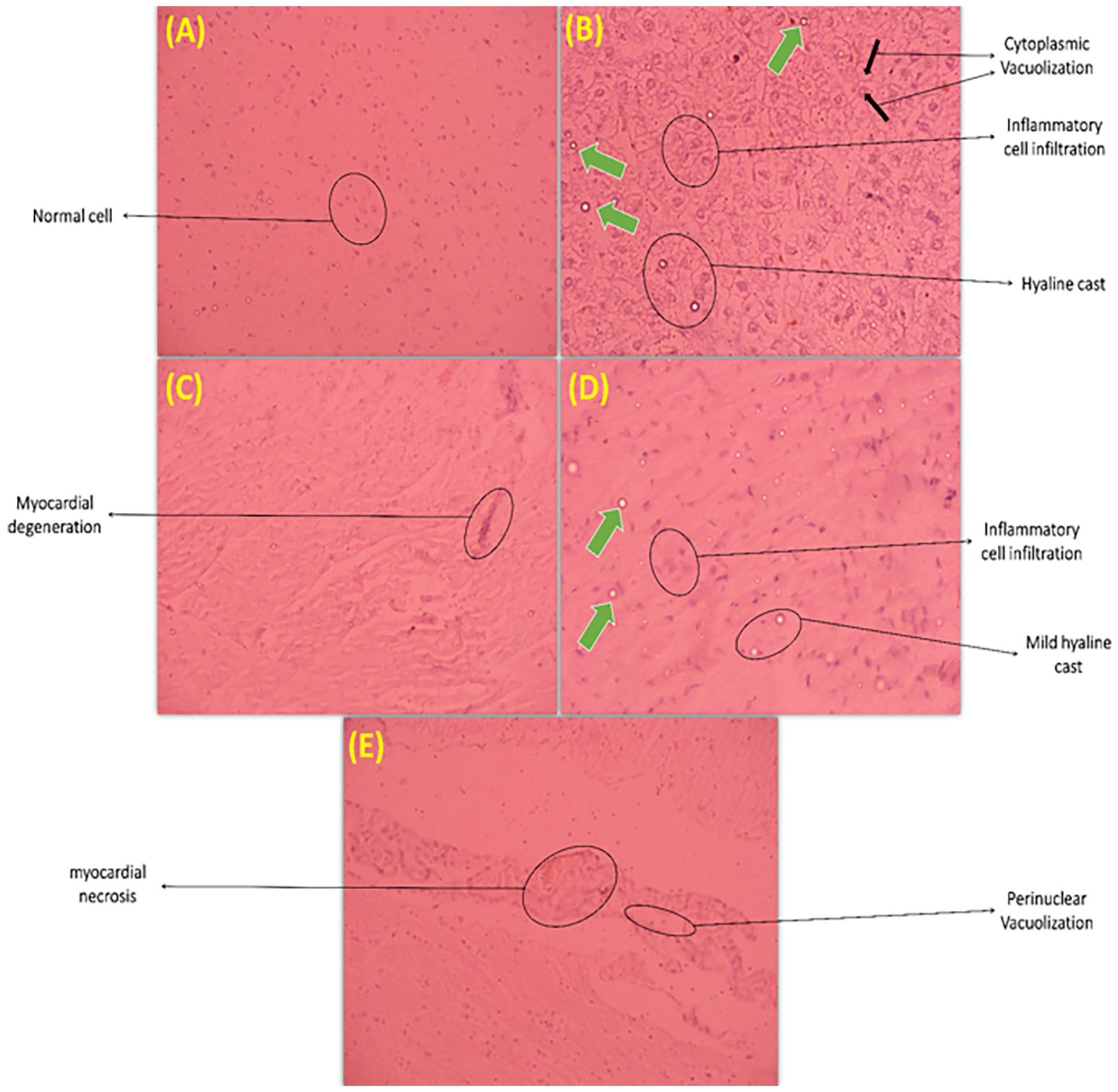
Histopathology of heart cell: (A) normal control (NC) group, (B) negative control (DOX) group, (C) water spinach (DOX + WS) group, (D) linseed (DOX + LS) group, and (E) wood Apple (DOX + WA) group. [Arrow indicates hyaline cast; H & E staining and 20× magnification were applied to the sections].
Discussion
DOX is one of the most promising anticancer medications for treating different types of malignancies, but due to its dose-dependent cardiotoxicity, its therapeutic use is severely restricted.24,25 The drug affects the pathways leading to apoptosis, redox cycling, oxidative stress, calcium dysregulation, and the mitochondrial electron transport system. 24 The current study investigated the therapeutic efficacy of water spinach, wood apple, and linseed against doxorubicin-induced cardiotoxicity and oxidative stress. This in vivo study revealed that the co-treatment of water spinach, wood apple, and linseed with DOX for 14 days significantly enhanced cardiac function by normalizing the cardiac biomarkers (LDH and CK-MB levels) and oxidative stress marker (MDA level).
According to the findings of the study, the body weight of all the groups of rats after the study period was significantly lower than that of the normal control group (NC). Water spinach cotreatment with DOX injection in rats made them heavier than the negative control group (DOX), and the effect was not statistically significant. Moreover, a statistically significant change was noticed for the negative control, water spinach, wood apple, and linseed groups regarding their effect on relative heart weight (heart weight vs body weight ratio, mg/g) when compared to the normal control group. Previous studies have shown that administration of DOX significantly reduced final body weight and increased heart weight and relative heart weight.26,27
DOX-treated animals exhibit a scruffy hair coat, a pinkish tint to the fur, as well as a considerable loss of body weight. The current study’s findings are consistent with several previous studies. The reduction in body weight may be explained by the decreased food intake and the suppression of protein synthesis induced by DOX administration. 28 Furthermore, DOX-induced nausea and vomiting might reduce appetite and result in weight loss. The drug may also cause fat reserves to break down and muscles to waste away, which will result in weight loss. In some circumstances, doxorubicin can also alter metabolism and lead to weight loss.29,30 Moreover, increased levels of ROS, swelling and malfunction of the mitochondria, and ATP depletion may all be contributing factors to the increase in heart weight. 11
An excessive generation of ROS can lead to harmful effects such as DNA damage, lipid peroxidation, protein oxidation, irreversible damage to mitochondria, reduced ATP production, cellular injury, and cell apoptosis.31,32 ROS can also be produced and accumulated in the heart tissues, where inflammation is a prominent characteristic of cardiotoxicity induced by DOX.21,33,34 There was a significant mean difference in LDH, CK-MB, and MDA levels between the normal control and negative control group. This phenomenon suggested that doxorubicin successfully induced cardiotoxicity along with oxidative stress. Besides, this phenomenon also provided the validity of this experimental model by elevating serum biochemical and cardiac enzymes resulting from cardiotoxicity. These findings mimic the suggested animal model studies of doxorubicin-induced cardiotoxicity,4,6,35,36 and the cardiotoxicity was brought on by DOX administration in the current study at 15 mg/kg body weight i.p. for 2 weeks. 26
Data from our investigation demonstrated that, compared to the normal control group, DOX-induced cardiotoxicity in rats was significantly correlated with elevated serum levels of the enzymes CK-MB and LDH. As markers for cardiotoxicity, elevated LDH, and CK-MB levels signify their leakage from the compromised cardiomyocyte membranes into the blood.37,38 Our results revealed that all the tested foods (water spinach, wood apple, and linseed) exhibited their significant capacity to attenuate the rise of LDH levels. Besides, the wood apple and linseed significantly tackled the rise of CK-MB levels due to cardiotoxicity. Manohar et al 39 demonstrated that Limonia acidissima (wood apple) exhibited a dose-dependent cardioprotective effect against acute myocardial injury from isoproterenol in a rat model. LDH and CK-MB, 2 cardiac marker enzymes, were markedly reduced by the wood apple (Limonia acidissima), while antioxidant enzymes were elevated significantly. Moreover, Zanwar et al 40 showed that flax lignin concentrate (FLC) linseed treatment reversed the biochemical changes significantly in isoprenaline-induced cardiotoxicity. Another study revealed that lactate dehydrogenase (LDH) and creatinine kinase (CK) levels increased significantly in mice treated with NaAsO2 (10 mg/kg). However, concomitant administration of water spinach (Ipomoea aquatica) aqueous extract (AEIA) (100 mg/kg) and NaAsO2 (10 mg/kg) considerably restored serum biochemical parameters to levels that are close to normal. 41
The current study’s findings demonstrated a substantial mean difference in MDA levels between the normal control group and the negative control group. All the tested foods (wood apple, water spinach, linseed/flaxseed) exhibited a significant reduction of MDA level as compared to the negative control group. In a GC-MS phytochemical analysis conducted by Senthilkumar and Venkatesalu, 42 it is found that wood apple is rich in essential oil with major constituent thymol (55.22%). The thymol-rich essential oil exerted a strong antioxidant capacity against various free radicals. 34 The harmful chain reaction may have been avoided due to the antioxidant capacity of wood apple, which decreased the production of ROS. Another study proved that pretreatment with methanolic extract of wood apple protected against drug-induced ischemia. 43
Phytochemical investigations of water spinach (I. aquatic) have identified the existence of certain alkaloids and carotenes, including myricetin, quercetin, lutein, epoxide of lutein, neoxanthin, and carotene. 44 Along with its activities as an antioxidant and free radical scavenger, the plant also influences the way detoxification enzymes are modulated. 13 Arunachalam et al 45 showed that I. aquatic therapy significantly reduced the serum level of MDA in Sprague-Dawley rats with thioacetamide (TAA)-induced hepatotoxicity. Similarly, secoisolariciresinol diglucoside (34%–38%), cinnamic acid glucoside (15%–21%), and hydroxymethylglutaric acid (9.6%–11.0%) are the 3 main components of flax lignan complex. 46 Free radical production is decreased by the flax lignan complex, which is also linked to lower levels of oxidative stress. A 31% reduction in atherosclerosis progression was caused by the flax lignan complex, which was correlated with a decrease in oxidative stress. 46
In many wood apple extracts, bioactive compounds such as phenols, flavonoids, alkaloids, terpenoids, tannins, saponins, fat steroids, glycosides, gum mucilage, and fixed oil have been reported. These compounds are assumed to be in charge of the fruit’s diverse pharmacological effects. 47 Omega-3 fatty acids, phytoestrogen mucilage, and fiber are all abundant in linseed (Linum usitatissimum). 48 Numerous studies have already reported the cardiac health benefits of omega-3 fatty acids. 49 Findings from research on cells and molecules suggest that the cardioprotective benefits of n-3 polyunsaturated fatty acids (n-3 PUFA) arise from a cooperative interplay of various complex mechanisms. These mechanisms encompass anti-inflammatory properties, the presence of pro-resolving lipid mediators, regulation of cardiac ion channels, lowering triglyceride levels, impact on membrane microdomains, modulation of downstream cell signaling pathways, and anti-thrombotic and antiarrhythmic effects. 49 Water spinach, also referred to as Ipomoea aquatica, belongs to the Convolvulaceae family and is abundantly filled with phenolics and flavonoids.13,50 Flavonoids have a crucial role in protecting against cardiovascular diseases (CVDs) by virtue of their antioxidant, antiatherogenic, and antithrombotic properties. 51
Heart tissues of DOX group rats showed severe necrosis, myocardial degeneration, perinuclear vacuolization, interstitial hemorrhage, inflammatory cell infiltration, and hyaline cast. These outcomes matched the information from earlier reports.27,52 There was no evidence of cell necrosis, myocardial degeneration, or vacuolization in the normal control group. The histological findings in the cardiac tissues of the animals treated with doxorubicin coupled with wood apple, linseed, and water spinach were somewhat comparable to those of the healthy control group. Although there was some degree of cell necrosis, perinuclear vacuolization, and inflammatory cell infiltration in all 3 dietary groups, the water spinach group showed the best recovery. The fact that the histopathology findings in the water spinach group were nearly identical to those in the NC group suggests that free radical detoxification enzymes and free radical scavenging capabilities are present in water spinach. Consequently, all food groups demonstrated their ability to reduce cardiotoxicity and oxidative stress, which was demonstrated by looking at their biochemical and histological outcomes.
According to the best of our knowledge, this study is the first report where we used water spinach, wood apple, and linseed in their consumable forms fried water spinach, roasted linseed powder, and mashed raw wood apple) to tackle cardiotoxicity because of their strong antioxidant characteristics. A study revealed that garden spinach, water spinach, Indian spinach, and green-leaved amaranth are among the leafy vegetables that are highly rich in phenolics and flavonoids, which have strong antioxidant potentials. 53 The amount of bioactive substances and the antioxidant capacity of vegetables are influenced by cooking. It would be preferable to cook the 4 green leafy vegetables in oil to increase their antioxidant and free-radical scavenging properties. 42 Another study conducted on 50 dyslipidemic human subjects presented that the administration of roasted flaxseed powder for 3 months improved lipid profiles, blood pressure, and body mass index (BMI), demonstrating a cardio-preventive effect. 54 Nutritional analysis of wood apple pulp performed by Pandey et al 55 exerted that it might serve as a source of nutrients such as phosphorus, magnesium, calcium, iron, zinc, proteins, dietary fiber, and vitamins such as thiamine, ascorbic acid, and β-carotene. A modest level of antioxidant activity was seen in the extracts. From these above results, water spinach, wood apple, and linseed could significantly mollify cardiotoxicity in an experimental animal model. 55
Strength and limitation
The utilization of food in the study in its natural consumable state is one of the main advantages of this study. The selected foods are rich in bioactive phytochemicals and are locally available. Although a significant result was found in this study, some limitations were also observed in the study. The period of the study was short (ie, only 14 days after eliminating the acclimatization period), which should be a longer time to visualize all anatomical changes during cardiotoxicity. Along with that, the exact dose of selected food items was not established. Moreover, estimation of other cardiac parameters such as aspartate transaminase (AST), alanine transaminase (ALT), and Troponin I were not performed in the study. In addition, the study solely relied on the normal control group and lacked a positive control (standard drug) to compare the samples’ effects on the animal model.
Future research
Water spinach, wood apple, and linseed can be used as cardioprotective agents in cardiotoxicity due to their ability to reinstate cardiac biomarkers and oxidative stress. However, further investigation is needed to establish the concept of increasing the consumption of selected foods to improve heart health. Exploring the exact mechanisms of antioxidant intake on cardiac health is necessary. Besides, more extensive research is required to determine the exact dosage and the most effective way to enhance cardiac health. As per the Food and Agriculture Organization (FAO) of the United States, the diversity of food significantly impacts the composition of various foods. In other words, the nutrient content of foods may vary as greatly among different types of food as it does among the various varieties of the same food in various regions of the world. Further studies might be done to estimate the total polyphenol content, antioxidant, vitamin C, and β-carotene of selected functional foods. Moreover, the synergistic effects of the combination of these food samples on cardiac health can be estimated in future studies.
Conclusion
The current study revealed that water spinach, wood apple, and linseed exhibited excellent cardiac enzyme markers (LDH and CK-MB) attenuating properties in DOX-induced cardiotoxicity. These foods also significantly reduce oxidative biomarker MDA levels by their free radical scavenging ability. Thus, these foods are proven to have good cardioprotective effects and oxidative stress-reducing activity because of their anti-inflammatory, anti-oxidative, and anti-apoptotic properties in biochemical and histopathological analyses. This study suggests that the tested foods can be good choices to combat cardiotoxicity in cancer patients during the treatment with doxorubicin chemotherapy. However, more extensive investigations, including clinical data monitoring, are warranted to clarify their exact mechanism of action and confirm the efficacy and potential of these 3 natural products.
Supplemental Material
sj-docx-1-nmi-10.1177_11786388231212116 – Supplemental material for Cardioprotection of Water Spinach (Ipomoea aquatica), Wood Apple (Limonia acidissima) and Linseed (Linum usitatissimum L.) on Doxorubicin-Induced Cardiotoxicity and Oxidative Stress in Rat Model
Supplemental material, sj-docx-1-nmi-10.1177_11786388231212116 for Cardioprotection of Water Spinach (Ipomoea aquatica), Wood Apple (Limonia acidissima) and Linseed (Linum usitatissimum L.) on Doxorubicin-Induced Cardiotoxicity and Oxidative Stress in Rat Model by Maisha Majid Mukta, Md. Jamal Hossain, Mousumi Akter, Badhan Banik, MD. Mahbub Zaman Mithun, Sneha Sarwar, Md. Saidul Arefin, Md. Rabiul Islam and Sheikh Nazrul Islam in Nutrition and Metabolic Insights
Footnotes
Funding:
The author(s) received no financial support for the research, authorship, and/or publication of this article.
Declaration of conflicting interests:
The author(s) declared no potential conflicts of interest with respect to the research, authorship, and/or publication of this article.
Data Availability Statement
All data involved to endorse the findings of this research were included in the manuscript.
Supplemental Material
Supplemental material for this article is available online.
References
Supplementary Material
Please find the following supplemental material available below.
For Open Access articles published under a Creative Commons License, all supplemental material carries the same license as the article it is associated with.
For non-Open Access articles published, all supplemental material carries a non-exclusive license, and permission requests for re-use of supplemental material or any part of supplemental material shall be sent directly to the copyright owner as specified in the copyright notice associated with the article.
