




Abstract
Background:
Sleep quality is defined as an individual’s consent to sleep experience. Poor sleep quality has important adverse health outcomes. There are drugs to treat sleep disorders but consumption of these drugs is accompanied by adverse effects whereas herbal treatments have fewer side effects. Saffron is spice obtained from Crocus sativus flower. Several articles have been done on its effects on the quality of sleep and its safety. This review for the first time critically evaluates effect of saffron on sleep quality improvement.
Method:
The search technique aims to get all related published data-based up to 2022 articles. PubMed, Central, Google Scholar, and Scopus were examined. Only full reports were evaluated (abstracts were excluded). The first screening was done by title and abstract. Then full text of articles was read and irrelevant articles were removed. Duplicate articles were also removed by Endnote. By using Cochrane risk of bias tool assessment, a quality score based on probability of bias was given. Methodological characteristics were also evaluated using the criteria of Stevinson and Ernst.
Result:
In the systematic review, 5 randomized clinical trials with 379 participants from 3 countries were identified. In placebo-comparison trials, saffron contains a large treatment.
Conclusion:
It seems that saffron has a beneficial influence on duration and quality of sleep. Saffron, crocin, and safranal induce hypnotic effects by increasing the duration of sleep. Research conducted so far provides initial support and safety for use of saffron to improve sleep quality.
Introduction
Saffron (Crocus sativus L.) (the costliest traditional seasoning around the world 1 ), is derived from the flower of Crocus sativus. 2 It belongs to the Iridaceae family and is generally found in Iran which annually produces most of the world’s saffron. 1 Also, it can be found in other countries such as Morocco, Spain, and Greece. 3 The most commonly consumed part of the saffron is the dried stigma. 1 Chemical analysis of C. sativus stigmas indicates that 3 original active components are: a. Crocin, b. Picrocrocin, and c. Safranal. 4 The concentration of 3 original metabolites causes the quality of the saffron, which prepares a special color and taste of stigmas. 4 Saffron also contains small amounts of thiamine, riboflavin, and significant amounts of carotenoids and flavonoids. 1 Recently, saffron has been considered for use in cosmetics. In traditional medicine, saffron can improve skin color and be used to treat erysipelas. It also can refresh the skin of the face and is used to remove bile from the liver and treat acne, skin illnesses, and wounds. 4 This valuable herb is used in medicine which is mentioned below:
Antidepressant, 5 Treating Sexual Dysfunction,6,7 Antioxidant, 8 Anti-carcinogenic, 9 Antispasmodic and Digestive Tonic, 10 Anti-Inflammatory and Analgesic Effect, 11 Effect on Blood Glucose and Insulin Resistance, Healing of Second-Degree Burns, 12 and Effects on the Eyes. 13 Sleep is a necessary component of emotional and physical health, and absence of that due to insomnia has a high prevalence. 14 Sleep quality is determined by a person’s satisfaction with all aspects of the sleep experience. Sleep quality has 4 characteristics: sleep efficiency, sleep delay, sleep duration, and waking up after sleep onset. For more than a year, the frequency of common sleep disorder is estimated at almost 85% and the initial diagnosis of insomnia is estimated at 10%. Poor sleep quality has considerable adverse health consequences. 15 Also, it can affect work performance and increase the risk of driving 3 and can cause fatigue, lack of attention, anxiety, mood instability, or even depression. 16 In a group of almost 5000 adults, sleep deficiency enhanced the risk of cardiovascular disease by about 29%. Sleep problems are correlated with an elevated risk of depression. In 2010, sleep disorders diagnosed in Australia were estimated to cost $5.1 billion, including direct health care costs, reduced productivity, informal care, and other indirect costs associated with vehicle accidents. 2 There are Effective drugs to treat this condition, for instance, benzodiazepine or benzodiazepine-receptor agonists. But utilization of these sleeping pills is limited due to their tolerance and high risk of dependency, adverse effects, and mortality with using for a long time but herbal remedies are available and have fewer side effects and lower costs and thus are commonly used. 2 Therefore, the search for efficient and safe compounds without adverse effects is important. 16 Herbal medicines are one of the most common alternative treatments for insomnia. The efficacy and safety of most of the herbal remedies for treating sleep problems are unclear. 2 It seems that saffron has beneficial effects on duration and quality of sleep. 16 Saffron, crocin, and safranal induce hypnotic effects by increasing the duration of sleep without Rapid Eye Movement (non-REM) and reducing its delay in animal models. 1 This review for the first time, is going to critically discuss the role of saffron in sleep quality improvement.
Saffron and Its Active Constituents Effects
Saffron derived from the flower of Crocus sativus, popularly known as the “saffron crocus.” Despite of some doubts remain on its origin, it is believed that saffron originated in Iran. 17 Saffron has many active constituents such as crocin, crocetin, safranal, and carotene.
Previous studies showed that saffron was efficacious against many symptoms and disorder processes such as: 1- anxiety, 18 2-hyperglycemia, 19 3- insomnia, 20 4- atherosclerosis, 21 5- Parkinson’s disease, 22 6- malignancy, 23 7- morphine withdrawal syndrome, 24 and 8-Alzheimer’s disease. 25
The properties from saffron, mainly get from crocin and many studies showed that the most effective extract in pharmacological application are alcoholic extracts (such as crocin). 26 Crocin is a water-soluble carotenoid that has a powerful antioxidant and anti-inflammatory effect in our body. 27 Crocin has a deep red color, forms crystals and is easily soluble in water and it is most important agent for the color of saffron. 28 It is the main pigment of saffron (approx. 80% of pigment content). Crocin is not absorbed from oral cavity. This substance hydrolyzed to crocetin before or during jejunal absorption, and the absorbed crocetin is partly metabolized to mono and diglucuronide conjugates. 29 Crocin and other carotenoid pigment, crocetin, are the major components responsible for the various pharmacological activities of saffron. For example, the anti-inflammatory effect of crocin may result to decline the pain and peace of mind that can a strong reason to consider these substance as good sleep controllers. Saffron has other phenolic content such as Safranal and Carotene. 26 The carotenoids of saffron are sensitive to light, oxygen, enzymatic oxidation and heat. Safranal is an effective anticonvulsant that showed act as an against at GABA receptors. This substance also exhibits high antioxidant and free radical scavenging activity that may result to increasing the sleep quality. Also there are many extracts of saffron that have antioxidant effect such as Ethanolic extracts (1- Having radical scavenging activity, 2- Showing strong free radical scavenging activity, and 3- Showing good antioxidant activity),30,31 Methanolic and water-methanolic extracts (1- Hydrogen peroxide scavenging activity, 2- Showing strong free radical scavenging activity, and 3- Having radical scavenging activity ) 32 and Aqueous extracts (1- Reduction of free radicals, 2- Having antioxidant effects in chronic stress, and 3- Reducing lipid peroxidation products).33-35
Materials and Methods
Search
According to the general criteria below, the search technique aimed to find all related published articles.
Saffron threads were used Orally.
The article’s main outcome was the analysis of sleep quality.
We used the following keywords throughout our computerized search of 4 different research databases.: Crocus sativus L, saffron, sleep quality, sleep, and herbal.
Databases like PubMed, Central, Google Scholar, and Scopus were all used in this search (Table 1).
Search strategy.

Protocol registration
The registered ID for our online protocol is also available (10.17605/OSF.IO/JRZTG).
Inclusion exclusion criteria
For more specification, only human clinical trials were searched in the 4 databases above. Included articles were not confined to randomized clinical trials due to obtaining the broadest variety of information on saffron, although only relevant articles were examined.
Risk of bias assessment
To analyze the sedative effect of saffron, studies that concluded healthy people with no reported sleep problems were used in the search. Thus, data was gathered and entered into standardized forms. Using the Cochrane Risk of Bias Assessment Tool, each study had a quality score based on the possibility of bias. Studies are graded on a scale of 0 (bad) to 5 (excellent) based on the explanation of randomization and double-blind techniques, and dropout reporting.
Result
The outcome of our computerized search ended up with 126 article titles from 4 different research databases such as PubMed, Scopus, Google Scholar, and Central. Twenty-one articles were found in PubMed, 67 articles in Scopus, 6 articles in Google Scholar, and 32 articles in Central. After reviewing the articles, 42 duplicates were found and removed. In the screening stage, 68 articles were excluded due to irrelevant descriptions to our search, being reviewed articles, or even being in vivo or in vitro article by checking the title and reviewing abstract. After reviewing the full text of 16 remained articles, 11 articles were removed because of irrelevant outcomes and being Non-RCT article. Finally, 5 articles were appropriate to enter our review (Figure 1). All studies reported a positive impact of saffron on sleep quality except Dehghanmehr et al 36 (Figure 2).
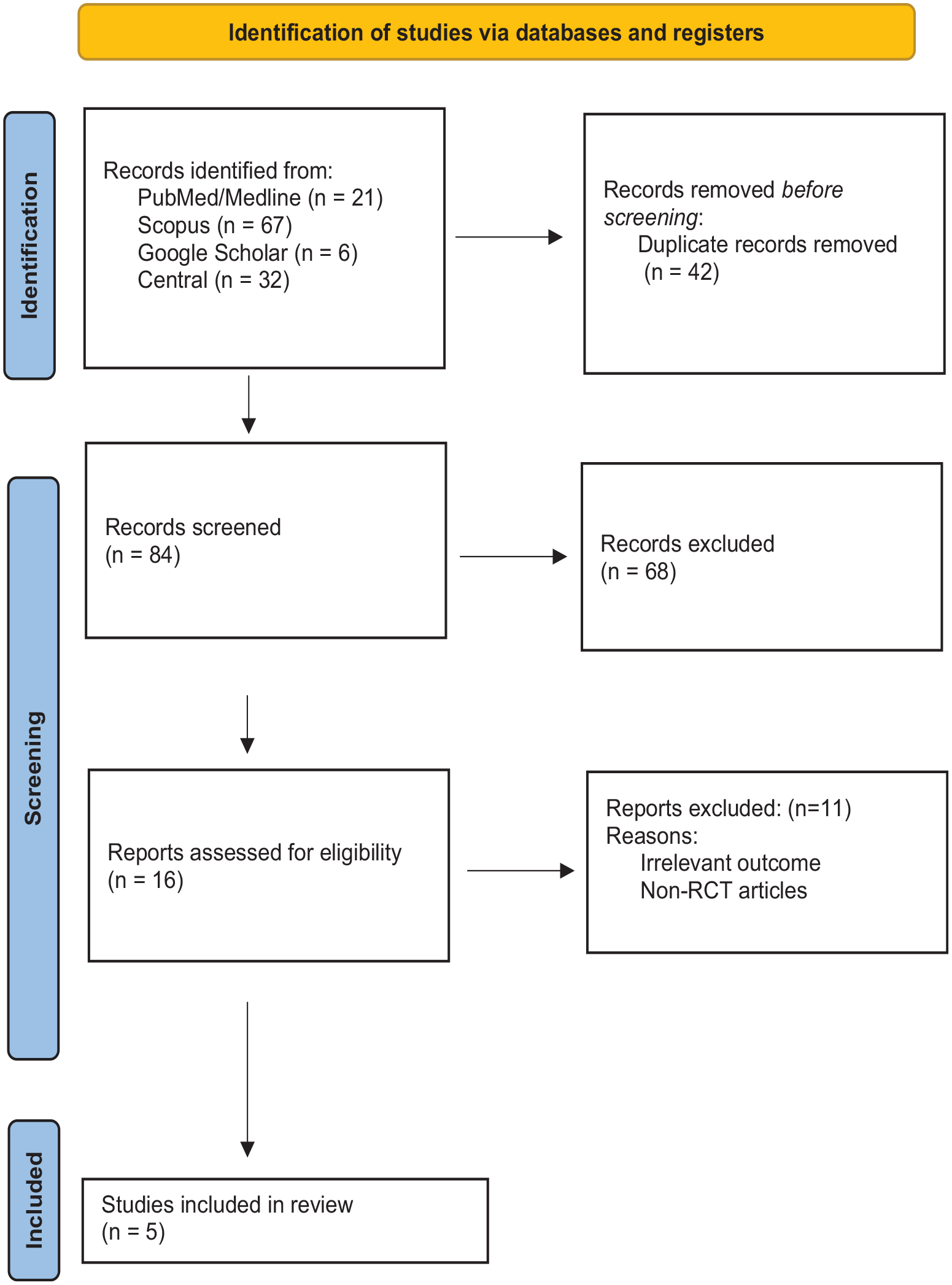
PRISMA flow diagram.

The summary of bias publication.
As a result of the 5 studies that were reviewed, 3 were conducted in Australia, 1 in Japan, and 1 in Iran. The total number of participants was 379 people with an age range of 36.7 to 55.42 ± 7.58. In these studies, the percentage of women is in the range of 47.61%-83.6%. The studies’ duration was 8 weeks in 2 studies and 4 weeks in the other 3 studies. The doses of saffron used in the studies were 15 mg of saffron hydroalcoholic extract twice a day, 1 14 mg twice a day, 2 0.6 mg daily, 3 28 and 22 mg daily, 37 14 and 28 mg daily. 38
In one study, a significant reduction in anxiety, depression + anxiety, and sleep disorders were observed. But it did not have much effect on depression and life satisfaction. 1 saffron was correlated with increased enhancements in PSD sleep quality ratings, Insomnia Severity Index (ISI) total score, and RSQ total score. 2 Mood upon awakening ratings was non-significantly reduced by 1.58% in the placebo group and elevated by 7.26% in the saffron 14 mg and by 14.42% in the saffron 28 mg groups. Also, sleep quality ratings were non-significantly elevated by 8.43% in the placebo group. However, there was a statistically significant rise in sleep quality ratings by 24.60% in the saffron 14 mg and by 22.26% in the saffron 28 mg groups. Moreover, ISQ scores were non-significantly elevated by 3.86% in the placebo group and by 15.75% in the saffron 14 mg, and 16.81% in the saffron 28 mg groups. The number of insomnia classifications was decreased by 26%, 6%, and 22% in the saffron 28 mg group, saffron 14 mg group, and the placebo group, respectively. 38 A significant effect of the saffron extract on daytime disturbances and sleep quality was observed. A tendency toward a reduced level of PSQI score after treatment was detected only in the saffron extract group. 3 The analysis demonstrated that at a 28 mg/day dose, stress and anxiety-related symptoms and negative mood are remarkably reduced. Also, POMS Total Mood Disturbance had a remarkable difference between placebo and 28 mg/day. However, no effects were observed at the 22 mg/day dose (Table 2). 37
Summary of included studies.

Abbreviations: ISQ, insomnia symptoms questionnaire; POMS, primary outcome measure; PSD, Pittsburgh sleep diary; PSQI, Pittsburgh sleep quality index; RSQ, restorative sleep questionnaire.
Discussion
In this systematic review, we investigated 6 randomized clinical trials about the influence of saffron on the quality of sleep. The results in these articles mainly showed that saffron improves sleep quality and quantity. Despite the similarity in the main results, these studies showed some differences based on the design, duration, population, and dose of saffron. Lopresti et al 38 reported that despite differences in ISQ total score, the placebo and saffron groups had no remarkable differences based on alternations in self-reported alertness ratings after awakening. There were different results about the best dose of saffron intake. Kell et al 37 indicated that there were no remarkable changes in sleep quality between the people treated with 22 mg/day of the saffron compared to the control group but 28 mg/day of saffron has significant effect on sleep quality. But, Lopresti et al 38 reported that there are sleep-related improvements in both 14 and 28 mg of saffron. However, an explanation for the lack of remarkable differences between 14 and 28 mg of saffron, is that they did not detect small-to-moderate treatment effects (eg, effect sizes of 0.6 and lower). But the thing that we know is that a 28 mg/day intake of saffron in 4 weeks has a good effect on nervous disorders such as insomnia and anxiety. Nishide et al 3 examined the effect of crocin on the sleep quality of 21 healthy adults and They confirmed 0.6 mg/day of crocin increases sleep quality with the effect of crocin of NMDA receptor mediated responses related to long-term potentiation. The mechanism of antagonistic effect of saffron extract is the biding to the NMDA receptor, resulting to block the channel pore of the NMDA receptor system that results to increase the sleep quality. 39 Also, to have better sleep-enhancing benefits at a higher dose, longer duration of intake is needed. Although consumption of saffron was correlated with relatively rapid enhancement in sleep quality in the first 7 days of treatment. 2 Using saffron elevated concentrations of evening melatonin in comparison to the placebo. Melatonin is a circadian hormone produced at midnight that peaks between 3.00 and 4.00 a.m by the pineal gland.40,41
Melatonin plays a role in the regulation of several biological activities including circadian rhythms, reproduction, sleep, and immunity. Melatonin and cortisol are one of the reasons that saffron improves sleep quality. 41 Many articles talked about the anti-inflammatory effects of saffron but some studies showed that the anti-inflammatory effects of saffron can elevate the concentration of melatonin as inflammatory cytokines including interleukin-1β and interferon-γ can impact the release of melatonin.42,43 Saffron effected on The serotonergic, glutaminergic, and γ-aminobutyric acid (GABA)-ergic systems that are implicated in sleep and insomnia so the effect of using saffron in a patient with insomnia is more than in ordinary people.44,45 The concentration of crocin in saffron is known to be extremely small, and this might not be enough to promote sleeping quality in saffron comparing pure crocin. 46 Animal model studies showed crocin can induce non-REM sleep, indicating that it can be used for insomnia therapy. Carotenoid pigments of C. sativus L. such as crocin and crocetin can elevate non-REM sleep in rats. 47 Other active ingredients of saffron play an important role to increase the sleep quality and peace of mind .For example, Safranal have a strong effect on brain function such as sleep and other actions with several ways including ABTS radical scavenging activities 33 and Prevention of the formation of peroxidized lipids Partly restored superoxide dismutase. 48 Another important compound is Carotene that could boost the neuron functions with participate in making the Vitamin C and its antioxidant functions. 49 Crocetin is an other important ingredients in saffron that could increase the sleep quality with boost neuron and brain functions with its antioxidant activity 50 and Inhibition of lipid peroxidation. 51
The mechanism of the saffron effect on sleep quality is not well known but some studies showed the saffron-mediated analgesic effects on sleep quality because insomnia and poor sleep quality are among the factors that are closely related to pain. 52 By investigating the effect of saffron on sleep quality, we found a powerful connection between the use of saffron, sleep quality, and decreased anxiety. In the higher stages of sleep disorders, using crocin should not be a stand-alone intervention. In these stages, using saffron should be an adjunct intervention beside other treatment ways.
Recommendation for future studies: Be recommend future studies to consider pathways between sleep quality and pain. Also more in vitro and in vivo studies are required to elucidated the underline pathways of saffron impact of sleep quality and More large scaled randomized-control-trials are needed to better confirm the impact of saffron on sleep quality.
Conclusion
In summary, saffron can improve nervous functions such as sleep quality and anxiety as confirmed in all the included studies in this systematic review.
Footnotes
Funding:
The author(s) received no financial support for the research, authorship, and/or publication of this article.
Declaration of Conflicting Interests:
The author(s) declared no potential conflicts of interest with respect to the research, authorship, and/or publication of this article.
Author Contributions
All authors listed on the title page have read and approved the manuscript.