




Abstract
Background and Aims:
The benefits of Mediterranean Diet (MeDiet) in prevention of cardiovascular diseases (CVD) in general and ischemic stroke (IS) have been extensively studied and reported. We hypothesize that the consumption of nutrients typical of MeDiet would also reduce the rate of silent brain infarcts (SBI) among AF patients.
Methods and Results:
Patients with a history of AF who scored 0 to 1 in the CHADS2 score, ⩾50 years and with absence of neurological symptoms were selected from Seville urban area using the Andalusian electronic healthcare database. A 3T brain MRI was performed to all participants. Demographic and clinical data and food-frequency questionnaire (FFQ) were collected. Of the 443 scanned patients, 66 presented SBI. Of them 52 accepted to be scheduled for a clinical visit and were included in the diet sub study and 41 controls were matched per age and sex. There were no statistically significant differences in baseline characteristics. After logistic regression analysis, we found that a higher consumption of fiber from fruit was independently associated with a lower risk of SBI, while a higher consumption of high glycemic load (GL) foods was associated with a higher risk of SBI in a population with AF
Conclusion:
Our findings support that MeDiet could be suggested as a prevention strategy for SBI in patients with AF.
Introduction
According to the World Health Organization (WHO), cardiovascular diseases (CVD) are the number 1 cause of death globally. Of these deaths, 85% are due to heart attack and stroke. People who are at high cardiovascular risk (due to the presence of one or more risk factors such as hypertension, diabetes, hyperlipidemia or already established disease) need early detection and management using counseling and medicines, as appropriate. Most CVD can be prevented by addressing behavioral risk factors such as tobacco use, unhealthy diet and obesity, physical inactivity and harmful use of alcohol using population-wide strategies. 1
One of the priorities in prevention strategies is dietary advice, as it is well known that diet influences vascular risk factors including obesity, LDL cholesterol, blood pressure (BP), and diabetes. 2
The Mediterranean diet (MeDiet) has been considered since its identification as a healthy diet. MeDiet major characteristics include a high consumption of fruits and vegetables, whole grain cereals, is rich in monounsaturated fat, with olive oil as the main source of fat, fish consumption is moderate to high and saturated fat, meats and dairy products consumption is low. 3
The benefits of MeDiet in prevention of CVD in general, and in stroke have been extensively studied and reported.4-6
Regarding ischemic stroke (IS), MeDiet has been associated with a reduced risk of stroke, both ischemic and hemorrhagic.6,7 A previous study has shown that high adherence to MeDiet has been related with less brain infarcts in community residents of New York. 8
According to the findings of several studies, the beneficial effects that were induced by the MeDiet are determined by its action toward the main risk factors for stroke, such as inflammation, oxidative stress, endothelial dysfunction, platelet aggregation, and diabetes. 7
Although these effects are not only explained by a single characteristic of MeDiet but by a synergic effect of several components of MeDiet, polyphenols are recently gaining relevance on CVD prevention, mainly due to their anti-inflammatory and antioxidant effects.
We hypothesize that a consumption of nutrients typical of MeDiet would also reduce the rate of silent brain infarcts (SBI) among atrial fibrillation (AF) patients. Therefore, the aim of this study is to evaluate the association between MeDiet components and the presence of SBI in MRI in a population with AF.
Materials and Methods
Study population
To explore this association and test the hypothesis we selected patients diagnosed of non-valvular AF (NVAF) from Seville urban area from DIRAYA, the Andalusian electronic healthcare database. The inclusion criteria were patients diagnosed of NVAF (according to ICD-9 classification) who scored 0 to 1 in the CHADS2 score, age ⩾50 years old and patients that gave their consent. Patients were excluded when they had history of previous stroke or TIA, if brain MRI was contraindicated for any reason or claustrophobia. A total of 443 patients were included.
Neuroimaging
After inclusion, patients were scheduled for a brain 3T-MRI. All MRI scans were performed with the same 3.0 Tesla MR (Philips Ingenia CX,Release 3.1, Koninklijke, Netherlands). SBI were defined as focal lesions with roughly the same intensity of CSF. SBI were classified into acute/subacute lesions (hyperintense signal lesion on DWI) and chronic lesions (hyperintense FLAIR signal lesions with hypointense signal on T1-weighted images). 9
Baseline visit
Baseline visit was performed at the same time and demographical data and medical history were collected. Dietary information was obtained using the validated food-frequency questionnaire (FFQ) from PREDIMED, designed to capture local dietary habits during the previous year. All questionnaires were centrally analyzed to determine values of calories, macronutrients and micronutrients. Polyphenol consumption was estimated according to previous reported data. 10
Statistical analysis
Statistical analysis was performed with the SPSS 21.0 statistical package (Chicago, Il, USA). To determine the nutritional variables independently related with SBI, multivariable logistic regression analysis was performed. For multivariable analysis, we included variables with significance and trends in the univariate analysis (P value <.10) and also those nutrients we considered relevant and specific of MeDiet. Results are shown as Odds Ratio (OR), 95% confidence intervals (CI) and P values.
Ethics statement
The study protocol and consent forms were approved by the Local Ethics Committee (reference no.2014PI/162-1).
Results
Of the 443 scanned patients, 66 patients (14.9%) presented SBI in the MRI. Of them, 52 patients agreed to be visited in clinics and PREDIMED FFQ was administered at that visit. Of the population without SBI, we randomly selected 41 controls that were matched per age and sex (Figure 1).

Study flow chart.
Univariate analysis
There were no statistically significant differences regarding baseline characteristics or classical risk factors between both groups. In the univariate analysis patients with SBI consumed more carbohydrates and the sum of glycemic load (GL) was higher than in those without lesions in the MRI. We observed a higher total kcal consumption, a lower ingestion of fiber from fruits and vegetables and a higher consumption of salt in the SBI + group. However, these findings did not reach statistical significance. Regarding polyphenol consumption, although it did not reach statistical significance, we also found that there was a slightly higher consumption of polyphenols from fruit among patients in the SBI – group (Table 1).
Baseline characteristics and univariate analysis regarding the presence of SBI in the studied population.

For all nutrients: mean, SD. In bold those variables that were included in the multivariable analysis because they were statistically significant in the univariate analysis or their special relevance in the MeDiet.
Adjusted multivariable analysis
For the multivariable analysis we included variables that were statistically significant in the univariable analysis and those that were especially relevant in the MeDiet. After adjusted multivariable logistic regression analysis, we found that a higher consumption of fiber from fruit was independently associated with a lower risk of SBI, while a higher consumption of high GL foods was associated with a higher risk of SBI in a population with AF (Table 2).
Adjusted multivariable analysis of frequency of food questionnaires. Adjusted multivariable analysis of frequency of aliments questionnaires.
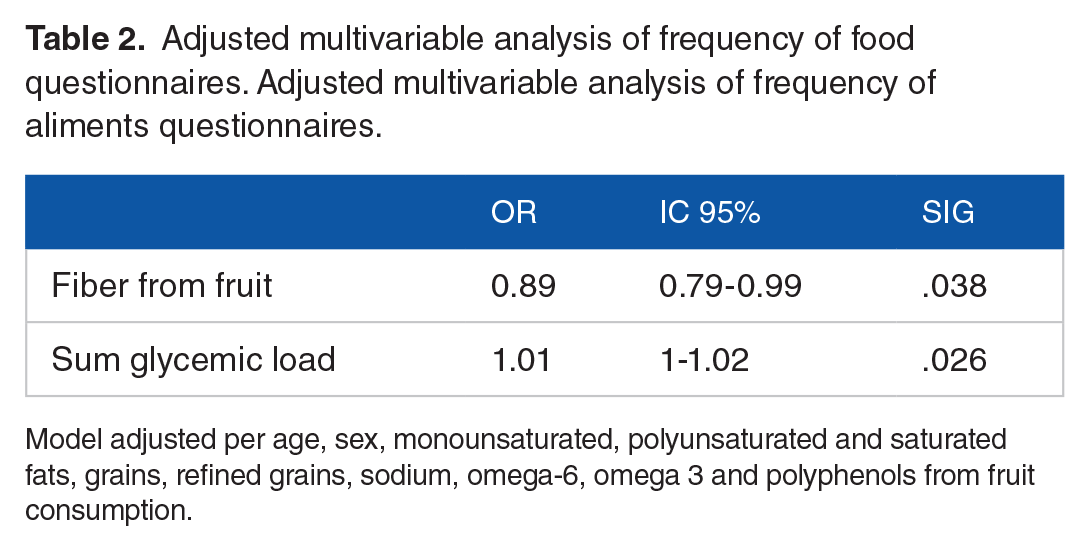
Model adjusted per age, sex, monounsaturated, polyunsaturated and saturated fats, grains, refined grains, sodium, omega-6, omega 3 and polyphenols from fruit consumption.
Discussion
Our results showed that among AF patients, a higher consumption of fiber from fruit and a lower GL sum per day were associated with a lower risk of SBI in MRI.
These findings support the hypothesis that MeDiet is a protective strategy to prevent CVD and ischemic stroke, not only in secondary prevention, but also in its initial subclinical stage, when lesions are detected in neuroimaging and asymptomatic.
Our results are consistent with the literature. Previous studies have reported the protective effect of fruit consumption on CVD and stroke, not only due to its high content on fiber but also in other bioactive compounds, such as vitamins and polyphenols.11,12 A recent prospective European study that included more than 400 000 patients showed that the risk of ischemic stroke was inversely associated with consumption of fruit and vegetables and dietary fiber. 13
Moreover, a cohort of patients of the REGARDS study showed that a high adherence to MeD seems to be associated with a lower risk of incident IS independent of potential confounders. 14
In our study, we found that fiber consumption was inversely associated but we have not found any statistically significant association regarding polyphenols and SBI risk reduction, although a trend toward a higher consumption of polyphenols from fruit in the SBI – group was observed.
GL estimates the impact of carbohydrate intake using the glycemic index while taking into account the amount of carbohydrates that are eaten in a serving. Typical diets contain from 60 to 180 GL units per day. 15 Regarding high GL, in the Framingham offspring cohort study, dietary GL was positively related to insulin resistance. More recently, a meta-analysis showed that high dietary GL is associated with a higher risk of CVD and stroke, and an Italian cohort study showed that increasing GL was associated with significantly increasing stroke risk.16-18 This Italian study conclude that all the carbohydrate-stroke associations they found support the hypothesis that high postprandial glycemia is the mechanism leading to increased stroke risk regarding carbohydrates consumption, and in our study, we found that patients with SBI consumed more carbohydrates, in grams per day and in total kcal. 16
Regarding fatty acids that have been previously associated with CVD prevention, in our study we have not found any association with omega 3 or 6 consumption and SBI reduction. Moreover, we did not find any association with saturated fat consumption and SBI presence in our population. However, regarding these compounds our data are based on estimations and metabolites have not been measured in our population.
When we compared our main results with the results of the ANIBES study, we found that our population had higher energy intake than the reference group (65-75 years) of this study. However, there percentages of the contribution of macronutrients to dietary intake were similar. 19
Our study has some limitations. One limitation is the small sample size of patients that has been completely studied for MeDiet adherence. This fact may be a bias in order to generalize our results. Although it is a single center study in Andalucía, our health results are consistent with other large studies conducted in our country. Regarding polyphenol quantification, it was an estimation according to the questionnaire results and they were not directly measured. Our results showed a higher consumption of polyphenols from fruits and vegetables than previous studies. 20 This might be explained because Andalucía is a region where these are main components of diet due to their direct production. Moreover, this is a region where virgin olive oil is the main source of fat and per previous studies, we know that this group of age consumes more fruit and vegetables than younger adults. However, another explanation might be that patients overestimate their consumption when answering to the questionnaire.
Conclusion
In conclusion, our results support that MeDiet could be suggested as a prevention strategy for SBI in patients with AF with a high potential impact on reducing stroke burden and dementia.
Highlights
Mediterranean Diet has a beneficial effect on cardio and cerebrovascular diseases, and this benefit may be present even in preclinical state.
Footnotes
Acknowledgements
We would like to thank our MRI technicians for their work and Mar Díez from Cajasol for her interest in the project.
Funding:
The author(s) disclosed receipt of the following financial support for the research, authorship, and/or publication of this article: The Spanish Ministry of Economy, Industry and Competitiveness (grant RTC-2016 5300-1), the Junta de Andalucía (grant PIN-0144-2016) and Neuroprotección Avanzada Reposicionando Drogas y Nutraceúticos para el Ictus en Andalucía: Proyecto NARDNIA (PE-0527-2019), the European Project ITRIBIS (registration number REGPOT-2013-1), and Cooperative Cerebrovascular Disease Research Network (INVICTUS+, RD16/0019/0015) supported the study. The Fundación Cajasol also contributed to the study.
Declaration of Conflicting Interests:
The author(s) declared no potential conflicts of interest with respect to the research, authorship, and/or publication of this article.
Author Contributions
IEM, FM, and JM have contributed equally to the design of the work. AV and MZ have contributed equally to data collection. IEM, FM, and PA have contributed to data analysis and interpretation. IEM and JM have contributed equally drafting the article. All authors have critically reviewed the article and given their final approval of the version to be published.
Statement of Ethics
Study approval statement: This study protocol was reviewed and approved by Local Ethics Committee, Hospital Universitario Virgen del Rocío, approval number 2014PI/162-1.
Consent to Participate Statement
Written informed consent was obtained from all participants.

Data Availability Statement
The data that support the findings of this study are not publicly available due to them containing information that could compromise research participant consent but are available from the corresponding author (JM) upon reasonable request.