




Abstract
Diabetes mellitus is one of the most prevalent metabolic disorders that affect people of all genders, ages, and races. Medicinal herbs have gained attention from researchers and have been widely investigated for their antidiabetic potential. Saffron (Crocus sativus L.) and its main constituents, that is, crocin and crocetin, are natural carotenoid compounds, widely known to possess a wide spectrum of properties and induce pleiotropic anti-inflammatory, anti-oxidative, and neuro-protective effects. An increasing number of experimental, animal and human studies have investigated the effects and mechanism of action of these compounds and their potential therapeutic use in the treatment of diabetes. This narrative review presents the key findings of published clinical studies that examined the effects of saffron and/or its constituents in the context of diabetes mellitus. Moreover, an overview of the proposed underlying mechanisms mediating these effects, the medicinal applications of saffron, and the new findings regarding its effect on diabetes and various cellular and molecular mechanisms of action will be debated.
Introduction
Diabetes mellitus (DM) is one of the most prevalent metabolic disorders and is known as a critical public health issue with noticeable consequences for human life and health expenditures.1,2 Each year over 1 million deaths can be ascribed to diabetes alone, making it the ninth leading cause of death. 3 Prolonged uncontrolled DM causes several micro and macrovascular complications, for instance, nephropathy, retinopathy, neuropathy, cardiovascular disease and stroke. Optimal control of blood glucose and lipid concentrations can decrease the incidence of DM-related complications; however, glycemic control is a constant challenge for diabetic patients. Drug therapy and lifestyle modifications such as dietary changes are strategies to modify blood glucose. 4 Herbal and natural medicine has been widely investigated for alternative treatment options. There is a growing body of literature addressing the use of herbal supplements in the management of diabetes. Saffron (Crocus sativus L.) has become a natural product of high interest since studies have shown promising effects of which on glycemic control. In vitro and in vivo studies as well as clinical trials have indicated that saffron and its constituents have antidiabetic, hypolipidemic, anti-hypertensive effects.5 -7 This review aimed to summarize the recently published evidence regarding the role of saffron and its bioactive components in DM.
Antidiabetic Medication: From Chemical Drugs to Herbs
Various drugs are used to lower the plasma glucose in patients with DM. Insulin is widely used among patients with type 1 DM as well as type 2 DM patients with uncontrolled diabetes despite optimal oral glycemic therapy. 8 Type 2 diabetes medications usually act through mechanisms such as enhancing insulin secretion, stimulating its function, or reducing glucose production in hepatocytes. 1 Some of these drugs include biguanides (Metformin), sulfonylureas (Gliclazide), dipeptidyl peptidase-4 (DPP-4) inhibitors (Sitagliptin), SGLT2 inhibitors (Empagliflozin), glucagon-like peptide-1 (GLP-1) receptor agonists (Liraglutide), and thiazolidinediones (Pioglitazone). 9 Some of these antidiabetic agents may cause side effects. Signs of congestive heart failure, fluid retention and bone fractures were observed in a group of patients treated with thiazolidinediones.10,11 Other drugs like biguanides, DPP-4 inhibitors and SGLT2 inhibitors can cause complications like lactic acidosis, nasopharyngitis and urinary tract infections, respectively. 12 This led researchers to seek alternative therapies.
Using herbal medicine to treat various diseases has a long history in different regions all around the world. 13 The numerous effects of these medicinal plants and the extracted compounds have been indicated in many studies. In case of diabetes there are evidences that type 2 diabetes mellitus was regarded as a major “Xiao-Ke disease” in ancient Chinese books and Chinese have used herbal medicines as treatment to the diseases for more than 1500 years. 14 Nowadays, there are numerous studies which attempted to find out the beneficial effects of herbal medicine on controlling the complications of diabetes and improving the outcome of patients.14 -17
The most common and effective antidiabetic herbs of Indian origin are bael (Aegle marmelose), Babul (Acacia arabica), onion (Allium cepa), garlic (Allium sativum), ghrita kumara (Aloe vera), church steeples (Agrimonia eupatoria), neem (Azadirachta indica), and ash gourd (Benincasa hispida). 18 Ginseng, Bitter melon, Golden Thread, Fenugreek, Garlic, and Cinnamon have been recommended in traditional Chinese medicine. 19 Several studies have also evaluated the anti-diabetic effects of spices such as cinnamon, 20 cardamom, 21 ginger, 22 cumin, black seed, 23 and saffron (Crocus sativus L). 24
Here in this article, we are going to review the studies on the anti-diabetic antidiabetic effects of saffron one of the most famous Iranian spices.
Saffron (Crocus sativus L)
Saffron, one of the most expensive spices, is usually grown as a perennial crop. The crimson-colored stigmas of saffron are used as a spice. Saffron has antitumor, anti-inflammatory, and an-depressant properties. It also is used to several diseases such as diabetes, several types of cancers, and Alzheimer’s disease. 25 Saffron is known as an ancient spice. Besides its medicinal effects saffron is used for dyeing and as a food spice. Saffron is cultivated in different countries such as Iran, India, Spain, Afghanistan, Greece, and Italy. Iran produces 90% of the world saffron. 26
Saffron contains various compounds including vitamins, minerals, carbohydrates and protein, flavonoids, and anthocyanin. The major saffron compounds are safranal, picrocrocin, crocin, and crocetin. Crocin and crocetin are 2 carotenoid compounds of saffron. crocin is responsible for the red color of saffron and composes the 6% to 16% total dry matter of saffron based on the types of methods that are produced. 27 The antihypertensive effect of safranal, and crocin have been proved in vivo. 28 Crocin has also shown anti diabetic and lipid lowering effects. 29 Crocin and safranal have also shown showed high antioxidant properties. 30
Methods
In order to extract relevant articles, we performed a thorough search in several databases such as PubMed, Web of Science, Scopus, Google scholar and Central. The keywords included “Saffron,” “Crocus Sativus L,” “Crocin,” “Crocetin,” “Diabetes mellitus,” and “Antioxidant.” The English language articles up to January 2022 were extracted through title and abstract screening. The duplicate articles were removed using Endnote X9. Hence the relevant articles were reviewed.
In Vitro Studies
Dehghan et al Conducted a study to investigate the effect of saffron consumption on diabetes. The findings showed that saffron consumption decreases triglyceride, low-density lipo-protein (LDL), very-low-density lipoprotein (VLDL), glycated hemoglobin levels, and could also increase insulin sensitivity by further expression of GLUT4 (Glucose transporter type 4), and AMPK (AMP-activated protein kinase). This effect was dose-dependent and more effective at higher doses. They also found that higher doses of saffron could increase insulin secretion and glucose uptake by affecting RIN-5F cells. 31 In a study by Kang et al, similar results were obtained on skeletal muscle cells. They found that saffron is involved in increasing glucose uptake in muscle cells via AMPK and PI3 kinase (phosphatidylinositol 3-kinase)/Akt (also known as protein kinase B) pathways. 6
About 100 different substances are obtained from saffron.32,33 These substances have different effects on human body and some can play an anti-diabetic role; however, the mechanism of action is not yet fully understood. Wali et al studied the anti-diabetic, antioxidant, and antibacterial effects of saffron and its derivates. These compounds (most importantly flavonoids and terpenes) showed anti-diabetic effects by inhibiting the α-glucosidase enzyme. It was also shown that saffron has antibacterial and antioxidant effects in a dose-dependent manner. 34
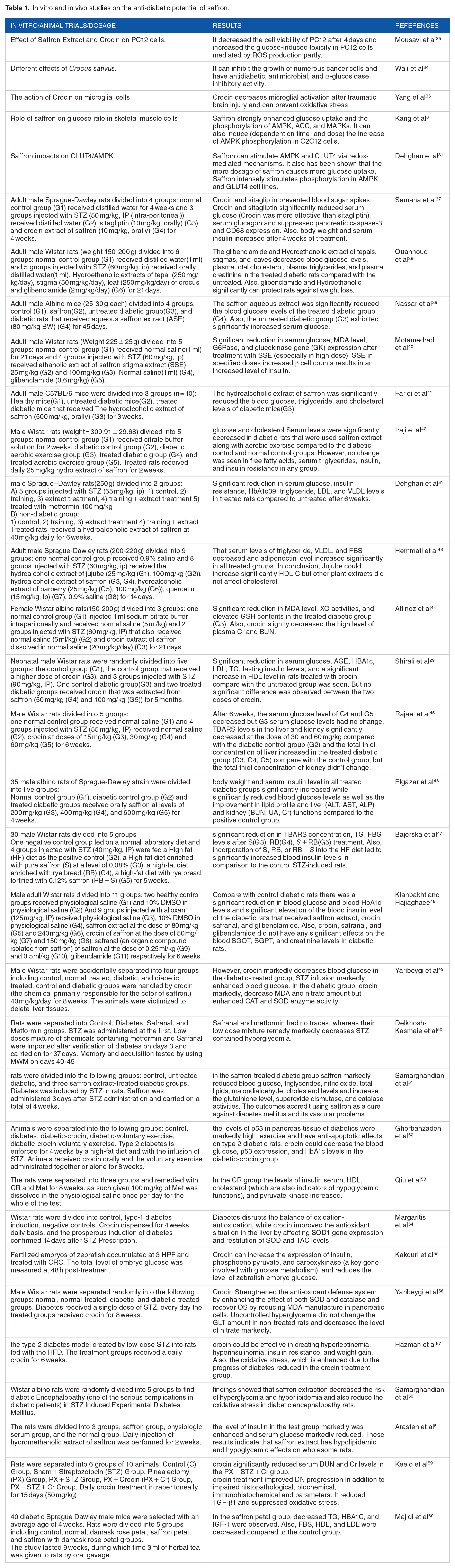
Saffron can also treat the complications of diabetes. Although the mechanism which glucose leads to neurotoxicity has not been fully elucidated, one of the possible explanations is the increase of reactive oxygen species (ROS) production. Mousavi et al found that saffron, especially crocin (one of the most important compounds in saffron as mentioned earlier), could reduce the effects of diabetic neuropathy by reducing ROS. 35 In another study, Yang et al realized that crocin has neuroprotective effects exerted through activating the PI3 kinase/Akt pathways and can also help to treat diabetic retinopathy by suppressing oxidative stress and pro-inflammatory response in microglial cells. 36 Table 1 summarizes the main findings of the in vitro studies on the anti-diabetic potential of saffron.
In vitro and in vivo studies on the anti-diabetic potential of saffron.
Animal Studies
Previous findings have confirmed that components of saffron extract including saffron petal extract and crocin have a high antioxidant capacity.30,61,62 Various articles referred to the antioxidant effects of saffron as the main mechanism for its beneficial effects on diabetic animals.40,45,49,51,53,54,56,58
Oxidative stress (OS) in uncontrolled hyperglycemia is known to have a fundamental role in pancreatic dysfunction and liver injury. The leading components of the intrinsic anti-oxidation system in the tissues are superoxide dismutase (SOD), catalase (CAT), and glutathione peroxidase. 50 In this regard, Yaribeygi et al studied the potential of Crocin, a pharmacologically active component of Crocus sativus L., to improve the antioxidant defense systems of pancreatic and hepatic cells. The results showed that Crocin boosted the antioxidant defense system by enhancing the enzymatic activities of both SOD and catalase and can decrease the oxidative stress by decreasing malondialdehyde (MDA) production (as the main indicator of OS) in pancreas and liver tissues of the diabetic-treated rats.49,56 Another mechanism of Saffron products to im-prove the antioxidant status is by reducing lipid peroxidation. 63 Saffron is reported to inhibit lipid peroxidation and restore SOD activity.64,65 In a study conducted by Rajaei et al the levels of total thiol (SH) groups, a sensitive component to oxidative damage, and thiobarbituric acid reactive substance (TBARS), an index of lipid peroxidation, were assessed in the kidney and liver of STZ (Streptozotocin)-induced diabetic rats. Their findings suggested that crocin has anti-oxidative effects, contributing to the decrease of lipid peroxidation in diabetic animals, and may be useful in the management of diabetes. 45
Hypoglycemic and hypolipidemic effects of saffron, as a result of its antioxidant, anti-inflammatory, and apoptosis regulatory potential, have been confirmed in different studies. Samaha et al performed a comparative study about the effects of crocin and sitagliptin (a standard oral hypoglycemic medication) in STZ-induced diabetic rats. The results showed that crocin had a greater effect compared to sitagliptin on serum glucose level, insulin immune-reactivity, and β-islets diameter.29,37,51 Physical activity is another method of diabetes management. Different kinds of activities including aerobic and resistance exercises, along with saffron consumption, are reported to have synergistic effects on improving diabetic parameters in rats. These effects are exerted via preventing excessive apoptosis of the pancreatic beta-cells associated with type DM and antioxidant mechanisms.31,52,66
DM patients suffer from hyperglycemia, dyslipidemia, and insulin resistance caused by abnormal metabolism which leads to many micro and macro vascular complications. 67 Saffron has been investigated in multiple in vivo studies for alleviation of diabetic complications.53,54,58 One of its complications is diabetic nephropathy, one of the main causes of death in DM patients. 68 In a recent study performed by Qiu et al the hypoglycemic and renal protection properties of crocin-I (CR) was demonstrated by the regulation of potential indicators of nephropathy. They reported hypoglycemic, hypolipidemic, and renal protective effects of CR in diabetic mice. 53
Diabetic encephalopathy is another severe complication in diabetic patients. The findings of a study by Samarghandian et al indicated that treatment with Saffron ameliorated oxidative stress in the hippocampus of diabetic rats and improved diabetic encephalopathy and cognitive deficits. 58 In diabetic rats, after consuming saffron extract, changes in blood sugar occurred, which included a decrease in fasting blood sugar, and a reduction of hyperglycemia in a high dose of saffron consumption combined with metformin. An increase in serum insulin levels and insulin secretion were also observed.5,38,39,46 -48,50,69,70 Saffron extract affects lipid profile by reducing the level of total cholesterol, blood triglyceride level, and VLDL.5,38,47,69 -71 Adiponectin and HDL-C are increased and the LDL / HDL ratio decreased overall improvement in lipid profile was observed.46,69 -71 Consumption of saffron extract prevented weight loss in mice treated with saffron compared to diabetic mice38,71 Weight gain has also been observed in studies. 72 Consumption of saffron extract in diabetic male mice reduces OS, infection, (interleukin) IL-1β levels superoxide dismutase, Malondialdehyde, and thiobarbituric acid-reactive substances. Also, the consumption of saffron, metformin, and the combination of them can improve learning and memory disorders and anti-apoptotic mechanisms.44,46,47,57,71 Pancreatic tissue function improved after consuming saffron extract and returned to normal. Many studies demonstrated that saffron extract has positive effects such as improving kidney tissue, reducing creatine, BUN (blood urea nitrogen) serum, immunoexpression of xanthine oxidase (XO) activities, glutathione (GSH) contents, and caspase-3.38,39,44,46 Kakouri et al used crocin isolated from Crocus sativus L to investigate its effects on the pancreatic beta cell of zebrafish. Embryos of zebrafish were exposed to an aqueous solution containing saffron; then, they measured glucose levels of the whole embryos. The results showed glucose levels of the zebrafish embryo decreased, and expression of insulin and phosphoenolpyruvate carboxykinase 1 (pck1) increased. It was concluded that crocin may have roles in the metabolism of glucose and insulin management. 55 Majidi et al 60 performed an experiment on 40 male diabetic rats to evaluate the effect of damask rose petals, saffron petals, and saffron-damask rose petal herbal teas in inflammatory factors, fasting blood sugar, weight loss, and lipid profile. In 3 intervention groups, saffron petals, damask rose petals and saffron petals along with damask rose petals, in comparison with the normal group, a decrease in weight, hba1c, and an increase in IGF-1 were observed. Along with a decrease in FBS, LDL, HDL. In the saffron petal group. In another study by Keelo et al, it was found that crocin exerts protective effects on the diabetic nephropathy. This study also showed that saffron can lower blood sugar and blood triglycerides and suppress reduced TGF-β1 and oxidative stress in the kidneys. In addition, crocin a protected renal architecture against the development of renal fibrosis and reduced BUN and creatinine. 59
Table 1 summarizes the main findings of the in vivo studies on the anti-diabetic potential of saffron.
Clinical Trials
Several studies investigate the effects of alcoholic extraction of saffron (Crocus sativus L) on depression, anxiety, sleep quality, and life satisfaction in type 2 diabetes mellitus (T2DM) patients. Milajerdi et al designed a double-blinded, randomized, and placebo-controlled clinical trial. Participants in this study were outpatients who suffered from mild to moderate Comorbid Depression-Anxiety (CDA). The results showed that mild to moderate Comorbid Depression-Anxiety (CDA), sleep disturbance, and anxiety were alleviated considerably in the patients who consumed saffron capsules compared to the control group. however, depression alone was not relieved. 73 In other studies, Dehghanmehr et al reported that daily saffron consumption can improve sleep quality in diabetic patients and have a beneficial effect on their anxiety levels.31,74 In another study conducted by Tajaddini et al to investigate the relationship between saffron consumption and quality of sleep and life, they concluded that saffron in DM patients is associated with improved sleep and quality of life. 75
Some studies reported some beneficial effects of saffron on the cardiovascular system and myocardial tissue. According to these findings, saffron consumption alone can have protective effects on the myocardium. In type 2 diabetic men, saffron extract consumption and aerobic exercise can reduce the Troponin T and Heart-Type Fatty Acid Binding Protein (HFABP) levels. 76 However, consumption of saffron and other herbs like cardamom, cinnamon, and ginger as herbal treatments has no significant effect on endothelial function and BP (blood pressure), as risk factors for cardiovascular diseases. 7 Various articles researched the effects of saffron extract on metabolic factors, glycemic control, lipid profile, oxidative stress, and inflammation. For example, Milajerdi et al conducted a study that indicates that saffron hydroalcoholic extract may improve hyperglycemia control by decreasing FBS in T2DM patients. 73 In another study, Barari et al attempted to investigate the effect of saffron extract and aerobic training on serum hemoglobin A1c (HbA1c) and Apolipoprotein A-1 (Apo-A1) in men with type 2 diabetes mellitus. The results from this study showed that consumption of saffron extract regardless of aerobic exercise can increase the level of Apo A-1 in T2DM patients, which is valuable because lower levels of serum Apo A-1 are reported in diabetic patients with dyslipoproteinemia and cardiovascular diseases like cardiovascular autonomic neuropathy (CAN).72,77 However, it does not affect the HbA1c level. 78
Other studies attempted to investigate the effect of the saffron extract on oxidative stress. Azimi et al revealed that consumption of saffron, cinnamon, cardamom, and ginger as herbal remedies have significant effects on levels of oxidative stress markers and inflammatory factors in type 2 diabetic patients. 7 Also, Barari et al reported that saffron extract and aerobic exercise seem to be able to decrease and increase the levels of MDA and erythrocyte glutathione peroxidase (GPX) activity in men with type 2 diabetes, respectively. 79 Another study presented by Azimi et al showed that saffron extract and other herbal medicines have beneficial effects on cholesterol levels but not on measures of glycemic control, oxidative stress, and inflammation. 7 Newer evidence shows that the overproduction of pro-inflammatory cytokines plays a role in the formation of diabetes issues. Certain herbals, namely Saffron can help patients with diabetes to maintain inflammation and improve the hyperglycemic states. 80 Sepahi et al attempt to measure the effects of the saffron supplementation on inflammatory markers and fasting glucose levels in T2DM patients and evaluate the effects of crocin intake on reducing inflammation in patients with diabetic maculopathy. They found that saffron supplementation significantly decreased Fasting blood glucose (FBG) levels within 8 weeks in the patients who received saffron. Also, the expressions of TNF-α and its serum level beside the level of IL-6 mRNA were noticeably Downregulated. 81
Lung volume loss, airway obstruction, airflow limitation, and also hypertension are risk factors for mortality in patients with type 2 diabetes. Rajabi et al performed a study to illustrate the effect of saffron supplementation and aerobic training on Blood pressure disparities, pulmonary function, and spirometric indices in women who are obese and overweight and are suffering from type 2 diabetes. Among these participants, this study shows that saffron consumption with exercise led to a significant decrease in blood pressure and improvement in pulmonary volume and capacities. 82
Saffron and its extract can cause a noticeable reduction in plasma glucose levels according to experimental models. Moravej Aleali et al determine the effects of the saffron extract on the fasting plasma glucose (FPG), HbA1c, lipid profile, liver, and renal function tests in patients with type 2 diabetes. In the following double blind randomized clinical test, patients with type 2 debates who were on oral antidiabetic drugs were received saffron capsules or placebo and analyzed. These variables were measured before and after intervention after 3 months. At end of follow-up duration, in the saffron group, FPG, Cholesterol, LDL c, and LDL/HDL ratio against HbA1c, HDLC, API, and TG showed significant reduction compared to the control group (P < .0001). The results of this study indicate that saffron consumption can improve hyperglycemia and lipid profile in type 2 diabetic patients. 83
In a randomized clinical trial, Karimi-Nazari et al investigated the effects of saffron on the lipid profile, glycemic and antioxidant status in individuals who are obese and overweight and who have prediabetes. The results of this study showed a noticeable effect of saffron supplementation on FBS, HbA1c, and DPPH (diphenyl-picryl-hydroxyl) levels. 84 In adjusting models, there was a marginal reduction in FBS and HbA1c in the saffron group in comparison to the placebo group. Furthermore, saffron supplementation tended to increase the DPPH radical scavenging activity and according to data of Sepahi et al, administration of crocin can affect central macular thickness (CMT) and improve best-corrected visual acuity (BCVA). The main purpose of this investigation is to examine the effects of saffron intake as an adjunct therapy to DM. 81 To investigate the effects of saffron supplementation on inflammation and metabolic responses in type 2 DM patients a double-blinded randomized control-placebo trial was conducted by Ebrahimi et al. The results of this study showed that saffron supplementation Compared to placebo caused a significant decrease in waist circumference and MDA However, saffron did not influence on other evaluated cardiometabolic risk markers in diabetic patients. In another study, they observed that C. sativus intake can result in a noticeable reduction of SBP (systolic blood pressure).85,86
In a study, Aghajani et al investigated the effect of aerobic and resistance training in 8 weeks with the aqueous extraction of saffron on malondialdehyde and glutathione peroxidase among T2DM. In this clinical trial, participants were divided into 6 groups: placebo, aerobic training, aerobic training with supplement consumption, resistance training, and resistance training with supplement consumption. The results concluded that the Level of malondialdehyde was significantly lowered in placebo and aerobic training with supplement before intervention. The level of glutathione peroxidase was noticeably increased in aerobic training with the supplement, resistance training, and resistance training with supplement groups after intervention. This study demonstrates that Aerobic and resistance training and their combination with saffron consumption can be considered an effective method to improve the peroxidase and antioxidant balance. 87 Hooshmand Moghadam et al studied the effect of saffron supplementation and exercise in men with type 2 diabetes. In all groups except the control group, insulin, FBG, IL-6, IL-1β, HOMA-IR, HbA1c, TNF-α, were decreased significantly. IL-10 was increased in 3 groups. A positive correlation was observed between the concentration changes of BFP and TNF-α, IL-10, IL-6, and IL-1β in the 3 intervention groups. It was also concluded that simultaneous consumption of saffron supplement and exercise could be of high efficacy. Specially in terms of anti-inflammatory effects. 88 Furthermore, in a critical appraisal of literature Kadoglou et al stated that the included clinical trials mostly showed weak effects of saffron and its main constituents on cardiovascular risk factors including modest lowering of FBG, without a significant reduction of HbA1c in type 2 DM patients, moderate or controversial hypolipidemic effect, negligible hypotensive effects, as well as inconsistent modification of the parameters of metabolic syndrome. 89
Table 2 summarizes the main findings of the clinical trials on the anti-diabetic potential of saffron.
Clinical trials on the anti-diabetic potential of saffron.
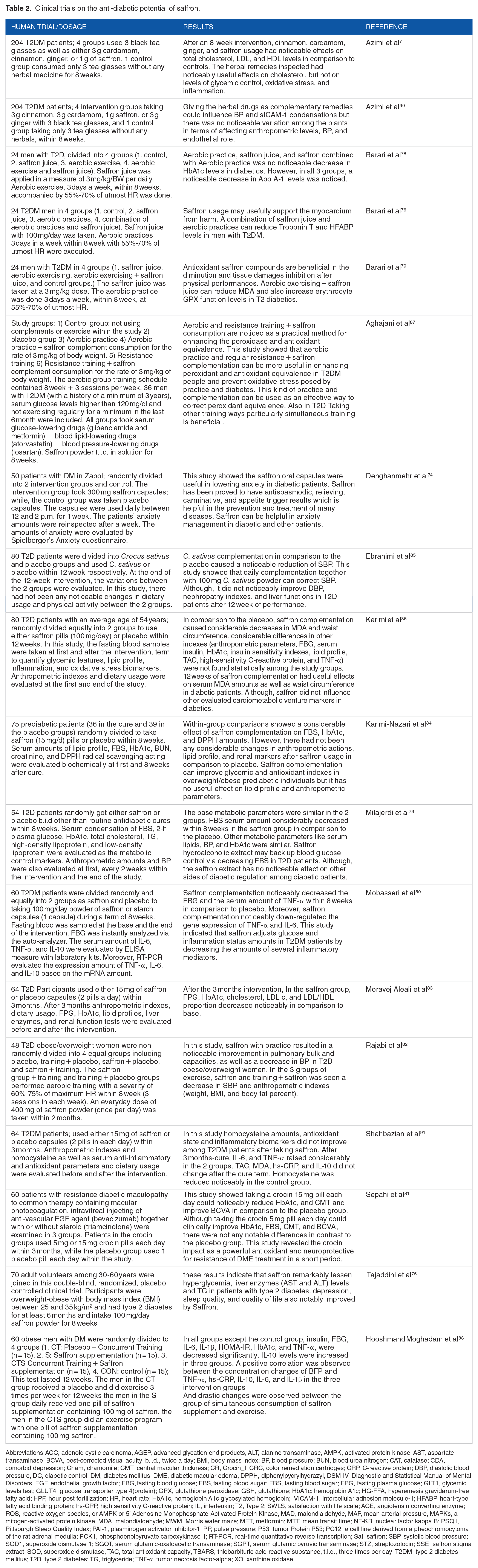
Abbreviations: ACC, adenoid cystic carcinoma; AGEP, advanced glycation end products; ALT, alanine transaminase; AMPK, activated protein kinase; AST, aspartate transaminase; BCVA, best-corrected visual acuity; b.i.d., twice a day; BMI, body mass index; BP, blood pressure; BUN, blood urea nitrogen; CAT, catalase; CDA, comorbid depression; Cham, chamomile; CMT, central macular thickness; CR, Crocin_I; CRC, color remediation cartridges; CRP, C-reactive protein; DBP, diastolic blood pressure; DC, diabetic control; DM, diabetes mellitus; DME, diabetic macular edema; DPPH, diphenylpycrylhydrazyl; DSM-IV, Diagnostic and Statistical Manual of Mental Disorders; EGF, endothelial growth factor; FBG, fasting blood glucose; FBS, fasting blood sugar; FBS, fasting blood sugar; FPG, fasting plasma glucose; GLT1, glycemic levels test; GLUT4, glucose transporter type 4(protein); GPX, glutathione peroxidase; GSH, glutathione; HbA1c: hemoglobin A1c; HG-FFA, hyperemesis gravidarum-free fatty acid; HPF, hour post fertilization; HR, heart rate; HbA1c, hemoglobin A1c glycosylated hemoglobin; IVICAM-1, intercellular adhesion molecule-1; HFABP, heart-type fatty acid binding protein; hs-CRP, high sensitivity C-reactive protein; IL, interleukin; T2, Type 2; SWLS, satisfaction with life scale; ACE, angiotensin converting enzyme; ROS, reactive oxygen species, or AMPK or 5′ Adenosine Monophosphate-Activated Protein Kinase; MAD, malondialdehyde; MAP, mean arterial pressure; MAPKs, a mitogen-activated protein kinase; MDA, malondialdehyde; MWM, Morris water maze; MET, metformin; MTT, mean transit time; NF-KB, nuclear factor kappa B; PSQ I, Pittsburgh Sleep Quality Index; PAI-1, plasminogen activator inhibitor-1; PP, pulse pressure; P53, tumor Protein P53; PC12, a cell line derived from a pheochromocytoma of the rat adrenal medulla; PCK1, phosphoenolpyruvate carboxykinase 1; RT-PCR, real-time quantitative reverse transcription; Saf, saffron; SBP, systolic blood pressure; SOD1, superoxide dismutase 1; SGOT, serum glutamic-oxaloacetic transaminase; SGPT, serum glutamic pyruvic transaminase; STZ, streptozotocin; SSE, saffron stigma extract; SOD, superoxide dismutase; TAC, total antioxidant capacity; TBARS, thiobarbituric acid reactive substance; t.i.d., three times per day; T2DM, type 2 diabetes mellitus; T2D, type 2 diabetes; TG, triglyceride; TNF-α: tumor necrosis factor-alpha; XO, xanthine oxidase.
Conclusion
In summary, findings from this review highlight the effects of saffron and its chief ingredients including crocin on various parameters of diabetes and its complications. Several in vitro, in vivo, and clinical trial studies were reviewed. Clinical trials revealed multiple positive effects of saffron on diabetic patients including improvement of metabolic factors, glycemic control, lipid profile, oxidative stress, and inflammation. Moreover, beneficial features of saffron components were detected in the cardiovascular system. Blood pressure state and pulmonary function, as well as depression, anxiety, sleep quality, and life satisfaction of diabetic patients. Furthermore, clinical trials and animal studies reported the synergistic effects of saffron consumption along with aerobic exercise. Saffron extracts improved diabetic status in STZ-induced diabetic rats via different mechanisms. Enhancement of antioxidant defense systems by boosting the enzymatic activities of SOD and CAT leads to decreased degrees of pancreatic dysfunction as well as kidney and liver injury in diabetic rats. The beneficial effects of saffron components on the metabolic condition of diabetic animals including hyperglycemia, dyslipidemia, and insulin resistance, were also confirmed in multiple studies. The suggested underlying mechanisms involved anti-oxidant, anti-inflammatory, and apoptosis regulatory potentials of saffron. In vitro studies confirmed the same anti-diabetic effects, using saffron components on different cells including PC12, microglial and skeletal muscle cells. Overall, the favorable effects of saffron are promising for the management of diabetes mellitus, although the possible risk of bias in the included studies should be considered. There is a need for further research with a solid design for revealing the underlying mechanism of these effects. Future clinical trials are needed to be conducted in populations with greater homogeneity and consistent regiments of saffron to reach a more detailed conclusion about the optimal dosage for treatment of diabetic patients.
Footnotes
Author Contributions
Study concept and design: ND. Acquisition of data: AS, AT, SSS, RK. Drafting of the Manuscript: AS, AT, SSS, RK, HT, MT, NSE, SmmAd. Critical revision of the manuscript for important intellectual content: ND, RK. Study supervision: ND.
Funding:
The author(s) received no financial support for the research, authorship, and/or publication of this article.
Declaration of Conflicting Interests:
The author(s) declared no potential conflicts of interest with respect to the research, authorship, and/or publication of this article.
