



Abstract
Background:
The Ghanaian elderly population is increasing at the fastest rate and this has become a burden as the rate is not proportional to the investment in health to meet their deteriorating health needs. This creates discrepancies and inequalities in healthcare access and coupled with poor healthcare provider services, the inequalities widen. Poor care services are related to poor knowledge and bad attitudes of care providers hence this study seeks to explore the health practitioners’ level of knowledge, attitude, and practice (KAP) toward geriatric care.
Methods:
The study used a cross-sectional survey design with a simple stratified random technique to select study participants. Out of 257 participants who were sampled for the study, 215 responses were received, representing 83.6% response rate. However, 200 questionnaires were complete (93%) and valid for analysis, which consisted of 166 nurses, representing 83% valid responses, and 34 medical officers, physician assistants, and other allied health care providers, representing 17% valid responses from these professionals. A structured questionnaire was used to assess KAP using the knowledge about Older Patients Quiz (KOP-Q) and Kogan’s Attitudes toward Old People Scale (KAOP). Using a mean score of 80%, knowledge, attitude, and practice were dichotomized into good or bad. The Kruskal-Wallis H test was used to compare mean rank across health professionals’ knowledge, attitude, and practice of geriatric care.
Results:
It shows that the majority (94%) of participants have low levels of knowledge in geriatric care. The majority (84%) of participants do not practice good geriatric care. Differences in knowledge exist among health providers and were statistically significant (P = .045). Doctors had the lowest mean knowledge score (78.61). Nurses (100.27) and physician assistants (106.15) had moderate mean knowledge score ranks. Although not statistically significant, the rank order for practice scores from highest to lowest was: physician assistants (112.95), nurses (99.19), and doctors (79.21). There were however no statistically significant differences between professions in practice scores (P = .067), or attitude scores (P = .097).
Conclusion:
Health care providers have low knowledge and, bad attitude toward aged care and this may be related to their service delivery which may affect the aged patronage of healthcare services. This is a wake-up call for authorities to organize continuous professional development to enable care providers to improve their service delivery.
Introduction
Health inequalities are a global challenge to policymakers across the globe. It is of particular concern especially to developing countries because of the unequal distribution of the available limited health resources.1,2 Geriatrics which is a branch of medicine and social sciences deals with the study and care of the aged or the elderly. The population of the elderly can be defined in several themes including chronology, co-morbidity, and frailty. Chronologically, they are the group greater than 60 years of age. Clinically, they are a population of interest because of the deterioration in health which affects the pharmacology of drugs used in such populations and the special care they need.3,4 Aged care inequalities can span from financial, and physical, to professional accessibility. Because of the vulnerability of the aged, they require, special care when they visit the general hospital. Geriatric care is a specialty that requires the special training of professionals just like the other specialties in medicine and nursing.
The global aged population is expected to double by the year 2050. The United Nations report showed an increase in life expectancy in recent decades. 5 The UN DESA report (2019) further estimated that about 87% of the countries across the globe will have their society aging. Some countries are expected to become aged whereas others will be super-aged. 6 The UN forecasted that the population of people aged 60 and above will hover over 3.1 billion by 2030. Between 2000 and 2050, the UN has predicted that the number of people over 80 years will increase from 70 to 401 million respectively. This is indicative of an imbalance in the global demographic characteristics. Significantly, individuals above the age of sixty will be more than those under 15 years in 40 years’ time. 5
The aged population in Ghana has considerably increased over the decade. The growing population and the demand for geriatric care calls for policy direction that seeks to train specialized professionals in the care of the aged. 7 About 2 million of the population in Ghana are 60 years and above (aged). Out of this population, 341 960 elderly persons are living alone with 62 480 out of that number being 80 years and older.
Numerous health issues affect the elderly, some of which may require hospitalization, long-term psychosocial treatment, and nursing care. 8 Therefore, it is clear from the present trends in health consumption and demographics that there is a growing need for health care providers who are skilled in providing care for senior citizens. Growing demands exist for inspired nurses and other health care workers to care for geriatric patients.9,10
Numerous studies looking into health care workers’ attitudes and understanding on caring for the elderly and their willingness to collaborate with them have been carried out in a number of countries. Most of these studies have found that the majority of health care providers, especially nurses and doctors are neither well-versed in or motivated to work with the elderly11-13
In Ghana, some studies have tried to explore the issue of aged care, with some focusing on the determinants of the aged choice of health facility and barriers to health care utilization. 14 Some other studies used qualitative approach to identify the experience of the aged with the health care workers.15-17 Some studies attempted to assess knowledge attitude and perception toward geriatric care but participants were nursing and medical students pursuing further studies in geriatrics.18,19 Similar to studies from other countries, most of these studies reported poor knowledge, attitude and perception toward the geriatric patient. Consequently, the studies reported that the bad attitude and experiences of the aged demotivate them from utilizing medical facilities and may promote the usage of alternative medicine which if done unsupervised can be detrimental to the health of the aged. 20 Limited knowledge of their need from the part of practicing healthcare professionals compounds their existing vulnerability. This calls for the assessment of health practitioner’s attitudes and practice toward geriatric care.
The current study therefore seeks to explore the knowledge, attitude, and practices of health care practitioners on effective geriatric care services in Kumasi, Ghana.
Research Methods and Design
Ethical consideration
Ethical approval for the study was sought from the Committee on Human Research and Development (KNUST) with reference number CHRPE/AP/196/23. Permission to conduct the study was granted by the respective hospitals where the study was conducted as they were assured confidentiality and security of responses. Written informed consent was obtained from study participants before responses were obtained. This was done by participants signing or thumb-printing a written consent form.
Design
A cross-sectional survey design was used to find out the level of knowledge, practice, and attitude of healthcare practitioners (clinical staff) on effective geriatric healthcare services to the aged in 3 selected government hospitals in Kumasi, Ashanti Region Ghana.
Setting
The study was conducted in the Ashanti region of Ghana. The region has 35 districts and 6 municipalities. After Accra, Kumasi is the second-largest city in Ghana. It is a multicultural community with a variety of socioeconomic and cultural pursuits that is well-positioned in the middle of the nation. The study sites were Tafo Government Hospital, Suntreso Government Hospital, and Kumasi South Hospital. All of these study sites are polyclinics in Kumasi with respective disciplines in medicine, and surgery, among other specialties. All 3 polyclinic hospitals run chronic care clinics which are meant for managing chronic diseases like hypertension, and diabetes among others, which mostly have a higher patronage of the aged. In addition, the 3 hospitals also have infectious disease centers which manage chronic infections like the human immunodeficiency virus (virus) and tuberculosis (TB) which also have the aged population. Although, together with the general outpatients, the estimate for the aged attendance is difficult to know, the aged form a significant population of outpatient department (OPD) care.
Study population
The study used clinical staff (medical doctors, Nurses, and Physician assistants) at various points of aged care such as the outpatient department, special clinics (hypertension/diabetes clinics), and medical wards in the 3 hospitals.
Study Variables and Definitions
Knowledge
Knowledge is one’s understanding of the subject matter. It is their ability to imagine and perceive a phenomenon. Relative to geriatrics, knowledge construct was defined as relatively good information about aged care. Data on knowledge was collected by the use of the Knowledge about Older Patients Quiz (KOP-Q) which has been an accepted tool for evaluating nurse’s level of knowledge on geriatrics.21,22 It is a 30-question-based tool. The tool was modified into a 5-point Likert scale ranging from strongly agree to strongly disagree. The tool measured health practitioner’s knowledge of the normal aging process, the presence of depression and delirium in older adults, geriatric nutrition and fluid imbalance, and other sub-scales. Participants were classified as either having good or bad knowledge in geriatrics when the mean score was more than eighty percent (80%). This tool has been validated and used in Ghana. The modified question which the validated tool took the form of a Likert was piloted at 3 different facilities and reliability was checked.23,24
Attitude
An attitude is a perspective or manner of being. This was a dichotomous variable based on the mean score. The Kogan’s Attitudes toward Old People Scale (KAOP) assess participant’s attitudes to geriatric care. It is a scale that measures respondent’s stereotypes of the aged and respondents’ image of older adults. It has 17 positive items and 17 negative items. This was modified into a 5-point Likert scale. An attitude is a perspective or manner of being. The variable will be defined by health providers’ reaction toward the care of the aged which was based on the Kogan attitude toward old people scale. 21 This was a dichotomous variable based on the mean score.
Validity
The content validity index (CVI) score 25 of 0.79 was determined through a panel of 4 experts. They rated each survey item on a scale from “1” (not relevant) to “4” (highly relevant). The Item-Level CVI (I-CVI) was calculated as the proportion of experts who rated the item as 3 or 4. The Scale-Level CVI (S-CVI) was then determined by averaging the I-CVIs across all items.
Inclusion criteria
Participants must be a certified professional (medical doctor, physician assistant, and nurse).
Participants must have at least 1 year of post-training working experience.
Participants must be someone who gives direct clinical care in the facility.
Participants should willingly agree to participate in the study and sign the informed consent form.
Exclusion criteria
A participant who is a student or intern.
Sampling
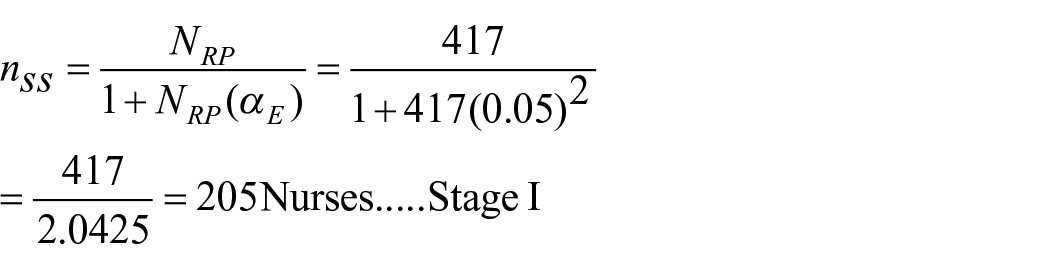
Two sampling methods were used for data gathering, including both stratified random and convenience sampling. Convenience sampling was used to recruit nurse participants relative to purposive sampling, which was used to recruit physicians and physician assistants. Krejcie and Morgan 26 formula was used for estimating sample size was used.
With a total nurse population of 417 across the 3 hospitals, the general sample size for the study was calculated using the formula.
This has been illustrated below

Sub-sample size calculation:

Sub-Population Estimation of Sample

The total sample size was 205 (nurses). However, a census sampling was used to recruit all available medical officers and physician assistants since their population was very small (26 medical officers and 26 physician assistants respectively). Therefore, the total sample size for the study was = 257.
Data management and validation
The data collection instrument was adapted and piloted among 20 participants after content validity was done group of experts in Geriatric Care. Data was collected electronically and retrieved as a Microsoft Excel 2019 spreadsheet and cleaned. Data was exported to SPSS version 23 for statistical analysis. Data quality checks and cleaning were done. Missing values were deleted as per the missing data thumb rule.
Data analysis
Where appropriate, descriptive statistics such as means, frequencies, and standard deviation were used to characterize the data. Normality testing was carried out to guide the statistical analysis paths or choice of the statistical tool during the inferential analysis phase. Unless otherwise specified, the alpha level for all significant values in the study was set at .05, with a 95% confidence interval. Pearson’s chi-square test was used to assess the associations between the various demographic factors (variables) and the dichotomized outcome variables. Subject to the normality of the distribution (using the Shapiro-wilk test), the appropriate inferential statistics were used to examine the study objectives, thus to compare the mean knowledge, practice, and attitude scores for geriatric care between different professions including nurses, physician assistants, doctors, and others Kruskal-Wallis H test was used to compare mean rank across multiple professional groupings since these variables violated the test of normality.
Likert scales were scored “1” for all Strongly Agree and Agree responses and “0” for all Strongly Disagree and Disagree responses. These were then summed and categorized into “Good” = 80% and above or “Bad” ⩽ 80%.
Results
Demographic characteristics of respondents
Out of 257 participants who were sampled for the study, 215 responses were received, representing an 83.7% response rate. However, 200 questionnaires were complete and valid for analysis, which consisted of 166 nurses, representing 83% valid responses, and 34 medical officers, physician assistants, and other allied health care providers, representing 17% valid responses from these professionals. Table 1 shows the demographic characteristics of the 200 respondents. The median age of the participants was 30 years and females (66.8%) were the majority. The majority of the respondents were unmarried (52%) and were Christians (92.5%) who were mostly Akan (89%). The majority of the respondents were Registered General Nurses (RGNs-73%) with the majority practicing with diploma qualifications who practice at the medical wards (30%).
Demographic characteristics of respondents.

1 Missing.
4 Missing.
1 Missing.
1 Missing.
7 Missing.
1 Missing.
25 Missing.
Table 2 represents respondents’ graded scores for the various constructs, thus knowledge, attitude, and practice of geriatric care. It revealed that the majority (94%) of participants have low level of knowledge in geriatric care. Further, though they had a good attitude (60.6%), the majority (84%) of participants did not have good practice toward geriatric care.
Respondents’ grade for the various constructs.

Knowledge, practice, and attitude scores by professional groups
Table 3 below shows a statistically significant difference in knowledge scores between the different professions (P = .045). There was a statistically significant difference in knowledge scores between the professional groups (P = .045), with doctors having the lowest mean knowledge score rank (78.61). Nurses (100.27) and physician assistants (106.15) had moderate mean knowledge score ranks. However, there were no statistically significant differences in practice scores (P = .067), perception scores (P = .766), or attitude scores (P = .097) between nurses, physician assistants, and doctors. Although not statistically significant, the rank order for practice scores from highest to lowest was: physician assistants (112.95), nurses (99.19), and doctors (79.21). For perception scores, the rank order was: doctors (107.50), nurses (97.85), and physician assistants (86.15). Lastly, for attitude scores, the rank order was: doctors (109.93), physician assistants (105.45), and nurses (94.88).
Knowledge, practice, and attitude scores by professional groups.

Relationship Between Demographic Variables and Dependent Variable
In Table 4 below, there was no statistically significant relation between participants’ demographic variables and dependent variables.
Association between demographic factors and practice of geriatric care.

Knowledge, Practice, and Attitude Scores by Working Experience
Table 5 presents the results of the Kruskal-Wallis test, which examined whether there were significant differences in knowledge, practice, and attitude scores related to geriatric care among healthcare professionals based on their years of working experience. There were no statistically significant differences in knowledge scores based on years of working experience (P = .576). Participants with 12 to 17 years of experience had the highest mean knowledge score rank (111.12), followed by those with 1 to 5 years (100.50), 6 to 11 years (92.77), and 18+ years of experience (77.50). Similarly, there were no significant differences in practice scores (P = .643), or attitude scores (P = .195) across the different working experience groups.
Knowledge, practice, and attitude scores by working experience.

Discussions
The paradigm shift of the aged from relatives to health professionals calls for the need to evaluate the care services the aged receive at the various public health facilities. Our study shows that, almost all participants (94%) had poor knowledge about geriatric care with most of them (60.6%) demonstrating poor practice. However, majority of them (62.7%) had positive attitude toward geriatric care.
The study adds to the body of knowledge in geriatric care that, healthcare providers have less knowledge and a bad attitude toward geriatric care27-29 even though few studies have found higher levels of knowledge among health professionals. 30
However, the current study evinced positive attitude of participants toward geriatric patients which supports earlier studies in Ghana, 14 Bangladesh, 31 and Nepal 32 which showed that nursing students and nurses have good attitudes toward aged care, this was believed to be the result of the similitude of the respect the aged receive owing to the belief that aging is associated with wisdom. This notwithstanding, the number of participants that demonstrated poor attitude is worrisome.
There is a relationship between knowledge and attitude, where, higher knowledge correlates with good attitudes.30,33 This observation is shown in our study as well where poor knowledge is related to poor attitude. This phenomenon does not foster confidence among health professionals in rendering geriatric care. It also does not give confidence to the geriatrics and their relatives who are shifting the duty of care to health professionals. The overall effect is low patronage of facility-based care.20,34,35 In contrast to this relationship, Muhsin et al 36 reported that even though there was poor level of knowledge among nursing students, their attitude was very positive. The difference may be related to the background of the participants, as in the latter study, most of the respondents had past experience with the aged, having lived in rural areas and stayed with an older person.
Although the current study did not show a statistically significant difference in attitude score among health professionals, if the variable (attitude) is dichotomized, the findings showed a higher rate of bad attitude toward geriatric care which agrees with other studies that used a qualitative approach to explore the subject among nurses and nursing students.18,37,38 Their results showed the depth of bad attitudes health providers (nurses) have toward aged care which include disrespectful attitudes of professionals shouting or yelling, making participants feel invisible, or not distinguishing participants from younger patients. 39 On the contrary, aging comes with psychological issues like depression, and feelings of rejection among other distresses. Because the training of health professionals includes basic care of the aged, it is expected that they should rather have an understanding of aged care. The impact of such an attitude is that the aged are less satisfied with the care they receive which further compounds their psychological distress state. Coupled with dissatisfaction from their family members, they tend not to patronize allopathic medicine but rather resort to herbal/alternative medicine which is done with ease because traditional medicine is easily accessible., These herbs are not hard to reach, and less costly, and knowledge of their use is handed over to us through generational folkloric practices.40,41 Some also seek institutionalized alternative/herbal practitioners. Consequently, Rababa et al 29 have posited that this negative attitude of health professionals toward the aged has a significant correlation with poor health outcomes of the aged.
Our analysis also showed that knowledge of aged care was statistically significant among health professionals and the highest mean rank was observed among other care providers and doctors had the lowest mean score. Low knowledge among medical doctors may be the result of low interest in the care of the aged. Karikari et al 19 showed that few medical students have an interest in pursuing a career in geriatrics. Similarly, a systematic review of literature demonstrated that nursing and medical students showed low interest level in working with the older population with training even though student nurses seemed to have higher preference for working with the aged. 42
Low motivation is associated with reduced interest in accepting new knowledge. Accordingly, the current study demonstrated that heath care providers with more work experience uncharacteristically had the lowest mean rank. Interestingly, individuals who had worked for between 12 and 17 years had the highest mean rank, followed by those that had worked for less than 5 years. This trend may relate to education and training. Individuals with less work experience are usually newly recruited staff from training (mostly diploma in nursing) who may still possess rich knowledge gained on geriatric care whilst in school.43,44 They may however become demotivated to gain more knowledge, with passing years of practice. However, individuals with more than 12 years’ experience are likely to have gone for further (higher education which inadvertently may again enrich their knowledge about the aged care. 45
This may be explained by the fact that, education improves knowledge toward the aged care. Obtaining a higher education will help the nurse to get an opportunity to partake in various seminars, workshops as well reviewing various literature for personal growth. These nurses are more likely to protect their patients’ health and to cope with changes in their health status.
This decrease in knowledge with increasing years of practice post training is detrimental to the vulnerable aged who have reduced physiology of their system and need specialized care this widens the gap in access to quality healthcare.
Limitation of Study
The study focused on a quantitative approach which may have limited the depth of understanding regarding the underlying reasons for the observed knowledge gaps, practices, and attitudes toward geriatric care. Further, if focused on only 3 hospitals in the Ashanti Region it may not be generalizable to the broader population of Ghana.
Conclusion
While this study focused specifically on healthcare practitioners in 3 government hospitals in Kumasi, Ghana, the findings show significant knowledge gaps and negative attitudes toward geriatric care among this population. There is therefore the need for curriculum designers to modify the curriculum in the training of health professionals in order to meet the contemporary need of geriatric care.
Supplemental Material
sj-docx-1-his-10.1177_11786329241285529 – Supplemental material for Knowledge, Attitude, and Practice of Geriatric Care Among Health Care Professionals in Kumasi, Ghana
Supplemental material, sj-docx-1-his-10.1177_11786329241285529 for Knowledge, Attitude, and Practice of Geriatric Care Among Health Care Professionals in Kumasi, Ghana by Emmanuel Amoateng, Manasseh B Wireko, Augustine Y Assah, Michael Darko Ashaley, Samudeen Sani, Henry S Opare- Addo and Gordon A Manu in Health Services Insights
Supplemental Material
sj-docx-2-his-10.1177_11786329241285529 – Supplemental material for Knowledge, Attitude, and Practice of Geriatric Care Among Health Care Professionals in Kumasi, Ghana
Supplemental material, sj-docx-2-his-10.1177_11786329241285529 for Knowledge, Attitude, and Practice of Geriatric Care Among Health Care Professionals in Kumasi, Ghana by Emmanuel Amoateng, Manasseh B Wireko, Augustine Y Assah, Michael Darko Ashaley, Samudeen Sani, Henry S Opare- Addo and Gordon A Manu in Health Services Insights
Footnotes
Acknowledgements
We are grateful to our authors in diverse ways in shaping the design of the research, write-up, and editing of the article.
Funding:
The author(s) received no financial support for the research, authorship, and/or publication of this article.
Declaration of conflicting interests:
The author(s) declared no potential conflicts of interest with respect to the research, authorship, and/or publication of this article.
Author Contributions

Supplemental Material
Supplemental material for this article is available online.
References
Supplementary Material
Please find the following supplemental material available below.
For Open Access articles published under a Creative Commons License, all supplemental material carries the same license as the article it is associated with.
For non-Open Access articles published, all supplemental material carries a non-exclusive license, and permission requests for re-use of supplemental material or any part of supplemental material shall be sent directly to the copyright owner as specified in the copyright notice associated with the article.
