



Abstract
Patient satisfaction is a critical indicator for assessing the quality of healthcare services, as it plays a crucial role in ensuring the effective, timely, and patient-centered delivery of high-quality healthcare. Additionally, patient satisfaction has a direct relationship with clinical outcomes. The objective of this study was to investigate the influence of clinic waiting time on patient satisfaction in an Ear Nose Throat (ENT) outpatient department. A total of 241 patients who visited hospitals and ENT outpatient departments in Jeddah were recruited for this cross-sectional study. Descriptive statistical analysis was performed using IBM SPSS version 25. The majority of patients expressed satisfaction with the waiting time at the clinic. Additionally, many patients reported being satisfied with the handling of appointments and the information they received from their friends or relatives. Significant statistical differences were observed between waiting time and demographic factors such as age, gender, employment status, and residence. Moreover, there was a statistically significant association between patient satisfaction with the appointment process and the information provided by the staff (P-value < .001). Notably, patients visiting the ENT outpatient department exhibited higher satisfaction scores. These findings hold the potential for informing quality improvement initiatives. Furthermore, it is recommended that future studies be conducted to assess patient satisfaction and provide valuable insights to policymakers and clinicians when making decisions related to healthcare delivery.
Introduction
Patient satisfaction is widely acknowledged as the extent to which patients perceive a congruence between their service expectations and their actual needs.1,2 Al-Harajin et al 1 have emphasized that patients’ satisfaction with healthcare services significantly influences their adherence to treatment regimens, ultimately leading to improved medical care efficiency. Furthermore, Hussain et al 3 have observed that satisfaction with healthcare facilities plays a crucial role in determining clinical outcomes and the occurrence of malpractice claims. However, identifying a single factor that directly impacts patients’ satisfaction is a complex task. Alturki and Khan 4 have postulated that this complexity arises from the involvement of various factors in shaping patient satisfaction. These factors encompass the patient’s health status, demographic characteristics (such as age, gender, nationality, marital status, and educational background), and features related to healthcare provision (including technical competence, attentiveness to patient care, and waiting time). Al-Harajin et al 1 have also indicated that the quality of the patient-hospital relationship is influenced by additional factors such as safety, efficiency, patient-centeredness, equity, timeliness, and effectiveness of the care provided.
Numerous studies have consistently demonstrated that waiting time significantly impacts patient satisfaction.1-5 Pokorny et al 5 specifically highlight that delays in service delivery commonly occur in outpatient settings. The Institute of Medicine (IOM) has also recommended that healthcare institutions strive to provide adequate treatment to at least 90% of patients within 30 minutes of their scheduled time. 1 The waiting time experienced by patients in healthcare services can have a detrimental effect on their willingness to revisit, consequently influencing care continuity. 6 Therefore, it is crucial to improve service delivery time to ensure the continued provision of high-quality healthcare. Research has shown that a waiting time of 30 minutes or less is associated with higher levels of service satisfaction. 7 Similarly, a study by Alahmari et al 8 reported that approximately 65.3% of patient satisfaction levels were influenced by waiting time. Moreover, other studies have consistently found that longer waiting times are associated with lower perceptions of healthcare quality from the patient’s perspective.9,10 While the impact of waiting time on patient satisfaction has been established, it should be noted that the duration of waiting time varies across countries and even within different healthcare centers within a country. This highlights the necessity of conducting studies on patient needs and satisfaction concerning appointment scheduling in outpatient clinics, particularly in the context of Saudi Arabia.
Waiting time in the outpatient clinic is widely recognized as a crucial factor that directly impacts the quality of care delivered to patients and their overall satisfaction. Surprisingly, there is a dearth of research focusing specifically on the ENT outpatient department of the Ministry of Health Hospitals in Jeddah, Saudi Arabia, regarding this matter. Consequently, this study aims to address this research gap by investigating the influence of clinic waiting time on patient satisfaction within the ENT outpatient department. The primary objective is to examine the relationship between waiting time and patient happiness. Additionally, the study aims to analyze demographic factors that may influence both patient satisfaction and waiting time.
Methodology
Study design and setting
A descriptive, correlational study design was implemented to examine the impact of the clinic waiting time and patient arrival on patient satisfaction within the outpatient department of the ENT clinic in Jeddah, Kingdom of Saudi Arabia.
Study sample
The sample size estimation for this study was conducted using the Epi Info software program, following a methodology similar to a previous study. 1 The sample size was determined based on the following parameters: a 95% confidence level, a 5% margin of error, and an estimated total number of outpatient clinic patients. Although the precise total number of patients in the ENT clinic was unknown, it was estimated to be less than 10 000, with a desired error margin of 5% and a statistical power of 84%. Based on these considerations, the minimum required sample size was calculated to be 150. A total of 241 patients were recruited for the current study between October 1, 2020, and November 1, 2020, which exceeded the minimum sample size requirement.
The inclusion criteria for participants in this study were as follows: patients aged over 15 years, without any underlying diseases, visiting the ENT outpatient department of health hospitals in Saudi Arabia, and willing to participate in the study. On the other hand, patients who were visiting an ENT clinic for the first time were excluded from the study. This exclusion was made because first-time visitors lack the experience of regularly visiting clinics and waiting, which could potentially influence their perception of waiting time and satisfaction.
Study procedure
The participants for this study were selected using a multistage cluster technique. Specifically, patients attending the outpatient clinic from Sunday to Thursday were considered for inclusion. The timing selected for enrollment was between the hours of 8 am to 12 pm, specifically targeting patients visiting the Ear Nose Throat (ENT) outpatient department. This timing was chosen to maintain consistency with the outpatient department (OPD) patient flow and outcomes, ensuring that the questionnaires were administered during the designated timeframe.
Pilot study
To ensure the questionnaire’s validity and the study’s overall procedure, a pilot study was conducted. This pilot study played a crucial role in establishing the reliability and validity of the questionnaire, as well as in organizing the necessary research materials and ensuring adherence to ethical guidelines. The pilot study included a sample of 10 participants, consisting of 6 males and 4 females. Based on the findings from the pilot study, necessary modifications were made to the study procedure before its implementation in the main research.
To assess the validity of the questionnaire, it was administered by the researcher according to the specific study requirements and context. The questionnaire, comprising both open-ended and closed-ended items, underwent a rigorous review process by 2 healthcare experts specialized in ENT healthcare. Their input was instrumental in evaluating the questionnaire’s face validity and refining it accordingly. The reliability of the questionnaire was assessed using Cronbach’s alpha, and each item’s value exceeded .7, indicating satisfactory internal consistency. The reliability of the questionnaire was assessed using Cronbach’s alpha, with a reported value of .9, as indicated by Lance et al 11 This high reliability score underscores the consistency and dependability of the questionnaire. This confirmed the questionnaire’s suitability for data collection purposes. Although a closed-ended questionnaire was used to collect the study data, native language translators were engaged to translate the questionnaire for the patients. Subsequently, the translated questionnaire was converted back into English to ensure consistency in data collection.
Data collection
Data collection for this study utilized a questionnaire consisting of 2 parts. The first part included a closed-ended questionnaire designed to collect patient data, while the second part featured an open-ended section focused on gathering feedback for improving the OPD. The questionnaire was self-administered by the researcher and underwent examination by academic experts to ensure research validity. Initially, the questionnaire was developed and documented in English. However, considering the Arabic-speaking population in the region, the questionnaire was subsequently translated into Arabic. This ensured that the Arabic-speaking patients could comfortably participate in the study. The first part of the questionnaire captured participants’ demographic details, including age, gender, education, marital status, and nationality. The second part inquired about the clinical waiting time patients experienced before receiving services. Additionally, an open-ended question was included to gather feedback on potential improvements in the outpatient department. To gauge the level of patient satisfaction, a closed-ended questionnaire based on a 5-point Likert rating scale was employed, allowing patients to express their satisfaction or dissatisfaction.
Ethical consideration
The study received approval from the Human Research Ethics Committee of the Saudi Ministry of Health Hospital in Jeddah and the Directorate of Health Affairs, Jeddah, ensuring adherence to ethical standards. In Saudi Arabia, the healthcare department strictly follows ethical guidelines, which include obtaining informed consent from participants and, if applicable, from their legal guardians if they are under 18 years old. The study also underwent review and approval by an international review board, ensuring compliance with relevant laws and regulations. 12
Ethical considerations in this study encompassed patient confidentiality and researcher behavior. Written consent forms were obtained from each participant before data collection, ensuring their informed participation and the protection of their privacy. In the case of participants under 18 years old, parental consent forms were also obtained to ensure their rights and welfare were safeguarded.
Data analysis
The collected data were analyzed using IBM Statistical Package for Social Sciences (SPSS Inc., Chicago, Ill., USA) Version 25.0. Descriptive analysis was conducted to analyze the categorical data, providing a summary of the variables under investigation. To examine the relationship between demographic factors and clinic waiting time, the chi-square test was employed. Multiple regression analysis was utilized to assess the impact of clinic waiting time on patient satisfaction. All statistical tests were conducted at a significance level of 0.05, ensuring that the results obtained were statistically significant and reliable.
Result
In this study, a total of 241 patients were recruited, with females accounting for 50.6% of the sample. The age distribution of the participants revealed that 55.2% were young adults between the ages of 15 and 30. Furthermore, 22.8% of the participants were unemployed. The vast majority of the patients (95.4%) were residents of Jeddah. When it comes to the purpose of their visits to the OPDs, 85.5% of the patients were there for follow-up appointments, while 14.5% were new visitors (Table 1). Overall, both male and female patients expressed satisfaction with the ENT services, with a satisfaction rate of 91.69% (Table 1).
Participant’s characteristics stratified by reported satisfaction.

Furthermore, both newly visiting and follow-up patients reported high levels of satisfaction with the ENT services and waiting time, with a satisfaction rate of 100%. Statistical analysis revealed significant differences in satisfaction scores based on factors such as age, gender, residence, education, and visit type, with P-values of .000 (Table 2). Notably, a significant proportion of the patients (71.1%) reported satisfaction when they received information about the hospital from friends or relatives. In contrast, patients who received information from advertisements, newspapers, or brochures expressed dissatisfaction, accounting for 45.9% (Table 2).
Patients satisfaction with the appointment and information received from the staff.
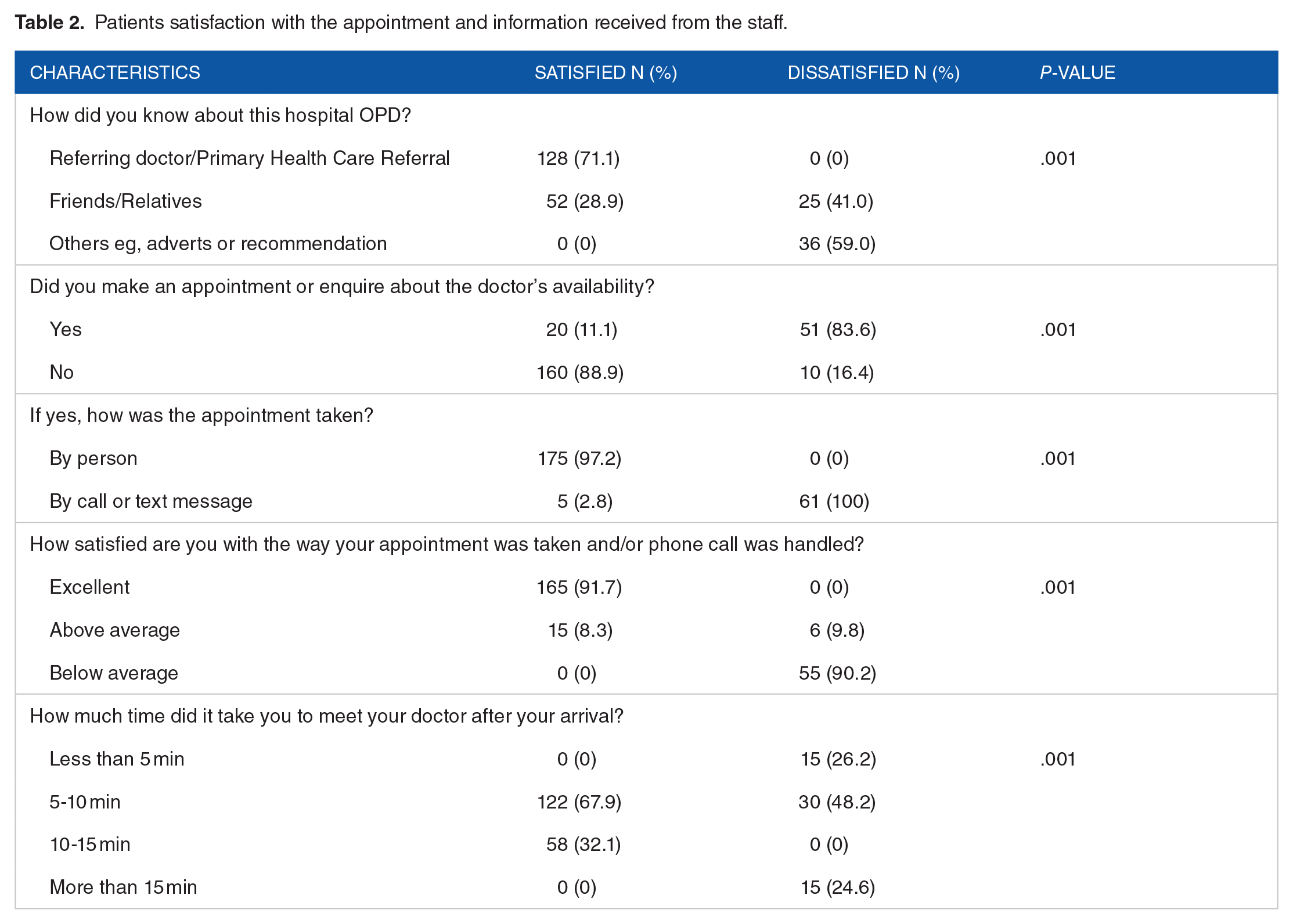
Interestingly, the majority of patients who made appointments or inquiries about doctor availability reported satisfaction, although there were some instances of dissatisfaction. Overall, the proportion of satisfied patients outweighed the dissatisfied ones. It is worth noting that none of the patients expressed dissatisfaction when making appointments in person, whereas the dissatisfaction ratio was higher when appointments were made via phone call, reaching 100%. Patients generally rated the response to phone call appointments as “excellent” (91.7%). However, a small percentage of patients were dissatisfied with phone call appointments. Among the dissatisfied individuals, 90.2% rated the appointment selection process on a phone call as “below average,” while 9.8% rated it as “above average.”
Regarding waiting time upon arrival at the OPD, the majority of satisfied patients reported waiting between 5 and 10 minutes for their turn. Additionally, 32.1% of satisfied patients had to wait for 10 to 15 minutes. Among dissatisfied patients, 48.2% waited for 5 to 10 minutes, while a few (26.2%) waited for less than 5 minutes. Furthermore, 24.6% of dissatisfied patients had to wait for more than 5 minutes. These findings support the observed statistical differences between satisfaction scores and waiting time upon arrival, further confirming the relationship between waiting time and patient satisfaction.
Discussion
This study aimed to explore the relationship between patient satisfaction and waiting time, as well as examine the potential demographic factors that could influence both patient satisfaction and waiting time. Surprisingly, the findings indicated that only about half of the patients expressed satisfaction with the waiting time. It is noteworthy that this level of patient satisfaction was relatively low considering the size of the sample.
The findings of this study revealed a significant relationship between satisfaction scores and waiting times, which aligns with previous research conducted in the Saudi region.1,13,14 These findings are also consistent with a previous Saudi study that reported a satisfaction rate of 60% with a waiting time of 14 (reference needed). Furthermore, the study identified statistically significant differences between waiting time and various demographic factors, including age, employment status, residence, and visit type. These findings are in line with both local and international studies,15-17 and Alhamad 18 also found a significant difference between these demographic factors and missed appointments.
International studies have explored the mean waiting time or its relationship with patient satisfaction. A survey conducted in the United States reported an average outpatient waiting time of over 30 minutes, suggesting that waiting times exceeding 30 minutes are not uncommon. 19 Other studies have indicated that patients tend to express satisfaction if the waiting time is around 30 minutes.20,21
The standard operating procedure for the outpatient department recommends specific waiting time benchmarks for different processes, such as laboratory examination, registration, and medicine dispensing. The findings of this study suggest that the waiting times slightly exceeded these benchmarks. Kumari et al 21 also reported waiting times ranging from 30 minutes to 1 hour for patients. However, our findings are consistent with their study, indicating that nearly all patients experienced some waiting time.
Longer waiting time has been consistently associated with decreased patient satisfaction in clinical practice. The Institute of Medicine has recognized that patient dissatisfaction is linked to extended waiting times and has recommended that at least 90% of patients should be seen within 30 minutes of their scheduled appointment.22,23
However, this study has identified certain limitations that should be acknowledged. Firstly, the study was conducted solely at a single hospital, limiting the generalizability of the findings to other healthcare facilities in Saudi Arabia. Therefore, caution should be exercised in applying these results to a broader population. Additionally, patients were interviewed during their medical consultations, which may have influenced their responses due to concerns about jeopardizing their medical care. This potential bias should be taken into account when interpreting the findings. Another limitation observed in the study was the relatively small sample size, resulting in several cells in the tables containing zero figures. Conducting the study with a larger sample size would have provided more diverse results and increased the reliability, stability, and generalizability of the findings. Furthermore, the study could have explored a wider range of demographic and socioeconomic factors to gain a more comprehensive understanding of their impact on patient satisfaction.
It is important to note that the findings may have been influenced by possible selection bias and the inherent unpredictability of the measures utilized in the study. To enhance the validity of future studies, alternative methods for minimizing these potential risks should be explored. While this study provides valuable insights into the relationship between waiting time and patient satisfaction, the limitations mentioned highlight the need for further research with larger and more diverse populations. By addressing these limitations and exploring alternative approaches, future studies can contribute to a deeper understanding of patient satisfaction concerning waiting time and facilitate the development of effective strategies to improve healthcare delivery.
Conclusion
The study findings indicate that waiting time varied among participants and across different clinics. Notably, the ENT clinic demonstrated shorter waiting times, which corresponded to higher satisfaction scores reported by patients. This suggests an opportunity for improving the quality of healthcare delivery by addressing waiting time issues. Hospital management should prioritize strategies aimed at reducing waiting times to enhance patient satisfaction. Furthermore, this study has explored the correlation between waiting time and satisfaction scores, highlighting the positive association between shorter waiting times and increased patient satisfaction at the ENT clinic. These findings underscore the importance of understanding the factors that influence patient satisfaction and provide valuable insights for future improvements.
To facilitate advancements in healthcare quality, it is recommended that hospital management actively addresses waiting time concerns, leveraging the study’s findings as a basis for implementing interventions. Additionally, policymakers and clinicians can benefit from future studies that measure patient satisfaction, as these insights can inform decision-making processes. Ultimately, the findings of this study can serve as a foundation for quality improvement programs within healthcare settings, guiding the integration of targeted interventions to enhance patient satisfaction. By prioritizing and addressing waiting time issues, healthcare organizations can make significant strides in providing better care experiences for patients.
Supplemental Material
sj-docx-1-his-10.1177_11786329231183315 – Supplemental material for Satisfaction of Clinical Waiting Time in Ear, Nose & Throat Departments of the Ministry of Health in Jeddah, Saudi Arabia
Supplemental material, sj-docx-1-his-10.1177_11786329231183315 for Satisfaction of Clinical Waiting Time in Ear, Nose & Throat Departments of the Ministry of Health in Jeddah, Saudi Arabia by Faris Ahmed Bahammam in Health Services Insights
Supplemental Material
sj-docx-2-his-10.1177_11786329231183315 – Supplemental material for Satisfaction of Clinical Waiting Time in Ear, Nose & Throat Departments of the Ministry of Health in Jeddah, Saudi Arabia
Supplemental material, sj-docx-2-his-10.1177_11786329231183315 for Satisfaction of Clinical Waiting Time in Ear, Nose & Throat Departments of the Ministry of Health in Jeddah, Saudi Arabia by Faris Ahmed Bahammam in Health Services Insights
Footnotes
Acknowledgements
The author is very thankful to all the associated personnel in any reference that contributed to/for this research.
Funding:
The author received no financial support for the research, authorship, and/or publication of this article.
Declaration of Conflicting Interests:
The author declared no potential conflicts of interest with respect to the research, authorship, and/or publication of this article.
Author Contributions
The sole author FAB is responsible for the conception, correspondence, analysis, methods, literature, drafting and approval of this research.
Ethical Approval and Consent to Participate
Approval was acquired from the Human Research Ethics Committee for performing the research in Saudi Ministry of Health Hospital in Jeddah and Directorate of Health Affairs, Jeddah.
Consent for Publication
Verbal consent was obtained from the patients while ensuring confidentiality and anonymity of collected data.
Availability of Data and Materials
The datasets used and analyzed during the current study are available from the corresponding author on reasonable request.
Supplemental Material
Supplemental material for this article is available online.
References
Supplementary Material
Please find the following supplemental material available below.
For Open Access articles published under a Creative Commons License, all supplemental material carries the same license as the article it is associated with.
For non-Open Access articles published, all supplemental material carries a non-exclusive license, and permission requests for re-use of supplemental material or any part of supplemental material shall be sent directly to the copyright owner as specified in the copyright notice associated with the article.
