



Abstract
Background:
Studying the organizational characteristics, factors and features in healthcare organizations will have its prompt in achieving the desired outcomes of the provided services. Addressing these variables, the subsequent study conducts a scoping review methodology to systematically evaluate existing information while focusing on conclusions and gaps representing organizational variables that have been shown to influence the management of healthcare organizations.
Methods:
A scoping review was performed to shed the light on the healthcare organizations’ characteristics, features and factors.
Results:
Fifteen articles were included in the final analysis of this study. Among the relevant studies, 12 were research articles and 8 were quantitative studies. Continuity of care, organizational culture, patient trust, strategic factors and operational factors are among the explored features that have an impact in the management of healthcare organizations.
Conclusion:
This review shows the gaps in the management practice and in the management studies that address healthcare organizations.
● Organizational effectiveness depends on the congruence between different structural characteristics.
● Organizational variables are a multidimensional concept.
● Research studies in healthcare focus primarily on issues related to defined outcomes.
● The gaps in the management or in the management studies address healthcare organizations.
● Variables in organizational epistemology that can more precisely describe its’ perception.
● Implications for administrators to focus on while implementing management interventions.
● Unknown variables that are influencing outcomes’ scaling and can be related to more indirect reasons such as context and adjacent factors.
● Concentrate on the involvement of higher and middle managers and how their involvement improves performance.
● Cohesive continuous communication between managers at all levels in HCOs’ management.
Background
According to the organizational contingency theory, organizational effectiveness depends on the congruence between organizational structural characteristics (such as centralization, formalization, and standardization1,2and organizational context or characteristics (such as ambiguity and complexity. 2 This states that organizational success depends not only on mono-structural and contextual characteristics, but also on the congruency of both. 3 The organizational variables are then determined by the adjacent circumstances that organizations are confronted with. In addition, the level of investigation is not uniform: organizational characteristics can be evaluated at the level of the whole organization (strategical) and also at unit level (operational).
Organizational variables are a multidimensional concept including size, ownership, culture, and staffs’ psychological work reactions such as job satisfaction, 4 innovation rate or patient well-being. 2 Hence, its’ effectiveness is equated to various aspects of healthcare organizations (HCOs) characteristics. Research studies in healthcare literature focus primarily on issues related to defined outcomes and less on those organizational features or characteristics’ differences of organizations. In organizational science, one of the key interests is to examine the impact of organizational characteristics on organizational outcomes and psychological outcomes of humans. 3 Awareness of these relationships is both supposedly and functionally essential, as the organizational characteristics will decide and form the task profiles of employees and influence the job reactions of staffs. 3
The extent to which HCOs may adopt variables affecting the management and evidence-based practices, is not yet the focus of many research studies. This research offers a systematic way of thinking about individual and organizational experiences within healthcare settings. It goes beyond having a prioritized list of organizational considerations and features that may flag up questions about quality of service, risk of maltreatment, or evidence remedies through presence or absence in specific circumstances. The healthcare research needs to pay careful attention to the most relevant factors, strategic factors and operational factors. It also has to consider ownership, scale, trust dimensions that are critical to understanding the organizational studies rather than the outcomes of HCOs.
Methodology
This study examines HCOs by employing scoping review methodology. A “scoping review,” is defined as a review of the literature that purposes “to map quickly the crucial perceptions supporting a research area and the foremost sources and categories of evidence existing expressly where an expanse is multipart or has not been revised broadly earlier.” 5
This type of scoping review may not aspect explicit conclusions from studies, but as an alternative envision accessible information within the boundaries of the research area. 6 Following the scoping review methodology designated by Arksey and O’Malley, 6 data were composed and investigated over steps, designated as below;
- The main review question was: “The research question for this scoping analysis is, what is known about factors, characteristics, and features affecting the implementation and management practice in HCOs and gaps are needed to focus on more from the current exist literature?”.
- A systematic, comprehensive bibliographic search was carried out in PubMed, Science-Direct, Scopus and Emerald databases for all articles. Search terms “organizational characteristics”; or “organizational factors” or “organizational features” and “healthcare organizations.”
Four major inclusion criteria were adopted (Figure 1):
Published papers
Papers with full access possibility
Papers written in the English language
Published between 2000 and 2019
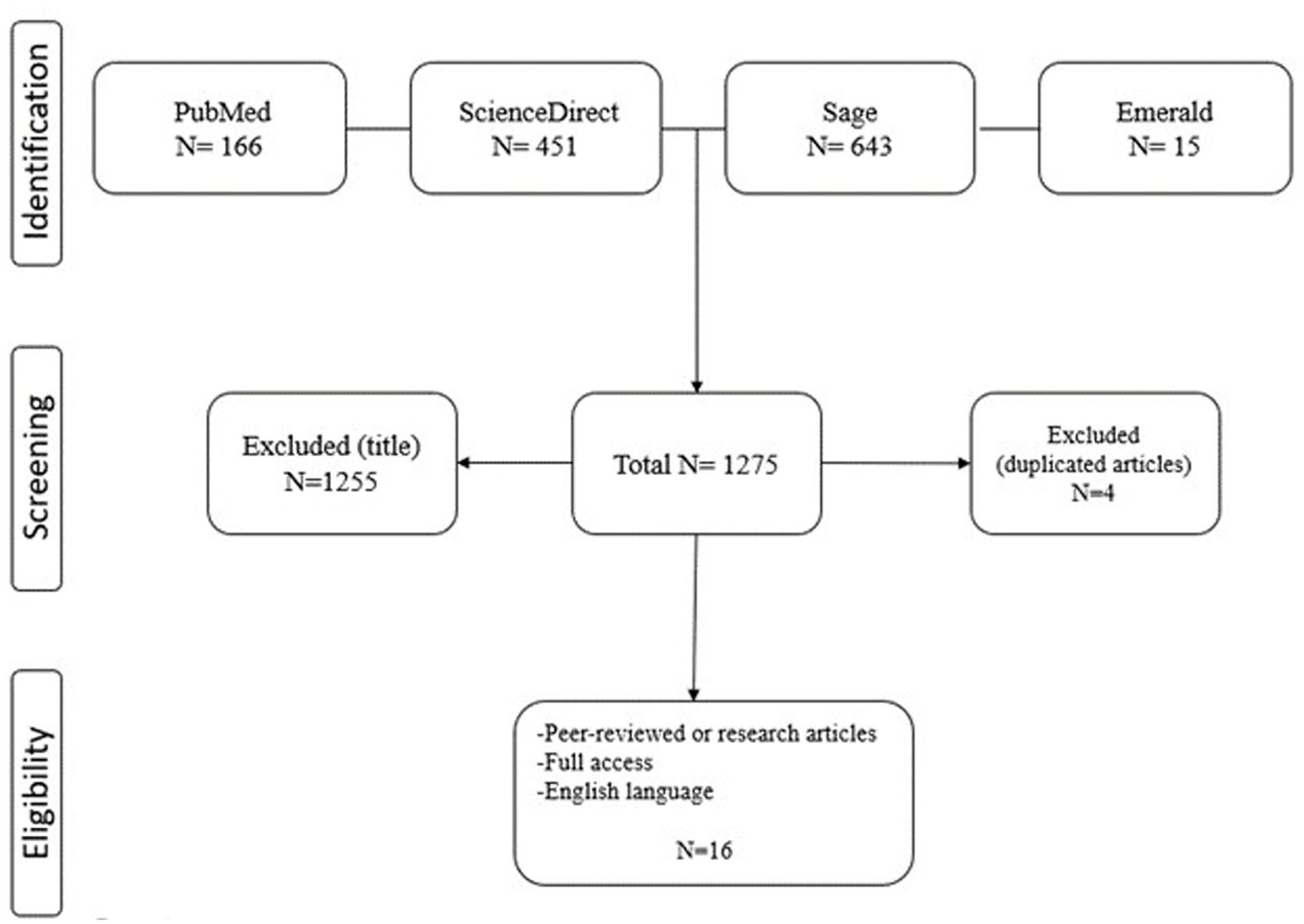
Prisma flow chart of the literature review search.
Studies that did not match the aforementioned requirements were excluded, while those that did were listed and subjected to further evaluation. Studies were assessed and given a critical review. Literature screening (a multiple process involving selection by reviewing the title, abstract, and full text of each retrieved paper) and extraction of main findings. Each of the studies that were included had the relevant information extracted (Table 1): title, authors, country, research approach, subjects, research goal, and key findings.
An overview of studies’ characteristics and main findings.

- Any tendency that can be endorsed at an organizational level is referred to by the terms “characteristics, factors, and features” including but not limited to staff behavior, service delivery processes, policy, and how an organization behaves in relation to its surrounding environment. According to Arksey and O’Malley, 6 who advise using a broad definitional approach, “search words can be modified and reduced later to handle bibliographic references once the entire depth of information within a certain topic is attained.” This methodology displays a “descriptive-analytical” approach to graphing, because it provides a popular analysis framework to all studies, which is recognized as the standard practice in scoping reviews. 6
Organizational Variables and Factors in Healthcare
Organizational variables and factors directly or indirectly influence the efficiency of healthcare organizations. This refers to healthcare systems in cases characterized by multiple encounters between patients and staff, requiring interpersonal participation due to the nature of the program being implemented. Much work in healthcare facilities is limited to a few organizational variables, such as the level of employment, for-profit level, ownership, size and to-bed ratio of nurses.21-23 Nevertheless, these earlier studies do not address common key organizational variables that are likely to affect healthcare personnel, service delivery, organizational behavior and overall service quality.
Organizational variables are different organizational situations that affect the actions of the process of an organization. While research is wide-ranging on organizational variables, the main theory is that organizational variables influence workers and service outcomes, which in turn impact patient satisfaction. 24 Organizational driving factors within an enterprise may considered to be organizational characteristics, procedures, or circumstances. Organizational factors influencing cooperation may include “structure and culture, team resources and administrative support, as well as processes of communication and teamwork.” 25 Moreover, organizational variables represent organizational strategies and can carry out organizational operations. Examining and monitoring organizational variables direct all organizations in coping with everyday routine procedures. Well-understood and managed HCOs can minimize costs and produce better outcomes by targeting objectives and targets, with professionalism and technical experience. 24
Continuity of Care
Throughout time, continuity of care affects the standard of treatment. Two important viewpoints exist in this regard. 26 Traditionally, in the patient’s understanding of a “continuous caring relationship” with an established healthcare provider, quality of care is idealized. The disparate goal for providers in vertically integrated care organizations is the delivery of an ideal environment through collaboration, communication and knowledge sharing between various professionals and units. As healthcare needs of patients can now only hardly be fulfilled by single qualified, multidimensional continuity models have had to be established to assimilate the likelihood of goals being achieved concurrently. 26
From the viewpoint of the healthcare providers claims, the emphasis is on better patient outcomes. This description again includes the continuity of treatment over time, but here the emphasis is on the degree of communication and quality between different types of treatment and between different staff members. 26 Unlike other healthcare quality models, which typically consider treatment evaluations at a single point in time, the definition of continuity of care incorporates a longitudinal dimension. 27 Continuity of treatment may embrace issues of access, feasibility and effectiveness as indicated by the concept of the American Academy of Family Physicians. 28
Continuity of treatment is assumed to occur, if it is given in a supplementary manner within a reasonable period of time. Continuity refers to the integrated, rational and timely delivery of treatment by the various providers. 29 The scope of public health issues and the effective utilization of resources requires a multidisciplinary and inter-institutional approach, which makes collaboration between HCOs critical, allowing for regional action at the prevention levels. 30 Continuity of service starts at the facility where the individual is attending, which contributes to the need to develop connections and bring the early planning of the discharge into action. There are several advantages associated with continuity of care including greater probability of combining the physical, psychological, social and economic dimensions, enhancement of the relationship between patients and care providers, decrease in the excessive utilization of health facilities and eventual cost reduction.
Collaboration With Other Organizations
There is a remarkable lack of a common definition of what it means to collaborate and enhance collaborative work. Definitions are often tailor-made to a certain context. 31 Some definitions in the research specify that collaboration comprises several people cooperating to accomplish a mutual goal 31 that involves social efforts and task inputs. 32 It is “an energetic and current partnership between professionals and institutions with miscellaneous experiences that dictates who work together to afford services.” 33 It includes building a collaborative effort to resolve diverse patient needs as well as an interprofessional working partnership involving respect and trust. 34 Common trends in those concepts indicate that collaboration is an integration of activities and information that involves a mutual authority and responsibility relationship.
Four basic elements that Sullivan 35 identified, provide a valuable overview of behaviors and arrogances that together create collective practice in healthcare; 1. Coordination (working toward common objectives), 2. Cooperation (contributing to a crew, recognizing and esteeming other team members’ charities), 3. Shared decision-making (based on negotiation, cooperation, transparency, confidence and a fair balance of power), 4. Partnerships (open, cooperative partnerships which have been established over time, in which all members work together fairly).
Organizational Culture
Organizational culture (OC) is a notion that has roots in a number of academic fields, including management, sociology, and anthropology. 36 The significance of culture for important organizational effects has recently come under more discussion 37 due to fresh interest in healthcare organization. However, “culture is a system of shared values defining what is essential, and norms defining attitudes and behaviors that guide member’s attitudes and actions” according to O’Reilly and Chatman. 38 As Schein 39 proposed: “Organizational culture is the set of shared basic assumptions—invented, discovered, or developed by a given group as it reveals to deal with the challenges of external change and internal integration—that have worked sufficiently well to be functioned and consequently to be instructed to newcomers as the accurate way to perceive, believe, and feel in relationship to those difficulties.” There are many qualitative and quantitative methods that measure OC depending on the purpose and goals of each investigator. 40
Based on the competing values framework, HCOs’ overall cultures (hierarchical, competitive, decentralized, or collaborative) were categorized. One consistent thread among several performance categories was the dedication to an important aspect of the organization’s culture and principles, especially in the face of difficulties in providing high-quality healthcare.
There were several common patterns, even though there was not complete agreement on cultural traits throughout HCOs. These included a culture of continual quality improvement, an emphasis on desires being at the center of care decisions, loyalty standards, and a sense that employees were encouraged to speak up and make judgments. Thus, facilities in this group testified that staff affiliates were more creative and can learn easier about new changes of healthcare.
Size and Ownership
Previous research found that the sizes of HCOs have an adverse effect on patient ratings.23,41 Many studies have indicated that the larger the scale (size) of the organization the more properties will be used to introduce new technology of information. 42 Hospitals with different scales have a different attitude toward investing in the information system and its use in the healthcare industry. For example, Furukawa et al 43 have pointed out that the hospital scale is an important health information technology (IT) adoption factor for treatment safety. Grover and Goslar 44 also believes that larger organizations, having more resources and greater capacity to address risks, are founded on a stronger basis. An organization will be able to adopt innovative technology after growing to a certain scale.
Organization growth may produce changes in organizational factors that may increase the chance of instability. Usually, mid-sized organizations may be at greater risk of failure because they cannot compete effectively with smaller or larger organizations. 45 Because of their many advantages, large organizations are desirable to workers. 46 Conversely, in small organizations, workplace benefits are often more restricted, and contracts with suppliers are less favorable. These differences suggest a “liability of smallness” 47 - small organizations are more likely than large organizations to fail. 48
Patient Trust and Clinical Trust
Trust has long been recognized as crucial to the patient-clinical relationship. 49 Research from management literature indicates an essential aspect of a well-functioning organization, is organizational trust. 50 Linzer et al’s study 51 identified working conditions correlations (eg, disorder, lack of control, time pressure) and patient results for the providers (eg, quality and safety). The confidence of patients in their healthcare providers is fundamental to clinical practice. 52 The General Medical Council 53 states that “Patients must be able to trust doctors with their health and lives, and keeping patients' trust is one of the fundamental rules for doctors to follow.”
Patients must trust their healthcare providers to work in their best interest and result. 54 Trust in the healthcare provider has been proposed as the basis for successful therapies 55 and vital to patient-centered care approach. In addition to such a deontological responsibility for trust theoretical models, mechanisms explain how trust can influence health outcomes. 56 Empirical evidence on this topic comes from an increasing number of studies revealing associations between trust levels and the outcome of patients’ safety. The health results in the different studies include multiple metrics, such as objective assessed measures, clinical findings (eg, clinical diagnoses), 57 and patients’ subjective self-ratings (eg, patient satisfaction). 58
It has been found that the relationship between trust and health outcome varies across individual studies. For example, in a study of diabetes patients, confidence in the healthcare provider has been shown to be absolutely linked to objective and subjective health results (glycemic management, life quality related to health, and patient satisfaction). 59 Empirical validation of the supposed correlation between confidence and health results will reinforce the arguments for trustful and patient-centered relationships in clinical settings that have been ethically established. 60
Strategic Factors
HCOs today face a variety of problems due to 2 main factors: growing difficulties in slowly satisfying, a more “conscious” and demanding customer. A gradual rise in sophistication and personnels’ capacity, does not guarantee works’ basic requirement to deliver what its clients really need. It is therefore time for an approach to be based on, (i) optimizing patient satisfaction by delivering the best outcomes at the lowest cost, and (ii) transitioning to an “organization-driven” care process.
Complex systems, however, are naturally conventional and rather resistant to change and this concept is no exception to the healthcare system. The strategy for transitioning to a high-value HCO now requires many variables; the pathfinder’s aim is to have a vision, identify the directions that the organization will be pursuing in the long run, and mark the path for those who follow. 61 Visions need to be transformed into “action plans” to efficiently envision the future and promote the pursuit of organizational excellence. 62
Strategic management is a course of action to achieve the mission of the organization and strategic long-term objectives using a realistic, logical, and structured approach. It includes assessing an organization’s internal and external dynamics to identify the strategic role of the organization, determining its long-term strategy, identifying a clear vision, creating practical long-term aims, formulating strategies, methods, policies and allocating the resources required to execute action plans and evaluating organizational performance. 63
Implementation of the strategy involves allocating resources to execute action plans, changing the organizational structure and culture to suit the objectives and undertaking the adjustments needed to achieve the priorities and goals. Finally, the evaluation of the strategy is troubled with measuring organizational performance, in contrast to distinct strategic goals, and also requires implementing curative activities which can guarantee thstrategies are effective. 63 However, if strategic planning is not performed, then HCOs may become obsolete or even cease to exist in a few years. 64
Operational Factors
The healthcare sector was reluctant to embrace the latest approaches to performance assessment. 65 It is due to this industry’s characteristics because it has various divisions, such as the divisions of primary, secondary and tertiary health services. One sees for-profit, non-profit, and government-owned organizations vying for the patients with each other within the last 2 type. 66 As such, some HCOs are starting to implement creative performance measures and assessment methods. 67 Other organizations seek to adopt these measurement approaches in their specific operational organizational environments. 68
However, some of these exertions have been hampered by the failure of HCOs to implement the required changes dictated by their exclusive operational features. Some of those distinctive qualities are highlighted as differences amongst organizations as a result of the various functions they perform in this sector. For instance, hospitals with well-defined boundaries, where patients are enrolled and discharged are included in the scope. Additionally, it incorporates open community-based primary healthcare groups with no clearly defined boundaries. 69 This makes indicators of success and evaluation sensitive to the public position of the organization and the limitations placed on its operations. Therefore, the assessment of patient satisfaction is complicated due to specific services and patient contexts.
Thus, investments by HCOs aimed at improving operational efficiency and the productivity of workers will contribute to improvements in results. However, to enhance the overall efficiency of the operating structure, these investments and actions need to be incorporated. As such, this platform focuses mainly on performance metrics which have a crucial effect on the success of organizations. Consequently, this platform’s steps have to be aligned with strategic metrics intended to gage the organization’s performance on the marketplace. 70
Discussion
A scoping review was chosen due to the broad nature of the concept and to capture the expected variety in the published information on HCOs’ variables. These findings are important as HCOs strive to enhance staff satisfaction and improve patient outcomes in rapidly shifting healthcare environments. This study has a particular value, as it addresses organizational characteristics, factors and features in healthcare. Better awareness of the associations of variables of HCOs would allow organizations to prioritize initiatives to improve the desired results as well as the quality of service. We performed a scope analysis of various methodological studies to (1) estimate the overall considered variables of the HCOs (2) explore unconsidered variables where managers of HCOs need to be conscious of these factors.
Strategic and operational aspects, with a focus on size, ownership, culture, collaboration, and trust were important organizational characteristics related with the desired objectives. In order to provide employees with a sense of strategic decision and denotation in their work, organizations should make validation of their mission and values is available. 71 According to the author and from the perspective of organizations, HCOs are places where there is a range of interests among the staff, scattered power, and work that is centered on professional expertise. Through casual conversation, dialog, and the tailored care given to each group, the countercultures in this setting have mostly been eliminated or reduced. The implementation of the concentration on multidisciplinary work, was one of the most important outcomes in this regard. HCOs should also encourage employee participation incentives, to provide them the freedom to manage their own individual variances. 9
Depending on their perspectives, some scholars have traditionally approached the topic of organizational effectiveness from either the strategic or operational levels. However, a lot of possessions influence and shape the organization before it offers any services to patients. Some of the gaps in research on health services can be filled by comprehending the many organizational and other factors that impact managerial experience. Recognizing the impact of organizational characteristics and determinants on both, the service production process and patient perceptions, is essential for performance gains in the healthcare sector, where competition has increased. 20
This review offers a framework for methodically considering various organizational variables in the context of HCOs. This shows that there is more to organizational aspects than just presenting a prioritized list. In some circumstances, organizational presence or absence may signal issues about care quality, safety risks, or management. Researchers and managers of HCOs should focus on organizational variables that have not been intensively investigated previously, to close the gap in management practice and research in this precise area.
Gaps and implications for research
It is clear that studying HCOs are required to implement best-practiced management to gain the desired outcomes. However, there is not many well-defined existing research on how HCOs’ evidence-based practices may be replicated by other organizations. Some existing studies do not have detail clues for other studies on how the organizational variables can affect the results and outcomes of their research.
Implications for practice
Variations have been found on how HCOs are being studied and to what degree the current literature has grasped this. The descriptions of HCOs’ characteristics focus on major concepts. Strategies to moderate-term changes and continuity of learning, should be considered for a better understating of healthcare services. This enlightens the start-point to change in the face of growing awareness of work-related factors and professional features among organizations’ staffs, as well as a shift in policy toward evaluating HCOs performance.
On the other hand, other managers need to identify the principles of social relations within an HCO, because this influences the degree of shared knowledge and actions of the organization. The healthcare settings also required to tackle the communication and engagement gap in this regard. Due to the limited attention paid to the degree to which healthcare staff trusts the organizations in which they operate, and the correlation of mistrust with the success of the organization and the outcomes of services, more efforts were needed from the high level organizational managers in this regard. The relationship between organizational characteristics and psychological reactions in HCOs, is a big gap that still needs efforts to be worthy explored. However, the sharing of information in HCOs increased the quality of service, which required professional network formation and well-trained health staff. This collaboration necessitates multi-disciplinary teamwork. Therefore, comprehensive and differentiated sources of available evidence have to be produced.
Implications for research
The author emphasizes the need to focus deeply more on organizational characteristics, factors and features (as continuity of care, collaboration with other organizations, organizational culture, strategic factors, operational factors, etc.) in studies targeted HCOs, before directed their research studies’ toward results and outcomes (as organizational communication, organizational commitment, etc.). However, other factors may be undefined variables predicting outcomes’ ratings that can be related to more indirect explanations such as context and environmental factors, which required not to be neglected in our discussions’ and conclusions’ analysis.
This research can attract some HCOs’ scholars to be aware of the most dynamic variables in their conducted studies, in addition to the benefit of strategic and operational management factors dimension for their research in such complex social organizations. Further studies are required to attract the involvement of higher and middle managers or low levels, to profoundly recognize how their involvement greatly affects performance and routine work as a part of strategy building and operation implementation. Other research has to show the roles of cohesive continuous communication between managers at all levels in HCOs’ management and especially in transformation time or initiatives.
Moreover, situational factors refer to the organizational features that affect staff’s trust toward their organizations, are countless and unavoidable. Major aroused situational factors include demands, clinical programs, available time, and technological factors. The studied outcomes may compete with patient care needs or the required service quality. This required to be considered in HCOs’ research studies and considered in their analysis.
The author suggests that further studies are needed on the existing subcultures as a source of problems to integrate and enhance health services. Given these findings, the author recommends that increased attention be devoted toward the characteristics, factors and features of HCOs, is mutual psychometric standards. Additionally, there is a need for the development and testing of measures in various contexts and among various population samples.
Conclusion
Numerous research papers have not yet concentrated on the degree to which HCOs may embrace characteristics that affect the HCOs management practices. There are many variables in organizational epistemology that can more precisely describe perception of the organization. HCOs’ problems could be exacerbated if one factor could undermine another, thus limiting the efficiency of management and reducing the quality of healthcare practice. This scoping review contains updated implications for healthcare administrators and providers, to consider which factors and characteristics to focus on, while adopting and implementing management interventions and the best evidence-based practices regarding the HCOs’ own specifications.
Contrary to other healthcare quality approaches, which take judgments at a particular point in time, the concept of continuity of care includes advantages of long-term dimension feature. Separately, from this normative issue for hypothetical expressions of trust, processes describe how trust may affect health outcomes. Moreover, if strategic planning is not done well, HCOs could become obsolete or perhaps go extinct in near times. HCOs make efforts aimed at enhancing operational effectiveness to improve the overall measures that must be integrated and matched with strategy metrics.
The goals of this scoping literature review are to convey practical recommendations to healthcare scholars, administrators, and practitioners, as well as to highlight conclusions and show road maps relating to the study issue. Healthcare administrators must be mindful of the heterogeneity of organizations and perceptions in their social realities and should engage in critical, transparent and integrated approach to guarantee the best role of management. In supporting recommendations from management studies, HCOs are needed to be regarded as a special characteristics-based organizations that are promised to give that best practice in healthcare management.
Footnotes
Acknowledgements
By completing this statement, the corresponding author acknowledges and accepts the responsibility on behalf of all concerning Authorship Responsibility, Criteria, and Contributions; and Financial Disclosure; and Copyright Transfer. I certify that I read the Guide for Authors and ensured the manuscript follows all its recommendations. I certify that the manuscript comprises original, unpublished materials that are not under consideration for publication elsewhere.
Funding:
The author received no financial support for the research and/or authorship of this article.
Declaration of conflicting interests:
The author declared no potential conflicts of interest with respect to the research, authorship, and/or publication of this article.
Author Contributions
The corresponding author is the sole author who designed the study, analyzed the data, wrote the manuscript and revised the final draft.
Ethical Statement
The study did not require an ethical board approval because it is only a scoping review paper.
Consent Statement
NA.
