




Abstract
To access the relationship between job satisfaction and turnover intention of preventive medicine workers in Vietnam, we conducted a cross-sectional study using a purposive convenience sample of 12 preventive medicine centers in 3 provinces of northern Vietnam (Hai Duong, a plain province, Yen Bai, a mountainous province, and Hanoi, the capital of Vietnam). Overall, 400 preventive medicine staff were invited to participate, and 383 questionnaires were analyzed (153 from 3 provincial centers and 230 from 9 district centers). All eligible participants completed the questionnaire, which included questions relating to general information, job satisfaction, intention to quit. We identified significant associations between turnover intention and personal factors, including age, marital status, education level, professional degree, and length of employment at the current center. The bivariate analysis also indicated that job satisfaction had an inverse relationship with turnover intention, as expected. The correlations varied between facets and overall job satisfaction, from −0.19 for community support to −0.37 for overall job satisfaction. These correlations remained significant after controlling for personal factors using hierarchical multiple regressions. The results indicated that facet and overall job satisfaction were significant predictors of turnover intention, while overall job satisfaction was the strongest predictor (β = 0.37, P < .001). This study could contribute to local system development and the international understanding of job satisfaction and turnover intention among preventive medicine workers. Addressing the aspects of job satisfaction that were found to have the lowest scores may help the preventive medicine system to retain staff.
Introduction
Preventive medicine staff are key workers of Vietnam health system. Provincial and district preventive medicine centers are responsible for preventive services such as communicable disease control, non-communicable disease control, environmental sanitation, injury and accident prevention, and immunization. They come from various professional backgrounds such as medicine, nursing, public health, epidemiology, and pharmacy. Their education levels vary from the professional training level to holding a university degree. According to the 2009 statistics, the whole country had about 16 500 health workers in the field of preventive medicine at central, provincial, and district facilities. By 2011, this number reached approximately 17 100 staff, an increase of only about 3.5% compared to 2009, showing that growth in the number of human resources for preventive medicine is, in general, still very modest.
Job satisfaction is likely to be a causal factor in turnover intention and actual turnover of workers. Larrabee et al 1 found that overall job satisfaction was a main predictor for quitting intention among registered nurses. Similarly, Singh and Loncar 2 surveyed registered nurses and found that job satisfaction was a major predictor of nurses’ turnover. Many other studies support this inverse relationship between job satisfaction and turnover3-7 which confirmed that high job satisfaction leads to low scores of turnover. 8
However, the correlations between job satisfaction and turnover intention vary across facets of job satisfaction, worker groups and countries. For example, a study by Gurková et al 9 among 1055 hospital nurses in the Czech and Slovak Republics found that the correlations were between −0.22 and −0.30 across facets of job satisfaction. In another study among 327 registered nurses in the USA, Eberhardt et al 10 found that the correlation between overall job satisfaction and turnover intention was −0.50. Although actual turnover only occurs when employees who are thinking about quitting the job have an alternative job,11,12 the intention to quit is strongly correlated with actual turnover, thus it has been used to measure turnover.2,13
In summary, the literature indicated that high levels of job satisfaction may reduce the turnover rates of health workers2,5,8,14 and help workers perform more effectively. 15 Moreover, each facet of job satisfaction could have their own effects on turnover intention. Overall job satisfaction was assumed to have a negative impact on turnover intention. 16
To date, there have been few studies undertaken regarding the relationship between job satisfaction and turnover intention among health workers in Vietnam and all of the studies were conducted in hospital or primary health care settings, not specific on preventive medicine workers. Thus, the relationship between job satisfaction and turnover intention amongst preventive medicine workers in Vietnam was in need explored.
Methods
Study design
This was a cross-sectional study using a quantitative data collection method.
Study local context
The survey was implemented in the district and provincial preventive medicine centers in 3 provinces, including Hanoi, Yen Bai, and Hai Duong. Hanoi is an urban city and the capital of Vietnam, Hai Duong is a well-developed plain province, about 70 km from Hanoi. Yen Bai, approximately 300 km from Hanoi, is a less-developed mountainous province. These provinces were chosen in order to maximize the regional diversity of the preventive medicine staff. There are 3 provincial, 15 urban districts, and 31 rural district centers in the city and provinces. About 900 staff work in the 49 centers.
Sampling
The sample was obtained using a convenience method. There are 3 main categories of provinces in northern Vietnam, including mountainous, plain, and urban provinces. Thus, it was decided to choose 3 provinces representing these 3 categories (Hanoi is the capital and urban city, Hai Duong is a plain province, and Yen Bai is a mountainous province). Three provincial centers and 9 district centers (2 in Hanoi, 3 in Hai Duong, and 4 in Yen Bai) of the 3 provinces were involved in the survey. Staff at the centers who were not working as a director, a deputy director, a supervisor, an accountant, a driver, or administrative staff, were invited to participate in the study. Given all preventive medicine centers are government-operated agencies and operate under the same structure and policies, the selected centers could be seen as representative of all preventive medicine centers in northern Vietnam. The sample size for the survey was set at 400 participants. This sample size was considered big enough for an organizational survey as suggested by Barlett et al. 17
From the 12 preventive medicine centers in the 3 provinces involved in the survey, 400 eligible participants were invited to complete the questionnaire. A total of 389 questionnaires were returned to the research team, of which 6 were judged to be incomplete because they had 2 or more blank pages. The final number of records for the analysis was 383 (the response rate was 95.7%).
Recruitment procedures
To recruit participants, the researcher first contacted the directors of preventive medicine centers in the selected provinces to explain the project and activities which would be undertaken at their own centers and gave them an Acceptance Letter for Conducting Research. Those allowing the researcher to collect data at their own centers would sign the letter and fixed the date and time for data collection. Afterward, the director introduced the research team (including the researcher and 2 assistants) to his/her staff. All staff of the center was given the Participant Information Sheets and the instrument attached with a pen and a blank envelope. They were assured that no one except the researcher could assess their completed questionnaire. Those agreeing to join the research completed the questionnaire, put it in the envelope, and returned the envelope to the researcher.
Instrument for data collection
Demographic information was collected, including gender, age, education level, professional degree, job tenure, marital status, number of children, having a second job, and distance from home to work.
The instrument used for the survey was a questionnaire that was validated and published previously. 18 The Cronbach’s alpha coefficients of individual dimensions and the whole instrument ranged from 0.684 to 0.854. The test–retest reliability coefficients over 5 days were 0.732–0.937, showing that the instrument had good test-retest reliability over a short period. The instrument consisted of 34 items and 8 facets, including pay and benefits (7 items), reward and recognition (6 items), supervision (4 items), community support (4 items), working conditions (3 items), communication (4 items), co-workers (3 items), and nature of the job (3 items). Each item is a 6-point response, from 1 (strongly disagree) to 6 (strongly agree). A score for each facet was the average score of the facet’s items. An overall job satisfaction score was calculated by averaging out the summed score of all of the facets and also published previously.
Score on turnover intention was gathered by asking respondents 3 questions adapted from Michaels and Spector. 19 This included questions asking how often respondents seriously thought about quitting their job, whether they wanted to quit, and whether they actually were planning to quit. Each question is a 5-point response, from 1 (never) to 5 (very often). A single score of quitting intention was an average sum of scores of the 3 items. Higher scores reflected a higher turnover intention.
Data management
Data management steps were conducted to ensure quantitative data integrity, including: (1) A coding manual was developed for the survey data; (2) All returned questionnaires were checked and cleaned for inconsistent responses and non-responses before the data entry. (3) Data were entered into Epi-Data version 3.1. Ten percent of the collected questionnaires were entered for a second time to double-check entry error. (4) The data were analyzed using the Statistical Package for Social Science (SPSS) version 20.0.
Variables were checked for normal distribution (for continuous variables), invalid response codes, and the frequency of missing data. Any records having missing data or invalid responses were checked against the original questionnaire. Facet job satisfaction, overall job satisfaction, turnover intention was measured as continuous variables. They were checked for normality and the results showed that they were all normally distributed. Personal factors were categorical variables.
Data analysis
Descriptive analysis was used to explore the characteristics of the respondents. Independent t-test, analysis of variance (ANOVA), and Kruskal-Wallis H test (if assumption of homogeneity of variances for ANOVA was violated) were employed to explore associations between job satisfaction and intention to quit. Correlations were used to check relationships between job satisfaction and intention to quit. Hierarchical multiple regression was applied to examine the relationship between job satisfaction and worker’s turnover intention when controlling for possible personal factors.
Ethics approval
The ethical clearance application for the quantitative survey was approved by the Human Research Ethics Committee of Queensland University of Technology (Ethics Variation Approval No. 1200000682) and the Research Ethics Committee of Hanoi School of Public Health (Ethics Approval No. 004/2014/YTCC-HD3).
Results
Personal characteristics of the participants
Table 1 shows the demographic characteristics of the respondents. Females made up 62.9% of the sample. Ages were categorized into 4 groups. The largest group were between 20 and 29 years (37.3%), followed by those aged between 30 and 39 years (30%), nearly 1 in 5 (19.6%) were between 40 and 49 years, and 13.1% were over 50 years. Most respondents had children (76%).
Gender, age, marital status, number of children and education level of respondents.

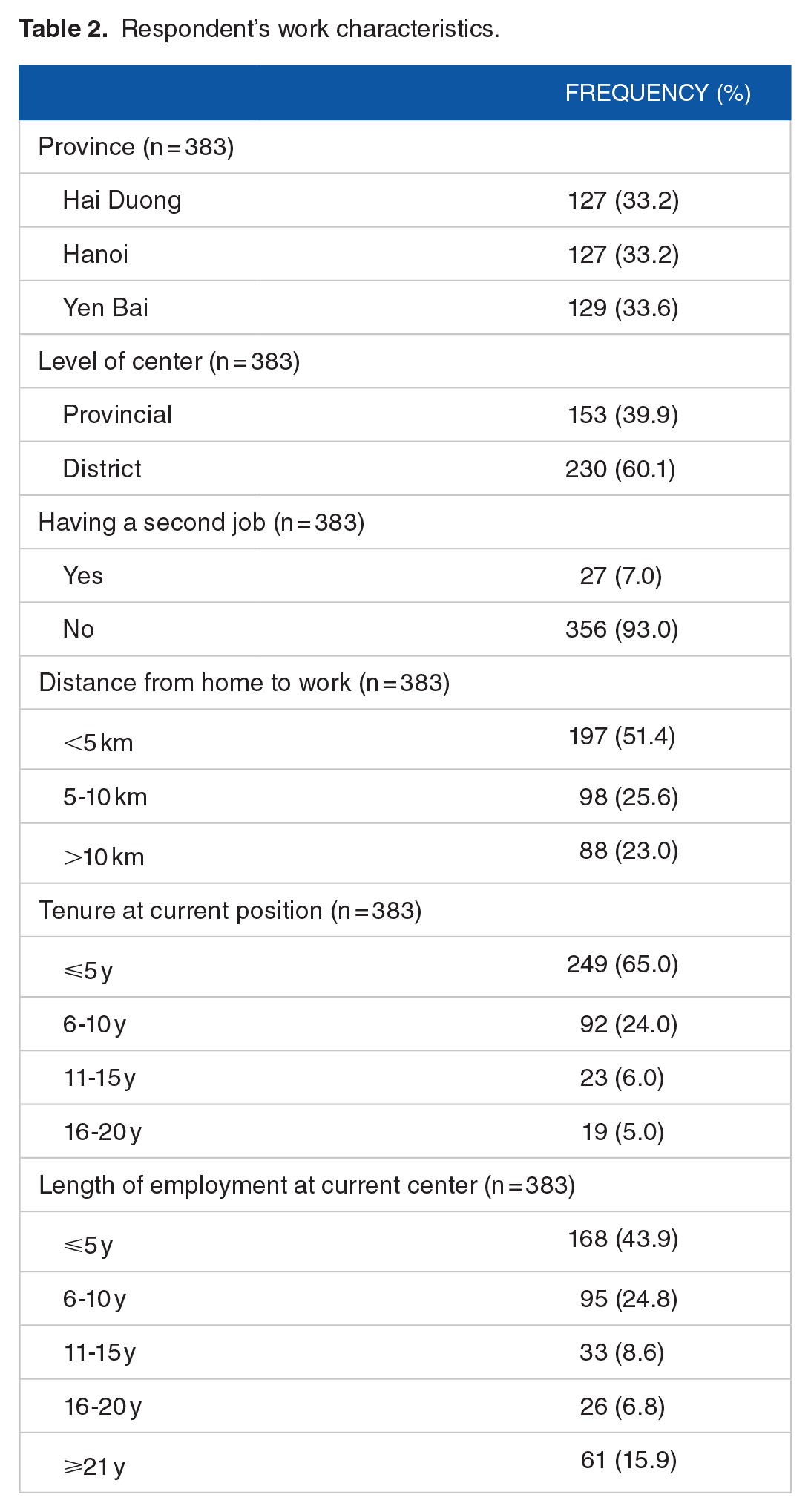
Work-related characteristics are presented in Table 2. Most participants were working at district preventive medicine ercenters while the remainder were at provincial preventive medicine centers. Most respondents did not have a second job. Just over half were living less than 5 km from their work center, while nearly 1 quarter lived more than 10 km from their workplace. Job tenure of the respondents ranged from 1 to 20 years, although two-thirds had worked for less than 5 years at their current job. A small number of the respondents had worked for between 11 to 15 and 16 to 20 years.
Respondent’s work characteristics.
Turnover intention
The turnover intention score mean of respondents was 2.12 (SD = 0.83). The results presented in Table 3 shows that age was significantly associated with turnover intention. Employees over 50 years old had significantly lower turnover intention than those between 20 and 29 years old. Married workers were more likely to express intention to remain in the job than single workers. Workers with a professional training degree had lower turnover intention than those with a bachelor’s degree and people with an employment length of fewer than 5 years had higher turnover intention than those who had worked over 21 years. Turnover intention was not significantly different by gender, number of children, center level, second job, distance from home to work, and tenure at current job.
Associations between turnover intention and personal factors.

Reference category.
Post-Hoc test P < .05. **Post-Hoc test P < .01.
Job satisfaction and turnover intention
The survey assessed 8 facets of job satisfaction and overall job satisfaction. The scores ranged from 1 (the least satisfied) to 6 (the most satisfied). Table 4 shows the mean scores and standard deviations of facet and overall job satisfaction of the participants. Satisfaction with pay and benefits (Mean: 3.81, SD: 0.76) was the lowest, while satisfaction with the nature of the job had the highest score (Mean: 4.81, SD: 0.56). Turnover intention was measured using 3 items. Each item had a 5-point option, from 1 to 5. Scores of intention to quit were the average values of the 3 items. Higher scores of turnover intention reflected higher turnover intention. Table 4 shows that all facets of job satisfaction and overall job satisfaction had inverse relationships with turnover intention. The correlations ranged from −0.19 (community support) to −0.37 (overall job satisfaction).
Levels of job satisfaction, bivariate analysis of correlations between turnover intention and job satisfaction (n = 383).

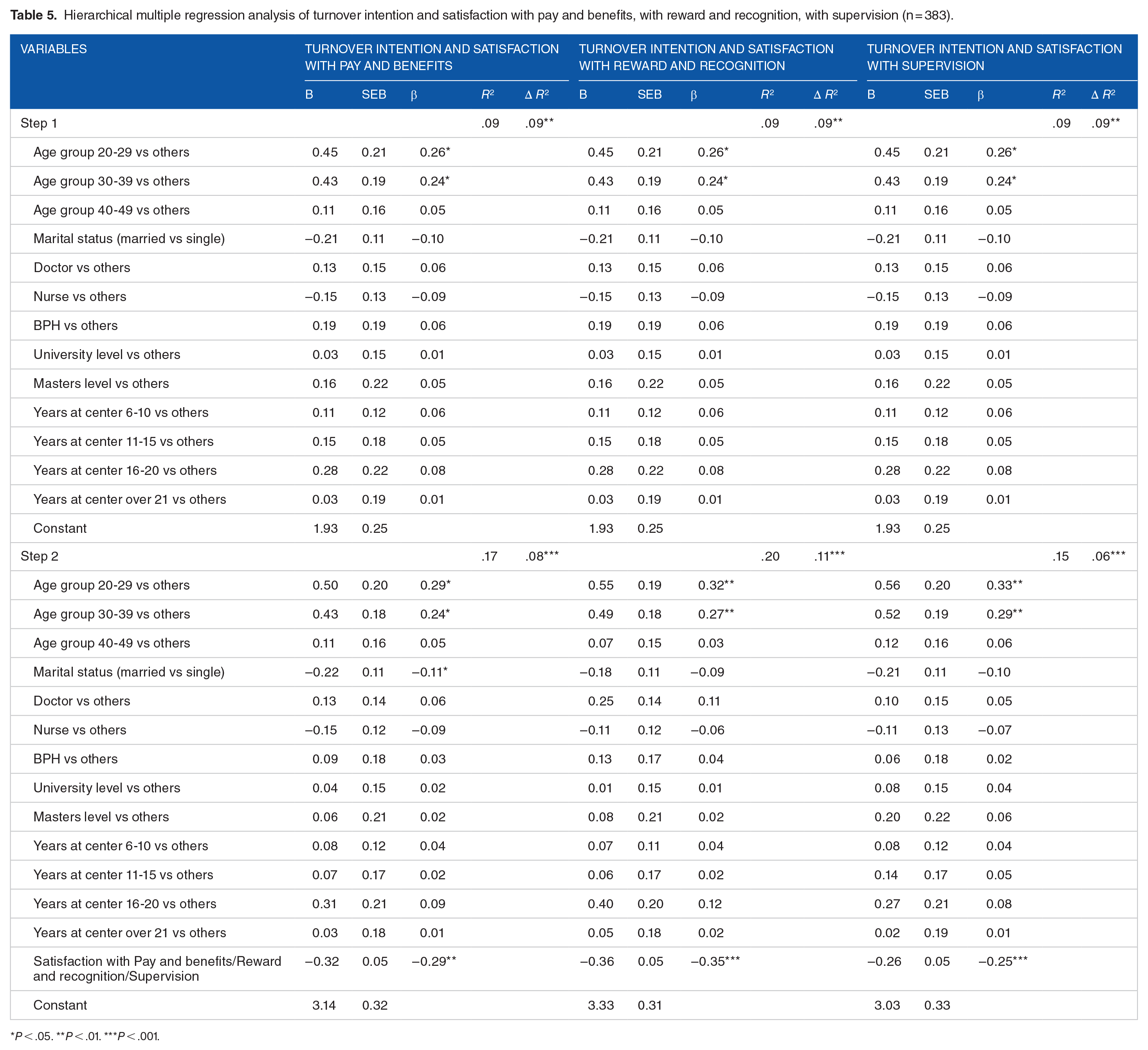
Table 5 presents a summary of the hierarchical multiple regression analysis of (1) satisfaction with pay and benefits; (2) satisfaction with reward and recognition; (3) satisfaction with supervision, respectively and turnover intention, after controlling for age, marital status, education level, professional degree, and length of employment at the current center. When the personal factors were entered into the first block, only the age groups 20 to 29 and 30 to 39 were significant predictors of turnover intention (R2 = 0.9, P < .01). When satisfaction with pay and benefits was added, it significantly improved the prediction (R2 change = 0.08, P < .001). The 2 age groups were still significant predictors and marital status became a significant predictor. The variables of education level, professional degree, and length of employment at the current center remained not significant. The group of variables significantly predicted 17% of the variance in turnover intention. When the score of satisfaction with pay and benefits increased 1 point, the turnover intention decreased 0.29 of a point.
Hierarchical multiple regression analysis of turnover intention and satisfaction with pay and benefits, with reward and recognition, with supervision (n = 383).
P < .05. **P < .01. ***P < .001.
The hierarchical multiple regression analysis on relationships between satisfaction with reward and recognition and turnover intention are presented in Table 5. With age, marital status, education level, professional degree, and length of employment at the current center in the first model, age groups 20 to 29 and 30 to 39 were the significant predictors of turnover intention (R2 = 0.9, P < .01). When satisfaction with reward and recognition was added, it significantly improved the prediction (R2 change = 0.11, P < .001). The 2 age groups were still significant predictors. The variables of marital status, education level, professional degree, and length of employment at the current center remained not significant. The group of variables significantly predicted 20% of the variance in turnover intention. When satisfaction with reward and recognition increased 1 score, turnover intention decreased 0.35 of a score. The results of the hierarchical multiple regression analysis of satisfaction with supervision and turnover intention (Table 5) show that supervision satisfaction was a significant predictor after controlling for related personal factors (R2 change: 0.06, P < .001). The age group 20 to 29 and 30 to 39 were also significant predictors when entered with supervision satisfaction. The model of the 3 significant variables explained 15% of the variation in turnover intention. When satisfaction with supervision increased 1-point, turnover intention decreased 0.25 of a point.
Table 6 presents the relationship between satisfaction with community support and turnover intention, after controlling for possible personal factors. Satisfaction with community support was a significant predictor (R2 change: 0.03, P < .05), when this aspect of satisfaction increased 1-point, turnover intention decreased 0.17 of a point. There were 3 predictors in the final model, including satisfaction with community support, in the age groups 20 to 29, and 30 to 39 years old. The beta of community support predictor (–0.17) was much smaller than other significant predictors of age group 20 to 29 (0.27) and 30 to 39 (0.23). The model explained 12% of the variation in turnover intention.
Hierarchical multiple regression analysis of turnover intention and satisfaction with community support, with working conditions, with communication (n = 383).

P < .05. **P < .01. ***P < .001.
The final model of predicting turnover intention from working conditions satisfaction and personal factors (Table 6) showed that working conditions satisfaction improved the prediction of turnover intention in comparison with the model containing only personal factors (R2 change: 0.06, P < .001). When working conditions satisfaction increased 1-point, turnover intention decreased 0.24 of a point. This final model includes 3 significant predictors: age group 20 to 29, age group 30 to 39, and working conditions satisfaction. The group of variables explained 15% of the variance in turnover intention.
Table 6 shows that communication satisfaction was a significant predictor after controlling for personal factors (R2 change: 0.05, P < 0.001). When this facet of satisfaction increased 1-point, turnover intention decreased 0.22 of a point. Age group 20 to 29 and 30 to 39 were still significant predictors when entered into the final model with communication satisfaction, while the other variables were not significant in the model. The final model explained 14% of the variation in turnover intention.
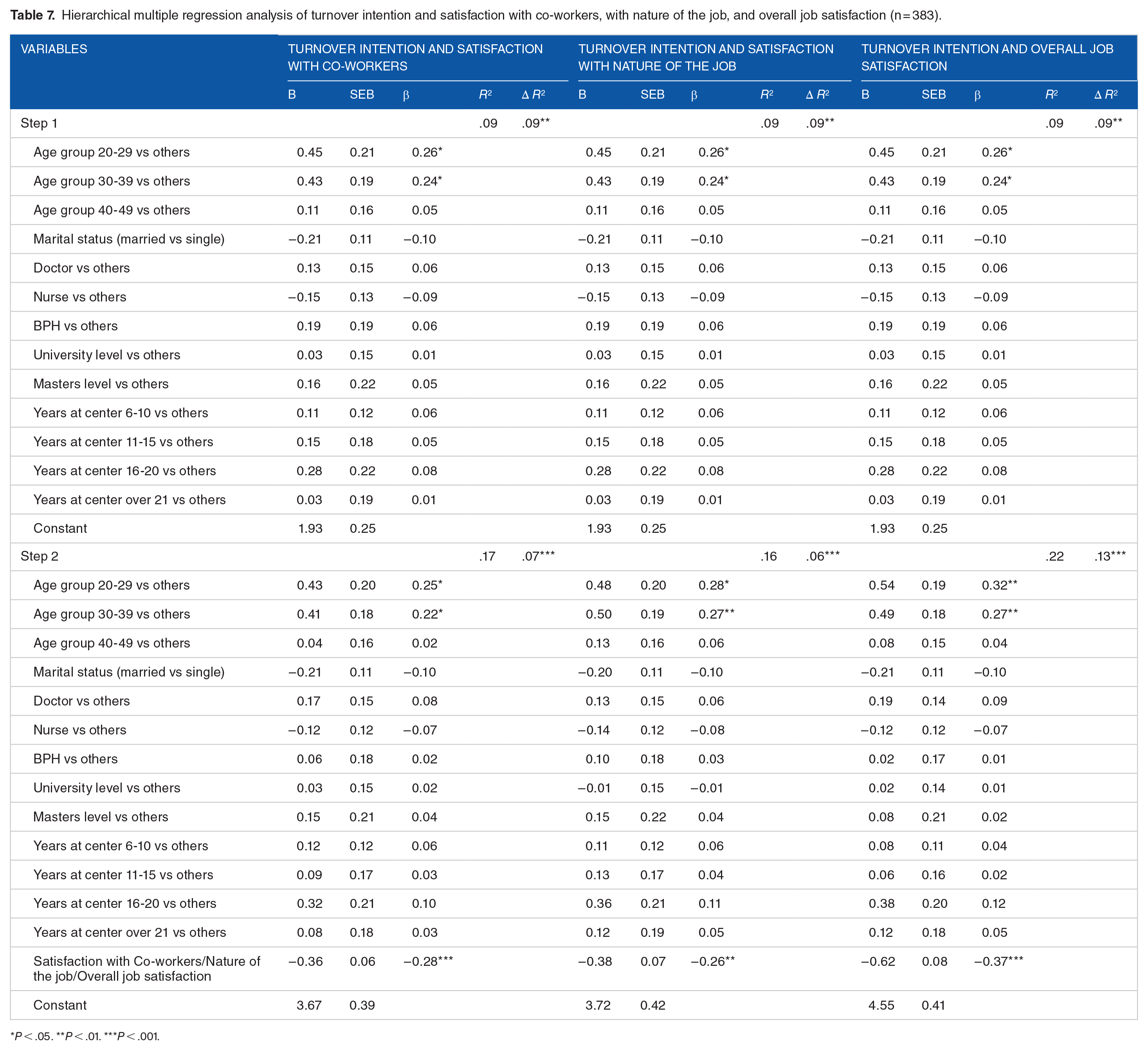
Co-workers satisfaction was still a significant predictor of turnover intention when controlling for personal factors (Table 7). When this aspect of satisfaction increased 1-point, turnover intention decreased 0.28 of a point. This variable explained 7% of the variation in turnover intention. In the final model, there were 3 significant predictors: age group 20 to 29, age group 30 to 39, and co-worker’s satisfaction. This model explained 17% of the variation in turnover intention.
Hierarchical multiple regression analysis of turnover intention and satisfaction with co-workers, with nature of the job, and overall job satisfaction (n = 383).
P < .05. **P < .01. ***P < .001.
Table 7 shows the results of the relationship between satisfaction with the job itself and turnover intention after controlling for personal factors. When entered the model containing related personal factors, satisfaction with the job itself significantly improved the prediction of turnover intention (R2 change: 0.06, P < .001). When the job itself satisfaction level increased 1-point, turnover intention decreased 0.26 of a point. In the final model, there were 3 significant predictors: age group 20 to 29, 30 to 39, and satisfaction with the job itself. This model explained 16% of the variation in turnover intention.
The results of the hierarchical multiple regression analysis presented in Table 7 indicate that among personal factors entered into the first model, age groups 20 to 29 and 30 to 39 were significant predictors (R2 = 0.9, P < .01). When overall job satisfaction was entered into the model, it significantly improved the prediction (R2 change: 0.13, P < 0.001). The 2 age groups were still significant (P < .01). Overall job satisfaction was the strongest predictor. When the overall job satisfaction level increased 1-point, turnover intention decreased 0.37 of a point. The final model explained 22% of the variation in turnover intention.
Discussion
According to our findings, turnover intention had inverse relationships with job satisfaction facets as well as overall satisfaction. The correlations ranged from −0.19 (community support satisfaction) to −0.37 (overall job satisfaction). After controlling for personal factors by hierarchical multiple regression analyses, these correlations remained significant. Satisfaction with reward and recognition and overall job satisfaction were better predictors of turnover intention than the others (β = −0.35 and −0.37 respectively). Similar to our findings, guidelines by Cohen 20 showed that overall job satisfaction, co-workers, and reward and recognition satisfaction had medium correlations (r ⩾ 0.3) with turnover intention, while overall job satisfaction had the strongest correlation (r = −0.37). The other facets of job satisfaction had small correlations with turnover intention (r ⩽ 0.3). These correlations remained significant when controlling for personal factors, where satisfaction with reward and recognition and overall job satisfaction had medium correlations (β = −0.35 and −0.37, respectively).
Among personal factors examined in this study, age, marital status, education level, professional degree, and length of employment at the current center were found to be associated with turnover intention. However, when examined in hierarchical multiple analyses with job satisfaction, only age remained a predictor of turnover intention. Respondents over 50 years old had significantly lower turnover intention than those between 20 and 29 years old. This can be explained by the fact that the older they are, the more difficult they have finding a new job, especially in the Government health care system.
The correlations in this study are similar or higher than those in other similar contexts. For example, a study by Moon and Han 21 among 445 nurses in Korea found that overall job satisfaction had a medium correlation (−0.33) with turnover intention. Another study by Zhang and Feng 22 among 1451 hospital physicians in China showed that the correlations of job satisfaction facets with turnover intention were between −0.053 and −0.146 across job satisfaction facets.
However, the correlations are lower than those in studies conducted in Western countries. For example, in a study among occupational therapists in Australia, Scanlan and Still, 23 found that the correlation between overall job satisfaction and turnover intention was −0.46. In another study among 200 hospital nurses in Canada, Singh and Loncar 2 found that the correlation between overall job satisfaction and turnover intention was −0.49. A study conducted in the USA among 327 registered nurses by Eberhardt et al 10 found that the correlation between overall job satisfaction and intention to quit was −0.50.
The differences in the correlation between job satisfaction and turnover intention may be since opportunities for quitting the job in developed countries are more available and easier than in developing countries or those with planned economies such as Vietnam or China. The data in this study suggests that job satisfaction can be used to predict turnover intention, and show that overall job satisfaction is a better predictor than facet job satisfaction.
Strengths and limitations of the study
This study provides evidence of the magnitude of the correlations between job satisfaction and turnover intention in the Vietnamese context. Although many studies were conducted to investigate the correlations between job satisfaction and turnover intention, there is no such study in Vietnam, especially in the health sector. This correlation differs across countries and worker groups. For example, in a study conducted among public higher education institutions in Malaysia, Noor 24 found that the correlation between overall job satisfaction and turnover intention was very high (−0.96). However, this correlation among preventive medicine workers in this study was only medium (−0.37). The results highlight the inverse associations between facets and overall job satisfaction and intention to quit.
Although the current study made significant contributions to the literature of the research area, especially in the Vietnamese context, there are several limitations associated with the study. There are some weaknesses in the current study regarding the generalizability of the findings. A convenience sample method was applied so the findings may not be able to be generalized to other provinces in Vietnam. In addition, the sample size for the main survey was calculated based on the time and finance limitations of the project, not on a statistical formula. Finally, the current study was cross-sectional so it could not identify the causal relationships between job satisfaction and turnover intention. This research design also prevented the researcher from including actual turnover rates of the workers and assessing the relationships between job satisfaction and actual turnover, which may be more meaningful than turnover intention.
Conclusion
There were significant associations between turnover intention and personal factors, including age, marital status, education level, professional degree, and length of employment at the current center. The bivariate analysis also indicated that job satisfaction had an inverse relationship with turnover intention as expected. The correlations varied between facet and overall job satisfaction, from -0.19 for community support to -0.37 for overall job satisfaction. These correlations remained significant after controlling for personal factors using hierarchical multiple regressions. The results indicated that facet and overall job satisfaction were significant predictors of turnover intention, while overall job satisfaction was the strongest predictor (β = 0.37, P < .001). Addressing the aspects of job satisfaction that were found to have the lowest scores may help the preventive medicine system to retain staff. To date, published literature on job satisfaction among health workers outside of hospital and healthcare facility settings is limited. The present study could contribute to local system development and an international understanding of job satisfaction and turnover intention in this field.
Footnotes
Funding:
The author(s) received no financial support for the research, authorship, and/or publication of this article.
Declaration of conflicting interests:
The author(s) declared no potential conflicts of interest with respect to the research, authorship, and/or publication of this article.
Author Contribution
Anh Dung Tran contributed to the design and implementation of the research, Quynh Anh Nguyen and Anh Dung Tran analyzed collected data and prepared the manuscript.
