



Abstract
Patient experience is being widely considered in evaluating the quality of health care services. This is a cross-sectional study with 860 inpatients hospitalized in 4 clinical departments (General Internal Medicine; Cardiology; General Surgery; Surgery, and Orthopedic Trauma) of the Kien Giang General Hospital, from April to June 2020. Data was collected through a two-part questionnaire used to evaluate the inpatient experience during hospital treatment, using the Likert scale 5 points. The patient’s experience is classified into 3 aspects (environment—facilities, healthcare staff's care, treatment information). In total, 815 participants responded to the interview (94.8%). The rates of patients having a positive experience on the environment and facilities, the care of health workers, and treatment information are 31.7%, 85.9%, and 74.2%, respectively. The patient’s positive overall experience rate is 65.5%. Factors related to the patient's overall experience are the department of treatment, residential area, age, and employment status (P < .05). Overall, the positive experience of inpatients at some clinical departments of Kien Giang General Hospital was a relatively low rate (65.5%). Specifically, healthcare staff's care is experienced at a high rate, this factor should be continuously promoted. Improving and upgrading factors in the aspects of the environment—facilities and the treatment information should be implemented if the hospital wants to improve its quality of healthcare services.
Keywords
Introduction
The Agency for Healthcare Research and Quality (AHRQ) defines “patient experience as the series of interactions a patient has with the healthcare system, care from health plans, from doctors, nurses and employees in health care facilities.” 1 The Berly Institute in the UK also defines patient experience as being shaped by an organization’s culture that influences the perception of patients throughout care, including many aspects of care delivery. Health care is highly valued by patients when they look for health care such as care process, the practice of health workers, the physical environment of health care facilities as well as access to information about disease status and good treatment and communication with health workers. 2
In developed countries, when their health system comes to being patient-centered, 3 specific goals are set, namely: treatment efficacy, patient safety, and patient experience. The inclusion of patient experience as 1 of the 3 pillars of quality of care is partially proven based on the reason that data on patient experience when sufficiently collected and analyzed can help highlight the strengths and weaknesses of health facilities. Regarding treatment efficiency and patient safety, a focus on resource improvement will increase the likelihood of improvement in these 2 areas.3–5 Therefore, reaching a positive experience is an important goal that needs to be set and achieved.
Complete and accurate information about patient experience informs health managers about what is happening in the practice of patient care and how consistent this practice is. Thus, the health manager can evaluate the patient’s treatment level as well as identify room for improvement responding to the needs of the patient, and consequently increase the rate of patients returning to the hospital for treatment.6–8
Though all hospitals in Vietnam follow the Ministry of Health’s regulations on patient satisfaction surveys,9,10 research on patient experience in Vietnam is still very sparse. In the socialist-oriented market mechanism like Vietnam today, improving quality and making a difference with competitors have an advantage in attracting patients to the hospital. Enhancing the utilization of healthcare services requires ultimately researching patient experience.
Despite having a few studies conducted to evaluate patient satisfaction in a general inpatient setting or specific healthcare clinics in Vietnam, these studies often shown a major geographic limitation, especially in the northern settings of Vietnam. For example, 1 study examined psychological and socioeconomic factors associated with patient’s evaluation of healthcare quality conducted in Hanoi in 2016. 11 Three other studies were conducted in the Northern part of Vietnam.12–14 Other studies dealing with some aspects of geographical differences, however, were limited to some specific clinic settings like HIV/AIDS for instance.15,16
This case study contributes to the medical literature by exploring the patient experience at one general hospital in the southern part of Vietnam—Kien Giang General Hospital in Kien Giang province. This case study, therefore, can provide reliable evidence to develop suitable programs for improvement of quality of care in the hospital context via improvement of patient experience for other similar settings nationally and internationally.
We would like to describe positive and negative experiences of inpatients treated in clinical departments of Kien Giang General Hospital in 2020 and related factors.
Methods
Study design
This was an analytical cross-sectional study.
Study participants
Study participants included inpatients aged 18 years or over who were admitted for inpatient treatment at 04 clinical departments of Kien Giang General Hospital. They also completed discharge procedures and were prepared to leave. If the patient could not answer the questions, they would be replaced with their family members aged 18 years or older also.
Study setting
The Kien Giang province is a coastal province and has the largest area in the Mekong Delta, it is in the southwest of Vietnam with an area of 6348 km2 spreading over 2 cities and 13 districts. The population was 1.8 million people in 2019. It is the 11th largest administrative unit in terms of population in Vietnam, 20th in terms of gross product in the area, 31st in GRDP per capita, and 39th in GRDP growth rate. The study was conducted at Kien Giang General Hospital, which is the only general hospital in Kien Giang province. The hospital has an area of 4.2 km2, the number of registered beds is 1630 and the actual number is 1885 beds with a total of 2001 medical staff. 17 In 2019, the number of inpatients was 86 213 accounting for 32% of the total number of inpatients in the province with an average length of stay of 7.2 days. 18
Sample size and sampling
Based on the sample size formula for a cross-sectional design (
Sampling is done by the systematic randomization method, based on the reported data of inpatients discharged from hospital at the same time in 2019, the estimated number of inpatients discharged from the hospital from April to June 2020 in 4 research departments, specifically in the Department of General Internal Medicine has 2231 people, Department of Cardiology has 1885 people, Department of General Surgery has 982 people, Department of Surgery and Trauma has 1103 people. Then, based on the formula k = N/n, where N is the total number of inpatients in the department who have been discharged from the hospital in the same period in 2019, n = 215 is the base of the local study of each department. The k-coefficients of the Department of General Internal Medicine, the Department of Cardiology, the Department of General Surgery and the Department of Surgery, and Trauma resulted to be 10, 9, 5, and 5, respectively.
Measurements
The dependent variable is the overall experience of the inpatient in 4 clinical departments of the hospital. The overall patient experience includes environmental experiences—facilities, care of healthcare staff, treatment information.
The independent variables include the sociodemographic status of the study participants such as the department of treatment, residential area, sex, age, education level, employment status, type of disease treated, number of times treatment was received in the hospital, number of days needed for treatment, household economic classification, health insurance status, affordability. The treatment department is divided into 4 groups: Department of General Internal Medicine, Department of Cardiology, Department of General Surgery, Department of Trauma Surgery. The residential area is divided into 2 groups: living in the Rach Gia city and living in another region. Sex is 2 groups of male and female. Educational level is classified as illiterate, elementary, middle school, high school, and higher. Employment status is divided into 2 groups: working and not working. Types of treatment are divided into 2 groups: acute and chronic. The number of times treated at the hospital is classified into 5 groups: once, twice, 3 times, 4 times, 5 times or more. The number of treatment days is classified into 4 groups: ⩽ 5 days, 6 to 10 days, 11 to 20 days, > 20 days. The household economic classification is classified into 5 groups according to the degree of the patient’s perception: poor, near-poor, normal, fair, and rich. Health insurance status is divided into 2 groups: having health insurance and having no health insurance. Affordability is divided into 3 groups: free of charge, payable, having to borrow to pay.
Cut-off score: for an experienced content with n sub-categories, the patient is evaluated as having a positive overall experience if the total score after coding is ⩾75% n (positive experience with at least 75% of the review content). The patient is evaluated as having a positive experience: environment—facilities if the total score after coding is ⩾7.5; on the care of medical personnel if the total score after coding ⩾11.25; on treatment information if the total score after coding ⩾6.75. With 3 experiences (environment—facilities, care of medical staff, the treatment information) with a total of 34 sub-categories, the patient is evaluated as having a positive overall experience if the total points after coding ⩾25.5
Data collection
The research tool is a structured questionnaire prepared under the form of an interview. This toolkit is built based on a theoretical framework and is referenced from the questionnaires to survey the inpatient experience at medical facilities in Ho Chi Minh City and from many tools of patient experience survey worldwide such as HKIEQ, 19 CPES-IC, 20 Ontario. 21 This toolkit was tested prior to official data collection to detect and revise inconsistent errors as well as being verified to adapt to reality of Kien Giang General Hospital. The toolkit has 47 questions divided into 2 parts, including information about patient's characteristics (part 1), and patient’s experience (part 2), specific details are Environment—Hospital facilities (10 questions), Care of medical staff (15 questions), Information about treatment (9 questions).
Data was collected through interviews with patients or their family members using pre-designed questionnaires and was implemented by 6 enumerators. The enumerator took a list of hospital discharge patients from the 4 departments during the survey and selected the study participants by coefficient k. After the patient had completed the discharge procedures, the patient and family members were invited to the separate site at the hospital. Data quality is controlled in the field.
Data analysis
Both descriptive and analytical statistics were done using Epi data 3.1 and SPSS 20.0 software to evaluate inpatient experience in 4 clinical departments of the hospital. The rates of the variables of interest were calculated with the corresponding 95% confidence interval (CI). A multivariate logistic regression model was performed to examine the associated relationship between patient experience and sociological factors. A significance level of P < .05 was used.
Ethical considerations
The protocol of this study was approved by the Institutional Review Board, Hanoi University of Public Health, under Decision N°126/2020/YTCC-HD3 dated March 30, 2020. All human subjects in the study were asked for their consent before official interview, and all had rights to withdraw from the study at any time without any threats or disadvantages.
Results
Table 1 presents demographical characteristics of studied patients. Out of the 860 patients discharged from the hospital from April to June 2020 selected in 04 research faculties, 815 people were interviewed (accounting for 94.8%). 34.2% of the respondents were the patients (while 65.8% being the relatives of the patients). 26.9% of patients lived in Rach Gia in the Kien Giang province. 54.7% of the respondents were men. The median age was 49.8 years. 61.5% of the patients were not working. 88.7% of patients were treated for an acute illness. 49.7% of patients came for the first treatment. The average number of days of treatment was 6.15. 55.8% of patients had less than 5 days of treatment. 84.3% of patients had health insurance. 54.6% of the patients were self-able to pay.
General information about patients studied.

Table 2 presents the rates of inpatients having positive experience with some clinical departments of Kien Giang General Hospital in 2020. The cohort of 815 patients or their family members in 4 clinical departments of Kien Giang General Hospital in 2020 showed that there were 258 people having positive experience about the hospital’s facilities and environment (31.7%), 700 patients having a positive experience about the care of the medical staff at the hospital (85.9%), and 74.2% of these patients having positive experience about treatment information at the hospital. The rate of positive overall experience (three aspects) is 65.5%, the highest rate (76.6%) was found in General Surgery Department, the lowest rate (56.5%) was found in Cardiology department. In other words, the environment and facilities had the lowest positive experience rate, care of the medical staff had the highest positive experience rate, meanwhile treatment information had relatively high positive experience rate.
The positive experience of inpatient treatment at 4 clinical departments of Kien Giang General Hospital by 2020.

The positive scale for each content is 1 to 5 (1: lowest, 5: highest). Patients are evaluated as having a positive experience for each content if the answer scores 4 or 5 (scores 4-5 are coded 1, scores 1-3 are coded 0). Patients are evaluated as having a positive experience in the environment—facilities if the total score after coding ⩾7.5. The patient is evaluated as having a positive experience of care by a healthcare provider if the total score after coding is ⩾11.25. Patients are evaluated as having a positive experience of the treatment information if the total score after coding ⩾6.75. Patients are rated as having a positive overall experience if the overall score after coding ⩾25.5 (positive experience with at least 75% of review content).
Table 3 presents the proportion of inpatients having positive experience at the Kien Giang General Hospital classified by independent variable groups. Regarding treatment department, the rate of positive experience, in general, was found highest in General Surgery Department (28.8%, CI: 24.6%-33.1%), and lowest in the Cardiology circuit (reaching 21.9%, CI: 18.9%-25.3%). Regarding residential area, the rate of positive experience was found higher for patients who live elsewhere (reaching 76.4%, CI: 72.3%-80.5%) rather than live in the Rach Gia city (23.6%, CI: 19.5%-27.7%). Regarding gender, the rate of positive experience was found higher in men (56.6%, CI: 52.8%-60.6%), and lower in women (43.4%, CI: 39.4%-47.2%). In terms of age group, the percentage of positive experience was the highest in the patients aged ⩾60 years old (37.1%, CI: 31.4%-41.5%), and the lowest in the patients aged ⩽17 years old (9.7%, CI: 7.2%-12.1%). Regarding educational level, the rate of positive experiences was the highest with patients having primary school level (27.7%, CI: 24.6%-31.0%), and the lowest with the patients having high school level (11.4%, CI: 8.1%-14.1%). Regarding the employment status, the rate of positive experiences was higher in the group of unemployed patients (65.7%, CI: 61.6%-69.7%), and lower in the group of working patients (34.3%, CI: 30.3%-38.4%). Regarding the type of disease, the rate of positive experience was higher in the patients with acute diseases (89.0%, CI: 86.4%-91.9%), and lower in the patients with chronic diseases (11.0%, CI: 8.1%-13.6%). Regarding the number of times of treatment, the rate of positive experience was the highest for the first-time treatment patients (45.7%, CI: 41.7%-50.6%), and the lowest for the patients with 5 times and more than 5 times of treatment (6.0%, CI: 4.0%-8.0%). Regarding the number of days of treatment, the highest rate of positive experience was found in the treatment group of ⩽5 days (56.0%, CI: 52.0%-60.6%), and lowest in the treatment group of >20 days (1.7%, CI: 0.7%-3.0%). In terms of household economic classification, overall, the highest percentage of positive experience was found in the normal households (62.4%, CI: 57.8%-65.9%), and lowest in the rich households (0.2%, CI: 0.0%-0.7%). Regarding health insurance status, the rate of positive experiences was higher in the patient group with health insurance (85.3%, CI: 83.1%-89.1%), and lower in the patient group without health insurance (13.7%, CI: 10.9%-16.9%). In terms of affordability, the percentage of positive experiences was highest in the patient group with self-affordability (54.7%, CI: 50.1%-57.9%), and the lowest in the group that must borrow to pay (14.4%, CI: 11.4%-18.2%).
The proportion of inpatients with a positive experience of the overall experience at the Kien Giang General Hospital by characteristics of independent variables.
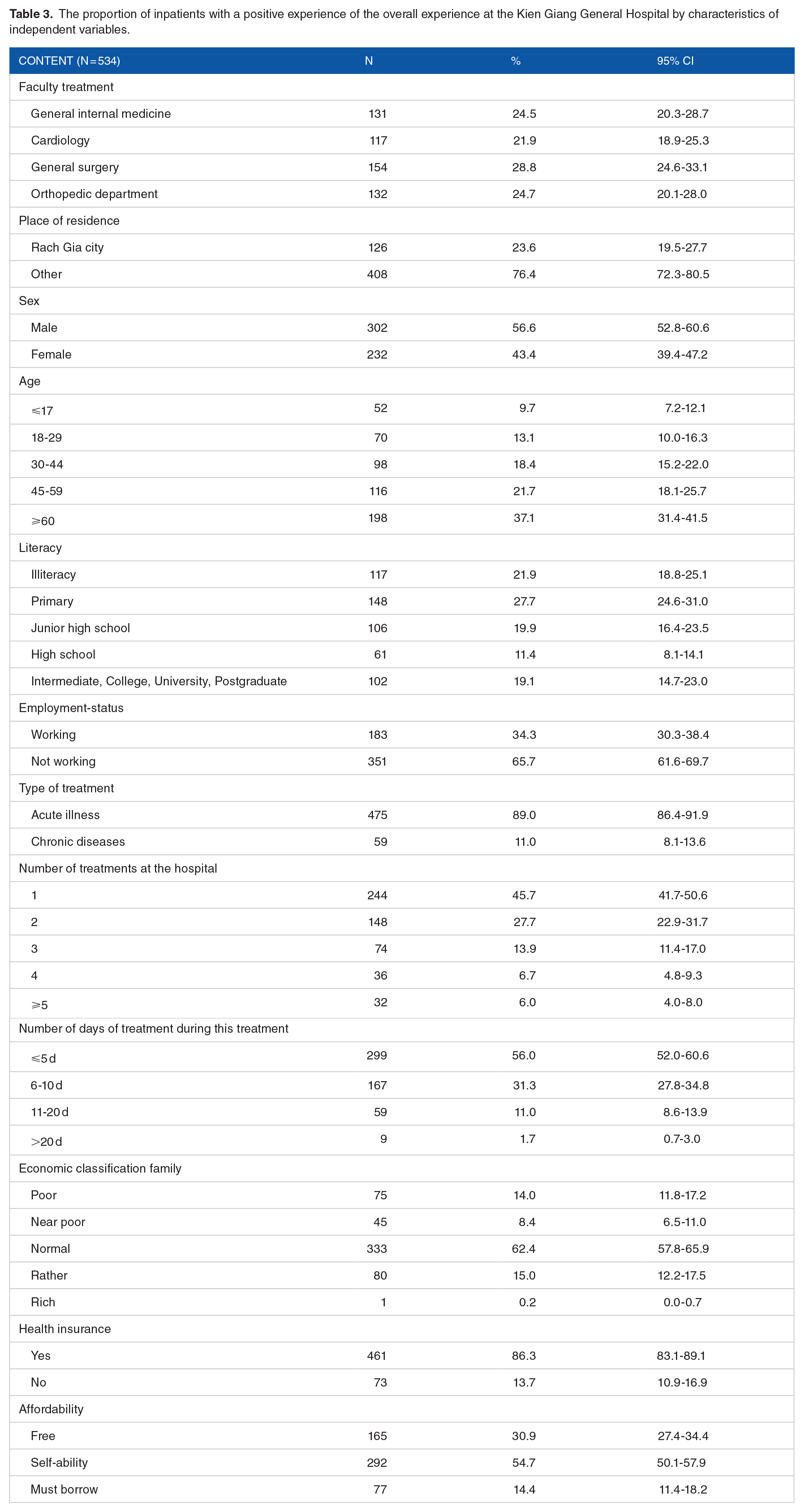
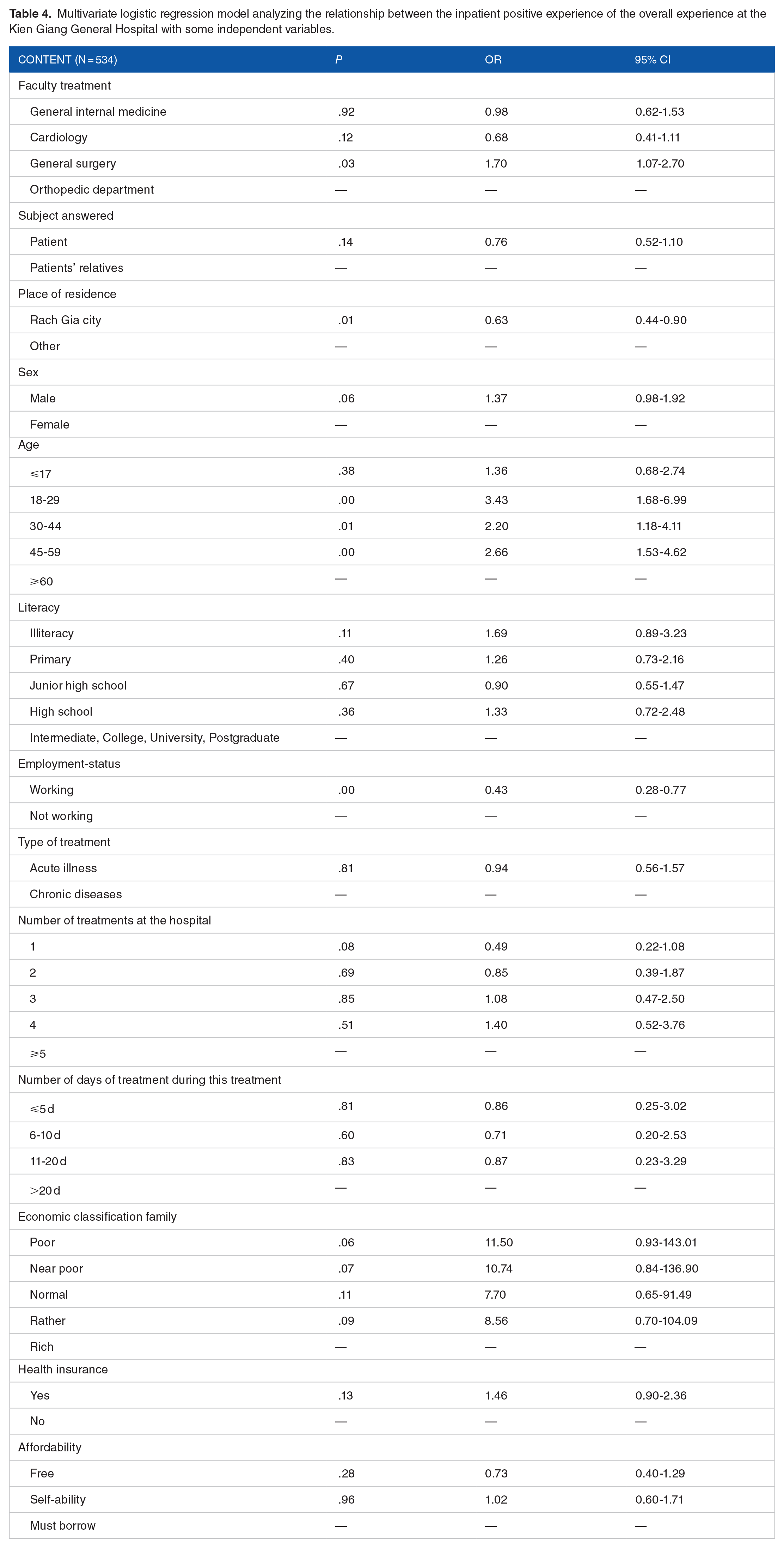
Table 4 presents the results of the multivariate logistic regression model analyzing the relationship between the active experience of the inpatient with the overall experience of the general hospital in Kien Giang province, with some independent variables. Out of 815 study participants, 534 inpatients had a positive overall experience at the Kien Giang General Hospital. Therefore, only 534 inpatients were selected for regressing multivariate logistic model to analyze the relationship between the inpatient's positive experience with some independent variables. Factors associated with statistical significance to the inpatient's positive overall experience include:
+ Department of Treatment: Patients in the surgery block had a higher positive overall experience than the internal block (OR = 1.70, 95% CI of OR = 1.07-2, 70).
+ Residential area: Patients who lived in Rach Gia city had a lower positive overall experience than patients who lived elsewhere (OR = 0.63, 95% CI of OR = 0.44-0.90).
+ Age: Patients aged 18-29 years old had a higher positive overall experience than patients aged⩾60 years (OR = 3.43, 95% CI of OR = 1.68-6.99). Patients aged 30-44 years old had a higher positive overall experience than patients aged ⩾60 years (OR = 2.20, 95% CI of OR = 1.18-4.11). Patients aged 45-59 years old had a higher positive overall experience than patients aged ⩾60 years (OR = 2.66, 95% CI of OR = 1.53-4.62).
+ Employment status: Working patients had lower positive overall experience than not-working patient group (OR = 0.43, 95% CI of OR = 0.28-0.77).
Multivariate logistic regression model analyzing the relationship between the inpatient positive experience of the overall experience at the Kien Giang General Hospital with some independent variables.
Discussion
To the best of our knowledge, this is the first study to evaluate inpatient experience with several clinics and related factors in the Kien Giang province, meanwhile, there are few studies ever conducted on the same topic in Vietnam. Our findings indicate that the patient’s age, residential area, and employment status are related to the inpatient’s experience.
This study complements existing literature about the inpatient experiences in developing countries. This study possibly provides useful insights into the development of policy responses and appropriate experience improvement programs in Vietnam and other similar settings to improve the quality of health services. Instead of focusing on a general survey of patient satisfaction, we should develop patient experience surveys to reinforce and promote the points where the patient has a positive experience as well as address the negative points, thereby improving the quality of healthcare services towards patient satisfaction.
Environment–facilities experienced
The survey results of 815 patients or their family members in some clinical departments of Kien Giang General Hospital by 2020 showed that with 10 sub-categories of the environment/facility aspect, there were 258 people with positive experience about the hospital’s facilities and environment (31.7%). With 15 sub-categories of care of the medical staff aspect, 700 patients are having a positive experience in the care of the medical staff at the hospital accounting for 85.9%. Regarding treatment information aspect (with 9 sub-categories), the overall positive experience rate was 74.2%.
The survey showed that 58.2% of people had positive experience about “the hospital room is always regularly clean.” Additionally, 27.6% of the patients had positive experience about “the bathrooms always being full and clean”; these results are much lower than those of Tram’s study, where the percentage of patients who had a positive experience of disease prevention and cleaning toilets is 98.2%. 22 That survey also reported that the percentage of patients having positive experiences about green, clean, beautiful toilets was 61.0%. 23 This is understandable because the hospital's infrastructure is old and degraded, leading to a negative impact on inpatient experience about the environment—facilities. To address this problem, it is necessary to focus on mobilizing resources for improvement of environment—facilities, giving the patients more space, which is always clean and fully furnished.
Care of health worker experienced
The primary care health worker was respectful and polite to the patient/patient’s family member with a positive experience rate of 98.8%, which is not much different in respect to the history of doctors (93.4%), nurses (94.2%) as in the study of Tram. 22 However, this rate is also higher than 87.0%—the rate of patient experience in respectful and polite health workers in survey conducted for Ho Chi Minh City, 23 and also 87% of patients being treated with respect from the published patient experience results of St Luke’s Hospital in Iceland. 24 Patients who have a positive experience with primary care providers were given a chance to ask questions about their treatment with a rate of 75.2%, almost equal to patients always having the opportunity to talk to the nurse when needed (76%) as of the result of patient experience survey at Tallaght Hospital. 25 There was no chance to talk to the doctor in the study of patient experience in county-level public hospitals in China 26 because the inpatients at Kien Giang General Hospital were very crowded, so this rate of positive experience was only relative. Even so, patients with a high rate of positive experience were paired with primary care workers who always listened to questions and concerns of the patient/patient’s family, and always explained things in a way easy to understand with the rates of 88.3% and 93.7%, respectively. Seemingly, the rate of positive inpatient experience in the care of medical staff of some clinical departments of Kien Giang General Hospital is high, proving that health care workers’ communication and behavioral culture directly influenced this positive experience through behavioral factors such as listening, respectfulness, understanding, and attention to questions/concerns, explaining, creating opportunities/spending enough time and other professional skills of health workers. These helped increase patient participation in treatment, promote long-term relationships between patients and medical staff, and build the patient’s trust with the medical staff, thereby retaining the patient and building a reputation for the hospital.
Treatment information experienced
The rate of positive patient experience in “always receiving public and consistent information from health workers about the disease status and progress” was 97.7%, higher than 39.24%—a similar rate from the study of Min. 26 Patients /relatives of patients who are “always well informed about the signs and symptoms that need to be monitored” had a relatively good rate of a positive experience at 78%, compared to 27% from result of the Tallaght University Hospital patient survey. 25 The rate of patients who had a positive experience in “always receiving information and reasons for drug use” and “always receiving information, reasons for taking tests” were 83.9% and 76%, respectively. These rates are lower than those from the inpatient experience survey in Ho Chi Minh City (92.8% and 91.6%, respectively), however, the rate of people who experienced positively and “always received information, such as the reason for performing surgery/procedures” was 95.1%, which is almost equal to the rate from the abovementioned study (96.9%). 23 Patients have a legitimate interest in providence of treatment information. Therefore, it is necessary to learn about the experience of information in the inpatient treatment.9,27
Associated factors of positive overall experience at the hospital
Multivariate logistic regression on the relationship between some independent variables with the patient's overall experience at the Kien Giang General Hospital was made. Factors related in a condition of statistical significance level of 95% CI and OR not containing the value 1 (P < .05) were: treatment department, residential area, age, and employment status. Specifically, the related factors are shown as follows:
In terms of clinical factors, patients in the surgery block have a higher positive overall experience than the inner block. This confirms that the treatment department is related to a positive experience of the patient’s general inpatient experience at the Kien Giang General Hospital. Surgery departments have a smaller number of patients and the characteristics of medical treatments are surgical, so the environmental condition, including the facilities and care of the medical staff and treatment information at the departments, was better than the Faculty of Internal Medicine.
Regarding residential factor, patients living in the Rach Gia city had a lower positive overall experience than patients living in elsewhere because patients living in urban areas like Rach Gia require different needs and more care needed from medical staff. Furthermore, patients living elsewhere rather than Rach Gia seemingly want to get well early to quickly leave the hospital and tend to disregard other issues.
Patients aged <60 years (age groups 18-59 years) had a higher positive overall experience than patients aged ⩾60 years old. Meaningly, young patients tend to have less anxiety about their illness and are not psychologically affected by the hospital environment, so the hospital is more comfortable to care for and provide information for them.
The working patient had a lower positive overall experience than not working patient. It can be explained that the working patients have a certain understanding and more knowledge, so their requirements about the hospital environment are also higher. In practice, long stay at the hospital made the working patient easily feels depressed and uncomfortable, so they have a higher need for health care and treatment information. While health care services have remained unchangeable, the positive overall experience of working patients is, thus, lower than that of not-working patients.
Some methodological limitations of this study must be considered. This is a cross-sectional study, so it possibly evaluates relevant factors related to the inpatient experience at the time of the study, and the study could not generalize the results beyond the specific hospital examined here—which is Kien Giang General Hospital. Additionally, the inpatient experience in several clinical departments of the hospital were merely quantitatively surveyed and we have no feedback from the patient to further understand the causes of negative experiences. Thus, this study is necessarily re-examined from time to time and, if eligible, it is advisable to conduct an inpatient experience survey in all clinical departments in the hospital. Conducting qualitative studies is also necessary to seek.
This study shows that the positive overall experience rate is 65.5%—the relatively low rate of positive experience of patients in the hospital. Specifically, patients have the highest rate of positive experiences about the care of health workers (85.9%). The patient’s positive experience with treatment information at the hospital has rate of 74.2%. The patient's positive experience in the environment—the hospital’s facilities have the lowest rate of 31.7%. The logistic regression results show that associated factors to inpatient treatment experience at Kien Giang General Hospital in 2020 are: department factor (patients in surgery block have 1.70 times higher positive experience compared with internal block), residential area factor (the patient living in the Rach Gia city has a positive experience 0.63 times lower than the patients living elsewhere), the age factor (the positive experience of the patients at the age of 18-29 years is 3.43 times higher, at the age of 30-44 years is 2.20 times higher, at the age of 45-59 years old is 2.66 times higher than the patients with age ⩾60 years old) and finally, employment status factor (working patients had a positive experience 0.43 times lower than not working patients).
Footnotes
Acknowledgements
This study received the support of the Board of Directors of Kien Giang General Hospital and the Board of Directors of the clinical faculties where the study was conducted. We thank the inpatients and their family members for participating in this study. We thank Melissa Barberan for editing this paper.
Funding:
The author(s) received no financial support for the research, authorship, and/or publication of this article.
Declaration of conflicting interests:
The author(s) declared no potential conflicts of interest with respect to the research, authorship, and/or publication of this article.
Author Contributions
Study design: Phuoc Thao Nguyen, Minh Van Hoang. Data analysis, writing: Phuoc Thao Nguyen. Revision of the manuscript: Anh Tuan Tran, Hoat Van Nguyen, Minh Van Hoang. Approval of final manuscript: all authors.
