



Abstract
The health risk of exposure to the Akaki River water remains an underrecognized issue among irrigation farmworkers at Gelan Farm Sites. To show the risk, this study assessed the prevalence and determinants of acute gastrointestinal illness (AGI) among these workers. A cross-sectional survey study was conducted between December 13, 2023, and January 8, 2024, within 296 randomly selected farmworkers aged 18 years and above who had been actively engaged in irrigation farming for at least a month. Totally, the prevalence of AGI was about 23% (95% CI: 18.2%-27.8%). In this study, factors such as being married, older age, higher education level, farming experience, and handwashing awareness were protective. The interaction between farming experience and safe water sources, were also protective. On the other hand, residing on the farmland, using untreated river water for cooking, unintentional ingestion of irrigation water, and interaction of river water use with limited access to clean water were AGI-exacerbating factors. For intervention, access to clean water, sanitation facilities, and health education are needed to protect the health and productivity of the workers.
Plain Language Summary
This research found the percentage of farmworkers who got stomach illnesses and the reasons why they got the sickness with stomach problems like diarrhea and nausea. According to the research findings, about 23 out of every 100 workers had recently been sick, two weeks prior to data collection time. A big reason for this was the use of polluted river water for cooking, eating meals at the farm without washing hands, and accidentally swallowing irrigation water during farm work. On the other hand, workers who were married, had a higher education level, and washed their hands regularly and bathed after irrigation work with clean water were much less likely to get sick. The study also identified that when multiple risky things combined together, like using river water and not having enough clean water, the chance of getting sick was even higher. But when farmworkers got safety training and used protective equipment, their risk of illness was reduced. In short, this research shows that simple changes can make a big difference. Giving farmworkers access to clean water, safe washing areas, and clear health information can help protect their health and well-being.
Background of the Study
In many low- and middle-income countries (LMC), like Ethiopia, wastewater irrigation has arisen as an increasingly common practice due to its cost-effectiveness and availability. Rich in organic nutrients, wastewater is often used as a substitute for chemical fertilizers and freshwater supplies to sustain year-round agricultural farms.1-3 However, despite its agricultural benefits, untreated wastewater contains a high load of waterborne pathogens that contribute to acute gastrointestinal illnesses (AGI) and other disease risks.4,5 The untreated urban wastewater as well as the receiver of the wastewater urban river water often contains significant quantities of fecal coliforms, viruses, protozoa, and parasites that are causative agents for gastrointestinal diseases.6-8
These hazards are more prevalent in urban irrigation farming of developing countries, particularly where personal hygiene practice habits are poor, sanitation infrastructure is inadequate, and access to protective equipment is limited. 9 As a result, farmworkers in urban irrigation farms in developing countries face increased vulnerability to AGI due to the unintentional ingestion of contaminated water and the consumption of raw or insufficiently sanitized produce irrigated with that water. 10
This issue is particularly significant in Gelan farm areas, Southeastern Sheger City, where the Akaki River serves as the primary source of irrigation. In that region, the Akaki River is critical threat to environmental integrity and public health because it is highly contaminated by industrial effluents, home sewage, and solid waste from Addis Ababa.11,12 Several studies have found that the levels of pathogen load in both the river water and crops irrigated by it surpass globally set safety standards.11,13-15 This raised major concerns regarding the occupational exposure risks encountered by farmworkers who are in daily contact with the contaminated river water supply.11,16
Additionally, other studies have found a high prevalence of gastrointestinal illness symptoms among communities residing along the upper catchment of the river in Addis Ababa.17,18 However, even though the river is extensively utilized in Gelan and the pollution loads appear high at that downstream point, most existing researches have focused on the upper catchment of the river, in Addis Ababa city. 19 Few researches have explored the occupational exposures and prevalence of acute gastrointestinal illness risks encountered by farmworkers in the area. Thus, the potential health risks posed by this river to these farmworkers are not adequately investigated. Nevertheless, estimating the prevalence and identifying the determinant factors of AGI in the irrigation farmworkers are critical for both occupational health and broader public health planning and sustainable agricultural development. Addressing this issue has impacts for public health planning and food safety. It also corresponds with global health goals targeted at lowering waterborne infections and supporting safe agricultural practices in vulnerable populations. Therefore, this study aimed to investigate the prevalence and contributing factors of acute gastrointestinal illness among farmworkers in the Gelan farms area.
Materials and Methods
Description of the Study Area
The study area is located in southeastern Sheger City, 27 km away from Addis Ababa City. It is a favorable agricultural zone, strategically positioned for its proximity to the big markets of Addis Ababa and it has conducive agroclimatic zone. Geographically, the area is situated between latitudes 8° 43′N and 8° 55′N and longitudes 38° 46′E and 38° 56′E, with altitudes ranging from 1800 to 2300 m above sea level. This farming area experiences a tropical climate, with an average annual temperature of 19°C, 20 and its main rainy season extends from June to mid-September, with annual rainfall roughly 861 mm per a year. In this area, the dry season’s farm production entirely depends on water from the Akaki River for irrigation. However, the river water is under extreme pollution due to industrial expansion, rapid urbanization, population overgrowth, and informal settlements in Addis Ababa and its surroundings. 21
The Akaki river receive untreated domestic, industrial, and institutional effluents from approximately 13 tributaries that transverse the city before converging near the downstream outskirt of the city. Consequently, the Akaki River serves as a main reservoir for diverse waste streams. 22 Despite this, the water from River is widely used for irrigation in the Gelan farming Area, particularly for growing leafy vegetables that are commonly consumed raw and supplied to wide markets of Addis Ababa and surrounding regional markets.
The study emphasized 5 kebeles: Gemeda, Hechu, Dawera Tino, and Abba Samuel, where local communities heavily rely on the Akaki River for irrigation. The Sidamo Awash site was included as a reference that uses the Dongora River; the river originates from the Oromia Region, out of Addis Ababa, which comparatively less affected by urban pollution. The irrigation period of the area normally begins in November and lasts until the end of May, the end of the dry season; however, yearly changes in rainfall can alter this period.

Results
Demographic and Socio-Economic Characteristics of the Respondents
The demographics and socio-economics survey results were presented in the following table (Table 1). Out of 296 participants, the largest proportion of participants (46.28%) were aged 18-25 years, followed by 38.18% in the 26-33 age group, and only 15.54% were aged 34 and over. The majority of the respondents were male (77.7%), and over half of the farmworkers were single (55.74%). In terms of education, 46% of respondents had completed elementary school, and 27.7% of them had attended high school, whereas 22.3% had no formal education. Concerning religious affiliation, Orthodox Christian followers were the dominant group (66.56%), followed by Evangelical Christian followers (19.93%). The followers of Muslim and waakefata (Oromo Traditional Faith Followers) were collectively represented by less 14%. Regarding income levels, the majority of respondents (65.87%) earned 5000 ETB or less per month, while only 9.8% of them reported their monthly incomes over 7000 ETB. In the case of place of residence, 40.2% resided on the farm, 50% lived in surrounding villages, and 9.8% commuted daily from nearby towns such as Sheger or Bishoftu City.
Demographic and Socio-Economic Characteristics of the Farmworkers at Gelan District Farm Sites, Sheger City, Ethiopia (n = 296), 2024.

Clean Water Access and Hygiene Practices
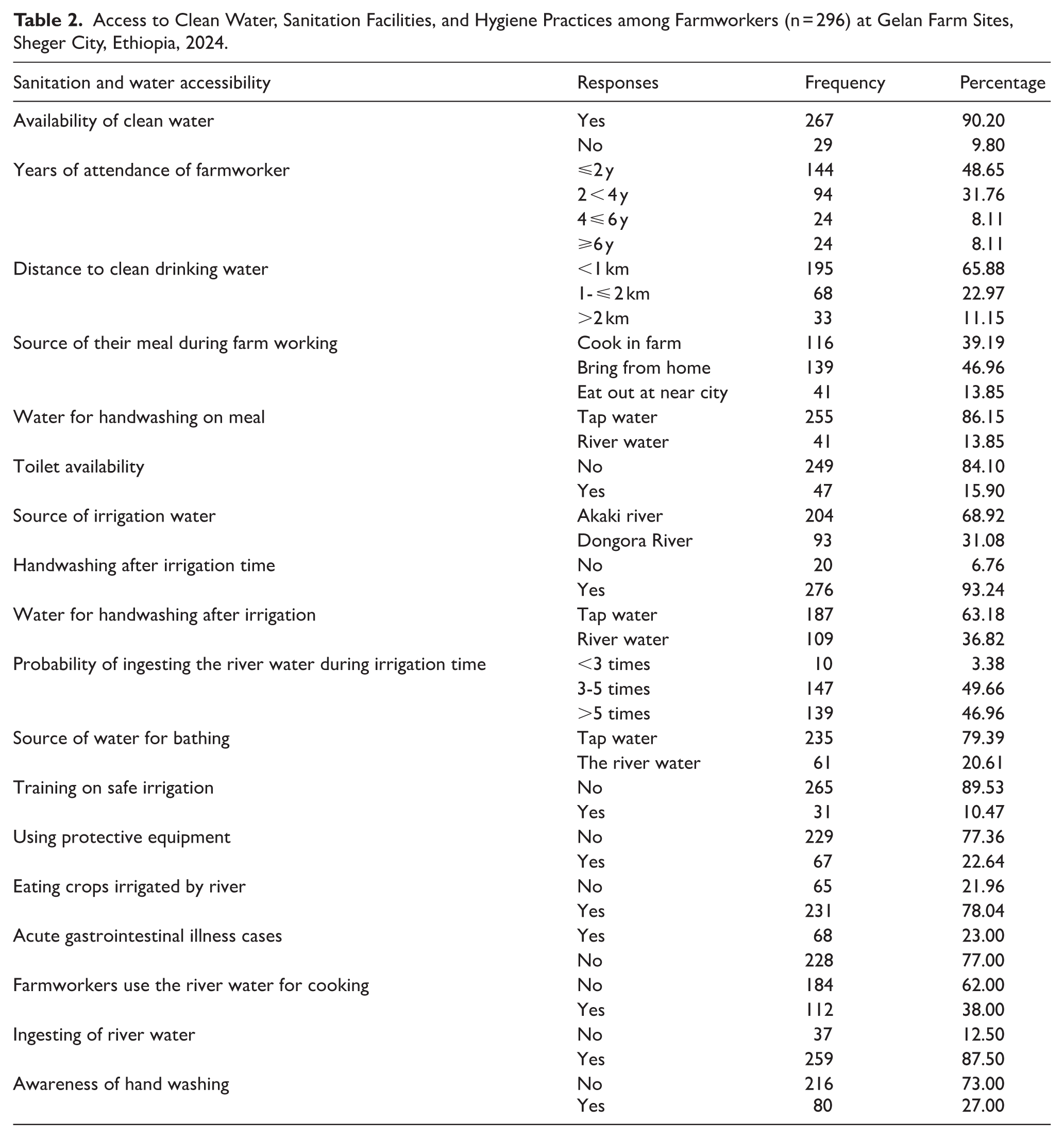
The survey results of water accessibility and the farmworkers’ personal hygiene practices were summarized in the following table (Table 2). According to the survey, a major proportion of the farmworkers (90.2%) had access to clean drinking water; however, distance to the water sources remained a challenge for many of the workers. Specifically, about 34% of respondents resided in the range of 1-3 km away from the nearest clean water source. In terms of having a meal, about 86% of the farmworkers reported eating their meal in farmland. This includes those who cook their meal in the farm sites (39.1%) or bring takeout from their home (46.96%). Regarding personal hygiene, handwashing before meals was widely observed, with 86.15% of workers using clean water for handwashing; nevertheless, a concerning 13.85% continue to rely on river water for washing their hands before having a meal. Sanitation facilities were inadequate across most farms; only 15.9% of the workers had access to toilet facilities, and open defecation was commonly practiced in farmland and along the riverbanks (Figure 1).
Access to Clean Water, Sanitation Facilities, and Hygiene Practices among Farmworkers (n = 296) at Gelan Farm Sites, Sheger City, Ethiopia, 2024.

The images provide a wide illustration of the Akaki River ecosystem: image (A) illustrates the river’s present state and its environment, while image (B) shows instances of open defecation along the Akaki riverbanks, emphasizing the public health and sanitation concerns. Image (C) illustrates a motorized water diversion system, and image (D) showcases the cultivation of green crops irrigated by river water.
Moreover, lack of personal protective equipment (PPE) during irrigation was high, with only 22.64% of the workers practicing such safety measures. Encouragingly, 93.24% of farmworkers reported washing their hands after irrigation work; however, it is important to note that 36.82% of these individuals used the river water instead of clean water. Further compounding the risks, 20.61% of farmworkers used river water for bathing, and 78.04% reported consuming raw produce irrigated with the river water. In addition, 38% of the workers reported using river water for cooking. Even more concerning, 87.5% of workers acknowledged unintentionally ingesting the water while working on the farm, with nearly 47% of them reported that ingesting it more than 5 times per irrigation day. Finally, training on safe irrigation was found to be severely lacking, with only 10.47% of them having received such instruction. Correspondingly, 73% of respondents had no formal awareness of effective hand hygiene practices.
Acute Gastrointestinal Illness Prevalence
Totally, the prevalence of acute gastrointestinal illness among farmworkers was 23%; nearly 1 in 4 farmworkers experienced illness during the study period (Figure 1B). Concerning specific symptoms among infected individuals (Figure 1A), diarrhea emerged as the most frequently reported symptom, affecting 32.4% of respondents. Then vomiting closely followed by 30.3.
The Determinant Factors to the Prevalence of the Gastrointestinal Illness
The influences of the demographic and behavioral of farmworkers and the environmental factors on the prevalence of acute gastrointestinal illness (AGI) were tested using statistical models. Accordingly, the chi-square test revealed strong associations (P < .05) between AGI and factors such as marital status, education level, living arrangements, meal having location during farm work, handwashing awareness, farm site location, frequency of irrigation water ingestion, farming experience, use of river water for cooking, and frequency of bathing after irrigation activities. Furthermore, a multivariable logistic regression test was performed to measures the effect magnitude of the factors on the AGI among the workers. The final model explained 42% of the variance in AGI results (pseudo-R2 = .42: McFadden). In addition, the Hosmer-Lemeshow goodness-of-fit test result was also satisfactory (P = .07), indicating a robust model performance to explain the variation in the illness. In accordance with the logistic regression model analysis, multiple determinant factors influenced the prevalence of the illness (Table 3). Among these, age emerged as a substantial protective factor against AGI; specifically, every additional year of age was associated with an approximately 10% decrease in risk of illness (P = .04).
Logistic Regression Analysis of Factors Associated with the Acute Gastrointestinal Illness Prevalence Among the Farmworkers (n = 296) in the Gelan District Farm Site, 2024.

Additionally, marital status showed strong predictive power: single workers were found to be over 2.5 times more likely to experience AGI compared to their married correspondents (P < .05). Likewise, educational level played a crucial role. The workers with at least elementary education levels are 61% less likely to suffer from the illness than those with no formal education (P = .01). Regarding the workers living place, individuals reside directly on the farm faced a risk of illness approximately 3.3 times higher than those who commuted from nearby urban or peri-urban areas, such as Sheger or Bishoftu City (P = .02).
Likewise, workers with 2-4 years of experience were nearly 71% less likely to report AGI compared to workers those who have less than 2 years’ experience in farm activities (P < .01). Similarly, the location of workers’ meal consumption influenced the likelihood of AGI risks. Workers who ate outside of the farm were 70% less affected (P = .01) when compared with those who had meals on the farm. Furthermore, hygiene-related practices demonstrated strong protective effects. Awareness of handwashing after using the toilet was found to reduce the illness risk by 70% (P < .01). In addition, a regular handwashing practice was linked to a further reduction in AGI occurrences (AOR = 0.70; P < .01).
Finally, the use of untreated wastewater for cooking was found to be 2.64 times more likely to develop AGI compared to workers who used tap water (P = .04). In general, these findings reveal the multifactorial nature of gastrointestinal illness in farming communities, highlighting the importance of both individual behavior and environmental management in disease prevention.
Interaction Effects of Factors on the Acute Gastrointestinal Illness Prevalence
The synergy of several factors considerably influenced the likelihood of acute gastrointestinal illness risk (AGI) among these farmworkers (Figure 2). These findings shed light on how overlapping environmental and behavioral factors contribute to AGI prevalence. For instance, there was a substantial variation between gender and age in the likelihood of experiencing AGI. Specifically, the risk of AGI increased with age, but more likely steeply among male workers (OR = 1.53; 95% CI: 1.14-2.20; P = .01).

(A) Proportions of illness symptoms among farmworkers diagnosed with gastrointestinal illness. (B) Prevalence of illness with at least 1 symptom among farmworkers who experienced acute gastrointestinal illness: A pie chart representation (n = 296, Gelan Farmland Area, 2024).
Similarly, the interaction between awareness of handwashing practices and farm site location significantly influenced the occurrence of AGI (OR = 3.11; 95% CI: 1.15-9.49; P = .03). Workers with awareness of handwashing practices benefited less if they worked at sites with minimal sanitation infrastructure facilities compared to those at there are relatively good sanitation infrastructure. A particularly alarming interaction was observed between unintentionally ingesting irrigation water and using the same river water for cooking. Workers experiencing both exposures faced over a fourfold increase in AGI risk compared to those exposed to only 1 or none (OR = 4.5; 95% CI: 1.90-11.2; P = .00). Finally, the interaction between source of irrigation water and farming experience showed a strong protective effect (OR = 0.02; 95% CI: 0.01-0.23; P < .01), implying a 98% illness risk reduction (Figure 3).

Interaction effects of selected risk factors on the prevalence of acute gastrointestinal illness among irrigation farmworkers in Gelan Farm Sites, Ethiopia, 2024. Odds ratios (log scale) and 95% confidence intervals are shown. Interaction terms include combined influences of water source, hygiene practices, bathing frequency, site location, and socio-demographic factors. Odds ratio’s value greater than 1 indicate increased risk, while values below 1 suggest protective effects.
Discussion
The study assessed he prevalence of acute gastrointestinal illness and determinant factors among irrigation farmworkers—those who used Akaki River water. The findings highlight the critical need to incorporate interventions related to water, sanitation, personal hygiene, occupational safety, and the interaction effect these factors in contexts where untreated wastewater is frequently utilized.18,25 To enhance understanding, the key findings were synthesized, placed within the context of existing literature, and discussed regarding their broader implications for public health in the following sections.
Contextualization of Results
Several studies from South Asia, Sub-Saharan Africa, and Latin America have repeatedly documented high acute gastrointestinal illness (AGI) among farmworkers exposed to untreated wastewater, particularly in the context of limited clean water access and sanitation infrastructure.18,26-28 These studies mainly focused on associations of the water quality, hand hygiene practices, and personal protective equipment with acute gastrointestinal illness prevalence. Nevertheless, the present study extends the literature by integrating both individual determinants and their interaction effects, a dimension often overlooked in traditional public health studies. Unlike previous investigations, these findings revealed the concurrence of risk factors that can amplify AGI risk. This approach provides a more all-inclusive, real understanding of health risks in vulnerable communities, and it develops the concept that factors influence the illness beyond basic cause-and-effect assumptions and clarifies how the interplay of factors in the real world shapes health risks. 29 Therefore, this study contributes to the scientific understanding of AGI prevalence among untreated wastewater-exposed workers and offers valuable perceptions for targeted intervention approaches.
Interpretation of Key Findings
The findings of the study revealed several factors associated with acute gastrointestinal illness risk among the farmworkers. For instance, younger age and single marital status were linked to increased illness prevalence. The younger-aged groups have fewer exposures and experiences relating to managing and mitigating the risks associated with untreated wastewater. Their relative inexperience could make them more susceptible to gastrointestinal pathogens that thrive in unhygienic conditions. 30 Regarding the elevation of AGI prevalence among the single farmworkers, these workers’ residing place might be the consequence. These workers often live in farmland that disproportionately exposes them to contaminated water sources for drinking, cooking, and washing, as they need water, and they cannot always afford to use clean water due to the distance matter. In contrast, life after marriage has increased good hygiene practices among the couple, as they could have several exposures to health professionals’ consultancy in family health care programs, 31 which argues that marital status often provides indirect health protections, such as improved housing conditions and healthy food practices.
On the other hand, education emerged as one of the most robust protective factors. Among the workers with formal education, substantially lower AGI prevalence was recorded, plausibly due to increased knowledge of hygiene and awareness of disease prevention approaches. These findings align with findings by several scholars, which recognized education as a tool of health welfare.32,33
Moreover, the use of untreated wastewater for cooking was a critical contributor to AGI. In this study’s findings, the workers who used the Akaki River for cooking faced significantly elevated illness risks. This is likely attributed by several exposures, like contacting their mouth with the water moisture, washing feeding plates, and other related utensils. This result is reinforced by other previous studies that identified that wastewater is a medium for enteric pathogens such as Salmonella, E. coli, and protozoan cysts, which may persist through food preparation and consumption.34,35
The Factors Synergistic Effects and Risks
The age–gender interaction revealed differential vulnerability patterns in AGI prevalence across the gender, indicating that the probability of exposure to infection and health outcomes is not uniform within female and male farmworkers but mediated by gender-specific physiological and social dynamics. According to the previous findings, this sex-based health outcome disparity is driven by immunological, hormonal, and occupational differences between the females and males. 36
Similarly, an important synergy was noted between handwashing awareness and farm site location. Despite handwashing is typically protective against acute gastrointestinal illness, its effectiveness becomes weak in high-risk environments where sanitation infrastructure is insufficient. This strengthens the important of combining good personal hygiene practices, with structural improvements of access to clean water, toilet facilities, and personal protective equipment, to ensure meaningful health benefits.
Likewise, concerning was the interaction between the irrigation water ingestion and use for cooking, which resulted in a fourfold increase in AGI risk compared to the contribution of the factors on the prevalence of the illness separately. This synergistic exposure via both ingestion and food preparation indicates a compounding risk pathway. Similarly, Adegoke et al reported that frequent exposure to fecal-contaminated water through irrigation or domestic use dramatically increases pathogen load and infection rates. 29
In addition, experience functioned as a protective moderator, but only when paired with enabling environments. Although experienced farmworkers faced lower illness risk compared to their juniors, this depends upon access to clean water sources and hygiene facilities, echoing findings from others Prior studies.32,37 This reflects that adaptive behavior is insufficient without supportive environmental conditions.
Conclusions
Acute gastrointestinal illness (AGI) is a substantial occupational health burden, affecting about 23% of irrigation farmworkers in the Gelan Farm Sites. This study identified marital status, higher educational level, post-irrigation bathing, and consistent handwashing as protective factors against the illness. Furthermore, the synergies of being married and having a formal education level and longer farming experience and bathing frequency after irrigation were found to reduce illness risk. In contrast, simultaneous exposure to the contaminated water through both ingestion and using it for cooking highly raised the illness risk. Regarding gender, male workers are more vulnerable to the illness. Generally, these findings suggest the urgent need for comprehensive, context-specific public health interventions.
Limitations
Despite this research’s strengths, we should address several drawbacks. First, the cross-sectional study limits the generalizability of the findings, as temporal correlations between exposure and illness are not definitively established. Second, the inclusion of self-reported data offers potential for memory bias and social desirability bias, specifically for hygiene behaviors. Third, while some crucial interaction contents were included, unmeasured confounding variables such as household sanitation, food diversity, and chronic health conditions may increase AGI risk. Thus, future studies should employ longitudinal and mixed-method designs, incorporating sociocultural dimensions of hygiene behavior to triangulate findings.
Supplemental Material
sj-docx-1-ehi-10.1177_11786302261423280 – Supplemental material for Prevalence and Determinants of Acute Gastrointestinal Illness among Irrigation Farmworkers in Gelan Farm Sites, Sheger City, Ethiopia
Supplemental material, sj-docx-1-ehi-10.1177_11786302261423280 for Prevalence and Determinants of Acute Gastrointestinal Illness among Irrigation Farmworkers in Gelan Farm Sites, Sheger City, Ethiopia by Iyasu Gudisa, Bezatu Mengistie, Adey Feleke Desta, Haile Alemayehu and Sirak Robele Gari in Environmental Health Insights
Footnotes
Acknowledgements
I am deeply grateful to my beloved friends, Geleto Erenso, Shoma Haile, Kebena Chalchisa, Bekela Diro, Misgana Dabessa, Jaleta Tamiru, Namso Geda, Tesfaye Gudisa, and Bula Kere, for their incredible support of the data collection. Your generous contribution of time, effort, and full professionalism offered entirely without any payment was invaluable to this work. I express my sincere gratitude to Merga Lebeta for his excellent supervision in managing the data collection, which was crucial. Alongside his steadfast support, he generously offered his motorcycle during the fieldwork, facilitating convenient transportation and access to remote sites.

Ethical Considerations
The study’s ethical approval was obtained from the Ethical Review Committee of the Oromia Emergency Research Bureau on the date of 10/18/2023 with Reference Number BFO/HBTFH/1-16/770. The committee thoroughly assessed the study’s goals, procedures, and possible risks to ensure alignment with ethical standards and to protect participants’ rights and well-being. Additionally, all study techniques were set in line with appropriate ethical criteria, guaranteeing adherence to the ethics of secrecy, voluntary participation, and informed consent.
Author Contributions
IIyasu Gudisa: Conceptualized and designed the study, conducted data collection and statistical analysis, and wrote the original manuscript. Bezatu Mengistie: Contributed to the development and refinement of the study methodology and provided overall scientific guidance throughout the research process. Adey Feleke Desta: Provided guidance for laboratory work and assisted in the execution of experimental procedures. Haile Alemayehu supervised technical supervision and laboratory activities and supported the implementation of experimental tasks. Sirak Robele Gari: Supervised the development of the study concepts, prepared manuscripts, provided critical revisions to the contents, and edited the manuscript to enhance clarity, coherence, and overall quality.
Funding
The authors received no financial support for the research, authorship, and/or publication of this article.
Declaration of Conflicting Interests
The authors declared no potential conflicts of interest with respect to the research, authorship, and/or publication of this article.
Data Availability Statement
The datasets used analyzed during the current study available from the corresponding author on the reasonable request.*
Supplemental Material
Supplemental material for this article is available online.
References
Supplementary Material
Please find the following supplemental material available below.
For Open Access articles published under a Creative Commons License, all supplemental material carries the same license as the article it is associated with.
For non-Open Access articles published, all supplemental material carries a non-exclusive license, and permission requests for re-use of supplemental material or any part of supplemental material shall be sent directly to the copyright owner as specified in the copyright notice associated with the article.
