



Abstract
This study investigates the organizational and behavioral barriers influencing occupational safety and health (OSH) outcomes in industrial zones, drawing on Bureaucratic Organization Theory and the Theory of Planned Behavior. The primary objective is to identify key structural, cultural, and psychological factors that undermine safety performance. A quantitative research design was adopted, utilizing survey data from 486 employees in industrial clusters across Vietnam. Data were analyzed using SPSS 22.0 and AMOS 22.0 through a 2-stage analytical process involving Exploratory and Confirmatory Factor Analyses, followed by Structural Equation Modeling. The results reveal that formalistic safety procedures, lack of operational empowerment, poor interdepartmental coordination, complex incident reporting, unsafe group norms, productivity-over-safety culture, low perceived behavioral control, and lack of safety motivation all negatively impact OSH outcomes. These findings underscore the need for participatory safety management, simplified reporting systems, and empowerment-focused interventions. The study provides both theoretical contributions and practical recommendations for developing more resilient and employee-centered OSH strategies in industrial contexts.
Plain Language Summary
• Complex incident reporting and formalistic safety procedures are the strongest organizational barriers to workplace safety.
• Low perceived behavioral control and lack of empowerment significantly reduce employee safety engagement and proactive risk management.
• Unsafe group norms and a productivity-over-safety culture undermine formal safety initiatives and normalize risk-taking.
• All 8 hypothesized organizational and behavioral barriers showed statistically significant negative effects on OSH outcomes.
• The study’s integrated model offers empirical support for prioritizing participatory safety, psychological empowerment, and streamlined reporting systems.
Keywords
Introduction
Industrialization remains a key strategy for economic growth in developing countries, promoting employment, sectoral shifts, and attracting foreign direct investment (FDI). As noted, industrial hubs in regions like Sub-Saharan Africa and Southeast Asia have enabled economic catch-up by integrating local firms into global value chains. 1 Yet in many contemporary industrial parks—particularly those located in peri-urban belts of rapidly industrializing economies such as Vietnam—the co-location of young, unskilled, and migrant workers coincides with uneven OSH enforcement and limited induction training, creating concentrated exposure to industrial hazards.2,3
While industrial zones in developing countries have played a pivotal role in driving economic development, they often present severe occupational safety and health (OSH) risks, including musculoskeletal injuries, respiratory illnesses, chemical exposure, and psychological stress. 4 These risks are not merely technical failures but are patterned by organizational routines—for example, formalistic compliance procedures, fragmented interdepartmental coordination, and a production-first ethos—that systematically displace prevention with output pressure.5-13
Many organizations compound these vulnerabilities by relying on reactive safety systems focusing primarily on post-incident responses rather than proactive risk prevention and capacity building. 14 The implications of inadequate OSH management are far-reaching—unsafe workplaces not only compromise worker health and safety but also reduce productivity, increase medical and compensation costs, and cause frequent operational disruptions. 15 Additionally, poor safety conditions can lower employee morale, raise turnover rates, and erode organizational resilience. 16 On a broader scale, occupational injuries place significant burdens on public health systems and exacerbate social inequality, particularly among vulnerable and informal workers. 17 In short, “paper safety” often substitutes for “real safety,” masking underlying organizational and behavioral constraints that impede genuine prevention.
Despite the urgency of these issues, empirical research on OSH in developing contexts remains limited. Most existing studies are descriptive and lack robust, generalizable quantitative analysis that links organizational and behavioral factors to safety outcomes. 18 Furthermore, many conceptual models treat organizational culture and behavioral determinants in isolation, failing to capture the complex interdependencies that shape safety performance. Two gaps are especially salient: first, the literature seldom integrates bureaucratic constraints (eg, procedural formalism, complex reporting chains, coordination deficits, frontline disempowerment) with behavioral drivers emphasized by the Theory of Planned Behavior (eg, perceived behavioral control, motivation, injunctive/descriptive norms, safety-related attitudes); second, evidence from developing-country industrial parks—where enforcement is uneven and informal labor is prevalent—remains sparse, limiting theoretical transferability and practical guidance.19,20
Addressing this research gap, the present study integrates Bureaucratic Organization Theory with the Theory of Planned Behavior (TPB) to develop a comprehensive model explaining OSH implementation in industrial zones. From this integrated lens, we theoretically derive and empirically test 8 barriers: (i) procedural formalism, (ii) incident reporting complexity, (iii) poor interdepartmental coordination, (iv) operational disempowerment, (v) productivity-over-safety culture (attitudinal priority), (vi) unsafe group norms, (vii) low perceived behavioral control, and (viii) low safety motivation. This mapping clarifies why these specific factors—rather than an arbitrary set—are selected: the first 4 operationalize bureaucratic impediments to prevention; the latter 4 capture core TPB mechanisms shaping safety behavior. Using Structural Equation Modeling (SEM), the study empirically tests multiple direct relationships within this framework. 21
This study contributes by (i) integrating Bureaucratic Organization Theory and the Theory of Planned Behavior to explain OSH as a structural-to-behavioral cascade in developing-country industrial parks; (ii) theorizing and validating a parsimonious set of 8 barriers that jointly account for organizational impediments and proximal drivers of safety behavior; and (iii) providing generalizable, Vietnam-based evidence to inform a shift from ritualized, reactive compliance to participatory, prevention-oriented safety management. Collectively, these advances address the precise literature gap identified by reviewers: why these factors, supported by what theory, to solve what unresolved problem.
Literature Review
Industrial Park, Industrial Cluster in Vietnam
Over the past 3 decades, Vietnam has undergone significant economic transformation fueled by industrialization, export expansion, and robust foreign direct investment (FDI) inflows. This trajectory has resulted in the establishment of more than 400 industrial parks (IPs) and 900 industrial clusters (ICs), which have become critical engines of employment, production, and export-led growth. 22 However, the rapid proliferation of these industrial zones has outpaced the regulatory and institutional capacities required for effective monitoring and enforcement of labor standards, particularly concerning occupational safety and health (OSH). 23
Thanh et al argue that the growth-first policy mindset has sidelined safety compliance mechanisms, allowing production demands to overshadow worker protection initiatives. 23 This situation is especially critical given Vietnam’s young and largely migrant industrial workforce, which often lacks access to formal labor rights protections. As a consequence, there is mounting evidence that OSH conditions have deteriorated.
Poor OSH conditions not only undermine worker health but also lead to increased absenteeism, reduced labor productivity, and reputational risks for investors and multinational brands. Crucially, these systemic OSH deficiencies threaten the long-term sustainability of Vietnam’s industrial development. Without stronger regulatory oversight, improved corporate accountability, and inclusive worker protections, Vietnam risks eroding its competitive advantage by weakening the very human capital on which its growth depends.
Despite the scale and strategic importance of Vietnam’s IPs/ICs, systematic, generalizable evidence linking organizational design features and behavioral mechanisms to OSH outcomes remains scarce. Existing work is either descriptive or extrapolated from high-income contexts with mature enforcement architectures, limiting transferability to Vietnam’s growth-first, migration-intensive industrial corridors.22,23 Crucially, under-reporting of incidents and near-misses—driven by complex reporting chains and output pressure—obscures risk patterns and blunts prevention, reinforcing a “paper safety” equilibrium that is poorly captured by current models. This study addresses that gap by providing validated, quantitative evidence from Vietnamese IPs/ICs that explicates how bureaucratic impediments and behavioral drivers jointly shape OSH outcomes.
Theoretical Framework: Bureaucratic Organization Theory and Theory of Planned Behavior
To understand the factors influencing the implementation of occupational safety and health (OSH) practices, this study integrates 2 complementary perspectives: Bureaucratic Organization Theory and the Theory of Planned Behavior (TPB).
Bureaucratic Organization Theory, rooted in Max Weber’s model of rational-legal authority, emphasizes hierarchical structures, formal rules, and standardized procedures as essential to administrative control. In the OSH context, such structures enable consistent enforcement through inspections, audits, and formal training. However, excessive proceduralism can lead to “bureaucratic overload,” where safety management becomes a ritual of compliance rather than genuine hazard mitigation. 24 Empirical studies show that while bureaucracy can enhance regulatory consistency, 25 it may also hinder responsiveness in dynamic environments due to rigid hierarchies and slow information flow.26,27
Complementing this structural lens, TPB provides a behavioral framework to explain why individuals comply—or fail to comply—with safety practices. According to Ajzen, behavior is driven by attitudes, subjective norms, and perceived behavioral control. 5 In OSH research, these psychological determinants have been linked to safety compliance across various industries. For example, Avci and Yayli found that positive safety climates and strong individual intentions predict safe behavior, 8 while Peng and Chan showed that perceived control significantly influences compliance among older construction workers. 28 Further studies have integrated TPB with models like the Technology Acceptance Model to understand protective equipment usage, 29 and linked it to organizational safety culture to predict unsafe behavior. 30
Building on the 2 lenses, we articulate a theory-to-mechanism map: Bureaucratic Organization Theory (BOT) explains how procedural formalism, multi-tier reporting, fragmented coordination, and frontline disempowerment (structural impediments) create information latency, responsibility diffusion, and weak local problem-solving.24-27 These structural conditions propagate into the TPB pathway by depressing perceived behavioral control (PBC), weakening motivation, and normalizing unsafe descriptive norms under a productivity-over-safety attitude.5,8,28-30 Thus, BOT factors act as upstream constraints; TPB factors operate as proximal psychological conduits translating structure into behavior and, ultimately, OSH outcomes. This integrated logic justifies the selection of 8 constructs as a parsimonious, non-redundant set covering both structural (BOT) and proximal (TPB) levers most salient in Vietnam’s IP/IC context.
To ensure that construct selection was theoretically grounded rather than ad hoc, a pre-registered selection protocol was employed. First, theory anchoring required each construct to map unambiguously either to Bureaucratic Organization Theory (BOT)—capturing structural impediments to prevention—or to the Theory of Planned Behavior (TPB)—capturing proximal determinants of safety behavior. Second, context relevance was applied: constructs had to be recurrently documented in developing-country industrial zones, such as multi-layer reporting chains, ritualized compliance, or fragmented interfaces between production, maintenance, quality assurance, and EHS units. Third, conceptual non-redundancy guided the elimination of overlapping or collinear factors to preserve parsimony and model identifiability. Fourth, measurability required that constructs could be operationalized with surveyable indicators demonstrating cultural and linguistic fit for large-N studies in Vietnam. Several potential candidates—such as frequency of external inspections, PPE budgets, or automation intensity—were deliberately excluded because they represent upstream policy inputs or resource endowments that (a) lie outside the focal organizational decision space, (b) vary systematically by sector and buyer contracts in ways that confound workplace-level inference, or (c) ultimately collapse into BOT pathways (eg, procurement formalism driving PPE shortages). The resulting set of 4 BOT constructs and 4 TPB constructs provides saturation sufficient to capture the structural-to-behavioral causal chain, while remaining lean enough to support robust estimation and theoretical clarity.
Hypothesis Development
The selection of these 8 factors was not incidental but grounded in a transparent construct-selection protocol. Each construct maps unambiguously to either Bureaucratic Organization Theory (BOT) or the Theory of Planned Behavior (TPB), ensuring clear theoretical anchoring.5,24 All 8 barriers are recurrently observed in developing-country industrial zones, where multi-layered reporting, ritualized compliance, fragmented interdepartmental coordination, and disempowered frontline workers represent systemic impediments to prevention.6,13,18
Overlapping or conceptually redundant constructs were deliberately excluded to maintain parsimony and model identifiability, following best practices in SEM research.31,32 Furthermore, each construct was operationalized using culturally adapted survey items validated in prior safety studies, ensuring linguistic and contextual fit for large-scale application in Vietnam.9,21 Importantly, while developed-economy research often emphasizes advanced regulatory enforcement and technological safeguards,11,33 OSH outcomes in low- and middle-income economies are shaped more directly by bureaucratic rigidity, weak empowerment, and social-norm dynamics—factors that remain underexplored in the literature.19,20,34
This study addresses that gap by systematically theorizing and testing how these 8 interdependent barriers, long recognized anecdotally, jointly undermine OSH outcomes in contexts where enforcement capacity is fragile and labor markets are dominated by young, migrant, and precarious workers. By doing so, the model advances a context-sensitive framework that is theoretically robust, empirically validated, and directly relevant to industrial zones in developing economies.
Bureaucratic Organization Theory
Formalistic Safety Procedures
Formalistic safety procedures refer to systems and protocols established mainly to fulfill regulatory requirements or maintain documentation, rather than to actively guide daily work practices. In many industrial zones of developing countries, these procedures are often implemented in a rigid, top-down manner, with little regard for the actual working conditions or risks faced by employees. This disconnect not only reduces their practical relevance but also fosters a false sense of security—where the presence of documented systems is mistakenly equated with genuine safety performance. 35
Choudhry and Fang explain that when safety protocols are perceived as symbolic rather than functional, workers are less motivated to internalize them, leading to increased rates of unsafe behavior. 15 In the Tanzanian construction sector, Mwemezi et al found that formal safety systems failed to address the informal realities of the workforce, creating a gap between policy and practice that contributed to elevated risk exposure. 36 Likewise, Koehn et al reported that in many developing contexts, professionals view safety procedures as externally imposed obligations, resulting in low implementation fidelity and resistance among site supervisors and laborers. 37 The lack of contextual adaptation means that such procedures often ignore local hazards, resource limitations, and cultural factors, reducing their effectiveness. 38 Consequently, rather than improving safety, formalistic procedures may create complacency or confusion, hindering proactive hazard identification and response.
Lack of Operational Empowerment
The lack of operational empowerment—defined as the exclusion of workers from meaningful decision-making and safety governance—significantly undermines occupational safety and health (OSH) outcomes in industrial zones of developing countries. Empirical evidence suggests that when workers are not empowered to report hazards, participate in safety committees, or halt unsafe practices, workplace risks remain unaddressed, contributing to increased injuries and chronic health conditions.
A study by Hoque et al found that in Bangladesh’s industrial zones, insufficient worker involvement in operational decisions led to the persistence of environmental and health hazards, including poorly maintained ventilation and inadequate waste disposal practices, exacerbating occupational illnesses. 39 Similarly, Landsbergis highlighted that organizational changes that marginalize workers’ roles correlate with elevated stress, reduced safety compliance, and increased accidents, especially in poorly regulated labor markets. 40 Abdalla et al further reported that participatory empowerment is crucial in reducing workplace injury rates, yet such frameworks are often absent or inconsistently enforced in low-income settings. 41 Moreover, Mahmood et al noted that hierarchical organizational structures in Bangladesh’s garment sector leave little room for mid-level managers to address OSH violations proactively, resulting in delayed hazard mitigation. 42 Research in Ethiopia confirmed similar trends, where Sileyew found that lack of operational knowledge transfers and worker empowerment in OSH matters led to systemic risk management failures. 43 These findings converge on the conclusion that:
Poor Interdepartmental Coordination
Poor interdepartmental coordination significantly undermines occupational safety and health (OSH) outcomes in developing country industrial zones by disrupting the integration of safety systems, delaying responses to hazards, and obstructing collaborative interventions. Across various industrial contexts, fragmented communication among internal departments—such as engineering, compliance, production, and health services—has been linked to higher rates of accidents, regulatory non-compliance, and inefficient risk mitigation.
Jilcha and Kitaw highlight that the absence of alignment between engineering and administrative departments in Ethiopian industries resulted in persistent safety lapses and elevated accident severity, 18 a pattern echoed in Bangladesh’s garment sector, where Huq et al found that poor coordination among procurement, compliance, and production teams weakened enforcement of OSH standards. 44 These challenges are compounded by systemic issues within public health and regulatory frameworks. Baron et al and Loewenson both emphasize that when public health agencies and workplace inspection bodies fail to coordinate, especially in informal or resource-constrained settings, the result is an under-protected labor force facing chronic exposure to preventable risks.45,46
This breakdown in horizontal collaboration is also evident in participatory initiatives; Kawakami et al observed that in Vietnam, the absence of a well-functioning interdepartmental support structure hindered the scalability of OSH programs among agricultural workers. 47 Moreover, at the government level, inadequate multi-agency collaboration was found to exacerbate workplace fire risks in low-income regions, as demonstrated by Peck et al in their study of burns and hazard response systems. 48
Complex and Delayed Incident Reporting
Complex and delayed incident reporting systems significantly impair the effectiveness of occupational safety and health (OSH) practices in industrial zones across developing countries by limiting the timely identification, analysis, and correction of hazards. These deficiencies often stem from bureaucratic, paper-based procedures, unclear reporting chains, and a fear-driven culture that discourages whistleblowing or error acknowledgment.
Jilcha and Kitaw argue that complex administrative reporting mechanisms in developing nations contribute to the underreporting of near-misses and accidents, depriving organizations of critical data necessary for proactive hazard mitigation. 18 Hale et al reinforce this view, noting that delays in reporting reduce the window for preventive intervention, leading to reactive rather than proactive OSH management. 33
Hermanus emphasizes that in South African mining sectors, delays in dust monitoring and incident documentation led to the late recognition of occupational diseases such as silicosis, undermining both treatment and policy responses. 49 Beck further correlates reporting delays with escalated industrial disasters in developing regions, noting that incidents were often not acted upon until irreversible damage had occurred. 50 Shrivastava et al suggest that without early detection via rapid incident logs, the cascading effects of industrial crises are magnified, resulting in broader socio-environmental fallout. 51 These findings collectively highlight that:
Theory of Planned Behavior
Productivity-Over-Safety Culture
A productivity-over-safety culture significantly compromises occupational safety and health (OSH) practices in industrial zones across developing countries, fostering environments where workers are exposed to preventable hazards to meet production quotas. In such settings, safety protocols are frequently deprioritized, compliance is selectively enforced, and reporting unsafe conditions may be discouraged due to fear of jeopardizing output metrics.
Jilcha and Kitaw identified this trade-off in Ethiopian manufacturing sectors, noting that productivity demands often overrode hazard control measures, resulting in higher accident rates and injury severity. 18 Fayyaz et al found that in Pakistan’s construction industry, the prioritization of efficiency over worker well-being severely limited the implementation of safety frameworks, especially under tight deadlines. 52 Similarly, Choudhry et al emphasize that in developing economies, production pressures compel middle managers to overlook or delay safety interventions, weakening the integrity of OSH systems. 6 A study by Abdalla et al across global low-income settings reveals that such cultures lead to increased rates of injury, particularly when safety responsibilities are seen as obstacles to output goals. 41 Based on these findings we believe that:
Unsafe Group Norms
Unsafe group norms in industrial zones refer to collectively accepted behaviors and informal practices among worker groups that deviate from established safety regulations and promote hazardous working conditions. These norms emerge when peer acceptance and group cohesion prioritize productivity or loyalty over individual safety, leading to routine risk-taking, non-use of personal protective equipment (PPE), and neglect of standard operating procedures. 53
Some studies have shown that unsafe group norms increase the rate of accidents, injuries, and rule violations for workers. When hazardous behaviors are normalized within a workgroup, individuals are more likely to engage in risk-taking to align with group expectations, even when it contradicts official safety procedures. 26 For instance, in industrial environments where peer approval is contingent upon maintaining productivity over safety, workers often feel compelled to bypass safety measures, leading to a higher incidence of workplace mishaps. 54 Choi and Lee further demonstrate that in construction sectors, the influence of perceived group norms significantly predicts unsafe actions, overriding even recent training efforts. 55
The collective endorsement of such behaviors cultivates a permissive culture that reduces personal accountability and blunts the effectiveness of top-down interventions. Consequently, unsafe group norms not only compromise individual well-being but also erode the organizational safety climate as a whole.
Low Perceived Behavioral Control
Low perceived behavioral control (PBC) in industrial zones refers to workers’ limited belief in their ability to perform or enforce safe practices due to external constraints such as limited autonomy, insufficient training, or systemic pressures from management and production targets. This concept, derived from the Theory of Planned Behavior, significantly predicts workplace behavior, especially in high-risk environments where employees may feel disempowered or constrained by organizational structures. 5
In many industrial zones, particularly in developing countries, workers operate under rigid hierarchies and time-intensive production systems, which diminish their sense of agency and self-efficacy regarding safety practices. For instance, research by Robertsen et al in the Norwegian smelting industry demonstrated that even when workers understood safety protocols, their behavior was largely influenced by perceived constraints, such as lack of protective equipment availability or insufficient time to follow procedures. 56 When PBC is low, workers are more likely to bypass safety rules, not out of ignorance, but due to perceived futility in challenging dominant operational pressures. Furthermore, studies have shown that environmental and organizational barriers—like poor communication from supervisors or the absence of role clarity—can suppress workers’ beliefs in their ability to act safely, thereby increasing risk exposure. 57 Based on the findings above, we believe that:
Lack of Safety Motivation
Lack of safety motivation refers to workers’ insufficient internal drive to prioritize or engage in safe behaviors, often stemming from a lack of incentives, recognition, or meaningful integration of safety into their work environments. In industrial zones of developing countries, this motivational gap is strongly associated with poor occupational safety and health (OSH) outcomes. Empirical studies highlight that in contexts where safety is not actively promoted or linked to performance rewards, workers tend to disengage from safety protocols, viewing them as peripheral rather than integral to their roles. 48 This disengagement is further compounded by monotonous and high-pressure environments, where minimal worker autonomy and punitive oversight erode psychological ownership of safety responsibilities. 58
A study by Gopang et al in Pakistan’s industrial zones revealed that lack of motivation significantly undermines the implementation of health and safety measures, with many workers perceiving compliance as burdensome in the absence of a supportive organizational culture. 59 Similarly, Jilcha and Kitaw argue that in many developing countries, motivation is impeded by inadequate institutional frameworks and weak enforcement mechanisms, leading to high accident rates and chronic underreporting. 13 These insights suggest that improving OSH outcomes in such contexts requires more than technical solutions—it demands fostering a culture that values safety intrinsically, reinforces it through leadership engagement, 60 and motivates workers via recognition, training, and empowerment.14,61
Boundary conditions, generalizability, and empirical contribution. The model targets workplaces embedded in multi-tier supply chains and growth-first regulatory regimes, as found widely across Vietnam’s IPs/ICs. While specific hazard profiles vary by industry, the structural-to-behavioral cascade we theorize is portable to industrial parks in similar institutional environments. Empirically, the study advances the field by validating a compact, theory-grounded battery of 8 barriers—with distinct structural and proximal roles—using SEM on a large Vietnamese sample. This design moves the literature beyond single-factor or purely cultural accounts toward an integrative explanation that is both theoretically interpretable and intervention-ready.
The hypotheses developed in this study are synthesized and empirically tested through the proposed research model illustrated in Figure 1.

The hypothesized model.
Methodology
Sampling and Data Collection
This study adopts a convenience sampling method to investigate barriers to occupational safety and health (OSH) among workers in Vietnam’s industrial parks and clusters. To increase transparency and reduce selection bias, we implemented a multi-stage, manager-facilitated non-probability design with purposive stratification by region (North–Central–South) and high-exposure sectors (eg, electronics, textiles, chemicals, food processing). With the support of industrial park and cluster managers, the researcher gained access to relevant zones and facilitated the distribution of surveys to participating companies and employees. Data were collected through an online survey, chosen for its cost-effectiveness and compatibility with mobile devices, ensuring accessibility for a wide range of workers. Surveys were disseminated via workplace phone-based messaging groups, enabling direct and convenient communication with participants. To enhance heterogeneity and practical representativeness, we applied soft targets across firm functions (production, quality control, maintenance/engineering, EHS/safety, administration/HR) and ownership types (FDI, private/joint-stock, state-owned) wherever feasible. Efforts to enhance representativeness included targeting a broad cross-section of sectors—such as textiles, electronics, and chemicals—and incorporating participants from diverse industrial clusters located across northern, central, and southern regions of Vietnam. This geographic and sectoral diversity offers valuable insights into OSH challenges across a wide operational landscape.
The final analytic sample comprised N = 451 valid responses after data quality screening (eg, time-on-task, straight-lining checks). Each survey began with a clear introduction outlining the study’s objective—identifying key OSH barriers such as lack of coordination between departments, slow and complicated incident reporting, unsafe team norms, and lack of safety motivation. To ensure clarity and cultural relevance, the survey was pilot-tested and refined with input from vocational safety experts. Ethical principles were strictly upheld: participation was voluntary and anonymous, no personal identifiers were collected, and all data were used exclusively for academic and policy-oriented research. Given the non-probability nature of the design, we interpret findings as analytically generalizable to IP/IC contexts sharing similar sectoral mixes, workforce demographics, and regulatory capacity; statistical population inference is not claimed.
Results are most applicable to labor-intensive IP/IC settings characterized by young, migrant, production-centric workforces and growth-first oversight regimes. External validity is supported by the study’s planned heterogeneity (multi-region × multi-sector × multi-function coverage); however, extrapolation to capital-intensive subsectors (eg, heavy petrochemicals) or jurisdictions with markedly different enforcement architectures should be made cautiously. To aid transferability, we report subgroup descriptives (Table 1) and discuss contextual levers (eg, incident-reporting complexity, procedural formalism) that are portable to similar industrial clusters. Future replications using probability sampling frames or administrative sampling (eg, gate-entry rosters) would further strengthen statistical generalization.
Respondent Characteristics and Distribution.
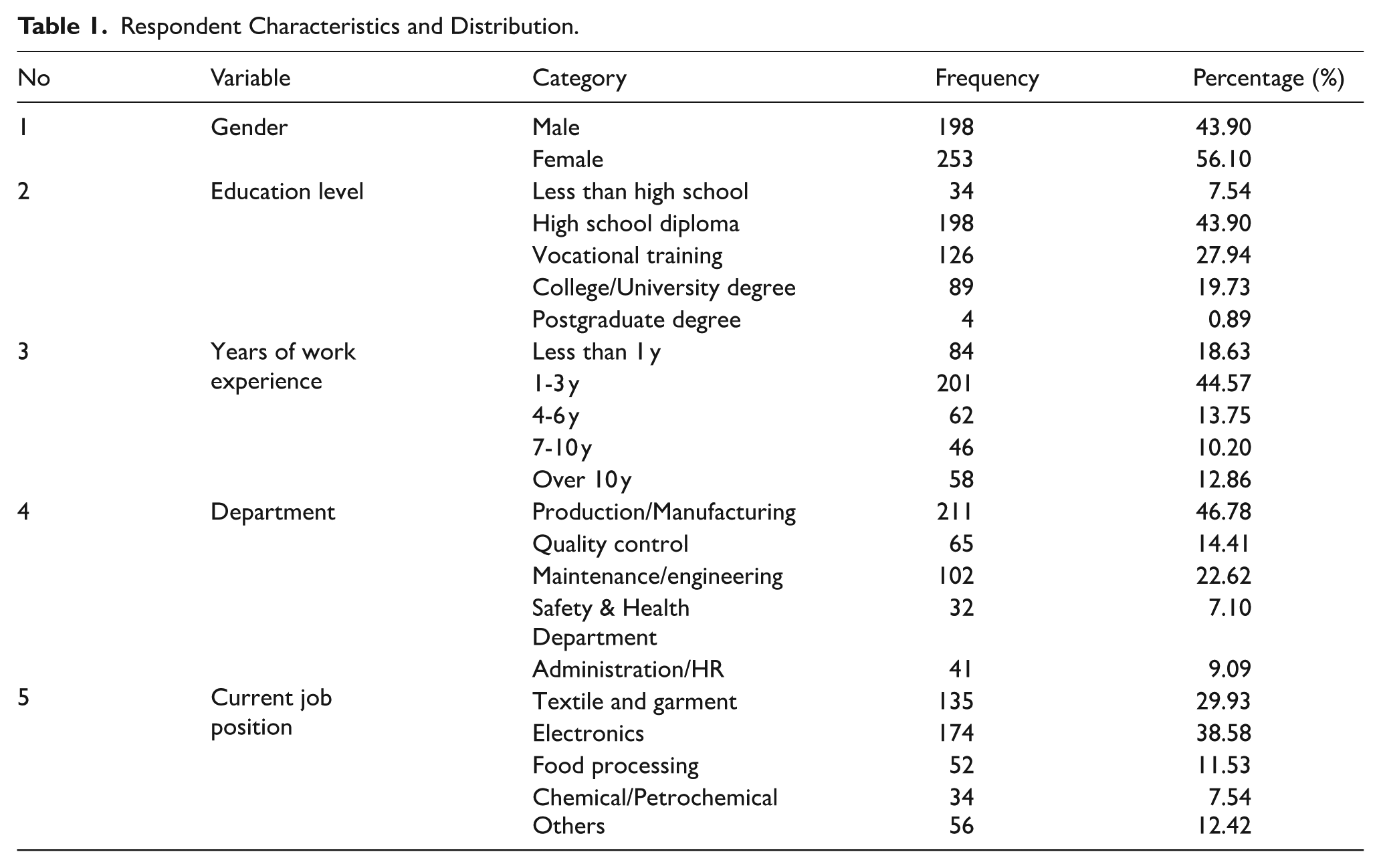
The sample consisted of 56.1% female and 43.9% male respondents, reflecting the gendered nature of labor-intensive sectors like textiles and electronics (Table 1). Most participants held a high school diploma (43.9%) or vocational training (27.94%), with only 0.89% possessing postgraduate qualifications—indicating an operationally focused workforce. Work experience was predominantly short-term, with 44.57% having 1 to 3 years and 18.63% less than a year, suggesting heightened vulnerability to safety risks. Departmentally, nearly half (46.78%) worked in production, followed by maintenance/engineering (22.62%) and quality control (14.41%), while only 7.1% were from safety and health units. The dominant sectors represented were electronics (38.58%) and textiles (29.93%). Overall, the sample reflects a young, moderately educated, and production-centric workforce. These characteristics underscore the need for practical, adaptive OSH strategies tailored to sectoral demands and grounded in behavioral insights. Consistent with the boundary-conditions above, readers should treat the estimates as most representative of Vietnam-type IP/IC environments and similar developing-country industrial parks with comparable sectoral composition and regulatory maturity.
Scales and Measures
This study employed a structured online survey to assess key organizational and behavioral barriers to occupational safety and health (OSH) in Vietnam’s industrial zones. A five-point Likert scale (1 = strongly agree, 5 = strongly disagree) was used to measure perceptions across all constructs. Data were analyzed using Confirmatory Factor Analysis (CFA) and Structural Equation Modeling (SEM) to ensure validity and reliability, offering a robust quantitative approach to understanding OSH implementation challenges in resource-constrained environments.
Formalistic Safety Procedures
Measured using 5 items adapted from Zohar and Luria 62 and Choudhry et al, 63 this scale captured the perception of safety procedures as superficial or compliance-focused (eg, “Safety procedures exist mainly to satisfy inspections”). Cronbach’s alpha: .856.16,28
Lack of Operational Empowerment
Based on Palojoki et al, this 5-item scale assessed workers’ perceived autonomy in decision-making (eg, “I am not allowed to make decisions that affect my daily work”). Cronbach’s alpha: .878. 48
Poor Interdepartmental Coordination
This 5-item scale, informed by Christensen et al and Akgün and Keskin, evaluated communication and collaboration gaps between departments (eg, “Departments rarely share important information in a timely manner”). Cronbach’s alpha: .853.47,64
Complex & Delayed Incident Reporting
Derived from Palojoki et al, this 5-item scale measured procedural and cultural barriers to incident reporting (eg, “Reporting safety incidents is overly complicated”). Cronbach’s alpha: .825. 48
Productivity-Over-Safety Culture
This 5-item scale, based on Probst and Zohar, captured organizational emphasis on productivity at the expense of safety (eg, “Meeting production targets is prioritized over safety”). Cronbach’s alpha: .869.16,65
Unsafe Group Norms
Using insights from Guetz and Bidmon, this 5-item scale assessed peer-driven behaviors that normalize risk (eg, “Colleagues often ignore safety rules to get the job done”). Cronbach’s alpha: .864. 49
Low Perceived Behavioral Control
A 6-item scale, based on Delanoë et al and Huang et al, evaluated workers’ perceived ability to act safely (eg, “I feel I lack the power to change unsafe practices”). Cronbach’s alpha: .827.66,67
Lack of Safety Motivation
This 5-item scale, referencing Sturm et al and Na-Nan et al, measured intrinsic and extrinsic disengagement from safety (eg, “I follow safety procedures only because I’m required to”). Cronbach’s alpha: .799.54,68
Occupational Safety and Health Outcomes
A 6-item scale adapted from Sturm et al and Christensen et al captured organizational commitment to safety (eg, “My workplace actively promotes a culture of safety”). Cronbach’s alpha: .911.47,54
Analyses
This study employs a quantitative design based on Anderson and Gerbing’s 2-step approach to ensure methodological rigor, using SPSS 22.0 and AMOS 22.0 for analysis. In the first stage, the measurement model is validated through Principal Component Analysis (PCA) and Confirmatory Factor Analysis (CFA), with reliability and validity assessed via Cronbach’s alpha, Composite Reliability (CR), and Average Variance Extracted (AVE).
The second stage applies Structural Equation Modeling (SEM) to examine the effects of strategic autonomy, digital capabilities, beliefs in digital transformation, self-efficacy, organizational support, tech-strategy alignment, and external pressures on leadership commitment. SEM, unlike traditional regression, accounts for measurement error and assesses both direct and indirect effects, making it ideal for validating complex, theory-driven models.17,32 Model fit is evaluated using CFI, TLI, RMSEA, and χ2/df, while hypotheses are tested via standardized path coefficients (β).
Results
Principal Components Analysis
To uncover the dataset’s latent structure, Principal Component Analysis (PCA) with Promax rotation was conducted, revealing 8 components with eigenvalues above 1.0, accounting for 62.20% of the total variance. Although the scree plot suggested a 9-factor solution, further analysis supported retaining 8 components for conceptual clarity.
During refinement, 2 items—Norms5 and Motivation5—showed significant cross-loadings and were removed due to theoretical misalignment. Their removal improved construct clarity and raised the explained variance to 65.55%. Subsequently, Confirmatory Factor Analysis (CFA) validated the revised factor structure, confirming its reliability and providing a solid foundation for hypothesis testing and Structural Equation Modeling (SEM).
Common Method Variance (CMV)
To address potential Common Method Variance (CMV), Harman’s Single Factor Test was conducted. Principal Component Analysis (PCA) results revealed that the first unrotated factor accounted for only 13.55% of the total 65.55% variance, remaining well below the 50% threshold.69,70 This suggests that CMV is unlikely to affect the study’s findings.
Additionally, procedural remedies such as randomized question ordering, respondent anonymity, and multiple measurement items per construct were implemented to mitigate response biases. These measures enhance the credibility of the findings, ensuring they reflect true theoretical relationships rather than measurement artifacts.
Confirmatory Factor Analysis (CFA)
Confirmatory factor analysis (CFA) was performed using AMOS 22.0 to validate the refined 8-factor measurement model and assess its alignment with the latent constructs. The model demonstrated a strong fit, with key fit indices meeting established criteria (χ2 = 1175.236, df = 861, χ2/df = 1.365, CFI = 0.968, TLI = 0.965, GFI = 0.899, IFI = 0.968, RMSEA = 0.028). These values conform to the benchmarks proposed by Hu and Bentler, 71 indicating χ2/df below 3, RMSEA below 0.08, and CFI/TLI above 0.90. The results confirm the structural soundness of the model, supporting its validity for subsequent hypothesis testing and theoretical exploration.
Validity and Reliability
The measurement model’s reliability and validity were rigorously evaluated using established criteria. Cronbach’s Alpha and Composite Reliability (CR) values for all constructs exceeded the .70 threshold (Table 2), confirming strong internal consistency. 17 Average Variance Extracted (AVE) values were all above 0.50, indicating satisfactory convergent validity and that each construct explained more than half of the variance in its indicators. 72 Standardized factor loadings ranged from 0.516 to 0.957, demonstrating strong item-construct associations.
Assessment Criteria for the Measurement Model.

Abbreviations: AVE, average variance extracted; Control, low perceived behavioral control; Coordination, poor interdepartmental coordination; CR, composite reliability; Culture, productivity-over-safety culture; Empowerment, lack of operational empowerment; Motivation, lack of safety motivation; Norms, unsafe group norms; OSH, occupational safety and health outcomes; Procedures, formalistic safety procedures; Reporting, complex & delayed incident reporting; SD, standard deviation.
Discriminant validity was confirmed via the Fornell-Larcker criterion, as the square root of each construct’s AVE exceeded its correlations with other constructs. These results collectively validate the reliability, convergent, and discriminant validity of the measurement model, ensuring a solid basis for structural analysis and hypothesis testing.
Hypotheses Testing
Model fit was evaluated using multiple indices, all meeting or exceeding accepted thresholds: χ2 = 1175.236, df = 861, χ2/df = 1.365, CFI = 0.968, TLI = 0.965, GFI = 0.899, IFI = 0.968, RMSEA = 0.028. These results indicate excellent model fit and confirm the structural coherence and predictive validity of the framework (Figure 2), supporting its relevance in analyzing barriers and occupational safety and health outcomes.

The standardized regression weight derived from the proposed model.
The results summarized in Table 3 provide strong empirical support for all 8 hypothesized negative relationships between specific organizational and behavioral safety risks and occupational safety and health (OSH) outcomes. The findings highlight the harmful effects of procedural inefficiencies, cultural misalignments, and psychological constraints on workplace safety.
Hypothesis Testing Results.

Abbreviation: Hy., hypothesis.
P < .001.
Among the tested predictors, complex and delayed incident reporting showed the most substantial negative impact on OSH outcomes (β = –.292, P < .001), confirming
Low perceived behavioral control (β = –.271, P < .001) supported
Support was also found for Hypotheses 6 and 2, as unsafe group norms (β = –.179, P < .001) and lack of operational empowerment (β = –.172, P < .001) were significant predictors of poor OSH outcomes. Finally, lack of safety motivation (β = –.151, P < .001) confirmed
Discussion
The current study’s empirical findings underscore that certain organizational and behavioral barriers exert a particularly strong influence on occupational safety and health (OSH) outcomes. Notably, complex and delayed incident reporting emerged as the most significant predictor of diminished safety performance (β = –.292, P < .001). This result is consistent with prior studies highlighting how bureaucratic and punitive reporting structures disincentivize timely communication of safety issues. Lucchini and London 73 emphasized that in many developing countries, fear of reprisal or disciplinary consequences discourages workers from reporting hazards, thus exacerbating latent safety risks and delaying corrective action. In Vietnam, official statistics recorded 8286 occupational accidents and 8472 victims in 2024, including 727 fatalities—figures that authorities explicitly link to under-reporting and delayed incident communication—while economic losses rose to approximately 43 trillion VND (US$1.68 billion) year-on-year. 47
The second most impactful factor was the prevalence of formalistic safety procedures (β = –.278, P < .001), which refers to rules that are perceived as rigid, symbolic, or disconnected from operational realities. Jilcha and Kitaw 18 corroborate this finding, arguing that in many low- and middle-income countries (LMICs), safety protocols are often adopted to meet external compliance requirements rather than to foster genuine behavioral change or risk mitigation. Such “paper safety” systems often create a false sense of security, offering the illusion of protection while failing to provide frontline workers with meaningful, actionable guidance. In many cases, safety regulations are overly cumbersome, difficult to interpret, or misaligned with the practical realities of business operations. As Masi and Cagno 35 argue, intervention programs and safety guidelines must move beyond rigid formalism and become more practical, flexible, and easy to implement if they are to effectively support workplace safety. 36 Recent incidents illustrate how formalism can fail under real-world pressures: a July 2024 blaze inside a Bình Dương industrial park rapidly spread across adjacent factories despite nominal compliance, and an April 2025 floor-collapse at a factory under renovation in the same province killed 3 workers and triggered a high-level investigation into oversight gaps. 46
Another powerful predictor was low perceived behavioral control (β = –.271, P < .001), affirming the centrality of psychological empowerment in shaping safe practices. Workers who feel incapable of influencing safety conditions are less likely to engage in proactive behaviors. This aligns with findings from Guerin and Sleet, 74 who applied the Theory of Planned Behavior (TPB) to demonstrate that perceived control significantly affects safety-related intentions and actions in healthcare and industrial settings. In Vietnam’s industrial parks—characterized by high labor churn and layered subcontracting—constraints on worker agency manifest in practice: for example, delays and opacity in reporting chains following explosions or fires (eg, a 2024 industrial gas blast in Bắc Giang) have been associated locally with insufficient stop-work authority and limited frontline discretion.
The impact of organizational culture also emerged prominently, particularly the prioritization of productivity over safety (β = –.210, P < .001). This cultural misalignment reflects systemic tensions between output-driven performance metrics and long-term risk prevention. 68 Kineber et al 40 identified similar dynamics in the construction industry, noting that in many developing contexts, short-term productivity goals often supersede investment in safety infrastructure or worker training. Vietnam’s sectoral accident profiles further underscore these pressures: textiles–clothing–leather–footwear and construction repeatedly account for a disproportionate share of fatalities and serious injuries, mirroring the time-pressure and manual-intensity documented in our sample. 48
Additional yet slightly less intense predictors included poor interdepartmental coordination (β = –.180, P < .001), unsafe group norms (β = –.179, P < .001), and lack of operational empowerment (β = –.172, P < .001). These findings align closely with Barriga and Garnica’s 75 study in Brazilian enterprises, which revealed that silos between departments and informal peer cultures significantly hinder OSH implementation. Similarly, Yap et al 68 emphasized the role of peer dynamics in shaping safety compliance, especially where organizational support is weak or inconsistent.
Finally, lack of safety motivation (β = –.151, P < .001) was also statistically significant, pointing to the need for more robust motivational frameworks. While this factor had the weakest effect among those studied, it remains crucial in reinforcing safety engagement. According to da Silva and Amaral, 22 effective safety motivation goes beyond financial incentives; it involves recognition, goal alignment, and opportunities for meaningful participation in OSH decision-making.4,22 Policy and donor attention to OSH in hazardous sectors (eg, current ILO initiatives) creates a window for embedding intrinsic and team-based motivators alongside compliance routines in Vietnamese IP/IC settings.
Overall, the findings affirm that structural inefficiencies, symbolic compliance cultures, and psychological disempowerment constitute the most substantial barriers to OSH effectiveness. By anchoring our interpretation in recent Vietnamese data and cases, we show how the same mechanisms documented globally (eg, reporting complexity, procedural formalism) manifest with distinctive intensity under growth-first oversight and migration-heavy labor markets. When compared with existing literature, the current study contributes novel empirical confirmation from the Vietnamese context, reinforcing the need for an integrated, behaviorally informed, and context-sensitive approach to safety management in industrial environments. Practically, the evidence indicates 3 near-term levers for Vietnam’s IP/ICs: simplify and digitize incident reporting (with protections against retaliation), hard-wire safety into production KPIs, and grant stop-work authority with cross-departmental OSH huddles to close hazards within 48 hours.
Theoretical and Practical Implications
The findings of this study make notable theoretical contributions to occupational safety and health (OSH) literature by integrating structural, cultural, and psychological perspectives within a single analytical framework. While traditional OSH models have focused predominantly on regulatory compliance and technical interventions, this study extends the scope by operationalizing constructs from the Theory of Planned Behavior (TPB) and Bureaucratic Organization Theory to explain workplace safety outcomes in a developing economy. Beyond consistency with the survey design, we articulate a structural-to-behavioral cascade in which upstream bureaucratic constraints (procedural formalism, reporting complexity, coordination deficits, disempowerment) depress proximal TPB pathways (perceived behavioral control, motivation, group norms, safety attitudes), thereby shaping OSH outcomes. The incorporation of perceived behavioral control into the safety context reinforces prior theoretical assertions that individual agency and perceived autonomy significantly influence safety behavior.1,74 This aligns with behavioral safety literature, which emphasizes the role of empowerment and internal motivation over mere rule adherence. 74
A further theoretical advancement lies in the conceptual unpacking of formalistic safety procedures—rules and protocols that are implemented symbolically rather than functionally. By distinguishing “paper safety” from “real safety,” the study specifies mechanisms—information latency, responsibility diffusion, and prevention displacement—through which formalism degrades outcomes in low- and middle-income settings. Such formalism is prevalent in many bureaucratic environments within low- and middle-income countries, where regulatory systems are enforced externally but lack embedded operational traction. 12 The study contributes to this conversation by empirically validating that symbolic adherence can have adverse consequences for safety outcomes, thus inviting future research to explore the mechanisms by which safety procedures become disconnected from practical workflows. 12
Crucially, the contribution is context-sensitive. In high-income contexts with mature enforcement architectures, integrated reporting systems, and stable skill bases, compliance routines often retain operational traction; in contrast, developing-country industrial parks feature growth-first oversight, high workforce churn, multi-tier subcontracting, and migration-intensive labor markets. Under these conditions, the same constructs behave differently: procedural formalism and reporting complexity actively suppress near-miss learning; unsafe group norms diffuse faster under output pressure; and weakened perceived behavioral control limits the translation of knowledge into action.
The research also contributes to organizational culture theory by empirically validating the detrimental effect of a productivity-over-safety orientation. While the tension between safety and performance goals has been conceptually acknowledged in the literature, 76 this study offers a rigorous quantification of that relationship within industrial zones in a developing context. Kineber et al 40 similarly argued that without cultural alignment between safety values and organizational goals, technical interventions often fail to gain traction. Our results therefore move beyond “testing eight hypotheses” to specify when and why those effects are strongest in low- and middle-income industrial clusters, providing boundary conditions absent from much of the developed-country literature.
Moreover, by analyzing unsafe group norms and interdepartmental coordination as predictors of OSH outcomes, the study expands the discourse on collective behavior and organizational networks in safety research. These dimensions underscore the importance of informal communication, peer influence, and horizontal integration, which are often neglected in top-down safety models. This insight corresponds with Sorensen et al’s (2017) work on culturally embedded interventions, which argues for participatory approaches that leverage team norms and group dynamics to drive behavioral change. 19
Methodologically, the study contributes a validated, parsimonious battery that discriminates between structurally upstream and psychologically proximal levers and ranks their relative salience—evidence that is scarce for developing-country industrial parks. Collectively, these theoretical contributions suggest a necessary evolution in OSH frameworks: from static, compliance-driven models to dynamic, integrative systems that incorporate behavioral science, organizational culture, and adaptive management principles. In sum, the paper’s value lies not in hypothesis enumeration but in advancing a transportable middle-range theory of OSH for rapidly industrializing economies, clarifying how bureaucratic and behavioral mechanisms interact under conditions unlike those predominant in developed countries.
The practical implications of this research are significant for organizations seeking to enhance occupational safety and health (OSH) outcomes in industrial contexts, particularly within low- and middle-income countries. By identifying and empirically validating the most detrimental organizational and behavioral barriers—such as complex reporting procedures, formalistic safety practices, and low perceived worker autonomy—the study provides actionable guidance for practitioners and policymakers.
Specifically, simplifying reporting systems, embedding safety into productivity metrics, and empowering frontline employees with greater decision-making capacity can lead to more effective and sustainable safety interventions. These findings support a shift from compliance-based models to integrated, participatory OSH strategies that align organizational culture with behavioral empowerment.40,74
Additional sector-level analysis reveals that high-risk industries such as construction and manufacturing face more pronounced OSH challenges due to labor-intensive operations and time-sensitive production demands, whereas sectors like electronics and food processing tend to exhibit slightly better safety performance due to greater automation and regulatory scrutiny. 65 Accordingly, we specify differentiated design principles: labor-intensive sectors should prioritize empowerment, hazard-responsive training, and rapid reporting loops, while more automated sectors should focus on reinforcing behavioral norms and cross-functional integration to prevent complacency.
This sectoral disparity underscores the need for tailored OSH interventions, where industries with high manual labor exposure should prioritize worker empowerment and hazard-responsive training, while more regulated sectors may benefit from reinforcing behavioral safety norms and system integration.
Limitations and Future Research Directions
This study provides valuable insights into organizational and behavioral barriers to OSH outcomes in Vietnam’s industrial zones, but several limitations must be noted. First, its focus on Vietnamese industrial parks may limit generalizability to other contexts with differing labor systems, regulatory frameworks, or cultural attitudes toward safety. Although Structural Equation Modeling (SEM) was used, the cross-sectional design prevents causal inference—an issue also highlighted by researchers who emphasize the need for longitudinal data to capture safety behavior dynamics over time.
Second, while integrating Bureaucratic Organization Theory and the Theory of Planned Behavior, the study omits potentially influential variables such as leadership style, trust in management, and union presence.59,65 Data collection relied solely on self-reported online surveys, risking social desirability bias and respondent misinterpretation, despite procedural safeguards. The sample’s demographic skew toward younger operational workers further limits insights from senior management or policymakers—key influencers of OSH culture.
To address these limitations, future research should adopt longitudinal designs to track how changes in safety culture and organizational structures impact OSH outcomes. Cross-cultural studies could improve generalizability by comparing institutional and regulatory influences across countries. Mixed-methods approaches, incorporating interviews, focus groups, and observational audits, would enhance data richness and mitigate biases associated with self-reports. Collecting multi-source data (eg, accident logs, third-party audits) and applying multi-level modeling would provide a more integrated view of how individual, team and organizational factors interact to shape safety behavior.
Finally, underexplored variables—such as leadership safety intelligence, organizational justice, and technological integration—deserve further attention as potential mediators or moderators of structural barriers. Addressing these gaps would strengthen OSH theory and inform the development of more adaptive, evidence-based safety management systems.
Conclusion
This study provides robust empirical evidence on how organizational and behavioral barriers significantly impair OSH outcomes in industrial zones. Drawing on Bureaucratic Organization Theory and the Theory of Planned Behavior, the research identifies 8 critical inhibitors—ranging from formalistic safety procedures and lack of operational empowerment to unsafe group norms and low perceived behavioral control. Among these, complex and delayed incident reporting, formalism, and disempowerment emerged as the most detrimental factors. The validated measurement and structural models not only reinforce existing safety theories but also offer a comprehensive analytical framework to diagnose and address systemic OSH weaknesses. Practically, the findings underscore the urgency of transitioning from compliance-based safety models to participatory, psychologically empowering, and adaptive systems that center on real-time engagement and frontline agency. Future research should prioritize longitudinal and multi-level designs to establish causal pathways and explore the mediating roles of leadership, organizational trust, and safety communication. Expanding cross-cultural comparisons and integrating qualitative insights could further contextualize and refine safety interventions, contributing to more resilient and inclusive OSH management in developing industrial economies.
Footnotes
Author Contributions
Thuy-Tien Le led the study design, data collection, statistical analysis, and manuscript drafting. She was responsible for conducting the field survey, performing the structural equation modeling, and synthesizing theoretical and empirical findings. Thi Thuy Hong Nguyen supervised the research process, provided critical guidance throughout the study, contributed to the conceptual framing, and reviewed and revised the manuscript for intellectual content. Both authors approved the final version of the manuscript and are accountable for its content.
Funding
The authors disclosed receipt of the following financial support for the research, authorship, and/or publication of this article: I sincerely thank my teachers and Vietnam Maritime University for their valuable guidance and support. This research was supported by Vietnam Maritime University.
Declaration of Conflicting Interests
The authors declared no potential conflicts of interest with respect to the research, authorship, and/or publication of this article.