




Abstract
Background:
Despite its significant application, DDT and its metabolites pose a potential threat to the environment. Therefore, data on environmental and health concerns must thus be investigated.
Objective:
The objective of this study was to assess the environmental and human health risks posed by DDT and its metabolites in Ethiopian surface waters.
Methods:
The total amount of DDT and its metabolites consumed as a sum (∑DDT) is calculated by considering their equivalent toxicity. To calculate the human risk from drinking contaminated water, the maximum concentrations in all of Ethiopia’s surface waterways were pooled. The average concentration values were added to calculate the human risk from consuming fish contaminated with ∑DDT. Similarly, ∑DDT residues in water can be used to predict the potential environmental risk.
Results:
A higher level of ∑DDT in surface water was detected in Gilgel Gibe I hydroelectric dam reservoir and its tributaries with an average concentration of 640 ng/l. There is no health risk associated with drinking these surface waters because the concentrations of ∑DDT were below the WHO’s recommended level. In fish samples, B. intermedius accumulated a higher level of ∑DDT (21.47 ng/g ww). With the exception of local infants, ∑DDT does not pose a non-carcinogenic risk to any age group. However, consuming fish contaminated with ∑DDT poses an unacceptable risk of cancer to all age categories. The risk posed by ∑DDT on aquatic species is highly likely. The bioaccumulation factor (BAF) value indicates that fish tissue does not absorb ∑DDT directly from the water.
Conclusion:
The prevalence of ∑DDT would link to both historical pollution and their current application in vector control. Ecosystems are frequently exposed to chemical mixes later in life; thus, rather than focusing on the ideal case of exposure to a single toxin, future studies can examine the mixture toxicity of numerous organic contaminants.
Introduction
Pesticides, including Organic Chlorine Pesticides (OCP), are one class of persistent organic pollutants (POPs) due to their toxic, lipophilic, and persistent characteristics that can pollute both terrestrial and aquatic habitats. 1 It is well recognized that OCPs used in one region can seep, leech, and drift into aquatic ecosystems. 2 Studies show that OCPs are growing in developing nations while decreasing in developed ones due to their ongoing usage in public health and agriculture. 3 One of the most widely used OCPs in the world is dichlorodiphenyltrichloroethane (DDT). DDT can be accidentally introduced into aquatic environments while being widely used to safeguard agricultural crops and control malaria vectors. 4 Studies revealed that 2 000 000 tons of DDT were produced worldwide. For instance, from the 1940s through the 1960s, DDT was widely employed in the health and agricultural sectors to control pests and mosquitoes, respectively. 5 Therefore, the use of DDT or its reintroduction to control malaria in several African countries is alarming both domestically and internationally.
DDT and Its Metabolites
DDT and its primary metabolites, such as dichlorodiphenyldichloroethylene (DDE), dichlorodiphenyltrichloroethane-op (DDT-op), and dichlorodiphenyltrichloroethane-p,p′ (DDT-p,p′), continue to be a major environmental danger due to their high toxicity, environmental persistence, high bioaccumulation, and low biodegradation rate.1,6 Through the food chain, DDT and its metabolites can build up in an organism’s adipose tissue, causing a biological magnification effect that is highly hazardous to top predators and has detrimental consequences on the ecology as a whole. 7 Reportedly, DDT and its byproducts cause carcinogenic and non-carcinogenic potential health effects, like newborn health complications, developmental neurotoxicity, cancer, and affect the reproductive and brain systems.8,9 Likewise, potential exposure to DDT and its metabolites can highly disturb the reproduction, growth, and development of aquatic organisms as well as cause a reduction in the immune system of these organisms. 10
The aquatic environment is threatened by DDT and its metabolites, which are released into the water through input routes such as wastewater discharge, sedimentation diffusion, air migration, and non-point source runoff. 11 Previous works have demonstrated that DDT and its metabolites are detected in Ethiopian surface water biotic and abiotic environmental segments mainly in fish, sediment, and water samples.12 -14 For instance, previous studies show that the maximum concentration of DDT and its metabolites in water (640 ng/l) was found in Gilgel Gibe I hydroelectric dam reservoir and its tributaries. 15 Similarly, a maximum concentration of DDT and its metabolites was found in B. intermedius (409.6 ng/g ww) from Lake Hawassa, which shows a risk for consumers. 16 However, only a very few studies have determined the risks posed by DDT and its metabolites on the environment and on human health. Furthermore, DDT and its metabolites’ Bioaccumulation Factor (BAF), as ∑DDT, have not determined yet. Therefore, the objective of this study is to assess the environmental and human health risks posed by DDT and its metabolites in Ethiopian surface waters. To the best of the authors knowledge, this is the first review focused on the environmental and health implications of DDT and its metabolites as well as their BAF in Ethiopian aquatic ecosystems. Later, the results will establish a baseline for the degree of risks that DDT and its metabolites pose to human health and the environment in surface water ecosystems and will aid in the efficient monitoring of environmental quality. Lately, it will also help with predicting how surface water pollution from DDT and its metabolites will change in the future.
Methods and Materials
Searching strategy and study protocol
The main goal of this search, which was carried out using databases mainly Google Scholar, PubMed, and SCOPUS between September 19, 2023, and February 28, 2024, was to look for peer-reviewed articles that discussed DDT and its metabolites in surface waters in Ethiopia. In this investigation, 92 articles published during the previous 11 years (from 2011 to 2022) that discussed DDT and its metabolites’ contaminations of Ethiopia’s surface water were examined. Totally, fifteen (15) publications in were found using the Cochrane approach (Figure 1). The following searching terms were used in the search tools: “organochlorine pesticides (OCP),” “chlorinated hydrocarbons,” “chlorinated pesticides,” “persistent organic pollutants,” “DDT in aquatic environment,” “DDT in water,” “DDT in fish species,” “effects of DDT,” and “pesticide monitoring.” The research time for peer-reviewed papers was left open-ended to enable the incorporation of a suitable amount of material.

A PRISMA flow diagram for the framework for literature search as adapted from Melake et al. 17
Exclusion criteria
Papers not published in peer-reviewed journals, including master and PhD thesis were excluded during the screening of the collected data. In addition, the published literatures may have been excluded from consideration because they had no connection to the keywords; all of the literatures that were used were only available in English; some were unavailable due to closed access; and still others were not included in these electronic databases. These factors may have limited all of the searches that were done during the review.
Instrumental analysis of DDT and its metabolites
In the study, to comprehend the available data, peer-reviewed publications were used. Most of the studies were conducted during the dry season. The objective of gathering the literature on DDT and its metabolites in fish muscle and water was identified. Observing the collected data, in every experiment, DDT and its metabolites were instrumentally analyzed using Gas Chromatography (GC)/Gas Chromatography-Mass Spectrophotometry (GC-MS) (Table S1). The levels of DDT and its metabolites in fish and water samples were only analyzed at the same time by Ga, 18 while other researchers examined the concentrations in fish or in water.
Human exposure and health risk evaluation
An evaluation of the human health risk for adults, children, and infants was conducted in order to comprehend the threat. When fish and water contaminated with DDT and its metabolites are consumed, the total amount of DDT and its metabolites consumed (as a sum; ∑DDT) is calculated by considering their equivalent toxicity in Ethiopian surface waters. To calculate the human health risk from drinking water contaminated with ∑DDT, the maximum concentrations in all of Ethiopia’s surface waterways were pooled, and the average concentration values were added to calculate the human risk from consuming fish contaminated with ∑DDT. After that, the maximum concentration was added to provide a worst-case scenario for estimating the risk that eating fish contaminated with ∑DDT poses to humans. According to Melake et al 17 and Zelalem et al, 19 ∑DDT concentration in fish tissue and in water less than the Limit of Quantification (LOQ) was calculated using LOQ/2.
Water consumption
Acute and chronic exposure from drinking surface water and risk characterization
To determine the Exposure Toxicity Ratio (ETR), first, the amount of water consumed through drinking within a single day (the Daily-Intake-Acute (DIA)) is calculated using equation (1). Then, the Daily Acceptable Intake Acute (DAIA), the permissible dose consumed over the course of a day, is calculated from Acute Reference Dose (ARfD) values using equation (2). The total amount of surface water utilized for drinking in Ethiopia, Large Portion (LP) intake, is 6 l/day. According to Deneer et al, 20 this was chosen to be greater than the 2 l/day that is often predicted for adults in order to account for increased fluid intake at extreme temperatures (over 25°C). Risks associated with drinking water were assessed using the concentration of ∑DDT in the area. Risks to human health are considered unacceptable; hence, the highest level of concentration is applied. 21


Where: DIA is the intake by drinking water from surface water in µg/day, LP is a large portion of drinking water (6 l/day), PECsw is the maximum concentration of ∑DDT detected in the surface water (µg/l), DAIA is the acceptable intake by drinking surface water (µg/l/day), 1000 is a conversion factor for mg to µg, ARfD is the acute reference dose (mg/kg/day), and BW is the average adult body weight (60 kg). The Exposure-Toxicity Ratio (ETR), by comparing DIA to DAIA, was determined using equation (3).

The long-term (chronic) risks associated with consuming a volume of contaminated water are assessed by comparing the amount consumed through drinking during 1 day (the Daily-Intake-Chronic (DIC)), calculated using equation (4), to the permissible dose consumed daily for the purpose of living (the Daily-Acceptable-Intake-Chronic (DAIC)) computed according to equation (5). Ethiopians are only allowed to consume 2 l (2 l/day) of water each day, which is the amount often recommended for adults. 20


In this case: DICsw is the intake by drinking water from surface water in µg/day, PECsw is the maximum concentration detected in the surface water (µg/l), 1000 is the conversion factor for mg to µg, P is the fraction of ADI to drinking water (0.1), ADI is the acceptable daily intake (mg/kg/day), and BW is an average Ethiopian adult body weight (60 kg).
The computation of carcinogenic and non-carcinogenic risks is of interest to authors as well. The carcinogenic and non-carcinogenic risk of ∑DDT in a water sample was determined using the USEPA’s recommended techniques. 22 Various routes of exposure to ∑DDT may present varying dangers to the human body. Therefore, drinking water or direct ingestion (equation (6)) and coming into contact with the skin (equation (7)) are the main ways that people are exposed to ∑DDT-contaminated water. Later, total water intake was computed as a sum using equation (8).23,24


Where: Wateringestion is the human body intake of ∑DDT via ingestion (drinking), Waterskin contact is human body intake of ∑DDT via skin contact, Water intake is the human body total intake of ∑DDT, C is the detected concentration of ∑DDT in water samples (ng/l), IR is human mean daily water intake (2 l/day); EF is the frequency of exposure (365 days/year); ED is exposure duration (70 years), BW is an average Ethiopian adult body weight (60 kg), AT is average exposure time (non-carcinogenic = ED × 365 days; carcinogenic = 25 550 days); k is human skin penetration time or coefficient of dermal permeability (0.001 cm/h), SA is the human body surface area for contact or exposed skin area (16,600 cm2), FE is human body bathing frequency (0.3/day), f is human intestinal tract adsorption od absorption ratio (1), T is the delay time (1 hour), TE is human skin or dermal contact time (0.4 hours), SF is slope factor of cancer of DDT, and RfD is the reference dose of DDT.25,26 Then, using equations (9) and (10), the non-carcinogenic hazard quotient (NCHQ) and carcinogenic hazard quotient (CHQ) values are calculated as follows. 27


Fish consumption
Two approaches to evaluating the frequency and quantity of fish eaten by the extreme consumer categories were carried out based on this review. These techniques differentiate between cancer risks that are short-term and long-term.
Non- carcinogenic risk assessment and risk characterization
Fish contamination concentrations and projected fish consumption rates were used to determine the risk of consuming contaminated fish. The estimation of the total dietary intake for DDT contamination was done in relation to the exposure assessment, taking into account the dietary intake data within each food group. The United States Environmental Protection Agency (USEPA’s) 28 risk assessment standards and the integrated risk assessment information system served as the foundation for the human health risk assessment. This meant that using these assumptions, the life-time exposure dose (LED), estimated daily intakes, Hazard quotient (HQ), and carcinogenic risk assessment were calculated. There was also an assumption that the body weights of infants, children, and adults would be 10, 30, and 60 kg, respectively, and that the reference dose (RfD) of DDT would be 0.5 μg/kg/day, 28 as well as Ethiopians’ average national fish consumption (0.027 kg/day). 29 Authors such as Yohannes et al, 14 however, have determined that the daily consumption of fish in the water area is 0.15 kg. Using reference doses, Equations 11 and 12 also calculated the estimated daily intake (EDI) and Maximum Edible Amounts (MEA), the greatest allowable daily intake of ∑DDT per person per day that has no detrimental health impacts from eating fish and does not pose a risk to human health. Using Equations 13 and 14, the hazard quotient (HQ) for acute and chronic estimation for each age class was also calculated.16,30 -33


Where: EDI is the estimated daily intake or estimated dose in μg/kg/day, MEA is the maximum edible amount with risk in μg/kg/day, RCin fish is residue concentrations or measured concentration of ∑DDT (ng/g ww) and FCR is fish consumption rate (kg/day), BW is an average Ethiopian adult body weight (60 kg) for different age groups and RfD is the reference dose in μg/kg/day.
Some authors did, however, raise the possibility that DDT will have long-term, chronic health effects. Because of this, while calculating the HQ in an evaluation, the value of ADI should be considered instead of the acute reference dose (ARfD). 34

ADI for DDT and its metabolites is 0.01 mg/kg bw/day, according to data from the publicly available literature. 35
Carcinogenic risk assessment and risk characterization
The USEPA’s guidelines 36 were used to establish cancer risk estimates and hazard ratios (HR). The lifetime exposure concentration is represented by the cancer benchmark concentration (CBC) for carcinogenic effects (equation (15)), which is set at 1 in a million (10−6), as the acceptable lifetime cancer risk. Carcinogenic risks below 10−6 are acceptable; the area of concern is set between 10−4 and 10−6, and a risk level greater than 10−4 is deemed unacceptable. The HR for cancer risks was obtained by computing the CBC using the following equation30,37:

The cancer slope factor (CSF) for DDTs is 0.34 mg/kg/day, and the CBC for carcinogenic effects is based on data from the USEPA. Based on a lifetime exposure at which the risk of developing cancer is 1 in a million, the CBC for carcinogenic effects is calculated using a value of 10−6. Equation (16) was used to calculate the Hazard quotient (HQ) for cancer risks by comparing the EDI and CBC.37 -39

Some authors, as Kasza et al, 35 however, determine the cancer risks using equation (17) for determining the intake rate (I) or chronic daily intake (DCI in mg/kg/day).

Where: C is the detected concentration ∑DDT in fish muscle (ng/g ww), IR is the human mean contact rate or daily fish consumption (kg/day); EF is the frequency of exposure (the number of days that the food that was contaminated was consumed in a given year, 365 days/year), ED is exposure duration (over a person’s lifespan, or roughly 70 years), BW is an average Ethiopian adult body weight (60 kg), and AT is average exposure time (throughout the course of a lifetime, or roughly 70 years = ED × 365 days = 25 550 days). Later, the stated risk for particular consumer groups is characterized by the product of the slope factor of the evaluated chemical pollutant and chronic daily consumption (CDI).
Environmental risk assessment (ERA): Effect assessment
Exposure and risk assessment in aquatic species
By calculating the exposure toxicity ratio (ETR) or risk quotient (RQ), which is the ratio of the measured environmental concentration (MEC) or predicted environmental concentration (PEC) to the predicted no-effect concentration (PNEC), pesticide residues in water (Table S2) can be used to predict the potential ecotoxicological risk. According to Amiard-Triquet et al, 40 and Papadakis et al, 41 the quantifiable pesticide concentrations measured during a study are represented by the MEC or PEC in this instance. The most sensitive biotic level includes fish, algae, aquatic invertebrates (mostly Daphnia), and occasionally aquatic plants (macrophytes). To determine the PNEC values, the no-observed effect concentration (NOEC) for these sensitive species is divided by the appropriate assessment factor (AF). There may be 1 or more species’ LC50/LE50 values available for the assessment of acute risk. Likewise, 1 or more NOEC values may be available for the assessment of chronic risk. In this instance, the lowest value of the LC50 or NOEC is chosen for risk assessment in order to preserve the aquatic species, even if there are other values available for acute and chronic risk evaluation (Table S4). The Exposure-Toxicity Ratio (ETR) method is used to evaluate the risk. Acute risk assessments are done for fish, macrophytes, algae, and aquatic invertebrates (Daphnia). The maximum PEC (PECmax) is used as the appropriate exposure concentration in surface water to evaluate acute risk. Since a brief exposure to the active ingredient may have long-term consequences, the maximum PEC also forms the basis for the assessment of chronic risk. Furthermore, for pragmatic reasons, the exposure estimates do not compute chronic exposure concentrations. This simple method yields conservative risk estimations in situations where a brief exposure has no long-term consequences.
Fish
The literature was searched in order to determine the LC50, which is typically for 96 hours, in order to assess acute risk. Equation (18) is used to calculate the ETR for fish and acute risk assessment.20,27,42

There is a NOEC value or values for 21 days for fish available for the assessment of chronic risk. The ETR is computed in the manner described below (equation (19)) in order to assess fish chronic risk4,20,27,42,43:

Invertebrates
The invertebrate LC50/LE50 values, 1 or more values for 48 to 72 hours, are available for the acute risk assessment. Equation (20)20,27,42 -44 is used to calculate the ETR for the assessment of invertebrate acute risk:

One or more invertebrate NOEC values are also available for the assessment of chronic risk. Equation (21) is used to calculate the ETR for the assessment of invertebrate chronic risk20,27,42,43:

Algae
EC50 value derived from growth rate is the accurate toxicity value. Due to their brief life cycles, algae are considered poisonous when their growth is inhibited instead of immobilizing them like invertebrates or having a deadly effect like fish. 20 The ETR is computed as follows (equation (22)) to determine the risk associated with algae20,27,42 -44:

Macrophytes
Like algae, macrophytes have an accurate toxicity rating based on their growth rate, which is expressed as EC50. The authors propose that, of the several aquatic plant species for which EC50 values are known, the lowest value should be used for risk assessment. 20 However, the same endpoint was applied to algae due to a lack of such data and the assumption of similar sensitivity. Afterward, to evaluate the risk associated with aquatic plants, ETR is computed using equation (23).20,27,42

Bioaccumulation factor (BAF)
The bioaccumulation factor (BAF) is used to quantify the amount of DDT and its metabolites that are transferred from water to biota as a result of absorption along all possible exposure paths. The BAF of DDT and its metabolites was calculated using a pooled estimation because studies on DDT and its metabolites in fish tissue and water were not one-to-one correspondence. The BAF is expressed as a ratio of the concentration of ∑DDT in biota and ∑DDT concentration in the water of Ethiopian surface waters (ambient media). To calculate BAF, the following formula (equation (24)) was utilized. 17

Where: RCfish is the residual concentration of DDT and its metabolites (∑DDT) in all fish species (ng/g ww) and RCw is the residual concentration of DDT and its metabolites (∑DDT) in water (ng/l).
Results and Discussion
Spatial distribution of DDT and its metabolites in surface waters
Most of the research works have been carried out in the Ethiopian Rift Valley Region’s surface waters (Figure 2). This may have been the writers’ goal because the Ethiopian Rift Valley Lakes Region (ERVLR) is a densely inhabited area with a wide range of agricultural activities. In the majority of Ethiopian Rift Valley Lakes, intensive agricultural practices and deforestation in the catchments have been highlighted as important environmental challenges, according to reports by Deribe et al16,45,46. It was found in earlier studies13,16,18,30,45,46 that the most common OCP in the samples was DDT (as ∑DDT). Ethiopia signed the Stockholm Convention in May 2002 and ratified it in January 2003; nonetheless, the government decided to continue using DDT because of the large number of malaria deaths and illnesses in the nation.13,30 Thus, the use of ∑DDTs in vector control now is related to their historical contamination as well as their current prevalence.

The spatial distribution of ∑DDT (in water) from all Ethiopian surface water ecosystems.
Figure S1 also shows the spatial distribution of ∑DDT in all Ethiopian surface waters fish species. The lowest, maximum, and mean concentrations of ∑DDT were examined in this investigation. This study’s investigation of fish species from all surface waterways revealed that T. zillii had the lowest concentration of ∑DDT, while B. intermedius had the highest concentration, followed by C. gariepinus (Figure 3). This was predicted based on earlier research that discovered both species to have larger concentrations. 45 Larger amounts of DDT and its metabolites (∑DDT) are generally found in carnivorous and omnivorous animals when their trophic level rises.13,16,18,30,45,46
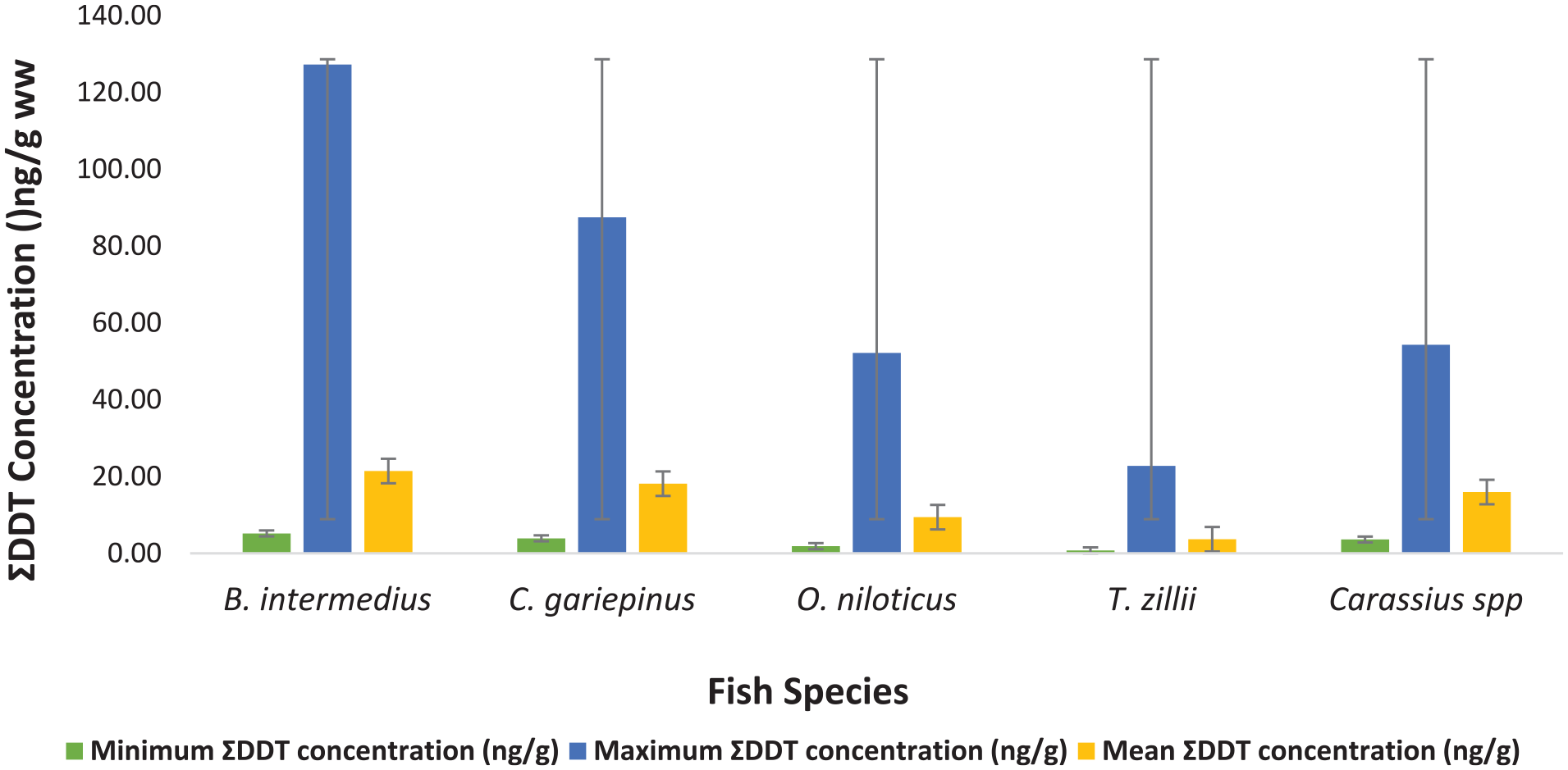
The average concentration and standard deviation (sd) of ∑DDT in fish species from all investigated surface waters of Ethiopia.
Human exposure and health risk assessment: Water consumption
Humans may be exposed to pesticide residues via food, water, or the air. Dependent on the individual’s daily consumption and type of exposure is reliability. Therefore, assessing the dangers that people pose from drinking water tainted with pesticides is essential. 47 The Gilgel Gibe I hydroelectric dam reservoir and its tributaries have the highest concentration of ∑DDT (640 ng/l), whereas Lake Ziway, Ethiopia, has the lowest value (Table S2). In this investigation, the concentration of ∑DDT ranges from non-detected level (ND) to 700 ng/l with a pooled average concentration of 190.93 ng/l. This was higher than earlier individual studies conducted in Ethiopia,4,13,18,48,49 but lower than a finding by Dejene et al. 15 A tolerable limit of DDT and its metabolites in drinking water is 1 µg/l as determined by FAO/WHO. 50 Consequently, all ∑DDT concentrations found were below this recommended level, meaning there was no human health risk associated with drinking these surface waters.
Acute and chronic exposure from drinking surface water
The study’s conclusions show that the ETR for both the acute and chronic conditions was less than 1 (Table 1). As a result, according to Deneer et al, 20 if the ETR is less than 1, the risk is acceptable; if it is larger than 1, the risk is unacceptable. This was predicted by earlier research, which discovered a decreased theoretical risk associated with drinking water contaminated with DDT. As a result, not all age groups are at risk when it comes to drinking water containing ∑DDT. Water is utilized for household and sanitary functions; thus further research is required to examine the risks of indirect routes of exposure. This could have a more detrimental effect on the community than what has been predicted by earlier and ongoing studies. The population of Ethiopia was also subjected to deterministic chronic exposure to surface water, as determined by the estimated daily intake (EDI). According to Abera et al, 4 the highest pesticide residual content in water (µg/l) was multiplied by the water intake rate (L/kg/day) to calculate the EDI, which still shows that risks are extremely unlikely. Research indicates that a carcinogenic HQ value larger than 10−6 indicates a significant carcinogenic risk and 10−4 is the highest amount of acceptable risk. A non-carcinogenic HQ value > 1 indicates a strong non-carcinogenic effect. 51 As a result, there is very little chance that drinking water contaminated with ∑DDT would cause cancer or other diseases.
Human health risk assessment from consumption of ∑DDT-contaminated water and fish.

Human exposure and health risk assessment: Fish consumption
Eating fish contaminated with organic pollutants may be bad for human health. 16 POPs mostly enter the body through food. 52 The majority of human food is fish muscle. 53 As a result, eating fish is the main focus.30,54 Table S3 provides an overview of data on all fish species data from all Ethiopian surface waters.
Non-carcinogenic risk assessment and risk characterization
Despite Ethiopians’ traditional preference for beef, eating habits are shifting in areas and among populations where fish is consistently and abundantly available for consumption.30,32 According to FAO, 29 certain communities may have annual fish consumption per person of more than 10 kg. Analysis of individual studies shows that there is an acute risk (HQ = 1.68) for infants at the local level posed by the consumption of B. intermedius. 45 However, in the present study (Table 1), consuming ∑DDT-contaminated fish, hence both HQacute and HQchronic are less than 1, does not pose a risk presently. Similarly, EDI was lower than MEA. According to Melake et al, 32 this no risk posed by ∑DDT for all age groups. However, worst-case scenario infants’ acute risks (HQ = 2.14) at the local level are unacceptable.
Carcinogenic risk assessment and risk characterization
Subsequently, hazard ratios (HR) and estimates of cancer risk were computed in accordance with USEPA guidelines. 36 The study’s findings indicate, using all author’s methods of estimation, carcinogenic risk values are greater than cancer benchmark values. Dougherty et al 55 state that a hazard ratio of more than 1 indicates a possible harm to human health. Likewise, Guo et al 27 state values greater than 10−6 are risky for consumer groups. This was predicted given that a previous study 30 similarly discovered intolerable carcinogenic hazards associated with eating fish contaminated with ∑DDT. As a result of ∑DDT fish consumption, the risk of cancer in all surface waters for all age groups (at the local and national levels) is not acceptable.
Environmental risk assessment
The use of pesticides has also resulted in major environmental problems since runoff from rainfall has the ability to carry active chemicals and associated residues (eg, DDT and its metabolites) into natural ecosystems like rivers and lakes 56 and may have an impact on non-target species. 57 Comparisons between predicted no-effect concentrations (PNEC) and anticipated environmental concentrations (PEC) provide the basis for an environmental risk assessment of chemical substances, such as pesticides. The PNEC, which is often obtained from laboratory impact studies, is a threshold below which adverse effects are not expected. To compute the lowest determined effect concentration, the no observable effect concentration (NOEC) is multiplied by an assessment factor. An environmental effect assessment of the aquatic compartment needs to have at least 3 levels of the trophic hierarchy represented in its dataset: primary producers (algae); primary consumers (invertebrates, such as Daphnia); and higher level consumers and predators (fish). Several uncertainties should be taken into account when deriving a PNEC from these tests, including variations between and between species, extrapolations of short- to long-term toxicity, variances within and across laboratories, and extrapolations from the laboratory to the field. If the only available data are from acute testing, the lowest effect value of the tests is found using an assessment factor of 1000 for fish, invertebrates, and algae at all 3 trophic levels. If information is available from long-term research covering 1, 2, or 3 trophic levels, this assessment factor may be further reduced to 100, 50, or 10 trophic levels.58,59 The assessment factor must therefore account for the uncertainty in the extrapolation to the real ecosystems. 60
Protection objectives for the aquatic ecosystem were established for aquatic animals (fish, algae, invertebrates, and macrophytes) that live in surface water and humans who use surface water as a source of drinking water without first purifying it.21,61 The local population is impacted by the country’s surface water resources in both direct and indirect ways. 4 In environmental risk assessment, expected environmental concentrations (PNECs) will be compared to actual or forecast environmental concentrations (PECs) to determine whether or not a substance’s risk is acceptable. RQ levels below 1 denote an acceptable risk, while RQ values above 1 during risk appraisal or characterization (Table 2) suggest a potentially dangerous risk.
Environmental risk assessment of aquatic organisms (fish, Daphnia, algae and macrophyte).

Risk assessment and risk characterization for fish
Acute and chronic risk assessment for fish
Ethiopia will be subject to the uncertainty factors also referred to as safety factors applied by the European Union. An exceedance factor that has been stated is required for the risk classification. Fish require a little bit more protection than other animal species because they are categorized as vertebrates. For the acute risk classification, a factor of 10 is thought to be appropriate. The study’s conclusions demonstrate that the acute and chronic risks were both higher than 1 (Table 2). This was similar to findings by Abera et al 4 in Lake Tana, where metabolites of DDT (DDE) pose a high risk to fish. ETR or RQ value < 0.1 is insignificant risk; ETR or HQ from 0.1 to 1 is moderate risk27,62; ETR or HQ above 1 suggests a potentially harmful risk4,27,62; and sometimes ETR or RQ levels below 1 indicate a manageable risk. 4 Other authors also classify 1 < ETR < 10 as a possible risk, ETR < 1 as low risk, and ETR > 10 as high risk. 20 The intervals for risk categories were as follows: 0 to 1 represented low risk for fish; 1 to 10 represented medium risk for fish; and >10 represented high risk for fish. 21 Therefore, acute and chronic HQ or ETR values, except in Central Rift Valley Regions, in the Ethiopian surface waters show that risk to fish is highly likely.
Acute and chronic risk assessment for invertebrate (Daphnia)
Given that invertebrates recover quickly, a factor of 100 is thought to be suitable for characterizing the acute and long-term risks associated with ∑DDT exposure in Daphnia. Acute ETR > 1 is revealed by this study’s risk evaluation (Table 2). This was predicted based on findings from a prior study that showed DDE was dangerous for Daphnia in Lake Tana. 4 According to Deneer et al, 20 ETR < 1 is low risk, 1 < ETR < 100 is a potential risk, and ETR > 100 is a high risk. Similarly, ETR values 0 to 1 represented a low risk for Daphnia; 1 to 100 represented a medium risk for Daphnia; and ETR > 100 represented a high risk for Daphnia. 21 Therefore, in studied surface waters, there is a potential risk posed by ∑DDT on Daphnia.
Risk assessment for algae
Acute and chronic variables are handled similarly when assessing algae risk. The final stage of an algae’s life cycle, known as growth inhibition, is defined by its short duration. As a result, a factor of 100 is regarded as appropriate for characterizing a possible risk. According to the study’s estimation, the ETR for acute risk in all surface waters is more than 1 (Table 2), which is comparable to the findings of Abera et al 4 in Lake Tana. Some authors classify risks for primary producers (algae) as risky if ETR > 100; likely risky if 1 < ETR < 100; and low risk if ETR < 1. 20 While others are set as ETR 0 to 1 low risk for algae; 1 to 100 medium risk for algae; and >100 shows high risk for algae. 21 Overall, this study shows ∑DDT has a likely risk to algae.
Macrophytes risk assessment
There is no distinction between acute and chronic risk assessments for aquatic plants. Aquatic plants are assigned a lower value for the exceedance factor than algae since they have a longer life cycle and do not multiply rapidly. A factor of 10 is considered appropriate for characterizing a possible risk. According to this study’s estimation, the acute risk’s ETR is more than 1 (Table 2). Below is a presentation of the risk classification: risky if ETR > 10; high risk if ETR > 1; and possible risk if 1 < ETR < 10.20,63 Therefore, the risk posed by ∑DDT on macrophytes is highly likely.
Bioaccumulation factor (BAF)
DDT and its metabolites are still a major environmental problem worldwide due to their persistence and potential to bioaccumulate. 6 The bioaccumulation factor (BAF) is mostly used to quantify the amount of DDT and its metabolites (∑DDT) that are absorbed across all possible exposure pathways and subsequently accumulate in biota from water. The bioaccumulation factor of all sampled fish species in the Ethiopian surface waters, which includes Barbus intermedius, Clarias gariepinus, Oreochromis niloticus, Cyprinus carpio, Carassius auratus, Carassius carassius, Tilapia zillii, and Ciprinus carpio, was determined. Accordingly, based on a pooled estimate, the BAF value was less than 1 (BAF = 0.07). According to Melake et al, 17 this indicates that fish tissue does not absorb ∑DDT directly from the water.
Conclusions and Future Prospects
The investigation’s findings proved that Ethiopian aquatic ecosystems still contain DDT and its metabolites, an illegal organochlorine pesticide. Due to the high costs of research and the lack of analytical capability in most African countries, including Ethiopia, it is sometimes impracticable to monitor POPs, especially DDT and its metabolites. Therefore, it is imperative to investigate the environmental distribution and potential hazards provided by POPs in African countries, particularly in Ethiopia. This study focuses on the bioaccumulation factor of DDT and its metabolites as well as the risk that these substances pose. DDT and its metabolites (∑DDT) are found in higher amounts in carnivorous and omnivorous species as trophic levels increase. Risks from ∑DDT-contaminated water ingestion continue to be extremely rare. There is an acceptable non-carcinogenic risk associated with ∑DDT for any age group except for infants consuming maximum ∑DDT concentrations at the local level, while the carcinogenic risks are highly likely. It is very likely that aquatic species are at risk from ∑DDT. Fish tissue does not directly absorb ∑DDT from the water, according to the bioaccumulation factor (BAF) value. Both past contamination and their ongoing use in vector control are possibly associated with the prevalence of ∑DDT. However, in the future, more investigation is required to get more accurate data about the residual concentration of DDT and its metabolites in the abiotic (water and sediment) and biotic (fish, algae, aquatic plants, macroinvertebrates, and so forth) segments. For this, long-term studies on DDT levels or the effectiveness of mitigation efforts are mandatory. To improve risk assessment, local and standardized endpoint values, dose descriptors, and assessment criteria should be created as well. Subsequent research can also concentrate on the mixture toxicity of numerous organic contaminants rather than the ideal case of exposure to a single toxin. This is because ecosystems are frequently exposed to chemical mixtures.
Supplemental Material
sj-docx-1-ehi-10.1177_11786302241307471 – Supplemental material for DDT and Its Metabolites in Ethiopian Aquatic Ecosystems: Environmental and Health Implications
Supplemental material, sj-docx-1-ehi-10.1177_11786302241307471 for DDT and Its Metabolites in Ethiopian Aquatic Ecosystems: Environmental and Health Implications by Bealemlay Abebe Melake, Tamagnu Sintie Alamirew and Salie Mulat Endalew in Environmental Health Insights
Footnotes
Acknowledgements
None.
Funding:
The author(s) received no financial support for the research, authorship, and/or publication of this article.
Declaration of conflicting interests:
The author(s) declared no potential conflicts of interest with respect to the research, authorship, and/or publication of this article.
Author Contributions

Data Availability Statement
All data used to support the findings of this study are included within the article, therefore, no associated data.
Supplemental Material
Supplemental material for this article is available online.
References
Supplementary Material
Please find the following supplemental material available below.
For Open Access articles published under a Creative Commons License, all supplemental material carries the same license as the article it is associated with.
For non-Open Access articles published, all supplemental material carries a non-exclusive license, and permission requests for re-use of supplemental material or any part of supplemental material shall be sent directly to the copyright owner as specified in the copyright notice associated with the article.
